Showing posts with label Ellen Page. Show all posts

Thursday, July 19, 2012

To Rome with Love

Around the World in Woody's Malaise
or
The Ozymandius Melancholia Gambit ("Turbulence!  My Favorite!")

Far be it for me to suggest that Woody Allen might actually be comfortable in his own skin as a storyteller. but when it has come time for him to do his own "Roman Holiday" film, To Rome With Love, there's not a hint of Fellini in it (Been there, done that—specifically, way back in 1980, when he made his Stardust Memories in tribute to the great Italian film-maker).  Truth to tell, his latest has more in common with the Italian "anthology" films of the 1960's, where directors would tackle similar themes in short personal films.

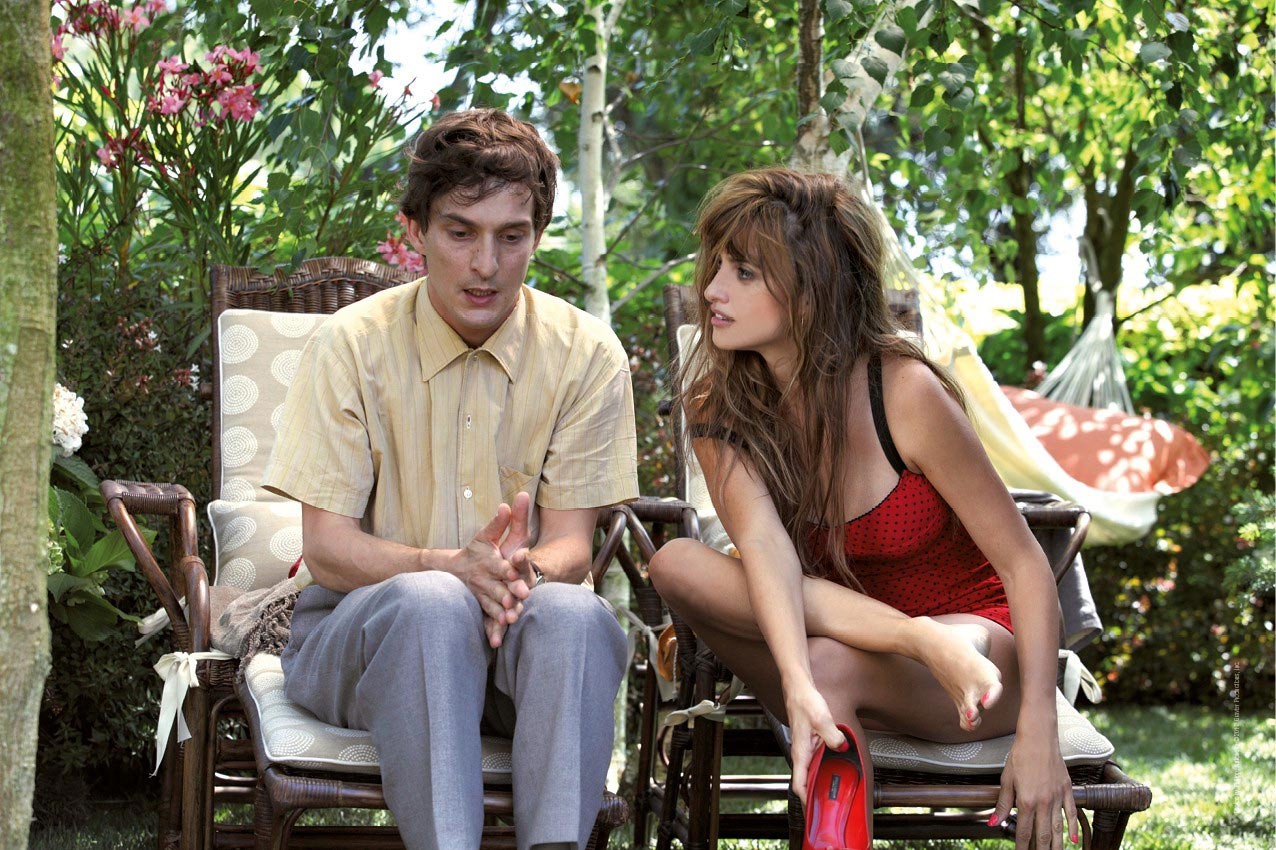
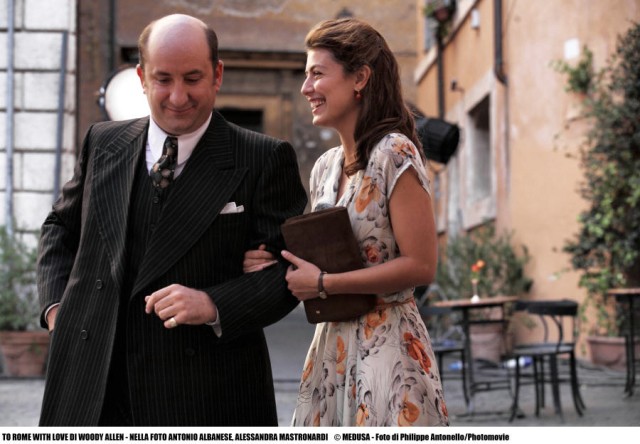
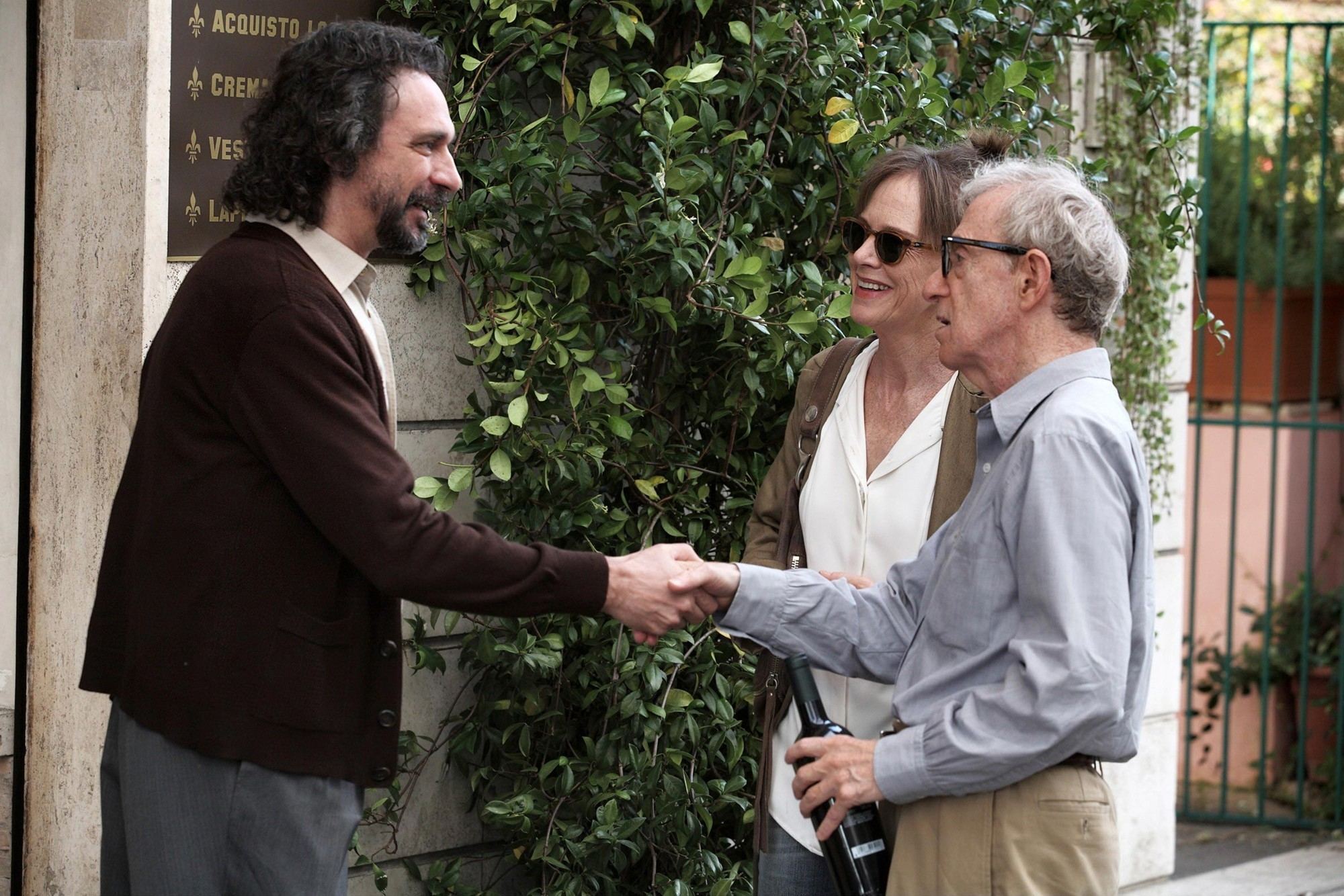
To Rome With Love has four interlocking fantasias about love and personal dissatisfaction: in the first, a young married couple (Alessandro Tiberi and Alessandra Mastronardi) come to Rome, where he is to be introduced to his new work situation—eager to make a good impression, the wife goes shopping and ends up getting lost and involved with an Italian film-star, and hubby, thanks to a case of mistaken identity, must go to his functions in the company of a pre-arranged hooker (Penelope Cruz); the second involves two architects, one seasoned (Alec Baldwin), the other just starting out (Jesse Eisenberg) who become each other's fantasy figures (of a sorts) when the young architect, already attached to Sally (Greta Gerwig), falls for her best friend Monica (Ellen Page), a self-involved, if fascinating, actress; the third involves a "normal member of the middle class" in Rome (Roberto Benigni) who suddenly becomes "famous for being famous," and is pursued and interviewed by an indiscriminate paparazzi; the fourth involves a former classical music executive (Allen), who discovers a great opera singer (Fabio Armiliato) in the family of his potential son-in-law..with conditions.

The setting is Italian, but the themes are pure "Allen-town."  Each of the characters get a brief glimpse of "life on the other side," gingerly placing their toes where the grass is greener, and find it wanting, but themselves enriched from the experience, survived without harm or consequences paid.   Baldwin's architect gets to play devil's advocate (much the same way as Bogart did in Play It Again, Sam) with a realist's wisdom, as opposed to a romantic's fool-hardiness—a good cure for his nostalgia.  The Italian couple experience romantic fantasies before settling down to domestic bliss, not older but wiser.
Benigni's civil-functionary briefly enjoys cultural significance, with all the invasiveness and dissection of minutiae, before returning to anonymity and the value of a private life, and Allen's retiree gets to witness a fulfillment of his dreams by providing a channel for another, and, having achieved it, returning to his normal life.

Any of these stories could be set anywhere.  Rome provides a nice catalyst for these quick short pieces that summarize the Allen world-view: "Life is terrible, but it beats the alternative."  And it's buttressed by the standard "Volare"...which mean "to fly."  

Happy landings.


To Rome With Love is a fine Matinee. 


Friday, April 29, 2011

Super

"The Weed of Crime Bears Bitter Fruit"
or
"Boltie!  NO!"

There will be four major super-hero movies coming out this Summer (starting with Thor next week, Green Lantern, X-Men: First Class, and Captain America: The First Avenger), plus a smattering of graphic novel adaptations and such.  Next year, The Avengers, Spider-man, Batman and Superman movies will be released.  Comic Books are hot in the movies because they're easily digestible, easy to adapt, and they skew young in the audience demographics.

It's just too bad that so many of them are terrible, and they've created a lazy back-lash of "Oh, I'm so sick of super-hero movies" to any blogger who can put two words together.  Sure, you're sick of them.  Too much of anything gets dull after awhile. 

So, stop going to them.  That's not so hard.  With great power comes great responsibility.  Super-hero movies have a lot of power right now and you're responsible.

Meanwhile, there is an antidote to all this nefarious meta-human poisoning, a tonic to the wish-fulfillment fantasy that the genre unquestioningly presents: Super, written and directed by James Gunn, former Troma writer-director.  Notice that it doesn't say "Super-hero," as that label doesn't really apply—it stops just short of the "hero" as the "vigilante" aspect of the crime-fighter takes center-stage along with its brother-in-arms, revenge.

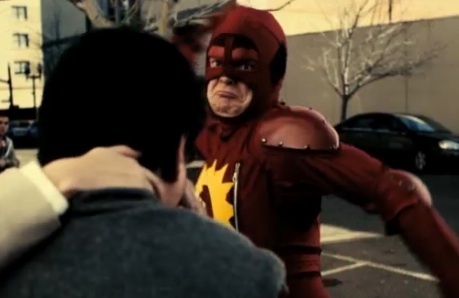
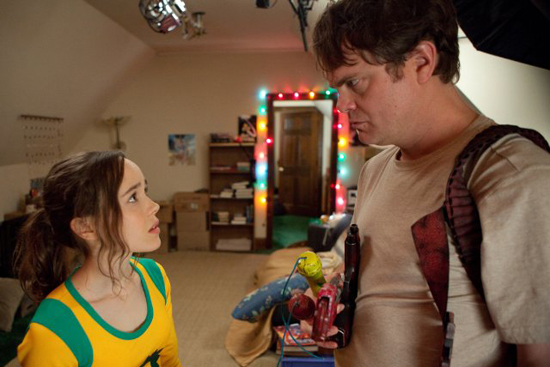
Frank D'Arbo (Rainn Wilson) is a short-order cook/man-child and the best thing that ever happened to him was marrying Sarah Helgeland (Liv Tyler), a waitress at the diner who's just come out of re-hab and is trying to get her life back in order.  Things are fine (at least from Frank's perspective) until Sarah runs off with Jacques (Kevin Bacon), a sleazy drug-dealer and then Frank melts down.  Despairing, angry and confused he's inspired by a religious station's superhero program "The Holy Avenger" (played by a smirking Nathan Fillion) and by having his brain "touched by the finger of God," to set his spinning-out-of-control back on track by taking on a vigilante role as The Crimson Bolt—his only weapons being his innate sense of "right" (no drug-dealing, no pedophilia, no butting-in in line) and a large pipe-wrench.  There are no fancy moves, no elegant acrobatic abilities pulled off with ease, just a schlumpfy guy in a leotard blundering into situations and clocking people with a big spanner.  Realistic, right down to the cranium-cracking that such action produces.  It's funny, but also slightly cringe-inducing as you see the damage that such blunt trauma can produce.  At that point, the "heroism" aspect becomes secondary to the thuggish behavior such actions create—the line between "do-gooder" and freakish assault becomes blurred and squishy.

Squishy being the operative word here.  Gunn is from Troma, the cheerily exploitative grind-house that's created such films as The Toxic Avenger, so no holds are barred in the presentation of violence with its resulting blood-splatter and meat-manufacturing.  When "The Bolt" increases his armory with guns, pipe-bombs and accelerant, things turn explosively ugly.  And that's where Super has it all over such juvenile exercises in juvie crime-fighting glorification as Kick-Ass.  However much that film tried do disguise its brutishness with smooth moves and well-choreographed stunt-work, it played fast-and-loose with the consequences of such actions, making it all 'look cool" and distracting from the carnage.  There's nothing smooth about this film; it's down and dirty and doesn't even look heroic so much as desperate and geekish, the results of adrenaline mixed with no skill whatsoever.  There's more danger in Super than anything simulated in Kick-Ass.

Things get complicated.  "The Bolt" starts to attract attention from the press and the local police, particularly one detective (Gregg Henry) who puts one and one together and connects the addled D'Arbo with the increased attacks around town.  Then, "The Bolt" gains a side-kick, the cute chick Libby (Ellen Page) at the comics store where he does his research.  A comics junkie, she also has a hyper-intense fantasy jones that makes her latch onto D'Arbo's crusade with an unhealthy zeal, becoming his junior partner, Boltie.  It's an unhealthy relationship, as Frank tries to mentor Libby ("That's inappropriate, Boltie!") in her adrenal-rush to take things too far.  And they go too far, to the point where Super jumps the genre line to become more like Taxi Driver than a super-hero film.

Super is not rated, simply because it wants to skirt the issue of taming the gore and present its message uninhibited by catering to the unfathomable whims of the MPAA.  So, the violence is squishy and upsetting, the language is pervasive ("Oh, maaan!  The Bolt-mobile is kinda fucked up!") and the places it goes only occurring to those who are seriously aware of the psychological twistedness of the genre (like Alan Moore).  It may look funny and goofy, but caution is advised if you're easily traumatized, or holding out for a hero.  Super isn't playing games or taking hostages.

Super is a rental.  Shut up, Crime! 


"This is how you fight crime...sit here and wait for it to happen?  It's so BORING!!"

Tuesday, July 20, 2010

Inception


"All That We See or Seem..." *

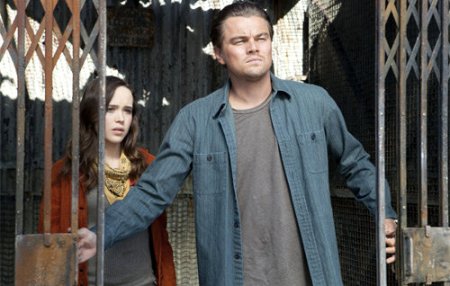
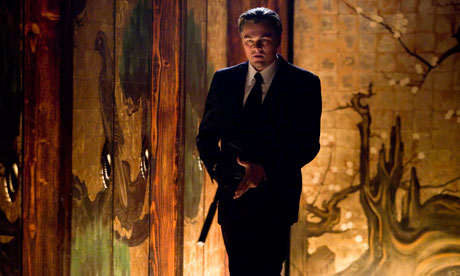
The latest film from that Master of Disorientation, Christopher Nolan—"Inception"—may be his most intricate puzzle yet.  A nest of corporate spies, using dream-suggestion, steal secrets from business rivals to their clients.  One such mission turns into a nightmare, and the team's leader, Dominic Cobb (Leonardo DiCaprio), accepts the subject (Ken Watanabe) of his previous mission's challenge: 1) to implant a suggestion into a rival while sleeping, which 2) requires a nested suggestion—"a dream within a dream"—to be pulled off, the reward being 3) Cobb will be given his dream come true, all inquiries into a previous tragedy will be dropped and he will be allowed to return to his home in the U.S., where his children await him.


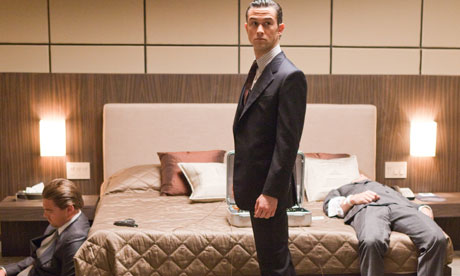
To accomplish this, he must assemble a team: "The Architect," Ariadne (Ellen Page), who will design the dream-scape, "The Point-Man," Arthur (Joseph Gordon-Levitt), who will monitor the progress of the mission and initiate the extrication from the dream, and "The Forger," (Tom Hardy), whose intricate research will reassure the subject that the dream has a basis in fact.  Then, there's Cobb.  An incredible asset, but a liability, he suffers from the guilt of not preventing the death of a previous team-mate, his wife Mal (Marion Cotillard), who pops up in the shared dream-scapes to unravel the scheme and punish him.  Of course, she's just his guilt talking.  The team's emotions have as much importance in dreams as the images.


Something about this sound familiar to you...beyond the surface "Mission: Impossible" trappings, gene-spliced with a psychic "Fantastic Voyage?"  An "Architect," like a set-designer, the "Point-Man," like a producer or location scout, the "Forger," like the cinematographer recreating verisimilitude, all illusionists dream-synced to accomplish a single goal;  Nolan is talking about The Movies.


He isn't the first: Howard Hawks equated the social structure of any inter-dependent team with the circus of techs and talents involved in film-making, and Hitchcock frequently ruminated on how the movies were a dream-scape (that often turned into nightmares) with his highly subjective angles and cutting.  But, Nolan—given his dream-projects—chooses to make movies that exploit and comment on the special illusory power of film: shifting narratives and time-lines, the power of the edit (and the critical when), the magic of movie-making that goes beyond simple photo-recording, and narratively bending that reality to your will.  Movies are a dream, tapping into our psyches, and also influencing them, their ideas infecting us (as we're often told in the film) "like a virus.".  One of the neatest narrative gambits in "Inception" is Cobb's rule for knowing you're in a dream: "Think—how did you get here?"  In a movie, you're edited into a situation, dropped from one place to another with a single splice.  Like magic.  Like a dream.


In "Following," Nolan threw us into "the deep-end" of an obsessive-compulsive's life, fracturing the time-line, with our only clues to structure being the protagonist's appearance (like a dream).  "Memento," we follow a man with cognitive dissonance, who can only retain a memory for 15 minutes, we alone are left to remember the dream to its beginning.  "Insomnia" centers around a man who can't dream, and "The Prestige" tells its tales of magic and science while playing with the conventions of story-telling.  Nolan's non-superhero films are all about movies—and how movies can be used to fool you, like a magician's trick.  His weakest films depend on it to hold them together; more than just an editing "gimmick," the films would be pointless without the structure.


There is no doubt in my mind that Nolan equates the two—and he leaves a final layer of his dream-within-a-dream-scape on the soundtrack at the end of the film to take us out of it.** The film's last visual gambit also calls into question dream versus reality, but does so in a very filmic way.  There has been some kvetching about that last shot being an obvious ploy to head-fuck—like the arbitrary shot of the ice-pick at the end of "Basic Instinct"—but that's missing the point: the significance of the shot is when Nolan cuts away from it. ***


When I did my "Now I've Seen Everything" piece on Nolan, I wrote this:

"In Media Res" is the term for one of his films, the lens aperture opening for a limited amount of time, and closing with events still in flux, the world changing, and the future uncertain. One has the sense of the film merely stopping, with the story-line continuing past the audience's part in it, again leading to a lack of fulfillment...or dread. In either case, one exits a Nolan film dis-oriented, uneasy...but not often dis-satisfied.

That still applies here.  And Nolan gets to do his time-bending tricks in a significantly different way, revealing them in personal dreams, while maintaining a (rare for him) linear time-line.  That strategy comes to fruition with a unique sequence where the team (and we) are plunged into deeper and deeper nested dreams, each with its own time-scale and dis-orientation, cutting back and forth between them as they progress at different speeds and different orientations (dependent on what is happening in the previous tier of dream-level).  It is a bravura sequence that leaves one a bit breathless, shaking one's head that it is so intricately staged and communicated.  I don't recall seeing anything quite like it.

There are little quibbles, of course: Nolan's dream-scapes never veer far into the surrealistic, remaining quite concrete in how things look and act, and the dream sequences maintain the hard-edged quality of movies and video-games (but, hey, it's Nolan's dreams); the third dream-level (which recalls a war/spy assault on an impenetrable mountain HQ) seems to be unaffected by the physical forces that so influence and warp the second; and the mission (and the entire movie is "the mission" making the general feel of the thing a bit slight) has a smug amoral satisfaction to it, that is vaguely disquieting, and no sense of good and evil (only profit and loss) which would give the movie some sort of conscious weight.

But these are minor distractions...vague notions in the subconscious while grooving on the movie.  I don't think "Inception" is Nolan's best film (I vacillate between "The Dark Knight" and "The Prestige"), but as an exercise on the possibilities and power of film—as both medium and message—is a dense, intricate, satisfying film that's fun to puzzle out during and after its playing.

No, I have no regrets.

"Inception" is a Full-Price Ticket.

* From Poe's "A Dream Within a Dream," which, in imagery, rumination, and motivation, fits many of "Inception's" themes—it probably inspired many aspects of it:

Take this kiss upon the brow!
And, in parting from you now,
Thus much let me avow-
You are not wrong, who deem
That my days have been a dream;
Yet if hope has flown away
In a night, or in a day,
In a vision, or in none,
Is it therefore the less gone?
All that we see or seem
Is but a dream within a dream.

I stand amid the roar
Of a surf-tormented shore,
And I hold within my hand
Grains of the golden sand-
How few! yet how they creep
Through my fingers to the deep,
While I weep- while I weep!
O God! can I not grasp
Them with a tighter clasp?
O God! can I not save
One from the pitiless wave?
Is all that we see or seem
But a dream within a dream?


** SPOILER ALERT: That audio clue is in the film's final minutes as Edith Piaf's emblematic "Non, je ne regrette rien" plays on the soundtrack until it is gradually replaced by the staticy thrum that indicates the waking process from the dream-scape; when it ends, the film ends.  That it is used in the film as the team's traditional "safe-word" alarm to extricate them from a dream is the film's final tie-in to being a dream-state.  It is significant that it is THIS song, as it is tied to Piaf so indelibly, and echoes as well to Marion Cotillard, who played the chanteuse in her Oscar-winning role in "La Vie en Rose," and here, plays Cobb's tragic wife, who represents his biggest regret.  This is one of ripples running through "Inception," through layers and layers and layers.  Like a glass onion.

*** And if you're looking for an answer to whether it's a dream or reality ("it's a FILM, dummy!"), just apply the "How did he get there?" rule: the whole movie is about "how he gets there."

Wednesday, October 7, 2009

Whip It

"Follow Your Blisster"

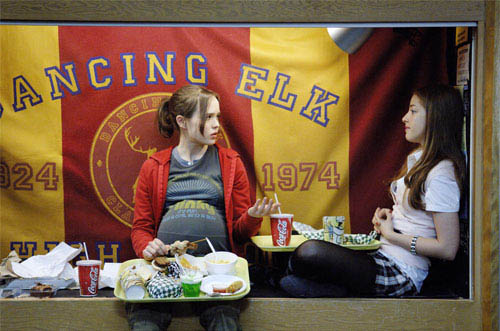
Drew Barrymore's first directorial effort "Whip It" is an odd little mixture of Afterschool Special and Grrl Power, seemingly contemporary but channelling the 70's. The titular "It" girl is played by Ellen Page, now riding the wave of "Juno." Her character, Bliss Cavender, is living a tractor-pull life in Bodeen, Texas, yanked on one hand by her letter carrier mother (Marcia Gay Harden) to follow in her sensibly-glam high heels on the beauty pageant circuit, or following the pull of the negatively glamorous life of a roller-derby queen in a D-circuit league in Austin.

Conflicts ensue. The one life is safe and conforming, the other is dangerous
and compromises her home life to pursue it. But, Bliss rationalizes that life IS compromise and begins lying through her mouth-guard to achieve it.

It's easy to see why: Mom is a harpee chewing the cud of her glory-days, and Dad (
Daniel Stern) is a good-natured lug who checks out to avoid conflict. Her school mates are cretins and her best buds' are her co-workers at the BBQ Joint with a dry-wall pig on the roof. "Are you being 'alternative' now?" asks a smarmy cheerleader (ex-friend) at her High School. "'Alternative' to what?" Bliss lamely asks. It's hardly Marlon Brando's challenging "What d'ya got?"; Bliss doesn't even know there's another choice.

But roller-derby seems a much more appropriate matriculation to life than beauty pageants. It's all elbows and knees and nose-checks while maintaining your balance going as fast as you can. You're among a group of competitors with grit in their gears and scar-tissue in their joints and they announce their aggressive tendencies with nom de guerre like Eva Destruction, Smashley Simpson, Bloody Holly, and Jabba the Slut. Bliss becomes "Babe Ruthless," and since the circuit's too small to say "a star is born," a satellite is launched into a tight circular orbit.

Her double life invariable costs her, though. 'Round about where the third commercial break should be, her best friend gets nicked for an open container violation, Bliss does the same (metaphorically)
with her slacker boy-band-toy-friend, her under-age status in the league is threatened to be exposed, and she has a hissy fit with her parents. Bliss is adrift without a breeze or a paddle and it's tough to be captain of your fate with neither.

The story weeps for a happy ending and Barrymore, to her credit, is stingy with it. Bliss doesn't achieve full happiness, no fireworks go off in triumph, and she takes her lumps as lessons learned. That's the difference between Young Adult Fiction in the Movies and Adult Fiction in the Movies.

So, how did our little Drew do, directing? Not bad, actually. "Whip It" doesn't exactly snap across the eyes—there are repeated shots to fill up narrative cracks she didn't anticipate, she depends a bit too much on the lame Jimmy Fallon to provide humor in the action portions, and she leaves Page a bit high and dry in giving her motivation in some scenes. But if it's technically not smooth, the voice is uniquely Barrymore's, raucously tom-boyish, girlish in Tarentino's field of girlish. It's a woman's world; boys are just allowed to play in it.

Which makes her film different than 99.99% of films out there.

And instead of playing it safe, she begins her career calling the shots by diving deep into action territory and staging some mock-brutal roller-derby matches that are intricate in planning and
a bit too careful in execution, like staging a car-wreck where most of the cars aren't moving. That's rare, though. It can't be easy duty filming a roller derby and Barrymore gets the excitement right most of the time. And, good general that she is, she puts herself in the middle, not letting her actresses do anything she wouldn't. Her "Smashley Simpson" takes most of the falls in the film and Barrymore doesn't fake the crashes. The actresses look like they're in danger, but rarely display anything but grit and it's a well-chosen cast. Eve, SNL's go-to gal Kristen Wiig, Tarentino's favorite stuntwoman Zoe Bell, and Juliette Lewis (Welcome back, Juliette!*)all display a casual toughness and nurturing bonding that makes Bliss' attraction to them seem natural and reflects Marcia Gay Harden's more austere version of it. It all makes one anticipate her next movie with fingers crossed.

"Whip It" has the feel of a well-skated over track: worn but slightly groovy, thin in parts but enough momentum in it to keep it interesting.

"Whip It" is a Matinee.

* Juliette Lewis is one of my least favorite actresses, but this role is rough, tough and mean and Lewis plays it unsympathetically without her usual mealy-mouthed mannerisms and pulls it off beautifully. Her character demands respect and the actress imbues why. Bravo.

Thursday, March 27, 2008

Juno


"Like the city?"

"No."

Juno is full of self-conscious attempts at hipster cred. The first half of the movie hardly features a single straight line; everything is an exercise in cooler-than-thou slang. Ellen Page, as the titular Juno, attempts to topple Thora Birch from Ghost World (who had previously deposed Christina Ricci) for the Indie Goddess crown. She's an artist, she has strong opinions, she has an alienated humanitarian affect, she's into cool music and isn't afraid to wear black or tell grown-ups where to stick it. But had that been the point of the film, critics would have rolled their eyes instead of swooning.


The second half redeems the film's overexposed style. The supporting cast radiates human warmth. Michael Cera, playing the same character Michael Cera always plays, is so damn adorable that he could serial murder half of Ohio and everyone would still love him. Juno's parents and friends queue up winsome scene after scene, providing the safety net for Ellen Page to do her reckless rebellion act. But after strutting around like Holden Caulfield for the first half of the movie, Page has to expose all her vulnerability and pain in the second reel. I won't give you any spoilers, but this is where the movie shines... with a poignant ending that will almost make you believe in love again.
This is a full price feature.

Sunday, February 24, 2008

Suspensions of Disbelief - "Like, yeah-HUH!"

Sacred Vessels in the Land of Addictionary.org

"Juno" is a film so dominated by its script (by Diablo Cody*) and its actors (they're all television veterans with countless man-hours before the camera) that all director Jason Reitman has to do is get out of the way-though in the transitions he routinely cuts on the 1's of the pervasively twee-rock soundtrack to maintain the air of perkiness. The kids that dominate this film about lower-middle-class families making the most of a bad situation--well, bad in the timing--are so pervasively cute and clever in their articulation and word-play that one wonders if they hail from some part of the country where the main sport is Scrabble, and instead of MySpace they all hover around "Addictionary.org." Ultimately one has to ascribe to it the same rule that one applies to Bette Davis movies where everyone always has the perfect come-back: "They have better writers than we do."

But the same troubles. Juno MacGuff starts the movie pregnant and pissed. And pissing. She's buying the home-pregnancy tests out of the box one at a time from the convenience store and using their facilities to test it. "You better pay for that pee-stick when you're done with it," says the clerk (played by "The Office's Rainn Wilson). "Don't think it's yours just because you marked it with your urine!" She gets the unholy pink "x" and starts to puzzle out how to proceed: telling parents, telling sperm-donor, what to do with said spawn, yadda yadda yadda. "Juno" skips along dealing with all these crises and quite a few more, and never slides into bathos, preaching or "after-school special" earnestness. The characters are all people for whom regrets are a waste-of-time, and are too busy doing their best to do too much navel-gazing. Well, almost all. One walks away charmed, and admiring the cleverness and the near-occasion of bravery the movie displays. And there are no bad performances. Anywhere. No actor lets this material touch the ground, whether its the stunningly decent work by vet-thesps like Alison Janney and J.K. Simmons, but also wise work by Michael Cera, Jason Bateman, and, yes, Jennifer Garner. But the big bouquet goes to Ellen Page who carries the movie on her slim shoulders and always finds a way to make the dialog sound like she's just saying it off the cuff. That's a tough trick to pull for an entire movie--an entire comic movie--this entire comic movie. Frankly, it would've been easier giving birth.

"Juno" is a pop-culture flip-remarkable "Matinee" (Whoah! Rate Big!)

--------------------------------------------------------------------

It Takes a Sex Toy to Raise a Village

Everybody likes Lars. Lars is 27, lives in the carriage-house of the family home. Keeps to himself. He goes to work, eats, attends church, chops wood.

And that's about it.

Lars is socially retarded to an alarming degree, so much so that he feels it hurts to be touched. His family worries about him. They feel guilty. They don't know what to do.

But Lars does. He's surrounded by people with relationships, so he decides to get one. But that touching thing...that's a problem.

Then one day, Bianca shows up, a mail-order girlfriend. Lars tells his brother and sister-in-law that he has a girl-friend and he'll bring her over for dinner. They're elated. Then they find they didn't need the extra setting. Bianca's a sex-doll. Fairly realistic looking, but she doesn't move. At all. Lars has to carry her, until he gets her a wheelchair. He cuts her food for her. Eats it, too.

In a case of intervention, all four go to the doctor (Patricia Clarkson, being warm but acting cold), who takes one look at Bianca and worries out loud that she needs weekly treatments for her alarmingly low blood pressure, and uses the opportunity to find out exactly what is going on with Lars. She advises that they should play along--"Bianca's in town for a reason," she says. "But, people will laugh at him!" says his harried brother, played by a note-perfect Paul Schneider. "You, too," says the doc.


It could be perverse, and if Lars actually had relations with Bianca, people wouldn't be enjoying this movie nearly so much. Nor would it be as enjoyable if the entire town didn't, for the sake of Lars, go along with the story and accept Bianca. And that acceptance happens almost immediately. Sister-in-law Karin informs her coffee klatsch friends that Bianca is anatomically correct, and one of them says, "Soooo...she's just one of the girls, then..." The pastor of the church goes along with it. Everybody does. Ev-e-ry-bo-dy. Which set off some reality alarms for me. There aren't any disaffected youth, or jerks or morons in this town? Hell, if any of the kids from "Juno" lived there, Lars would be getting the "stink-eye," at least. And in a land where every inflatable Christmas lawn ornament is at risk, Bianca has it REALLY easy.

Still, it's an enjoyable film, full of heart in the right place, and offers lots of enjoyable surprises in screenplay, performance (it's hard to believe this is the same Ryan Gosling from "Fracture") and overall tone. One wishes there was a second there where one could believe in it.

"Lars and the Real Girl" is a matinee, though my opinion is deflating.

---------------------------------------------------------------------------------
* Diablo Cody has such a fresh, smart way with dialog that one hasn't been as excited by a screen author's work since Zach Helm, who wrote "Stranger Than Fiction." Since Helm went on to create the lead balloon "Mr. Magorium's Wonder Emporium," one doesn't want to be too effusive in one's praise, lest one set oneself up for disappointment.