 Writer's Cell-Block
or
"He Talked to Me Like I'm Not Pretty!"
The writing-directing team of Diablo Cody and Jason Reitman reunite to present what could be the dark sequel to their sunny, funny Juno. But, instead of examining the student body sub-strata of geeks, we're looking at the sosh's side down there at the very shallow end of the gene pool and the eventual disintegration of High School Dreams.
Trouble is knowing when to wake up. That's the thing about the privileged and the entitled, they never know when the party's done and it's time to go home (and don't even bother asking them to help clean up—that's maid-service). It's the problem of Mavis Gerry (Charlize Theron): her party's over but she's still rocking in the corner, hugging her Maker's Mark bottle, and she picks the perfectly wrong time to go home to Mercury, Minnesota. A writer of moony, self-absorbed children's books (No, no...that's "Y-A's," the contradictory term "Young Adult" novels) about High School life in a series called "Waverly 128", she draws mostly from real life—her own—but with additional snatches of overheard conversations cribbed from teen conversations in fast-food joints and malls.
She need not bother with the latter. Mavis' emotional development is so arrested it should be serving 10 to 20 in "juvie." Her thought processes are still confined to Middling School concerns, even if her behaviors have become more adult in nature, with one marriage behind her and several casual affairs left high and dry, to sleep it off in her bed, and the height of a social life being getting hammered in a bar, anticipating it like a kegger, and her one constant companion an "accessory pet," an animated white hair-ball named Dolce that is left, more or less abandoned, but still capable of the one love Mavis can accept or understand—reverse unconditional. Oh, in our self-absorbed and -absorbed youth culture, she can pass for a grown-up, she's pretty, put-together, and trendy, but on the inside she hasn't graduated, pushing off her writing assignments like she was having to write a term-paper.
In the midst of burbling out her latest teen tome, she gets a message from an old flame (Patrick Wilson) that he and his wife (Elizabeth Reaser) have had their first child...and something in Mavis snaps. She packs up laptop and lap-dog and cruises back to Mercury to recapture her past and maybe new father Buddy Slade and "rescue" him from responsible domesticity, two things she can't fathom or stomach. I mean, have you seen that baby? Ga-ross!
Thing is, she's clueless. Mavis is so stuck in the past rattling around inside her head, you begin to wonder if she might be a little insane, besides insular. Fortunately, she runs into somebody she perpetually ignored in High School—the guy who had the hall-locker next to her that she never noticed existed, Matt Freehauf (Patton Oswalt, best thing he's ever done), who had his own development beaten out of him ("Oh, yeah, you're the "hate-crime" guy!" blurts Mavis, tactfully and sensitively) by High School toughs who, in a clear case of High School temperance, tolerance and judiciousness, mistakenly assumed he was gay. Matt, with his twisted body, develops a fascination with Mavis and her twisted logic, only half-heartedly trying to suggest that...you know...she might be a little out of sync with the normal, a notion that she scoffs at, before taking another slug and checking herself out in her mirror.
"You...are a piece of work," says Matt, admiringly. "And you are a piece of shit," comebacks writerly Mavis.
This can not go well, and one wonders where the movie could possibly go and if it can ever be resolved without something being destroyed. The damage being done, though, is to the expectations of the casual movie-goer. Mavis is not your charming debutante "sweet thing" that you'd find in your standard rom-com. She is, as one of her class-hates says, a "psychotic prom-queen bitch," and, though smart and clever, thoroughly unlikable, even when sometimes bordering on the sympathetic. Theron is never afraid of tackling this type of character (she did, after all, win an Oscar for her terrifying Aileen Wournos in Monster) or challenging expectations of the audience, and Cody (with Reitman) has a fine time skewering the traditional "woman-pursues-her-soul-mate" brand of romantic fiction. For that, Young Adult, as cringe-inducing and unsettling as it is, deserves an acknowledgement for being a brave film, risking a lot, while also giving a bitch-slap to the Hollywood romance. It left me in an odd place. I didn't thoroughly enjoy Young Adult, but, at the same time, I recognized that the makers were making a thoroughly professional statement...or at least an obscene gesture...to the too-easy way that love is presented in the movies, something I've railed against myself. This isn't love. It's selfish obsession. And Mavis, like so many of the protagonists in Reitman's films, is an outlier of Society, playing by her own rules, but, as opposed to the others, she reaches no self-awareness, and is absolutely clueless as to where the goal-post is (knowing Mavis, she probably would pick a random spot, easy to reach, and declare it 'good"). One is hesitant to praise or applaud such accomplishments, when the impulse is to show it the door and kick it in the ass on the way out.
Young Adult is a Rental.
Wednesday, January 11, 2012
Young Adult


Tuesday, December 8, 2009
Up in the Air
 "Passing Over"
Down in the lower right hand corner of this review (and every review on LNTAM) there's a space for meta-data to help readers find similar personnel, year of release, director, major stars—basically general stuff.
But I also like to put the genre of where the film would fit, say, at the video store—nothing too specific. Jason Reitman's new film "Up in the Air" is the first one to have me stumped. I lean towards "drama," but it's too clever and funny to meet that description. It's not a "comedy" as it deals with pain and contemporary issues that most comedies (most modern comedies, at least) steer clear of—although it's tempting to say that it's a "Judd Apatow comedy" for adults, taking on his basic "gowing up" arc, but with a more mature, melancholy overtone. Yet it made me laugh out loud fairly regularly. And it made me think of what a sorry mess we're in.
Ryan Bingham (George Clooney) is a corporate hit-man for hire. His company (run by a tight-smiled cut-throat Jason Bateman) provides a termination service for struggling companies. Bingham flies to the home-offices and fires the people the weasley exec's are too cowardly to break the news to face-to-face. And business is booming.
"This is the biggest financial melt-down in our nation's history" crows Bateman's CEO. "This is our moment." And to make the most of it, he's hired a new 23 year old tyro named Natalie Keener (Anna Kendrick, who gets perpetually lost in the lunch-room in the "Twilight" movies*), who hopes to streamline the down-sizing process by doing it over the internet, rather than in person.
This throws the well-managed world of Bingham into a tizzy. No more frequent flier miles which he collects like office-absconded paper-clips. No more stipends and luxury cars for hire, and platinum service lounges. He'll be flying coach rather than first-class. Worse than that, he'll be stuck in a cubicle going nowhere, considerably worse than coach.
Not only will he have to get his own drinks, he may have to get a life. Bingham is in a groove, as personal and as transitory as the swipe of a card-reader. He is constantly between Point A and Point B and prides himself on finding the most efficient route. His life is reduced to a minimum of baggage—carry-on's with wheels that don't squeek, a packing ritual as choreographed as a Fosse number down to the split-second, and little contact with family. He knows the airport routine cold. And as a sideline, he gives lectures on travelling efficiently in the air and in life. "Our attachments weigh us down," he intones to his conference rooms of drones. "The slower we move, the faster we die. Make no mistake, moving is living. We are not monogamous swans. We are sharks."


Clooney's in full smug mode—a variation of his divorce attorney Miles Massey from "Intolerable Cruelty" played straight—he practically marches to the beat of "Come Fly With Me" and his smile is as practiced and measured as his patter...with everyone, business associates and family. His character has a part to play and when the show's over, it's "me" time, like the "James Bond" fantasy of living the high life while doing dirty jobs. Everything is first-class and preferred customer, his one goal being a targeted accumulation of miles over a life-time—his own personal best. He has an apartment, but he's never in it and it has the same empty utilitarian ambience of a Ramada Suite. He's the personification of "fly-by-night" in slip-off shoes.


So are his relationships, such as they are. At the same time that he is forced to show Natalie "the ropes" of the "down-sizing" business, he's established a "ships that pass in the night" fling with fellow traveller Alex Goran (Vera Farmiga, finally getting a role that has more heft than "girlfriend"). Natalie, who probably has a Power-Point presentation for how her life is going to go ("I should be driving an Explorer by 23"), is horrified at the casualness of it all. She's just out of the starting blocks and doesn't know the pit-falls of the track ahead, with all the confidence and brashness of someone who doesn't know what she doesn't know, and how theory reacts when it collides with reality. It's a crash-course in transitioning, on the job and in real life, and the two veterans try to bring the kid down easy—at least to get her to remember to lock her wheels.



There'll I'll leave it, for to tell too much will ruin it. But I admire any movie that acknowledges the mature adult, that attempts to show that a life is segmented, complicated and compromised, where dreams could come true, but mostly don't, where decency is its own reward and the idea of "soul-mates" is a lot of hooey. A lot of hooey to sell soap.

And movies.
Jason Reitman grew up in movies—his father is Ivan Reitman—and with his first three films (the others being "Thank You for Smoking" and "Juno") he has shown himself all too willing to throw sabo's into the gears of the Hollywood Dream Factory,** making contemporary movies of stylish form about tough choices and compromised principles in today's America, while still keeping them highly entertaining and unpretentious. One hopes he can sustain that promise and not flirt with issues of the elite, as so many of his peers have in the past, and buy into the fairy tale myth of mainstream Hollywood.
One hopes he can keep his feet on the ground.
"Up in the Air" is a Full-Price Ticket. Full-Price and First-Class.
* Kendrick is great, no doubt about it, but one hears a whine of feed-back in the false amplification of her perfromance. It is nuanced and studied, alright, and just a tinge robotic. The joy in the performance is watching the gears seize, the plugs mis-fire, and the LED's in her eyes dim. It's like watching a puppet turn into a real live girl. But she doesn't blow the other stars away, or "steal the movie." There's just a whiff of Dream Factory hype in this talk. As long as it stays in the publicity and stays off the screen, I'm all for it.
** If you do want an unequivocal happy ending and an example of dreams coming true, stay to the end of the movie. Reitman is a very generous man. And the song manages to perfectly distill the movie.
Sunday, February 24, 2008
Suspensions of Disbelief - "Like, yeah-HUH!"
 Sacred Vessels in the Land of Addictionary.org
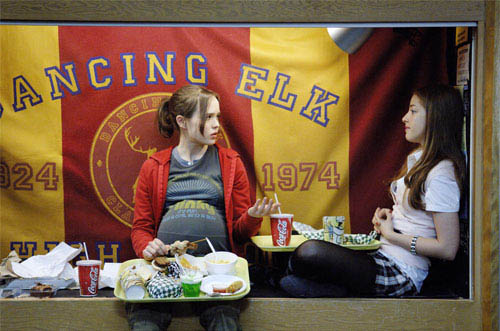
"Juno" is a film so dominated by its script (by Diablo Cody*) and its actors (they're all television veterans with countless man-hours before the camera) that all director Jason Reitman has to do is get out of the way-though in the transitions he routinely cuts on the 1's of the pervasively twee-rock soundtrack to maintain the air of perkiness. The kids that dominate this film about lower-middle-class families making the most of a bad situation--well, bad in the timing--are so pervasively cute and clever in their articulation and word-play that one wonders if they hail from some part of the country where the main sport is Scrabble, and instead of MySpace they all hover around "Addictionary.org." Ultimately one has to ascribe to it the same rule that one applies to Bette Davis movies where everyone always has the perfect come-back: "They have better writers than we do."
But the same troubles. Juno MacGuff starts the movie pregnant and pissed. And pissing. She's buying the home-pregnancy tests out of the box one at a time from the convenience store and using their facilities to test it. "You better pay for that pee-stick when you're done with it," says the clerk (played by "The Office's Rainn Wilson). "Don't think it's yours just because you marked it with your urine!" She gets the unholy pink "x" and starts to puzzle out how to proceed: telling parents, telling sperm-donor, what to do with said spawn, yadda yadda yadda. "Juno" skips along dealing with all these crises and quite a few more, and never slides into bathos, preaching or "after-school special" earnestness. The characters are all people for whom regrets are a waste-of-time, and are too busy doing their best to do too much navel-gazing. Well, almost all. One walks away charmed, and admiring the cleverness and the near-occasion of bravery the movie displays. And there are no bad performances. Anywhere. No actor lets this material touch the ground, whether its the stunningly decent work by vet-thesps like Alison Janney and J.K. Simmons, but also wise work by Michael Cera, Jason Bateman, and, yes, Jennifer Garner. But the big bouquet goes to Ellen Page who carries the movie on her slim shoulders and always finds a way to make the dialog sound like she's just saying it off the cuff. That's a tough trick to pull for an entire movie--an entire comic movie--this entire comic movie. Frankly, it would've been easier giving birth.
"Juno" is a pop-culture flip-remarkable "Matinee" (Whoah! Rate Big!)




------------------------------------------------------------------ --
--
It Takes a Sex Toy to Raise a Village
Everybody likes Lars. Lars is 27, lives in the carriage-house of the family home. Keeps to himself. He goes to work, eats, attends church, chops wood.
And that's about it.
Lars is socially retarded to an alarming degree, so much so that he feels it hurts to be touched. His family worries about him. They feel guilty. They don't know what to do.


But Lars does. He's surrounded by people with relationships, so he decides to get one. But that touching thing...that's a problem.

Then one day, Bianca shows up, a mail-order girlfriend. Lars tells his brother and sister-in-law that he has a girl-friend and he'll bring her over for dinner. They're elated. Then they find they didn't need the extra setting. Bianca's a sex-doll. Fairly realistic looking, but she doesn't move. At all. Lars has to carry her, until he gets her a wheelchair. He cuts her food for her. Eats it, too.


In a case of intervention, all four go to the doctor (Patricia Clarkson, being warm but acting cold), who takes one look at Bianca and worries out loud that she needs weekly treatments for her alarmingly low blood pressure, and uses the opportunity to find out exactly what is going on with Lars. She advises that they should play along--"Bianca's in town for a reason," she says. "But, people will laugh at him!" says his harried brother, played by a note-perfect Paul Schneider. "You, too," says the doc.


It could be perverse, and if Lars actually had relations with Bianca, people wouldn't be enjoying this movie nearly so much. Nor would it be as enjoyable if the entire town didn't, for the sake of Lars, go along with the story and accept Bianca. And that acceptance happens almost immediately. Sister-in-law Karin informs her coffee klatsch friends that Bianca is anatomically correct, and one of them says, "Soooo...she's just one of the girls, then..." The pastor of the church goes along with it. Everybody does. Ev-e-ry-bo-dy. Which set off some reality alarms for me. There aren't any disaffected youth, or jerks or morons in this town? Hell, if any of the kids from "Juno" lived there, Lars would be getting the "stink-eye," at least. And in a land where every inflatable Christmas lawn ornament is at risk, Bianca has it REALLY easy.



Still, it's an enjoyable film, full of heart in the right place, and offers lots of enjoyable surprises in screenplay, performance (it's hard to believe this is the same Ryan Gosling from "Fracture") and overall tone. One wishes there was a second there where one could believe in it.
"Lars and the Real Girl" is a matinee, though my opinion is deflating.
---------------------------------------------------------------------------------
* Diablo Cody has such a fresh, smart way with dialog that one hasn't been as excited by a screen author's work since Zach Helm, who wrote "Stranger Than Fiction." Since Helm went on to create the lead balloon "Mr. Magorium's Wonder Emporium," one doesn't want to be too effusive in one's praise, lest one set oneself up for disappointment.