Showing posts with label Y. Show all posts

Wednesday, July 4, 2012

Yankee Doodle Dandy

Yankee Doodle Dandy (Michael Curtiz, 1942) Of all the films in James Cagney's storied career, his favorite was his most unusual—not one of his gangster films (some of which revolted him) or his dramatic efforts, but this one, the one that won him his Best Actor Oscar, the musical biography (very loose) based on the life of George M. Cohan.  Cagney always described himself as "a hoofer," starting out as a dancer in vaudeville, and the athleticism did him well in Hollywood.  Cagney's energy, timing, and directness—his grace (even if he was playing a hood)—came from this background, and the compensatory toughness came from his growing up and observing the streets, providing "that unmistakable touch of the gutter," as he eloquently put it in his acceptance speech for the second AFI Lifetime Achievement Award.

Yankee Doodle Dandy begins with Cohan (Cagney) on Broadway playing Franklin Roosevelt in "I'd Rather Be Right" when he is summoned to the White House to receive the Congressional Gold Medal from FDR himself.  The visit gives him a chance to tell his life-story to the President, which is presented in flash-back form, from his early days to performing with his family (Walter Huston, Rosemary DeCamp, Jeanne Cagney) to the lean years when stubbornness gets him blackballed in the theater community, and he has to struggle back to the stage by song-writing,* eventually coming back and becoming the King of Broadway.

It's still startling to see Cagney's dance moves; loose, limber below the waste, and ramrod straight above, his movements alternate between drunken sloppiness that looks like it could severely snap tendons if gone wrong, and stiff-legged woodenness, giving the impression that he's a puppet with the strings cut—not really in control of his own movements (and, of course, he always was—that was the illusion of it all, the mastery of it), but compelled to dance for the sheer energy of it forced him to do so.  It's scary, but Cagney always is.  He is, after all, the guy who shoots people by pumping the pistol forward, as if the movement puts more energy in the bullet to kill faster, make it more definite, more personal.  His gangsters make the guns part of them, rather than just a tool.  

Some of the moves look archaic, compared with the gymnastics-as-dance school today—the leaping and bouncing off a wall (as if there wasn't enough room on stage) looks tame now, even though it amazed me as a kid, but the high kicks I appreciate more, the toe-steps, the tap—all amazing.  And they look spontaneous, which in itself is a marvel.*

It's a feel-good musical about celebrating the spirit of America, which we all do on the Fourth of July.  That it happened during war-time, added mightily to the propaganda potential of it (and, although it's always been denied, might've helped Cagney get rid of the "pinko" label he was being saddled with at the time—my, how times haven't changed).  But, it's a fine achievement, and Curtiz, who's known for hating unused space in a movie frame, overcrowds the stages—every theater-piece for this director was "SRO."  And, although something of an autocrat, with musicals he let loose the reins (something Cagney appreciated) and allowed spirit to flow.  Maybe that's why Yankee Doodle Dandy still seems fresh.


It was voted into the National Film Registry in 1993 for being "culturally, historically, and aesthetically significant."


* Cagney could relate.  He was constantly battling the Warner Brothers brass, at one point suing the production company and staying away.  Jack Warner called him "The Great Againster."

** Evidently Cohan's final tap down the White House staircase at the end, was improvised.

Wednesday, January 11, 2012

Young Adult

Writer's Cell-Block
or
"He Talked to Me Like I'm Not Pretty!"

The writing-directing team of Diablo Cody and Jason Reitman reunite to present what could be the dark sequel to their sunny, funny Juno.  But, instead of examining the student body sub-strata of geeks, we're looking at the sosh's side down there at the very shallow end of the gene pool and the eventual disintegration of High School Dreams.

Trouble is knowing when to wake up.  That's the thing about the privileged and the entitled, they never know when the party's done and it's time to go home (and don't even bother asking them to help clean up—that's maid-service).  It's the problem of Mavis Gerry (Charlize Theron): her party's over but she's still rocking in the corner, hugging her Maker's Mark bottle, and she picks the perfectly wrong time to go home to Mercury, Minnesota.  A writer of moony, self-absorbed children's books (No, no...that's "Y-A's," the contradictory term "Young Adult" novels) about High School life in a series called "Waverly 128", she draws mostly from real life—her own—but with additional snatches of overheard conversations cribbed from teen conversations in fast-food joints and malls.

She need not bother with the latter.  Mavis' emotional development is so arrested it should be serving 10 to 20 in "juvie."  Her thought processes are still confined to Middling School concerns, even if her behaviors have become more adult in nature, with one marriage behind her and several casual affairs left high and dry, to sleep it off in her bed, and the height of a social life being getting hammered in a bar, anticipating it like a kegger, and her one constant companion an "accessory pet," an animated white hair-ball named Dolce that is left, more or less abandoned, but still capable of the one love Mavis can accept or understand—reverse unconditional.  Oh, in our self-absorbed and -absorbed youth culture, she can pass for a grown-up, she's pretty, put-together, and trendy, but on the inside she hasn't graduated, pushing off her writing assignments like she was having to write a term-paper.

In the midst of burbling out her latest teen tome, she gets a message from an old flame (Patrick Wilson) that he and his wife (Elizabeth Reaser) have had their first child...and something in Mavis snaps.  She packs up laptop and lap-dog and cruises back to Mercury to recapture her past and maybe new father Buddy Slade and "rescue" him from responsible domesticity, two things she can't fathom or stomach.  I mean, have you seen that baby?  Ga-ross!

Thing is, she's clueless.  Mavis is so stuck in the past rattling around inside her head, you begin to wonder if she might be a little insane, besides insular.  Fortunately, she runs into somebody she perpetually ignored in High School—the guy who had the hall-locker next to her that she never noticed existed, Matt Freehauf (Patton Oswalt, best thing he's ever done), who had his own development beaten out of him ("Oh, yeah, you're the "hate-crime" guy!" blurts Mavis, tactfully and sensitively) by High School toughs who, in a clear case of High School temperance, tolerance and judiciousness, mistakenly assumed he was gay.  Matt, with his twisted body, develops a fascination with Mavis and her twisted logic, only half-heartedly trying to suggest that...you know...she might be a little out of sync with the normal, a notion that she scoffs at, before taking another slug and checking herself out in her mirror.

"You...are a piece of work," says Matt, admiringly.  "And you are a piece of shit," comebacks writerly Mavis.

This can not go well, and one wonders where the movie could possibly go and if it can ever be resolved without something being destroyed.  The damage being done, though, is to the expectations of the casual movie-goer.  Mavis is not your charming debutante "sweet thing" that you'd find in your standard rom-com.  She is, as one of her class-hates says, a "psychotic prom-queen bitch," and, though smart and clever, thoroughly unlikable, even when sometimes bordering on the sympathetic.  Theron is never afraid of tackling this type of character (she did, after all, win an Oscar for her terrifying Aileen Wournos in Monster) or challenging expectations of the audience, and Cody (with Reitman) has a fine time skewering the traditional "woman-pursues-her-soul-mate" brand of romantic fiction.  For that, Young Adult, as cringe-inducing and unsettling as it is, deserves an acknowledgement for being a brave film, risking a lot, while also giving a bitch-slap to the Hollywood romance.  It left me in an odd place.  I didn't thoroughly enjoy Young Adult, but, at the same time, I recognized that the makers were making a thoroughly professional statement...or at least an obscene gesture...to the too-easy way that love is presented in the movies, something I've railed against myself.  This isn't love.  It's selfish obsession.  And Mavis, like so many of the protagonists in Reitman's films, is an outlier of Society, playing by her own rules, but, as opposed to the others, she reaches no self-awareness, and is absolutely clueless as to where the goal-post is (knowing Mavis, she probably would pick a random spot, easy to reach, and declare it 'good").  One is hesitant to praise or applaud such accomplishments, when the impulse is to show it the door and kick it in the ass on the way out. 

Young Adult is a Rental.

Thursday, April 21, 2011

Your Highness

"Du-uh..."
or
"Natalie Portman's Post-Oscar Slump, Part 1"

I've needed a laugh lately.  I've been second-and third-guessing myself, not sure which way to go on all sorts of matters.  And after seeing two movies, good and bad, in which anyone can be tread upon by the Government (The Conspirator and this Saturday's "Take Out the Trash" entry), I needed something light, something frothy, something not Hanna or The Lincoln Lawyer.

I needed a comedy, dammit!  After playing pin-ball in my head for a week and a half, I wanted a new thought to tilt me out of my doldrums. It would be appropriate, too, as every scene we've looked at Sundays of this April Fools Month has been a comedy (this week will be no exception), so a comedy might be just the thing to kick my torpor in the ass, or at least make it slip on a banana peel.

Wish I'd found one, because this isn't it.

Your Highness, in fact, makes me wish I was living in a different era—not the one depicted in the film, of course, but also not in a time when such a movie, with big stars (every Briton who isn't in the "Harry Potter" series, like Charles Dance and Damian Lewis), sumptuous locales and elaborate costuming can be so sloppily put-together that one gets the impression that at every stage the film-makers said "Eh...good enough" and moved on.  I noticed myself laughing exactly twice, and longing for something—anything—to be half-way clever or even half-way executed.*  I like my comedy to have a brain in its head, and something to say besides what could shock your grandmother.  Despite the cast, this one has so little going for it, you start to worry that at least the cast were well compensated.  Because it couldn't have been for love.

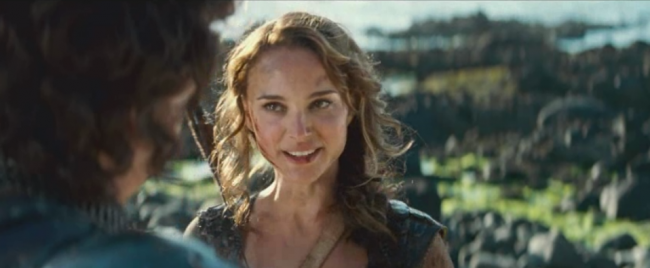
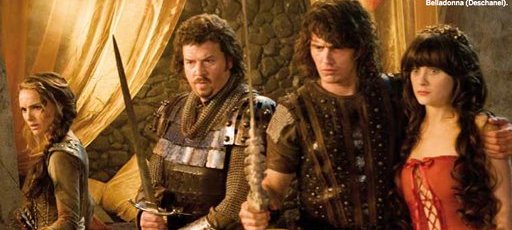
I'm a fan of James Franco, Natalie Portman and Zooey Deschanel, but why they should play second-fiddle to Danny McBride (who's usually lousy...Land of the Lost...and who barely registered as the reluctant groom in Up in the Air) is beyond me  Sure, Franco probably owes director David Gordon Green for his role in Pineapple Express (which I haven't seen, but have heard good things about), but he seems a bit lost in this, although gamely appearing cluelessly cheery throughout.  

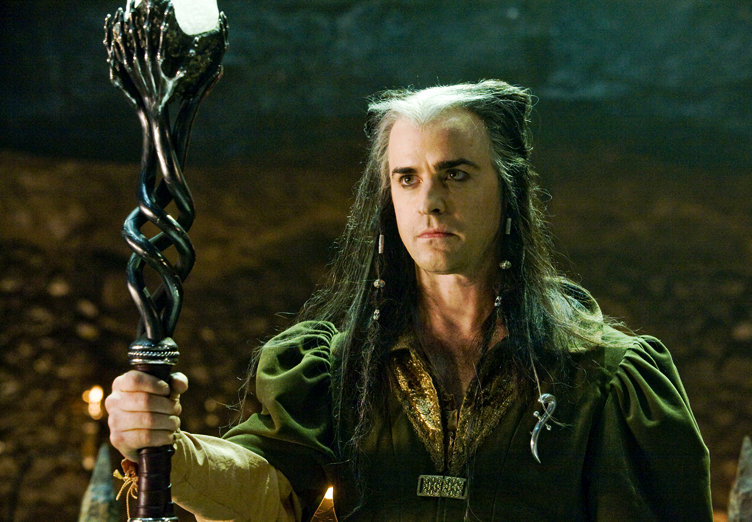
Borrowing heavily from every fantasy-adventure movie from the last 20 years (and liberally from Star Wars—their take on Yoda is particularly nasty, and they have a clockwork bird-familiar after the original Clash of the Titans), Highness tells the story of the sons of King Tallious (Dance) and his two sons—the heir to the throne, Fabious (Franco), and the ne'er-do-well younger Thadeous (McBride) who would appear to be "Your Lowness."  Fabious' bride Belladonna (Deschanel) is kidnapped by the evil sorcerer Leezar (Justin Theroux, who co-wrote Tropic Thunder, another high-concept low-result comedy) for his own nefarious plans.  Fabious recruits Thadeous to go on the search for Lezar, despite the fact that the younger Prince can't fight, doesn't travel well, and is in all things incompetent.  Plus, he's the "troop griper/whiner."  Good planning.  Dick jokes ensue.

Between the puerile humor there are some action sequences, but Green has a hard time deciding whether he's playing them for laughs or for jolts.  Not that it matters, as they succeed in neither, not even in the way that competent directors can achieve both or even one.  And, although things are accomplished, nobody really learns anything so character arcs are as flat as a crushed pixie (the only clever idea I saw in the whole thing).

But, one thing Your Highness did accomplish: I had no second thoughts about it.

Maybe Hanna would have had more laughs.

Your Highness is a Waste of Everybody's Time.

* A complete execution...of me...was what I wanted after seeing this movie!  One thing that is mentioned in all the write-ups I've seen is that the crew went into production with  only a story and everything was adlibbed on-set.  Really, they shouldn't be boasting about that.

Tuesday, November 2, 2010

You Will Meet a Talk Dark Stranger

"Man Makes Plans. God Laughs."
or
"The 'Thing Without Feathers' Turns Out to be My Nephew."

With a title like You Will Meet a Tall Dark Stranger, you know this won't be one of Woody Allen's autobiographical tales.  The Woodman never strays too far from All Things Woody, his characters usually being scrambled aspects of himself, with one character being a direct comic stand-in.  The likes of Kenneth Branagh, Mia Farrow, John Cusack, Larry David and Edward Norton have all been past dopple-neuroti-gangers for the writer-director.  Rarely has there been a film of his without one.

This is one of those rare films, although one could say this tangled web of London residents could all be aspects of Allen's personality, with the closest being (maybe) Anthony Hopkins' Senior Fool.  One needs a play-book to keep everybody in this rondeau straight, although they are all in each others' orbits.  Start with Hopkins' Alfie—married to Helena (Gemma Jones), parents of Sally (Naomi Watts), wife of Roy (Josh Brolin).  Alfie, going through his "middle-age crazy" period, divorces Helena, sending her to a faux psychic (Pauline Collins) in her grief.  This all upsets Sally, who's trying to make ends meet working for a gallery owner, Greg (Antonio Banderas) while her husband is becoming frayed trying to write a follow-up to his previous publishing success.  Basically, everyone's in the weeds, and it's not long before everybody decides that somebody else's grass in better than their own.  Soon Da is marrying a call-girl/"actress" (Lucy Punch), Roy is pursuing a neighbor he keeps oggling through his window (Freida Pinto), and Sally starts to have feelings for her boss, as her feelings for Roy start to wane.

Allen starts and ends the movie with Leon Redbone warbling "When You Wish Upon a Star," and begins with Helena visiting a psychic, making one think that instead of a rating designation ("R," btw), it should have a sign saying "Abandon All Hope, Ye Who Sit in the Auditorium."  That he equates spiritualism as just a more rigorous form of "hoping against hope" (when the two are merely con-games with different sources—second-hand or internal) is dispiriting, and though it's a continuation of his life-view—"full of loneliness, and misery, and suffering, and unhappiness, and it's all over much too quickly"—there isn't the shrugging whimsey that serves as a warming punch-line this time.

For it may be true, as Emily Dickinson says, that "Hope is a thing without feathers" (and Allen's screwball lateral to that is the second title for this review), and "if wishes were horses, beggars would ride," I tend to take the more optimistic view.  Yes, there will always be poor (because Jesus tells me so) without a nagging destiny, that's no reason that, even though their feet are perpetually on the ground, they shouldn't be reaching for the stars.

Because there will always be stars, too, even if we don't see them, and even if we're not looking for them.  It's why I keep looking up at them.  It's why Woody Allen keeps making movies. 

Maybe his next one will be better.  I hope. 

You Will Meet a Tall Dark Stranger is a Rental. 

Tuesday, February 9, 2010

Young @ Heart (Take Two)

"Young @ Heart" (Stephen Walker and Sally George, 2007) Good movies need good casts and "Young at Heart," the documentary about seniors singing rock songs has one of the best casts in movies in many years. The motley gang of oldsters, struggling mightily with the rhythms and lingo of late model rock n' roll, charm and beguile. The characters and cranks, alike, are so fragile you worry for them and mourn briefly at the news of a death in the family, one of those proud voices stilled.

Conceived and led by Bob Cilman—one gets the idea that he more than lives the impresario role—
the choir-leader picks the songs, teaches, cajoles, cheer-leads and nannies the old folks who are nothing but game...even at the risk of their health...to get out there and put on a show.

Quite the show it is. The film chronicles the ramp-up and try-outs of new material for an upcoming performance from the first halting attempts (they do "Yes, we Can-Can," something I'd be hard-pressed to get right!) to the suspense-filled stage appearance—will they pull it off?—before a sold out crowd of towns-people and family-members of fallen comrades. Interspersed are ingenious music videos that are clever and funny and are something of a tonic throughout the movie.

Because hovering over the film is the specter of mortality.
The singers are frail, in failing health, their eyesight failing, their voices quavering, suffering from diabetes and heart flutters. But combined with the angst and nihilism of rock songs, the result is poignant, even defiant. To see Fred Knittle (who passed in January 2009), morbidly obese, on oxygen, going through Coldplay's "Fix You" is a revelation, not only due to the performer, but for the effect he has on the material—the song is transformed to a world-weary hymn. The Bee Gee's "Staying Alive," that vampire of the disco days is dug up and becomes a cheekily triumphant "up you" to death.

And in one of the most poignant moments, Bob Dylan's "
Forever Young," sung to a group of hardened inmates, growing misty with it, becomes a benediction from one group of survivors to aspirants, only hoping to. The post-concert interaction between them brings tears to the eyes.

"By the end of the filming, I felt like I had 25 new grand-parents," says Walker in his voice-over.

Exactly well put. 25 new grandparents, their lives preserved for all time on film, in a special moment in time.


The poster for the concert. Joe Benoit, in front, died before the concert.

Wednesday, January 13, 2010

The Young Victoria

"Her Serene Highness"

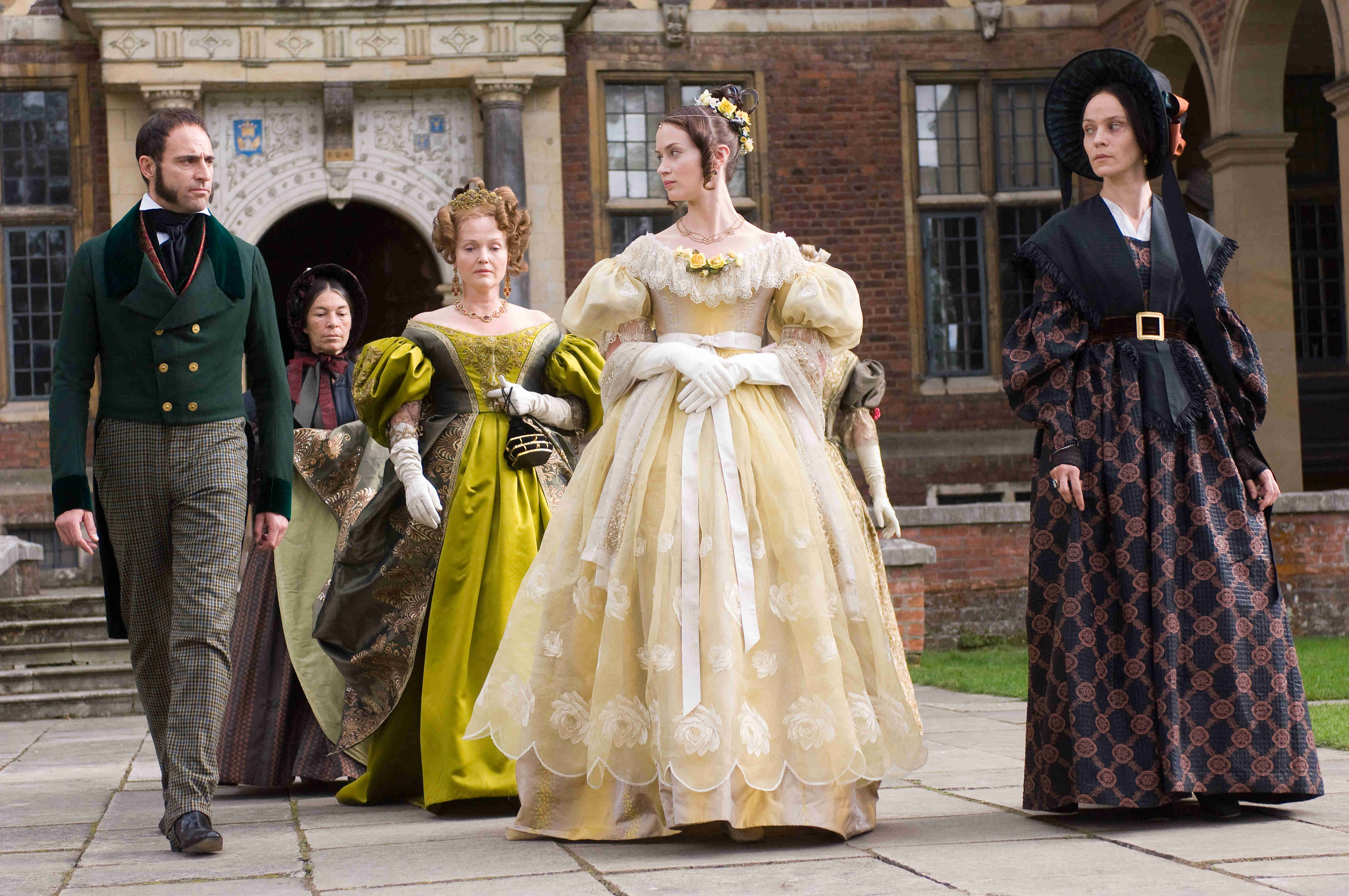
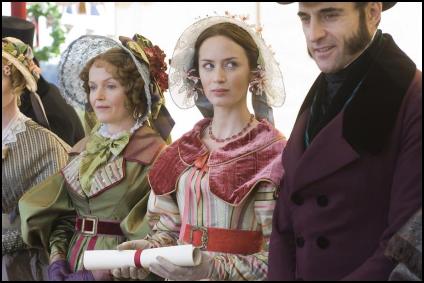
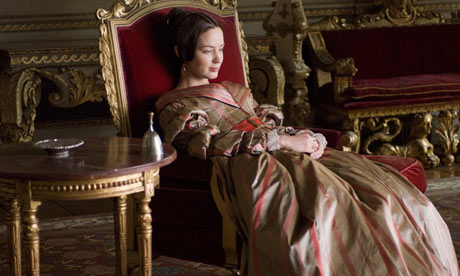
William Jefferson Clinton famously called The White House the crown jewel of the U.S. prison system. Young Queen Victoria (Emily Blunt) says early on in "The Young Victoria," "Even a palace can be a prison." As the only heir to England's throne in the Royal House of Hanover, the young princess is managed and controlled, ostensibly for her safety, but also for the power that an unprepared and naive queen can offer her advisers. The last image we see before the title of the film is a gate swinging towards us and slamming shut with a bang.

Go to black. Title up.

There are a lot of shuddering doors in "
The Young Victoria," as the upstart princess, well aware of the red carpet ahead, defies her manipulaters and her mother (Miranda Richardson), who is cowed by their presence, especially that of Lord John Conroy (Mark Strong—his second villain role this year after "Sherlock Holmes"—risking typecasting, he'll be playing Sir Godfrey in the upcoming "Robin Hood" ) who viciously seeks to be made regent in case of the death of King William (Jim Broadbent). Ambition is on everyone's mind, except the one who will be getting the power. And ambition is what the young queen must learn, if only to be used as a weapon.

Director
Jean-Marc Vallée (and his script-author Julian Fellowes, who wrote "Gosford Park") spend a lot of time concentrating on Victoria's noggin. It is focussed on, framed and discussed. "Look at that demure little head," says Lord Melbourne (Paul Bettany) at her coronation. "And all of us wondering what's inside it." He, like the rest of the court, really couldn't care less. If her mind can be changed, then it doesn't matter. But there is enough rebellion, and enough fighting the gold shackles binding her, that can be used to sway her.

It should be noted at this point that one of the producers of "
The Young Victoria" is none other than Sarah Ferguson, the Duchess of York, who endured her own time of constraints while married to Prince Andrew. "Fergie" was known to be quite feisty, herself, and one looks at the movie and wonders how much of its editorial stance originated with her, as it is pretty sly in its view of the monarchy as being both a blessing and a curse. Whatever animosities Ferguson has incurred with the current Royal family, there seems to be an understanding of just what is asked of a monarch, and with "The Queen," it shares a similar visual touch—the Royal de-focussing of the eyes that appear to see nothing, but are merely providing a non-commital mask for the public to see, the eyes looking, instead, inward.*

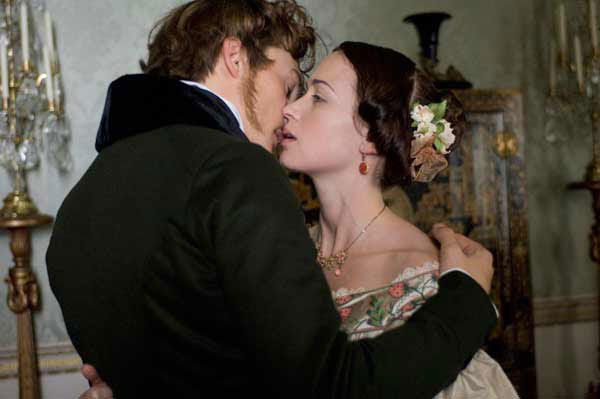
Given that, enter Prince Albert (Rupert Friend) of the Belgians. Groomed as a suitor by his father King Leopold (Thomas Kretschmann), the young Prince also resents being kept in a can, and upon meeting Victoria goes off-script, showing himself to be of equal mind. During a supervised chess game, they compare notes on their similar circumstances. "I know what it means to live inside your own head," he offers. "You must learn the rules of the game, so you can play it better than they can," and as if we don't get the point, he takes her Queen and sweeps it off the board, captured.

Vallée keeps things properly ornate and unfussy in his direction, save for some odd little rack-focuses interrupting the continual focus on Emily Blunt's head of restrained expression. At one point, though, he does indulge. At the Queen's entrance to a Royal Ball, upon seeing Albert, he keeps Blunt locked in position and then yanks her away from her party, as if pulled, floating to her paramour. A neat little trick that, and very dependent on Blunt keeping her muted expression while having her transport taken completely away. It's indicative of Vallée knowing that his best weapon in the movie is Blunt's subtle whisps of expression; one is drawn to her face to see how she'll react, even if, until the last frame, it is reluctant to reveal.

"The Young Victoria" is a Matinee.


* At the end, there is a title stating that Victoria was the longest reigning British monarch. And as if to tweak the ex-mother-in-law a bit, with a wink, a new title emerges below it—"To date." Elizabeth II is en route to surpass Victoria on September 10, 2015. She'll be 89.

Saturday, July 11, 2009

Youth Without Youth

"Youth Without Youth" (Francis Ford Coppola, 2007) There are two Francis Ford Coppola's: the good director, who made the first two "Godfather" movies, "The Conversation," "Tucker: The Man and His Dream," and "The Outsiders," and the bad one, who made "Dracula," "Peggy Sue Got Married," "Apocalypse Now," and "Rumble Fish." The good Coppola maintains a strict storyline, and finds interesting ways to chronicle it with a rich sub-text. The bad one sees the weakness in his story and rather than improve it, obfuscates and hides it behind film-making technique and effects. Both directors are on display in "Youth After Youth."

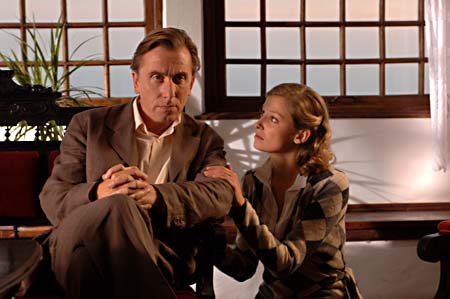
It's an interesting story that takes a while to get going, like a good novel. Dominic Matei (
Tim Roth) is an elderly scholar of language, not yet gifted, frustrated that time is growing short and his life's work has come to naught. Crossing the street, he is struck by lightning, but survives, burned to a crisp. Under the care of Dr. Stanciulescu (Bruno Ganz), Matei begins to recover, growing new teeth, the burned skin sloughing off to expose a new epidermishe is young again, rejuvenated, and may even be growing younger than his appearance. Plus, he is gifted with strange electromagnetic powers, able to scan books with a touch, and able to form an odd prescience.

And he seems to have grown another soul.

Well, there's another Dominic in his mind, a wiser more assured entity, a guide, a guardian, who's not omniscient, but provides perspective. And Matei, has become something of a medical sensation for his new butterfly existence—he's come under the watchful of the growing Nazi party, trying to improve the race with horrific experiments in electricity.

"Youth After Youth" is complicated just at that point, part horror movie, part sci-fi,
part spy movie, part war film. It defies classification, which is good. But to get through that muddle, Coppola tries some desperate acts to communicate it all, and doesn't quite pull it off, with inverted dream-sequences, picture-fades within fades, reversed film exposures. It's nice to see he's having fun (and some of that could be exhilarating as his tricks in "Dracula" were), but they're not "saying" anything. They're empty grace-notes without purpose other than to evoke, rather than communicate. It's a rich banquet of cinematic tricks, but the caloric content is nill.

Where the movie takes off is in its third act, where Matei's "gifts" become relevant, and he is singularly in a position to solve a mystery of another lightning accident,
one that holds personal consequences and sacrifice. It is at that point Coppola settles down and provides a clean, uncluttered narrative, just as rich in detail, but focused on expression rather than film-tricks.

Where Coppola excels, usually, is casting, and now, with his own money and a more frugal sensibility, he can cast as he sees fit, rather than for marketability, and
Tim Roth is given a suitable starring role, where he can stretch those acting muscles. It's a multi-layered performance of quiet maturity that navigates well through the Coppola gears and is far more valuable than the digital manipulation Coppola employs.

Friday, September 26, 2008

You Can Count On Me - Take Two

"You Can Count On Me" (Kenneth Lonergan, 2000) Samantha Prescott does everything right. She's a responsible single mom, with a well-regimented life, a steady job as a loan officer at a bank in upstate New York.* Life is good.

Her younger brother, Terry, though, wanders around, has no job but does have a girl "in trouble," and needs money. So it's time for a visit to Sammy to get away from the disaster of his life, spend some time with family. Maybe borrow some money.

Sammy is the responsible one. Terry is responsible, too, but it's usually for trouble.
How can two disparate people come from the same family? Easy! And Terry's visit becomes a disruptive influence in the calm of Sammy's life. Doesn't it?

That's the central issue in
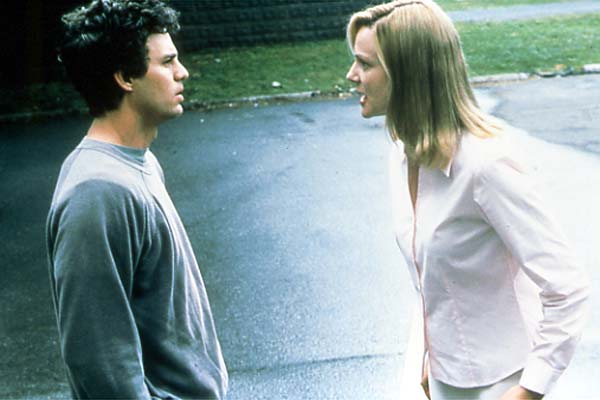
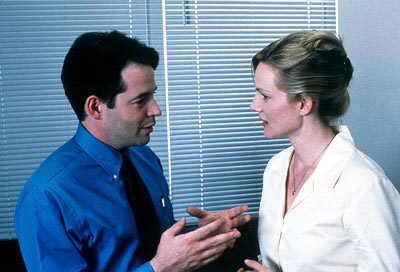
this warm, bitter little dramedy that has at its core two extraordinarily strong performances from the astonishing Laura Linney and the chameleon-like Mark Rufalo. Linney doesn't change her look much from movie to movie; for her, it's all in the eyes, and in this one, she's got her "high-beams" on, scoping the world for danger, but rarely seeing it. Imagining it, yes, but never seeing it. Rufalo is all shaggy schlumpf in attitude and posture--a human question mark. He answers a few questions in the mind of Sammy's son Rudy (the latest spookily-good Culkin, Rory)--things Mom would never reveal to keep things tidy. Meanwhile she has a prickly problem with her new boss (Mathew Broderick, in full smarm mode--what he does best).

It's a
seemingly simple film about the complications of family, which as everyone and his brother knows, implies a lot of blood under the bridge, because it's always thicker than water.


* Alright, I see you smirking! At the time this was written, it wasn't nearly so ironic.

Tuesday, June 17, 2008

Olde Review: Young Frankenstein

This was part of a series of reviews of the ASUW Film series back in the '70's. Except for some punctuation, I haven't changed anything from the way it was presented, giving the kid I was back in the '70's a break. Any stray thoughts and updates I've included with the inevitable asterisked post-scripts.

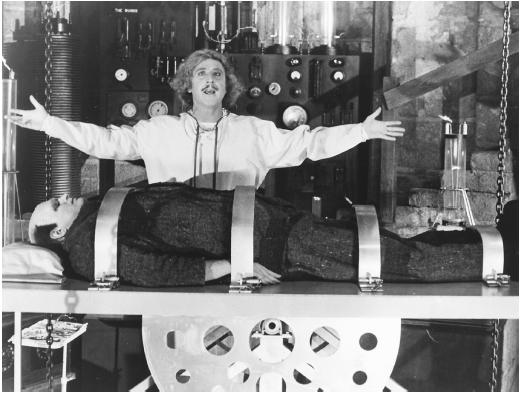
"Young Frankenstein" (Mel Brooks, 1985) In my review of last quarter's bill of comedies,* I stated that Mel Brooks is just about the only remaining graceful comedy filmmaker**--his films have a flow along with the jokes. After a couple of false starts,*** Brooks achieved his cinematic sense with "Young Frankenstein," and achieved it, as most film-makers do today, by following the example of a predecessor in film-making--in this case. the director of the original "Frankenstein" films, James Whale. His coming of age didn't occur only because of the help of Gene Wilder's script (Wilder's own "Sherlock Holmes' Smarter Brother" was an abysmal failure), but through the realization by Brooks that the best movie spoofs are those that poke fun at and embrace their cinematic progenitors. And so, in tandem with the humor, good and bad, we are treated to the charms of two-dimensional castles, rain-washed cobblestones, studio-built forests and the glories of black and white photography. And you have to have a special love to go to the trouble to obtain the lab equipment from the original "Frankenstein." Brooks' love of the original gentles this film. His love makes him understand the charms of the original "Frankensteins." "Young Frankenstein" turns serious when Gene Wilder screams out during the experiment because Brooks understands that he is challenging God's right to be the sole source of life. It turns serious when Wilder confronts his creation, and is able to conquer his fear to become the loving father-creator to his very lonely, dependent creation, a moment coupled with the young scientist's first ecstatic re-affirmation of his family name. Brook's understanding goes so far as to present its own version of the wierd sexuality that was in the old "Frankenstein" films. Brooks also has the melancholy understanding of the monster's plight--the plight of all those different enough to be rejected by society. However, there is one thing different about "Young Frankenstein," as opposed to the originals--this one has a happy ending for all concerned--for Brooks' "Young Frankenstein" is a sentimental, gentle film--a rarething these days--a quality that only adds to my enjoyment and appreciation of the films of Mel Brooks.

Broadcast on KCMU-FM on January 6th, 1977


As far as that goes, and it didn't go far. Brooks made a wonderful, financially-risky movie called "Silent Movie," (and it was silent, except for one word, spoken by mime Marcel Marceau), then came "High Anxiety," a somewhat haggard Hitchcock parody, then "History of the World, Part 1," "Spacebals," "Life Stinks," and on. And sadly on. Brooks is now a Broadway entrepreneur with his wildly successful Broadway production of "The Producers," and his fine staging of a musical version of "Young Frankenstein." And his company, Brooksfilms, is still in business--except for his own films Brooks rarely played it safe.

*Those being "The Running, Jumping, Standing Still Film," "Love and Death" and "Monty Python and the Holy Grail"--I just found those reviews, we'll get to them eventually.

** I hope I changed my mind on this. Blake Edwards was still active at the time, as was Woody Allen.

*** Presumably, "The Producers," (clumsy, but funny as Hell) "The Twelve Chairs," (better, but not terribly funny), and "Blazing Saddles," (which was rude, crude, hilarious, and one of the worst looking movies I've ever seen)

Saturday, June 14, 2008

Young Mr. Lincoln

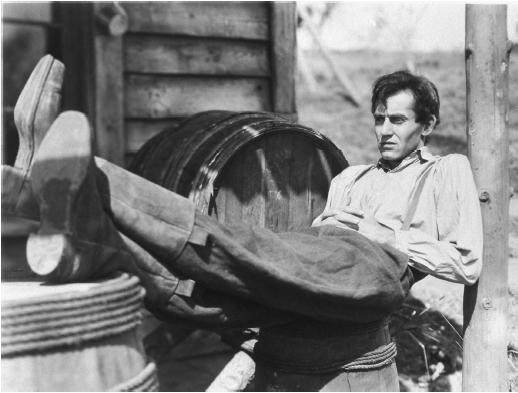
"Young Mr. Lincoln" (John Ford, 1939) Essential "John Ford at Fox" movie about the "jack-legged country lawyer" who would become the 16th President at the time of the nation's sundering. The film is filled to the bursting with fore-shadowing, from Abe playing "Dixie" on a jew's harp to encountering Stephen Douglas and Mary Todd to the penultimate shot of him striding up a storm-tossed hill lit by lightning (more on that later). Henry Fonda, heel-lifted, stiff-gated and nose-puttied plays Abe with a slow "drawrl" and far-away look, the film concentrating on the young Lincoln's learning and early practice of the law in Springfield, Illinois. Along the way he's haunted by the loss of his first love, Anne Rutledge and takes part in a murder case involving an angelic country family that stirs up feelings of home. Ford has a fine time skewering the pomposity of trial proceedings and the airs of high society.

The film is a prime example of the emotional mood swings that energized Ford's films.

But it also showcases the director's eye for composition and use of Nature to re-inforce story points. For example, there's this early scene where Abe and Anne tentatively express feelings. Anne is friendly with Abe, while he is tragically smitten. Ford frames them by a river where a great tree forms an arch extending from Anne and branches out to barely graze Abe.

The scene will end with Lincoln walking under that arch, alone, and throwing a rock into that swiftly-flowing river, its ripples starting a transition in time that will show the river clogged with ice, and a graveyard containing Anne's grave. In the background, a yearning violin piece serves as "her" theme, but also, generally, of memory and loss, as it keeps coming back throughout the film (23 years later, Ford would use it again in the same context in "The Man Who Shot Liberty Valance.")

And there's no denying the power of that almost-final shot (a more obvious studio shot serves as the last one, followed by Lincoln Memorial views) of Lincoln's film-ending hill-climb "goin' on a-piece." The bordering fence forming a barricade and the huge sky rumbling with thunder. It's one of the most beautiful representations of Destiny ever committed to film, from the film-laureate of History and nostalgia with a painter's eye and a poet's command of metaphor.

Sunday, June 8, 2008

Young@Heart

Young@Heart (2007, Walker) Like a cross between Saura's Carmen and Parker's The Commitments,Young@Heart directed by Stephen Walker is a documentary movie about the resilience of the human spirit. Rock stars are rebels and aging rock stars are rebelling against the vissitudes of time as much as anything else but this is not a documentary about Keith Richards though he would probably have the time of his life playing with Young@Heart. It is instead a documentary about a group of seniors who for twenty years have been getting together to sing. So successful have they been that they have even toured Europe and plan to do so again.Originally produced as a documentary for British TV, Young@Heart follows 7 weeks of rehearsal before show for a performance in their hometown of Northampton, Massachusetts. However even though their own musical tastes run the gamut you would expect of people in their seventies and eighties (from The Sound of Music to classical opera) these seniors perform the most unlikely songs by the likes of the Clash and Sonic Youth.

The singers are led by
Bob Cilman who both cares deeply about the project but more importantly the people. He does not patronize his singers nor does he cajole them as much as demand and challenge them; his performers are also not afraid to show their opinions but also are so open to the experience that they find something to admire about even the most unlikely of choices. Imagine your grandmother extolling the virtues of Schizophrenia by Sonic Youth. Or your grandfather belting out 'I Wanna Be Sedated'? Some of the songs they sing are more obvious selections if still well-chosen such as Staying Alive, Road to Nowhere, Should I Stay or Should I Go, I Got You (I Feel Good) but others are more challenging both lyrically and musically as when the group struggles over You Can Can by Allen Toussaint with its 71 'cans.'

For the most part the director is happy to stay off-camera as we watch the rehearsals interspersed with some hilarious music videos but it is clear that he is establishing a relationship with the group members and so are we. There are moments of sadness - two cast members die in the time in which the documentary was filmed and the movie is also dedicated to the oldest member who died after filming - it is inevitable and the movie is not afraid to let us get close to these people so that the documentary does not give us an overly-sanitized look at the reality of old age.

Young@Heart is a foot-stomping, inspirational full price ticket.

Monday, May 26, 2008

You Can Count on Me

You Can Count on Me, (Lonergan, 2000) - to screw up, to get on your case but also to be there for you.

A tale of personal accountability and how life isn't always fair but that there are some things you can rely on. Like the younger brother who always screws up, and the older sister who is always on his case, but also that people can and do sometimes act out of character or even change, and that some bonds are too strong to be broken.

It is a curious morality tale in which even Ron (played by the director, Kenneth Lonergan), the local priest admits that it doesn't matter too much about what you call your beliefs as long as you just have something to believe in:

Sammy: I don't know what the church's official position is on fornication and adultery these days, and I felt really hypocritical not saying anything to you about it before, but what is the official position these days?
Ron: Well... it's a sin.
Sammy: Good, I think it should be!
Ron: But we try not to focus on that aspect right off the bat.
Sammy: Why not? I think you should.
Ron: Well...
Sammy: Maybe it was better when they screamed at you from the box for having sex with your married boss, they told you what a terrible thing it was, they were really mean to you. Maybe it would be better if you just told me that I'm endangering my immortal soul and that if I don't stop, I'm gonna burn in hell. Don't you ever think that?
Ron: No, not really.

Laura Linney (as Sammy) and Mark Ruffalo (as her brother, Terry) carry the movie. Matthew Broderick (as Sammy's boss, Brian) does enough to show you why no one would want to work for him if not exactly why Sammy would want to meet him in a motel but maybe that's why Terry is right about how boring life is in Stockville. Definitely one to put on your list: you can count on it.