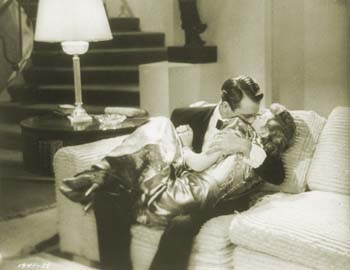
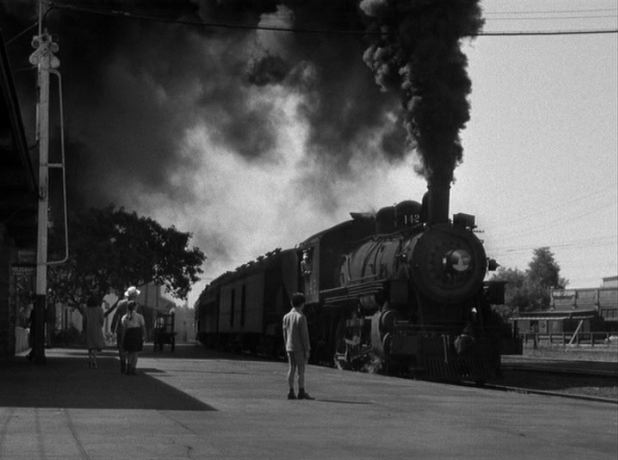
The Story: Thornton Wilder could be pretty dark. Anyone who's seen his stage-plays will tell you that. Which is why his 1943 collaboration with Alfred Hitchcock was a match made in....well, I'm not sure where it was made, but it can't be anywhere pretty, that's for sure. The story of a mentally cracked serial killer who decides to take a cooling-off sabbatical with his Sister's family is a weird tale of family secrets and intuition and of the insinuation of the macabre and the terrible that moves like a black cloud over halcyon small town American life. Forty years later, David Lynch would stake his own plot in this territory. But Hitchcock, with his Wilder inspiration during the war days, turned over enough earth in that regard to last a generation.
The dark joke here is just how easily Uncle Charlie fits into the gentle Santa Rosa domicile. While the Newton family isn't "the Addams Family," they're not exactly the Cleavers (er, bad choice of name) either. Pa and his creepy neighbor (Hitchcock's friend Hume Cronyn) have a hobby of dissecting mystery novels and trying to improve the ways of knocking people off. They're all a bit gossipy, but that's small town for you.
There's tension around the table, too. There's a bond between the two Charlie's—she knew Uncle Charles was coming before the news came out, her restlessness and sense for excitement is a perverse reflection of his vicious vagabond ways. Then there's that "ear-worm," the song that keeps popping into her head, and in this scene shows up in her mother's.* And that's not the only Newton female affected; little book-worm-ish Ann has developed a fear of Uncle Charlie that she can't explain. For the men, there's little Roger's defiant defense of himself that Mom cows and Uncle Charlie is suspicious of. And poor Joe; displaced from the head of the table by Charlie, the conversation is dominated by his wife and brother-in-law to which he can only interject pleasantries and look sheepish at jokes between them he doesn't understand.
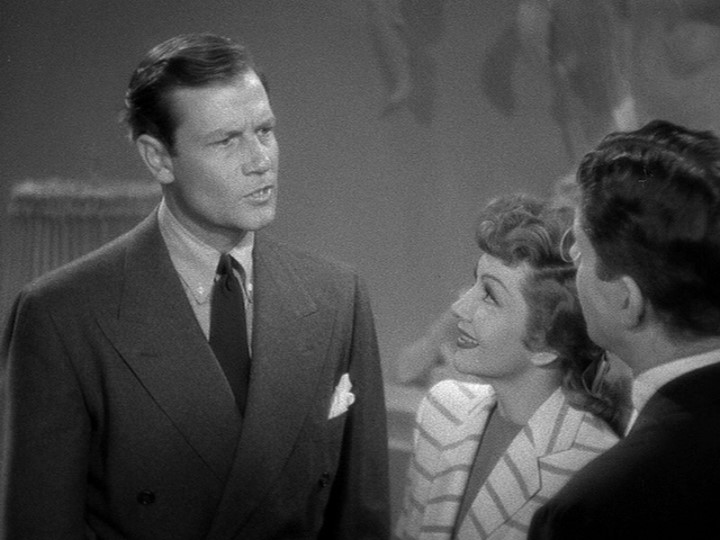
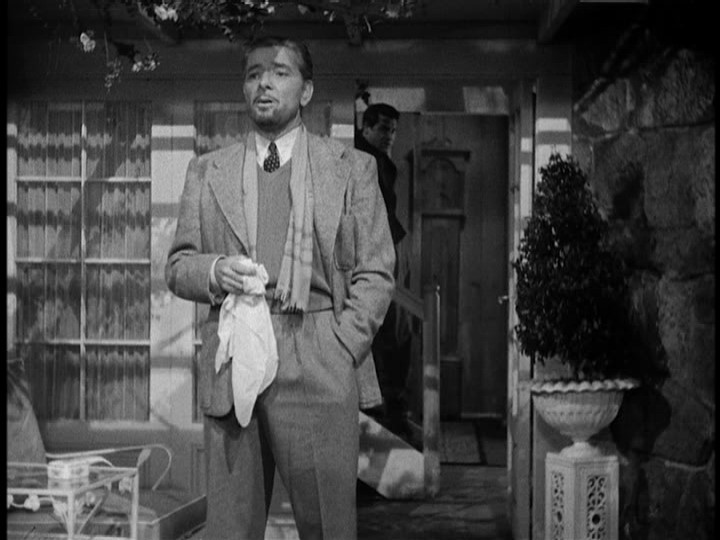
Hitchcock keeps the camera moving, picking up reaction shots while conversation goes on—the controlled chaos of the family dinner table. No shot is held for too long, until "The Speech." Then Hitchcock changes the direction the camera is looking to show Uncle Charlie's "other" side; it's a shot from Charlie's point-of-view at the table, which creeps closer and closer as Charles' words grow darker and more malevolent—she knows his true identity now and is fighting against it, and we're seeing the monster that lies beneath the surface. And when she protests Charles' misogynistic rant, she is speaking from the audience's perspective, echoing their own sentiments, only to be rebuffed by Hitchcock's extreme close-up of his face, coldly cutting us down.
We've just been chilled to the bone, but what sort of reaction do Charles' words have around the table? Next to none. Charles' sister prattles on as if nothing happened: "Well, you'd better not talk like that at the meeting..." Everyone else eats. Evil is sitting at their table and no one recognizes it except the one character to whom we are attached. That may actually be more chilling than the sequence itself. We know. We're alone.
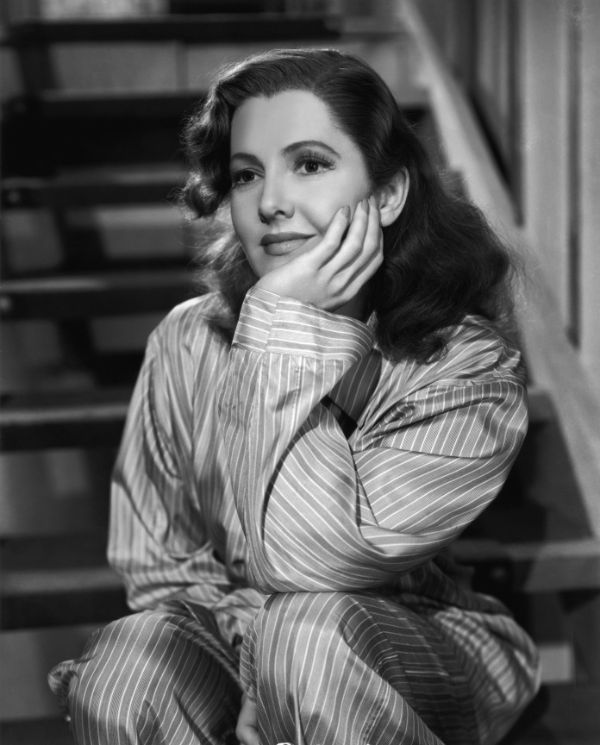
The Set-Up: Charlotte "Charlie" Newton (Teresa Wright) is "bored, bored, bored," with her life in Santa Rosa, California, and wants some excitement. Be careful what you wish for. Her mother's brother, Uncle Charlie Oakley (Joseph Cotten), is coming for a visit from the East Coast. Shadowing him are a pair of FBI agents (Macdonald Carey, Wallace Ford) who suspect Oakley of being "The Merry Widow Killer," who's been murdering rich widows for their inheritance. There've been some vaguely troubling things happening since Uncle Charlie came to town (why is he obsessively reading the local paper?), and it isn't long before the agents tell young Charlie their suspicions. A trip to the Library confirms them, and she spends the day in her room, "sleeping" and avoiding her Uncle. A big dinner is planned, and Charlie conspires to spend as little time with him as possible, her relationship with him shadowed by her suspicions.
Action!

 Charlie: Mother, let me finish mashing those. I'll fix the rest of dinner and get it all on the table. You go talk to Uncle Charlie.
Emmy: How do you feel, darling?
Charlie: Fine. I must have been tired or something. I slept like a log.
 Emmy: Well, your Uncle Charlie was asking for you again. He's awfully fond of you. And that nice young man came twice to ask after you. I told him you were asleep and I didn't want to disturb you.
 Emmy(Humming)
Charlie: I'm rested now and ready for anything. Is the gravy made?
 Charlie: Why're you humming that waltz? Please don't hum that tune anymore. I've just got it out of my head and don't want it started again.
 Charlie: Please remember, don't hum that tune.
 Charlie: And don't keep getting up every few minutes. You just sit there and be a real lady.
Emmy: Alright, if you say so, but at least I can carry in the soup.
 Emmy: Roger, wash your hands! Joe. Charles. Dinner.
Ann: Mama -
Emmy: What is it? Ann, I told you not to put things behind your ears. And don't pull at me. And don't whisper. When you whisper, anyone could hear you a block away.
 Ann: May I sit by you at the table?
Emmy: By me? Why, I should think you'd want to sit by your Uncle Charlie.
Ann: No, I want to sit by you.
 Emmy: Why do you want to change?
 Charlie: Mother, let her change with Roger if she wants to.
 Ann: I asked Roger, he doesn't mind.
 Emmy: No, certainly not. Uncle Charlie might think... No, certainly not.
Charlie: Mother, let her change if she wants to.
 Emmy: Well alright, but Ann has too many foolish ideas.
Charlie: Go on, go in the dining room, both of you.

 Uncle Charlie: Well, what's going on here? Have I lost my little girl?
 Emmy: Roger wanted to sit next to you, for awhile and I thought it would be nice if the children took turns.
 Roger: I never...
Uncle Charlie: Never what, Roger?
Roger: Nothing.
 Emmy: Come, Ann. Come and help me.
 Emmy: Joe!
Joe: I brought it in by mistake. Had it in my hands, I guess. Nothing special in it.
- Want to look at the headlines, Charles?
Uncle Charlie: Thank you, Joe.

 Emmy: Roger, don't make so much noise with your soup.
Ann: If he holds his lips close together, he could draw it carefully, like a horse.
 Emmy: Don't be disgusting.
Roger: Mom, May I dip my bread in it?
 Joe: Where's Charlie ?
Emmy: She wanted to serve dinner. - She'll be in in a minute.
 Uncle Charlie: You're right, Joe. Nothing special.
 Uncle Charlie: Nothing special tonight.
 Uncle Charlie: Oh, here she is!
 Uncle Charlie: Here's my girl.
 Roger: I wonder how many hours you slept?
 Roger: If you could tell me the exact minute you went to sleep, the exact minute you woke up, then tell you woke up in between and how long you stayed awake each time you woke up, then I could tell you exactly -
 Joe: You won't sleep tonight, Charlie. Nobody who sleeps all day can sleep all night, too.
 Charlie: I slept all right, and I kept dreaming perfect nightmares about you, Uncle Charlie.
 Uncle Charlie: Nightmares about me?
 Charlie: You were on a train, and I had a feeling you were running away from something and when I saw you on the train, I felt terribly happy.
Emmy: Well, Charlie, how could you feel happy seeing Uncle Charles on a train?  Emmy: Goodness knows, I don't want to see him on a train. I hope he stays here forever.
Charlie: Well, he has to leave sometime. I mean we all have to realize he has to leave sometime. We have to face the facts.
2facefacts.jpg) Uncle Charlie: I like people who face facts.
Uncle Charlie: I like people who face facts.
 Emmy: Well, we're not going to face any such facts as those.
 Uncle Charlie: Oh, Ann, would you like to see the funnies?
Ann: I'm too old for funnies. I read two books a week. I took a sacred oath I would. Besides, in this family, no one's allowed to read at the table. It isn't polite.
 Emmy: Ann! Don't correct your elders!
 Uncle Charlie: She's right, Emmy. I'm forgetting my manners. Joe, I'm going to blame this paper on you.
 Uncle Charlie: Roger, go to the kitchen, look in the icebox and bring me a big, red bottle you'll find there.
 Charlie: You can throw the paper away. Dad's read it, you've read it. We don't need to play any games with it tonight.
 Emmy: Ann, you can help Charlie carry in the vegetables. I saw that bottle when I was getting dinner.
 Uncle Charlie: You know what St. Paul said...
 Uncle Charlie: "Take a little wine for thy stomach's sake."
Emmy: Wine for dinner sounds so gay!
 Emmy: Charles! Remember they had the champagne when the oldest Jones girl got married?
 Uncle Charlie: This is sparkling burgundy.
 Emmy: One sip and I'll be calling it "sparkling burgledy."
 Emmy: Maybe I'd better not take any.
 Joe: Oh... imported.
 Emmy: Charles, Imported Frankie and his tweeds?
 Uncle Charlie: And his loaded cane.
 Emmy: His loaded everything!

 (Emmy, Uncle Charlie Laughing)
 Emmy: Roger, go to the cupboard and get four of the small glasses with stems.
 Emmy: Charles, I promised Mrs Greene, the president of our club, that you'd talk to the ladies and she wants to know what you're going to talk about.
 Uncle Charlie: Well, what am I going to talk about? Lectures usually given them travel or current events, don't they?
 Emmy: Oh, not current events. We get current events.
 Uncle Charlie: What sort of an audience will it be?
(Cork Popping)
 Emmy: Oh, women like myself. Busy with our homes, most of us.
Uncle Charlie: Women keep busy in...
 Uncle Charlie: ...towns like this. In the cities it's different. The cities are full of women, middle-aged widows...
 Uncle Charlie: ...husbands dead, husbands who've spent their lives making fortunes...
 Uncle Charlie: ...working and working, and then they die and leave their money...
 Uncle Charlie: ...to their wives, their silly wives. And what do the wives do, these useless women?
 Uncle Charlie: You see them in the hotels, the best hotels every day by the thousands, drinking their money, eating their money, losing their money at bridge, playing all day and all night,
 Uncle Charlie: ...smelling of money. Proud of their jewelery, but of nothing else.
 Uncle Charlie: Horrible, faded, fat, greedy women.
 Charlie: But they're alive! They're human beings.

 Uncle Charlie: Are they?
"Shadow of a Doubt"
Words by Thornton Wilder, Sally Benson and Alma Reville**
Pictures by Joseph A. Valentine and Alfred Hitchcock
"Shadow of a Doubt" is available on DVD from Home Video.
* It's "The Merry Widow" Waltz. Uncle Charlie has been dubbed "The Merry Widow" Killer by the authorities.
**Alma Reville was Hitchcock's co-scenarist, co-plotter, co-editor, co-conspirator and beloved wife. Sally Benson wrote the book of "Meet Me in St. Louis," as well as the screenplay for...wait for it..."Viva Las Vegas."


_01.jpg)




_01.jpg)