Showing posts with label Walter Huston. Show all posts

Wednesday, January 23, 2013

The Shanghai Gesture

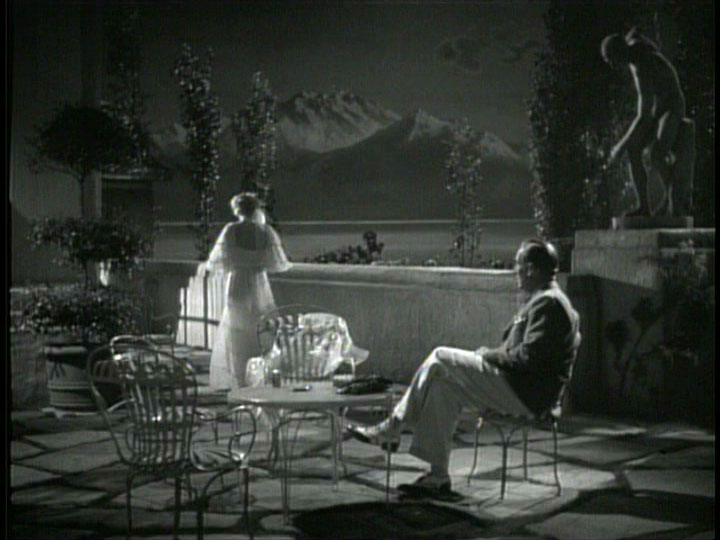
The Shanghai Gesture (Josef von Sternberg, 1941) So, what would happen if a film-stylist like Josef von Sternberg had directed a programmer like Casablanca? It would be a lot like The Shanghai Gesture (made a year before Ilsa walked into Rick's), with a disparate group of diaspora all gathered around a central community house—but, instead of Rick's Cafe Americain, it's Mother Gin-Sling's Casino, a casino of ill-repute that the Shanghai city-fathers (all white, all Brits) frequent with abandon, even while they're plotting to get rid of it ("I am shocked, SHOCKED that gambling is going on in this establishment!") The script is by von Sternberg, Gerza Herczeg, and Howard Hawks' scripter Jules Furthman, with emphasis on the smart-aleck remark, witty patter and easy irony.  The script is smart, the acting mannered (but in the von Sternberg manner of haughtiness and exaggeration for effect), and everything else from costuming, set design, and photographic style is elaborate.

Boris Leven's design for Mother Gin-Sling's Casino resembles a multi-level Pit of Hell
The men are von Sternberg's collection of stiffs, drones, and leering rakes (heck, von Sternberg turned Gary Cooper into one of the latter in Sahara). Walter Huston plays the stiff, a reforming developer who runs afoul of Mother Gin-Sling, while the latter is in the form of Victor Mature's "Dr. Omar," a Muslim "doctor of nothing," except one assumes, for a memorized expertise on "The Rubaiyat of Omar Khayyam."


The women are von Sternberg's complicated, well-lit archetypes, more devils than angels, the way he used Marlene Dietrich.  They had to do a lot of cleaning up of the original play by John Colton, resulting in a "coded" film that "suggested" what was really going on.*  The original location was a house of ill repute—a brothel (hinted at by the caged women ringing the casino's playing area, which, as designed by Boris Leven, looks like the Pit of Hell), the floosie (Phyllis Brooks) that Omar picks up in the street is a hooker, not a "dance-hall girl, in the play "Mother Gin-Sling" is named Mother Goddam, and the addiction the young thrill-seeker Gene Tierney plays isn't gambling (as in the film), but drugs, as suggested by her name "Poppy."  So, yes, a lot of self-censorshp, but sophisticated audiences could see through the veiled references to see what the issues were.


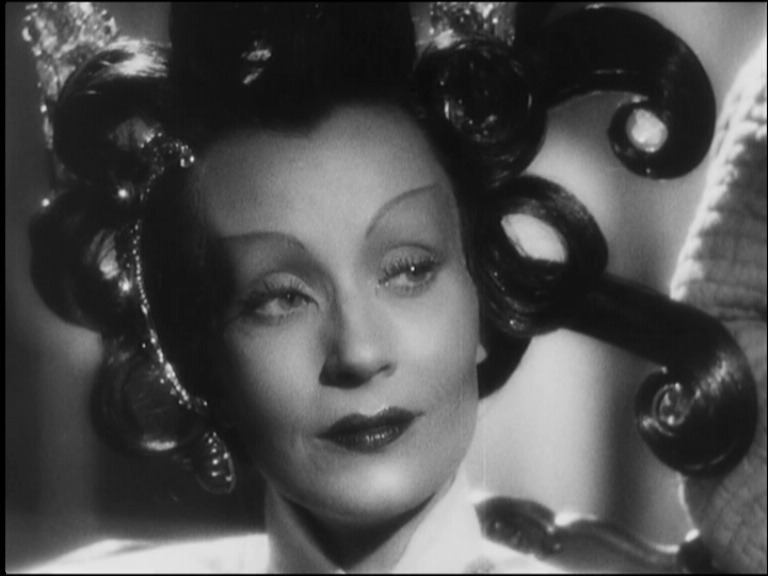
Von Sternberg was a stylist with an emphasis on glamor photography—his work with Dietrich is some of the most scrupulously accomplished shadow work in movies—and his capturing of Ona Munson, Brooks, and especially Tierney is a tightly controlled use of light to emphasize the contours of the face.  Munson's wild hair-styles suggest nothing so much as a medusa, and Tierney, once she slides down the slippery slope of..."too much gambling" begins, in her body language, is all broken doll, a marionette with some strings broken (something foreshadowed by von Sternberg early on)

Both Curtiz and von Sternberg had penchants for filling up the screen-frame, but Curtiz kept things naturalistic, with his performers squarely rooted in specific places.  Von Sternberg's close-ups are frequently floating heads, backed by a light pattern that has nothing to do with their surroundings.

But, that's where comparisons end: The Shanghai Gesture is a bizarre bazaar of weirdness, a combination of kitsch and creepiness, a glamorized descent into degradation and venality (beautifully shot, though!), with possibly the worst example of mother-love demonstrated on screen.  It is the dark side of entertainment, gussied up with glamor to make the proceedings seem tolerable, something that could be said for all of the work of von Sternberg, master of both light and darkness.


The Shanghai Gesture is also unique for giving a credit to the extras.


 * Furthman was great at that: in The Big Sleep he and Hawks suggested nymphomania by having the character suck her thumb.

Wednesday, July 4, 2012

Yankee Doodle Dandy

Yankee Doodle Dandy (Michael Curtiz, 1942) Of all the films in James Cagney's storied career, his favorite was his most unusual—not one of his gangster films (some of which revolted him) or his dramatic efforts, but this one, the one that won him his Best Actor Oscar, the musical biography (very loose) based on the life of George M. Cohan.  Cagney always described himself as "a hoofer," starting out as a dancer in vaudeville, and the athleticism did him well in Hollywood.  Cagney's energy, timing, and directness—his grace (even if he was playing a hood)—came from this background, and the compensatory toughness came from his growing up and observing the streets, providing "that unmistakable touch of the gutter," as he eloquently put it in his acceptance speech for the second AFI Lifetime Achievement Award.

Yankee Doodle Dandy begins with Cohan (Cagney) on Broadway playing Franklin Roosevelt in "I'd Rather Be Right" when he is summoned to the White House to receive the Congressional Gold Medal from FDR himself.  The visit gives him a chance to tell his life-story to the President, which is presented in flash-back form, from his early days to performing with his family (Walter Huston, Rosemary DeCamp, Jeanne Cagney) to the lean years when stubbornness gets him blackballed in the theater community, and he has to struggle back to the stage by song-writing,* eventually coming back and becoming the King of Broadway.

It's still startling to see Cagney's dance moves; loose, limber below the waste, and ramrod straight above, his movements alternate between drunken sloppiness that looks like it could severely snap tendons if gone wrong, and stiff-legged woodenness, giving the impression that he's a puppet with the strings cut—not really in control of his own movements (and, of course, he always was—that was the illusion of it all, the mastery of it), but compelled to dance for the sheer energy of it forced him to do so.  It's scary, but Cagney always is.  He is, after all, the guy who shoots people by pumping the pistol forward, as if the movement puts more energy in the bullet to kill faster, make it more definite, more personal.  His gangsters make the guns part of them, rather than just a tool.  

Some of the moves look archaic, compared with the gymnastics-as-dance school today—the leaping and bouncing off a wall (as if there wasn't enough room on stage) looks tame now, even though it amazed me as a kid, but the high kicks I appreciate more, the toe-steps, the tap—all amazing.  And they look spontaneous, which in itself is a marvel.*

It's a feel-good musical about celebrating the spirit of America, which we all do on the Fourth of July.  That it happened during war-time, added mightily to the propaganda potential of it (and, although it's always been denied, might've helped Cagney get rid of the "pinko" label he was being saddled with at the time—my, how times haven't changed).  But, it's a fine achievement, and Curtiz, who's known for hating unused space in a movie frame, overcrowds the stages—every theater-piece for this director was "SRO."  And, although something of an autocrat, with musicals he let loose the reins (something Cagney appreciated) and allowed spirit to flow.  Maybe that's why Yankee Doodle Dandy still seems fresh.


It was voted into the National Film Registry in 1993 for being "culturally, historically, and aesthetically significant."


* Cagney could relate.  He was constantly battling the Warner Brothers brass, at one point suing the production company and staying away.  Jack Warner called him "The Great Againster."

** Evidently Cohan's final tap down the White House staircase at the end, was improvised.

Tuesday, November 10, 2009

Dodsworth

"Dodsworth" (William Wyler, 1936) "Why are Americans always such snobs?" asks David Niven's snobbish Capt. Clyde Lockert.

Well, the answer is that there are two kinds of people in this world: people who lump people together with presumptive generalizations and those who don't. And the best place to lump people together is a cruise ship. Just ask
the captain of "The Love Boat."

Sinclair Lewis's 1929 novel about "us" and "them," maturity of age or the lack of it, and the pull and drag of greener pastures was adapted for the stage, and then film, by Sidney Howard and directed both times by William Wyler.

The tale of
two small-town empty-nestershe's a retired auto manufacturer looking for a new challenge, and she's looking for a long-desired European vacation among the sophisticates—is a long, slow sunset of ships passing in the night and the attraction of what has been missed. For Dodsworth (Walter Huston), the trip is an adventure, eye-opening in the possibilities of what the world has to offer. For his wife Fran (Ruth Chatterton), it is an opportunity to move among the elite, whose charm and manners are nothing like her folksy husband's. Eight years her elder, she resents him for making her appear older than she is to the new crowd with whom she seeks attention and company. Attempting to catch a youth-enhancing lightning in a bottle, she begins to have affairs behind his back, risking their marriage and future. The difference between the two after a long marriage with children is the difference between living a life and living a lie—embracing life or avoiding it.

It's a tough movie, even tougher coming as it does from the "speak your piece" 1930's, and it still hearkens to values and the lure of the new and glitzy—of those who jump into life with both feet, and those who choose to remain in the shallow end of the pool. And it's interesting to see a movie that not only focuses on "Can this marriage be saved", but "Should it?" It's amazing how contemporary and timeless "old" movies can be. Their wisdom is always showing up the less mature output of its antecedents.

Wyler's direction is unfussy, placing the camera where it can do the most good, and with a large cast roaming about
that usually means some deep-focus shots of the entire "stage." The cast alternates between good actors that you like and you want to slap (although given Huston's robust characterization, what woman wouldn't want a bit of her own limelight?) and the performances, though never vocally subtle—gotta pick up that dialogue!—are helped by the director's intricate lighting and camera placement.

And it's always worth checking out a movie with
Walter Huston or Mary Astor.

"
Dodsworth" became a part of the National Film Registry in 1990—among the second 25 films chosen—and Time Magazine voted it one of its 100 Greatest Movies of the 20th Century.

Sunday, February 3, 2008

The Devil and Daniel Webster

The Devil and Daniel Webster (William Dieterle, 1941) I've known about this film for years, because it was the film that won Bernard Herrmann his only Oscar for Best Score, over his other score that year, "Citizen Kane." It's had a checkered history, though, after a less than blockbuster business it was cut by 20 minutes and released with a sexier, less folksy ad campaign (see right) under the name "All That Money Can Buy," which seems to celebrate the profilgate life-style, rather than the altruistic, socialist one espoused by the film. It seems that Jabez Stone only really finds redemption until he's joined the Grange. I may be revealing the ending here, but, really, the outcome is inevitable considering the extraordinarily heavy hand that is used to show the tyrannies of wealth, lust, and greed that are the by-products of selling your soul to the Devil. Fortunately, the great orator Daniel Webster is around to plead the case for the defense when a breach of contract occurs. Usually these scenes are the highlights, but in this film it's a disappointment. Even though played vigorously (by the least likely actor, Edward Arnold, well-known for playing power-brokers and fascists in many a movie) the Webster homilies that are spun are so much sentimental goo and would curl the lip of Aimee Semple McPherson, much less the hardened denizens of Hell that make up the jury in the matter. Even Frank Capra must have rolled his eyes. But Dieterle seems to have shurked those sections to go all-out for his scenes with The Devil. Mr. Scratch's entrances are extravaganzas with light and smoke, he has the best lines (of course), and a truly creepy performance by Walter Huston (John's dad) with maliciously twinkling eyes, and a smile that's so broad that it may turn feral at any moment. Huston is the thing to see in this film, although Jane Darwell (Ma Joad from "The Grapes of Wrath") and Simone Simon (just before she became big with "Cat-People") do wonders with their material as well.

And Then There Were None

And Then There Were None (René Clair, 1945) Agatha Christie's classic (despite its racist name "Ten Little Indians" or its even more racist original name!) about a collection of disparate people gathered in a remote location and then picked off one by one is a staple of the mystery format. It's been directly adapted for the screen no less than nine times, and homaged endlessly on television (I can recall variations on "The Avengers" and "The Twilight Zone") as well as Neil Simon's encyclopedic send-up of the mystery genre "Murder By Death." This one precedes them all, and is probably the best of the bunch. With an all-star cast (for the 30's) and the nimble direction of René Clair (sadly unacknowldged these days, but he was a crafty film-maker--check out the sequence where some suspicious males start to eaves-drop on each other for clues that is as witty as it is intriguing) this adaptation of Christie's play (with an ending amended by Christie to make it more of a crowd-pleaser) is a fine study of upper class paranoia, with stand-out performances by Barry Fitzgerald, Walter Huston, Dame Judith Anderson and Mischa Auer.