Showing posts with label William Dieterle. Show all posts

Saturday, June 22, 2013

Satan Met a Lady

Satan Met a Lady (William Dieterle, 1937) Warners' second adaptation of Dashiell Hammett's "The Maltese Falcoln" done with a much freer hand and less devotion to the source novel.

When confronted with the Hays Office crackdown on lascivious content in movies, Warner Bros. found a lot of their catalog unreleasable for re-issues.  In the short term, they solved the problem by judicious cuts in audience favorites and by creating revamped versions of past product.  A new "Maltese Falcon" was put in production a scant five years after the first's release.  In the interim, another Hammett property had scored big at the box office; The Thin Man with William Powell and Myrna Loy had proven a sensation, and since nothings exceeds like success, "The Maltese Falcon" was freely adapted to be more in line with what worked with The Thin Man, more comedy and an emphasis on glamour and the high life.  So, Sam Spade became detective Ted Shane, as played by Warren William, a stetson-wearing rake, seen at the start of the film as being run out of town by some city-fathers and returning to his old haunts and old job at a detective agency in San Francisco.  Among his first clients is Valerie Purvis (Bette Davis) who warns of being tracked by a dangerous man, and before long, Shane's detective-partner (Porter Hall) is killed and the story begins anew.


Same story but, like Hammett's detective, the characters are significantly altered, if the track of story-line still stays basically the same.  Take, for example, Joel Cairo who is transformed into a stuffy Brit played by Arthur Treacher (rather than fisticuffs, Shane and the character do some jolly breakage in Shane's apartment); Kaspar Gutman is Madame—note thatMadame Barabbas (Alison Skipworth), and Wilmer is a thick gunman named Kenneth (Maynard Holmes), whom she dotes on, and Effie Perrine, the Spade and Archer receptionist is Miss Murgatroyd (Marie Wilson), the epitome of a dumb blonde.  And the falcon?  It's now the legendary horn of Roland.  The whole debacle is treated as farce, with more interest in having a good time than actually acquiring the MacGuffin.


The film is directed by William Dieterle, one of Warners' prestige directors, having already directed their all-star version of A Midsummer's Night's Dream in 1935, and who would go on to direct the multi-Oscar winner The Life of Emile Zola, The Devil and Daniel Webster, and projects for David O. Selznick.  He keeps everything moving breezily for awhile, but the movie stops dead at the end with an exposition scene that makes up for lost dialogue and movie-time (the Huston version, four years later—the only one where the male lead is top-billed—has the same issue, but it's part and parcel of the drama).  Davis was so dismissive of the script that she stayed away from filming for three days, hoping to be taken off the job, in favor of the more serious, prestigious roles which she favored.


Satan Met a Lady probably did not need a falcon, as, by itself, it is one strange bird.  With its detective that is anything but private and sticks out like a sore thumb, its eccentric cross-gendering to appease the Catholics, and its game of "Who's got the horn," it does no justice to the source novel or the other Hammett adaptation its trying to ape.  Five years later, John Huston, hot from his scripting duties for Warners (including Dieterle's Dr. Ehrlich's Magic Bullet) would take the property with another Warners B-player in the lead, and stay true to the novel by scratching awy at the layers of lacquer demanded by the studio, to find the gold underneath. 


William and Davis not seeing eye to eye

Saturday, October 17, 2009

Elephant Walk

"Elephant Walk" (William Dieterle, 1954) There are days...and movies...where you just want to say "this is just really bad," and be done with it. On to the next show with hope and a fresh perspective and a renewed realization of just how good cinema can be by seeing it...in its failings.

"
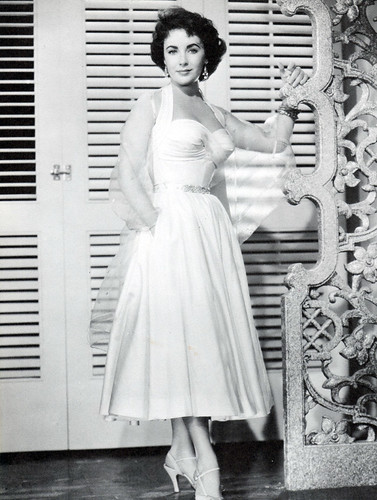
Elephant Walk" was a "programmer." A fiction property with clamored-for stars and an exotic location (Ceylon, now Sri Lanka) that probably made it to the top of a double-bill (when so many classic films were always relegated to the red-headed step-child "second feature"). Translating it to cinema, though, takes whatever might have been of value in the details, and splays out its derivative nature 100 feet across. This one's basically "Rebecca" crossed with "Moby-Dick"--an ingenue, Ruth (the glowing Elizabeth Taylor, newly mature) marries a rich businessman and travels with him to his estate (Manderley in "Rebecca," "Elephant Walk," here) where the new locale and the strange customs and a mysterious past make her an outsider when she should be at her happiest. And the Maxim DeWinter of this story is a cad; John Wiley (Peter Finch, who sounds eerily Burton-esque on occasion) runs an imperial tea facility, and the estate sits smack-dab in the middle of an elephant trail to a migratory watering hole. The elephants are pissed about it, of course and, led by a particularly aggressive bull, make regular attempts to cross through the property, always pushed away by the Ceylonese servants keeping "Elephant Walk" running. John is Ahab here, his obsession with the bull tearing away the veneer of civility that Ruth fell in love with. And "Elephant Walk" has all the spacious sterility of a James Bond villain's lair.

To cement the "
Rebecca" ties, there is a vaguely threatening servant (Abraham Sofaer) who objects to the new mistress butting into things, and there's a locked room that she is not allowed to enter. Ruth, however, is more of a spit-fire than "Rebecca's" shrinking violet, and soon there are purple-tinged daggers flying from her eyes.

Oh, and toss in a little of "
The Painted Veil," as well. One of Wiley's workers, Dick Carver (Dana Andrews) is attracted to the new Mrs. Wiley, to the point where she seeks him out as an alternative to her cold husband. As if that isn't enough conflict with the stampeding elephants and the stampeding hormones, there's a cholera epidemic and a crop-threatening delay in the monsoon season, leaving everyone high and dry.

There's plenty of photographic evidence that Finch and Andrews made the trip to Ceylon, but it's evident that
Taylor never set foot outside of Los Angeles, fully a third of her performance being performed by doubles for the long shots and the stunts*—the latter comes to the fore with the inevitable laying waste of "Elephant Walk"...by elephants. The sequences of Taylor's double being chased around the sets, and shoved around on ornate staircases, by trained pachyderms has a high camp zeal that dissolves all the drama in fits of delirious giggles.** Maybe it was the cholera speaking.

* One should always research the history of a film before writing about it, but for a sorry strip of celluloid like this, research might evoke a bile-blocking sympathy not unlike the elephant-walls surrounding John Wylie's nature-defying manor. My bad. Here's the story: The reason Taylor is never seen in Ceylon is that Vivien Leigh was playing the role. Although it was shaped and initially cast for Taylor, a pregnancy forced her out of of the role, and Leigh started the filming in Ceylon, but bowed out due to her bi-polar disorder (and that's her in some of the long shots) as well as a rumored affair-gone-badly with Finch. That might have been avoided if the original casting had kicked in: Laurence Olivier as Wylie ("Rebecca" again...Olivier played Maxim DeWinter in Hitchcock's film) who was still attached to the film when Leigh was cast—a natural for the married thespians—but Olivier dropped out due to a scheduling conflict.

** According to the Wikipedia article on it, Leonard Maltin makes one of his rare slams of a movie reviewing "Elephant Walk:" "Pachyderm stampede climax comes none too soon."

Sunday, February 3, 2008

The Devil and Daniel Webster

The Devil and Daniel Webster (William Dieterle, 1941) I've known about this film for years, because it was the film that won Bernard Herrmann his only Oscar for Best Score, over his other score that year, "Citizen Kane." It's had a checkered history, though, after a less than blockbuster business it was cut by 20 minutes and released with a sexier, less folksy ad campaign (see right) under the name "All That Money Can Buy," which seems to celebrate the profilgate life-style, rather than the altruistic, socialist one espoused by the film. It seems that Jabez Stone only really finds redemption until he's joined the Grange. I may be revealing the ending here, but, really, the outcome is inevitable considering the extraordinarily heavy hand that is used to show the tyrannies of wealth, lust, and greed that are the by-products of selling your soul to the Devil. Fortunately, the great orator Daniel Webster is around to plead the case for the defense when a breach of contract occurs. Usually these scenes are the highlights, but in this film it's a disappointment. Even though played vigorously (by the least likely actor, Edward Arnold, well-known for playing power-brokers and fascists in many a movie) the Webster homilies that are spun are so much sentimental goo and would curl the lip of Aimee Semple McPherson, much less the hardened denizens of Hell that make up the jury in the matter. Even Frank Capra must have rolled his eyes. But Dieterle seems to have shurked those sections to go all-out for his scenes with The Devil. Mr. Scratch's entrances are extravaganzas with light and smoke, he has the best lines (of course), and a truly creepy performance by Walter Huston (John's dad) with maliciously twinkling eyes, and a smile that's so broad that it may turn feral at any moment. Huston is the thing to see in this film, although Jane Darwell (Ma Joad from "The Grapes of Wrath") and Simone Simon (just before she became big with "Cat-People") do wonders with their material as well.