Showing posts with label Bette Davis. Show all posts

Saturday, June 22, 2013

Satan Met a Lady

Satan Met a Lady (William Dieterle, 1937) Warners' second adaptation of Dashiell Hammett's "The Maltese Falcoln" done with a much freer hand and less devotion to the source novel.

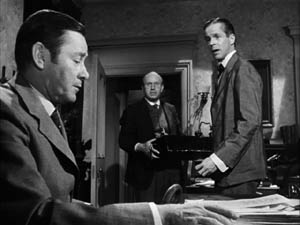
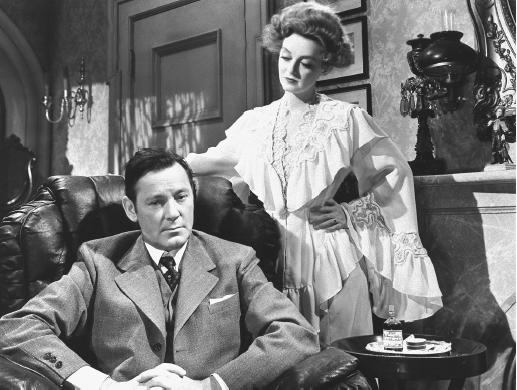
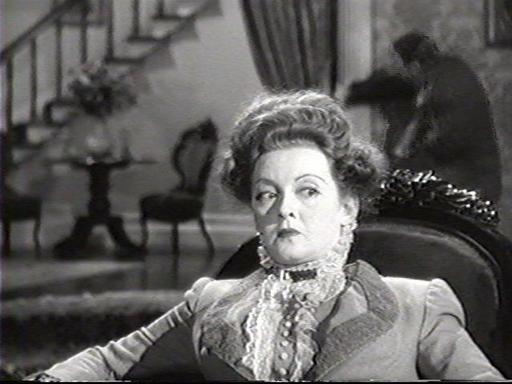
When confronted with the Hays Office crackdown on lascivious content in movies, Warner Bros. found a lot of their catalog unreleasable for re-issues.  In the short term, they solved the problem by judicious cuts in audience favorites and by creating revamped versions of past product.  A new "Maltese Falcon" was put in production a scant five years after the first's release.  In the interim, another Hammett property had scored big at the box office; The Thin Man with William Powell and Myrna Loy had proven a sensation, and since nothings exceeds like success, "The Maltese Falcon" was freely adapted to be more in line with what worked with The Thin Man, more comedy and an emphasis on glamour and the high life.  So, Sam Spade became detective Ted Shane, as played by Warren William, a stetson-wearing rake, seen at the start of the film as being run out of town by some city-fathers and returning to his old haunts and old job at a detective agency in San Francisco.  Among his first clients is Valerie Purvis (Bette Davis) who warns of being tracked by a dangerous man, and before long, Shane's detective-partner (Porter Hall) is killed and the story begins anew.


Same story but, like Hammett's detective, the characters are significantly altered, if the track of story-line still stays basically the same.  Take, for example, Joel Cairo who is transformed into a stuffy Brit played by Arthur Treacher (rather than fisticuffs, Shane and the character do some jolly breakage in Shane's apartment); Kaspar Gutman is Madame—note thatMadame Barabbas (Alison Skipworth), and Wilmer is a thick gunman named Kenneth (Maynard Holmes), whom she dotes on, and Effie Perrine, the Spade and Archer receptionist is Miss Murgatroyd (Marie Wilson), the epitome of a dumb blonde.  And the falcon?  It's now the legendary horn of Roland.  The whole debacle is treated as farce, with more interest in having a good time than actually acquiring the MacGuffin.


The film is directed by William Dieterle, one of Warners' prestige directors, having already directed their all-star version of A Midsummer's Night's Dream in 1935, and who would go on to direct the multi-Oscar winner The Life of Emile Zola, The Devil and Daniel Webster, and projects for David O. Selznick.  He keeps everything moving breezily for awhile, but the movie stops dead at the end with an exposition scene that makes up for lost dialogue and movie-time (the Huston version, four years later—the only one where the male lead is top-billed—has the same issue, but it's part and parcel of the drama).  Davis was so dismissive of the script that she stayed away from filming for three days, hoping to be taken off the job, in favor of the more serious, prestigious roles which she favored.


Satan Met a Lady probably did not need a falcon, as, by itself, it is one strange bird.  With its detective that is anything but private and sticks out like a sore thumb, its eccentric cross-gendering to appease the Catholics, and its game of "Who's got the horn," it does no justice to the source novel or the other Hammett adaptation its trying to ape.  Five years later, John Huston, hot from his scripting duties for Warners (including Dieterle's Dr. Ehrlich's Magic Bullet) would take the property with another Warners B-player in the lead, and stay true to the novel by scratching awy at the layers of lacquer demanded by the studio, to find the gold underneath. 


William and Davis not seeing eye to eye

Tuesday, April 28, 2009

The Little Foxes

"The Little Foxes" (William Wyler, 1941) This is a good one (and thanks go to MGM's "This TV" network for digging it up)-a "feel bad" play as only Lillian Hellman could cook it up (adapted by her for the screenplay and aided by Hellman cronies and Dorothy Parker), it is basically the play as staged in 1939, featuring the same cast with four notable exceptions: Teresa Wright (her first film) as ingenue Alexandra Giddens, Richard Carlson as a potential beau and a playing-field-evening "good" man, Herbert Marshall as the sickly father Horace Giddens, and as the bitch-mother from Hell, Bette Davis. She's the only female in the avaricious Hubbard clan in the turn of the century South, where every thought and relationship is geared towards more wealth and power. There is some good among the vipers but all subject to being poisoned by the venom--Aunt Birdie (Patricia Collinge), married for her land and now abused and alcoholic, daughter Alexandra who has managed to survive with a conscience, Horace, the weak, dying father who has escaped to save his life and whose fortune the plot revolves around, and the servants, symbols of the subjugation in which the Hubbards hold their world.

The scenes of Carlson and Wright are designed to bring a ray of hope to this clutch of venal graspers, and a way out for the vulnerable Alexandra, whose life could be ground in the gears of the Hubbards' plan, just as surely as if she was the cotton in the very mill they're trying to finance illegally. It brings more of a balance to the play where she and the saintly (but weak) Horace are the only trace of decency with power.

And the credits are staggering: Hellman would later scratch out preachy screeds, but she's at the heighth of her gifts here (with the levening of Parker,
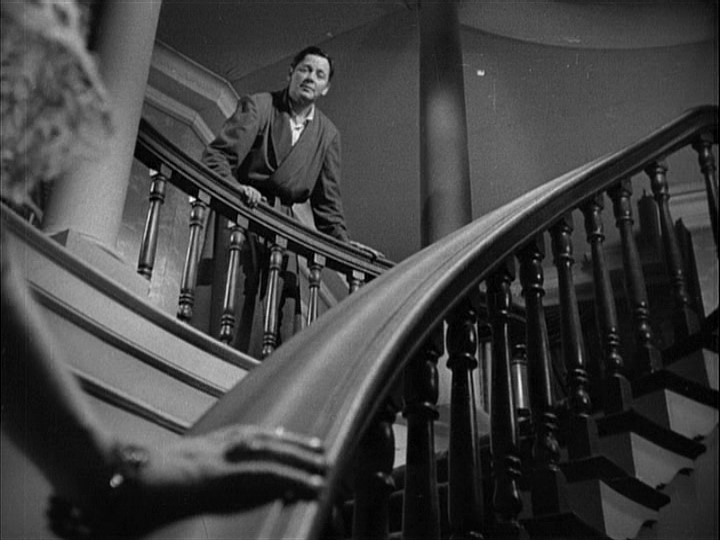
Arthur Kober, and Alan Campbell). William Wyler's direction is never, ever natural, but very inventively staged, and he's aided by one of the most innovative and creative of cinematographers Gregg Toland, the two men bringing out the best in each other (and the score is provided by Meredith Willson, creator of "The Music Man"). This would be the last collaboration between Wyler and his star of choice, Bette Davis—the two had a falling out during this film. Not that you can tell, Wyler is Davis' best co-conspirator, designing shots that evoke her mood and thinking. In a pivotal scene, he keeps Davis in close-up while dramatic events are happening behind her, her head swivelling in the exact opposite way from where the events are occurring, like she's watching with eyes in the back of her head. It's already an eerie, black-hearted scene, but Wyler keeps the focus on Davis' Regina Hubbard (literally, this is one shot where the background is out of focus) in her deliberate sins of omission, making the scene extremely theatrical, while exploiting the virtues of the cinema.

You don't hear about this movie much—it's barely mentioned at
the official Wyler web-site. But it's a must-see, as a lesson in filming a play effectively, in a superb presentation, and with top-notch performances perfected on-stage and buffered for the screen.

Friday, February 27, 2009

Olde Review: All About Eve

This was part of a series of reviews of the ASUW Film series back in the '70's. Except for some punctuation, I haven't changed anything from the way it was presented, giving the snarky, clueless kid I was back in the '70's a break. Any stray thoughts and updates I've included with the inevitable asterisked post-scripts.

This is a companion piece to "Sunset Boulevard."

"All About Eve" (Joseph L. Mankiewicz 1950) "All About Eve" is not unlike "Sunset Boulevard." It deals with the lust for glamour in show business—in this case, the theater in New York, not the neighborhoods of studios in Hollywood. It, too, was made in 1950, its female characters, for the most part, actresses, are...uh, abnormal. And it, too, is biting, but places its knives-in-the-back in a ci-vi-lized manner, and twists it...delicately...not with Wilder's carving techniques.

What we have is
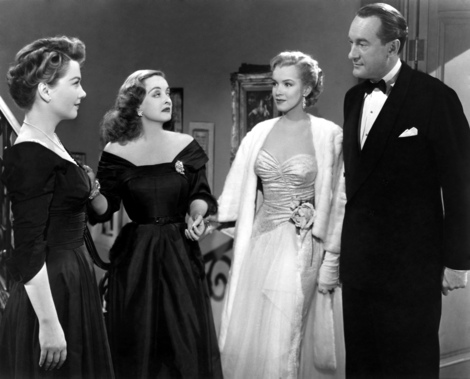
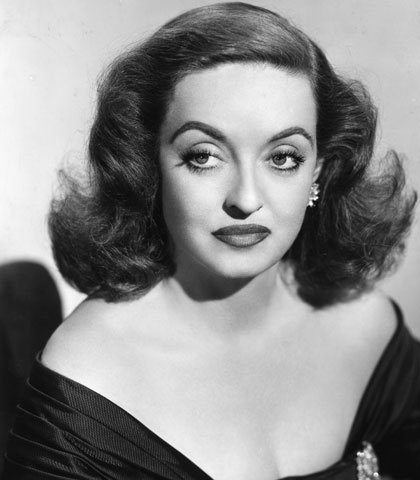
Bette Davis as Margot Channing, a spoiled child-actress, now on the shady side of 40, but still playing ingenue roles. What we have is Anne Baxter as Eve Harrington, a young ingenue who gazes adoringly at her idol, Margo Channing. What we have is Addison DeWitt (played by George Sanders as drily as a total-vermouth martini), the chief stiletto of the critical press, but you've also got Gary Merrill, Celeste Holm, Thelma Ritter, (and, in a very brief role, Marilyn Monroe) in a highly literate script which gives almost everyone some role they can sink, or cut, their acting teeth on, in a story that has "everything but the blood-hounds snapping at their rear end" (and, in a way, that happens, too.)

You see, we meet all these people as
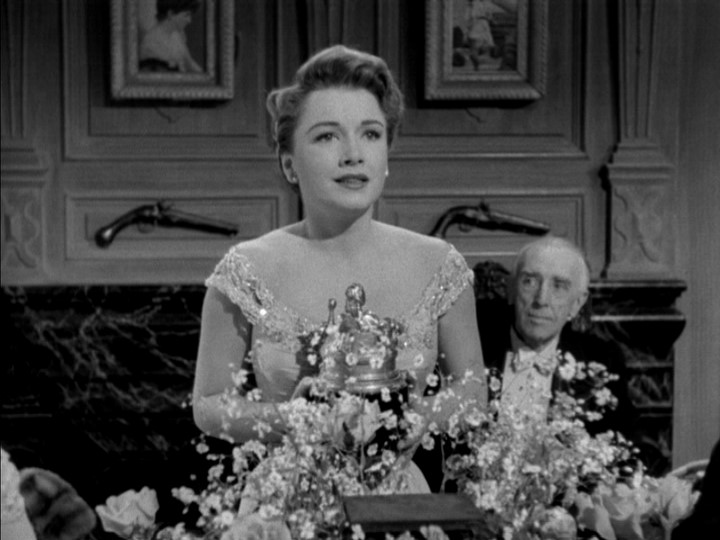
Eve is receiving the Sarah Siddon Award for Best Stage Performance of the Year. A joyous occasion for everyone, right? The very young actress gets a big break—everyone's happy, right?

No, the principal characters are either looking embarrassed, wonderingly perplexed, mad, or just cold to the event. It's flashback time to see why such a double-reaction to the prestigious theater event. And in a "Citizen Kane-switch," one flashback is narrated in turn by several people. And we are through this told "
All About Eve"...but also Margo, Addison, everybody. Everybody's soul is laid bare through the dialogue and the quirks and pops of the performances of the cast. It's a thoroughly entertaining two and a half hours, and its light cynicism will take of the staleness of "Sunset Boulevard" out of your mouth. It will do that, but will hardly make hopeful young starlets complacent.

Broadcast on KCMU-FM on February 3-4th, 1976

I still love this movie and I find it invaluable as a source for great lines. Go ahead. Go to the IMDB listing for "All About Eve" (all you have to do is click on the name at the head of the review*) and go to "Memorable Quotes." There's at least a couple pages of them. All smart, literate and bitchy. I used one in January 2009, as a sub-head for the blog-title (Addison DeWitt's non-self-deprecating "While you're waiting you can read my column. It'll make the minutes fly like hours." Only he could say that about himself--everybody else would be cut down for a remark like that, sort of like only Nixon being able to go to China.) Another favorite of mine is in this olde review: "Wow. Everything but the blood-hounds snappin' at her rear-end" as expressed by the inimitable Thelma Ritter. There's one involving Marilyn Monroe's hungry starlet, Miss Casswell, as she enters a theater-party. She scans the room looking at the producers: "Why do they all look like unhappy rabbits?" DeWitt leans in and confides: "...because they are." Smart. Literate. Bitchy.

And curiously old-fashioned. One doesn't get too far in that list before it comes to the Margo Channing monologue about the value of her life—a speech that always made me uncomfortable: "Funny business, a woman's career - the things you drop on your way up the ladder so you can move faster. You forget you'll need them again when you get back to being a woman. That's one career all females have in common, whether we like it or not: being a woman. Sooner or later, we've got to work at it, no matter how many other careers we've had or wanted. And in the last analysis, nothing's any good unless you can look up just before dinner or turn around in bed, and there he is. Without that, you're not a woman. You're something with a French provincial office or a book full of clippings, but you're not a woman. Slow curtain, the end."

Oh, really! Pretty prosaic for a smart script. Even though this was written in the late 1940's, it still rankles a bit unless you're, say, Anita Bryant.
There's also the way Addison DeWitt and Eve Harrington come across as asexual monsters for whom career is everything and a "normal" lifestyle is to be shunned and mocked.** Being a careerist is a bad thing in "All About Eve." Chasing after love, whether you're good at it or not is the holiest of holies. As I said, this was written in the 40's. One of my favorite quotes from 2008 is Richard Dreyfuss' one about being directed by Oliver Stone in "W.": "You can be a liberal and still be a fascist." Just as you can be smart, literate, and bitchy, and still come across like a schoolma'rm.

"All About Eve" was one of the first films to be made part of The National Film Registry.

It has a "100% Rating" on the Rotten Tomatoes site. Can't do better than that.

* That would be the start. It's an old habit of mine to think interms of "reels." The "head" is the start, and the "tail" is the finish, or the part that tucked into the reel's hub.

** The wikipedia article on "All About Eve" suggests that Addison and Eve are gay, thus making their aberrant behavior a result of their sexuality. "Okay, but whatever you do, don't tell Chuck."