Showing posts with label Best Picture. Show all posts

Thursday, November 1, 2012

Argo

Hoo-Ray for Hollywood (grumble)
or
The Best Bad Idea We Have...By Far

The 1979-1981 Iranian hostage crisis, the 444 day ordeal of the American Embassy workers captured and held by a well-organized angry mob (funny how those angry mobs in the Middle East have a sustainable infrastructure that can keep the ball...and the U.S...in the air for over a year), was an event that gave us our first taste of extremist Muslim terrorism and the presidency of Ronald Reagan (Way to go, Iran!  Can't wait to see the inadvertent fallout from your nuclear program!).

One of the back-stories of the whole magilla was what became known as "The Canadian Caper," where six of the workers walked out of the Embassy and stayed at the Canadian ambassador's residence for a nice chunk of the crisis and managed to fly home  under the noses of the cracked-down Iranian security thugacracy.  What was not known was that the operation to extricate those workers—on the QT, hush-hush, and only recently declassified—was the work of the very agency that was being blamed for the Shah's presence in the first place*—the CIA.

The story of the very weird "Mission: Impossible"-styled rescue is told in Argo, the third film to be directed by Ben Affleck (after Gone Baby Gone and The Town) and it's his most assured movie to date.  It's also his safest and least nuanced.  Maybe the story is so bizarre, so full of dangerously easy irony and satire, that the director in Affleck felt the need to tone things down on his style (much the same way that Affleck the actor does here, as well, in his performance as CIA advisor Tony Mendez) and just "stick to the facts" and get his recreations down right (there's enough pride in this that the end-credits show a split-screen of archive footage and movie film footage to prove the point), thinking he'd be guilty of "gilding the lily" or even undermining it by...I don't know...showing any "style," other than switching film-stocks and shooting in a "found-footage" way of snatch-and-grab.  And yet, were that true, the film might have had a far more different ending, rather than the one Argo actually presents.  It would have been nice to throw in some of Affleck's previous shooting ingenuity, rather than create the dichotomy that Argo ultimately presents.

It is a story that captures the imagination.  Six of the American embassy workers in Tehran manage to hole up at the residence of the Canadian ambassador, but time is of the essence as the Iranian guard are closing in on their location after carefully piecing together intel from the embassy.  The wonks at the State department and CIA try to come up with a scenario that might get the workers over the border—bicycles—but Mendez is skeptical of putting the six out in the open for a "casual" bike trip of a couple hundred miles.  Mendez's scheme (hatched after a viewing of a "Planet of the Apes" movie) hides them in plain sight—have them pose as a scouting group for a sci-fi movie that needs a desert location (like, say, Iran) and have the group (who have appeared out of nowhere) just fly out under those assumed roles and identities working on a project viable enough to be fact-checked at the time of departure.

So, Mendez recruits an industry friend, John Chambers (John Goodman), who has done extensive make-up and prosthetics work for the CIA and the Army (as well as winning an Oscar for his monkey-faces on those "Planet of the Apes" movies) to start a project that has enough publicity splash to make it all the way to Iran. A producer, Lester Siegel (a fabrication and played by the masterful Alan Arkin), is recruited to lend industry cred and get the word out to the press, allowing Mendez to fly to Tehran to train the hostages on their roles, synchronize watches, and sweat the details, which are many and widely scattered.

The idea is so crazy and "out there" that it "just could work."  The beauty of it is that it did,  but not quite in the way Affleck and scripter Chris Terrio would have us believe.  In fact, the final "ex-filtration" is so nested with complications and roadblocks—and a seeming need to fulfill some perceived action quotient—that it becomes frustratingly conventional in a "Hollywood" sense. 

This is slightly gear-grinding.  By now, we should be so used to The Movies' need to dramatically enhance actual events, that it shouldn't come as a surprise that some fact-tinkering is involved.  But, Affleck's film is so cynical of Tinseltown tampering,** that it's a little cake-eating to then rely on such notions for a white-knuckle finale, as the actual situation is tense enough without having to also (oh, I don't know) stage a gunfight on the sinking Titanic.  And it strains credulity that at each checkpoint on the way out, everything must come down to the wire, in the very nick of time...every...single...time.  I mean, didn't anything go right on this mission? Sure, the whole thing was a "Hail Mary" pass, but some of the planning had to have come off.  The story had a genuine happy ending.  Did it have to be The Ultimate Happy Ending?

Maybe the election year has got my fact-checker in overdrive, because up until then, Argo is a measured, understated, restrained, almost bloodless film, that manages to be smart, clever, and tense.  And while there's very little of the flair displayed in his first two films, it is a fine example of Affleck's impeccable sense in casting (although—quibbling again—he might have had someone genuinely Latino to play Mendez), and having the great good sense of staying out of his actors' way.

It might not be Affleck's best work to date, but for all that could have gone wrong, the results are quite impressive.  Hmm.  Maybe art does imitate life.

Argo is a Matinee.


The "Canadian Caper" embassy workers with President Carter


Argo concept art, created by comics veteran Jack Kirby

* The movie gives some back-story but is a little cagey in what it leaves out.  The CIA "coup" deplaced the democratically elected Persian prime minister Mossadegh who had the affrontery to nationalize the Iranian oil industry (pissing off the British) and flirting with communists (pissing off the Americans) and returned the Shah, who'd only fled the country fearing a communist take-over, to power.

** There are more zingers at the expense of the film industry than any movie since Altman's The Player.  My favorite: "We're going to make a movie in the most desolate, dangerous, paranoid place on Earth." "Universal City?"

Friday, September 16, 2011

The Hurt Locker

This week, we're re-publishing some reviews of the films from the post 9-11 environment.


Moonwalking Through the Kill-Zone
or
"Cravin' a burger. Isn't that strange?"


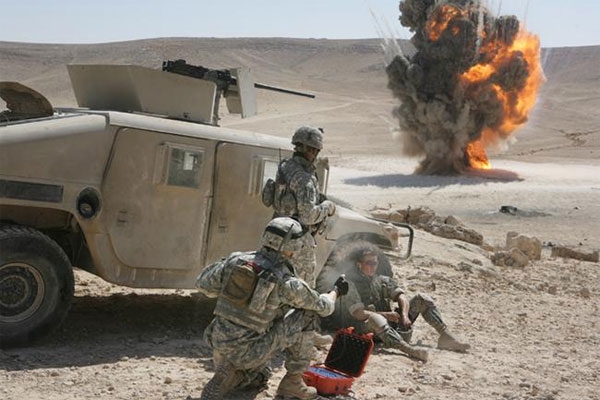
A lone figure walks down an alien landscape in a space-suit of Kevlar and crash-helmet, his only companions are his breath and his thoughts. Death surrounds him, and he walks towards the only certain death he knows of: a make-shift explosive device, conceived in cunning and hate that he must dis-arm in order to save himself, his comrades, and the watching by-standers, one of whom just might be waiting to explode the device. It is not some forbidden planet, or an anarchic Western town, but it could be. It's downtown Iraq, and it comes down to one man walking and facing his fear.Kathryn Bigelow will probably never be considered a "superstar" director.

That's too bad, because she miles ahead of the so-called "young Turks" doing action movies these days. Instead of following current trends, she adheres to the rock-solid action direction styles of
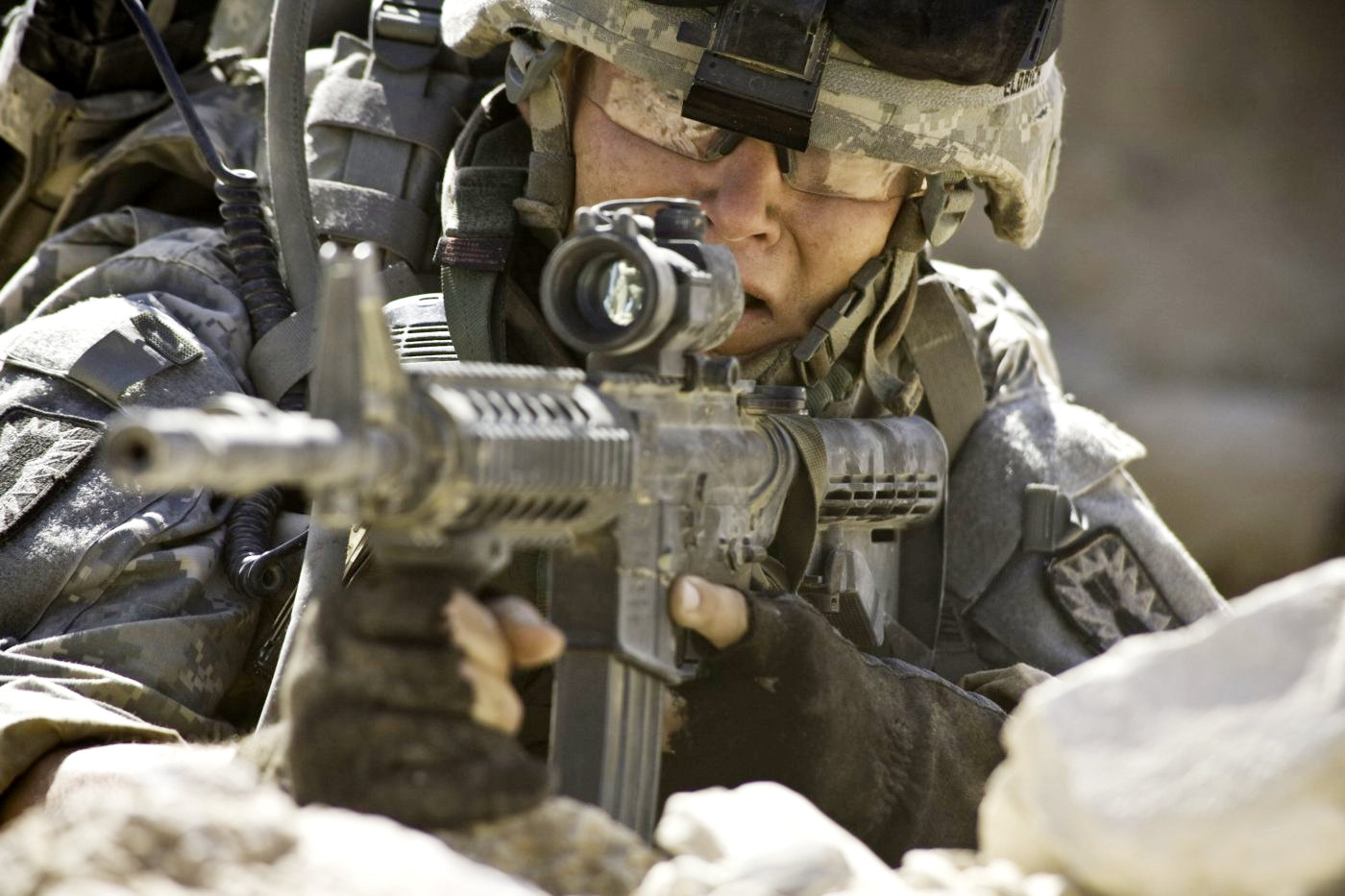
Anthony Mann and Don Siegel: let the audience know what's going on, and one other thing that too many directors these days forget—an audience has to know the territory their heroes walk through to fully present the dangers they face. In The Hurt Locker she may use a hand-held camera a bit too much to re-create the verisimilitude of war-footage, but it comes in handy to lock you into the searching point-of-view of Bravo Company's of Bomb "Tech's" and "Post-Bomb Assessors"—"The Blasters"—in Iraq's Camp Freedom ("They changed it from Camp Liberty to Camp Freedom because Camp Freedom sounds better," says veteran Sergeant JT Sanborn (Anthony Mackie) to the new Team Leader Staff Sergeant William James (Jeremy Renner, looking like a cross between Nathan Fillion and Brendan Fraser, like most of the principals of "The Hurt Locker," his performance is understated and full of small nuances). James is described as "a rowdy boy" and "reckless." Before his arrival, "the suit," that cumbersome Kevlar get-up which would protect anyone but the man who needs it most, has been the last resort in a disarmament situation. But that's not good enough for James. He likes to disarm the things by hand, and collect the odd bit of equipment for a trophy that "could have killed" him. He'll go in with "the suit" first, and puzzle the thing out, something that doesn't win him prizes with his team-mates, especially Specialist Eldridge (Brian Geraghty), because the longer it takes James to disarm a bomb, the more vulnerable his team-mates are to snipers.

It doesn't take long for the team to realize that James loves his work a little too much, and that it may kill them before their tour is up. Bigelow keeps a running track of the "
short-timer" count-down as the situations become more dire and the traps more intricate, electronically and ethically.

War films have gone through a weird evolution from the time they were conscious enough to move beyond the "good guys vs. bad guys" (while still acknowledging that both sides share their share of casualties. But it's been since the Korean conflict that movies started to go deeper into the psychosis of war—not the PTSD issues, but the psychosis of being inside the conflict. One of the counselors at Camp Freedom ineffectually tells Eldridge "You know, this doesn't have to be a bad time in your life." Easy for him to say. All Eldridge can think about is the best outcome of the war—surviving it. And when his orders come down to "Be smart. Make a good decision" it's tough to say what is a good day and what is a bad day. But lately, war-films have taken a look at the man on the line and what makes a good soldier, and it comes down to a blurred combination of self-sacrifice and controlled psychopathy. Whatever the motivations its the results that count. We've seen that theme in Hell is For Heroes, and Patton, Apocalypse Now, The Burmese Harp, Full Metal Jacket, and Flags of Our Fathers. How the soldier compartmentalizes the war experience to survive and even stay sane through the fire determines his ultimate worth as a soldier and as a human being. It is that perspective, of life is brief increments, that keeps a soldier walking alone in The Now, where "The Big Picture" is unseen in the limited view of his path, unknowable and brutally finite—the past a bitter memory, the future an empty promise, and today is walked with the high of High Noon.

The Hurt Locker is a Full-Price Ticket.


Tuesday, April 26, 2011

The French Connection

The French Connection (William Friedkin, 1971) Peripatetic police thriller with discernible street-grit in the film-emulsion, The French Connection, adapted freely from Robin Cook's "True Crime" book, tells the story of two New York police detectives Eddie "Popeye" Doyle and Buddy Russo (Gene Hackman and Roy Scheider, playing the noms de film of real-life detectives Eddie Egan and "Sonny" Grosso) tracking a high-level cocaine operation from overseas. 

The French Connection won the Best Picture Oscar, which seems like a good choice until you realize it was in contention with A Clockwork Orange and The Last Picture Show (as were Fiddler on the Roof and Nicholas and Alexandra).*  Then, the choice feels as safe and conservative as can be.  Yes, it's gritty.  Yes, it's "edgy," but does it have anything to say, besides that sometimes the good guys have to be rough with the bad guys in order to break even on the law and order scales, and that outlaws have an easier time of it simply because they're outlaws, bending the rules?

Not really.  But The French Connection did take police procedurals in another direction.**  The cops were less formal in their attire and language, and tougher in their asking questions.   Friedkin took a near-documentary approach to the subject matter (with the help of Owen Roizman's inelegant constantly searching subjective cinematography), while conveying the frustration that cops, though maybe not crossing the "T's" and dotting the "i's" on the letter of the law, go through to try to achieve a legitimate, legally-binding collar.  One is left with a morally ambiguous ending in which lines are crossed to merely achieve a semi-positive result, as opposed to the greater good.

And everyone remembers the car chase.


But, the biggest through-line of The French Connection is Friedkin's constant contrasting of the cops and drug-dealers as diametrically opposed in almost every way.  Charnier (Fernando Rey) and his traffickers travel and conspire unimpeded, while the detectives skulk and blend in with the savage streets and observe their targets working out in the open.  The criminals live the high-life, dining and dressing elegantly, while the cops sit in the cold, eating stale sandwiches and swilling bad coffee on their stake-outs, dealing with bureaucracies and competing enforcement agencies, as the bad guys routinely handle such impediments punctually with gun-fire.

It is only at the end when a police road-block stops the conspirators in their tracks that the tables are turned, and the lines blur, and the ambiguities become real.  And what is essentially a police chase has no discernible finish line.


The real-life Eddie "Popeye" Egan with the fictional Sonny Russo  (Roy Scheider)


* It was also the year of Straw Dogs, Dirty Harry, McCabe and Mrs. Miller, Walkabout, Carnal Knowledge, Klute, and Harold and Maude, none of which made the Best Picture category and in some cases, received no nominations, at all.

** Wikipedia has a funny story about Friedkin's behind-the-scenes decision-making.   The director was living with the daughter of legendary director Howard Hawks, who suggested that since Friedkin's pictures were "lousy," he should put a good chase in the movie "better than anyone's ever done."

Wednesday, June 30, 2010

The Silence of the Lambs

The Silence of the Lambs  (Jonathan Demme, 1994) "I will NOT go see a movie like THAT!"

My client was adamant. I knew what he meant. I was repulsed by the idea, myself. After all, it was based on a novel by
Thomas Harris, the most ghoulish and cruelest of thriller writers. I'd read "Black Sunday" and it had an image I wish I could sand-paper out of my mind. I'd read "Red Dragon" (and seen it's Michael Mann movie adaptation, Manhunter), but I hadn't read "The Silence of the Lambs." After "Red Dragon" I swore off his novels. Harris went places I just didn't want to go...ever...not even in a pulp entertainment.

But the "buzz" about
The Silence of the Lambs was so good, I had to go. My wife didn't want to see it ("UH-uh"). But a female colleague heard I was going (and her husband was "in no way" going to see it), so we agreed to meet up at the theater—almost like a dare—and satisfy our morbid personalities.

See, I'd seen
Manhunter (starring pre-"CSI" William Petersen and Joan Allen), and the most intriguing thing about it was the introduction of a character named Dr. Hannibal Lecter* (played in Manhunter by Brian Cox). Lecter was an über-villain, like Dr. Mabuse. An insane genius psychiatrist, far more twisted than his clients, and he seemed unstoppable, uncontainable. Indeed, he was portrayed as a criminal so dangerous, he was kept in an impenetrable transparent cage of perspex. Cox played him agitated, and as a cannibal, he perpetually chewed gum, as if to satisfy a craving (or to keep his jaw strong).


A study in contrasts: Brian Cox (left) and Anthony Hopkins (below) as their respective Lecters


Anthony Hopkins famously played him in The Silence of the Lambs as an unblinking, supremely confident being of stillness.  When we first see him (after an extended build-up talking about how dangerous he is), the camera slides him into view—and he's already waiting for us.  That's a bravura move (done in silence, purely visually, pure cinema) in collaboration between Hopkins and director Jonathan Demme (who has never been so "to-the-bone" instinctual in his set-ups).  Our first sight of Hopkins is a shock; he's not doing anything. Nor does he have to.  In a dungeon-cage with a tranparent front (not bars, as they're too penetrable, but more like a zoo for observation), he still is in control of the situation and knows it, and his "laser-like intellect" has already begun profiling his prey, FBI Agent Clarice Starling (a bird's name, indicative of small, tremulous life), played by a subtly vibrating Jodie Foster (who's brilliant).


This is a horror movie.  And the best horror movies don't just scare us.  They touch a nerve, grab on tight and slither up into our brains and take root, never leaving us.  They know what scares us, right down to the DNA in our collective alligator brains, and individually to our unbidden (but specially created) nightmares.  And like Jaws, The Silence of the Lambs serves up one of the special horrors to our conqueror species:  fear of being eaten...consumed.  It's not just the dying and the reduction to meat, but it's taking away ourselves, our "souls," our specialness and uniqueness (like Gene Hackman's Sheriff in Unforgiven blurting down the echoing cave of a gun-barrel: "I was building a HOUSE!"). "Deserves got nothing to do with it."

And that's a horror.  A true horror.  A viscerally twisting fear of humankind, that we don't matter, everything that we are, that we do, can't hold off Death.  Any Death.  Every "snuff" makes us just dust in the wind.  And everything we are amounts to nothing.  "Tell her to paint an inch thick.  To this favour, she must come."

"Make her laugh at that."

Sure, it's a horror movie.  But becoming carrion is one thing.  This is about skin-suits. Bad enough to be turned into a meal, yes.  But apparel? 

Yeee-EEE-eee!

So, that's the reason so many people might NOT want to go see The Silence of the Lambs.  What is there, of such value, to see it?  To face your fears and walk into the darkened theater to face these horrors?


There is a subtle sub-text in the film and a not-so-subtle-visual one.  One of the travails of Agent Starling is to go through her rigorous FBI training, the obstacles, the paths, includes making her way through a traditional world (and institutuion) of men.  She is often under-estimated (except by, of all people, Lecter, who is intrigued and challenged by her: "People will say we're in love" is his witty reversal on it) and must point out to the officious males she's dealing with (and it is dealing) that they are treating her in a subordinate manner ("You know, we get a lot of detectives here, but I must say I can't ever remember one as attractive."), even though she calls everyone—her superior Jack Crawford (Scott Glenn), Lecter, even the serial killer she's seeking (the terrific Ted Levine, whose brave work in this film should never be unacknowledged in any review) "sir."  


Foster's Starling is a victim, too, although she won't succumb to victimization.  She fights it.  And she fights the battle for the women whose lives have been lost through the pathological extension of that subjugation, and, with her work, might be saved.  Reduction of the human being is the tough theme that runs through The Silence of the Lambs, and it is perpetrated by serial killers and officials alike, anyone who assumes more authority than they are due.  Or more superiority than they deserve.  We all covet that to some degree.  Look in the mirror.

What looks back?


"The eyes are the window to the Soul" they say (although it's difficult to trace who originally said it).  And director Demme makes sure we see them, both eyes and souls.  Frequently, even in conversations, he will photograph the actors looking straight on, their eyes on a direct axis with the center of the camera lens (and thus, the audience).  A lot of directors do that (Spike Lee and Woody Allen, for instances), but more often than not, those uses are to have the characters speak directly to the audience, breaking the fourth wall between player and played.  Not Demme (and this is what makes Silence unique).  Whole conversations happen, with the actors looking out at us, as if we are the ones having the conversation—we connect with them, those flickering phantoms on the screen, making them more than casual phantoms, the ones we merely observe as if they were any passer-by on the street.  We look into those windows, see the Souls (even those of the Soulless) and immediately those beings have value and worth, not just victims of our gaze, but true intimates, more than the mere shells that envelop their spirits.

And this is what separates The Silence of the Lambs from the many serial-killer/slasher movies that stalk through the genre—separates it a full 180° from the other films, in fact.  So many of those use the POV subjective shot of the killer observing and hunting its prey (and Demme uses it, too, in the nerve-jangling final confrontation between Starling and "Buffalo" Bill).  So many used it, in fact, that it became a cliché of the type, putting us in the uncomfortable position of seeing the world through the victimizer's vision, rather than the victim's—the hunter's, rather than the hunted's—accompanied by the rasping inhuman breath of the coveting, rather than the pleadings of the coveted.  "The Silence of the Lambs" breathes new life into the form, elevating the victim, the genre...and us.  It gives value to the human being, and in so doing, raises itself up, as well.

---------------------------------------------------

"So," the client began tentatively. "I went to go see Silence of the Lambs... 

"And?" I offered. "Wha'd ya think?"

He blurted. "Ya know, that was a REALLY GOOD movie."

Yes, it is.  Still is. Repulsive, still, certainly. But a great movie.


And it still has the distinction of being the only horror movie to win the Best Picture Oscar, and, even rarer, to win the Big Five categories (Best Picture, Director, Actor, Actress, Screenplay), all deservedly so.


* In Mann's film, he's Hannibal Lecktor, a more oral-associated mad scientist name.

Thursday, January 21, 2010

Patton

"Patton" (Franklin J. Schaffner, 1970) "Patton" was a different kind of war movie. Where most of the genre would concentrate on the cinematic battles, or use the war as a back-drop for soap-stories, "Patton" chose to take the more quixotic route of "Lawrence of Arabia" (or more appropriately, "The Desert Fox" about Patton's "player on the other side" in Africa, Erwin Rommel) by making a personal story about war and how it shapes the human being. The war is the most important story, of course. But the story of General George S. Patton, Jr. (played by George C. Scott, with all the eerie command he brought to every role, probably far more than the real Patton personified) is so intertwined with the war, as a mover and shaker of it, and his fortunes so changed by it (and not for the good) that even as it revels in the eccentricities of the man, it also shows how out of touch a professional warrior and student of conflict can be in this day and age.


"God, how I hate the twentieth century" is one of the laugh-lines of "Patton." But it's one of the truest lines of the script (by Fox scribe
Edmund H. North and a very young Francis Ford Coppola). Patton, the soldier, was from another time (he thought so, literally), and his romantic notions of war and warriors made him an "odd duck" of the military, and a "lame duck" when it came to the political strategies inside an Army at war. He held disdain for bureaucratic warriors on both sides of the conflict (including "that paper-hanging son-of-a-bitch" in Berlin), the exceptions being his West Point classmate Eisenhower, and Rommel, who had opposing tank battle scenarios to Patton's own. The movie has the Germans studying Patton and his techniques, more approving of Patton than his fellow Allied Commanders.

Scott's position as the centerpiece of the film is critical, but director Franklin J. Schaffner,* who apprenticed in live television and whose previous film was the better-than-it-deserved "
Planet of the Apes," brought his customary expansiveness to the war. With a wide-screen process dubbed "Dimension 150,"** Schaffner created vistas of carnage and blazing battles of ferocity that took a dirtier, grimier and bloodier view of battlefield action than had been seen previously in the "clean-kill" war movies preceding it.

Patton, the man, romanticized war, revelled in it, but the film bearing his name went further than most in de-glamourizing the traditional heroics of the less thoughtful war films, carefully explaining the strategies, viewing the battles dispassionately, almost like a chess-master reviewing the board, and in the after-math, taking stock of the scattered pieces. However planned a battle may be, it ends in chaos. Chaos and death. And in "Patton," you can almost smell the stench of a battle-field's carnage.

Death is omnipresent in "Patton," with detailed shots of dead and wounded in the battlefilds, and the crude graveyards made in haste. Some of the eeriest parts of "Patton" take place in those moments, the cascading trumpets and marching jig of Jerry Goldsmith's score stilled to shimmering strings, and unresolved motifs.

Schaffner used his locations well, taking a page from David Lean, cramming as much information into the frames as he could, or by presenting stark landscapes that seemed to go on forever, showing the regimentation of war, how vast numbers of human beings could crowd a frame, or how solitary individuals could be lost in a landscape, or for that matter, History. The scenarists and Schaffner choose to leave Patton alive, just days before having his neck broken in a jeep accident. They leave him contemplating the transience of Glory walking mythically (and quixotically) towards a solitary wind-mill.

It is also about showmanship. A lot of actors turned down the role (some, like
Rod Steiger, to their regret), but it was a tour de force for George C. Scott, who buried himself in the role, studying biographies, running films of the general over and over, doing an extensive make-up transformation—shaving his head to sport a Patton buzz-cut, matching the moles on Patton's face, and even having his teeth capped to make his smile more like the general's. There were some things he wouldn't do, like try to match Patton's voice—Scott felt simulating Patton's high-pitched voice would undercut some of his authority in the role.

The effect was extraordinary. Patton's kids, who were never too keen on the idea of the film, were amazed at Scott's appearance, and the role (which won Scott a Best Performance Oscar—which he famously refused) replaced the real-life General in the imaginations of the Nation, despite ample archival evidence.


Partially, it is the opening. Written by Francis Ford Coppola in an early draft of the script, it is a combination of several of Patton's inspirational addresses to his troops, performed—as if a stage performance—by a solo Scott before an out-sized American flag. It is this section of the script that most intrigued Scott, the stage actor, but also intimidated him. It was the last section filmed, and director Schaffner promised that it would be placed after the Intermission, as the actor—rightly—felt that the address would overpower the rest of the performance.

Schaffner, having a showman's instinct, reneged. And that speech, setting the tone and tenor of the performance that dominated the film, went immediately into pop iconography. It has been parodied and propagated for decades, a radical introduction to one of the more colorful players in the second World War. A thesis, a preamble, if you will, a first movement...but, more appropriately, a shot across the audience's bow.


* Few men were as suited as Schaffner to film this story: during WWII, he was part of the contingent landing at Sicily...under the command of Patton.


** It was camera-maker Todd AO's challenge to Cinerama, and presented a viewing range, or scope, of 150. Only two movies were shot in "Dimension 150"—"The Bible" and "Patton." George C. Scott appeared in both of them.

Friday, September 4, 2009

The Lost Weekend

"The Lost Weekend" (Billy Wilder, 1945) Don Birnam (Ray Milland) is an aspiring writer, drunk and sober, caught in a self-defeating loop of dependence and neurosis. His dependence on, and devotion to, alcohol has put him into a tail-spin of false confidence and self-loathing where his dreams are only out of reach because he can't pick himself off the floor. His "rye" attitude drowns his dreams and feeds his nightmares and without it, he's brittle, paranoid and living in the future, waiting for the shot-glass aimed at his destruction.

Sounds like so much fun. Sounds like a "speech" or a lecture coming on. Sounds like one of those movies "for your own good." Sounds like I'd rather have a drink. Fortunately, Billy Wilder's in charge, and yes, it's preachy at times, but most of the time, it's tough as nails and doesn't hold back on what a louse Birnam is without alcohol, and how pathetic he is with it. It's not "Pity-Party: The Movie." Wilder makes it clear that Birnam is his own worst enemy and the alcoholism is just a symptom. At movie's start with Birnam barely through a week of sobriety and packing for a trip in the clean country upstate New York with his brother (
Phillip Terry), it's all he can do to keep from eyeing the bottle he has hanging out his apartment window. Milland's performance is brittle, officious—like Cary Grant without the stick pulled out. But, once his brother and girlfriend (Jane Wyman, pathetically co-dependent) are out of the way, Milland's eyes go snaky looking for alcohol in his apartment's old familiar places. Then, once he's got a burn going on, Milland is in full glory as an actor—an amazing performance, eerily reminiscent of Gloria Swanson's Norma Desmond four years in the future (and also directed by Wilder).

There are joys aplenty in this film, not just from some cracker-jack writing, but also Wilder's direction—putting Milland in front of a subtly discombobulating projection-screen for his long "wild turkey" chase to find a liquor store open on a Jewish holiday, the nightmare sequence of the alky ward and the subsequent "screamin' meemie" sequence in his apartment. There are also great performances by
Howard Da Silva as a particularly wary bartender, and a wonderfully creepy performance by Frank Faylen, who is eerily complacent telling Birnam about the tortures of DT's.

Part tract, part horror film, but without the absurd homilies or "Reefer Madness" hysteria, "The Lost Weekend" lets you off with a warning this time.

"The Lost Weekend" was a co-winner of the Grand Prix at the very first Cannes Film Festival (Ray Milland won Best Actor), and it went on to win Oscars for Best Picture, Best Director, Best Screenplay and Best Actor. Only two films in history have won both the Palme and the Best Picture Oscar. Premiere Magazine voted it one of it's "25 Most Dangerous Movies."*

All that, and it has yet to be chosen for the National Film Registry.

(What are they? Drunk?)

* Paramount was pressured by both the alcohol industry AND temperance societies not to release the film. It did so on a very limited basis to critical acclaim, encouraging the tee-totaling studio to take a chance and open it in more theaters.

Thursday, August 13, 2009

The Apartment

"The Apartment" (Billy Wilder, 1960) I went to a party the other night and a friend upbraided me, saying "Irony is so passé!"

Gosh, I hope not. That'd mean I can't enjoy
Billy Wilder films anymore.

Wilder came to Hollywood as a writer* and had great success with and "
Ninotchka" "Ball of Fire" and graduated to directing with "The Major and the Minor" and "Double Indemnity." Talk about a valedictorian. With the start of his directing career, Wilder concentrated on dramas with a biting humor (winning a Best Director Oscar in the process**), but with the failure of "Ace in the Hole" in 1951 shifted his course slightly to make more comedies with dramatic overtones, the most acclaimed being "The Apartment," one of the many collaborations between Wilder and actor Jack Lemmon.***

"
The Apartment" tells the story of C.C. "Bud" Baxter (Lemmon), working for a major insurance company as one of the many drones stranded behind desk and adding machinethe mammoth working pool set, a miracle of forced perspective looks like it covers several city blocks and feels like you should pack a lunch just to cross it. Crossing it is uppermost in Baxter's calculating skull. And to that end, he uses everything at his disposal, including lending his apartment as a love-nest for the married executives to pursue...outside interests. That apartment should have a revolving door on it, as Baxter must keep a scheduler as well as a well-stocked liquor cabinet. The arrangement helps him get ahead and the personal recommendations brings him to the peaked attention of the company's personnel director Mr. Sheldrake (Fred MacMurray****) who has need of the Apartment himself.

Baxter is climbing the ladder now, but it's one of the elevator operators, Miss Francine Kubelik (
Shirley MacLaine) that gets a rise out of him. They start a flirty relationship that Kubelik is a little cool to pursue, seeing as she is on a downward spiral in a relationship with Sheldrake. For Baxter, it will become a case of clashing ambitions.

The situation drips with irony: an insurance company, where the exec's juggle statistics and mistresses with no moral compasses. And the hierarchy of executive structure is paralleled to the status of folks in their private lives: the mistresses are treated with contempt if they begin to interfere with the home turf.
And Baxter is literally left out in the cold every night, as the executives hedonistically burn through relationships that Baxter doesn't have the roots to start. It's only when a crisis occurs that Baxter begins to grow a conscience over the moral compromises he's making and providing.

The crisis sparks something Baxter's superiors (in everything but morals) never slow down enough to experience—a caring relationship, centered around (ironically) Kubelik in Baxter's bed. Schedules get shuffled, promises broken, and complications loom that the usually organized Baxter can barely manage all in an effort to create a recuperating stillness in a hectic personal life that comes crashing into his business-life. Conscientiousness ensues.

It seems like a fairy-tale today with current rubber-board rooms of the business-world filled with sociopaths. But, at the tale end of the 50's and the concerns of the world moving away from our boys in khaki to the boys in grey-flannel, it was a cautionary tale. Revolutions of all sorts in the '60's and plagues, both sexual and financial, in the 70's have made the film seem...one shudders at the word... "quaint."

But, that doesn't affect its wit, its insight, its charm, or high entertainment quotient. As a film it's a perfectly built comedic construction, a bon-bon exquisitely made and wrapped, with just a hint of bitterness at its core. And in the running gag that permeates the conversation of the film, it delivers its bellyful of laughs with no disconnect to the head, on its way to the heart, intellectually-wise.


* Wilder liked to tell the story of escaping Nazi Germany, entering the United States through Mexico. When asked his occupation by the immigration official, Wilder tremulously answered, "I write movies." The Fed looked him up and down, then said "Write good ones" and stamped his papers.

** For the "The Lost Weekend," Ray Milland won the Oscar for Best Actor for that film.

*** Those being "Some Like It Hot" (1959), "The Apartment" (1960), "Irma la Douce" (1963), "The Fortune Cookie" (1966), "Avanti!" (1972), "The Front Page" (1974), "Buddy Buddy" (1981).

**** I had MacMurray's daughter for a client once, and I had to tell her, "Ya know, your dad could play terrific bastards!" She fairly sparkled, and thanked me.

Tuesday, August 4, 2009

The Hurt Locker

Moonwalking Through the Kill-Zone
or
"Cravin' a burger. Isn't that strange?"


A lone figure walks down an alien landscape in a space-suit of Kevlar and crash-helmet, his only companions are his breath and his thoughts. Death surrounds him, and he walks towards the only certain death he knows of: a make-shift explosive device, conceived in cunning and hate that he must dis-arm in order to save himself, his comrades, and the watching by-standers, one of whom just might be waiting to explode the device. It is not some forbidden planet, or an anarchic Western town, but it could be. It's downtown Iraq, and it comes down to one man walking and facing his fear.

Kathryn Bigelow will probably never be considered a "superstar" director.

That's too bad, because she miles ahead of the so-called "young Turks" doing action movies these days. Instead of following current trends, she adheres to the rock-solid action direction styles of
Anthony Mann and Don Siegel: let the audience know what's going on, and one other thing that too many directors these days forget—an audience has to know the territory their heroes walk through to fully present the dangers they face. In "The Hurt Locker," she may use a hand-held camera a bit too much to re-create the verisimilitude of war-footage, but it comes in handy to lock you into the searching point-of-view of Bravo Company's of Bomb "Tech's" and "Post-Bomb Assessors"—"The Blasters"—in Iraq's Camp Freedom ("They changed it from Camp Liberty to Camp Freedom because Camp Freedom sounds better," says veteran Sergeant JT Sanborn (Anthony Mackie) to the new Team Leader Staff Sergeant William James (Jeremy Renner, looking like a cross between Nathan Fillion and Brendan Fraser, like most of the principals of "The Hurt Locker," his performance is understated and full of small nuances). James is described as "a rowdy boy" and "reckless." Before his arrival, "the suit," that cumbersome Kevlar get-up which would protect anyone but the man who needs it most, has been the last resort in a disarmament situation. But that's not good enough for James. He likes to disarm the things by hand, and collect the odd bit of equipment for a trophy that "could have killed" him. He'll go in with "the suit" first, and puzzle the thing out, something that doesn't win him prizes with his team-mates, especially Specialist Eldridge (Brian Geraghty), because the longer it takes James to disarm a bomb, the more vulnerable his team-mates are to snipers.

It doesn't take long for the team to realize that James loves his work a little too much, and that it may kill them before their tour is up. Bigelow keeps a running track of the "
short-timer" count-down as the situations become more dire and the traps more intricate, electronically and ethically.

War films have gone through a weird evolution from the time they were conscious enough to move beyond the "good guys vs. bad guys" (while still acknowledging that both sides share their share of casualties. But it's been since the Korean conflict that movies started to go deeper into the psychosis of war—not the PTSD issues, but the psychosis of being inside the conflict. One of the counselors at Camp Freedom ineffectually tells Eldridge "You know, this doesn't have to be a bad time in your life." Easy for him to say. All Eldridge can think about is the best outcome of the war—surviving it. And when his orders come down to "Be smart. Make a good decision" it's tough to say what is a good day and what is a bad day. But lately, war-films have taken a look at the man on the line and what makes a good soldier, and it comes down to a blurred combination of self-sacrifice and controlled psychopathy. Whatever the motivations its the results that count. We've seen that theme in "Hell is For Heroes," and "Patton," "Apocalypse Now," "The Burmese Harp," "Full Metal Jacket," and "Flags of Our Fathers." How the soldier compartmentalizes the war experience to survive and even stay sane through the fire determines his ultimate worth as a soldier and as a human being. It is that perspective, of life is brief increments, that keeps a soldier walking alone in The Now, where "The Big Picture" is unseen in the limited view of his path, unknowable and brutally finite—the past a bitter memory, the future an empty promise, and today is walked with the high of High Noon.

"The Hurt Locker" is a Full-Price Ticket.

Friday, February 27, 2009

Olde Review: All About Eve

This was part of a series of reviews of the ASUW Film series back in the '70's. Except for some punctuation, I haven't changed anything from the way it was presented, giving the snarky, clueless kid I was back in the '70's a break. Any stray thoughts and updates I've included with the inevitable asterisked post-scripts.

This is a companion piece to "Sunset Boulevard."

"All About Eve" (Joseph L. Mankiewicz 1950) "All About Eve" is not unlike "Sunset Boulevard." It deals with the lust for glamour in show business—in this case, the theater in New York, not the neighborhoods of studios in Hollywood. It, too, was made in 1950, its female characters, for the most part, actresses, are...uh, abnormal. And it, too, is biting, but places its knives-in-the-back in a ci-vi-lized manner, and twists it...delicately...not with Wilder's carving techniques.

What we have is
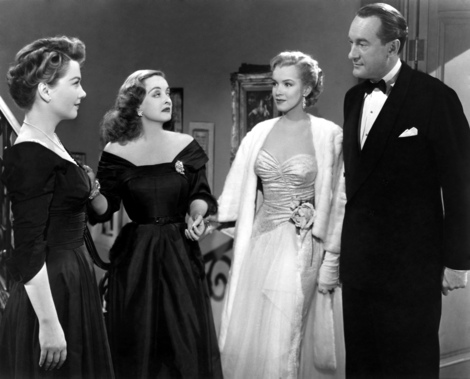
Bette Davis as Margot Channing, a spoiled child-actress, now on the shady side of 40, but still playing ingenue roles. What we have is Anne Baxter as Eve Harrington, a young ingenue who gazes adoringly at her idol, Margo Channing. What we have is Addison DeWitt (played by George Sanders as drily as a total-vermouth martini), the chief stiletto of the critical press, but you've also got Gary Merrill, Celeste Holm, Thelma Ritter, (and, in a very brief role, Marilyn Monroe) in a highly literate script which gives almost everyone some role they can sink, or cut, their acting teeth on, in a story that has "everything but the blood-hounds snapping at their rear end" (and, in a way, that happens, too.)

You see, we meet all these people as
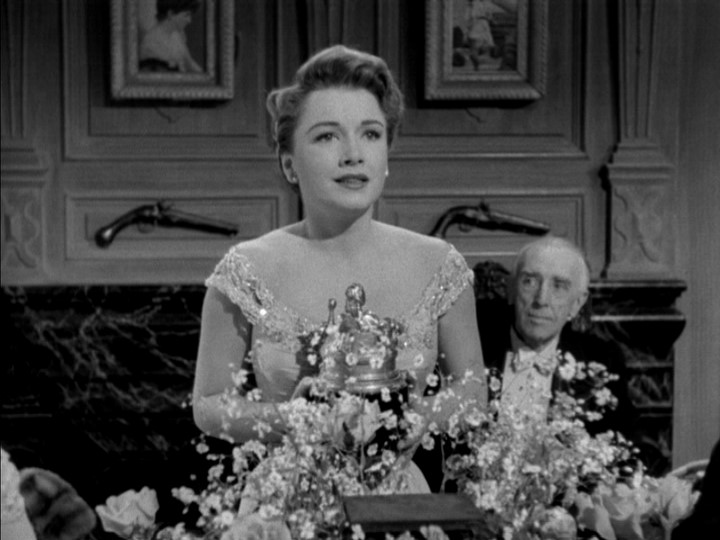
Eve is receiving the Sarah Siddon Award for Best Stage Performance of the Year. A joyous occasion for everyone, right? The very young actress gets a big break—everyone's happy, right?

No, the principal characters are either looking embarrassed, wonderingly perplexed, mad, or just cold to the event. It's flashback time to see why such a double-reaction to the prestigious theater event. And in a "Citizen Kane-switch," one flashback is narrated in turn by several people. And we are through this told "
All About Eve"...but also Margo, Addison, everybody. Everybody's soul is laid bare through the dialogue and the quirks and pops of the performances of the cast. It's a thoroughly entertaining two and a half hours, and its light cynicism will take of the staleness of "Sunset Boulevard" out of your mouth. It will do that, but will hardly make hopeful young starlets complacent.

Broadcast on KCMU-FM on February 3-4th, 1976

I still love this movie and I find it invaluable as a source for great lines. Go ahead. Go to the IMDB listing for "All About Eve" (all you have to do is click on the name at the head of the review*) and go to "Memorable Quotes." There's at least a couple pages of them. All smart, literate and bitchy. I used one in January 2009, as a sub-head for the blog-title (Addison DeWitt's non-self-deprecating "While you're waiting you can read my column. It'll make the minutes fly like hours." Only he could say that about himself--everybody else would be cut down for a remark like that, sort of like only Nixon being able to go to China.) Another favorite of mine is in this olde review: "Wow. Everything but the blood-hounds snappin' at her rear-end" as expressed by the inimitable Thelma Ritter. There's one involving Marilyn Monroe's hungry starlet, Miss Casswell, as she enters a theater-party. She scans the room looking at the producers: "Why do they all look like unhappy rabbits?" DeWitt leans in and confides: "...because they are." Smart. Literate. Bitchy.

And curiously old-fashioned. One doesn't get too far in that list before it comes to the Margo Channing monologue about the value of her life—a speech that always made me uncomfortable: "Funny business, a woman's career - the things you drop on your way up the ladder so you can move faster. You forget you'll need them again when you get back to being a woman. That's one career all females have in common, whether we like it or not: being a woman. Sooner or later, we've got to work at it, no matter how many other careers we've had or wanted. And in the last analysis, nothing's any good unless you can look up just before dinner or turn around in bed, and there he is. Without that, you're not a woman. You're something with a French provincial office or a book full of clippings, but you're not a woman. Slow curtain, the end."

Oh, really! Pretty prosaic for a smart script. Even though this was written in the late 1940's, it still rankles a bit unless you're, say, Anita Bryant.
There's also the way Addison DeWitt and Eve Harrington come across as asexual monsters for whom career is everything and a "normal" lifestyle is to be shunned and mocked.** Being a careerist is a bad thing in "All About Eve." Chasing after love, whether you're good at it or not is the holiest of holies. As I said, this was written in the 40's. One of my favorite quotes from 2008 is Richard Dreyfuss' one about being directed by Oliver Stone in "W.": "You can be a liberal and still be a fascist." Just as you can be smart, literate, and bitchy, and still come across like a schoolma'rm.

"All About Eve" was one of the first films to be made part of The National Film Registry.

It has a "100% Rating" on the Rotten Tomatoes site. Can't do better than that.

* That would be the start. It's an old habit of mine to think interms of "reels." The "head" is the start, and the "tail" is the finish, or the part that tucked into the reel's hub.

** The wikipedia article on "All About Eve" suggests that Addison and Eve are gay, thus making their aberrant behavior a result of their sexuality. "Okay, but whatever you do, don't tell Chuck."