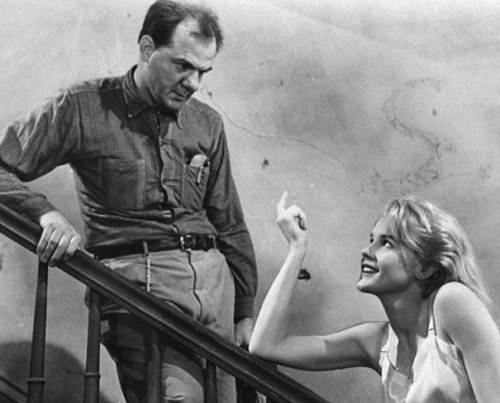
Baby Doll (Elia Kazan, 1956) On December 16, 1956, the Catholic Church's Cardinal John Spellman denounced this film in his sermon as "grievously offensive to Christian standards of decency." Calling the film "revolting" and "morally repellent," he extended his reach with a Power Grab, declaring "In solicitude for the welfare of souls entrusted to my care and the welfare of my country, I exhort Catholic people to refrain from patronizing this film under pain of sin."
In order to drum up business he might have said, "If you see it, say two Hail Mary's and call me in the morning." Ironically, he probably ended up driving up attendance for the film, whose worst sin was bad timing, but more questionable booking decisions have been made during the Christmas season.
A week later, Time Magazine, in its review of it led off with this line: "Baby Doll (Newtown; Warner) is just possibly the dirtiest American-made motion picture that has ever been legally exhibited." Then, in the same paragraph, goes into double-Time-speak stating "Baby Doll is an almost puritanically moral, work of art." Thanks for the clarification.
Well, lightning bolts notwithstanding—and all the participants in Baby Doll led nice, long lives—it can be seen with the perspective of time (rather than "Time") that Spellman just had a bee in his biretta, using his bully pulpit (emphasis on the "bull") to pass Holy Judgment on a film he probably didn't see, or, if he had, mis-read. Suggestive, yes. Baby Doll is very suggestive, in the style of Italian comedies coming out at the time, where everything is implied, but nothing is seen, portrayed or shown. What happens off-screen (or off-frame) is in the prurient mind of the beholder, and if such is the case His Eminence probably should have broken out the birch branches and started flailing.
Tennessee Williams' original screenplay features Karl Malden as Archie Lee Meighan, a Southern gentleman of Benoit Mississippi who's fit to be fried. Archie Lee gets no respect, y'all, not from the town, not from his employees, and not from his child-bride Baby Doll (Carroll Baker), on the cusp of her twentieth birthday, a significant event for the couple. Baby Doll has moved from father-figure to father-figure, agreeing to her father on his death-bed to marry the middle-aged cotton-gin owner, who might be able to provide for her. Part of the bargain is that Archie Lee would buy her a fabulous mansion, the biggest in Benoit (although it is in disrepair), and wait until her 20th to consummate their marriage. This leaves Archie Lee is a peripatetic state of frustration.
But, the tamped fires at home aren't his only reason for agitation—his cotton-gin business is failing, due to the conglomerate cotton-gin run by Silva Vaccaro (Eli Wallach) doing big business downtown. In a fit of pique, Archie Lee burns down the demon gin, leaving him open to negotiate a deal to do the work. But Vaccaro has other things in mind. He suspects Meighan as the arsonist, and so he hangs back from the mill, in an effort to gain information from the rather vapid Baby Doll, who is very susceptible to falling for Vaccaro's tricks.
Suggestiveness ensues. But also hilarity. It is, after all is said and done (rather than implied and imagined), a comedy—a Williams "Southern"—like a Western, a story about the civilizing of an uncivilized situation, where the brutes are dispatched and the naive gain some wisdom, balancing the scales to Williams' own vision of the charming, graceful South he knew and wanted to recreate.
And the part that everyone was hung up about—the scene on the swing between Baker and Wallach that Kazan shot in tight close-up? Seems the fact that you couldn't see the hands of the players was extremely questionable and prurient to outraged viewers. The documentary included with the film has the answer: Kazan shot the scene in close-up, so you couldn't see the very large heaters keeping the actors warm on that supposedly very hot day shot in the cold temperatures of Benoit. One more example of the mystical power of film—and why what isn't in the frame is just as important as what is.


 Patton, the man, romanticized war, revelled in it, but the film bearing his name went further than most in de-glamourizing the traditional heroics of the less thoughtful war films, carefully explaining the strategies, viewing the battles dispassionately, almost like a chess-master reviewing the board, and in the after-math, taking stock of the scattered pieces. However planned a battle may be, it ends in chaos. Chaos and death. And in "Patton," you can almost smell the stench of a battle-field's carnage.
 Death is omnipresent in "Patton," with detailed shots of dead and wounded in the battlefilds, and the crude graveyards made in haste. Some of the eeriest parts of "Patton" take place in those moments, the cascading trumpets and marching jig of Jerry Goldsmith's score stilled to shimmering strings, and unresolved motifs.
 Schaffner used his locations well, taking a page from David Lean, cramming as much information into the frames as he could, or by presenting stark landscapes that seemed to go on forever, showing the regimentation of war, how vast numbers of human beings could crowd a frame, or how solitary individuals could be lost in a landscape, or for that matter, History. The scenarists and Schaffner choose to leave Patton alive, just days before having his neck broken in a jeep accident. They leave him contemplating the transience of Glory walking mythically (and quixotically) towards a solitary wind-mill.
 It is also about showmanship. A lot of actors turned down the role (some, like