Showing posts with label P. Show all posts

Thursday, May 23, 2013

The Power

The Power (Byron Haskin, 1968) A sci-fi "who-thunk-it" by the producing-directing team of George Pal and Byron Haskin, whose work included the 1953 War of the Worlds, When Worlds Collide, and Robinson Crusoe on Mars.  The subjects of the Pal-Haskin team were usually puerile, with sophisticated special effects that dazzled the child in anyone, no matter their age.  The Power, however, is light on special effects, and the sub-text is less extra-terrestrial than sensorial.

A team of scientists (George Hamilton, Suzanne Pleshette, Richard Carlson, Earl Holliman, Nehemiah Persoff, and Arthur O'Connell) are working on a top-secret project testing astronaut endurance.  They are visited one day by their government liaison Arthur Norlund (Michael Rennie) who is skeptical of the worth of the whole project, other than the ideas of the team crack-pot, anthropologist Henry Hallson (O'Connell) who is convinced by his survey studies that one of the subjects has paranormal abilities.  His outbursts embarrass the entire board, especially Dr. Tanner (Hamilton) who tries to beat down the doctor's ideas at every opportunity.  However, a simple test proves that one of the scientific team has extraordinary mental powers.


Before you can say "Agatha Christie's 'Ten Little Indians'" the scientists start being knocked off in strange ways that only we, the audience, are privy to.  First Dr. Hallson is found dead, centrifugally squished in a centrifuge run amok.  Then Dr. Tanner is fired from the project, accused of never having attended college, and faking his way into his position.  He teams up with fellow researcher (and main squeeze) Marge Lansing (Pleshette) to try and track down who the murderer could be.  In the meantime, more of the research team end up incapacitated, and it becomes readily apparent to Tanner and Lansing that they're going to end up on a slab unless they can find the killer.  But who is it?


The movie is quite clever in how it clicks along, even if the love story feels a bit tepid, and Haskin's stage sense is always assured at making the strange either commonplace or particularly fascinating.*  For instance, the scientists work in a facility where their offices are separated by glass, so everybody can keep tabs on everybody else, making hiding the killer a difficult project.  Once Tanner is fired, however, the confining space is taken out of the equation, and the individual attempts at messing with people's minds are given free reign and can come out of anywhere...and nowhere at the same time.


As far as the acting is concerned, it's a bit cheesy, with O'Connell over-emoting until you wonder about his credentials, and Hamilton smolders throughout, as if told he'd be the leading man, but not told how.   He's at his best convincing us that the illusions he sees are real, and the horror/confusion that he feels play across his face.  That's when he truly bonds with his audience, and is the filmmakers' best asset in making the movie come across.


  * Haskin had worked with Disney live action films, and did the more superior episodes of the original version of "The Outer Limits" as well as the first pilot for a little series called "Star Trek."


Wednesday, November 14, 2012

The Perks of Being a Wallflower

Something from Nothing
or
No Man is an Island of Misfit Toys 

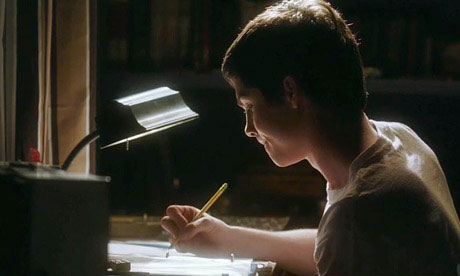
Charlie (Logan Lerman) is starting his first year in High School as a freshman and he has a lot to learn.  He's shy, introverted, and fragile the result of some trauma we know not what going in.  He walks the corridors friendless, a punching bag for the cool kids and their posses.  His parents (Dylan McDermott and Kate Walsh) are lightly caring, and his English teacher (Paul Rudd) reassures—"If you make one friend on your first day, you'll do good."  "If my English professor is the only friend I make today, that'll be sorta depressing."

But Charlie does have one friend, writing to him about his experiences, pouring out his frustrations and observations in letter after letter about his "trying not to be a loser."  The friend is anonymous, may not even exist, or once existed, but those letters keep Charlie going and serve as his avenue of expression, rather than having his day pulled out of him at the family dinner table.   It's an uphill battle from some valley that isn't discussed, but Charlie is self-aware enough to know some perspective.  "My life is officially an after-school special," he grouses.


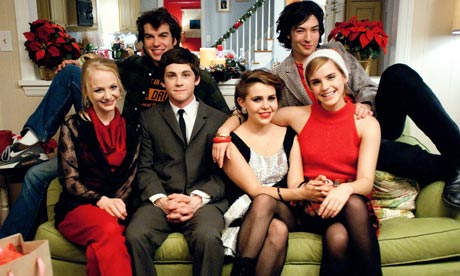
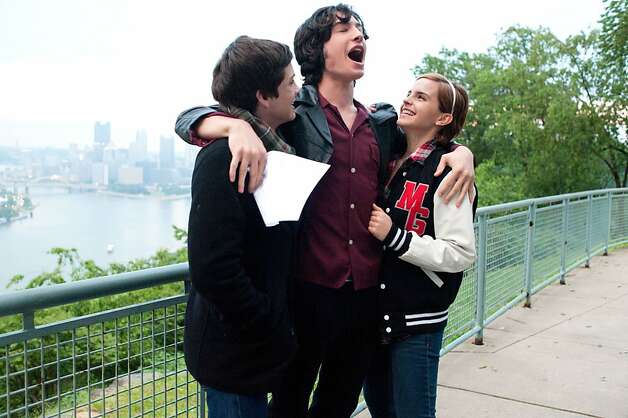
At a football game, he meets Patrick (Ezra Miller), a senior and the subject of some casual bullying, but Patrick has a wicked sense of humor that he throws out with no hesitancy as a shield.  Charlie gravitates to him, and meets Patrick's step-sister Sam (Emma Watson), also a Senior, but who is coming back from "having a reputation."  After the football game, the three hang out at a diner and compare notes of commonality, which involve a distinct lack of fitting in with the high school social structure, and Charlie is introduced to more of the group, who hold fast, hang out, and provide safety in numbers and a fresh perspective on the puerile benefits of normalcy.


The Perks of Being a Wallflower (written and directed by Steven Chbosky  from his own novel) is a fine quirky example of a "Coming of Age" movie, that sub-set of the teen flick where lessons are learned (his life really is an after-school special) and is not so much a film about growing up, as growing out.  Growing out of the insular self-inspection, narcissism and selfishness that is comfortable and has no risk, it's dark and warm and safe in that little "black cave of the psyche."  But is it?  That cave only echoes one's own thoughts back to us, providing no perspective and no horizon to reach to or for.

Yeah, it's pretty safe in there...if there aren't any demons or other creatures of the nightmare lying in wait to strike when you're most vulnerable.  And we all have those.  And even if we don't, the echoes of our own thoughts are only phantoms and zephyrs, not sustaining, and if that's all we cling to, they become echoes of echoes, distorting, becoming less clear, and often impenetrably undecipherable—a feedback loop. 


And feedback loops, uninterrupted, can become weapons.

Charlie is scared.  And ashamed.  And that limits his choices, when he does make a choice.  Most of the time, things are just foisted on him and he has to make a decision: like this, or don't?  Comfortable or not?  Aware, or comatose?  And by the time, he makes a decision, it's usually too late, putting him a tail-spin, and another trap.   His fellow wallflowers are in traps, too (isn't that what High School is all about?), but one thing he learns is that they're not the only ones and the traps, self-made or imposed are universal.

It's a good film, with good imagery, but a neophyte director's tendency to hit things a little too square—the shot from the communion wafer to the LSD tab, please—but the performances feel real, Emma Watson is a helluva dancer, and it's a good trip down memory lane, now that it's gone and out of our lives.  "See ya, wouldn't wanna be ya"

For the truth of the matter is, we all grow out.  We couldn't survive if we didn't.  Yes, "we are infinite" as the movie's tag line wants to be sure we know.  

But not individually.

And not by ourselves.

The Perks of Being a Wallflower is an After-school Special Matinee.


Out of the black cave and into the light


Thursday, September 27, 2012

The Public Enemy

The Public Enemy (William Wellman, 1931) "Learn your lines, find your mark, look 'em in the eye and tell 'em the truth."  That was James Cagney's recipe for good acting, succinct, humble, with plenty of lee-way to find your own path, and completely shy of the mark when it came to talking about how he did it.  This gangster film was Cagney's first starring role—in fact, up until two weeks before filming, Edward Woods (who plays Tom Powers' best friend) was going to play the lead.  But, there was something about the little guy with the bantam rooster's brio that made director William Wellman turn the tables on the roles.

It's the story of a rotten kid from a good family with all the contrary instincts to look out for a number one—himself—who has no moral compunctions about anybody else, that leads him down a precariously slippery slope at a time in history when society was providing an excellent opportunity for taking advantages of loop-holes in the law and morality.  Pretty soon, "Tommy" is a booze-runner during Prohibition, and anybody getting in his way, even some he'd pledged loyalty to earlier, would find their way on the wrong end of his fist or the business end of his gun (and curiously, Cagney's Powers employs both the same way, with a forward thrust of the arm, as if fist and firearm were interchangeable).

It's a pretty standard morality—or immorality—tale.  But, you watch Cagney do it his way and you never forget it.  He's extremely charismatic, and like James Dean, does so in a way that separates him from everybody else.  Where the rest of the cast—in one of the early talkies—is ramrod-stiff and talking with fine e-lo-cu-tion, Cagney is loose in everything, wrapping himself around furniture, spitting out his slang dialogue, and if there's a little dead-air, throws in a little wise-crack in word or gesture for good measure.  He's encouraged by Wellman, who takes a lot of chances in this pre-Code drama ("Did he just say what I think he said?"  "Is that gesture in the credits what I think it means?"), and who sets up the tenor of the times in one masterful shot from a street corner's vantage-point, moving from a distillery to a corner-bar, following a pole of beer-buckets that crosses the path of a Salvation Army band.  Wellman liked to play it rough—they used real bullets in a shot where masonry is picked off close to Cagney's head, and when Cagney is hit by the actor playing his sanctimonious brother, Cagney goes down like a ton of bricks—because Wellman told the other actor to clobber him, breaking a tooth in the process.  And there's the famous grapefruit-in-the-face shot (making Mae Clarke something of a legend extending far beyond her career), that Wellman came up with—because he always imagined doing that to his own wife, who habitually ate half a grapefruit in the morning.

But, it's Cagney that's the Big Show.  Watch the scene where he stands in the rain, luxuriantly eyeing his next targets, the guys who gunned down his buddy in the street.  With murder on his mind, a smirk comes over his face, that turns into a fierce grin, then disappears into a grimace as he moves forward and walks right into the camera, like a ball of fire that can never be put out. 

Cagney's so good, he's scary.  


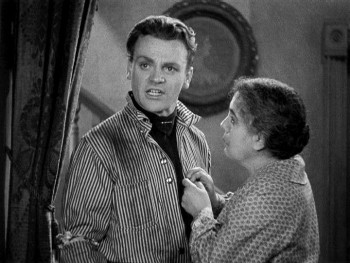
Cagney's Tom Powers with murder on his mind—that not even a downpour can douse.


Tuesday, August 28, 2012

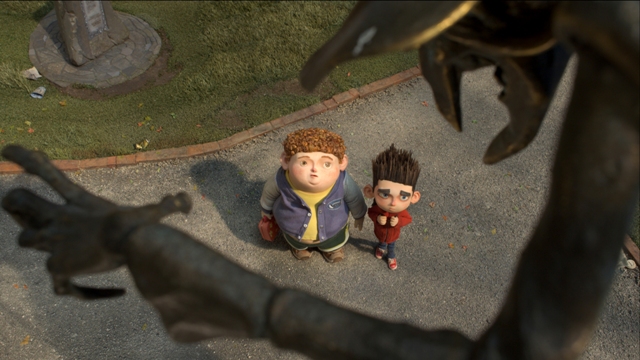
ParaNorman

Re-Animators
or
"I See Dead Puppets"

The town of Blithe Hollow depends on the supernatural for its tourist trade.  But, what the city fathers probably don't understand is that if you live by the sword...well, let's just say you'd better have a good cleaning crew.

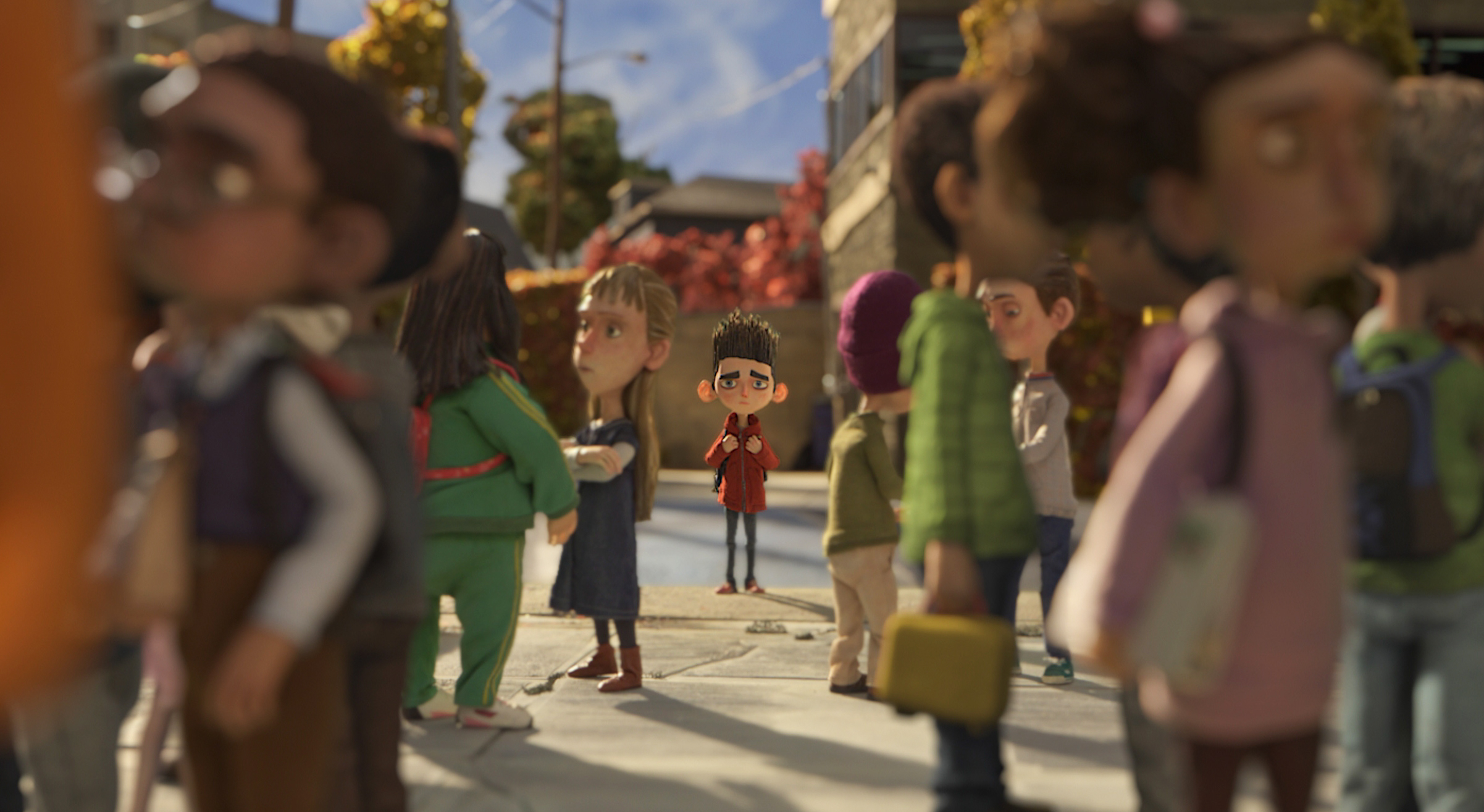
One of the town's citizens is young Norman Babcock (voiced by Kodi Smith-McPhee) and he has a problem—he sees dead people, all of them. He's ostracized from friends, family and reality...from life, really...as most of his acquaintances are non-corporeal and that leads to bullying, loneliness and a general lack of enthusiasm.  He'd be better off dead—as the only people he can relate to already are.

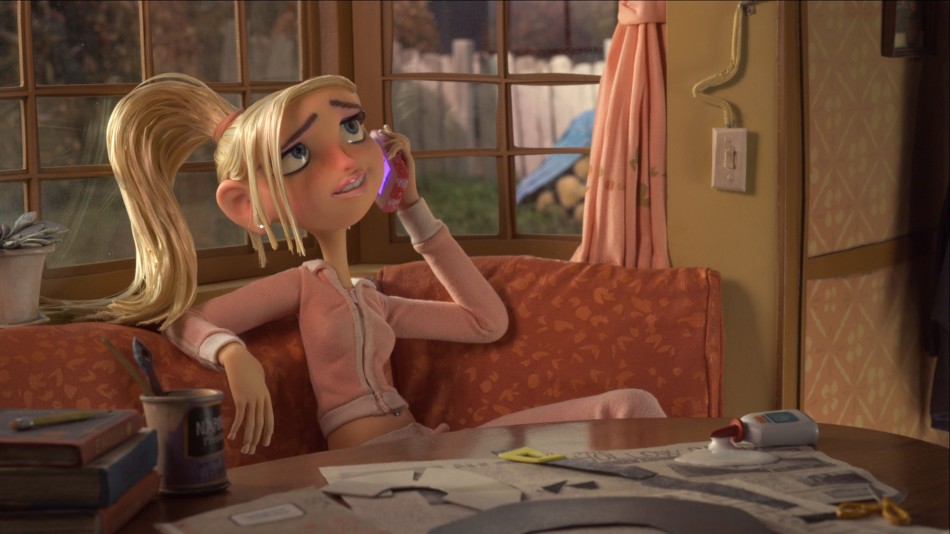
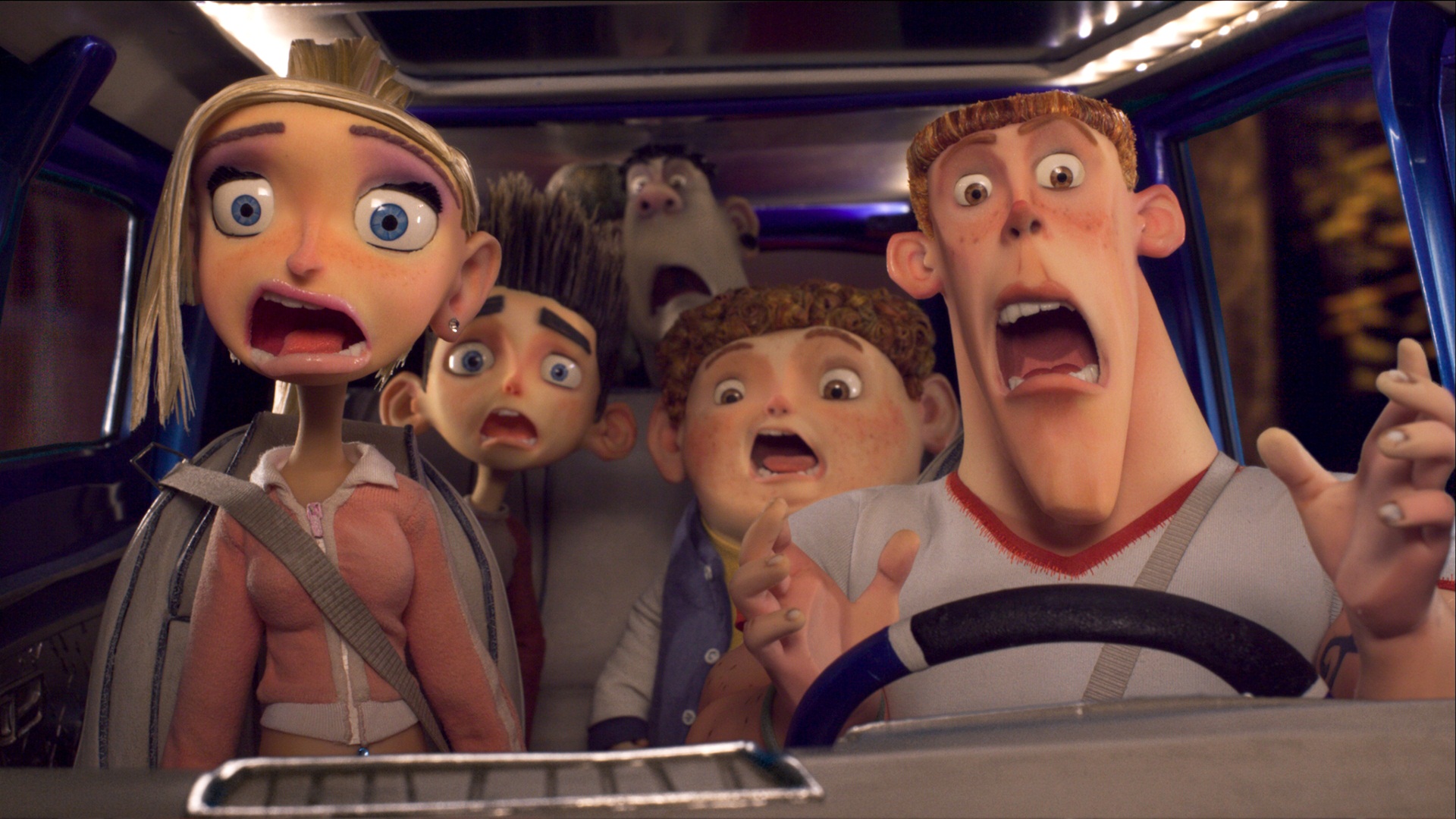
Then, there's his creepy Uncle (a wonderfully comic vocal performance by John Goodman) who tasks him with a special duty—saving Blithe Hollow from destruction by the wrath of the very witch of the town's fame, killed by the city elders centuries before.  To do so, he must go on a hero's journey with unlikely allies, many roadblocks both physical and emotional, while evading zombies, the undead, jocks, bullies and narcissistic big sisters to confront the evil witch.

ParaNorman is hilarious, quirky certainly, but also has a lot of depth and breadth to it.  It would be an easy—too easy—temptation to call it a Tim Burton knock-off (stop-motion animation, horrorific subject matter...it must be a Tim Burton knock-off), but it's actually far more concerned with story over effect than Burton, whose work can become tangentially derailed for a sequence or bit that the director finds funny, even if its a mismatch for the rest of the film and its nonsensibilities.  ParaNorman stays on track, managing to brings its humor out of character, rather than despite it, and with a sense of comic timing that's by turns subtle, surprising and goofy.  Yes, there are scary bits—it's rated PG, so maybe the littlest of kids shouldn't go—but its horrors are not there to shock, but to thrill.  And when the film does build up a full head of horror steam at the end, it provides some of the most awesome sights and effects that have been seen in animation in quite some time.  A hybrid of the Burton and Aardmann animation studios—directors Chris Butler and Sam Fell worked for both groups, respectively, and you can see aspects of their animation styles meshing, hallmarking the best of both stop-motion worlds—Burton's anticness and Aardmann's appreciation (and mining the comedic possibilities) of stillness.  Combine that with the story of an outsider who manages to collect a posse of co-adventurers who handle the auxilliary parts of the hero's main mission, and you have a well-rounded story that manages to surpass the limitations of the parts (making it, amusingly, a bit of a zombie-movie itself).  

What's nice is there's enough time in the plot (involving more than just the cemetery variety) to appreciate the artistry behind it—the way the town is laid out with abandoned squalor in the detail, the people with perpetually bemused expressions, and are, like us, anything but symmetrical, the way an ear glows with the back-lighting of sunshine, and in the ending that manages to combine moments of dark beauty and true psychotic scariness.  Lots to appreciate.  Lots to like.  It's a fine film that makes the most of its slim ambitions, and rises above them.

ParaNorman is a Full-Price Ticket.

Wednesday, June 13, 2012

Prometheus

Going to Meet Your Maker 
or 
"Eloi, Eloi, lema sabachthani?"*

Every time I see a poor copy of a good idea become the latest pop darling out there, I get the inevitable useless reply from someone who takes it personally: "There aren't any original ideas anymore!  Just because it's been done before doesn't make it bad!"  (And it certainly doesn't make it "good!")  It's missing my point.  I don't care that it's been done before (and I'll identify where if anybody wants to look it up), what I care about is that it isn't done as well.  Jean-Luc Godard said "It doesn't matter where you take things from, it matters where you take things to."  

Succinct and right on.

So, now, Prometheus—Ridley Scott's return to SCI-FI, and the world he created in Alien.  If one goes in seeking another "Alien" movie, one might come out a little disappointed.  Oh, there are chases with disoriented POV's, conflicted crews and amoral androids, "hair-in-the-drain" icky effects, H.R. Giger designs, shocks and revelations, but this isn't Alien.

It's better, richer, and more thought-provoking...while still being a rather nifty action-horror-science-fiction hybrid.  It must be a hybrid, as Scott (and screenwriters Jon Spaihts of The Darkest Hour and "Lost"'s Damon Lindelhof) have stolen just about every science-fiction idea in the Universe.  

But, again, where they take it is original in its implications.  SCI-FI always asks "What if...?"  This one goes one question further in the interrogation and asks "But why?"  Yes, it's a monster movie, but like so many of those, God plays a role. 

There's a significant amount of religion in this film, and speculation about God and our origins, but it still manages to find room for Faith in settings that remind one of Hell.

Dr. Elizabeth Shaw (Noomi Rapace, the first "Girl with the Dragon Tattoo") is an archaeologist who stumbles on the latest of a series of cave paintings that have the same image even though originating from different parts of the globe.  This new one is in the Isle of Skye in Scotland.  The paintings show a group of primitives praying to a huge humanoid figure who is gesturing towards a configuration of six planets.

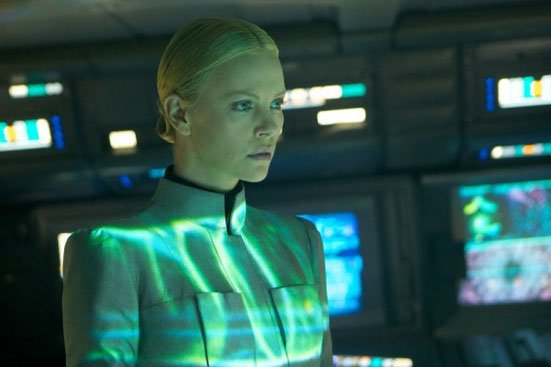
It's enough to fund Shaw and her lover-colleague Dr. Holloway (Logan Marshall-Green, in a performance that's trying too hard to find significance) on a trillion dollar excursion to find the only place in the Universe where the planets have that configuration at that point in the sky (??) aboard the good ship USCSS Prometheus, captained by Janek (Idris Elba, even more impressive than he was in Thor, in fact, I'd enjoy a movie centered around this character), overseen by Meredith Vickers (Charlize Theron, in brittle ice-queen mode) of The Weyland Corporation, caretakered by David (Michael Fassbender, in a terrific heavily-influenced performance), an android who serves as ships' H.A.L. in all manners, including a slightly unctuous air, but in movie choices fancies David Lean over Kubrick.**  Once they get planet-side, a holographic image of the CEO of the Weyland Group (Guy Pearce, in extreme old-age make-up) introduces Shaw and Holloway to the dubious crew—the mission: to find that planet in the cave paintings and see if we can find the humanoids pointing us there.  In simple terms, we want to find that ancient "god."  They find a landing strip of sorts and settle there because "God does not build in straight lines."

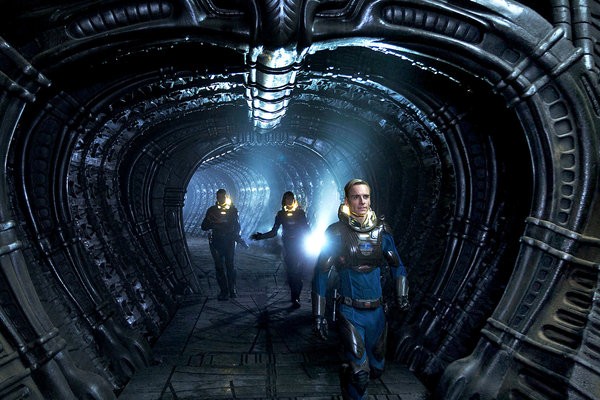
Upon landing they find a semi-hostile environment with two ancient dome-like structures.  They enter and begin digital cartographing with laser mapping drones.  As they go deeper into the structures, things seem somewhat familiar to the sequel-oriented movie-goer, but not really.  It's a clean environment, protected against savage wind-storms, snaking corridors and the occasional dead body of an alien species.  What happened here?

If you think you know where it's going, you're wrong.  This one's going somewhere else than running down a neon-lit corridor being chased by a monster (well, there's some of that, in fact quite a bit of it). But, it's a much bigger Universe than the Xenomorph of the first one (I've started calling them "glitches" after this movie), and if there is a sequel to Prometheus, it's going to be along a different track than Alien, and has bigger fish to light up with a flame-thrower.

It's technically stunning, and fun to see how they took all the unused stuff left on the drawing room floor in Alien and incorporated it here.  And lest you think that this is a high-philosophy movie, no, it's scary, designed to make you jump and gross you out.  It is a horror film, after all, but for all the shock stuff, it might also make you think, as it toys with big sci-fi ideas—"A Shaggy God Story" as acerbic critic John Simon called 2001: A Space Odyssey.  But, it's Scott's best film in years, retracing old steps, sure, but finding a new path to go somewhere else, some place a lot more interesting.

Prometheus is a Full-Price Ticket.


"The answer, Dear Brutus, is not in our stars, but ourselves"


* No, it's not Klingon. It's Aramaic.

** In fact, he watches a scene that we featured in a "Don't Make a Scene" article.

Tuesday, September 6, 2011

Project NIM

"More Human Than Human"
or
"If We Could Talk to the Animals (Speaking to a Chimp in Chimpanzee)"

"It was the 70's...," says one of the interviewees in Project NIM, as if in explanation.

"It was the species," says I, looking for my tranquilizer gun. 

The new film by Man on Wire director James Marsh examines a scientific experiment by Columbia researchers to teach sign language to a chimpanzee.  The chimp, NIM (son of Carolyn) is taken from its mother almost at birth, to be raised by humans, and thereafter taught to communicate in a language that humans can understand (This immediately raises a red ethical flag—why not take the Goodall route and learn theirs, but if you're going to get all PETA on me, you might as well just picket the theater rather than watch it).

For just as Man on Wire is a study of hubris and the arrogance of man (which results in a marvelous, magical thing), Project NIM does the same thing, while showing just how lousy human beings are, even with the best (or most curious) of intentions.  We meet a lot of talking heads in Project NIM and few can be considered the best examples of our species to teach another anything.  In fact, Project NIM is more of a study of human behavior than it is anything to do with monkeys'.

The guy who devises the study is Dr. Herbert Terrace (after Project Washoe which was an earlier, more disciplined study and was more convincing of anecdotal evidence), and one wonders what his motivations are, besides the obvious personal ambitions of getting attention and using it as a means of attracting young interns.*  The first person to raise NIM is Stephanie, a self-described "hippie-chick," and it's a mystery that Terrace picked her to be the initial teacher for NIM, as she had no desire to keep notes and records, did not know sign language, and eventually grew impatient with all the insistence on "process," preferring to just interact with NIM as a member of her family.  Terrace makes some comment about her being a "warm," "empathetic" person and then drops the bomb that the two had had a previous "relationship,"  (which will prove to be a common—all-too common—theme throughout the documentary, as the humans seem more concerned with "hooking up" than concentrating on their charge—"it was the 70's, after all").  Eventually another trainer is found for NIM, Laura-Ann, and it's readily apparent that there is no love lost between her and Stephanie, as some mutual passive-aggressive sniping occurs between the two.  Laura-Ann is much more successful in teaching sign to NIM (Stephanie says on-camera "Words are a fucking nightmare to communication..." which makes one wonder about her qualifications even more) and the chimp's knowledge of ASL increases at an fast clip.  Terrace and she also begin "a relationship," just as two other therapists begin working in the study.  Also, at this point, Terrace steps out of the day-to-day monitoring, that is, unless a camera shows up for a photo op, or a news-story, and there are some amusing out-takes of Terrace trying to handle NIM, but being quite incapable of it.  "Herb Terrace was an absentee landlord" grouses one of the researchers.

It becomes readily apparent in Marsh's timeline and necessary compression of the events that the humans were far more concerned with their own lives, and that, however much affection and wonder is expressed at NIM's progress, he is little more than an amusing lab-rat, albeit one you can talk to about food.  And, as with "Frankenstein," pretty soon the subject of the study is considered less valuable, and, ultimately, disposable.

It cannot end well and it doesn't, even with the best of intentions, and the heroes of the story, if there can be any, come from the most unlikely of places.

What I find amazing is that Marsh, as he did with Man on Wire, can coax such naked honesty in a documentary that makes the researchers look like such creeps.  Philippe Petit, the subject of Man on Wire came across as something of a jerk, but his accomplishment was so amazing one could forgive his idiosyncracies and foibles.  These men and women have no such stunts to hide behind, and although they may act like the end justifies the means, in the end, they simply abandoned a project and left the life they'd altered on its own, not quite chimp, not quite human.  That ivory tower looks a little less spotless in the aftermath.

Makes one wonder if this evolution "thing" is all it's cracked up to be, given the evidence.

Project NIM is a Full-Price Ticket.


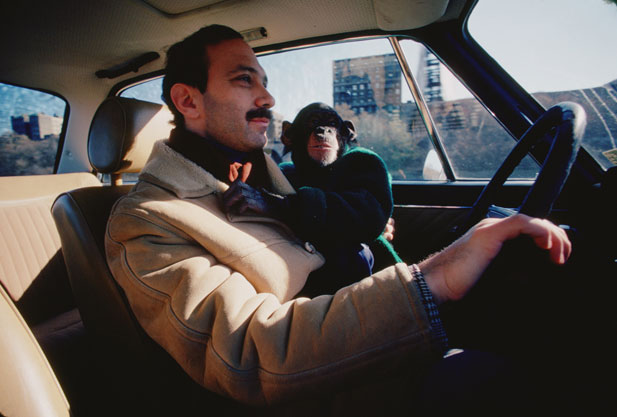
Two of "the good guys"—Bob Ingersoll and Nim Chimpsky


* I seem to be coming down hard on Terrace ("That's DR. Terrace..."), but he comes across as smug, arrogant...and a tad clueless in Marsh's film (Don't these folks know how they're going to come off?).  Also, slightly retributive.  After his slap-dash study, heavy on the personal agenda, ends he writes a book about the study sayin "Nah...chimps don't use language because they have no syntax"—merely parroting words they've been taught to get what they want, without proper senetence structure, or tense.  True.  It's the same way I communicate with my dog, Smokey.  We pick up on each other's "cues" of behaviors and words we recognize and respond appropriately.  For example, if I command my dog to go to the bathrrom (he does this by suggestion) and he doesn't "have to go," he'll simply sit.  Which tells me "No, really, it's not necessary.  How about a cookie, though?"  NIM was doing this with his trainers and with other apes...and taught other apes basic ASL (shades of "Planet of..."), just as he communicated with ape-cues to other apes.  The thing that struck me about NIM (which I remember from some of the docs made when the study was going on), was that he cursed.  If he got mad at something, he'd make the sign for "Dirty," which was related to his toilet training.  Nobody taught him that "Shit!" was an expression of frustration.  He came up with that on his own.

Friday, May 27, 2011

Pirates of the Caribbean: On Stranger Tides

"Sinking to Lower Depps"
or
"PG-13? It Should Be Rated "Arrrrrrrrrrr."

I enjoyed the boisterous first Pirates of the Caribbean—who would have thought that even talented film-makers and writers could turn a ride at Disneyland into a good movie?  But, it had been awhile since there'd been a quality pirate pic, and POTC hearkened back to the giddy Saturday-matinee thrills of past sea-faring adventures, but with a nice, gritty frou-frou quality.  Yes, it was loud, and confusing, and piled on too many episodes of buckling swashes, so it was hard to separate the buccaneers from the privateers.  And it gave Johnny Depp a break-through role that saved him from the pit of despair that is Tim Burton's cob-webbed basement-rec room. 

It was just plain, simple fun.

I passed on the second and third films because I figured they'd run the formula for movie trilogies: the second one turns dark and complicated without the fresh feeling of the first, leaving cliff-hangers that could grow barnacles on any writer's knuckles; then the third complicates things more, and resolves everything quickly and rushes to a well-deserved finale where everything (*sigh*) turns out alright.

I gave them not so much as a hailing shot across my bow.  I'd sailed on.

But, I thought I'd give Pirates of the Caribbean: On Stranger Tides a chance.  For one thing, having resolved the Keira Knightley/Orlando Bloom romance (again), they're no longer present on this passage and the additions of Penélope Cruz and Ian McShane was an inducement.  Plus, the director is Rob Marshall and I wanted to see how he did with a project of a lesser pedigree than his previous work.  I liked Chicago, and parts of Memoirs of a Geisha.  But I thought Nine was an unmitigated disaster, occasionally brightened by performance (I was surprised to find numbers by Fergie and Kate Hudson the highlights).  Marshall needs a hit, and On Stranger Tides is just the ticket—an established franchise ($2.6 Billion in revenues?) with a built-in audience that doesn't care who directed it—all they care about is Depp's tipsy Keith Richards imitation and running like a girl from trouble.

Those sunken souls will be pleased; Depp does that schtick but with that silent-comedian's crack razor-sharp timing in the reactions.  It plays like It's a Mad, Mad, Mad, Mad World with three groups of sailors all after one thing: Ponce de León's fabled Fountain of Youth (it seems, all of a sudden, Spain, England and the Pirates are interested in the same thing).  After a brief sequence where Sparrow frees a member of his crew, he is arrested and brought before King George II (Richard Griffiths—when he sits there is a big musical fwump from Hans Zimmer's "Mickey-Mousing" score).  It seems that Spain's interest in the FOY has reached the King and he hires Captain Hector Barbossa (Geoffrey Rush, or most of him anyway) to lead the expedition.  Jack escapes...and then things get complicated.

In the meantime, there are McShane and Cruz, as the pirate Blackbeard and his daughter, Angelica, mermaids, a Jack Sparrow imposter, silver chalices to find, and the series' obligatory focus on the supernatural (while also having a missionary hero, despite all the disparagements of religion in the script).  Blackbeard knows his voodoo, has a "zombified" crew, a magic cutlass, and a fine collection of ships-in-bottles.  Plus, his vessel "Queen Anne's Revenge" has a few nifty tricks that other pirate ships do not.  McShane is terrific, playing the comedy for truth ("If I don't kill a man now and then, they forget who I am"—a line similar to one from The Princess Bride—is played absolutely straight and with a baleful disinterest that never leaves his face.  Cruz is fine, but it appears she's just along for the ride—as duplicitous as her character is, she doesn't register much range, or fire...as she can. 

Marshall keeps things moving, editing things a bit too quickly for continuity to rush the dialogue, eliminating any pauses, and he does a few cute things with the 3-D imaging, beyond the snakes and pointy swords and rolling barrels, moving his cameras over the heads of a court-room, giving a sailing shot of the sea actual depth, and making the split-screen Jaws water's edge shot work well.  And although he isn't that good framing the fights, which jerk along with the breezy calculation—and lack of zest—of a Roger Moore fight from a James Bond film,* and there really isn't much of an ending—although there are three of them—it's pretty sprightly, the highlight being an encounter with mermaids—portrayed as supermodels with the manners of piranhas**—that is genuinely exciting.  There are even a couple of charming, if brief, surprises along the way. 

There is another quality issue, though.  On Stranger Tides, shot in 3-D, has an opening that is pretty murky once you put on the dark glasses, the same kind of clarity issues you get at drive-in's when they would start a movie at dusk.  Even in 3-D and IMAX (which is how I saw it—I was splurging), it's a little difficult to determine precisely what is going on.  It's something of a toss-up just how one should see the latest Pirates of the Caribbeans. It might be worth it to see it in three dimensions, but I'd do it at home.

Pirates of the Caribbean: On Stranger Tides makes a fine Rental.


* Every once in awhile, sitting through this, I got the odd "formulaic" bustling feeling I get from the Bond films and the Indiana Jones movies (Zimmer's "Pirates of the Caribbean" dance-step has to accompany every bit of derring-do, like the "Indiana Jones Theme"), where the dialog is just not clever enough, but "it'll get by," if you don't mind a bit of eye-rolling (it does, after all, relieve some of the eye-strain produced by those glasses), and the action set-pieces just go on and on.  And one can set their watch by when action is timed in this thing.

** ...or is that redundant?


Wednesday, October 27, 2010

Scare Me Once, Shame on You. Scare Me Twice...


"Just So You Know, I Won't Be Your Friend"

Let Me In is an American remake of Let the Right One In, the terrifically creepy 2008 Swedish film—(here's my review of that here).  For those who hate sub-titles, this is probably a good thing.  And what's good about the original is slavishly copied here, but director Matt Reeves (Cloverfield) does some good things (and a couple bad) to move the situations from frozen Sweden to a wintry Los Alamos, New Mexico.* The best thing is the acting.  Let Me In includes such great thesps as Richard Jenkins (a fine actor and more people will see him in this than any other film he's done) and Elias Koteas.  But, it's the kids who are the best thing about it.  Anyone who's seen Kick-Ass already knows Chloe Moretz is terrific, but this is less of a joke-performance, and plumbs the depths of what she can do dramatically.  Her  waif, Abby ("I'm 12...more or less") starts out alarmingly strange, but as the movie progresses, the character turns more vulnerable and sympathetic—far more than Lina Leandersson in the original.  But, the stand-out here is Kodi Smit-McPhee as the initially screwed-up Owen, a victim in danger of continuing in an unthinking cycle of violence.  McPhee's Owen wears his heart on his sleeve—he just won't show it on his girlish face—but as the movie progresses, that face starts to beam (he is far more expressive than the Swedish version's Kåre Hedebrant, in fact, both kids in the first have a Teutonic reserve that is appropriate for that film's style, but would seem catatonic in this version) as he approaches his relationship with Abby with the same vulnerable hopefulness he just can't allow in his other interactions.

Reeves does manage to make some things his own, as well.  He mostly discards the firsts glacial blue color palette for a neon orange that suffuses scenes, and he nicely captures a bit of the gender-bending feel of the first, though differently.  Also, he very cleverly stages some of the violent sequences obliquely, thrusting them in the stage-rear of the frame while the main focus is going on in the foreground.  The more human attacks are handled extremely well, surprisingly—alarmingly so, but the movie veers into goofiness whenever more occultish violence occurs.  The director holds on the scenes too long, and even though a lot of it is done in back-lit cameo, the effects make it look like the perp is less a savage beast than a crazed monkey with a banana-buzz.  Sure, there should be some giddy thrill involved in horror, but "giddy" shouldn't translate to guffaws.  He also makes crystal-clear the true horror of the piece, something that only occurred to me, after a bit of time of contemplation—for some reason, I like my "OMG" moments to be outside the theater.  And he gums up the last scene of the film with a too-nostalgic pop reference that negates its effectiveness.

Still, after having dismissed the idea of an American remake with "may it never see the light of day," I have to admit that this one doesn't suck badly.

Let Me In is a Matinee. 


"Paramount Pictures would like to thank the family of the deceased..."

I'm surprised that Matt Reeves wasn't pegged to direct Paranormal Activity 2, considering he pulled the same cinéma vérité trick with his Cloverfield as Oren Peli did with the first PA.  Reeves might have actually done something different, as opposed to this corporate product generated to merely try and tap the success of the first.  Right off the bat, the vibe for this one is different, with the Paramount honchos putting the corporate brand in the very first crawl (which is partially used for the title of this piece)—a subterfuge, anyway, as it is "only a movie" and Paramount Pictures isn't thanking anybody, they're just trying to take your money, while fulfilling their initial wish to re-make the first movie (which was made independently for $11,000) under their corporate umbrella, thus inflating the cost to $2,750,000, while, cluelessly, also hoping to duplicate the original's success.  Guess what, Paramount?  The Paranormal Activity's financial success depended on the negative cost being so damned low.  That won't happen when you're paying gaffers, best boys, painters, assistant directors and assistants to the executive producer (all missing from the original) a sizable wage.*

They also can't duplicate the original's artistic success, either, such as it was.  The first film took a nugget of a good idea and ran with it, employing some audience knowledge of video conceits and, like any good horror-meister, letting the audience do their dirty work, trusting that what the sweating masses in the dark will come up with will be far more horrible than what actually occurs.  A couple of shock-cuts, and you leave them quivering in fear.

But Paranomal Activity 2 really doesn't do anything else than go through the same motions.  Oh, there is more coverage, thanks to an in-home security system that is installed after the initial "things that go crash on vacation" incident.  There is no 80herz hum that accompanies every incident, just some indeterminate sound effects (which are re-capped—and exposed as rather cheap—in the end-credits...End Credits?  That kinda destroys the illusion, too).  And this one is exposed to be more or less a prequel to the original...except that the actors shared by both look quite a bit older this time when the time-frame should be the same. 

It's just one of those moments of bone-headedness on the producers'/director's parts that show all they're interested in is going through the motions and collecting the cash, even if their efforts undercut the basic spookiness of the movie.  It's Corporate movie-making at its dumbest, laziest and most crass.  For example, you can't have a corporate movie release without some product placement (like that recognizable bottle of Sunny Delight in the kitchen, or the dramatically worthless talk about Burger King), which goes somewhat against the grain of a "captured" video source—and gaffe-spotters will have a field-day with this one—at one point, dad cracks a sexual joke by saying "Release the Krakken!" (the line from Clash of the Titans).  That would be funny, if it wasn't a glaring mistake.  That line of Liam Neeson's from the 2010 movie only became a catch-phrase this year...and the movie is supposed to be taking place...in 2006.  Oopsy!

There was no reason, other than plunder, for this movie to be made, and while one can say that the performances are decent, and it delivers enough jolts that you forget that dogs and children are the potential victims here, this is one best not attended.  Bad movies and bad movie franchises should be given the same advice as demon-poltergeists: "Just ignore it and maybe it will go away..."

Paranormal Activity 2 is a Waste of Time.


* Yes, it DOES snow in Los Alamos, New Mexico, and it has nothing to do with a Nuclear Winter.

** One of those Executive Producers is Akiva Goldsman, whose name seems to appear on any movie that sucks.

Thursday, July 15, 2010

Predators

"Its Jungle.  Its Game.  Its Rules.  You Run.  You Die."
or
"Last Tango in the Game Preserve"

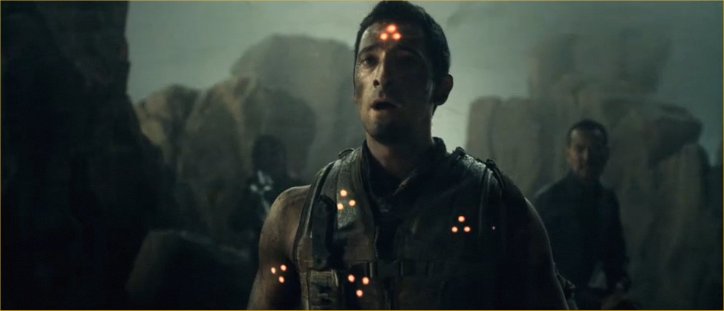
"Predators" drops you, literally, into itself.  It opens as one of its combatants (Adrien Brody) is in free-fall, with no idea where he's dropped from and no idea where he's dropping to.  All he knows is he's in free-fall.  He doesn't even know if he'll survive the landing.  Or how.  All he knows is the panic, the wind, and the thing beeping on his chest in an increasingly accelerating rhythm.

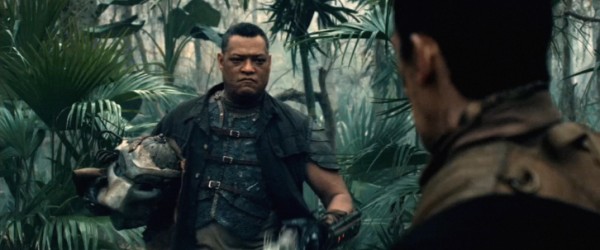
Once he makes land-fall, he finds himself surrounded, by an impenetrable hostile jungle and a rag-tag clutch of mercenaries (Alice Braga, Walton Goggins, Danny Trejo—a new trailer for "Machete" is attached to the print—Oleg Taktarov, Louis Ozawa Changchien, Mahershalalhashbaz Ali, Laurence Fishburnedoing something very, very different this time, brilliantly) and a doctor (Topher Grace?!), an odd-man-out in a team of hostiles from every hot-spot corner of the Earth.  First, they must learn to trust each other—they're all loners, but Brody's character is more of a lone-wolf than others, interested only in survival, names are not important, and familiarity breeds empathy and weakness—which quickly becomes irrelevant when they discover that they are part of a deadly game—they are ruthless predators being pursued by an invisible implacable enemy for sport; these hawks have become quail, and they must use their inherent killer-instincts to put themselves in the running foot-steps of so may of their victimsThe predators have become prey.

The "Predator" series was never a great series of films.  The first one, with Arnold Schwarzenegger (which is referenced here) was the only good edition and it quickly degenerated into an also-ran cousin of the "Alien" series (and Agatha Christie's "And Then There Were None").  The concept didn't have anywhere else to go; it was a "one-idea" pursuit film that resisted expansion or depth...until this one.  "Predators" (directed by Nimród Antal) slightly expands the concept and heaps on the irony of cut-throats getting their just desserts, while also giving the participants more back-story than the "Dirty Half-Dozen-or-so" of the first film.  Antal crams a lot into the story, never sacrificing pace, suspense or the "wtf?" quality necessary for this kind of "out-of-their-depth" story.  It also manages to pay homage to fiction's Rosetta Stone of this sub-genre, Richard Connell's "The Most Dangerous Game."  TMDG was at the core of the original, but "Predators" manages to take it several steps further, even incorporating that other "man-hunters-in-the-jungle" story, Joseph Conrad's "Heart of Darkness" (yes, the basis for "Apocalypse Now") in a sub-plot.  

Busy, busy film.  And adroit. Tough-minded and unsentimental.  Perverse and holding deeper truths...there's even a hint of a mystery story in there.  Entertaining and satisfying, if this is your bucket of blood.*  Personally, this one tops the original, with a fine cast—who'd have though Academy-Award-winner Brody would be so effective in a role like this?**—and higher ambitions that it handles efficiently.  A product of Robert Rodriguez's Troublemaker Studios, it shows how excellently this brand of B-movie entertainment can be produced.

"Predators" is a Matinee 

* And it is violent...one scene has a predator ripping the spine and skull of a victim from its carcass and bellowing in its victory.  Despite the implausibility of such an act (ever try to do that with a chicken?), it's a powerful scene.  Filmed obliquely—the film is a hard "R," but doesn't stray into "X" territory (which you have to be REALLY over-the-top to earn from the Ratings Board)—it's a visceral moment.

** Roman Polanski, probably.  On second consideration, the whole of "The Pianist" is a similar story of being hunted during WWII, and Brody made you feel every twitch of his nerves in that one.  If you haven't seen that film (and I also delayed watching it for a long time because, frankly, I didn't want to see another film about The Holocaust), you owe yourself to get a copy and view it.