Showing posts with label Joan Cusack. Show all posts

Friday, October 25, 2013

The Addams Family

First, came the macabre series of Charles Addams one-panel cartoons in The New Yorker (where the ghoulish family were only periodic characters).

Then came the TV series—the characters' names provided by Addams himself.


A quarter century later, given the trend to recycle old television into new movies, The Addams Family came to the big screen.


The Addams Family (Barry Sonnenfeld, 1991) The first directing job by cinematographer Barry Sonnenfeld, who came out of a short, boisterous career that started in the Coen Brothers/Sam Raimi early years of hyper-activity, something that he has maintained throughout his own films. Sonnenfeld's movies careen between dead-pan humor and break-neck agitation—you could see it in some of his camera moves for the Coen's and you can certainly see it in the pell-mell caroming of the first big-screen version of The Addams Family.  The casting is truly inspired and may, in fact, be perfect, with Anjelica Huston as Morticia, Raul Julia as Gomez, Chris Lloyd as Fester, and Carel Struyken as Lurch.*  

But the breakout performance is by 11 year old Christina Ricci as daughter Wednesday, who manages to make her lines all laughers with a bland expression and a direct unironic reading of her lines.  She found the secret to making the script work, because it isn't very good, (a collaboration between Beetlejuice author Larry Wilson and Edward Scissorhands scripter Caroline Thompson) not doing anything really unique with the characters, basically amping up the character traits of the TV versions while creating a plot in which Uncle Fester has been missing for 25 years (presumably lost in the Bermuda Triangle).  Gomez's crooked accountant (played by Dan Hedaya) attempts to bring an impostor in to take over the Addams fortune.  For awhile, it looks like the plan succeeds, but it doesn't, and it's soon revealed that the impostor really IS Fester, and blah, blah, blah. 


One of the jokes that works-Pugsley's collection of "Stop" signs

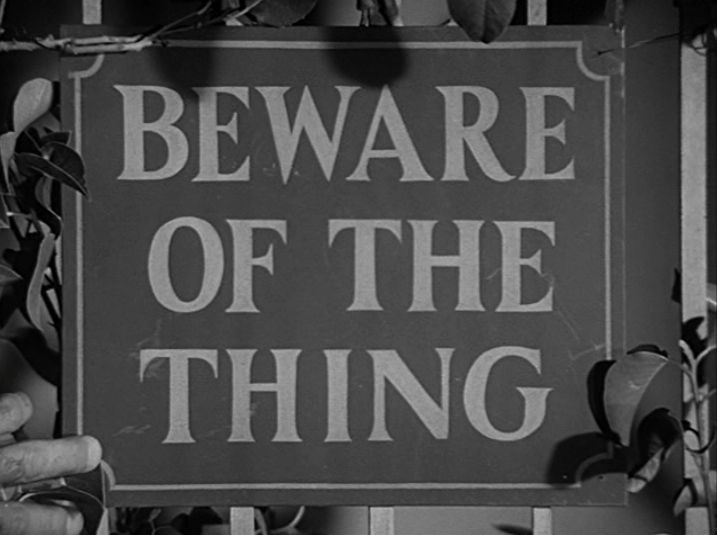
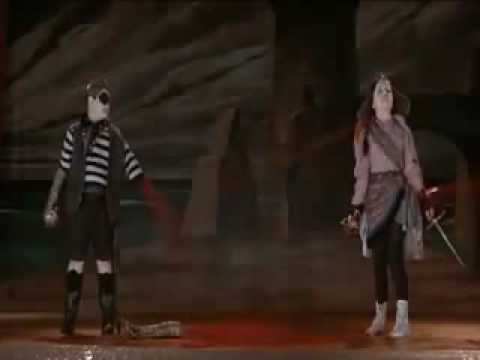
Sonnenfeld ramps up the film for all it's worth, making a lot—in fact, too much—of the character of "Thing," the disembodied hand-servant to the Addams, but the only time the film gets lively is when children Pugsley and Wednesday are forced to participate in a school version of "Hamlet" which involves a sword-fight that they make look decidedly real.  Sonnenfeld had the help of two legendary craftspeople Owen Roizman (who shot The French Connection and The Exorcist**) and master editor Dede Allen (who edited Bonnie and Clyde, Slaughterhouse-Five and Reds), but even played well, the material is stale, and was a major disappointment.  When it was announced that a sequel was being prepared, one could only think "...why?"


One of the Addams cartoons used in the film—this one
before the credits!  Frankly the film could have used
more of this and less of what they did use, which was
watered down sit-com material.


Addams Family Values (Barry Sonnenfeld, 1993) As much of a fan as I was of the "Addams" television show—I liked them, far more than the bland television families usually presented—I didn't even go see Addams Family Values in the theater (I was working—a lot).  

Big mistake.  Sonnenfeld was back, having completed a slightly tamer Michael J. Fox comedy in the interim.  Dede Allen was gone.  Owen Roizman was replaced by Don Peterman (who'd DP'd Star Trek IV, Splash, and Flashdance) and Ken Adam, legendary Art Director came on-board.


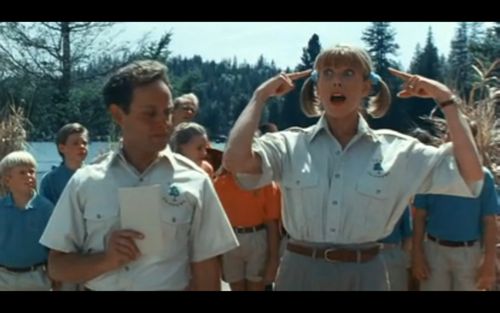
But the most important element was the script...written by Paul Rudnick*** with what must have been a poison pen from an inkwell filled with snark and maliciousness.  It is an extraordinarily funny movie, despite an unpromising premise: the Addams welcome a new child to the family, a boy, Pubert (the original name Charles Addams gave to Pugsley, rejected by the network censors). This creates enormous tension in the family, as Pugsley and Wednesday exhibit jealously and make many plans to kill the child, who manages to thwart their every efforts.  Concerned, Morticia and Gomez hire a series of nannies for the kids, all of whom are frightened away by the children, except for Debbie Jilinsky (Joan Cusack, never funnier), who attracts the attentions of Uncle Fester.  When the children become suspicious of her behavior, she convinces Gomez and Morticia to send them to Camp Chippewa, run by the extraordinarily wasp-y and perky Gary and Becky Granger (Peter McNichol and Christine Baranski), who make no secret of their disgust with these "weird" children who don't fit in.


Indoctrination in Addams Family Values


Now, that is truly creepy.  And funny.  The "Camp Chippewa" segments are the best of the film's sub-plots, indicating that if someone wants to do another film with the Addamses they need to 1) get them out of the house and 2) hire Rudnick (This iteration's Gomez, Raul Julia, sadly, passed away a year after Addams Family Values was released).  But, the entire film has more zest, more life (or what passes for it, given the subjects) and genuinely twisted humor than the original exhumation.****  It's always a pleasure to run into on the tube, no matter at which point one comes in.  


* I love doing this if only to share finds: like Carel Struyken's 360 photography site, which you can find here.

** Roizman left the production after a month.  Sonnenfeld ended up finishing the film himself.

*** Rudnick did some dialogue touch-up on the first film.

**** I've spared a lot of the quotable lines (they're peppered all over the Inter-spider-web anyway), but one little joke I love is the lighting of Mortiicia in Values-taking the "Kirk-lighting effect" used a little in the first film, and in the second, bending lightwaves backwards in order to achieve the same effect in every. single. shot.

Finally, this is my favorite Charles Addams cartoon....


Wednesday, November 14, 2012

The Perks of Being a Wallflower

Something from Nothing
or
No Man is an Island of Misfit Toys 

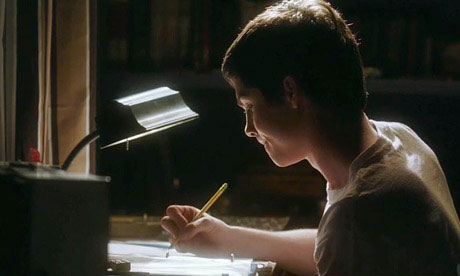
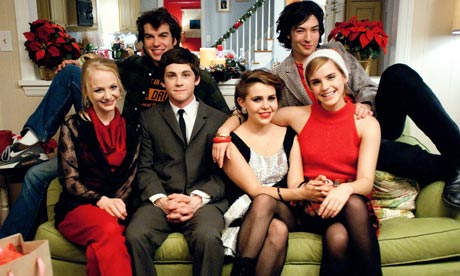
Charlie (Logan Lerman) is starting his first year in High School as a freshman and he has a lot to learn.  He's shy, introverted, and fragile the result of some trauma we know not what going in.  He walks the corridors friendless, a punching bag for the cool kids and their posses.  His parents (Dylan McDermott and Kate Walsh) are lightly caring, and his English teacher (Paul Rudd) reassures—"If you make one friend on your first day, you'll do good."  "If my English professor is the only friend I make today, that'll be sorta depressing."

But Charlie does have one friend, writing to him about his experiences, pouring out his frustrations and observations in letter after letter about his "trying not to be a loser."  The friend is anonymous, may not even exist, or once existed, but those letters keep Charlie going and serve as his avenue of expression, rather than having his day pulled out of him at the family dinner table.   It's an uphill battle from some valley that isn't discussed, but Charlie is self-aware enough to know some perspective.  "My life is officially an after-school special," he grouses.


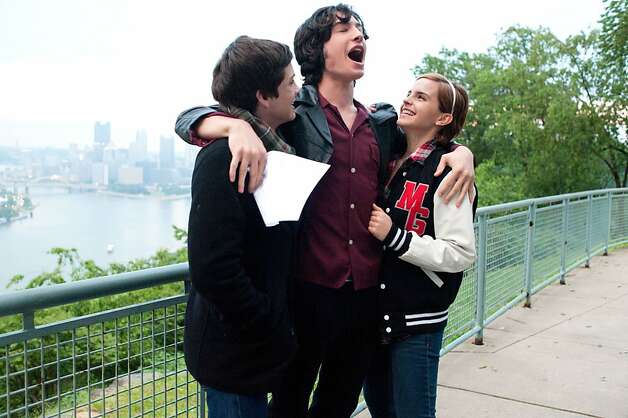
At a football game, he meets Patrick (Ezra Miller), a senior and the subject of some casual bullying, but Patrick has a wicked sense of humor that he throws out with no hesitancy as a shield.  Charlie gravitates to him, and meets Patrick's step-sister Sam (Emma Watson), also a Senior, but who is coming back from "having a reputation."  After the football game, the three hang out at a diner and compare notes of commonality, which involve a distinct lack of fitting in with the high school social structure, and Charlie is introduced to more of the group, who hold fast, hang out, and provide safety in numbers and a fresh perspective on the puerile benefits of normalcy.


The Perks of Being a Wallflower (written and directed by Steven Chbosky  from his own novel) is a fine quirky example of a "Coming of Age" movie, that sub-set of the teen flick where lessons are learned (his life really is an after-school special) and is not so much a film about growing up, as growing out.  Growing out of the insular self-inspection, narcissism and selfishness that is comfortable and has no risk, it's dark and warm and safe in that little "black cave of the psyche."  But is it?  That cave only echoes one's own thoughts back to us, providing no perspective and no horizon to reach to or for.

Yeah, it's pretty safe in there...if there aren't any demons or other creatures of the nightmare lying in wait to strike when you're most vulnerable.  And we all have those.  And even if we don't, the echoes of our own thoughts are only phantoms and zephyrs, not sustaining, and if that's all we cling to, they become echoes of echoes, distorting, becoming less clear, and often impenetrably undecipherable—a feedback loop. 


And feedback loops, uninterrupted, can become weapons.

Charlie is scared.  And ashamed.  And that limits his choices, when he does make a choice.  Most of the time, things are just foisted on him and he has to make a decision: like this, or don't?  Comfortable or not?  Aware, or comatose?  And by the time, he makes a decision, it's usually too late, putting him a tail-spin, and another trap.   His fellow wallflowers are in traps, too (isn't that what High School is all about?), but one thing he learns is that they're not the only ones and the traps, self-made or imposed are universal.

It's a good film, with good imagery, but a neophyte director's tendency to hit things a little too square—the shot from the communion wafer to the LSD tab, please—but the performances feel real, Emma Watson is a helluva dancer, and it's a good trip down memory lane, now that it's gone and out of our lives.  "See ya, wouldn't wanna be ya"

For the truth of the matter is, we all grow out.  We couldn't survive if we didn't.  Yes, "we are infinite" as the movie's tag line wants to be sure we know.  

But not individually.

And not by ourselves.

The Perks of Being a Wallflower is an After-school Special Matinee.


Out of the black cave and into the light


Tuesday, March 31, 2009

War, Inc.

"War, Inc." (Joshua Seftel, 2008) It's hard to say exactly when the satire of "War, Inc." starts to outwear its welcome. It does a very neat job of skewering so much that was wrong with the Bush Administration and its gung-ho weldng of the Military-Industrial Complex made simple, while at the same time being rather prudish about why it might not be such a good thing to export American culture to other parts of the world. Perhaps the problem is it doesn't take anything seriously, not its believes-in-nothing protagonist, not its comical situation (it's trying to be "Dr. Strangelove" but has more in keeping with "The Americanization of Emily" or even "John Goldfarb, Please Come Home"), it would probably sneer at the legitimate instincts that might engender such over-reactions...and then when it decides to get serious about something, you start looking around for the apple-pie salesman. Let's review.

Hauser is a corporate hit-man (what inspires
John Cusack to play assassins—not enough action movie offers?) working for the multi-national, multi-faceted Tamerlane Corporation. Hauser gets a new assignment from the just-out-of-office Vice President (Dan Aykroyd, animating Dick Cheney) to assassinate one Omar Sharif (seriously), the head of UgiGas in Turaqistan, where America has just won the first-in-history 100% "completely out-sourced" war. Hauser is posing as an event-planner for Tamerlane's first Corporate meeting in its new acquisition, the centerpiece of which will be the marriage of Turaqistan's jail bait pop-star Yonica Babyyeah (Hilary Duff, miles away from Disney) to one Ooq-Mi-Fay,* all in an effort to inspire Democracy in the Turaqistanis with American culture.

Already you can see the combination of deep thought and juvenilia mixed in one big lumpy stew, but the movie occasionally scores grisly points: reporters in Turaqistan enjoy the "Imbedded Journalistic Experience," a Six-Flags-like jerk-ride that lets them gape at high-def war-footage while strapped into comfy high-chairs feeling the buffets; and one point Hauser checks in with a chorus line of Turaqistani women high-kicking...with artificial limbs. All visitors be they friendly or terrorist walks away with a Tamerlane SWAG-bag, a running gag that doesn't stale.

Hauser is so dead inside, that the only way he can feel anything is kicking back with a shot-glass of hot-sauce straight, although he is frequently diverted by a left-wing journalist (
Marisa Tomei, excellent...again!) trying to get to the bottom of anything. Yonica Babyyeah is your basic Britney-Jessica-Christina-Paris-Lindsey-Miley sex-'tween (authentically played by Hilary Duff, who convincingly curses like a sailor) although the point of the vapidity of America's pop-culture is done to death. John Cusack's sister Joan is his administrative assistant in a performance that is extreme even for her. Sir Ben Kingsley rounds out the cast as Tamerlane's Supreme Commander Walken, in an American accent highly reminiscent of the bad ones Laurence Olivier used to sport, when he deemed to slum as a colonist.

Eventually everything comes to such a frothy rabid boil that it curdles, so much so that even someone sympathetic to its ideas (like me) would rather invest their time in writing a letter to their congressman than sitting through this thing again.

* His father's name is Ooq-Yu-Fay. That might be the tipping point right there.