Showing posts with label John Cusack. Show all posts

Saturday, October 20, 2012

Shadows and Fog

Shadows and Fog (Woody Allen, 1991) When Woody Allen makes a film in the style of Ingmar Bergman (Interiors), it's done in deadly earnest.  But, when he takes on German Expressionism, entering the angular world of Lang, Murnau, with a para-nod towards Kafka, it's a comedy.  Not quite sure why; maybe he has an affinity towards one stylization and the other he just finds phony, but the different approaches are like, well, day and night.  Allen explored that theme—taking the same story and interpreting it as either comedy or tragedy—in Melinda and Melinda, a bit of a mis-fire—but one suspects that the Nordic tradition he buys completely, and completely dismisses the German (God knows why).

Here, the visual is pure dread, but the subject matter is a mixed bag of precision and vagueness, comedy and darkness.  Allen plays Kleinman, a passive-aggressive bookkeeper, who is recruited in the middle of the night by a vigilante mob (including David Ogden Stiers and James Rebhorn) to roam the streets looking for a serial strangler.  Being a professional coward, and only dealing well with facts and figures in black-and-white, Kleinman is ill-suited for the activity and begs off, inviting suspicion from the group.  When there is speculation that maybe he won't do his duty as a citizen because he might be the strangler, Kleinman caves.

On his dark journey through the city streets (the largest set ever built in New York's Kaufman-Astoria Studios, making this Allen's most expensive film), he runs across an all-star cavalcade of slothful potential victims: a philosophy student (John Cusack) with a weakness for prostitutes (among them Lily Tomlin and Jodie Foster, madamed by Kathy Bates), a circus love-triangle tangentially related (with John Malkovich, Mia Farrow and Madonna) and the town coroner (Donald Pleasence), who has a purely scientific interest in the killer.*

Kleinman soon realizes that life simply doesn't add up, that a little slippage occurs, especially when it comes to illusion and reality (in the form of a very handy and practical magician named Armstead, played by Kenneth Mars).  The film struggles with the dichotomy throughout, as highly contrasted as the black and white photography, never truly meshing, and finally ends, as many of Allen's weaker films—and one of Allen's strongest ones (Hannah and Her Sisters)—do, with a Deus ex Machina** that buttons everything up inexplicably, leaving no questions but a lot of raised eyebrows.

Which is fine for the purposes of the film, but it's hardly what you'd find in an example of German Expressionism, where the punishment fits the crime...and where things really are in black and white.  


* Yes, the film is top-heavy with fine actors (and Madonna), but if you look in the darkened nooks and crannies of the film you'll also find Fred Gwynne, William H. Macy, John C. Reilly, Josef Sommer, Wallace Shawn, Kate Nelligan, Kurtwood Smith and Philip Bosco.  Was this film cast or filmed at a SAG convention?

** Here's a question:  It's a Woody Allen film; Can there be a Deus Ex Machina if there's no Deus?

Saturday, April 10, 2010

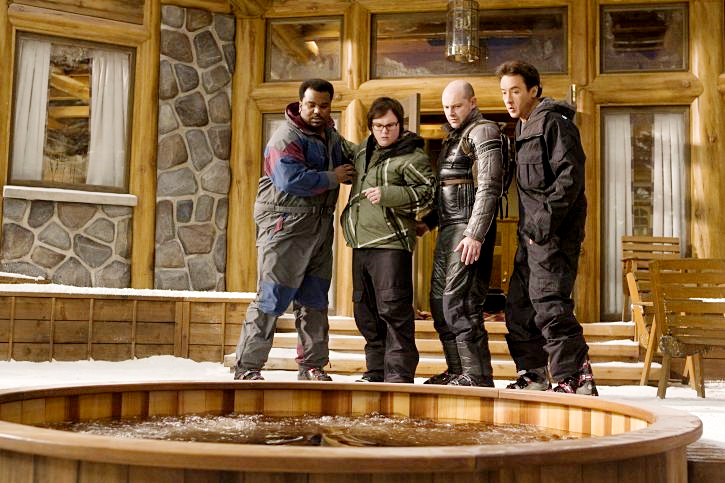
Hot Tub Time Machine

"What...Again?!"

These things go in cycles, but every so often someone has to do the "If I Knew Then What I Know Now..." movie. Let's tick off a few, shall we? "Big," "Freaky Friday," "Vice Versa," "Like Father Like Son," "Peggy Sue Got Married," "18 Again!" (with Charlie Schlatter), "17 Again" (with Zac Efron), they (and I'm sure I've left one or a dozen out) tell the story of a bitter adult who yearns to go back to the time when they were happy ... before all "THAT" happened, and they learn...what, that life wasn't as good as they thought, or they'd probably do the same thing all over again ... whatever, their eyes are opened to some basic truths about themselves or their times and that "there's no time like the present." It's the future, get used to it.

After so many variations (or are they parallel universes) on the theme, we should be used to it by now. Sadly,
"Hot Tub Time Machine" is a roll-back to those films without significantly supplanting that feeling of Déjà vu while seeing it. It actually feels like a been there/done that version of "Back to the Future" (very much so*) in the process, with only an an upsurge in smut to recommend it. Even the era the quartet goes to (Reagan's 80's) is a recall of the period where these "do-over" films occurred with alarming frequency...again and again.

The basic plot is: after their friend Lou (
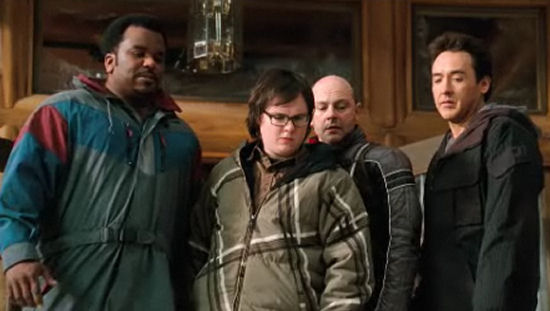
Rob Corddry) attempts suicide, buddies Adam (John Cusack), a recently dumped insurance salesman, and Nick Webber-Agnew (Craig Robinson) decide to take their friend (as well as Adam's nephew, played by Clark Duke) on a sentimental journey for the weekend to their favorite party location—Kodiak Valley Ski Resort, which has fallen on hard times.

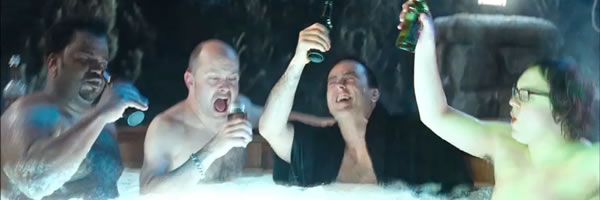
At least the room still has a hot-tub. But a drunken slob-party knocks vodka and an illegal Russian energy drink, Chernoblé, into the hot tub's controls sending the four back to 1986 and that one eventful week-end they'd celebrated before. After that, everything went down-hill for them, so it's conveeeeenient that the HTTM takes them to that one point in time. From then on, it's Big Hair, poofy parkas and leg-warmers, some minor time-goofs, and 80's references around every corner.

Corddry's character comes out strongest,** an anarchic spirit dispirited, a man so debauched that anything and everything can and should be tried if only to feel something, anything from the torpor he suffers from. For him, life is a gateway drug. He learns the valuable lesson: events in time are not fixed, they can be changed. He discovers this, first, to his pain, and then, to his delight, and its his very go-for-broke spirit that "makes things happen," to everybody's advantage. And for a movie guided by John Cusack and directed by Steve Pink (who co-produced the superior "Grosse Pointe Blank" starring Cusack), the movie adheres to a fairly conservative conclusion, where the entrepreneurial spirit (and a bit of insider-trading prescience) can conquer your inner slacker. W. would be proud.

I wonder if that's what they intended.

From a technical stand-point, the movie's sort of a mess. Oh, it keeps its concurrent time-lines properly creased, but it has the look and feel of an 80's B-movie, not unlike "
Better Off Dead" (also starring Cusack), which felt like it was hurried through (despite a good first half) and then it became a matter of knuckling down and finishing the thing within time and budget...but not inspiration. It has the feel of a low-end TV-movie that could never be shown on TV due to its raunchiness.

It's okay to waste a couple hours on, but, really, don't you have better things to do with YOUR time? You just might want to experiment with your own hot tub to get those hours back.

"Hot Tub Time Machine" is a Cable-Watcher.

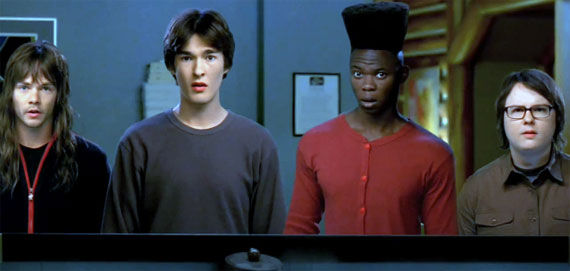
* Okay, instead of a Delorean Time Machine, this one is another 80's icon, a hot tub. The boys—it is SUCH a boy's movie—must recreate the disasterous weekend they'd experienced: Cusack's character suffers a nasty break-up, while being stabbed with a fork, Cusack's nephew keeps zapping away—rather than fading—if his conception doesn't happen, Richardson's character introduces a song that hasn't happened yet—"but you'll love it" he says—Corddry's character must suffer the same fight-humiliation he orginally did, and uses his knowledge of the future to alter events. Crispin Glover's in both films, and Chevy Chase's character could be Doc Bown in disguise. Sure, it could be an "homage," but it plays like a set-piece by set-piece remake—and that was done in "Back to the Future, Part II." In fact, the more I think about it, Zemeckis and Gale have a potentially lucrative law-suit brewing. But then it's released through United Artists, so maybe "lucrative" doesn't apply).

** Who comes off the worst is Chevy Chase in a ill-conceived half-idea of an Alternate Reality Hot Tub Maintenance Man. Maybe they thought Chase would add something to the proceedings with some choice ad-libs, but if he did, the part was a real dud to begin with. I kept hoping that he'd be revealed to be Clark Griswold
thrown out of the time-space continuum by a Christmas lighting disaster.

Wednesday, November 18, 2009

2012

"...And I Feel Fine"

Earth to Roland Emmerich: "Cut it out!"

Between "
Independence Day," "The Day After Tomorrow," and, now, "2012," the German director has now destroyed the world three times.

Well, enough is enough. Gaea's getting pissed.

And so am I.

Seventeen special effects companies, including Sony and Digital Domain (two heavy-weights and they're not even the first ones listed) were employed to create the global carnage on display in this flick, and there's still a recession going on. The attention to detail and dedication to photo-realism is the only evidence of professionalism in the enterprise. That's entirely appropriate as the only reason to see this monstrosity is to witness things blow up "real good." That they do. Los Angeles develops wrinkles and cracks that even
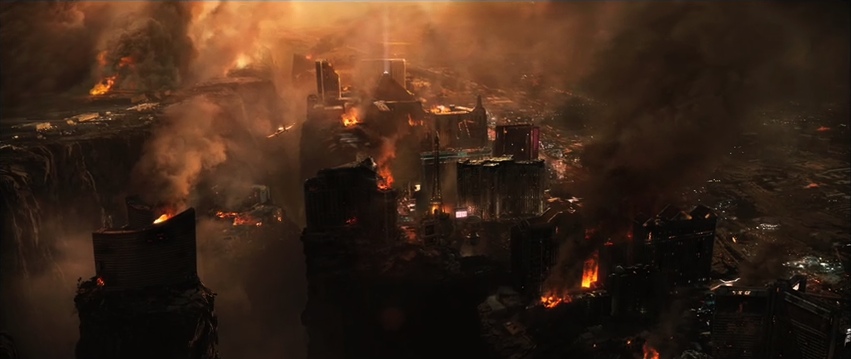
Joan Rivers' supply of Retin-A can't erase and falls into the Pacific. Yellowstone faithfully incinerates in a verrry slow pyroclastic flow that the hero can out-run. Las Vegas becomes the new Grander Canyon (they were going to knock those buildings down anyway!). Hawaii's a volcano (but the surfing's great!). Washington D.C. becomes more chaotic than it already is.

I'll admit it. There is a giddy, monstrous 2-year old's glee in seeing the White House (which Emmerich imploded with a shiny blue destructa-beam in "Independence Day") being destroyed again—this time by the aircraft carrier John F. Kennedy, propelled on a Potomac tidal wave (That's about as "high concept" as this film gets). And St. Peter's. Tibet.* All the hots spots become much hotter. The fly-over-and-through of Los Angeles over the splintering clover-leafs and under collapsing buildings is a thrilling roller-coaster ride through Hell with digi-people clinging to collapsing floors, all manner of auto-mayhem and even violence by Rolling Donut sign. But if you were to take out all the countdowns to disaster in "2012" ("We've got five minutes before everything blows!!") and just include the disasters, you'd have a 20 minute highlights reel, rather than a 158 minute poorly written series of contrivances and coincidences.

And everything blows, anyway.

You'd almost think the thing was worthwhile with
Chiwetel Ejiofor, Oliver Platt, John Cusack, Danny Glover, George Segal and Thandie Newton in the cast. But they're only mouth-pieces for exclamatory dialog and furrowed brows. Seems the whole thing starts with a planet alignment, which triggers solar flares which sends out neutrino's that miraculously microwave the Earth's core and destabilize the Earth's tectonic plates, reverse the Earth's magnetic field and create monster tsunami's. Now, in this world-wide scenario, everybody in the cast has only one degree of separation to everybody else, so that they can look with surprise at their monitors and intone "Wait! I know that man/woman/dog!" Coincidences are the order of the doomsday, and little dialog goes unmatched without the appropriate chunk of irony whistling through the air and squishing the speakers with a thud. It's the kind of movie where hubby says to wife "I feel like there's something pulling us apart" right before a fissure opens up between them. When St. Peter's Basilica starts to collapse, the cracks split down the Sistine Chapel right between Man and God's fingers. Roland Emmerich is not a subtle director. No man whose ambition is to make a better "Godzilla" movie can be.

And what Emmerich is re-making here is "
When Worlds Collide,"** a 1950's sci-fi flick that imagined Earth hit by another planet, and its treasures, two-by-two's of animals and a lottery-chosen clutch of humans are rocketed off to the convenient companion planet that precedes it. Here, the art is rounded up, libraries accumulated, animals airlifted, and although a lottery is mentioned, the folks who go in the arks are world leaders (naturally), the folks who can afford to pay 1 billion euros per seat, and anyone conniving enough to smuggle themselves on-board. The Best and the Brightest. Everybody else becomes part of the new petroleum deposits the survivors will profit from in the future.

Talk about your disasters. Imagine a world where among the survivors are Dick Cheney, Mahmoud Ahmadinejad, Hugo Chavez, Rod Blagojevich, Paris Hilton, Mike Tyson and Pat Robertson, but no research scientists—not even the guys who invented Post-it Notes! That's a version of Hell even Milton wouldn't have conjured.***

It was at this point, I would have been happy to see everybody die, but no such luck. The last few minutes of the film are
disaster heaped upon disaster, with survival dependent on the actions of one man—guess who? But, my concern was what exercises I could find to relieve the pain in my eyes from rolling them so much. They don't sell aspirins in the lobby. Not even chocolate-covered ones.

Truth be told I don't enjoy writing reviews for bad movies, as there's more inspiration in good ones. But I'll leave it with this quote from the director (in a New York Times profile by Tyler Gray) complaining about people's reactions to his making a film like "
2012" in a "post-9/11 environment."

"If I cannot destroy a big high-rise anymore, because terrorists blew up two of the most famous ones, the twin towers, what does this say about our world?”

Our world is fine, Rollie, no thanks to you. But it says your priorities are really shitty.

And the only way to make it good to us is to make all your digital models of people caught in wholesale slaughter based on your likeness.

Verstehen sie?

Verstehen sie nicht.

"2012" is a Cable-Watcher.****

* But not Mecca. Fatwa's need not apply. Kinda lily-livered of Emmerich to not risk personal destruction when destroying the world for his art. Don't they have "sins of omission" in Islam?

** And just our luck, that master of the cinematic form Stephen Sommers ("The Mummy," "Van Helsing," "G.I. Joe: The Rise of Cobra") is making his own direct re-make of "When Worlds Collide" to be released in 2010. Oh, the joy.

*** Not to politicize too much (or think, God help me) but given the Ark scenario envisioned by the movie, with the whole "two-by-two" concept, I'm imagining the passenger list is restricted to "breeders," meaning there are no gays and lesbians on the boats. Emmerich is gay. What is he thinking?

**** Part of the mission of these reviews is to promote the theatrical experience when it is deemed important to the presentation of the story. It is tempting to say that "The Big Screen" is the only way to watch "2012," because there are so many little demons in the details. But, no. The story is so lunk-headed and gleefully clap-happy nihilistic that the best presentation is merely putting a bow on a cess-pool.

Tuesday, March 31, 2009

War, Inc.

"War, Inc." (Joshua Seftel, 2008) It's hard to say exactly when the satire of "War, Inc." starts to outwear its welcome. It does a very neat job of skewering so much that was wrong with the Bush Administration and its gung-ho weldng of the Military-Industrial Complex made simple, while at the same time being rather prudish about why it might not be such a good thing to export American culture to other parts of the world. Perhaps the problem is it doesn't take anything seriously, not its believes-in-nothing protagonist, not its comical situation (it's trying to be "Dr. Strangelove" but has more in keeping with "The Americanization of Emily" or even "John Goldfarb, Please Come Home"), it would probably sneer at the legitimate instincts that might engender such over-reactions...and then when it decides to get serious about something, you start looking around for the apple-pie salesman. Let's review.

Hauser is a corporate hit-man (what inspires
John Cusack to play assassins—not enough action movie offers?) working for the multi-national, multi-faceted Tamerlane Corporation. Hauser gets a new assignment from the just-out-of-office Vice President (Dan Aykroyd, animating Dick Cheney) to assassinate one Omar Sharif (seriously), the head of UgiGas in Turaqistan, where America has just won the first-in-history 100% "completely out-sourced" war. Hauser is posing as an event-planner for Tamerlane's first Corporate meeting in its new acquisition, the centerpiece of which will be the marriage of Turaqistan's jail bait pop-star Yonica Babyyeah (Hilary Duff, miles away from Disney) to one Ooq-Mi-Fay,* all in an effort to inspire Democracy in the Turaqistanis with American culture.

Already you can see the combination of deep thought and juvenilia mixed in one big lumpy stew, but the movie occasionally scores grisly points: reporters in Turaqistan enjoy the "Imbedded Journalistic Experience," a Six-Flags-like jerk-ride that lets them gape at high-def war-footage while strapped into comfy high-chairs feeling the buffets; and one point Hauser checks in with a chorus line of Turaqistani women high-kicking...with artificial limbs. All visitors be they friendly or terrorist walks away with a Tamerlane SWAG-bag, a running gag that doesn't stale.

Hauser is so dead inside, that the only way he can feel anything is kicking back with a shot-glass of hot-sauce straight, although he is frequently diverted by a left-wing journalist (
Marisa Tomei, excellent...again!) trying to get to the bottom of anything. Yonica Babyyeah is your basic Britney-Jessica-Christina-Paris-Lindsey-Miley sex-'tween (authentically played by Hilary Duff, who convincingly curses like a sailor) although the point of the vapidity of America's pop-culture is done to death. John Cusack's sister Joan is his administrative assistant in a performance that is extreme even for her. Sir Ben Kingsley rounds out the cast as Tamerlane's Supreme Commander Walken, in an American accent highly reminiscent of the bad ones Laurence Olivier used to sport, when he deemed to slum as a colonist.

Eventually everything comes to such a frothy rabid boil that it curdles, so much so that even someone sympathetic to its ideas (like me) would rather invest their time in writing a letter to their congressman than sitting through this thing again.

* His father's name is Ooq-Yu-Fay. That might be the tipping point right there.

Saturday, January 24, 2009

Midnight in the Garden of Good and Evil

"Midnight in the Garden of Good and Evil" (Clint Eastwood, 1997) This may seem like an oddball project for Eastwood, but truth to tell, it fits him like a wolfish scowl. He's always been interested in "true-crime" stories, and John Berendt's fictional non-fiction book about the Jim Williams trials fills that bill. Eastwood loves to shoot in the South, and Savannah, Georgia provides a wonderful backdrop for the jazz afficianado, who can use the music of the tangentially related Johnny Mercer.

And most importantly, it's a story of outsiders and iconoclasts, and that's where Eastwood excels. He was obviously having the time of his life fitting in the kooks and eccentrics who flit about the story like one of Luther Driggers' lassooed flies. For Eastwood, it must have seemed like filming "Every Which Way But Loose" with a murder trial thrown in. And he clearly loves working with drag queen The Lady Chablis working her into as much as the movie as he can, no matter how illogically--he squawked about getting more money, Eastwood probably figured he'd better earn it. During an extended comedic set-piece where Chablis crashes a very posh debutante ball and shocks the locals you can almost hear Eastwood chuckling--John Cusack is encouraged to mug just a bit too much.

And the cast, though not so stellar, is filled with great character actors: Eastwood crony Geoffrey Lewis, Kim Hunter, Jack Thompson, Dorothy Loudon, Richard Herd, Bob Gunton, Michael Rosenbaum, and the irrepressible Irma P. Hall. Doesn't matter if you've heard of them or not, you'll recognize them from other things. Heading the cast alongside Cusack is a sly and reserved Kevin Spacey, with molasses running through his veins. The only sour note is the one struck by Jude Law as the murder victim. You only wish there were more bullets.

It was the perfect tonic for Eastwood, coming between the "Absolute Power," and "True Crime."