Showing posts with label 1991. Show all posts

Friday, October 25, 2013

The Addams Family

First, came the macabre series of Charles Addams one-panel cartoons in The New Yorker (where the ghoulish family were only periodic characters).

Then came the TV series—the characters' names provided by Addams himself.


A quarter century later, given the trend to recycle old television into new movies, The Addams Family came to the big screen.


The Addams Family (Barry Sonnenfeld, 1991) The first directing job by cinematographer Barry Sonnenfeld, who came out of a short, boisterous career that started in the Coen Brothers/Sam Raimi early years of hyper-activity, something that he has maintained throughout his own films. Sonnenfeld's movies careen between dead-pan humor and break-neck agitation—you could see it in some of his camera moves for the Coen's and you can certainly see it in the pell-mell caroming of the first big-screen version of The Addams Family.  The casting is truly inspired and may, in fact, be perfect, with Anjelica Huston as Morticia, Raul Julia as Gomez, Chris Lloyd as Fester, and Carel Struyken as Lurch.*  

But the breakout performance is by 11 year old Christina Ricci as daughter Wednesday, who manages to make her lines all laughers with a bland expression and a direct unironic reading of her lines.  She found the secret to making the script work, because it isn't very good, (a collaboration between Beetlejuice author Larry Wilson and Edward Scissorhands scripter Caroline Thompson) not doing anything really unique with the characters, basically amping up the character traits of the TV versions while creating a plot in which Uncle Fester has been missing for 25 years (presumably lost in the Bermuda Triangle).  Gomez's crooked accountant (played by Dan Hedaya) attempts to bring an impostor in to take over the Addams fortune.  For awhile, it looks like the plan succeeds, but it doesn't, and it's soon revealed that the impostor really IS Fester, and blah, blah, blah. 


One of the jokes that works-Pugsley's collection of "Stop" signs

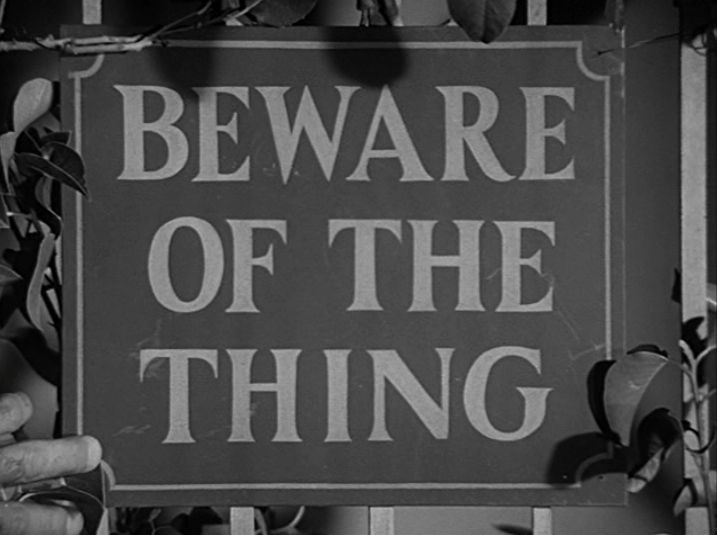
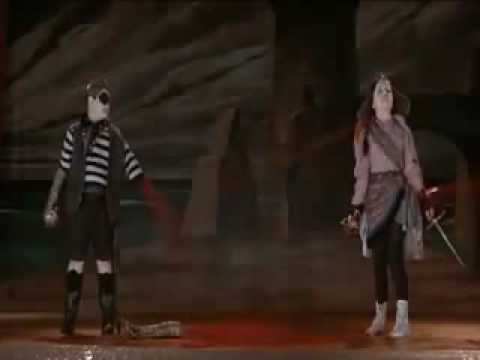
Sonnenfeld ramps up the film for all it's worth, making a lot—in fact, too much—of the character of "Thing," the disembodied hand-servant to the Addams, but the only time the film gets lively is when children Pugsley and Wednesday are forced to participate in a school version of "Hamlet" which involves a sword-fight that they make look decidedly real.  Sonnenfeld had the help of two legendary craftspeople Owen Roizman (who shot The French Connection and The Exorcist**) and master editor Dede Allen (who edited Bonnie and Clyde, Slaughterhouse-Five and Reds), but even played well, the material is stale, and was a major disappointment.  When it was announced that a sequel was being prepared, one could only think "...why?"


One of the Addams cartoons used in the film—this one
before the credits!  Frankly the film could have used
more of this and less of what they did use, which was
watered down sit-com material.


Addams Family Values (Barry Sonnenfeld, 1993) As much of a fan as I was of the "Addams" television show—I liked them, far more than the bland television families usually presented—I didn't even go see Addams Family Values in the theater (I was working—a lot).  

Big mistake.  Sonnenfeld was back, having completed a slightly tamer Michael J. Fox comedy in the interim.  Dede Allen was gone.  Owen Roizman was replaced by Don Peterman (who'd DP'd Star Trek IV, Splash, and Flashdance) and Ken Adam, legendary Art Director came on-board.


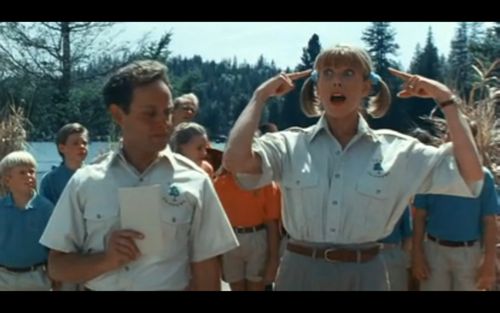
But the most important element was the script...written by Paul Rudnick*** with what must have been a poison pen from an inkwell filled with snark and maliciousness.  It is an extraordinarily funny movie, despite an unpromising premise: the Addams welcome a new child to the family, a boy, Pubert (the original name Charles Addams gave to Pugsley, rejected by the network censors). This creates enormous tension in the family, as Pugsley and Wednesday exhibit jealously and make many plans to kill the child, who manages to thwart their every efforts.  Concerned, Morticia and Gomez hire a series of nannies for the kids, all of whom are frightened away by the children, except for Debbie Jilinsky (Joan Cusack, never funnier), who attracts the attentions of Uncle Fester.  When the children become suspicious of her behavior, she convinces Gomez and Morticia to send them to Camp Chippewa, run by the extraordinarily wasp-y and perky Gary and Becky Granger (Peter McNichol and Christine Baranski), who make no secret of their disgust with these "weird" children who don't fit in.


Indoctrination in Addams Family Values


Now, that is truly creepy.  And funny.  The "Camp Chippewa" segments are the best of the film's sub-plots, indicating that if someone wants to do another film with the Addamses they need to 1) get them out of the house and 2) hire Rudnick (This iteration's Gomez, Raul Julia, sadly, passed away a year after Addams Family Values was released).  But, the entire film has more zest, more life (or what passes for it, given the subjects) and genuinely twisted humor than the original exhumation.****  It's always a pleasure to run into on the tube, no matter at which point one comes in.  


* I love doing this if only to share finds: like Carel Struyken's 360 photography site, which you can find here.

** Roizman left the production after a month.  Sonnenfeld ended up finishing the film himself.

*** Rudnick did some dialogue touch-up on the first film.

**** I've spared a lot of the quotable lines (they're peppered all over the Inter-spider-web anyway), but one little joke I love is the lighting of Mortiicia in Values-taking the "Kirk-lighting effect" used a little in the first film, and in the second, bending lightwaves backwards in order to achieve the same effect in every. single. shot.

Finally, this is my favorite Charles Addams cartoon....


Saturday, October 20, 2012

Shadows and Fog

Shadows and Fog (Woody Allen, 1991) When Woody Allen makes a film in the style of Ingmar Bergman (Interiors), it's done in deadly earnest.  But, when he takes on German Expressionism, entering the angular world of Lang, Murnau, with a para-nod towards Kafka, it's a comedy.  Not quite sure why; maybe he has an affinity towards one stylization and the other he just finds phony, but the different approaches are like, well, day and night.  Allen explored that theme—taking the same story and interpreting it as either comedy or tragedy—in Melinda and Melinda, a bit of a mis-fire—but one suspects that the Nordic tradition he buys completely, and completely dismisses the German (God knows why).

Here, the visual is pure dread, but the subject matter is a mixed bag of precision and vagueness, comedy and darkness.  Allen plays Kleinman, a passive-aggressive bookkeeper, who is recruited in the middle of the night by a vigilante mob (including David Ogden Stiers and James Rebhorn) to roam the streets looking for a serial strangler.  Being a professional coward, and only dealing well with facts and figures in black-and-white, Kleinman is ill-suited for the activity and begs off, inviting suspicion from the group.  When there is speculation that maybe he won't do his duty as a citizen because he might be the strangler, Kleinman caves.

On his dark journey through the city streets (the largest set ever built in New York's Kaufman-Astoria Studios, making this Allen's most expensive film), he runs across an all-star cavalcade of slothful potential victims: a philosophy student (John Cusack) with a weakness for prostitutes (among them Lily Tomlin and Jodie Foster, madamed by Kathy Bates), a circus love-triangle tangentially related (with John Malkovich, Mia Farrow and Madonna) and the town coroner (Donald Pleasence), who has a purely scientific interest in the killer.*

Kleinman soon realizes that life simply doesn't add up, that a little slippage occurs, especially when it comes to illusion and reality (in the form of a very handy and practical magician named Armstead, played by Kenneth Mars).  The film struggles with the dichotomy throughout, as highly contrasted as the black and white photography, never truly meshing, and finally ends, as many of Allen's weaker films—and one of Allen's strongest ones (Hannah and Her Sisters)—do, with a Deus ex Machina** that buttons everything up inexplicably, leaving no questions but a lot of raised eyebrows.

Which is fine for the purposes of the film, but it's hardly what you'd find in an example of German Expressionism, where the punishment fits the crime...and where things really are in black and white.  


* Yes, the film is top-heavy with fine actors (and Madonna), but if you look in the darkened nooks and crannies of the film you'll also find Fred Gwynne, William H. Macy, John C. Reilly, Josef Sommer, Wallace Shawn, Kate Nelligan, Kurtwood Smith and Philip Bosco.  Was this film cast or filmed at a SAG convention?

** Here's a question:  It's a Woody Allen film; Can there be a Deus Ex Machina if there's no Deus?

Wednesday, June 16, 2010

The Rocketeer

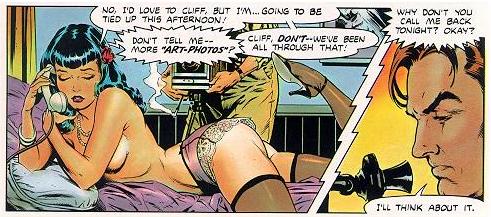
"The Rocketeer" (Joe Johnston, 1991) Graphic artist Dave Stevens was handed an assignment for a new comic book*—he'd get to create an eight-page second feature of his own devising and do anything he wanted with it. For Stevens, that meant it had to have a pulp-fiction atmosphere, a late 1930's Los Angeles locale, an art-deco look, and characters with which he was familiar enough to draw. He based the hero on himself, his mechanical engineer Peavey on Doug Wildey (who'd created "Jonny Quest") and for the hero's girlfriend, a forgotten pin-up girl of the 40's and 50's, "Bettie" Page.**

That second feature, "The Rocketeer," quickly eclipsed the comic's title character, and moved to its own publication that, due to Stevens' fastidious attention to artistic detail, came out only infrequently. But the elements were there to attract Disney, looking for a comic-book hero that could economically catch the wave of the recent burgeoning comic-book movie and match the box office returns of the "Batman" series.

Even though "The Rocketeer" didn't have the Caped Crusader's cache of cultural iconicism (That's Adam West-speak for recognition by the general public), the cult-status of the comic and the script's deep-dish banquet of 30's flotsam (Rocket-packs, Flying Gee-Bee's, Nazi's, gangsters, ugly goons, Howard Hughes, zeppelins, Erroll Flynn swinishness, and the Griffith observatory) looked like it was going to be 1991's "sure thing" at the box-office.  So confident that it would soar on plumes of flame into the stratosphere that Disney honcho's put out a "memo" saying that this was "the way" they were going to make movies: good properties, well-cast with cheap stars--put all the money up there in the screen.

Good plan if only "The Rocketeer" hadn't flamed out and fallen to Earth.  "The Rocketeer" under-performed badly at the time of its release.

It became popular on the rental circuit, but the damage was done.  No sequels (a trilogy was planned), the other studios chortled about Disney's memo hubris, and went back to paying stars (and their agents) $20 million for a movie.

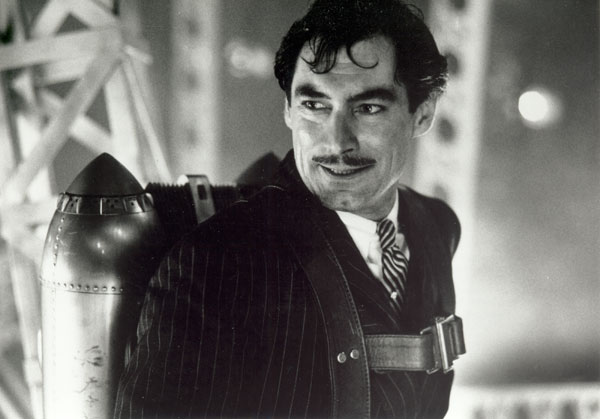
Too bad.  "The Rocketeer" is not that great of a movie, but if it had inspired similar "value" films, it would have been worth it.  The thing is, its heart is in the right place, it's sweet and affectionate about the period it's in, the romance is chaste and makes no concessions to modern audiences, the players adept—Billy Campbell was born to play "The Rocketeer," he looks just like Dave Stevens and any movie with Alan Arkin and Paul Sorvino, AND Terry O'Quinn, it goes without saying...plus, Tim Dalton got to bust up his Bond image a bit. 

The movie only takes off, logically enough, when the rocket-pack fires, then things zip, zoom, loop-de-loop and go slightly out-of-control in a giddy display pyrotechnics.  The rest of the time the film stays firmly rooted to Earth, refusing to soar.  Oh, Dalton has fun with his role—he was always better suited playing bad-guys, anyway—And Jennifer Connelly adds some brief spark to her role as "Jennie," Cliff's naive actress girl-friend. 

That's the problem.  Sweet as it is, "The Rocketeer" could use some spice, which Disney was just too timid to provide.  "Jennie" was "Bettie" in the comics, specifically "Bettie" Page, who was far more world-wise and ambitious than the screen incarnation could capture.  There was a bit of the real Page's persona in the original character, all too aware that she was the type of girl "men like," and all too willing to exploit her looks to be exploited.  That was way too hot for Disney, who gussied Connelly up from head to toe, effectively neutering her ambitions.  That the real "Bettie" Page was still alive at the time, and fully capable of contacting lawyers, probably influenced Disney's decision, as well.

And that's too bad.  "The Rocketeer" takes chances, but still feels "safe," something the comic was having too good a time to worry about. 

Dave Stevens, died after a long fight with leukemia, at the too-young age of 52.

Splash page ad from the original "Rocketeer" story, which promised more pulp sensibility than it delivered (at least it had a guest appearance by an unnamed "Doc" Savage character) but still contained the necessary "Bettie" Page figure.

* Mike Grell's "Starslayer" #2 was the first appearance of "The Rocketeer"

** She wouldn't stay forgotten for long.  "The Rocketeer" re-generated interest in her long career as a photographer's model, and "nudie" dancer, and she was able to see some money from the marketting of her image.  "The Notorious Bettie Page" is based on her life.  She didn't like it much, reportedly.

Saturday, January 31, 2009

Raise the Red Lantern

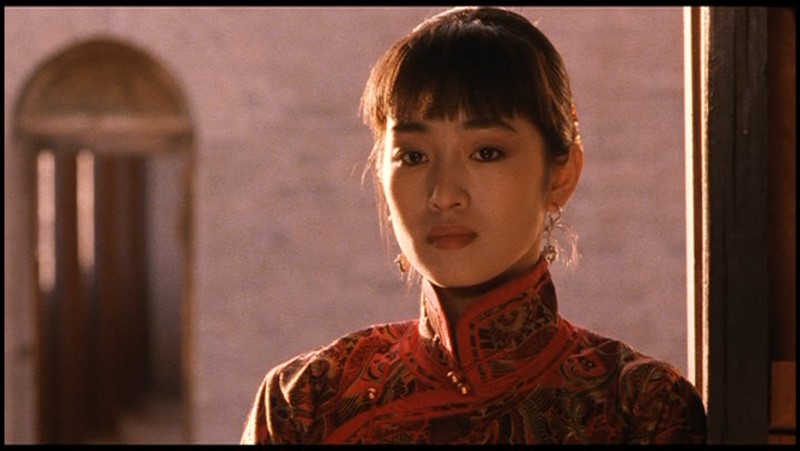
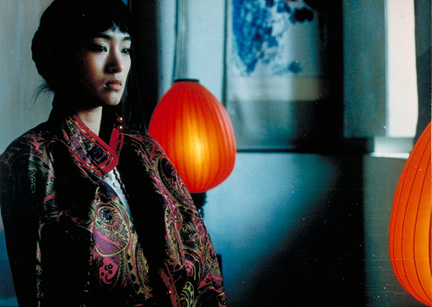
"Raise the Red Lantern" aka "Da hong deng long gao gao gua" 大紅燈籠高高掛 (Yimou Zhang, 1991) Typically gorgeous Zhang Yimou film, although at this early stage with a very limited budget. But that doesn't limit his imagination. The film is staged (with the exception of a prologue) in an clutch of houses, which are the enclave for The Four Mistresses of The Master. Wife #4 Songlian (Li Gong) was a college student who dropped out when her father died, and now is the new bride, the youngest and most frequenly sought by The Master for her favors. Every night is a competition among the wives as the one for whom the red lanterns are raised receives special treatment. This leads to duplicity and deception and Songlian is caught in the middle and learns cunning when dealing with the outwardly polite, but squabbling mistresses.

The compositions and colors are as sumptuous as one has come to expect from Zhang, but his manipulation of light is just as impressive, the film descending into murky twilight as the bitter consequences of the Mistress' actions become apparent, and the psychological wounds tear at the women. Although the acting is by and large austere, the director keeps the emotions brewing through his subtle manipulation and triangulation of passed looks and simmering reactions. Very early in his career, it shows Yimou Zhang as a master of formal cinema, and capable of great effect with merely actors and a limited location. As he embraced new technology and expanded his horizons, his cinema would explode. with possibilties. He is one of the few directors whose work I always anticipate.

Wednesday, April 23, 2008

Mississippi Masala


"Mississippi Masala" (Mira Nair, 1991)

There is so much that I liked about Mississsippi Masala that is seems churlish to be critical. It is the story of a family of Ugandan Asians expelled from their homeland by Idi Amin who fetch up in Greenwood Mississippi, living on the charity of relatives. Most of the movie takes place in 1990 and revolves around the Romeo and Juliet tale of Meena and Dimitri, a black carpet cleaner who first meet when she rear-ends his truck. Nair also shows us the circumstances of the family's expulsion from Uganda in order to introduce us to Okelo, the childhood friend of Meena's father, Jay. He is the person who persuades Jay that he must leave his homeland because 'Africa is for Africans now, Black Africans'. Yet, he is the one who rescues Jay from prison by bribing the police chief. This friendship is important because it reveals the tension that drives the movie, between what people feel about each other and what they feel about race and how these can conflict within the same person. The strength of this movie is that Nair manages to let all sides tell their own story and she refuses to be partial. We end up being as sympathetic to the Asian-Americans as to the African-Americans, to the immigrants as to the natives. The only group that comes out wholesale as less than sympathetic are the few White characters who appear. There are plenty of scenes that are well-observed such as when Meena first meets Dimitri's family at a backyard barbecue when she is interrogated by his family who are fascinated by her - the irony is that as they try to understand where she is from and what category she fits into, it is finally clear that she is the only one at the party who is truly African.

What doesn't work so well for me was first of all the episodic nature of the movie. Nair is concerned to give us a full context for the experiences of this Ugandan Asian family and so we have the sub-plot of her father's struggle to be compensated for all that he has left behind in Africa. It is rather heavy-handed as is some of the direction. There are times in the movie when the acting seems forced and awkward and you wish for a lighter hand on the tiller. However, it is a movie that is more than the sum of its parts.