Showing posts with label 1993. Show all posts

Friday, October 25, 2013

The Addams Family

First, came the macabre series of Charles Addams one-panel cartoons in The New Yorker (where the ghoulish family were only periodic characters).

Then came the TV series—the characters' names provided by Addams himself.


A quarter century later, given the trend to recycle old television into new movies, The Addams Family came to the big screen.


The Addams Family (Barry Sonnenfeld, 1991) The first directing job by cinematographer Barry Sonnenfeld, who came out of a short, boisterous career that started in the Coen Brothers/Sam Raimi early years of hyper-activity, something that he has maintained throughout his own films. Sonnenfeld's movies careen between dead-pan humor and break-neck agitation—you could see it in some of his camera moves for the Coen's and you can certainly see it in the pell-mell caroming of the first big-screen version of The Addams Family.  The casting is truly inspired and may, in fact, be perfect, with Anjelica Huston as Morticia, Raul Julia as Gomez, Chris Lloyd as Fester, and Carel Struyken as Lurch.*  

But the breakout performance is by 11 year old Christina Ricci as daughter Wednesday, who manages to make her lines all laughers with a bland expression and a direct unironic reading of her lines.  She found the secret to making the script work, because it isn't very good, (a collaboration between Beetlejuice author Larry Wilson and Edward Scissorhands scripter Caroline Thompson) not doing anything really unique with the characters, basically amping up the character traits of the TV versions while creating a plot in which Uncle Fester has been missing for 25 years (presumably lost in the Bermuda Triangle).  Gomez's crooked accountant (played by Dan Hedaya) attempts to bring an impostor in to take over the Addams fortune.  For awhile, it looks like the plan succeeds, but it doesn't, and it's soon revealed that the impostor really IS Fester, and blah, blah, blah. 


One of the jokes that works-Pugsley's collection of "Stop" signs

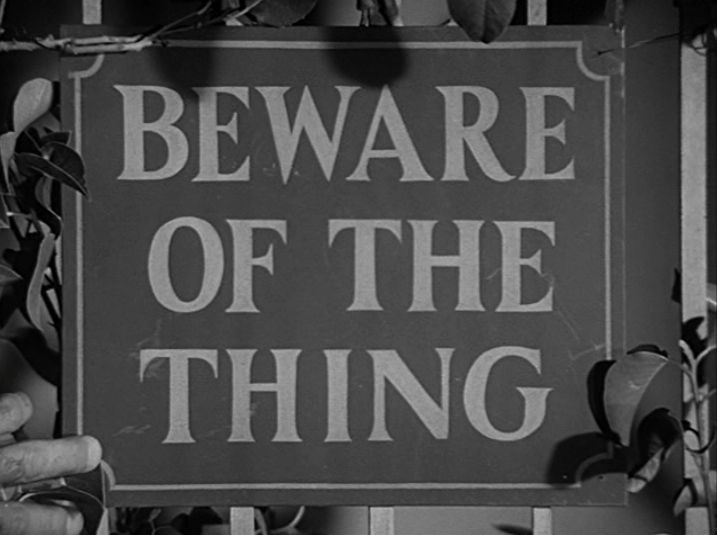
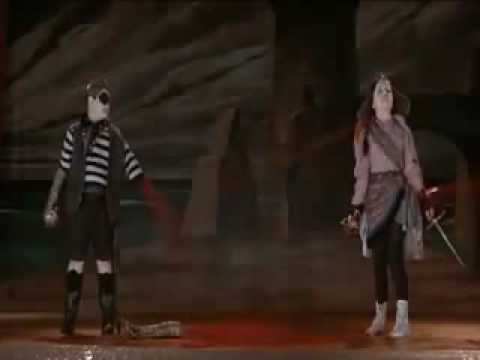
Sonnenfeld ramps up the film for all it's worth, making a lot—in fact, too much—of the character of "Thing," the disembodied hand-servant to the Addams, but the only time the film gets lively is when children Pugsley and Wednesday are forced to participate in a school version of "Hamlet" which involves a sword-fight that they make look decidedly real.  Sonnenfeld had the help of two legendary craftspeople Owen Roizman (who shot The French Connection and The Exorcist**) and master editor Dede Allen (who edited Bonnie and Clyde, Slaughterhouse-Five and Reds), but even played well, the material is stale, and was a major disappointment.  When it was announced that a sequel was being prepared, one could only think "...why?"


One of the Addams cartoons used in the film—this one
before the credits!  Frankly the film could have used
more of this and less of what they did use, which was
watered down sit-com material.


Addams Family Values (Barry Sonnenfeld, 1993) As much of a fan as I was of the "Addams" television show—I liked them, far more than the bland television families usually presented—I didn't even go see Addams Family Values in the theater (I was working—a lot).  

Big mistake.  Sonnenfeld was back, having completed a slightly tamer Michael J. Fox comedy in the interim.  Dede Allen was gone.  Owen Roizman was replaced by Don Peterman (who'd DP'd Star Trek IV, Splash, and Flashdance) and Ken Adam, legendary Art Director came on-board.


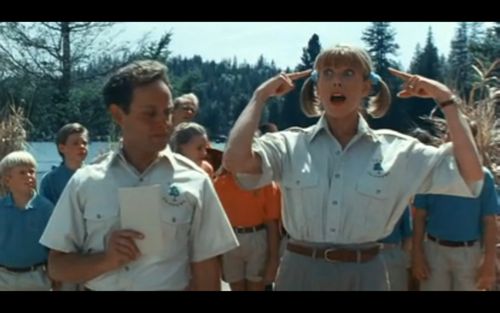
But the most important element was the script...written by Paul Rudnick*** with what must have been a poison pen from an inkwell filled with snark and maliciousness.  It is an extraordinarily funny movie, despite an unpromising premise: the Addams welcome a new child to the family, a boy, Pubert (the original name Charles Addams gave to Pugsley, rejected by the network censors). This creates enormous tension in the family, as Pugsley and Wednesday exhibit jealously and make many plans to kill the child, who manages to thwart their every efforts.  Concerned, Morticia and Gomez hire a series of nannies for the kids, all of whom are frightened away by the children, except for Debbie Jilinsky (Joan Cusack, never funnier), who attracts the attentions of Uncle Fester.  When the children become suspicious of her behavior, she convinces Gomez and Morticia to send them to Camp Chippewa, run by the extraordinarily wasp-y and perky Gary and Becky Granger (Peter McNichol and Christine Baranski), who make no secret of their disgust with these "weird" children who don't fit in.


Indoctrination in Addams Family Values


Now, that is truly creepy.  And funny.  The "Camp Chippewa" segments are the best of the film's sub-plots, indicating that if someone wants to do another film with the Addamses they need to 1) get them out of the house and 2) hire Rudnick (This iteration's Gomez, Raul Julia, sadly, passed away a year after Addams Family Values was released).  But, the entire film has more zest, more life (or what passes for it, given the subjects) and genuinely twisted humor than the original exhumation.****  It's always a pleasure to run into on the tube, no matter at which point one comes in.  


* I love doing this if only to share finds: like Carel Struyken's 360 photography site, which you can find here.

** Roizman left the production after a month.  Sonnenfeld ended up finishing the film himself.

*** Rudnick did some dialogue touch-up on the first film.

**** I've spared a lot of the quotable lines (they're peppered all over the Inter-spider-web anyway), but one little joke I love is the lighting of Mortiicia in Values-taking the "Kirk-lighting effect" used a little in the first film, and in the second, bending lightwaves backwards in order to achieve the same effect in every. single. shot.

Finally, this is my favorite Charles Addams cartoon....


Saturday, March 26, 2011

Fire in the Sky


Fire in the Sky (Robert Lieberman, 1993) I once remarked to a family in distress that they'd gone through "everything except alien abduction." Not the most comforting of consolements.

But, if you believe Fire in the Sky (and that's not easy...), alien abduction can be pretty dull.

"Based on the (proverbial) True Story"—but trumped up by screenwriter Tracy Tormé from Travis Walton's account, evidently because studio executives found the story boring—Fire in the Sky tells the story of Walton's disappearance in 1975 around the area of Snowflake, Arizona.  What's different about the Walton story is that it was witnessed by several of his co-workers who were clearing brush for the Forest Service.*  They didn't actually see Walton lifted by the bright blue-green light into the bright disk that attracted them to the area.  He was lifted a couple feet into the air, then knocked to the ground, prompting his friends to gun their truck and get the hell out of there...like the friends they were.  They came back for him...but the disc and Walton were gone.

Cue the theremin.

The initial phone call to the police merely said that Walton was "missing." The abduction story didn't come up until they actually met with the local constabulary to report that he was gone.  An extensive search ensued, lasting five days, until Walton called from a phone booth to ask to be picked up at a gas station—he was fully clothed, wearing the same clothes as the last time he'd been seen, and not naked as the movie depicts.

So...what happened?  The "story" had attracted attention, not only from police, but also "ufologists" from around the country, who flew to Arizona as if it was Mecca.  The story became bigger than the described spacecraft (8 feet high, 20 feet across) could contain.

And that's what Fire in the Sky is about—the turmoil on the ground between the friends and Walton's relatives and the police and the "experts."  It's a tale of suspicion, speculation, confused facts, guilt, and accusation....with elements of torture by black-eyed beings that looked like fetuses.  Of course, the latter is the most interesting part, so they save it for near the end—with Travis kept in a huge honey-combed hive until he escapes and starts making the aliens' lives difficult.  It bears little resemblance to his story, which involves actually moving the controls of the ship, and visits by smiling human-resembling "ambassadors."  The movie's sequence involves horror elements and probes and sticky shrouds.  The rest resembles a Lifetime movie with aliens instead of oxycontin.

Whether it's true or not seems irrelevent.  The story and the movie made from it is dull.  It only leads to wondering why advanced aliens choose to scope out the limited life-forms on Earth in rural areas at night, why they avoid cities or cultural centers (maybe they saw how well it went in The Day the Earth Stood Still?) or even people with a phD or a Master's degree...in anything.  There's only one thing sure, and that is, while the upper 1% of this country have 38% of the wealth, the lowest seem to get all the alien abductions.


* One of the things that brings up red glowing pulsating flags is that the job they were doing was running behind in schedule, and the crew had been working quite long hours to make up time.  There was some speculation that the whole thing was cooked up because the job couldn't be finished, and the disappearance was a convenient distraction.  But, that the contractor never invoked the "act of God" clause to get out of it, flies in the bug-eyed face of that theory.

Tuesday, October 26, 2010

Faraway, So Close!


Faraway, So Close (aka In weiter Ferne, so nah!) (Wim Wenders, 1993) "Every time your ears ring, an angel gets its wings."  Wenders' follow-up to Wings of Desire is not a footnote to the original or a regurgitation.  It's one of those rare sequels that seems necessary and actually throws the first into a better light, complementing and expanding it.

Faraway, So Close! follows the path of "the other" angel, Cassiel (Otto Sander, who is brilliant in this, in a comic performance that Wings of Desire barely hints at), who, although he might want to become human, will not...until his hand is forced in an incident that is reflected from a tragic incident in the first film.  "It's so vivid here!" he exudes upon entering the world of color, following the same rules that the first film established (the angels' POV is black and white, but ours is color; no one but small children can see the angels, and when they "fall" they lose their armor...and their pony-tails), but things are different.

Wings of Desire takes place in a divided Berlin and so everything has a sense of separation and crossing over, but Faraway, So Close! has no Berlin Wall in it, the structure having been sledge-hammered into extinction by the very citizenry it restricted (and Mikhail Gorbachev, whose act of omission in preventing the incidents, allowed the Wall to fall, is prominently featured in a cameo).  Like the Wall, there's a lot of falling in Faraway, So Close!, but a lot of gliding, too.  In fact, the film is less about barriers than it is about how things transition so easily between one and the other.  Drama becomes comedy, comedy becomes tragedy, the color/black and white sequences fade together in a single shot, and the film is a sub-titler's nightmare moving seamlessly between several languages—Horst Buchholz (remember him from The Magnificent Seven?) plays a German expatriate moved back from America and he banters between German and English without missing an umlaut, and Bruno Ganz, the fallen angel from Wings..., has decided to become a pizza chef with accompanying Italian language (and why not?).

Where Wings of Desire was all Sturm und Drang in its romanticism, Faraway, So Close! is a comedy in both the modern and classic terms.  It feels less like an "important" film than its older brethren, but seems absolutely necessary, like a completion to the first, and makes you think that the story was really about the "holding-back angel" Cassiel all the time.  If you love the first, you should see the second, but don't expect the same response to either of the movies when you're done.  Still, it is always nice to visit old friends.

Faraway, So Close! also features Nastassja Kinski as the angel Raphaela, Willem Dafoe as a shady character with time on his hands, Lou Reed, and, of course, Peter Falk.


Friday, April 23, 2010

Benny and Joon

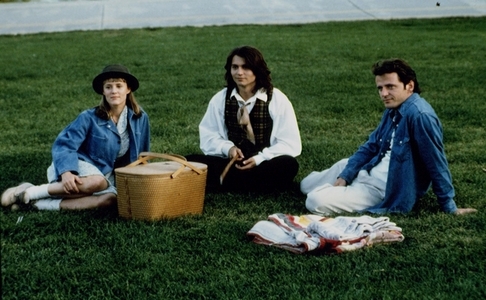
"Benny and Joon" (Jeremiah S. Chechik, 1993) When examining the career of Johnny Depp, one looks to the blockbusters: the "Pirates" movies, the many Tim Burton collaborations. But then there are the films that fall through the cracks—not unlike the characters in this film. For anyone doubting Depp's ability to not depend on his looks and create a compelling character, "Benny and Joon" is a revelation.

Filmed in
Spokane, Washinton, it tells the story of of an auto mechanic, the eponymous Benny (Aidan Quinn) taking care of his 1/3 eponymous but schizophrenic sister, Juniper (Mary Stuart Masterson). He's torn between his commitment to Joon and his desire to live a life, free of her responsibility. But, his sense of duty and brotherly protectiveness trap him into doing nothing else, even though he might be inadequate at the care-taking task.

By luck of the draw,
Sam (Depp) drops into their lives...literally; Joon wins him in a poker game. That plot development prat-falls "Benny and Joon" directly into "twee-ville," but Sam's addition to the cast arrives just in time to avoid it. Sam is a movie-freak, who knows every movie—the weirder the better—and models himself as the love-child of Buster Keaton and The Little Tramp. Eccentric, scruffy, but in a non-threatening way, Depp's head-tilting performance is just the right fizz to put in this Shirley Temple of a movie. You wonder what he's going to do next, and Depp is given enough ground to deliver a number of mute routines that are laugh-out-loud charming.

But, there are more joys to be had with guest-turns by
Julianne Moore, William H. Macy, CCH Pounder, Oliver Platt, and Dan Hedaya—the kind of movie where your attention is slapped every few minutes with a "They're in this?" It might get a little heavy for kids in the third act—"everybody's MAD at each other!"—but there's a satisfying resolve. And if you have a sister or daughter not in love with Johnny Depp yet, this one will do it.

"Benny and Joon" is a Chick-Flick that guys can enjoy.

Wednesday, December 16, 2009

Searching for Bobby Fischer


"Searching for Bobby Fischer" (Steve Zaillian, 1993) There's an episode from "Star Trek: Deep Space Nine" that's more than a bit absurd, but it has one good line in it. It centers around a baseball game among the crew-members, and while Captain Sisko patiently explains the rules to his Security Officer Mr. Worf, he tells the Klingon, "...the important thing isn't who wins, but enjoying the game." Worf looks at him a moment and says, "If that is true, then why do you keep score?"

Can't argue with that logic. Our culture (and not just our sports culture) is suffused with the "Win at all costs" mentality that has broken down our moral fiber. You can't blame
Vince Lombardi alone. One must look at the business class who steal the same "Winning is the only thing" philosophy (and other absurdly inappropriate sports metaphors) to push their paeons to boost profits no matter who gets hurt in the scrimmage (One remembers the tapes of Enron shills guffawing over "granny in California" freezing to death). And there has been the same philosophy in politics as long as there has been politics. We're all about "losing gracefully" in this country. But it seems like "winning gracefully" went out with Christy Mathewson, in favor of the "Ty" Cobb philosophy of play of the spike-and-dance in the end-zone and the smash-dunk in the basket.

And you can't win in this country without crowing you're going to Disneyland.

"Searching for Bobby Fischer" is one of my favorite sports movies. And it's about chess—hardly a sport although you can never say it's not a competition. But the film is very much about sports, as it explores the competitive spirit, and gamesmanship, and being "a good sport," whether you're a winner or a loser. Based on the book by
Fred Waitzkin about his son Josh's aptitude and passion for chess at a young age, and the care and nurturing of a savant, "Searching for Bobby Fischer" sounds like a snoozer (especially given it's about chess!), but it's anything but.

Fred Waitzkin (played by
Joe Mantegna) is a sports-writer, and, like a lot of parents, his pathology is to re-create his glory days through the accomplishments of his child. A series of gifts of sports paraphenalia to son Joshua (Max Pomeranc) goes unloved, but a walk though Washington Square amid its chess-players catches his youngster's eye, and he begins a self-taught exploration of the game, gaining the attention of the trash-talking Vinnie (Laurence Fishburne), who thinks the kid's the "next Bobby Fischer." Good enough for Dad, who puts him in tournaments with other kid chess-players and their anxious fathers (among them David Paymer and William H. Macy), then enrolls him with a chess-master (Ben Kingsley) to improve his game and toughen his resolve. But, Josh' starts to lose, and his Mom (Joan Allen) and teacher (Laura Linney) express concerns that he may be being pushed too hard. Complications...and tough choices...ensue. Raising a kid is not like a chess game. There aren't any rules, and more often than not any child will be a few moves in front of you. And the mistakes are all too evident: there's the reclusive Bobby Fischer, who serves as mythic inspiration and cautionary tale; and there's the kid from the other side, untempered with a killing instinct and a sociopath's glint in his eye.

Zaillian, a gifted script-writer, takes a difficult text of intellect and psychology and makes a rousing film of it, gentle and tough. If he compromises at all, it's that he gets all of Josh's influences in the same room to kibbitz and try to "Obi-Wan Kenobi" winning strategies to him against "The Other," making it feel a bit too much like Luke "embracing the Force" to tag the entry port on the Death Star. But even there, Zaillian tilts it 90° with a move that simultaneously undercuts the suspense but heightens the stakes, while defining character through action and reinforcing the message of the movie. A moment of grace in a graceless world.

And, now, fifteen years after the movie, we know where Bobby Fischer was: criss-crossing the globe with his winnings, settling in those anonymous places by other chess-masters who could stand to be around him. He'd occassionally spew some anti-semitic venom into a world that no longer cared and had turned their back on him. Not that he could see—he'd already turned his back on humanity. He even wrote a congratulatory letter to Osama bin Laden after the 9/11 attacks. And he complained that he hadn't "received one thin dime for the totally exploitative Paramount Pictures 'rip-off' full-length feature film." He died of renal failure January 17, 2008 in Reykjavik, and on specific instructions only a hand-chosen few witnessed his interment. It was yet another "draw" for Fischer, proving once again you can win and lose simultaneously.


Towards the end of his life "Ty" Cobb was asked if there was anything he would have done differently, and he replied, "I'd have had more friends "

Wednesday, December 2, 2009

The Piano

"The Piano" (Jane Campion, 1993) This award-winning film by New Zealand's High Priestess of Ostracism is an off-putting drama that slowly seduces and mesmerizes.

We first meet Ada McGrath (
Holly Hunter in her Oscar-winning role) in a way that no one else does—in her own words. Purposefully mute since the age of six, she finds herself bought as a wife to a set-in-his-ways settler (Sam Neill) in a rain forest territory of Kiwi natives, a tribe of Māori. Think of it as a counter-clockwise Western of sorts, Down Under rather than Out West and Campion's themes start to come into focus. Ada and her child, Flora (Anna Paquin, in her Oscar-winning role) arrive by boat in widow's clothes and immediately stand out like...well, like a piano on a beach.

Just as she carries her grief in the past with her muteness, she also carries her most prized possession—a grand piano—along on her semi-circumnavigation to the Outback. Seemingly an albatross, the piano is ultimately her most effective means of expression and also her passage to letting go of that past. Dismissed as pointless by husband Alistair, the piano is rescued and settled in the home of Baines (Harvey Keitel), who has forsaken civilization and lives with the Māori people. Baines barters with Alistair, first for the piano, and then for lessons from Ada. Attracted to her, Baines then barters advances for keys of the piano—one key for a touch, two for a kiss. Thereby, Ada can buy back her piano, notes at a time, but there is more in the bargain.

What she's buying back is her soul. What she's buying back is her self. What she's buying back is her sexuality and everything that actually has been bought like a commodity in her arranged marriage to Alistair. But the piano only reinforces burgeoning ties to Baines, and compromises whatever shaky freedom she attains with it. Alistair and his marriage are a prison that holds her against her will, when she already is so self-contained, of her own accord. That Baines takes possession of it, then acquiesces by offering the freedom of it back is too much for Ada to resist. And so, to have her soul, she must give some of her freedom away. It's a bittersweet rebellion that doesn't take into account her oppressor. When Alistair hears of her infidelity, his revenge is to sever her connection to the piano in the most intimate way possible.

Campion is a lyrical film-maker who buries her messages as deep as a Kiwi rain-forest, but the films always ring true with a stark brutality that cuts through any mawkishness. In "The Piano," her metaphors are more obvious than her past films. When, at one point, Ada is nearly taken to the bottom of the ocean by the piano, one can't help but think of the implications of materialism.

But, one is ultimately led to the thought that a woman needs a piano, like a fish needs a bicycle. And if one so chooses and loses one, there are plenty in the sea.

Thursday, February 5, 2009

The Fugitive

"The name: Dr. Richard Kimble. The destination: Death Row, State prison. The irony: Richard Kimble is innocent. Proved guilty, what Richard Kimble could not prove was that moments before discovering his murdered wife's body, he saw a one-armed man running from the vicinity of his home. Richard Kimble ponders his fate as he looks at the world for the last time. And sees only darkness. But in that darkness, Fate moves its huge hand...."

As sepulchrally intoned by William Conrad (far removed from his narration of "The Rocky and Bullwinkle Show!"), you couldn't reach higher levels of melodrama than "The Fugitive" starring David Janssen as Dr. Kimble, running a cross-country race between the man who wants to capture him and the man he wants to capture. I was a devoted fan of the show when it had its initial four year run on ABC-TV in the States, and watched it more religiously than "Star Trek" in syndication.

When I heard there were plans to make a big budget movie with
Harrison Ford, I groaned. How could they possibly take a stretched out concept like "The Fugitive" where half the suspense is how long the man has been on the run and make it work as a compressed two-hour film?

Pretty damned well. Of course, there are changes. The crime is a conspiracy, rather than a random act of violence. Yes, there is a one-armed man. But there are other staples of the series, too.
Kimble must change his identity--he even uses the patented black hair-dye at one point. He toils at...acouple of jobs, posing as various hospital employees and, at one point, a janitor. Yes, he still dangerously acts the Saint, taking time out from his detective work at a hospital to help a kid with a chest condition that's counfounding the residents (one of whom is Julianne Moore). They have the incident from the first season where Kimble goes to see a one-armed man in the local lock-up only to be spotted by Lt. Gerard (Tommy Lee Jones in his Oscar-winning role as "Sam"—not "Philip"—Gerard*) and miss getting caught by that much. And they have the gambit where a fellow passenger on public transportation recognizes the guy across the aisle in the mug-shot on the front page.

But it's action that's been amped up for the film.
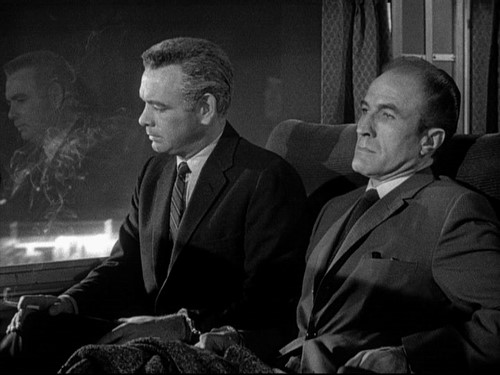
In the tv series, Kimble and Gerard are on their way to Death Row when their H-O scale train (in the model shots) jump the tracks and Kimble escapes.

It's a bit more complicated in the movies—Fate's "huge hand" is ginormous in this one. Kimble and the other prisoners are being transported on a bus,
when an escape attempt kills the bus-driver, sending the bus over a guard-rail and tumbling onto a set of railroad tracks...into the path of an on-coming train. Kimble has just enough time to save one of the guards before he leaps off the bus a split-second before the train hits it. The crash causes some of the cars to detach, derail and come careening after Kimble before crashing spectacularly into a culvert, sending its load of logs exploding into everything in sight. It is spectacular. And sets the audience up by 1) getting them prepared for some stuntly fire-works and 2) lets you know just how desperate Kimble is to avoid being caught so he can find his one-armed man.

The entire chase from escape to ending takes place in a period of less than a week, so he only has to go through a couple changes of clothes, his hair turns back to Harrison Ford brown, and Kimble never has enough baggage to have baggage as he did in the series. Plus, he never has to do anything for full employment for the short period he is free in the movie. Taut, a bit more realistic in maintaining anonymity in a modern world (though not so much with the stunts), "The Fugitive" does a great job of maintaining the integrity of the original and even surpassing it.

Dr. Kimble gets his (one-armed) man.

* One of the improvements in David Twohy and Jeb Stuart's fine script is the squad of deputies Marshall Sam Gerard has helping him investigate this case. In the series, Gerard, as played by Barry Morse, was an obsessive-compulsive lone wolf. He's no less dedicated here, but its sublimated by the way he runs his deputation ragged. It provides a lot of the comedy as well.