Showing posts with label Steve Zaillian. Show all posts

Friday, October 7, 2011

Moneyball

"Re-Inventing the Game/Enjoying the Show"
or
"...Like an Island of Misfit Toys"

"It is played everywhere...in parks and playgrounds and prison-yards.  In back alleys and farmers fields. By small boys and old men.  Raw amateurs and millionaire professionals. It is a leisurely game that demands blinding speed. The only game in which the defense has the ball. It follows the seasons, beginning each year with the fond expectancy of Spring-time and ending with the hard facts of Autumn. Americans have played baseball for more than 200 years, while they conquered a continent, warred with one another and with enemies abroad, struggled over labor and civil rights and the meaning of freedom.  It is an American Odyssey that links sons and daughters to fathers and grandfathers.  And it reflects a host of age-old American tensions: between workers and owners; scandal and reform; the individual and the collective.  It is a haunted game in which every player is measured against the ghosts of all who have gone before. Most of all, it is about time and timelessness, speed and grace, failure and loss, imperishable hope and coming home.  At its heart lie mythic contradictions: a pastoral game born in crowded cities;  an exhilarating democratic sport that tolerates cheating and has excluded as many as it has included; a profoundly conservative game that often manages to be years ahead of its time. And...the men who fail seven times out of ten are considered the game's greatest heroes."      Geoffrey C. Ward and Ken Burns, "Baseball"

Baseball is my favorite sport.  I've played that and soccer (never well) but baseball has always seemed to fascinate me as an observer as no other sport can.  Yes, it depends on athleticism, but it also has an intricate strategy, a formula that can be tossed out in favor of an improvised gambit—baseball can go for long stretches with nothing happening except anticipation, which will snap into frenetic activity, going from 0 to 60 at speeds that NASCAR fans can only dream about.  It can create long-term loyalties but crush your heart in an instant.  It is a cruel mistress, inspiring love but at the cost of your spirit.

There's never been a movie about baseball that has satisfied me.  Often,  the game is ignored for personality, or uses it has a metaphor, wrapping it in myth (The Natural) or legend (Eight Men Out).  But the game is lost in the melodrama, serving only as backstop or stage.

This is why Bennett Miller's film of Moneyball grabbed me so intensely.  Written brilliantly by Steven Zaillian and Aaron Sorkin, it manages to tell the story of the game—as it is now, where budget and salaries have as much to do with a winning season as the efforts on the field, the front office strategy (or lack thereof), team dynamics and its construction, the reliance between old ways of doing things and the boiling down of what it takes to win, its joys and failings in one film, created by filmmakers all playing their A-game.

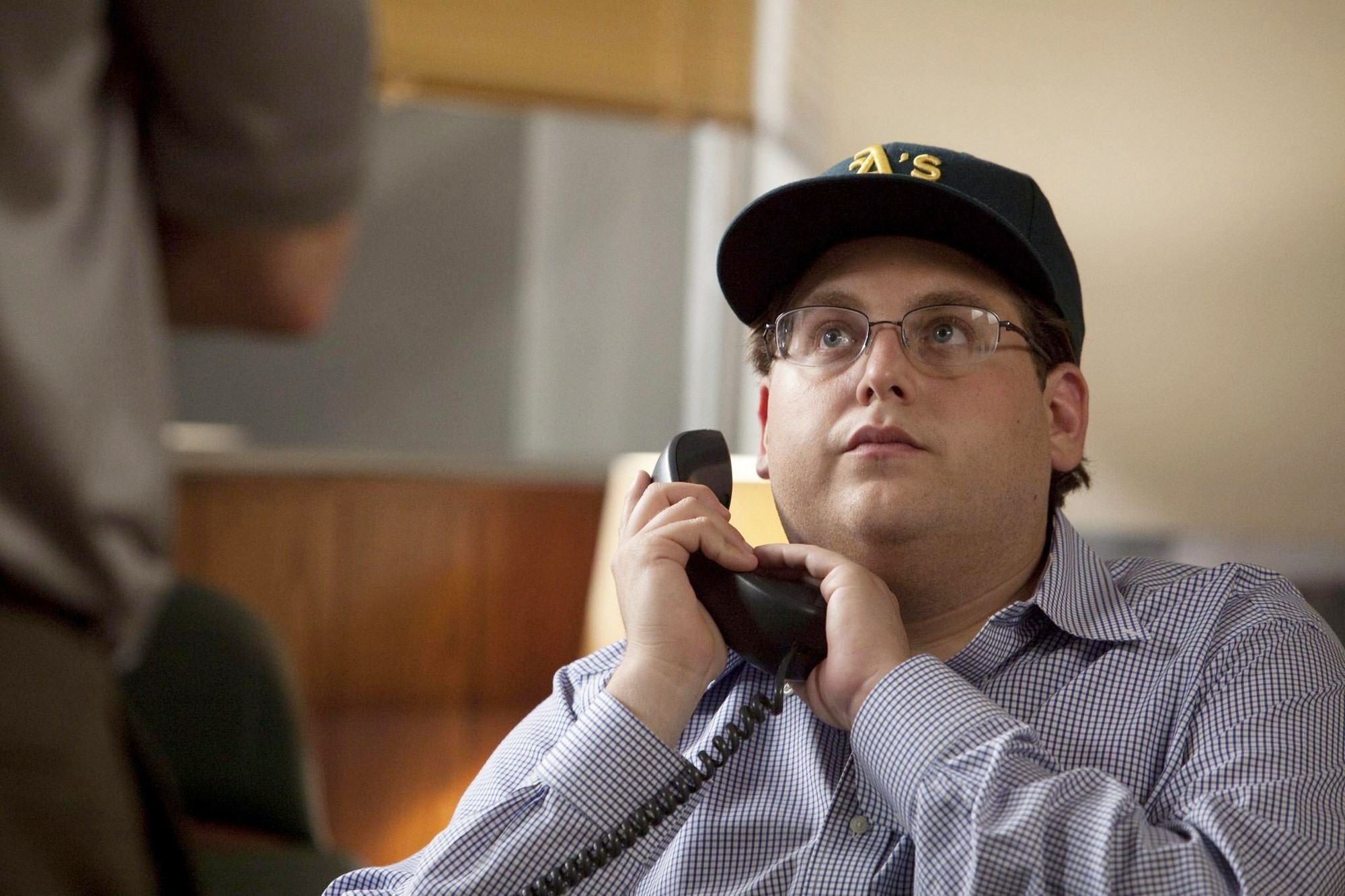
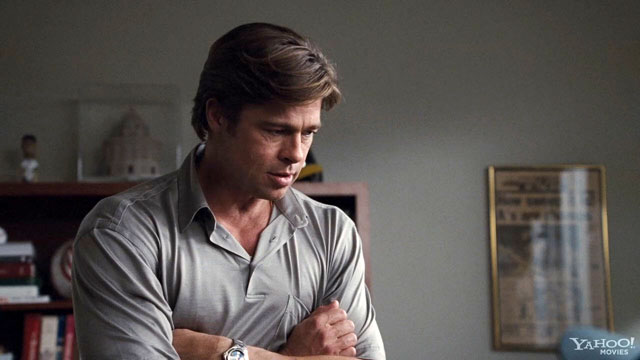
The Oakland Athletics have just lost another chance to make it to The World Series and their general manager, former washout-as-a-player Billy Beane (Brad Pitt) faces a long winter trying to re-build a winning team after losing his three key players while his budget for salaries is capped.  He can't compete with money-pits like the Yankees ("It's like a farm system for the New York Yankees," he gripes to his scouts at one point. "We're organ donors for the rich!").  Convinced that the economics of the game, as it stands, is unfair, he tries unsuccessfully to make headway, until he meets Peter Brand (Jonah Hill—never better), former Yale student in economics, who is working his first job as an adviser to the Cleveland Indians.  The nonathletic portly kid has a unique way of working, matching stats against potential, finding a niche of talent that is undervalued by the old-school way of judging talent ("He's got an ugly girlfriend—means he lacks confidence") Beane's first recruit is Brand as Assistant GM, who can look past the "conventional wisdom" and see the best advantages of the worst paid players.  The strategy is to abandon the "home run hitters" and find the guys who can get on base, make plays and score in-field runs.  The top-dollar guys can have their home run derbies, Beane wants to win, and find a way to win that doesn't depend on the size of the purse-strings.

But, the conventional wisdom still runs the A's.  Beane clashes with the vet scouts and with the coach (Philip Seymour Hoffman, who starred in Bennett's Capote), whose traditional ways tend to hamper the efforts rather than enhance them.  The A's start the season at the bottom of the ALWest, and the traditional empty-air of sports opinion turns against Beane. 

The story is in the record-books, but that's just a collection of stats.  Moneyball, as with "Moneyball," depends on what you do with them.  The nicely streamlined script is smart, subtly funny, and performed by all involved, especially by Pitt, whose never seemed so relaxed in front of the camera, can be caught in nary "a pose," and even manages to do some nifty tricks with delivery that seem beyond casual. Hill is a performer I've always seen as comic stunt-casting, but here, playing a character perpetually on the verge of a peptic ulcer, he gives a performance of such restraint, that when he does break out it's a bit of a revelation.  And Hoffman, playing the A's "seen-it-all" cynical coach, barely lifts an eyebrow playing smug defiance.  There are pieces of this film that I already know will be showing up in my "Best Moments of 2011" at the end of the year.

The film does hedge the timeline a bit.  "The system" didn't pay off quite so immediately for Beane, but it did pay off—enough that the "level playing field" he dreamed of, is even leveler while more askew, thanks to other teams adapting his methods. The "mythic contradictions" of baseball never seem to cease.  

Moneyball is one for the record books and (yes) the best film about sports I have ever seen.

Moneyball is worth a Full-Price Ticket—right behind home plate.


Wednesday, December 16, 2009

Searching for Bobby Fischer


"Searching for Bobby Fischer" (Steve Zaillian, 1993) There's an episode from "Star Trek: Deep Space Nine" that's more than a bit absurd, but it has one good line in it. It centers around a baseball game among the crew-members, and while Captain Sisko patiently explains the rules to his Security Officer Mr. Worf, he tells the Klingon, "...the important thing isn't who wins, but enjoying the game." Worf looks at him a moment and says, "If that is true, then why do you keep score?"

Can't argue with that logic. Our culture (and not just our sports culture) is suffused with the "Win at all costs" mentality that has broken down our moral fiber. You can't blame
Vince Lombardi alone. One must look at the business class who steal the same "Winning is the only thing" philosophy (and other absurdly inappropriate sports metaphors) to push their paeons to boost profits no matter who gets hurt in the scrimmage (One remembers the tapes of Enron shills guffawing over "granny in California" freezing to death). And there has been the same philosophy in politics as long as there has been politics. We're all about "losing gracefully" in this country. But it seems like "winning gracefully" went out with Christy Mathewson, in favor of the "Ty" Cobb philosophy of play of the spike-and-dance in the end-zone and the smash-dunk in the basket.

And you can't win in this country without crowing you're going to Disneyland.

"Searching for Bobby Fischer" is one of my favorite sports movies. And it's about chess—hardly a sport although you can never say it's not a competition. But the film is very much about sports, as it explores the competitive spirit, and gamesmanship, and being "a good sport," whether you're a winner or a loser. Based on the book by
Fred Waitzkin about his son Josh's aptitude and passion for chess at a young age, and the care and nurturing of a savant, "Searching for Bobby Fischer" sounds like a snoozer (especially given it's about chess!), but it's anything but.

Fred Waitzkin (played by
Joe Mantegna) is a sports-writer, and, like a lot of parents, his pathology is to re-create his glory days through the accomplishments of his child. A series of gifts of sports paraphenalia to son Joshua (Max Pomeranc) goes unloved, but a walk though Washington Square amid its chess-players catches his youngster's eye, and he begins a self-taught exploration of the game, gaining the attention of the trash-talking Vinnie (Laurence Fishburne), who thinks the kid's the "next Bobby Fischer." Good enough for Dad, who puts him in tournaments with other kid chess-players and their anxious fathers (among them David Paymer and William H. Macy), then enrolls him with a chess-master (Ben Kingsley) to improve his game and toughen his resolve. But, Josh' starts to lose, and his Mom (Joan Allen) and teacher (Laura Linney) express concerns that he may be being pushed too hard. Complications...and tough choices...ensue. Raising a kid is not like a chess game. There aren't any rules, and more often than not any child will be a few moves in front of you. And the mistakes are all too evident: there's the reclusive Bobby Fischer, who serves as mythic inspiration and cautionary tale; and there's the kid from the other side, untempered with a killing instinct and a sociopath's glint in his eye.

Zaillian, a gifted script-writer, takes a difficult text of intellect and psychology and makes a rousing film of it, gentle and tough. If he compromises at all, it's that he gets all of Josh's influences in the same room to kibbitz and try to "Obi-Wan Kenobi" winning strategies to him against "The Other," making it feel a bit too much like Luke "embracing the Force" to tag the entry port on the Death Star. But even there, Zaillian tilts it 90° with a move that simultaneously undercuts the suspense but heightens the stakes, while defining character through action and reinforcing the message of the movie. A moment of grace in a graceless world.

And, now, fifteen years after the movie, we know where Bobby Fischer was: criss-crossing the globe with his winnings, settling in those anonymous places by other chess-masters who could stand to be around him. He'd occassionally spew some anti-semitic venom into a world that no longer cared and had turned their back on him. Not that he could see—he'd already turned his back on humanity. He even wrote a congratulatory letter to Osama bin Laden after the 9/11 attacks. And he complained that he hadn't "received one thin dime for the totally exploitative Paramount Pictures 'rip-off' full-length feature film." He died of renal failure January 17, 2008 in Reykjavik, and on specific instructions only a hand-chosen few witnessed his interment. It was yet another "draw" for Fischer, proving once again you can win and lose simultaneously.


Towards the end of his life "Ty" Cobb was asked if there was anything he would have done differently, and he replied, "I'd have had more friends "

Saturday, February 14, 2009

All the King's Men (2006)

"All The King's Men" (Steven Zaillian, 2006) The story goes that Robert Rossen, the director of the 1949 version of "All the King's Men" was not happy with his film. Too long, too talky, and too boring, Rossen was unsure of what to cut to get it down to length. A plan was drawn up: he told his editor to take 30 seconds from the beginnings of scenes and 30 seconds from the end. What was left came in under two hours of running time and moved at a jarring pace, but it won Oscars for its star Broderick Crawford, Best Supporting Actress Mercedes McCambridge...and Best Picture.

"
All the King's Men" was already a great film, but there were too many compromises to the Hays Code to get it to the screen. Steve Zaillian (a fine screenwriter, who directed a favorite film of mine "Searching for Bobby Fischer") decided to make a new film of Robert Penn Warren's Pulitzer Prize winning book, and sadly, wasted the opportunity in a film convinced of its own importance.*

From the crack of thunder that appears before the opening credits, to the thudding
James Horner score that telegraphs (with hammers) each imminent plot-point (Horner uses one dirge-like theme which, by its third appearance, I had assigned lyrics "This-is-a-sad-sto-ry/A-bout Lou-i-si-an-na"), to the subdued lighting and the art design in shades of "Godfather" mordant, everything about this movie promises great portent, but merely meanders through its story of how nothing born of corruption can come to any good, be it man, ideals or building materials.

It's a frustrating film to sit through, because the pieces are there given a less respectful (as in funeral respect) presentation. The cast is impressive.
Kate Winslet and Mark Ruffalo and Anthony Hopkins play the well-to-do Stanton clan. Kathy Baker and Jude Law are the blighted Burden clan, and Sean Penn, looking more and more like an young George C. Scott, plays the fictional surrogate of Huey Long, Willie Stark. As his flaks and flunkies, James Gandolfini, Patricia Clarkson and Jackie Earle Haley.

Good cast. But there are problems.
Penn, as he is wont to do, goes over-the-top in his speechifying, his arms waiving wildly in the air, his fingers doing filigreed dances. Where Penn got the inspiration to play it this way is a mystery, as footage of Long in speech-mode (below) shows him much more in control. Not even Adolph Hitler emotes this much. Jude Law, never the strongest of actors, falls into the dreariness of the film, staring at the other actors or nothing-in-particular with sad doe-like eyes.** One suspects editing problems with this film—Zaillian did spend an inordinate amount of time in post-production on it. Subjects are brought up and dropped, like Stark's football-playing son, who figures prominently in the '48 film, is mentioned here and then never heard from again.*** We never do find out how Burden's mother acquires facts to make an accusation against him. Mark Ruffalo's character is left as a dissatisfying enigma.

What we do get is ponderous, and pretentious. Zaillian spends a lot of screen-time trying to show (visually) that the only thing that could unite the "hicks" and gentry of Louisiana is death. Again, that same lesson had been told in better films.


* Given the awards-history of the cast and screenwriter it was assumed that "All The King's Men" would be a top contender come Oscar-season, but its poor box-office reception scuttled those hopes.
** K (who likes Law) kept yelling out "accent-drop!" whenever his "Lawsiana" draw-el moved to Market Street. Anthony Hopkins, the sly old dog, doesn't even try.

*** Sadly, Zaillian, in an attempt to simplify his film, gutted some crucial scenes from it including the sub-plot about Stark's son, and an extended ending that provides the best scenes for Jude Law and Jackie Earle Haley.