Showing posts with label Jackie Earle Haley. Show all posts

Tuesday, November 20, 2012

Lincoln

Noisy and Messy and Complicated
or 
WWLD?

At the end of John Ford's Young Mr Lincoln, "the jack-legged country lawyer" (as played by Henry Fonda) walks up a blighted horizon in the darkening gloom, as thunder rolls in the background, the rough-hewn fence he trudges along taking on the look of military barricades, as the young Lincoln walks with his long stride into the storm of history awaiting him.  Steven Spielberg's Lincoln starts where Young... left off—with the sound of thunder over credits, which evolves into cannon-fire before placing us straight on in the middle of the Civil War, blue-on-gray, white-on-black (and the reverses) amid the blood and the mud of the Earth.  The shots of the battlefield are tight, confusing, with no sense of place, no horizon—just a frame filled with humans killing each other by any means.  No glory.  No higher purpose.  Just the immediacy of conflict.  War is the point at which politics breaks down, and politics is where Spielberg's film is concerned to compare and contrast with today's stew of chicanery, graft, and playing fast and loose with the facts to the purpose of getting your way.  'Twas ever thus, and it was no different in Lincoln's time—they just didn't have cameras documenting everything then.

The approach is as good a starting place as any—that is, ending with Ford's last gambit—linking the two, as both films' main goal is to take the monument out of the man, and put him within reach of attainability, wart and all.  The canonization of Lincoln began at the moment of his death with the pronunciation "now he belongs to the ages" and his visage, homely, homespun, ragged sunken and contemplative, has been preserved in nickel, bronze, marble, granite to the point where one can hardly imagine it as flesh and blood anymore. 


Young Mr. Lincoln: walking into a History still to occur.
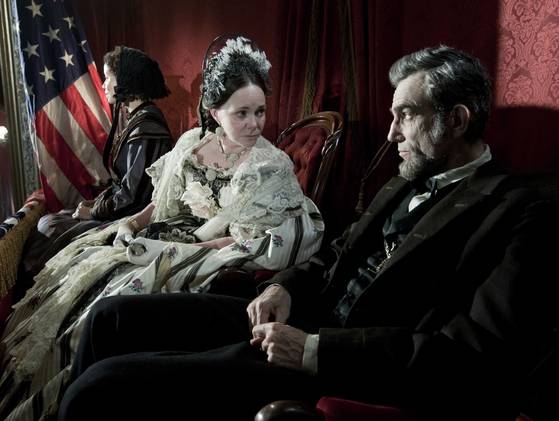
As portrayed by Daniel Day-Lewis, Lincoln is pitch-perfect, not only in his make-up, but his high tenor rasp of a voice, and—the remarkable part for me—in his still-legged gait that kicks and plants itself on the earth, not too steps away from the ragged dance of Wyatt Earp (Fonda, again) in My Darling Clementine.  It's a big, robust cast—I had error alerts for all the names I tried to cram into this article's meta-data labels—but the hub of it all is Day-Lewis' Lincoln.  Soldiers (including Lukas Haas) quote his Gettysburg Address back to him (which the President tries to staunch: "Been there, delivered that."*)  His wife (Sally Field) constantly badgers him—but then she consistently badgers everybody, his cabinet is frequently frustrated by him, by his prevarications, his story-telling that constantly derails conversations to his agenda, and his thought processes which annoy them.  "Actually," says Secretary of State Seward (David Straithairn) after Lincoln quotes verse, "I have no idea what you mean by that."

What he means may be too pragmatic for them, it's just how he expresses it that confounds.  In one exceptional scene—Tony Kushner worked on this script for a long time and it shows—Lincoln explains in minute, often harsh, detail how he employed his newly granted War Powers Act and it comes down to what he thought he could get away with, legally.

His concern, in the waning days of the war, is to pass the 13th Amendment, thereby abolishing slavery, and it takes every trick, every dodge, every promise and appointment in the middle of a lame-duck Congress before the war could end.  The timetable is critical: Lincoln has just been re-elected and is riding a wave of popularity; a crucial number of Congressmen are in their last days of their jobs and are looking to their futures and not to the wishes of their constituents; and, if the war ends, the urgency to pass the Amendment will dwindle, amidst the rebuilding of the Nation.  Lincoln's Republicans will vote for it, but they need to tone down their rhetoric.  The Democrats are dead-set against it, but getting Democrats to agree on anything is like herding cats and Lincoln wants to exploit the party's fractures into fissures.  

So, the problem is attacked from several fronts (if only the war had started that way): Preston Blair (Hal Holbrook), prominent Republican and journalist, is sent to the South to negotiate a Southern settlement, which the South is anxious to do (although Lincoln is reluctant).  Meanwhile, he wheels and deals with the largesse of power, offering appointments, threats, anything to curry votes, and unleashes a trio of stooge-lobbyists (James Spader, John Hawkes, and Tim Blake Nelson) to press the flesh and pass the greenbacks (not "officially," though).  Votes are critical.  On the home-front, Lincoln's son Robert (Joseph Gordon-Levitt) is back from college, but feeling the weight of his kinship with the President and wants to enlist, which sends wife Mary Todd into another accusatory tailspin as she has barely survived the death of their son, Tad.

Throughout, Lincoln keeps his counsel. but sometimes erupts into spasms of frustrationwith "Molly" (as he calls her), the congress and his cabinet, choosing his moments and pressing his advantage, knowing no peace except what he can create for himself.

As good as Day-Lewis is, he's matched by Tommy Lee Jones as House Republican Thaddeus Stevens.  In chambers, Stevens sits and fumes, then reaches his limit and bursts out in loud insulting harangues, just in control enough to get his point across, and even smiling tightly—very tightly—when when dressed down by Mary Lincoln over his tight reins over The White House purse strings.  Jones finds different ways to make his speeches crackle, while never betraying any sense that the words haven't sprung originally from his head.  And Spielberg has given special attention to casting key roles with the like of great character actors like Bruce McGill, Michael Stuhlbarg, and Lee Pace who make their relatively small parts punch out and become memorable.

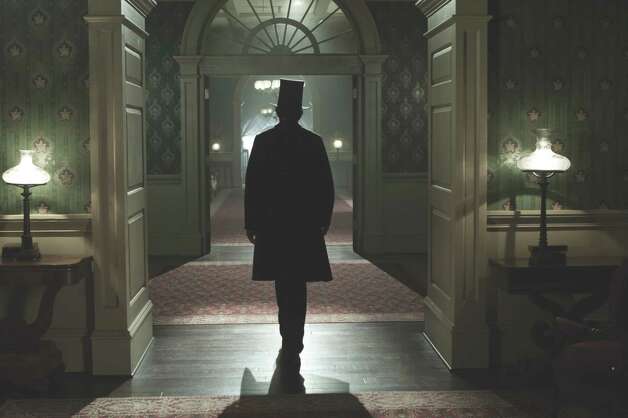
And Spielberg's eye for painterly detail shines, as Lincoln moves through the gloomy corridors of The White House or sets up an eerie dream sequence for the President.  And in one lovely scene, between Lincoln and Ulysses S. Grant (Jared Harris), where the war's toll on Lincoln is expressed in Day-Lewis' exhausted eyes and the shadows of a long rank of soldiers trudging in front of a setting sun play across his face.  

You can't see the moving shadows...
Spielberg's regular team of artists: Kaminski, Kahn, Carter, and Williams construct a great quilt of imagery and dynamics, making Lincoln a fascinating display of historical intimacy writ large.  It would make a superb triple bill sandwiched between Young Mr. Lincoln and The Conspirator.

Lincoln is a Full-Price Ticket.


* There's a nice contrast of Licoln delivering a dedication at a flag-raising ceremony that lasts a measly few lines.  "That's my speech" he says as he tucks his paper back into his stove-top hat.  They can't all be gems.

Wednesday, May 16, 2012

Dark Shadows (2012)
Camping Vamps and Risible Damp
or
"What Strange Terrain is This?"

"Dark Shadows" has been a cult favorite for Baby-Boomers for 40 years (ouch!), long before it was fashionable to have vampires as fodder for young adults.  The ABC soap opera ran for several seasons of afternoons replacing the standard plot-lines of cheating spouses and long-lost family secrets with long-buried family relatives and a full range of gothic ghoulery that plundered every horror story in the crypt-library, including vampires, werewolves, Frankenstein-ish monsters, time-travel, parallel dimensions and ghost stories.

It was a TV habit of mine when I was a kid, timed perfectly to be the after-school tonic for a parochial school education, an occult chaser for the catechism, all those crucifixes I was surrounded by during the day being used for other purposes.  It was also a fixation for Tim Burton and Johnny Depp, Burton digging the horror genre and Depp grooving on the character of Barnabas Collins (played by the late—or is he?—Jonathan Frid, who puts in a very brief cameo here along with a couple of other cast-mates), the reluctant vampire who pursued hearts, rather than the blood that pumped through them.  The result of their dual obsessions is this version of Dark Shadows, produced by Depp, directed by Burton.

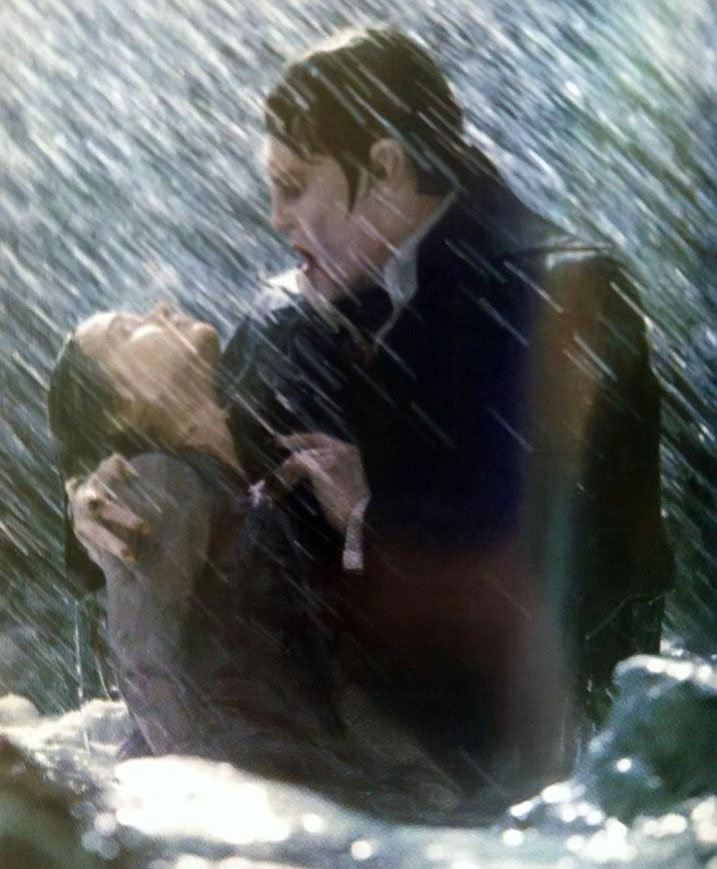
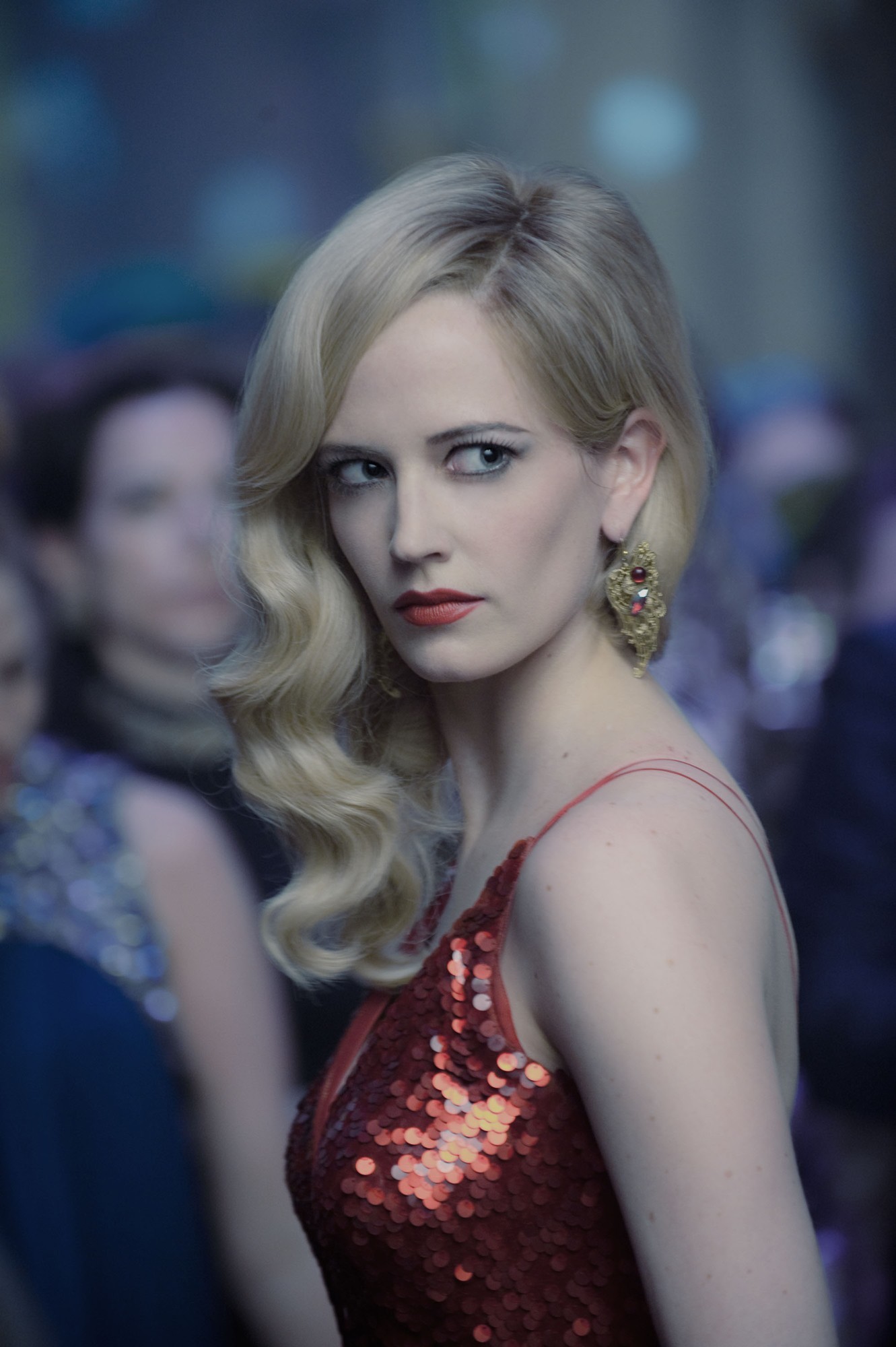
"It is said that blood is thicker than water," narrates Barnabas Collins (Depp), over the strains of Robert Colbert's alto flute-through-echoplex composition "The Secret Room" from the original series.  "It binds us, confines us, curses us."  For a moment, things are fairly serious as the 18th century story of young Collins scion Barnabas is unearthed, with his spurning of the witch Angelique Bouchard (Eva Green) and her subsequent dark revenge, killing the Collins elders, forcing the suicide of Barnabas' love Josette and turning him into an eternally cursed vampire.  She subsequently sets the townsfolk on the monster who chain him into a coffin and bury him for all eternity.

Depp and Burton get it right at the beginning: Barnabas learns his fate.
The worst-laid plans of mages and men...Eternity is cut short around 1972 as the construction of a new McDonald's in Collinswood unearths Barnabas and he lays waste to a construction crew (who must have been getting overtime working at night!) with an explanatory "You have no idea how thirsty I am!" 

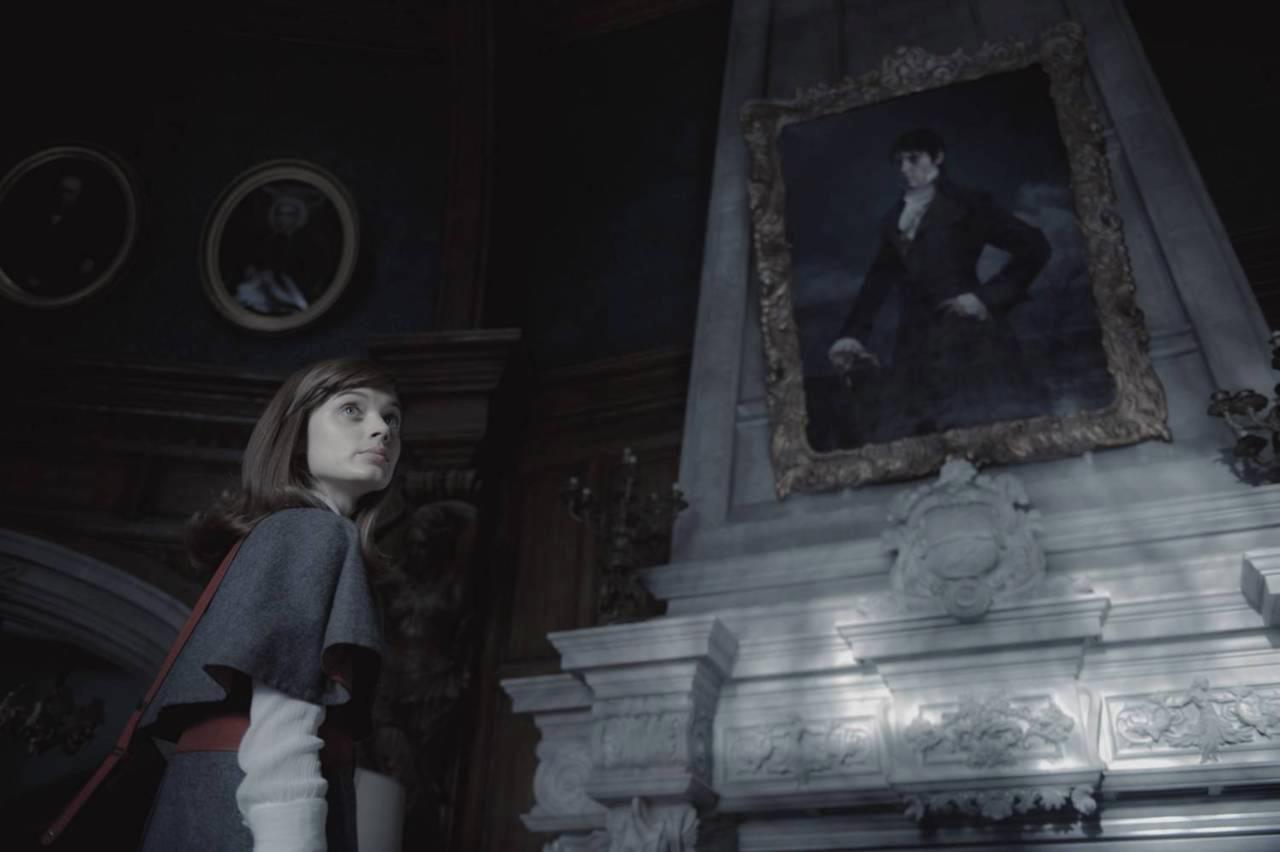
On a parallel course, Maggie Evans (Bella Heathcote, the latest in a long line of Burton ingenues with thin necks topped by big heads with huge eyes and "big" hair) is on a train to Collinswood where she has applied for a job as a governess to young David Collins (Gulliver McGrath), who is having psychological issues from the disappearance of his mother at sea.  Abruptly, she decides to change her name to Victoria Winters, indicating a past she wants to run away from, as The Moody Blues tune "Knights in White Satin" burbles over the soundtrack.  Hey, Burton may be onto something here.  The combining of '70's kitsch and some of its more mordant songs with the gothic mood of "Dark Shadows" works well, setting the tone of the series and the morbid fascination my generation had with it.  Can "Don't Fear the Reaper" be far behind?

Then, things get a little weird.  She's picked up by a VW van of hippies, and there's some stoned comedy about how they're so wasted, and Vicky is cool, man, and it's easy laughs and you wish it was more clever.  It becomes apparent quickly that Burton will be playing this for laughs, which is fine (he always does to a certain extent), but the original material is already so melodramatic and over-the-top that the humor undercuts the effectiveness of what drama there is that ekes through the dramatic stares and the vamping poses.  "Dark Shadows" was always "camp" entertainment in the broad sense, but to broaden it even further nullifies whatever chills and thrills can be drained from it.  This is why Frid's performance on the show was such an anchor for it—he played it absolutely straight, and in fact, ramrod-stiff; you didn't make fun of Barnabas for fear of his wrath—or his breaking down in tears.

Depp's Barnabas is tortured, of course, but risibly so (in a performance that's a combination of Frid's formality, some Max Schreck thrown in, and a bit of Ed Wood cast-mate Martin Landau's incarnation of Bela Lugosi).  And there's the "otherness" factor that Depp brings to so many of his roles, as if he's in a different movie from everybody else—he walks through it, and everybody reacts, usually comedically and derisively.  In part, that's the point: it ties in with Burton's feelings growing up as being an outsider-geek, looking on at the rest of the world that he found strange, while it found him odd (and there's a mirroring through-line of humor throughout the film of Barnabas, out of his time, observing to some horror the eccentricities of 1970's life, that reflects it).*

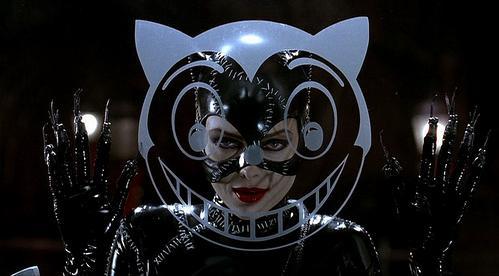
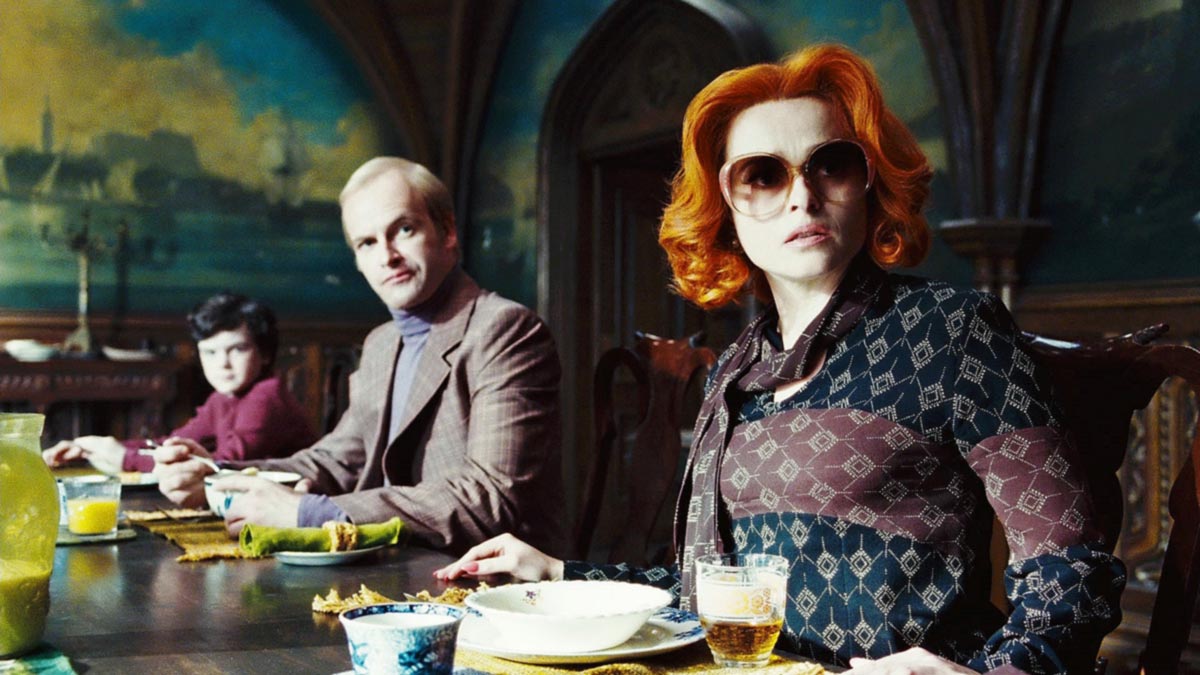
But Collinwood's odd family doesn't bat an eye when Victoria shows up and doesn't react to the disrepair of the gothic Collinwood mansion or to David's assertion that he speaks to his dead mother, and she follows quite readily when the ghost of Josette appears floating down the hallways, whispering "He's coming..."  Barnabas' arrival, in Victorian array and the palest of skin, and the oddest of manners only brings up temporary suspicions, but the matriarch of the house (Michelle Pfeiffer, who played Burton's Catwoman) readily accepts him as family, even after revealing his vampirism.  The cast is uniformly fine, gamely being archly camp throughout, but the one performer who's best at it is Green, who clearly relishes the villainess role and has fun with it, taking it in some very odd, even poignant places.

It looks great.  Burton's films always do, with a superb design sense and his knack for picking terrific, seemingly impossible angles to shoot from.  But, like a lot of Burton films, it tends to fall apart in story, snatching hasty explanations and deus ex machina to get out of trouble, or to provide the director with a bizarre concept that may seem right in retrospective sub-context, but that comes out of nowhere, randomly and jarringly.  One has to stop, back-track, only to realize that, no, this has never been mentioned before, and why now?

One suspects it's a whim, a passing "wouldn't-it-be-crazy-if" thought passed between Depp and Burton as they geek out, rocking in their corners, internal logic no longer mattering as much as a superficial entertaining notion.  As such, Dark Shadows accomplished their goals.  Yeah, it's entertaining, but highly insubstantial, a mere spirit of a movie.

Dark Shadows is a Rental.


The first Dark Shadows movie (left) and the original Barnabas Collins, Jonathan Frid


* This also sets up a series of sight-gags that are somewhat clever, as Barnabas never seems to be able to find appropriate sleeping arrangements at Collinwood.

Friday, February 19, 2010

Shutter Island

"What's yer Next Move, Boss?"
or
"Tag! You're It!"

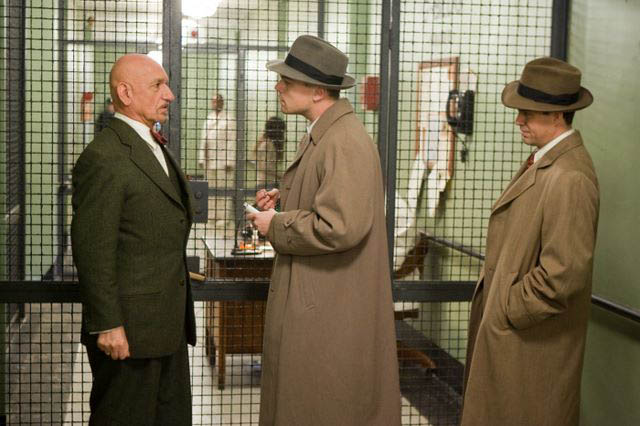
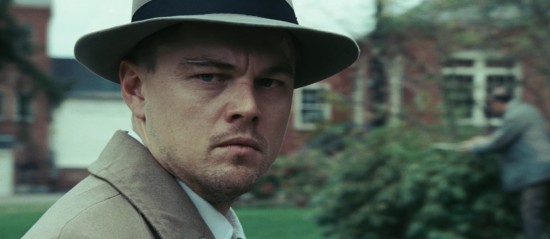
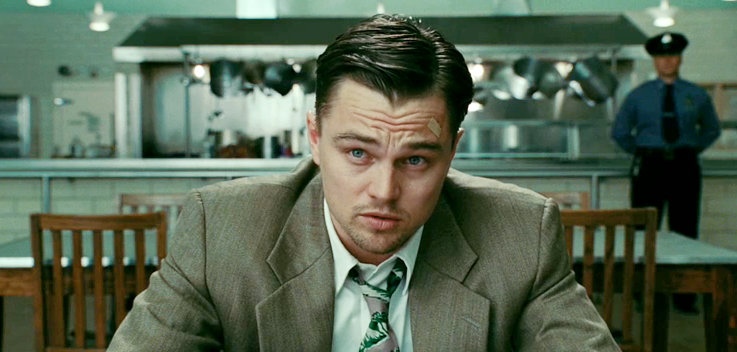
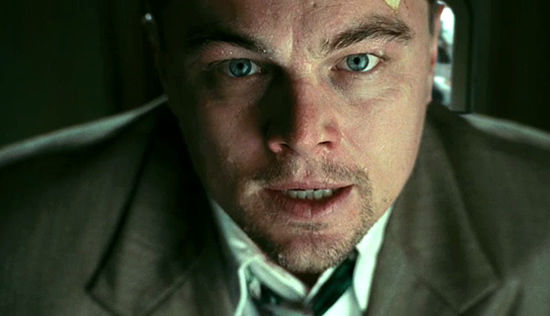
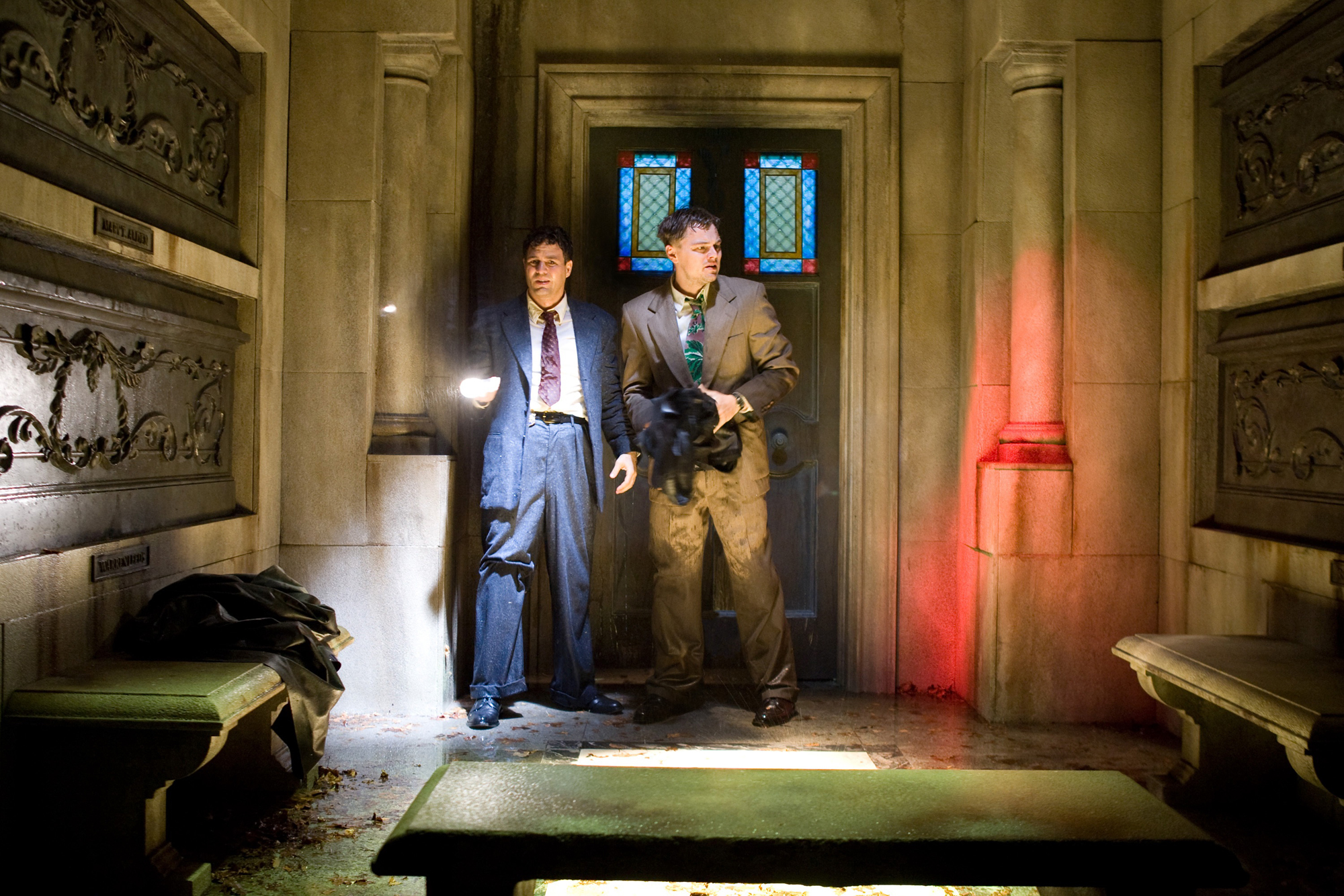
It is 1954, and out of the fog comes a ferry boat carrying two U.S. Marshalls, heading for "Shutter Island", where squats, in various stages of dis-repair, Ashecliffe, an asylum for the criminally insane. In the "head," sea-sick,* is Marshall Teddy Daniels (Leonardo DiCaprio), "the legend" as his partner from Seattle Chuck Aule (Mark Ruffalo, who has a rather thick Massachusetts accent for it) calls him. The two are investigating the disappearance of an inmate from Ward B, the women's section, and right from the get-go, the two are at a disadvantage.

Upon crossing the electrified fence, their weapons are confiscated, security being what it is. "What?" Teddy smirks at the guard "You act like insanity is catching." The guard only smirks back. That should have been his first clue.

The doctors (
Ben Kingsley and Max von Sydow) are helpful to a point, but then they become somewhat diffident and challenging, even obstructing, protective of their "advanced" techniques—"a moral fusion between law and order and clinical care." The missing woman, Rachel Solendo (Emily Mortimer), drowned her kids after her husband was killed during the Normandy invasion and has never acknowledged the act. But she somehow managed to escape from a cell, locked from the outside, and with a guard on duty. Investigating, Daniels finds a cryptic note "The Law of 4. Who is 67?"

But that's all surface.
Daniels volunteered for this case because he wanted to get to Shutter Island for some personal business. He's still haunted by the death of his wife, Dolores (Michelle Williams), who died in a fire that was set by an insane fire-bug named Andrew Laeddis (Elias Koteas**), presently incarcerated in Ashecliffe's Ward C—for the most dangerous criminals. Daniels has done some investigating of the facility, and what he's turned up indicates that radical techniques, from experimental drugs to lobotomies, are being practiced, and as funds are being channelled there from the House Un-American Activities Committee, he thinks the government is working on a secret brainwashing program to infiltrate radicals as double agents. Teddy wants to blow the lid off the place.

That is, if Nature doesn't get the chance first. A hurricane is barrelling down on Shutter Island ("It's like f...ing Kansas out there!"), threatening to cut off power to the electrical systems keeping the prisoners locked up and backed off. If the power goes, there's no back-up generator to kick in.

All of this concerns his partner, Marshall Chuck Aule; Teddy's been doing all this investigating of Ashecliffe, the doctors are resisting co-operating, they have no guns, the facility controls the ferry that's their only way out, and there's a storm coming.
They're stuck on an island with a bunch of crazy convicts and an administrative staff who doesn't like them much, and wouldn't mind if they just...oh, had an accident or something. And Teddy's starting to get sick—plagued by migraines that Dr. Cawley (Ben Kingsley) diagnoses only too quickly with some handy aspirin nearby. Then, there's the German Doctor Naehring (Max von Sydow) who's the co-director of Ashcliffe and chief diagnostician. Teddy was one of the soldiers who liberated Dachau, so he's immediately suspicious of him. "Do you believe in God, Marshall?" Naehring challenges him. "Ever seen a death-camp, doctor?" Teddy sneers back.

There's a lot of story-point to juggle,*** but director
Martin Scorsese focuses on the atmospherics, which is laid down with a heavy hand in the same manner as he directed "Cape Fear." When it comes to working on genre features, Scorsese is never subtle, and the film is filled with dark spaces (with things that go KA-BOOM in the night), blinding lightning strikes, dripping facades and the most suggestive of dream-sequences. Before too much has happened, you begin to question everything you see, and at that point the director throws the continuity girl off the cliff and does whatever he wants, reality having little to do with the movie. The secret to this kind of film-making is keeping audiences guessing and Scorsese stretches it out as far as he can (to the point where some audience members will still be questioning it after they leave the theater).

Which is unfortunate. Because the most important thing about this movie (and story) is another of author
Dennis Lehane's moral quagmires. That is what one should be discussing, as opposed to "What just happened?"

So, call this another in a series of "minor Scorsese films" (but not so minor that it might win a mercy "Best Picture" Oscar), and we hope (again) that we'll see another film from him with more substance than mere style. One wonders how much Scorsese is sacrificing by hitching his film-making wagon to star Leonardo DiCaprio. DiCaprio is a bankable star so studios are only too happy to finance a Scorsese film starring him and this allows Scorsese to keep working in a youth-oriented market in the most profit-based center of film-making, Hollywood. But DiCaprio the baby-faced star (no matter how much he scowls) is the water to Scorsese's boiling oil. There is a sense, and it may only be mine, that DiCaprio is shoe-horned into Scorsese projects for which he is not suited, and perhaps the two should have a trial separation to see what kind of film the mature film-maker will produce without his too-young star. In the first part of his career, Scorsese's non-Robert DeNiro films were "Alice Doesn't Live Here Anymore," and "After Hours," two distinctive films that, even without the director's frequent collaborator, said something about our lives and times prismed through Scorsese's kinetic view-finder. After his tampered-with version of "Gangs of New York," he has produced "The Aviator," "The Departed," and this film, all with DiCaprio, and they are films more like "New York, New York," that accentuate style over substance. Great cinematic rides they may be, but they're flashes in a film-can, that leave you still hungry to see a great movie.

"Shutter Island" is a Matinee.

Post-script: I've changed my rating of "Shutter Island" to a matinee and I'm not so sure it is a minor Scorsese film, as it's stayed with me for more than a week, and the images and intricacies keep popping into my brain to slap me upside the head. "Missed it!" I think the "Decaprio" element still brings the movie down a bit, but a second viewing of "Shutter Island" shows intricacies that in the first viewing one doesn't know they don't know. That's subtle film-making that doesn't wave red flags at the audience, and the film slots into Scorsese's body of work quite smoothly. Trouble is, I can't go into details about it, or I might spoil the movie for anybody else.

Well, we'll just leave that for a piece down the road.

* Teddy is another Mass. cop who has the shakes about water. In "Jaws," Chief Brody's wife tries to be helpful: "There's a technical name for it..." "Drowning" is his quick reply.

** No, it's not Robert DeNiro, although it looks like him in the trailer. It's Elias Koteas...with a really big scar.

*** The script is by "Avatar" adapter Laeta Kalogridis, who Lehane thought did a masterful job with a difficult assignment. It is.


Friday, March 6, 2009

Watchmen

"Turning Air to Gold:
The Transmutation of 'Watchmen' from Graphic Novel to Silver Screen"


After years of failed attempts by various studios and directors, Alan Moore and Dave Gibbons' epic deconstruction of super-hero stereotypes in graphic-novel form has finally made it to the screen. Two studios financed it (with proceeds going to a third) and the director is Zack Snyder, who did an interesting re-make of "Dawn of the Dead," and the film adaptation of Frank Miller's "300." "300" was a somewhat mixed result due to the weakness of its source material, and Snyder's reliance on a bleached CG oppressiveness, but one could see him trying to find interesting ways to make Miller's panoramas and boxes translate to interesting moving images, if not a fully-realized film.

When one heard that his next project was to film the unfilmable "
Watchmen," there was some cautionary hope: Moore's works "From Hell," "V for Vendetta," and "The League of Extraordinary Gentlemen" were not the movies they should have been, mostly due to liberties taken to Moore's blue-print (and as a result, Moore has refused any interest, personal or financial, from filmed adaptations of his writing—his lack of credit yawns like a big black hole in the film's credits).

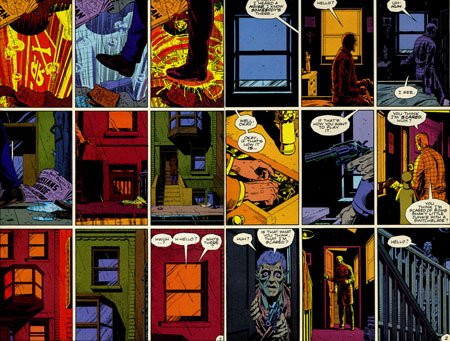
His "Watchmen" is another animal—a sprawling 12 issue serial based on an alternate Earth where masked vigilantes do exist, it crossed eras and locations in a blink, played on nesting cultural references and on-the-nose word-play, while having
the look and feel of a movie story-board. It looked like it should be filmed, even though its nudity, ultra-violence and political satire made it somewhat over the heads of the casual movie-goer and beyond the scope of the MPAA. Given Moore's history, the expectations were another bastardization, or, given Snyder's, a by-the-numbers adaptation with nothing new to offer.

The result, though, is neither extreme.

It's a faithful adaptation that doesn't mind sharing in the fun of creation.


"Structurally, There's No Difference"

Snyder and his scriptwriters David Hayter and Alex Tse have compressed the story, eliminating some second and third-tier characters (although they appear in the movie if you're looking for them), completely eliminating the parallel stories (in comic form) of "Tales of the Black Freighter" and the super-hero memoir "Under the Hood" (which will appear on a separate DVD, apparently) and concentrating on the main thread of the story: "Somebody is killing the Great Retired Superheroes of America."** It follows the investigation of never-realized super-group The Watchmen into who might be killing their members, starting with The Comedian, a government-sanctioned vigilante. All the Watchmen are vigilantes and, to some degree, fascists breaking arms and legs in brutal fist-fights that are, in the film, probably the best realized comics-fights yet filmed—like cage-matches in the open air. They all dress in the spandex kicking heads for different reasons and their very differences in attitude, sense of justice and heritage are what make the characters interesting, not the justice dispensed. There's action aplenty,*** but where Snyder has excelled and made the film his own is to take Moore's example and kick it up a notch. Moore's super-America of 1985 has Nixon still in the White House for an unprecedented sixth term, the Viet Nam War having been won by Watchmen incursion. But Snyder doesn't stop there. There are all sorts of cultural references spread throughout the film mixing History with heroes. TV, political and business personalities are recognizable from their Real World counter-parts. Moore piled on the culture references but Snyder takes advantage of the audio-visual tools he has to provide a great soundtrack of hits from a diverse group of Bob Dylan, Simon and Garfunkle, Leonard Cohen, and Phillip Glass. Compositions and dialog are taken from other movies to sometimes hilarious effect, and although one doesn't want to give away too many of Snyder's surprises, to not acknowledge them would be giving this film's own strengths short-shrift. It is its own animal—a fully functional moving picture that takes the strengths of the comics medium source, but builds on it and takes the viewer between the panels without a sense of filler or extraneous material.

"But my Eyes were stabbed by the flash of a neon light/
That split the night"


Just as Moore nested references throughout the series, Snyder takes visual cues and unites them throughout the film. Where Moore has his "Smiley Face" icon throughout (a device that seems a shade contrived in the film), Snyder's white-bright light flashes carry resonances throughout the film, especially in an ages spanning credit-sequence (which contains one of the best comics call-backs in the film). Those flashes will carry dramatic weight throughout the movie right up to the ending (which manages to logically improve on the novel's proposition-of course, that's how you solve "the problem," it's been staring us in the face all along).

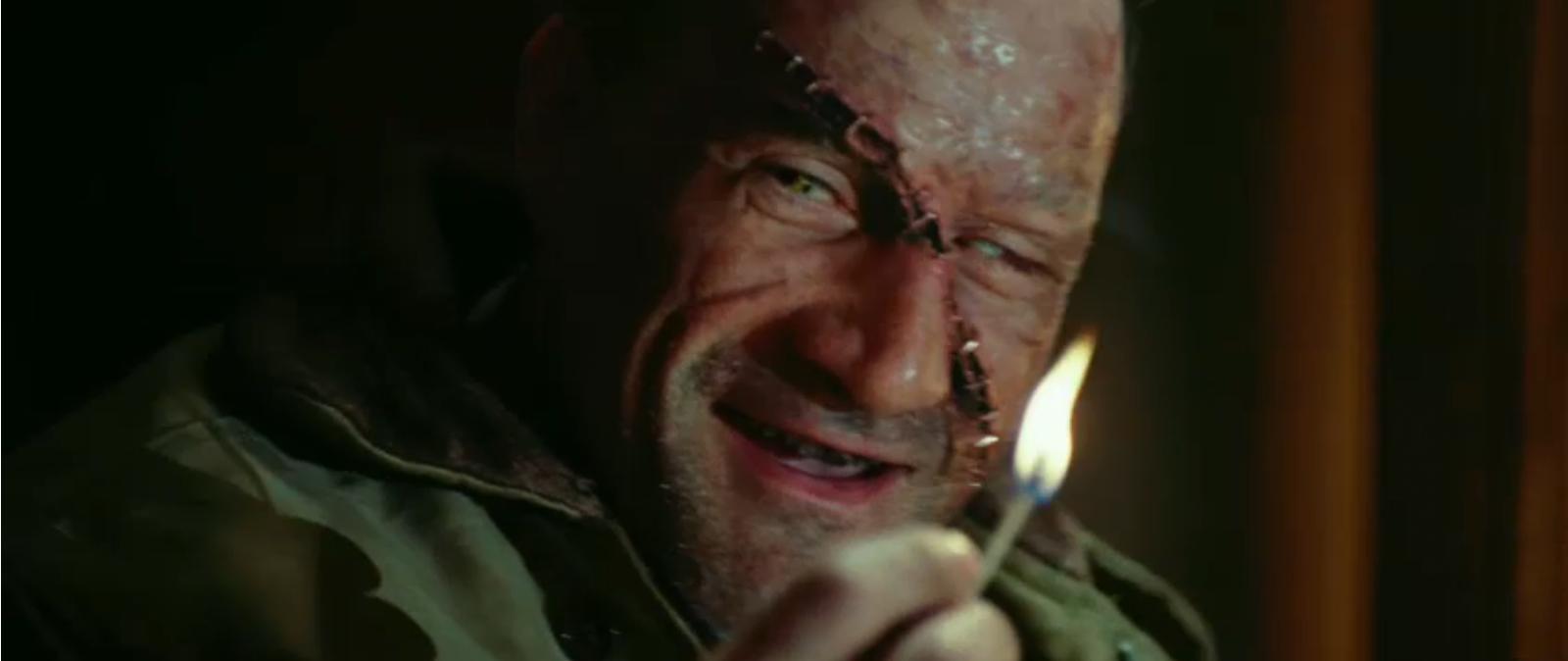
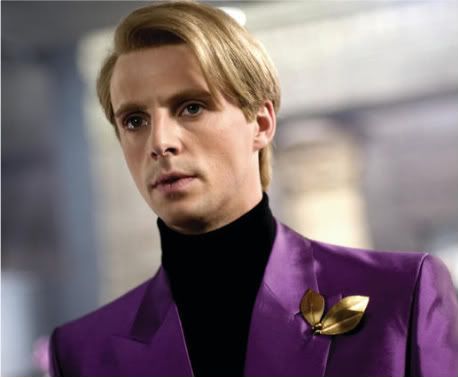
But, you can have all the CG wizardry in many worlds if the organic part ofthings, the actors, don't breathe life into the characters, and here "Watchmen" excells. Patrick Wilson has spent too much time being the handsomely bland blonde guy that it's a welcome relief to see him stand out appreciably as Dan Dreiberg, The Nite-Owl. Matthew Goode as Ozymandias has a lazy, lithe, slurry quality that shows how used he is to being The Smartest Man in the Room, always. Jeffrey Dean Morgan has the hardest role as The Comedian, but makes it work, as Malin Akerman does for The Silk Specter. But the big raves go to to guys who spend most of the time hidden: Billy Crudup, who manages to make a character of Dr. Manhattan despite the fact that it's all CGI imagery (can you believe they wanted Schwarzenegger for the role?), and Jackie Earle Haley, who does wonders as Rorshach. The stand-out character of the series needed a superb performance and Haley, who's made few mis-steps since re-igniting his peculiar acting career slams it home. One hopes that his talent is acknowledged soon.

I was surprised and delighted by "Watchmen," the movie re-creating the same emotions I had reading the book all those years ago. But I wonder how much information one would get from the movie without having read the source. For me, there was recollected information bursting out of every frame, but to someone without the book in their banks those frames might seem over-crowded with useless knick-knacks...instead of pieces of the puzzle. Without that fore-knowledge, is the movie as compelling, or does one take a Manhattan-ish dis-interest?

"Watchmen" is a Full-Price Ticket (Hrn).

* There have been some review complaints of "slavish" adherence to the source material. Whole sections have been lifted, but it's only once in awhile when those sections encompass a lot of material (usually from a God's eye perspective). "Slavish adherence" is simply not true. Even if it was, when was that ever a movie sin? Nobody complained when "Lonesome Dove" stuck so close to Larry McMurtry's novel. Why is it an issue now? Nothing else to write about?

** "Watchmen" grew out of Alan Moore proposing a 12 issue series based on characters acquired by DC Comics when it bought the
Charlton Comics line. DC wanted to use those characters in the regular comic-line, but wanted Moore's story, too. So, Moore created new heroes based on those characters: Captain Atom became Dr. Manhattan; Blue Beetle became Nite-Owl; The Question became Rorschach; Pete Cannon-Thunderbolt inspired Ozymandias; The Peacemaker became The Comedian; Nightshade became The Silk Specter.

*** "Watchmen" is a hard "R" for moments of sexuality, nudity and stomach-churning violence, for instance, characters are meat-cleavered in the head, one criminal has his hands tied to prison bars and his arms sawed off, not to mention the near-occasion of brutal fights—The Silk Specter breaks an arm so hard the bone pierces the skin — and a prison fight ends when a prisoner is dowsed with boiling oil. The movie begins with a bone-crunching fight between The Comedian and an unknown assassin, leading to his being thrown through a plate-glass window a couple dozen stories high. The movie's lone super-powered hero, Dr. Manhattan, explodes people with a wave of his hand. The show I went to, a couple brought their five year old son. He's gonna be in therapy for months.


Saturday, February 14, 2009

All the King's Men (2006)

"All The King's Men" (Steven Zaillian, 2006) The story goes that Robert Rossen, the director of the 1949 version of "All the King's Men" was not happy with his film. Too long, too talky, and too boring, Rossen was unsure of what to cut to get it down to length. A plan was drawn up: he told his editor to take 30 seconds from the beginnings of scenes and 30 seconds from the end. What was left came in under two hours of running time and moved at a jarring pace, but it won Oscars for its star Broderick Crawford, Best Supporting Actress Mercedes McCambridge...and Best Picture.

"
All the King's Men" was already a great film, but there were too many compromises to the Hays Code to get it to the screen. Steve Zaillian (a fine screenwriter, who directed a favorite film of mine "Searching for Bobby Fischer") decided to make a new film of Robert Penn Warren's Pulitzer Prize winning book, and sadly, wasted the opportunity in a film convinced of its own importance.*

From the crack of thunder that appears before the opening credits, to the thudding
James Horner score that telegraphs (with hammers) each imminent plot-point (Horner uses one dirge-like theme which, by its third appearance, I had assigned lyrics "This-is-a-sad-sto-ry/A-bout Lou-i-si-an-na"), to the subdued lighting and the art design in shades of "Godfather" mordant, everything about this movie promises great portent, but merely meanders through its story of how nothing born of corruption can come to any good, be it man, ideals or building materials.

It's a frustrating film to sit through, because the pieces are there given a less respectful (as in funeral respect) presentation. The cast is impressive.
Kate Winslet and Mark Ruffalo and Anthony Hopkins play the well-to-do Stanton clan. Kathy Baker and Jude Law are the blighted Burden clan, and Sean Penn, looking more and more like an young George C. Scott, plays the fictional surrogate of Huey Long, Willie Stark. As his flaks and flunkies, James Gandolfini, Patricia Clarkson and Jackie Earle Haley.

Good cast. But there are problems.
Penn, as he is wont to do, goes over-the-top in his speechifying, his arms waiving wildly in the air, his fingers doing filigreed dances. Where Penn got the inspiration to play it this way is a mystery, as footage of Long in speech-mode (below) shows him much more in control. Not even Adolph Hitler emotes this much. Jude Law, never the strongest of actors, falls into the dreariness of the film, staring at the other actors or nothing-in-particular with sad doe-like eyes.** One suspects editing problems with this film—Zaillian did spend an inordinate amount of time in post-production on it. Subjects are brought up and dropped, like Stark's football-playing son, who figures prominently in the '48 film, is mentioned here and then never heard from again.*** We never do find out how Burden's mother acquires facts to make an accusation against him. Mark Ruffalo's character is left as a dissatisfying enigma.

What we do get is ponderous, and pretentious. Zaillian spends a lot of screen-time trying to show (visually) that the only thing that could unite the "hicks" and gentry of Louisiana is death. Again, that same lesson had been told in better films.


* Given the awards-history of the cast and screenwriter it was assumed that "All The King's Men" would be a top contender come Oscar-season, but its poor box-office reception scuttled those hopes.
** K (who likes Law) kept yelling out "accent-drop!" whenever his "Lawsiana" draw-el moved to Market Street. Anthony Hopkins, the sly old dog, doesn't even try.

*** Sadly, Zaillian, in an attempt to simplify his film, gutted some crucial scenes from it including the sub-plot about Stark's son, and an extended ending that provides the best scenes for Jude Law and Jackie Earle Haley.