Showing posts with label Sally Field. Show all posts

Tuesday, November 20, 2012

Lincoln

Noisy and Messy and Complicated
or 
WWLD?

At the end of John Ford's Young Mr Lincoln, "the jack-legged country lawyer" (as played by Henry Fonda) walks up a blighted horizon in the darkening gloom, as thunder rolls in the background, the rough-hewn fence he trudges along taking on the look of military barricades, as the young Lincoln walks with his long stride into the storm of history awaiting him.  Steven Spielberg's Lincoln starts where Young... left off—with the sound of thunder over credits, which evolves into cannon-fire before placing us straight on in the middle of the Civil War, blue-on-gray, white-on-black (and the reverses) amid the blood and the mud of the Earth.  The shots of the battlefield are tight, confusing, with no sense of place, no horizon—just a frame filled with humans killing each other by any means.  No glory.  No higher purpose.  Just the immediacy of conflict.  War is the point at which politics breaks down, and politics is where Spielberg's film is concerned to compare and contrast with today's stew of chicanery, graft, and playing fast and loose with the facts to the purpose of getting your way.  'Twas ever thus, and it was no different in Lincoln's time—they just didn't have cameras documenting everything then.

The approach is as good a starting place as any—that is, ending with Ford's last gambit—linking the two, as both films' main goal is to take the monument out of the man, and put him within reach of attainability, wart and all.  The canonization of Lincoln began at the moment of his death with the pronunciation "now he belongs to the ages" and his visage, homely, homespun, ragged sunken and contemplative, has been preserved in nickel, bronze, marble, granite to the point where one can hardly imagine it as flesh and blood anymore. 


Young Mr. Lincoln: walking into a History still to occur.
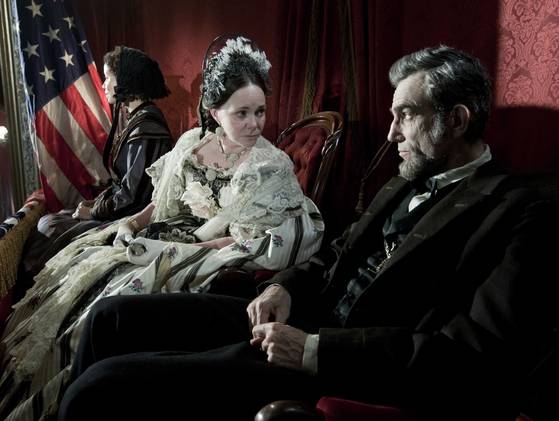
As portrayed by Daniel Day-Lewis, Lincoln is pitch-perfect, not only in his make-up, but his high tenor rasp of a voice, and—the remarkable part for me—in his still-legged gait that kicks and plants itself on the earth, not too steps away from the ragged dance of Wyatt Earp (Fonda, again) in My Darling Clementine.  It's a big, robust cast—I had error alerts for all the names I tried to cram into this article's meta-data labels—but the hub of it all is Day-Lewis' Lincoln.  Soldiers (including Lukas Haas) quote his Gettysburg Address back to him (which the President tries to staunch: "Been there, delivered that."*)  His wife (Sally Field) constantly badgers him—but then she consistently badgers everybody, his cabinet is frequently frustrated by him, by his prevarications, his story-telling that constantly derails conversations to his agenda, and his thought processes which annoy them.  "Actually," says Secretary of State Seward (David Straithairn) after Lincoln quotes verse, "I have no idea what you mean by that."

What he means may be too pragmatic for them, it's just how he expresses it that confounds.  In one exceptional scene—Tony Kushner worked on this script for a long time and it shows—Lincoln explains in minute, often harsh, detail how he employed his newly granted War Powers Act and it comes down to what he thought he could get away with, legally.

His concern, in the waning days of the war, is to pass the 13th Amendment, thereby abolishing slavery, and it takes every trick, every dodge, every promise and appointment in the middle of a lame-duck Congress before the war could end.  The timetable is critical: Lincoln has just been re-elected and is riding a wave of popularity; a crucial number of Congressmen are in their last days of their jobs and are looking to their futures and not to the wishes of their constituents; and, if the war ends, the urgency to pass the Amendment will dwindle, amidst the rebuilding of the Nation.  Lincoln's Republicans will vote for it, but they need to tone down their rhetoric.  The Democrats are dead-set against it, but getting Democrats to agree on anything is like herding cats and Lincoln wants to exploit the party's fractures into fissures.  

So, the problem is attacked from several fronts (if only the war had started that way): Preston Blair (Hal Holbrook), prominent Republican and journalist, is sent to the South to negotiate a Southern settlement, which the South is anxious to do (although Lincoln is reluctant).  Meanwhile, he wheels and deals with the largesse of power, offering appointments, threats, anything to curry votes, and unleashes a trio of stooge-lobbyists (James Spader, John Hawkes, and Tim Blake Nelson) to press the flesh and pass the greenbacks (not "officially," though).  Votes are critical.  On the home-front, Lincoln's son Robert (Joseph Gordon-Levitt) is back from college, but feeling the weight of his kinship with the President and wants to enlist, which sends wife Mary Todd into another accusatory tailspin as she has barely survived the death of their son, Tad.

Throughout, Lincoln keeps his counsel. but sometimes erupts into spasms of frustrationwith "Molly" (as he calls her), the congress and his cabinet, choosing his moments and pressing his advantage, knowing no peace except what he can create for himself.

As good as Day-Lewis is, he's matched by Tommy Lee Jones as House Republican Thaddeus Stevens.  In chambers, Stevens sits and fumes, then reaches his limit and bursts out in loud insulting harangues, just in control enough to get his point across, and even smiling tightly—very tightly—when when dressed down by Mary Lincoln over his tight reins over The White House purse strings.  Jones finds different ways to make his speeches crackle, while never betraying any sense that the words haven't sprung originally from his head.  And Spielberg has given special attention to casting key roles with the like of great character actors like Bruce McGill, Michael Stuhlbarg, and Lee Pace who make their relatively small parts punch out and become memorable.

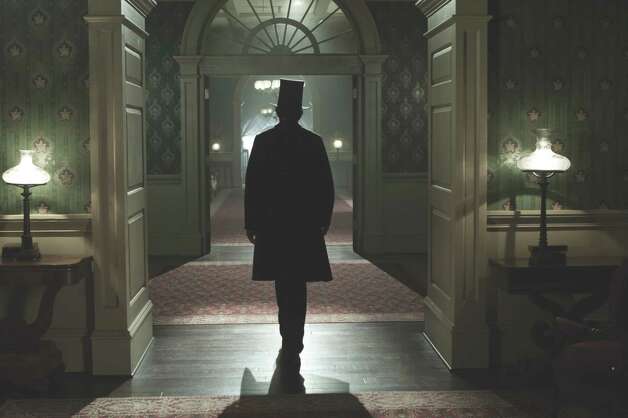
And Spielberg's eye for painterly detail shines, as Lincoln moves through the gloomy corridors of The White House or sets up an eerie dream sequence for the President.  And in one lovely scene, between Lincoln and Ulysses S. Grant (Jared Harris), where the war's toll on Lincoln is expressed in Day-Lewis' exhausted eyes and the shadows of a long rank of soldiers trudging in front of a setting sun play across his face.  

You can't see the moving shadows...
Spielberg's regular team of artists: Kaminski, Kahn, Carter, and Williams construct a great quilt of imagery and dynamics, making Lincoln a fascinating display of historical intimacy writ large.  It would make a superb triple bill sandwiched between Young Mr. Lincoln and The Conspirator.

Lincoln is a Full-Price Ticket.


* There's a nice contrast of Licoln delivering a dedication at a flag-raising ceremony that lasts a measly few lines.  "That's my speech" he says as he tucks his paper back into his stove-top hat.  They can't all be gems.

Friday, July 6, 2012

The Amazing Spider-man

Spider-man v. 2.0
or
"With Great Power Comes Sequels, Re-Boots, Etc....(A Spider-man's Work is Never Done)"

It may be a web-strand too soon to be doing a re-boot of the "Spider-man" franchise, but The Amazing Spider-man does do one thing that justifies its existence—it's better than the Tobey McGuire/Sam Raimi first film in the original trilogy, and right off the ledge manages to have the fun, energy, pop-soapishness, and inventiveness of the second film in that series, the one with Dr. Octopus.  We have to go through the origin story again (but that's okay, we seem to have to with every "Superman" film, and evidently will with the next one).

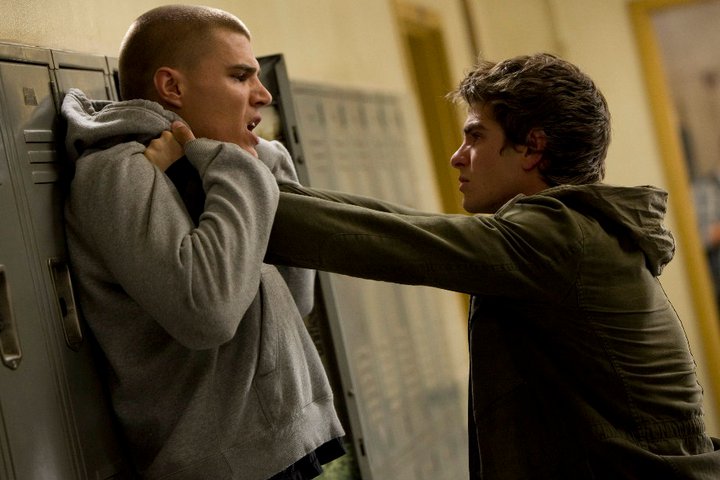
The story is basically the same—Peter Parker (Andrew Garfield) is a smart high school geek with a photog hobby, and his first encounter with an industrial science lab manages to put the bite on him, arachnidally-speaking, then strange things start happening as he does whatever a spider can, conflicts, conflicts, conflicts (of the physical and angst variety), "with great power comes great responsibility," yadda yadda yadda.  But there's a lot of "Spidey"-history to draw on, and the writers (James Vanderbilt, Alvin Sargent—who added a lot to Spiderman 2—and Steve Kloves—who mentored Harry Potter) have tinkered and brought a lot of missing pieces to the table.  This time the love interest is Gwen Stacy (Emma Stone, who appears to be the oldest person in school, but that may be part of the appeal of the character, certainly to Parker), daughter of an NYPD captain (Denis Leary, who plays it straight, tough, and with impeccable comic timing), and bowing to the fanboyish, his web-powers are not so organiche's got the little web-shooters now, although interestingly, he doesn't develop the web-goo.  Oscorp is still around, although we never see its CEO (or do we?), so's the Daily Bugle—but Parker doesn't have a job there yet, so there's no J. Jonah Jameson (how could replace or improve on J.K. Simmons' interpretation?).  The villain is another industrial bio-scientist, Curt Connors (played as if was Peter O'Toole by Rhys Ifans and he's terrific), who—not giving anything away here—eventually turns into the Lizard.

What's different is motivation and sub-text.  Echoing the Potter series, attention and emphasis is paid to what happened to Peter's parents (Campbell Scott and Embeth Davidtz) that put him in the care of Uncle Ben and Aunt May (Martin Sheen and Sally Field, both extraordinarily good) and indications are that is the story which will run throughout this movie-arc (as well, I suspect, as the consequences of keeping secrets (as I said, there's a lot of history to drawn on). 

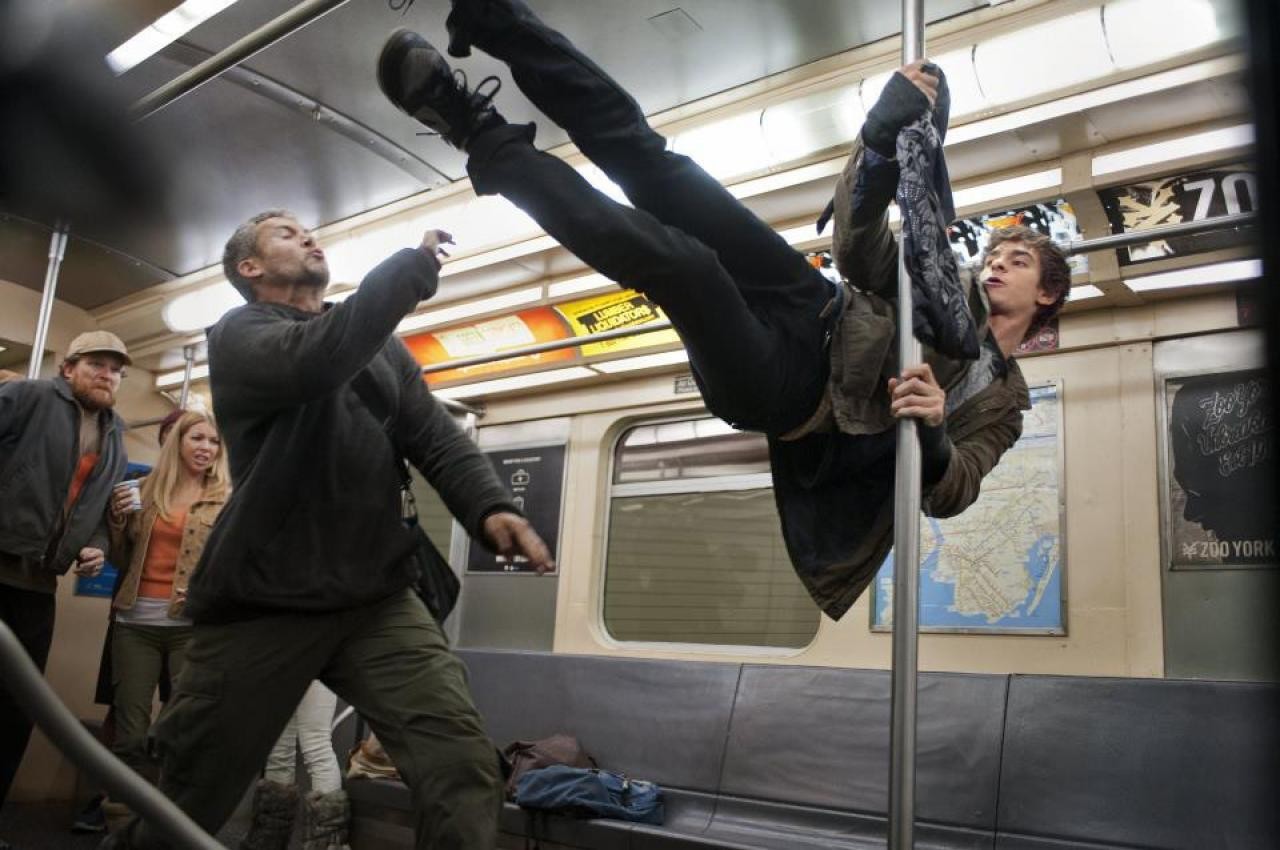
What's also different and good is how everybody's perfected the formula, including director Marc Webb (who made the, to me, extraordinarily fine (500) Days of Summer): Garfield's Parker is more in line with the comic character, mood-swinging as well as web-slinging, and his Parker is awkward, stammering, frequently inarticulate and perceived outwardly as something of a jerk, a simp, or worthless* (hey, wow, they got the character of a misunderstood teenager down), and the fights, which in the past have been rushed and often unfollowable, now flow and, frequently—thanks to CGI—in one continuous shot that swoops, loops and parallels Spider-man's flight patterns.  The pace is still there, but thanks to stunt arranger and second-unit director Vic Armstrong (a few of the Bonds and Indiana Jones), it's not all a blur.  Also, under Raimi, some of these fights were brutal and sadistic, and, don't get me wrong, these are no less savage, and take more of a toll on the participants.**  But the desperation is there, and the "wrong-ness" of the abuse of power, which kept my moral compass (or is it "Spidey"-sense?) from peaking out in the red zone.  

So, yes, it's the same story, but more sure-footed (by having its hero less so), and also intriguing for what it might hold in the future.  The first trilogy seemed to be a little wobbly as it went along, searching for story.  This one already feels like it knows where its going, and will find the best and most opportune path to get there.***

The Amazing Spider-man is a Full-Price Ticket.  (I saw it in IMAX 3-D, but it's not really necessary).


* And—a nice touch—he's thin and ungainly, not buffed-out, like the typical "strong-man" super-hero, which is the way he was when Steve Ditko first drew him.  Nice.

** This does bring up something that will be difficult to sustain: Parker is frequently shown battered, bruised, and slashed from these fights, which makes his encounters post-fight with Aunt May a little illogical.  And at some point, when will she clamp down on him, or child-protective services step in? 

*** A couple more things: there's no interpretation of the "Spider-man" theme from the 60's cartoon ("Hey there, there goes the Spider-man!") but James Horner's score is his most inventive in a long time—if a little needlessly bombastic in rare instances; there is a "coda" of sorts, but early in the credits (so you won't be missing anything if you don't stay for the full credit roll); and the Stan Lee cameo actually made me smile and feel affectionate towards the man.  Now, that's amazing.

Tuesday, July 29, 2008

Places in the Heart

"Places in the Heart" (Robert Benton, 1984) Robert Benton's distillation of life growing up in Waxahachie, Texas during the Depression begins with an accidental death, which expands to an act of evil, but ends, after Earthly trials, with an ambiguous epiphany that extends the simple gift of community into an expression of spiritual healing and harmony--one of the gutsiest segues from hard-scrabble reality to the Mystery of Faith ever put to film.

The cast is impeccable with unsentimental work from
Sally Field, to pitch-perfect early performances from Danny Glover and John Malkovich, to excellent work by Ed Harris, Amy Madigan and Lindsay Crouse. All portray an extended family that forgo the boundaries of blood and race to pull together and survive the deprivations of Nature and man.

Sure sounds like heavy stuff, but the artists behind and in front of the camera make it compelling drama that stays clear-eyed and rarely sinks into easy sentimentality. Quite the opposite; Glover plays the role of a poor share-cropper with a tentativeness that awaits disaster, and Malkovich makes his blind war vet a petulant jerk. Plus, there's a collection of townsfolk that includes greedy bankers, murderous racists and opportunists of every stripe. In "
To Kill a Mockingbird," racism seems like bad manners and poor up-bringing, while in "Places in the Heart" it's a way of life and charity is the exception, rather than the norm.

It's a story of perserverence in the face of great change, and, if not welcoming and embracing change, at least having the grit to roll with it. It's one of my favorite films from a fine film director.

And that ending. Gets me every time.