Showing posts with label Civil War. Show all posts

Tuesday, November 20, 2012

Lincoln

Noisy and Messy and Complicated
or 
WWLD?

At the end of John Ford's Young Mr Lincoln, "the jack-legged country lawyer" (as played by Henry Fonda) walks up a blighted horizon in the darkening gloom, as thunder rolls in the background, the rough-hewn fence he trudges along taking on the look of military barricades, as the young Lincoln walks with his long stride into the storm of history awaiting him.  Steven Spielberg's Lincoln starts where Young... left off—with the sound of thunder over credits, which evolves into cannon-fire before placing us straight on in the middle of the Civil War, blue-on-gray, white-on-black (and the reverses) amid the blood and the mud of the Earth.  The shots of the battlefield are tight, confusing, with no sense of place, no horizon—just a frame filled with humans killing each other by any means.  No glory.  No higher purpose.  Just the immediacy of conflict.  War is the point at which politics breaks down, and politics is where Spielberg's film is concerned to compare and contrast with today's stew of chicanery, graft, and playing fast and loose with the facts to the purpose of getting your way.  'Twas ever thus, and it was no different in Lincoln's time—they just didn't have cameras documenting everything then.

The approach is as good a starting place as any—that is, ending with Ford's last gambit—linking the two, as both films' main goal is to take the monument out of the man, and put him within reach of attainability, wart and all.  The canonization of Lincoln began at the moment of his death with the pronunciation "now he belongs to the ages" and his visage, homely, homespun, ragged sunken and contemplative, has been preserved in nickel, bronze, marble, granite to the point where one can hardly imagine it as flesh and blood anymore. 


Young Mr. Lincoln: walking into a History still to occur.
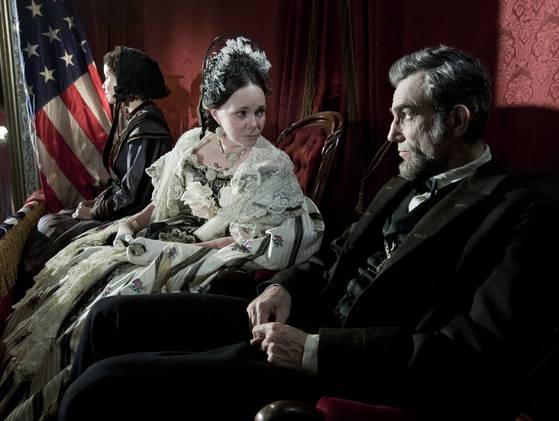
As portrayed by Daniel Day-Lewis, Lincoln is pitch-perfect, not only in his make-up, but his high tenor rasp of a voice, and—the remarkable part for me—in his still-legged gait that kicks and plants itself on the earth, not too steps away from the ragged dance of Wyatt Earp (Fonda, again) in My Darling Clementine.  It's a big, robust cast—I had error alerts for all the names I tried to cram into this article's meta-data labels—but the hub of it all is Day-Lewis' Lincoln.  Soldiers (including Lukas Haas) quote his Gettysburg Address back to him (which the President tries to staunch: "Been there, delivered that."*)  His wife (Sally Field) constantly badgers him—but then she consistently badgers everybody, his cabinet is frequently frustrated by him, by his prevarications, his story-telling that constantly derails conversations to his agenda, and his thought processes which annoy them.  "Actually," says Secretary of State Seward (David Straithairn) after Lincoln quotes verse, "I have no idea what you mean by that."

What he means may be too pragmatic for them, it's just how he expresses it that confounds.  In one exceptional scene—Tony Kushner worked on this script for a long time and it shows—Lincoln explains in minute, often harsh, detail how he employed his newly granted War Powers Act and it comes down to what he thought he could get away with, legally.

His concern, in the waning days of the war, is to pass the 13th Amendment, thereby abolishing slavery, and it takes every trick, every dodge, every promise and appointment in the middle of a lame-duck Congress before the war could end.  The timetable is critical: Lincoln has just been re-elected and is riding a wave of popularity; a crucial number of Congressmen are in their last days of their jobs and are looking to their futures and not to the wishes of their constituents; and, if the war ends, the urgency to pass the Amendment will dwindle, amidst the rebuilding of the Nation.  Lincoln's Republicans will vote for it, but they need to tone down their rhetoric.  The Democrats are dead-set against it, but getting Democrats to agree on anything is like herding cats and Lincoln wants to exploit the party's fractures into fissures.  

So, the problem is attacked from several fronts (if only the war had started that way): Preston Blair (Hal Holbrook), prominent Republican and journalist, is sent to the South to negotiate a Southern settlement, which the South is anxious to do (although Lincoln is reluctant).  Meanwhile, he wheels and deals with the largesse of power, offering appointments, threats, anything to curry votes, and unleashes a trio of stooge-lobbyists (James Spader, John Hawkes, and Tim Blake Nelson) to press the flesh and pass the greenbacks (not "officially," though).  Votes are critical.  On the home-front, Lincoln's son Robert (Joseph Gordon-Levitt) is back from college, but feeling the weight of his kinship with the President and wants to enlist, which sends wife Mary Todd into another accusatory tailspin as she has barely survived the death of their son, Tad.

Throughout, Lincoln keeps his counsel. but sometimes erupts into spasms of frustration—with "Molly" (as he calls her), the congress and his cabinet, choosing his moments and pressing his advantage, knowing no peace except what he can create for himself.

As good as Day-Lewis is, he's matched by Tommy Lee Jones as House Republican Thaddeus Stevens.  In chambers, Stevens sits and fumes, then reaches his limit and bursts out in loud insulting harangues, just in control enough to get his point across, and even smiling tightly—very tightly—when when dressed down by Mary Lincoln over his tight reins over The White House purse strings.  Jones finds different ways to make his speeches crackle, while never betraying any sense that the words haven't sprung originally from his head.  And Spielberg has given special attention to casting key roles with the like of great character actors like Bruce McGill, Michael Stuhlbarg, and Lee Pace who make their relatively small parts punch out and become memorable.

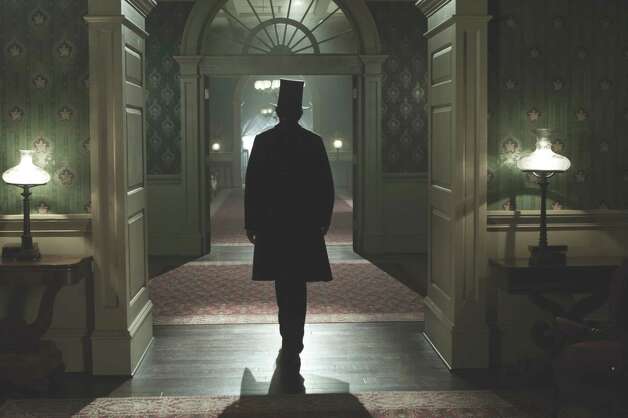
And Spielberg's eye for painterly detail shines, as Lincoln moves through the gloomy corridors of The White House or sets up an eerie dream sequence for the President.  And in one lovely scene, between Lincoln and Ulysses S. Grant (Jared Harris), where the war's toll on Lincoln is expressed in Day-Lewis' exhausted eyes and the shadows of a long rank of soldiers trudging in front of a setting sun play across his face.  

You can't see the moving shadows...
Spielberg's regular team of artists: Kaminski, Kahn, Carter, and Williams construct a great quilt of imagery and dynamics, making Lincoln a fascinating display of historical intimacy writ large.  It would make a superb triple bill sandwiched between Young Mr. Lincoln and The Conspirator.

Lincoln is a Full-Price Ticket.


* There's a nice contrast of Licoln delivering a dedication at a flag-raising ceremony that lasts a measly few lines.  "That's my speech" he says as he tucks his paper back into his stove-top hat.  They can't all be gems.

Tuesday, April 19, 2011

The Conspirator

"What About the Woman?"
or
"Inter Arma Enim Silent Leges"

Robert Redford's last film—Lions for Lambs—was a self-indulgent tract on the tearing down of constitutional law in times of crisis—the short-cuts in due process and individual freedoms that occur when authorities are more concerned with short term results, rather than demonstrating the strengths that underpin the foundations of the Nation under attack.  War is a very danerous time; one must guard against attacks from without and within.

He needen't have bothered.  History was already there with the same lessons, but distanced by time to demonstrate, rather than lecture and ostracize.

I was always fascinated by the Lincoln assassination and its aftermath.  As a grade-school student, I'd read books about those hysterical days following the surrender at Appomatox ending the Civil War, culminating in John Wilkes Booth's assassination of Lincoln (who, in trying to preserve the Union, had already done enough damage suspending habeas corpus during the course of the War), the man-hunt for the conspirators (whose intentions were to kidnap the President in exchange for Rebel prisoners) when Booth was killed, trapped in a burning barn, thus robbing the Nation of a cathartic trial (which probably would have been a kangaroo court anyway, to prevent the vain-glorious actor from speaking and fomenting discord in the wake of an uneasy truce).  Short-cuts were made...civil trials disbanded in favor of more stringent military tribunals (sound familiar?)...and the conspirators deprived of any rights of the accused.*

Justice was thrown out the barred windows in the sake of revenge.

The Conspirator focusses on only one of the accused, Mary Surratt (played in the film by Robin Wright Penn), mother of conspirator John Surratt (who had fled to Virginia) and owner of the boarding house where much Virginia venom was pit during the war, along with some of the conspirators' planning sessions.  Surratt was widowed, Catholic, a woman, Southern and sympathetic to its cause, all strikes against her.  But that she was the mother of John was what damned her—his association with the plotters made the location of their meetings, planned or otherwise, a foregone conclusion, and her arrest and trial was national news—maybe the government could coerce the son to surrender to save the mother.

That might have worked if the government wasn't operating in the same manner the Rebels feared it would.  The new President Johnson, under advisement from Secretary of War Edwin Stanton (played by Kevin Kline, and more than making up for his performance in No Strings Attached) insured that the South would pay for Lincoln's death, just part of his crack-down on the South after the war.  No insurrection, no slight would be tolerated, and justice would move fast and frequently recklessly. 

Redford's film of the proceedings is austere, but leaves no parallel with modern times (post 9/11) unparalleled.  The facts are there, supported by generous newspaper headlines from the period bridging sequences, focussing on Surratt's defense by legal aide to Senator Reverdy Johnson (Tom Wilkinson), Frederik Aiken (James McAvoy, whose American accent is superb).  The film is front-loaded with young stars (Evan Rachel Wood, Alexis Bledel, Justin Long) as acquaintances of Aiken's, all urging him to be cautious in his precipitously uphill battle to have Surratt acquitted, lest he fall under suspicion of the government as well.  But, there are also good turns by Colm Meaney, Danny Huston, and Stephen Root, who is fast becoming one of my favorite character actors.

There is little humor in the film, save bitter irony, but given the circumstances of the case, that is hardly unexpected.  There are some subtle touches as well.  Like sunshine.  Watch how Redford—always the Nature-boy—uses the sun throughout the movie (and the lack of sun).  So many darkened, shuttered rooms reflecting that time of skulkers and hidden agendas.  One doesn't have to make to big a leap remembering that the light of day is a natural disinfectant, especially in scurrilous times.

This is the first film of The American Film Company, founded in 2008 by the Ricketts family, and even though it might seem tempting for the owners of the Chicago Cubs to re-write history, the purpose of the film-house is to present accurate portrayals of American History without the issuance of dramatic license.  It's a noble mission, but given that manifesto it guarantees that most of their films will not have a happy ending—I can't even think of a treaty that this Nation has agreed to and honored.  One hopes that it can stay in business long enough to produce some great, accurate films about the hidden corners of the past. 

The Conspirator is a Full-Price Ticket.


The documentation of the hanging. 
Mary Surratt is on the left.


* Redford makes a cogent observation by also placing all the Ford Theater actors in custody, as well—they were, after all, associates of Booth—along with with the suspected assassins.

Tuesday, June 16, 2009

Major Dundee

"Major Dundee" (Sam Peckinpah, 1965) Semi-restored version of "Major Dundee" that's a bit closer to the idea Sam Peckinpah had in mind when producer Jerry Bresler took the film over, edited it with a meat cleaver and threw on a wildly inappropriate score (a ranch massacre with bodies littering the desert and the main house on fire until it collapses is set to a bouncy Mitch Miller tune?* Say, what? Peckinpah has been accused of bad taste in his movies, but he'd never have pulled something as agregious as that!).

Peckinpah's first big-budget movie has a great story. A hard-nosed Union Major, Amos Dundee (Charlton Heston)** side-tracks a bit from the Civil War to capture or kill the marauding Apache chief who torched that outpost. To do so, he must cross the border to Mexico in a mission that doesn't officially exist. His requisitioned army of nobodies employs cut-throats and horse-thiefs, Confederate Rebels and Buffalo Soldiers. No one asks: Can't we all get along? It's just assumed that they can't, but a sense of order and hierarchy is maintained within the groups, while the groups test and prod each other en route.

The cast includes Richard Harris as leader of the Confederates (who has a past with Dundee), a small band made up of Peckinpah irreg'lars Ben Johnson, Warren Oates, L.Q. Jones and John Davis Chandler. Brock Peters is in charge of the Buffalo Soldiers. Slim Pickens and Dub Taylor are two of the criminals, R.G. Armstrong as a vengeful preacher and in Dundee's command are Michael Anderson Jr. (who narrates), Mario Adorf, Jim Hutton (whose character arc is almost as interesting as Harris' character's) and crusty scout James Coburn.

That's a great cast. And the film is full of detail (you want to see it on a big screen). There are some extraordinary screen-caps from the film below that show Peckinpah's innate ability to fuse landscape and character, not unlike John Ford, whom Peckinpah seems to emulate while presenting either a celebrational rabble or a ceremonial piety but infused with a more cynical rough-hewn presentation. I don't think John Ford would have had a soldier swatting flies away from a war wound, but I could be wrong.

Heston is a bit of an odd man out in the film, his acting rhythms are slower than Peckinpah is able to deal with in his cutting style (in fact, there's a couple places where Peckinpah cuts in the middle of Heston's reaction shots just to speed the man up a bit) and the clashes show. In an interview, R.G. Armstrong calls Heston "a poser," (which is certainly true, but also calls him "the nicest guy in Hollywood"—Heston gave up his salary to keep an embattled Peckinpah as director***), but Heston loosens up quite a bit in this film than he had in any previous one, setting a tone for his subsequent work as less heroic, more recognizably human presences.

But the movie falls apart somewhat, when the troop liberates a starving town from the French; everyone looks impoverished (even the dogs outside town are skin and bones), the exception being the widow Santiago (Senta Berger)**** whose nursing duties among the starving citizens hasn't reduced the glow in her cheeks or made her any less voluptuous. Her presence and the subsequent romance with Dundee just doesn't sit well with the grit of the rest of the movie, and so Peckinpah wounds Dundee and sets him on a rehabilitating toot that manages to negate a lot of the nobleness of the character, and undermines a couple other parts as well.

Production began before a suitable third act was constructed, and Peckinpah was convinced that once filming had begun, the script would be hammered out. But production delays and disputes between the director, the studio and the producer ate up a lot of that valuable work-time. And Peckinpah began to drink, most days towards the end, showing up drunk on the set.

Still,
up until the romance, it's a gritty, atypical Western story with integrity and a nice mature brusque edge to it. Studio interference would hamper this film and dog Peckinpah for the rest of his career.


Figures in a landscape:A broken arch does not connect (and thus dooms any romance)
between Major Dundee and Teresa Santiago (Senta Berger)

Peckinpah gives shape to Richard Harris' Captain Tyreen caught between
his sense of honor and loyalty to the Confederacy.

The remains of Dundee's command escape the French across the Rio Grande.
A shot with such depth it approaches 3-D.


* The opening credits run over the shot of the house burning, and the structure collapses when the director's credit comes up. Peckinpah liked to do things like that.

** To give you a flavor of the writing by Peckinpah and Harry Julian Fink (Dirty Harry), Dundee is characterized as a "$70 red-wool, pure-quill military genius or the biggest damn fool in Northern Mexico."

*** When asked by a reporter if that would set a precedent among Hollywood actors, Heston said, "It's not even going to set a precedent with ME!" A great line.

**** Peckinpah was dissatisfied with the romance storyline imposed on the script but not the actress: Senta Berger would work with Peckinpah again (and James Coburn) in the director's fine Nazi war film "Cross of Iron."