Showing posts with label Tommy Lee Jones. Show all posts

Friday, June 14, 2013

Emperor

The Supremes
or
Doing Our Duty While Losing Our Humanity

Like his 2003 film The Girl with the Pearl Earring, Peter Webber's Emperor is the long and involved story behind a single image—a photograph of the U.S.'s General Douglas MacArthur and Japan's Emperor Hirohito in July of 1946.  The image is normal-looking, pedestrian even, if one does not know the back-story, which is extraordinary, without precedent at the time, and represented a brave new world shattering a history of 2,000 years.

Japan had surrendered to the U.S. soon after what  one character describes as turning Japan "into the largest crematorium the world has ever known."  General Douglas MacArthur had been established the "Supreme Commander" of the occupied territory, a role one author has described as making him "an American Caesar."  One of his first tasks is the establishment of blame and war-crimes tribunals, and uppermost in his mind is what "to do" with the Emperor, Japan's supreme leader held to be almost a deity for his people, not to be looked at directly, not to be photographed, not to be touched.  America is calling for his head, but MacArthur, wily politico that he is, ponders what will become of a Japan without its Emperor, if tried, found guilty and hung by the American conquerors.  The "Supreme Commander" sees only chaos and revolt in such a future.  


So, he assigns the task to someone else.


Emperor is the story of that investigation, as carried out by General Bonner Fellers at MacArthur's behest.  In the film, Fellers is conflicted: America is calling for the Emperor's head, but the reality of controlling a defeated nation hinges on his fate; Fellers is a Japan-ophile, and yet the iron bureaucracy surrounding the Emperor makes his job difficult getting answers, and the 2,000 year old traditions are part and parcel of what keeps the shattered country together; he is also looking for a girl that he befriended in the States during college, but her parents demanded she return to Japan, and now he's looking for her in the ashes of the city she was last in; other Army officers are  questioning Fellers credentials to do an unbiased investigation despite his history with Japan, and are pushing for his demotion in their own biased fashion.


The story is based on a novel by Shiro Okamoto, and might be playing with the character of Fellers a bit.  In fact, Fellers was an extreme conservative and a member of the John Birch Society post-war.  He had also been involved in a disastrous tenure in the European front when his reports were intercepted by Axis powers, and the intelligence influenced the outcomes of battles in Northern Africa (entirely due to the Army's insistence that Fellers NOT use coded encryptions to send his reports).  The man portrayed in the film may not be the one doing his duty in Japan, but the outcomes are the same, and that's where the fascination lies.


What Fellers learns in his frustrating investigation does lead to an ultimate decision, and is tied to the character of Emperor Hirohito.  But the layers of protection keep him from learning about the man and his actions in the final perilous days of the war, delaying any decision about the Emperor's implications in war-crimes.  And its wrapped up entirely in tradition, reflected in the protocol id one should ever come face to face (highly unlikely) with the Emperor.  He cannot leave the Imperial palace.  You cannot look him in the eye.  He cannot be touched.  He cannot be photographed. 

And yet, there's that picture, taken in MacArthur's office as the men have their first meeting after Japan's surrender.  And that, to use the old phrase, is worth more than the traditional thousand words, about Japan's supreme leader.

The story is fascinating, but the film telling that story drains a bit of that fascination out of it.  Perhaps, the twists and turns in Fellers investigation are designed to "open up" the movie in terms of post-war conditions, but the "Romeo and Juliet" sub-plot feels forced and a bit "traditional" in movie terms.  In the performances, Jones' MacArthur feels more like reflections of the actor's personality than the public persona the general showed (itself a carefully controlled performance), and as much effort as Fox puts into his role of Fellers, the character comes off as not very interesting, constrained as it is by duty, protocol, and sub-plots.

Still, the movie feels like one of those stories that need to be told, but one wonders if it could be done with a touch more flair, without damaging the content of the truth.

Emperor is a Rental. 


The Supremes

Tuesday, November 20, 2012

Lincoln

Noisy and Messy and Complicated
or 
WWLD?

At the end of John Ford's Young Mr Lincoln, "the jack-legged country lawyer" (as played by Henry Fonda) walks up a blighted horizon in the darkening gloom, as thunder rolls in the background, the rough-hewn fence he trudges along taking on the look of military barricades, as the young Lincoln walks with his long stride into the storm of history awaiting him.  Steven Spielberg's Lincoln starts where Young... left off—with the sound of thunder over credits, which evolves into cannon-fire before placing us straight on in the middle of the Civil War, blue-on-gray, white-on-black (and the reverses) amid the blood and the mud of the Earth.  The shots of the battlefield are tight, confusing, with no sense of place, no horizon—just a frame filled with humans killing each other by any means.  No glory.  No higher purpose.  Just the immediacy of conflict.  War is the point at which politics breaks down, and politics is where Spielberg's film is concerned to compare and contrast with today's stew of chicanery, graft, and playing fast and loose with the facts to the purpose of getting your way.  'Twas ever thus, and it was no different in Lincoln's time—they just didn't have cameras documenting everything then.

The approach is as good a starting place as any—that is, ending with Ford's last gambit—linking the two, as both films' main goal is to take the monument out of the man, and put him within reach of attainability, wart and all.  The canonization of Lincoln began at the moment of his death with the pronunciation "now he belongs to the ages" and his visage, homely, homespun, ragged sunken and contemplative, has been preserved in nickel, bronze, marble, granite to the point where one can hardly imagine it as flesh and blood anymore. 


Young Mr. Lincoln: walking into a History still to occur.
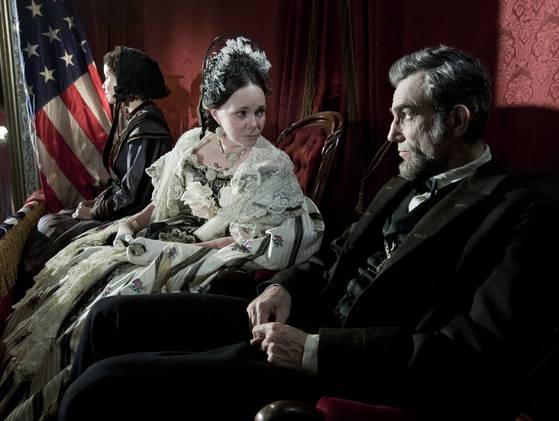
As portrayed by Daniel Day-Lewis, Lincoln is pitch-perfect, not only in his make-up, but his high tenor rasp of a voice, and—the remarkable part for me—in his still-legged gait that kicks and plants itself on the earth, not too steps away from the ragged dance of Wyatt Earp (Fonda, again) in My Darling Clementine.  It's a big, robust cast—I had error alerts for all the names I tried to cram into this article's meta-data labels—but the hub of it all is Day-Lewis' Lincoln.  Soldiers (including Lukas Haas) quote his Gettysburg Address back to him (which the President tries to staunch: "Been there, delivered that."*)  His wife (Sally Field) constantly badgers him—but then she consistently badgers everybody, his cabinet is frequently frustrated by him, by his prevarications, his story-telling that constantly derails conversations to his agenda, and his thought processes which annoy them.  "Actually," says Secretary of State Seward (David Straithairn) after Lincoln quotes verse, "I have no idea what you mean by that."

What he means may be too pragmatic for them, it's just how he expresses it that confounds.  In one exceptional scene—Tony Kushner worked on this script for a long time and it shows—Lincoln explains in minute, often harsh, detail how he employed his newly granted War Powers Act and it comes down to what he thought he could get away with, legally.

His concern, in the waning days of the war, is to pass the 13th Amendment, thereby abolishing slavery, and it takes every trick, every dodge, every promise and appointment in the middle of a lame-duck Congress before the war could end.  The timetable is critical: Lincoln has just been re-elected and is riding a wave of popularity; a crucial number of Congressmen are in their last days of their jobs and are looking to their futures and not to the wishes of their constituents; and, if the war ends, the urgency to pass the Amendment will dwindle, amidst the rebuilding of the Nation.  Lincoln's Republicans will vote for it, but they need to tone down their rhetoric.  The Democrats are dead-set against it, but getting Democrats to agree on anything is like herding cats and Lincoln wants to exploit the party's fractures into fissures.  

So, the problem is attacked from several fronts (if only the war had started that way): Preston Blair (Hal Holbrook), prominent Republican and journalist, is sent to the South to negotiate a Southern settlement, which the South is anxious to do (although Lincoln is reluctant).  Meanwhile, he wheels and deals with the largesse of power, offering appointments, threats, anything to curry votes, and unleashes a trio of stooge-lobbyists (James Spader, John Hawkes, and Tim Blake Nelson) to press the flesh and pass the greenbacks (not "officially," though).  Votes are critical.  On the home-front, Lincoln's son Robert (Joseph Gordon-Levitt) is back from college, but feeling the weight of his kinship with the President and wants to enlist, which sends wife Mary Todd into another accusatory tailspin as she has barely survived the death of their son, Tad.

Throughout, Lincoln keeps his counsel. but sometimes erupts into spasms of frustration—with "Molly" (as he calls her), the congress and his cabinet, choosing his moments and pressing his advantage, knowing no peace except what he can create for himself.

As good as Day-Lewis is, he's matched by Tommy Lee Jones as House Republican Thaddeus Stevens.  In chambers, Stevens sits and fumes, then reaches his limit and bursts out in loud insulting harangues, just in control enough to get his point across, and even smiling tightly—very tightly—when when dressed down by Mary Lincoln over his tight reins over The White House purse strings.  Jones finds different ways to make his speeches crackle, while never betraying any sense that the words haven't sprung originally from his head.  And Spielberg has given special attention to casting key roles with the like of great character actors like Bruce McGill, Michael Stuhlbarg, and Lee Pace who make their relatively small parts punch out and become memorable.

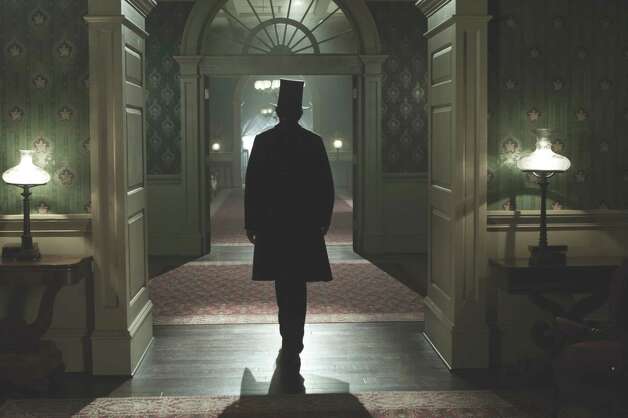
And Spielberg's eye for painterly detail shines, as Lincoln moves through the gloomy corridors of The White House or sets up an eerie dream sequence for the President.  And in one lovely scene, between Lincoln and Ulysses S. Grant (Jared Harris), where the war's toll on Lincoln is expressed in Day-Lewis' exhausted eyes and the shadows of a long rank of soldiers trudging in front of a setting sun play across his face.  

You can't see the moving shadows...
Spielberg's regular team of artists: Kaminski, Kahn, Carter, and Williams construct a great quilt of imagery and dynamics, making Lincoln a fascinating display of historical intimacy writ large.  It would make a superb triple bill sandwiched between Young Mr. Lincoln and The Conspirator.

Lincoln is a Full-Price Ticket.


* There's a nice contrast of Licoln delivering a dedication at a flag-raising ceremony that lasts a measly few lines.  "That's my speech" he says as he tucks his paper back into his stove-top hat.  They can't all be gems.

Tuesday, August 21, 2012

Hope Springs

Breathe 
or 
Breaking Noses and the Fourth Wall

When Tommy Lee Jones was interviewed on "Inside the Actors Studio" and they got to the point where James Lipton asks "those" questions, and he was asked "What word do you hate?" Jones curled his lip and said "Cute."

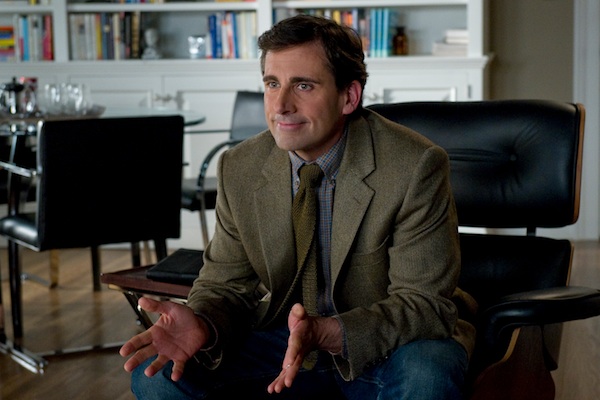
Fortunately, he's in Hope Springs, which, unfortunately, is the very definition of "cute," and manages to take some of the smirk out of it and put in the sting.  The tale of a pair of "empty-nesters" trying to rekindle the pilot light of their marriage and claw out of their rut, it is merely saved by the stalwart efforts of Jones and Meryl Streep, who say more with their body language—his trudging walk and her nervous, frustrated sighs—than any blunt dialogue could convey.  The script by Vanessa Taylor (she's written for "Everwood," "Alias," "Game of Thrones" and created the short-lived but well-regarded "Jack & Bobby"—quite the gamut, there) is long on touchy-feely aphorisms about metaphors, commitment and getting outside your comfort zone, dispensed by marriage counselor Steve Carell, who cuts out the dangerous aspects of his comedy potential and replaces it with wan smiles and scrutinizing eyes.  David Frankel's direction (he directed Streep in The Devil Wears Prada, directed Marley and Me and last year's The Big Year) is safe, but sound (which makes you wonder why he's not directing for The Weinsteins, and he's much more adventurous when working in TV) and keeps things from getting too treacly.

The pressure, then, is on Streep and Jones to bring everything to the table and they're an interesting study in contrasts.  She's all invention, imaginatively communicating with extraneous gestures of agitation and nuance, that burst out of her in spurts.  Jones is instinctive, making the text real with superb line readings with a minimum of fuss—funny as Jones' character is the fussy one, complaining constantly, passively aggressive, and not offering much in the way of support.  Both have issues and neither is entirely blameless—it takes two to make a bad marriage—but the sympathies throughout are with Streep's character, which is hammered home by the director and actress in moments of her satisfaction, by having her look directing at the camera for some sort of conspiratorial communal support from the audience ("Ladies...").

A little of that goes a long, long way,* and exposes that the film is geared to a female audience of a certain age and like-minded sympathies.  Such pandering mars the film, taking it out of the situation, and, by acknowledging the intended audience, shatters the illusion of reality, making it a staged presentation.  They might as well break into song, if this film about commitment isn't going to commit to anything.

Hope Springs is a blue-haired Rental.

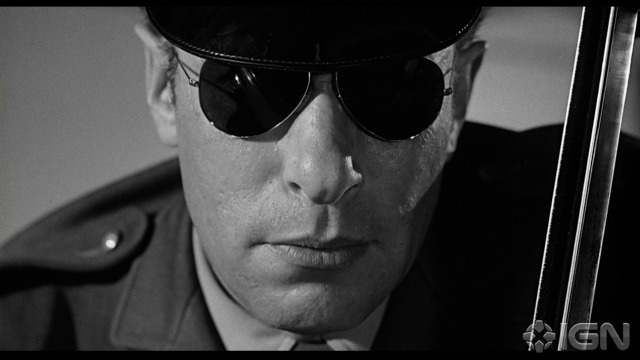
* Too far actually, and in the days after watching the film, the feeling that it recalled for me in a previous film experience is Anthony Perkins smiling directly at the camera at the end of Psycho (There are other straight-on shots in the film—Marion driving, the patrolman, Arbogast—but they're usually looking past the audience, eyes unfocused, not directly at the audience).

Wednesday, May 30, 2012

Men in Black III

Time Wounds All Heels
or
"Don't Ask Questions You Don't Want to Know the Answer To..."

The third "Men in Black" film had to go somewhere else but up.  The first two films were variations on the "illegal alien" theme about a government organization that monitored the activities of extraterrestrials in the world and specifically New York City, and revolved around alien invasions and the containment of said aliens. And when you've seen one alien invasion directed by Barry Sonenfeld, you've seen them all, and hyper-kinetically at that. And once it's been established that "aliens can be anywhere" the joke runs a bit dry pretty quickly, especially when the sub-species can contain pug-dogs and large cockroaches.  The second film tried to expand on those concepts and felt a bit thin in the process, concentrating a bit too much on the secondary characters rather than the basic plot and the character interactions.

So, where does Men in Black III go from there?  

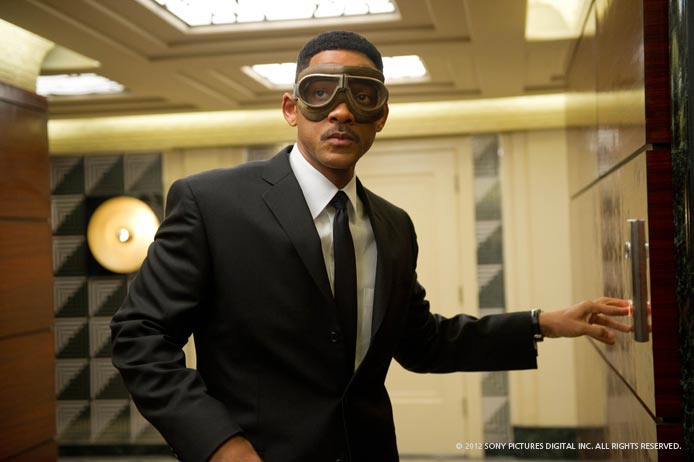
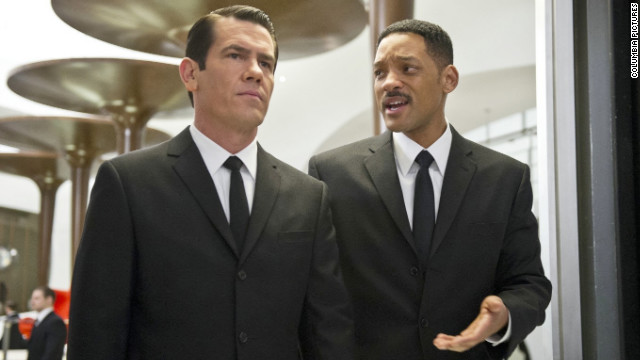
One of the nice aspects of the series has been its ability to still think outside the box, while expanding the horizons of just what that box might contain, be it variations of scale and dimension, even if only in afterthought.  With the infinite reaches of space seemingly exhausted, the group (based, supposedly on an idea by Will Smith) has the series going back in time.  Naturally.  It ostensibly revolves around an Earth-takeover plot by another alien (one must ask at some point "why always us?"), "Boris the Animal" (who seems based on the DC Comics "Hell's Angel in Space" Lobo and is played with growly gutteral responses by Jemaine Clement from "Flight of the Conchords") who escapes from his maximum (and we mean maximum) security prison to find the man who sent him there 40 years ago—Agent K (Tommy Lee Jones).  When he's unable to kill him here, the Boglodite finds another means to do so, and Agent J (Smith) wakes up the next morning, the only one with any memories of K past July, 1969.  Agent K has been killed by Boris in the past, and J must journey back to try and save him.*

Once back there, J negotiates his way through a 1960's era way of doing things.  Everything's a little less high-tech (a little less), but the MIB Agency is still there, as is the much younger Agent K (Josh Brolin, doing a bang-on interpretation of Jones) and J must solve the puzzle of saving the Earth (of course), while keeping K safe.  The past sequences are great—Men in Black has exploited the "fish-out-of-water" angle perpetually—and new corners are being thrown out the whole time (My favorite being a brief glimpse of a "Barbarella"-type being escorted around MIB, and although Smith is a bit too "Red Bull" throughout the entire movie, check out his understated reaction to some Black Panthers).  Great cast, too.  Rip Torn is gone, but David Rasche plays him in the past, Emma Thompson is on hand as the new MIB head, Will Arnett makes a brief appearance as does Bill Hader.  Toss in the chameleon-like Michael Stuhlbarg as an alien able to read multiple time-lines and there's always someone to deflect the eye, or hand things off from Smith.

But, the best thing about this "Men-in-Black" installment is resonance.  The other two were fine, the first better than the second just for its novelty, but had a shelf-life of three minutes.  Part of it is Sonenfeld's way of comically undercutting any meaning to the thing, by changing perspective—"you think you got a handle on it yet? Well, let me throw THIS at you!"  The whole "the Universe is so big and cosmic that there's no way you can understand it because there's so many mysteries, so nothing is real" concept, which is the backbone of the series (and the source for most of its humor) leaves one with a feeling of "meh"--nothing matters in a vast uncaring, unfathomable Universe.  Not here.  The cold of Space has nothing to do with the leavening of Time, and, in this case, the franchise plays it straight, without a wink, a nod, a reveal, or a goo-spraying splat.  For once, something really means something in the "Men in Black" Universe, and that venturing into uncharted territory makes the third time the charm.

Men in Black III is a Matinee.  (Not really necessary to see it in III-D)


* I'm not saying anything here that isn't revealed in the trailer.


Friday, September 16, 2011

In the Valley of Elah

This week, we're re-publishing some reviews of the films from the post 9-11 environment.


The Quagmire at Home

This is Paul Haggis' first directorial effort since Crash. In the meantime he wrote three films for Clint Eastwood, The Last Kiss and Casino Royale. He wrote this one for Eastwood, too, but to star in, not direct, which Clintus declined, saying that he's retired from acting. Too bad. This one might have gotten him that Best Actor Oscar. As it is, Tommy Lee Jones has the role, probably does a better job of it, and is certainly deserving of an Oscar. His Hank Deerfield, ex-Army investigator, is a portrait of a guy so meticulous, so disciplined that you wait for him to crack the whole film. It's one of the joys of the film, along with another of Charlize Theron's fine "de-glammed" performances, and Susan Sarandon bringing maximum effort to a small but vital role, all doing great work in a film that tries to be too many things, though it does succeed in many of them.

Part mystery, part war-story, part psychological drama, "Elah," punctuates its story with fragments of media recovered from a cell-phone that, like "Blow-Up" and "The Conversation," give tantalizingly legible glimpses into Deerfield's son's tour in Iraq, and frustratingly opaque clues into his post-Iraq behavior. He's gone AWOL, and Dad Deerfield goes to New Mexico to get to the bottom of it, because that's what he does. Once there, he and a detective try to piece together the evidence, and fight the bureaucratic red tape that hinders their work. Just as Crash owes so much to La Ronde," Elah calls to mind Courage Under Fire, about the death of a Persian Gulf War veteran, where conflicting stories and the subject of post-traumatic stress disorder are dealt with tangentially. Here, it's more overt, but there is an underlying message of the power of doing nothing, or of passing the buck, even ignoring the buck, taking the easy way out, or as the phrase went in Chinatown, the futility of good intentions, when not backed with action. The characters of In the Valley of Elah do "as little as possible" until provoked, challenged and threatened, and its reach is all-pervasive. In the end there is no one perpetrator, but a constant thread of sins of omission, and therein lies the tragedy.

As he did so much in Crash, Haggis telegraphs too many things, with some pretty obvious set-ups that are none too subtle.** The man just doesn't believe in red herrings, and everything gets used. Maybe that's his buttoned-up-in-25-minutes television writing showing. He's become better at cloaking some, though, hiding them in plain sight until they're trotted out for weighty significance. Some will see his final statement as un-American (which they're looking for, I expect), but a careful reading of what's gone before* reveals exactly what he's saying, and its entirely appropriate and, frankly, completely non-controversial. But Haggis seems to invite mis-interpretation. It's what makes him interesting. On top of that, you'll never see better work out of Tommy Lee Jones and Susan Sarandon and their scenes together have a lived-in familiarity and friction that speaks volumes of history and experience. There's some awfully good work in this.

In the Valley of Elah is a solid Matinee.

* Easy for me to say, I take notes!

** According to the Addictionary, this is called "five-shadowing"


Saturday, July 23, 2011

Captain America: The First Avenger


"When Captain America Throws His Mighty Shiiiield..."  (KLANG!)
or
"Yeah, I've Knocked Adolf Hitler Out Over 200 Times."

This is the one that needed to work.

It all hinges on this one and it would be a tough fight.  Captain America is the one Marvel A-lister who has seemed to defy the switch to other media.  There were the '60's cartoons—basically limited-animation panels from the comics—a bad '90's film, a serial film, a couple of lousy TV movies.  Next year's The Avengers extravaganza depends on the character, so this is the one to be nervous about.

"Cap" is Marvel's version of Superman, a Big Blue Boy Scout, but like DC's Big Guy, it's tough to write for him—the fight always has to come to him and a lot of the time he plays defense, he has no motivation other than an altruistic manner, and he's seemingly unstoppable, meaning the villains have to be more elaborate and more interesting than he is.  Like Superman, the character is often changed—costume, identity, or even, when all else fails...killed.  Up until this time, the few live-action CA interpretations have seemed like shielded "Six Million Dollar Man" episodes, cheap and stunted.  It's tough to replicate the dramatic moves the character pulls in the comics (he's usually shown in mid-move, suspended, too) as opposed to Spider-man.  Captain America: The First Avenger has to work.

It does.  Like gangbusters.

Director Joe Johnston has been down this road before—he directed The Rocketeer, another WWII-era superhero flick, after all—but he's never made a film as good as this one (he made The Wolfman last year).  CA:TFA takes the story back to its comic-book origin roots when it was created by street-wise kids Joe Simon* and Jack Kirby—fighting Nazi's and flying colors.  At the same time, it pays affectionate tribute to past Cap incarnations, while delivering the action goods in a neat retro-futuristic environment, a bit like what Sky Captain and the World of Tomorrow should have been.** 

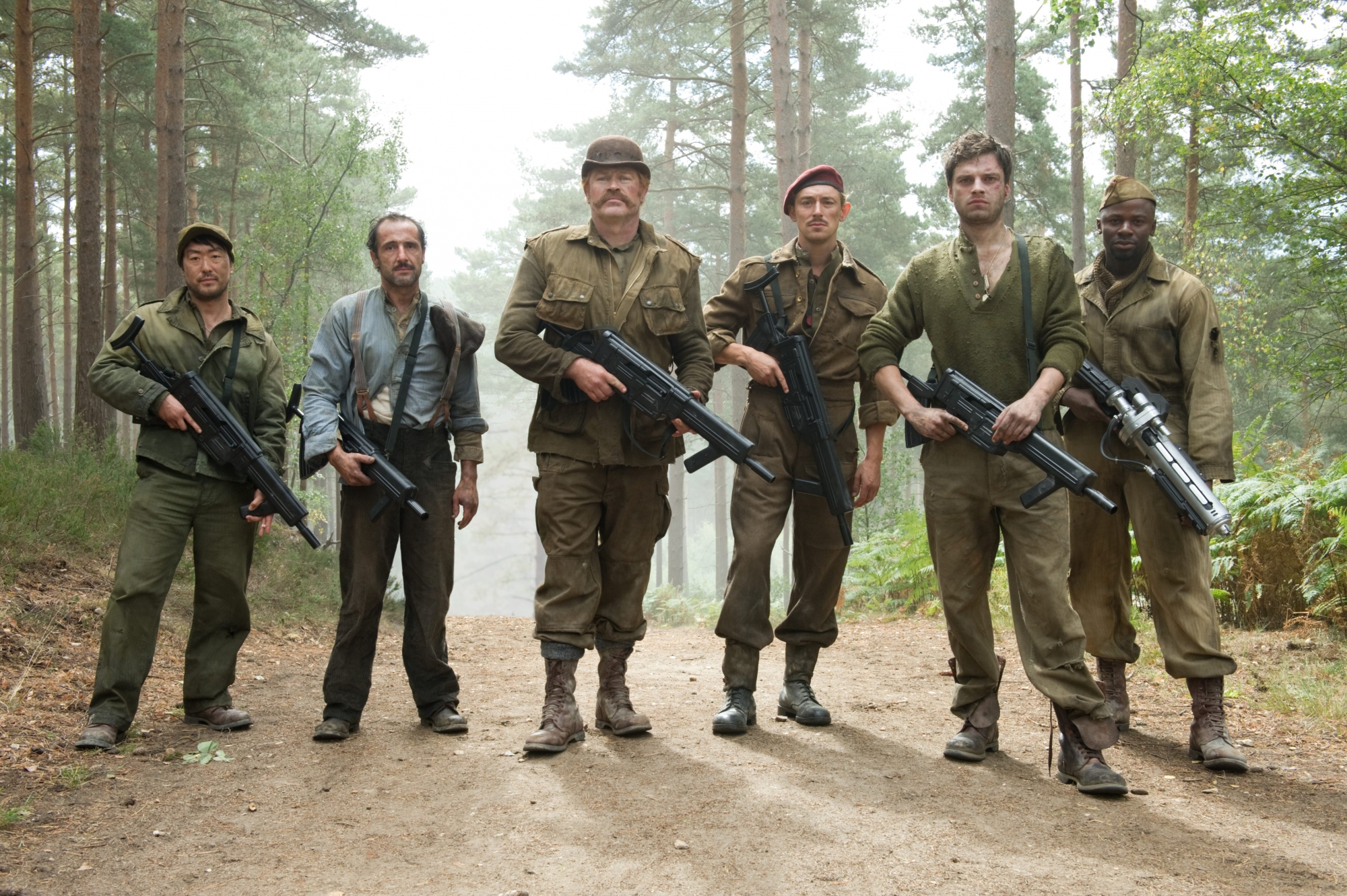
Steve Rogers (Chris Evans) is a 98 pound Brooklynite weakling (such things do exist, I've heard), who wants to join the Army and is constantly turned down for any number of good reasons and envious of his pal James "Bucky" Barnes (Sebastian Stan) who's off to fight in the European Theater with the 107th.  In a note that ties in with locations from the Iron Man movies, Rogers goes to the New York World's Fair on a double-date with Bucky, and his G.I. jones is noticed by Dr. Erskine (Stanley Tucci), who gets the kid a hitch, and a washout in training, signs him up for a "super-soldier" program that Hitler was very interested in before Erskine fled Germany.  Meanwhile, half a world away, one of Erskine's test-subjects Johann Schmidt (Hugo Weaving) is blitz-krieging around the world looking for ancient artifacts, ostensibly to help with Germany's war-effort, but secretly to gain ultimate power to form his own Reich, with his science group, Hydra.   Erskine's experiments on Schmidt have drastically disfigured him, but for Rogers, the attempts are a stunning success.  Rogers wants to fight, but the government instead presses him into service as a war-bonds spokesman, as "Captain America," which goes over well at home, but is a joke to the soldiers on the line.  Under the auspices of Colonel Chester Phillips (Tommy Lee Jones, who laconically nearly walks away with the movie) and Major Peggy Carter (Hayley Atwell, plucky—she doesn't blink when she fires a gun), Rogers goes against orders and inserts himself into the fight, rescuing a squad of Hydra prisoners, including his pal Bucky and a motley crew of dog-faces familiar to anyone who's read the comics.

The sight of The Howling Commandos brought a big smile to my face, but even without them, Johnston makes a fun, goofy film, with some nice war action mixed in with well-done super-hero antics, and shot along the lines of a film Johnston storyboarded early in his career, Raiders of the Lost Ark (with the occasional nod to Leni Riefenstahl).  Johnston does some nice movie cross-referencing by making the character of Howard Stark, very Howard Hughes-like after his own The Rocketeer, and casting Dominic Cooper in the part, often resembling Leonardo DiCaprio from The Aviator.  Chris Evans, who plays Steve Rogers, is a good funny actor, but he's tamped down here, playing everything completely straight and without irony, very much the Boy Scout.  This is one of the better Marvel movies, and one of the better superhero movies to come out, as well.

As with the other Marvel films, stick around until after the credits for a big surprise, that will whet your appetite for next year.  "Some assembly required."  Heh.

Captain America: The First Avenger is the perfect Saturday Matinee.


Wilhelm Alert @ 01:33


* Simon is still alive (bless him) at age 97, and still active—he has a new comic coming out this year.  As Stan Lee has his customary cameo in this film (he's good, too) it would have been nice—really nice—if Cap's REAL creator was included in the film.  The legendary Jack Kirby died in 1994.

** It's a combination of Kirby-esque pod-forms, more suited for the 1960's, and lo-tech '40's dials and toggles (which spit sparks in duress), and my favorite joke in the film is the non-LED (not invented yet) countdown indicators used in the Red Skull's lab—as any timed pyrotechnician will tell you, the only reason to have such a device is to build suspense in movie audiences.


Friday, February 11, 2011

The Company Men

"The Worst They Can Do..."
or
"Looking Out for No. 1"

John Wells cut his teeth on "China Beach," "ER," and "The West Wing" (his company produced, and had the unenviable task of following Aaron Sorkin and Thomas Schlamme as its shepherds), and excelled at the TV requirements of the easy irony and the clean, unfussy shot.  He brings that same sensibility to The Company Men, which at least has the stones to risk box-office disaster addressing the financial meltdown.

While banks are failing and institutions too big to fail do so, Boston's GTX corporation is warding off a possible hostile take-over by fluffing their stock; the most expedient way to do that in an uncertain economy is cut overhead and "redundancies," meaning shoes on the floor.  Wall Street looooves a good blood-letting.  Bobby Walker (Ben Affleck), a cocky well-to-do sales associate is one of the first to go, getting the pink slip and the complimentary empty boxes on the desk.  He's mad.  He's angry. He's bitter.  Life changes.  The wife goes back to work (after he insists that she doesn't).  The kids worry (though the parents attempt to keep it a secret).  The long process of looking for a job is a full-time life-sucking process, while as time drags on, the cockiness fades, the budget tightens, the possessions fade away and the lying starts.  Pride goeth before the fall.  But, first go the Porsch', the house, the country-club membership, the perks, then goes to the bone—the self-respect...the self-worth.  The things you say you'd never do, you do.

GTX rolls on and over.  The CEO (Craig T. Nelson) continues to prop up the corporation in grand strokes of hubris.  His ship-building division head, Gene McClary (Tommy Lee Jones) tries to protect his assets, like division chief Phil Woodward (Chris Cooper) and head of HR Sally Wilcox (Maria Bello)—who just happens to be his mistress—but those efforts make him look disloyal to his his boss and friend Nelson.  It is telegraphed early on that they're at risk, too, and Wells doesn't surprise by falling the most likely story path.

Bobby soon ends up working for his wife's brother (Kevin Costner) in construction, just to make what ends he has left meet, but it's too little too late, and he gets lectured on "how things are:" "GTX's President makes 700 times what the average guy on the floor makes; you think he works 700 times as hard?" brother-in-law asks at Thanksgiving dinner.  Pass the cranberries, bro.'  Pretty soon the entire film feels like a lecture on the twin (somewhat negating) virtues of self-reliance and helping others, with the inevitable triumphs and tragedies that the script calls for before the final commercial break—even though this is a theatrical presentation and the commercials come at the beginning. 

It's all Wells and good.  The writer-director is helped immeasurably by Coen Brothers lenser Roger Deakins, and he's got a great cast doing varying degrees of cagey work—Costner, in particular, plays his part completely, unsentimentally, which is unusual for him and refreshing.  But, its all a little too little too late.  As a summing up of the human consequences of down-sizing, it's a noble effort, but its audience—if they can afford to go—already knows all this and may end up feeling like they've been watching a parrot tell them their lives for two hours (Thanks, John, appreciate the sermon—you don't need a sound designer, do you?).*  One wishes that someone would mention that these economic bubbles aren't restricted to this one time, but to the cycles that come from risky, if not downright criminal, actions that take place every twenty years.  That an increasing life in the fast lane runs the risk of losing control of the vehicle.**  That, even if one takes the safe, conservative approach, you can still lose everything if the timing isn't fortuitous.  That life is a crap-shoot, at times, and the guy who does the best may be that crazy guy who doesn't contribute to the economy, but stuffs his mattress with cash.***

But, that's never said.  Maybe it will be in the sequel, The Company Men 2: That Ship has Sailed, which will basically be the same thing twenty years later, when the next crash occurs.  And when one says that, one realizes that the real of message Oliver Stone's Wall Street: Money Never Sleeps is that a sequel needed to be made at all.

The Company Men is a Rental.

* I watched your movie; you did.

** For more on that, see tomorrow's review...

*** I won't even mention that the messenger for all this comes from a tinsel-towned industry known for its waste and excess.  Kudos that everybody on your film got a wage, but at what proportion to the stars and the execs—as long as we're making comparisons? How's that for irony? Heal thyself, Preacher.

Thursday, February 5, 2009

The Fugitive

"The name: Dr. Richard Kimble. The destination: Death Row, State prison. The irony: Richard Kimble is innocent. Proved guilty, what Richard Kimble could not prove was that moments before discovering his murdered wife's body, he saw a one-armed man running from the vicinity of his home. Richard Kimble ponders his fate as he looks at the world for the last time. And sees only darkness. But in that darkness, Fate moves its huge hand...."

As sepulchrally intoned by William Conrad (far removed from his narration of "The Rocky and Bullwinkle Show!"), you couldn't reach higher levels of melodrama than "The Fugitive" starring David Janssen as Dr. Kimble, running a cross-country race between the man who wants to capture him and the man he wants to capture. I was a devoted fan of the show when it had its initial four year run on ABC-TV in the States, and watched it more religiously than "Star Trek" in syndication.

When I heard there were plans to make a big budget movie with
Harrison Ford, I groaned. How could they possibly take a stretched out concept like "The Fugitive" where half the suspense is how long the man has been on the run and make it work as a compressed two-hour film?

Pretty damned well. Of course, there are changes. The crime is a conspiracy, rather than a random act of violence. Yes, there is a one-armed man. But there are other staples of the series, too.
Kimble must change his identity--he even uses the patented black hair-dye at one point. He toils at...acouple of jobs, posing as various hospital employees and, at one point, a janitor. Yes, he still dangerously acts the Saint, taking time out from his detective work at a hospital to help a kid with a chest condition that's counfounding the residents (one of whom is Julianne Moore). They have the incident from the first season where Kimble goes to see a one-armed man in the local lock-up only to be spotted by Lt. Gerard (Tommy Lee Jones in his Oscar-winning role as "Sam"—not "Philip"—Gerard*) and miss getting caught by that much. And they have the gambit where a fellow passenger on public transportation recognizes the guy across the aisle in the mug-shot on the front page.

But it's action that's been amped up for the film.
In the tv series, Kimble and Gerard are on their way to Death Row when their H-O scale train (in the model shots) jump the tracks and Kimble escapes.

It's a bit more complicated in the movies—Fate's "huge hand" is ginormous in this one. Kimble and the other prisoners are being transported on a bus,
when an escape attempt kills the bus-driver, sending the bus over a guard-rail and tumbling onto a set of railroad tracks...into the path of an on-coming train. Kimble has just enough time to save one of the guards before he leaps off the bus a split-second before the train hits it. The crash causes some of the cars to detach, derail and come careening after Kimble before crashing spectacularly into a culvert, sending its load of logs exploding into everything in sight. It is spectacular. And sets the audience up by 1) getting them prepared for some stuntly fire-works and 2) lets you know just how desperate Kimble is to avoid being caught so he can find his one-armed man.

The entire chase from escape to ending takes place in a period of less than a week, so he only has to go through a couple changes of clothes, his hair turns back to Harrison Ford brown, and Kimble never has enough baggage to have baggage as he did in the series. Plus, he never has to do anything for full employment for the short period he is free in the movie. Taut, a bit more realistic in maintaining anonymity in a modern world (though not so much with the stunts), "The Fugitive" does a great job of maintaining the integrity of the original and even surpassing it.

Dr. Kimble gets his (one-armed) man.

* One of the improvements in David Twohy and Jeb Stuart's fine script is the squad of deputies Marshall Sam Gerard has helping him investigate this case. In the series, Gerard, as played by Barry Morse, was an obsessive-compulsive lone wolf. He's no less dedicated here, but its sublimated by the way he runs his deputation ragged. It provides a lot of the comedy as well.

Monday, April 21, 2008

In the Valley of Elah

There is a good movie here wishing it could be born out of this mess. Tommy Lee Jones is giving it all he's got, portraying a meticulous and persevering war vet trying to uncover the mystery of his son's death. Some nice details build his character... like the way he creases his pants even when he's living out of a motel room; or the way he pumps young soldiers for information by inviting them to share a cigarette or a shot of Jim Beam. The center of the film is a half-hearted attempt at a detective story, with Tommy Lee and Charlize Theron sniffing out a cover up. I say "half-hearted" because the film never fully commits to engaging you in the detective story... instead, it gets distracted. There's an aborted try at a family drama (where TL Jones becomes surrogate daddy for Charlize's kid, which is not only unbelievable, but only lasts for about 2 minutes and is never mentioned again); some limp attempts to address racial prejudice (in which TL Jones again breaks character and beats a man while delivering an ethnic slur); and wasted appearances by fine actors Barry Corbin and Josh Brolin. Their screen time is well-written and compellingly delivered, but fails to contribute to any central thrust of the film. (BTW, I think this must have been filmed around the same time as No Country for Old Men, which might explain how at least three cast members appeared in both films.)

The film hints at fertile territory, but it's all undone by a heavy-handed insistence at creating a "message" film. As such, it reeks of embarrassingly obvious symbolism and propaganda. It's the same sort of failure that plagued Fast Food Nation. Lots of good actors contribute to both films (no doubt they support the respective causes) but nothing cohesive or satisfying comes of it.

I would only recommend In the Valley of Elah for Tommy Lee Jones completists. Otherwise, like me, you'll probably want your two hours back.