Showing posts with label Biography. Show all posts

Tuesday, November 20, 2012

Lincoln

Noisy and Messy and Complicated
or 
WWLD?

At the end of John Ford's Young Mr Lincoln, "the jack-legged country lawyer" (as played by Henry Fonda) walks up a blighted horizon in the darkening gloom, as thunder rolls in the background, the rough-hewn fence he trudges along taking on the look of military barricades, as the young Lincoln walks with his long stride into the storm of history awaiting him.  Steven Spielberg's Lincoln starts where Young... left off—with the sound of thunder over credits, which evolves into cannon-fire before placing us straight on in the middle of the Civil War, blue-on-gray, white-on-black (and the reverses) amid the blood and the mud of the Earth.  The shots of the battlefield are tight, confusing, with no sense of place, no horizon—just a frame filled with humans killing each other by any means.  No glory.  No higher purpose.  Just the immediacy of conflict.  War is the point at which politics breaks down, and politics is where Spielberg's film is concerned to compare and contrast with today's stew of chicanery, graft, and playing fast and loose with the facts to the purpose of getting your way.  'Twas ever thus, and it was no different in Lincoln's time—they just didn't have cameras documenting everything then.

The approach is as good a starting place as any—that is, ending with Ford's last gambit—linking the two, as both films' main goal is to take the monument out of the man, and put him within reach of attainability, wart and all.  The canonization of Lincoln began at the moment of his death with the pronunciation "now he belongs to the ages" and his visage, homely, homespun, ragged sunken and contemplative, has been preserved in nickel, bronze, marble, granite to the point where one can hardly imagine it as flesh and blood anymore. 


Young Mr. Lincoln: walking into a History still to occur.
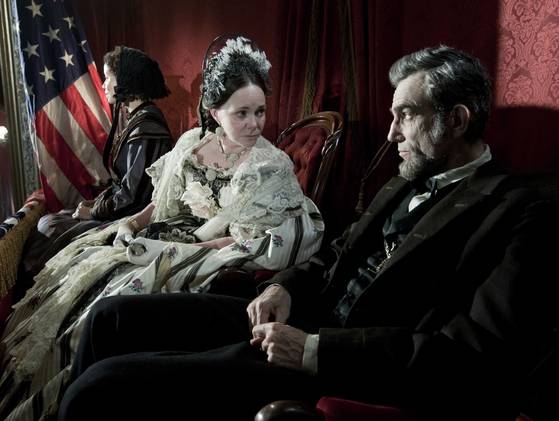
As portrayed by Daniel Day-Lewis, Lincoln is pitch-perfect, not only in his make-up, but his high tenor rasp of a voice, and—the remarkable part for me—in his still-legged gait that kicks and plants itself on the earth, not too steps away from the ragged dance of Wyatt Earp (Fonda, again) in My Darling Clementine.  It's a big, robust cast—I had error alerts for all the names I tried to cram into this article's meta-data labels—but the hub of it all is Day-Lewis' Lincoln.  Soldiers (including Lukas Haas) quote his Gettysburg Address back to him (which the President tries to staunch: "Been there, delivered that."*)  His wife (Sally Field) constantly badgers him—but then she consistently badgers everybody, his cabinet is frequently frustrated by him, by his prevarications, his story-telling that constantly derails conversations to his agenda, and his thought processes which annoy them.  "Actually," says Secretary of State Seward (David Straithairn) after Lincoln quotes verse, "I have no idea what you mean by that."

What he means may be too pragmatic for them, it's just how he expresses it that confounds.  In one exceptional scene—Tony Kushner worked on this script for a long time and it shows—Lincoln explains in minute, often harsh, detail how he employed his newly granted War Powers Act and it comes down to what he thought he could get away with, legally.

His concern, in the waning days of the war, is to pass the 13th Amendment, thereby abolishing slavery, and it takes every trick, every dodge, every promise and appointment in the middle of a lame-duck Congress before the war could end.  The timetable is critical: Lincoln has just been re-elected and is riding a wave of popularity; a crucial number of Congressmen are in their last days of their jobs and are looking to their futures and not to the wishes of their constituents; and, if the war ends, the urgency to pass the Amendment will dwindle, amidst the rebuilding of the Nation.  Lincoln's Republicans will vote for it, but they need to tone down their rhetoric.  The Democrats are dead-set against it, but getting Democrats to agree on anything is like herding cats and Lincoln wants to exploit the party's fractures into fissures.  

So, the problem is attacked from several fronts (if only the war had started that way): Preston Blair (Hal Holbrook), prominent Republican and journalist, is sent to the South to negotiate a Southern settlement, which the South is anxious to do (although Lincoln is reluctant).  Meanwhile, he wheels and deals with the largesse of power, offering appointments, threats, anything to curry votes, and unleashes a trio of stooge-lobbyists (James Spader, John Hawkes, and Tim Blake Nelson) to press the flesh and pass the greenbacks (not "officially," though).  Votes are critical.  On the home-front, Lincoln's son Robert (Joseph Gordon-Levitt) is back from college, but feeling the weight of his kinship with the President and wants to enlist, which sends wife Mary Todd into another accusatory tailspin as she has barely survived the death of their son, Tad.

Throughout, Lincoln keeps his counsel. but sometimes erupts into spasms of frustrationwith "Molly" (as he calls her), the congress and his cabinet, choosing his moments and pressing his advantage, knowing no peace except what he can create for himself.

As good as Day-Lewis is, he's matched by Tommy Lee Jones as House Republican Thaddeus Stevens.  In chambers, Stevens sits and fumes, then reaches his limit and bursts out in loud insulting harangues, just in control enough to get his point across, and even smiling tightly—very tightly—when when dressed down by Mary Lincoln over his tight reins over The White House purse strings.  Jones finds different ways to make his speeches crackle, while never betraying any sense that the words haven't sprung originally from his head.  And Spielberg has given special attention to casting key roles with the like of great character actors like Bruce McGill, Michael Stuhlbarg, and Lee Pace who make their relatively small parts punch out and become memorable.

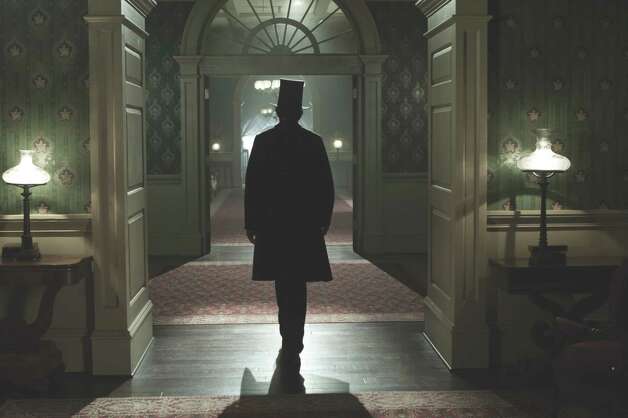
And Spielberg's eye for painterly detail shines, as Lincoln moves through the gloomy corridors of The White House or sets up an eerie dream sequence for the President.  And in one lovely scene, between Lincoln and Ulysses S. Grant (Jared Harris), where the war's toll on Lincoln is expressed in Day-Lewis' exhausted eyes and the shadows of a long rank of soldiers trudging in front of a setting sun play across his face.  

You can't see the moving shadows...
Spielberg's regular team of artists: Kaminski, Kahn, Carter, and Williams construct a great quilt of imagery and dynamics, making Lincoln a fascinating display of historical intimacy writ large.  It would make a superb triple bill sandwiched between Young Mr. Lincoln and The Conspirator.

Lincoln is a Full-Price Ticket.


* There's a nice contrast of Licoln delivering a dedication at a flag-raising ceremony that lasts a measly few lines.  "That's my speech" he says as he tucks his paper back into his stove-top hat.  They can't all be gems.

Wednesday, July 4, 2012

Yankee Doodle Dandy

Yankee Doodle Dandy (Michael Curtiz, 1942) Of all the films in James Cagney's storied career, his favorite was his most unusual—not one of his gangster films (some of which revolted him) or his dramatic efforts, but this one, the one that won him his Best Actor Oscar, the musical biography (very loose) based on the life of George M. Cohan.  Cagney always described himself as "a hoofer," starting out as a dancer in vaudeville, and the athleticism did him well in Hollywood.  Cagney's energy, timing, and directness—his grace (even if he was playing a hood)—came from this background, and the compensatory toughness came from his growing up and observing the streets, providing "that unmistakable touch of the gutter," as he eloquently put it in his acceptance speech for the second AFI Lifetime Achievement Award.

Yankee Doodle Dandy begins with Cohan (Cagney) on Broadway playing Franklin Roosevelt in "I'd Rather Be Right" when he is summoned to the White House to receive the Congressional Gold Medal from FDR himself.  The visit gives him a chance to tell his life-story to the President, which is presented in flash-back form, from his early days to performing with his family (Walter Huston, Rosemary DeCamp, Jeanne Cagney) to the lean years when stubbornness gets him blackballed in the theater community, and he has to struggle back to the stage by song-writing,* eventually coming back and becoming the King of Broadway.

It's still startling to see Cagney's dance moves; loose, limber below the waste, and ramrod straight above, his movements alternate between drunken sloppiness that looks like it could severely snap tendons if gone wrong, and stiff-legged woodenness, giving the impression that he's a puppet with the strings cut—not really in control of his own movements (and, of course, he always was—that was the illusion of it all, the mastery of it), but compelled to dance for the sheer energy of it forced him to do so.  It's scary, but Cagney always is.  He is, after all, the guy who shoots people by pumping the pistol forward, as if the movement puts more energy in the bullet to kill faster, make it more definite, more personal.  His gangsters make the guns part of them, rather than just a tool.  

Some of the moves look archaic, compared with the gymnastics-as-dance school today—the leaping and bouncing off a wall (as if there wasn't enough room on stage) looks tame now, even though it amazed me as a kid, but the high kicks I appreciate more, the toe-steps, the tap—all amazing.  And they look spontaneous, which in itself is a marvel.*

It's a feel-good musical about celebrating the spirit of America, which we all do on the Fourth of July.  That it happened during war-time, added mightily to the propaganda potential of it (and, although it's always been denied, might've helped Cagney get rid of the "pinko" label he was being saddled with at the time—my, how times haven't changed).  But, it's a fine achievement, and Curtiz, who's known for hating unused space in a movie frame, overcrowds the stages—every theater-piece for this director was "SRO."  And, although something of an autocrat, with musicals he let loose the reins (something Cagney appreciated) and allowed spirit to flow.  Maybe that's why Yankee Doodle Dandy still seems fresh.


It was voted into the National Film Registry in 1993 for being "culturally, historically, and aesthetically significant."


* Cagney could relate.  He was constantly battling the Warner Brothers brass, at one point suing the production company and staying away.  Jack Warner called him "The Great Againster."

** Evidently Cohan's final tap down the White House staircase at the end, was improvised.

Friday, March 23, 2012

The Iron Lady


Keeping Up Appearances
or
"Don't Want to Dig Around Too Much, M'. You Don't Know What You Might Find."

The Weinstein's last bid in 2011 to win an audience of Anglophiles seems a trifle desperate and might be a bit too early to give the subject proper justice, like Oliver Stone's Nixon or W.we're still too close to the Thatcher years to have any sort of perspective, other than a cursory glance at the events that shaped the Conservative years of the '80's.  What damage was done, what was gained, is still unknowable, especially given the subsequent Blair years and how British-American relationships changed and coalesced.  We get highlights and lowlights, but no illumination, and, instead, we get a look-back, not unlike Nixon's drunken reverie, but this time filtered through Maggie's Alzheimic reflections, with the dementia-figure of her dead husband Denis' presence as a Iago-like devil's advocate (played by Jim Broadbent, in just the way you think he would, a little dotty, but with a puckish edge).  Really, both of them deserve a little better, no matter what one thinks of the politics.

But, the Alzheimer's is a good tool if someone wants to do a hatchet-job.  The disease brings the past into crystal clarity (for the afflicted, not for the story-teller), while also undercutting the reliability of the narrator in the present day.  Hardly seems fair, as the two women who wrote and directed The Iron Lady (Abi Morgan and Phyllida Lloyd) do seem sincere about presenting the hurdles that Thatcher had to overcome in her ambition to seek change, achieve office, and, in becoming a political animal, save her party and become PM.  The role could have easily gone into caricature, were it not for Thatcher's best supporter in the film, Meryl Streep .

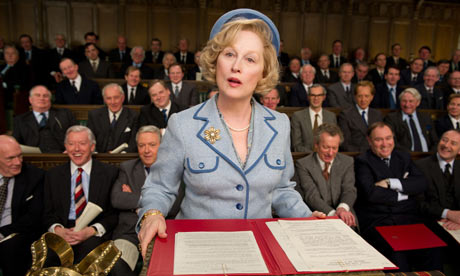
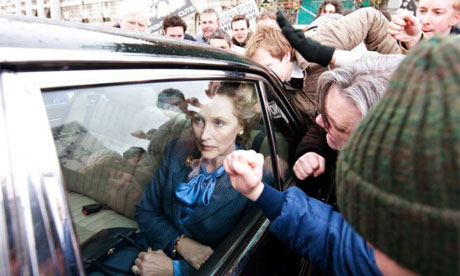
The role ultimately won LaStreep another Oscar (and, say what you will about the "unfairness of it all," she does deserve it—this is an amazing performance) and it contains her hallmark studied approach with the same intricate nuances she brings to every role—the rock-solid accent, the filigreed gestures, the interesting way she fills up the pauses and held-shots with interesting choices that are unexpected, but deeply felt.  In the elderly sections, she doesn't quite have the "thousand-yard-stare" I've seen in Alzheimer's patients, but the frailties are there, right down to the quaking-arms-under-pressure and the processing pauses that flash through without making a big deal of them.  Streep's always good, good enough that one might take her for granted, but this one's practically a one-woman show and certainly the best thing in a film that's "too little-too soon."

The Iron Lady is a Rental.