Showing posts with label Daniel Day Lewis. Show all posts

Tuesday, November 20, 2012

Lincoln

Noisy and Messy and Complicated
or 
WWLD?

At the end of John Ford's Young Mr Lincoln, "the jack-legged country lawyer" (as played by Henry Fonda) walks up a blighted horizon in the darkening gloom, as thunder rolls in the background, the rough-hewn fence he trudges along taking on the look of military barricades, as the young Lincoln walks with his long stride into the storm of history awaiting him.  Steven Spielberg's Lincoln starts where Young... left off—with the sound of thunder over credits, which evolves into cannon-fire before placing us straight on in the middle of the Civil War, blue-on-gray, white-on-black (and the reverses) amid the blood and the mud of the Earth.  The shots of the battlefield are tight, confusing, with no sense of place, no horizon—just a frame filled with humans killing each other by any means.  No glory.  No higher purpose.  Just the immediacy of conflict.  War is the point at which politics breaks down, and politics is where Spielberg's film is concerned to compare and contrast with today's stew of chicanery, graft, and playing fast and loose with the facts to the purpose of getting your way.  'Twas ever thus, and it was no different in Lincoln's time—they just didn't have cameras documenting everything then.

The approach is as good a starting place as any—that is, ending with Ford's last gambit—linking the two, as both films' main goal is to take the monument out of the man, and put him within reach of attainability, wart and all.  The canonization of Lincoln began at the moment of his death with the pronunciation "now he belongs to the ages" and his visage, homely, homespun, ragged sunken and contemplative, has been preserved in nickel, bronze, marble, granite to the point where one can hardly imagine it as flesh and blood anymore. 


Young Mr. Lincoln: walking into a History still to occur.
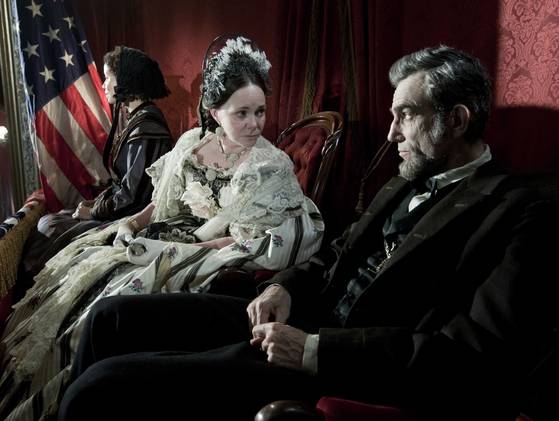
As portrayed by Daniel Day-Lewis, Lincoln is pitch-perfect, not only in his make-up, but his high tenor rasp of a voice, and—the remarkable part for me—in his still-legged gait that kicks and plants itself on the earth, not too steps away from the ragged dance of Wyatt Earp (Fonda, again) in My Darling Clementine.  It's a big, robust cast—I had error alerts for all the names I tried to cram into this article's meta-data labels—but the hub of it all is Day-Lewis' Lincoln.  Soldiers (including Lukas Haas) quote his Gettysburg Address back to him (which the President tries to staunch: "Been there, delivered that."*)  His wife (Sally Field) constantly badgers him—but then she consistently badgers everybody, his cabinet is frequently frustrated by him, by his prevarications, his story-telling that constantly derails conversations to his agenda, and his thought processes which annoy them.  "Actually," says Secretary of State Seward (David Straithairn) after Lincoln quotes verse, "I have no idea what you mean by that."

What he means may be too pragmatic for them, it's just how he expresses it that confounds.  In one exceptional scene—Tony Kushner worked on this script for a long time and it shows—Lincoln explains in minute, often harsh, detail how he employed his newly granted War Powers Act and it comes down to what he thought he could get away with, legally.

His concern, in the waning days of the war, is to pass the 13th Amendment, thereby abolishing slavery, and it takes every trick, every dodge, every promise and appointment in the middle of a lame-duck Congress before the war could end.  The timetable is critical: Lincoln has just been re-elected and is riding a wave of popularity; a crucial number of Congressmen are in their last days of their jobs and are looking to their futures and not to the wishes of their constituents; and, if the war ends, the urgency to pass the Amendment will dwindle, amidst the rebuilding of the Nation.  Lincoln's Republicans will vote for it, but they need to tone down their rhetoric.  The Democrats are dead-set against it, but getting Democrats to agree on anything is like herding cats and Lincoln wants to exploit the party's fractures into fissures.  

So, the problem is attacked from several fronts (if only the war had started that way): Preston Blair (Hal Holbrook), prominent Republican and journalist, is sent to the South to negotiate a Southern settlement, which the South is anxious to do (although Lincoln is reluctant).  Meanwhile, he wheels and deals with the largesse of power, offering appointments, threats, anything to curry votes, and unleashes a trio of stooge-lobbyists (James Spader, John Hawkes, and Tim Blake Nelson) to press the flesh and pass the greenbacks (not "officially," though).  Votes are critical.  On the home-front, Lincoln's son Robert (Joseph Gordon-Levitt) is back from college, but feeling the weight of his kinship with the President and wants to enlist, which sends wife Mary Todd into another accusatory tailspin as she has barely survived the death of their son, Tad.

Throughout, Lincoln keeps his counsel. but sometimes erupts into spasms of frustration—with "Molly" (as he calls her), the congress and his cabinet, choosing his moments and pressing his advantage, knowing no peace except what he can create for himself.

As good as Day-Lewis is, he's matched by Tommy Lee Jones as House Republican Thaddeus Stevens.  In chambers, Stevens sits and fumes, then reaches his limit and bursts out in loud insulting harangues, just in control enough to get his point across, and even smiling tightly—very tightly—when when dressed down by Mary Lincoln over his tight reins over The White House purse strings.  Jones finds different ways to make his speeches crackle, while never betraying any sense that the words haven't sprung originally from his head.  And Spielberg has given special attention to casting key roles with the like of great character actors like Bruce McGill, Michael Stuhlbarg, and Lee Pace who make their relatively small parts punch out and become memorable.

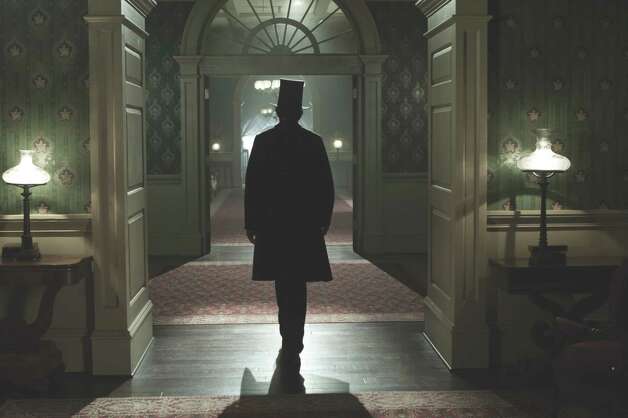
And Spielberg's eye for painterly detail shines, as Lincoln moves through the gloomy corridors of The White House or sets up an eerie dream sequence for the President.  And in one lovely scene, between Lincoln and Ulysses S. Grant (Jared Harris), where the war's toll on Lincoln is expressed in Day-Lewis' exhausted eyes and the shadows of a long rank of soldiers trudging in front of a setting sun play across his face.  

You can't see the moving shadows...
Spielberg's regular team of artists: Kaminski, Kahn, Carter, and Williams construct a great quilt of imagery and dynamics, making Lincoln a fascinating display of historical intimacy writ large.  It would make a superb triple bill sandwiched between Young Mr. Lincoln and The Conspirator.

Lincoln is a Full-Price Ticket.


* There's a nice contrast of Licoln delivering a dedication at a flag-raising ceremony that lasts a measly few lines.  "That's my speech" he says as he tucks his paper back into his stove-top hat.  They can't all be gems.

Thursday, December 31, 2009

Nine

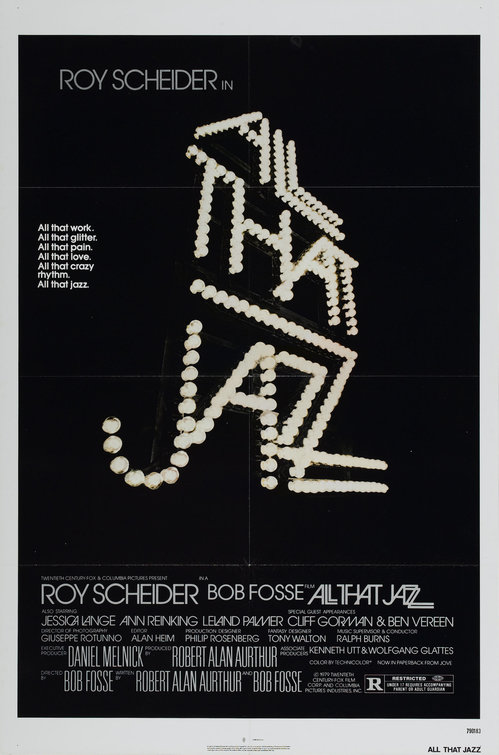
"How Do You Solve a Problem Like Fellini?"
or
"There Ought To Be Clowns (Don't Bother, They're Here)"


There is a great movie, I'm sure, to be made of the Tony Award winning musical "Nine." But this isn't "it." Nor, I think, was "it" an intention for the production company to do so.

In fact, it is hard to determine what "it" is, and what "it" intends to do. Is it a musical adaptation of
Fellini's "8 1/2," or of Fellini's life? Is it even an adaptation of the original musical, as there are far more songs left out of it than are in it?* Locations are changed, circumstances and motivations are sliced and diced. One wonders what was so wrong about a hailed musical confection that the late Anthony Minghella and Michael Tolkin (who wrote the script), current director Rob Marshall, and the producers seem to be running away from it.

They aren't the only ones, merely they slowest of the pack.
Daniel Day-Lewis was a last minute first tier replacement for the more suitable Javier Bardem when Bardem walked off the project pleading "exhaustion"—but not exhausted enough to flee, evidently. Bardem makes very wise career choices. Nicole Kidman replaced Catherine Zeta-Jones after the producers wouldn't accomodate her demands to expand her part. One wonders why they'd balk about making any more changes for their "Chicago" Oscar-winner after making so many of their own.

But, truth be told, the thing is a sorry, sorry mess. Not true to its source, its inspiration, or even to itself, one reads the description of the original musical and wonders why it is not the movie. But one gets an inkling.
Fellini's film, made about a creator's inability to create a harmonious chorus of the voices in his head, his muses, his collaborators and backers all clamoring for attention had a structure, a purpose and an approach. But it did not have a lift, a creative inspiration until Fellini made it about a director rather than a writer. Fellini had no trouble making it, letting his conscience and unconscious be his guide (or Guido, if you will). On the contrary, he was energized by it. His "film that got away" would not occur until a bit later in his career.

The creators of "
Nine" saw it as about themselves, and the difficulty of achieving a vision. One sees the disconnect with the Fellini inspiration as soon as the musical Guido's obsession with the Folies Bergiere is brought to song. Folies Bergiere? Mama Mia! Where's the Circus? Fellini equals circus! Comprende? But, "Nine" the musical—not the film, that gets even worse—is glitz and spangles and presentation with a smattering of psychological insight embroidered in a mash-up (one can't call it a mixture) of half-inspired and un-inspired songs.

"Nine," the movie, is a whoring down of that concept.
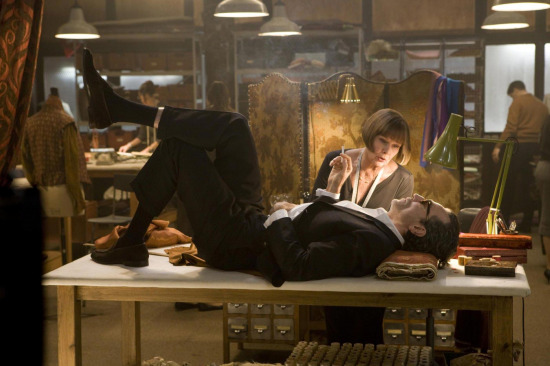
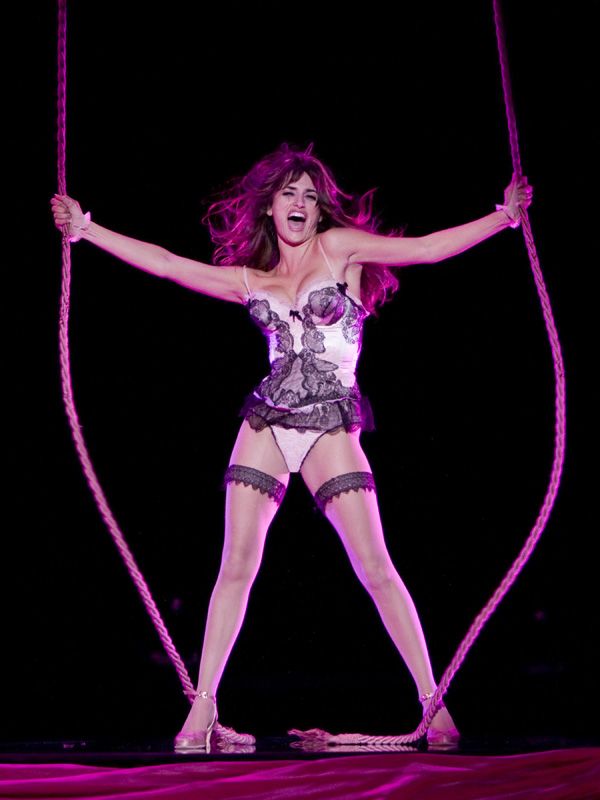
Big stars. Small ideas. A polyglot of a tribute to a movie it doesn't understand, and the broadway production that the money-men didn't feel had enough pizzazz** to put keisters in the seats (Because nothing makes you want to "Fosse, Fosse, Fosse" and booty-shake like ennui and creative stagnation!***). So, we've got Day-Lewis (he's fine—not too believable, but at least he's not doing a John Huston imitation this time).**** We've got Nicole Kidman and Penélope Cruz (wonder what they had to talk about on-set?), Kate...Kate Hudson (??), and....Fergie?(!!). Then, to give it some ethnic legitimacy they throw in Sophia Loren***** and Miramax staples Judi Dench and Marion Cotillard. Cotillard is heart-breaking as the Giulietta Massina look-alike wife—played by Anouk Aimée in Fellini's film (she's even got Massina's brave smile down). Dench does fine by her number, silly and irrelevent as it is, but as if to gin up any excitement, they work over-time trying to make it entertaining. Cruz gets a sizzling number as director Guido Contini's mistress-played by Sandra Milo in the original film. Kidman plays Contini's past star Claudia (based on the Claudia Cardinale character in "81/2"—which would have tied in with Zeta-Jones' participation, but goes back to the original inspiration, "ice queen" Anita Ekberg for Kidman's participation). Loren plays Contini's domineering Mamma, usually a grotesque in Fellini's films.

Director Rob Marshall undercuts the material by over-cutting, editing all the momentum out of the music, which veers from worthwhile ("Be Italian" given a rip-roaring rendition by...give her credit, she's the best thing here...Fergie of "The Black Eyed Peas") to the filler ("Cinema Italiano" given sass by Kate Hudson, but shot and edited like an MTV version of the old '60's "Shindig!" program).

I was looking forward to this one, but very high expectations leave the biggest craters when they fall. Not a fan of musicals, "Nine" only confirmed why I've rarely enjoyed them, as they can be false and irrelevent to anything resembling life or the inpulse to song that it might evoke.

This adaptation of an adaptation of a somewhat autobiographical work by the artist, even though titularly and musically adjusted for inflation, just isn't worth as much as the original. Artistically, it is bankrupt.

"Nine" is a Cable-Watcher.

* Three new songs were written for it, all of them unmemorable—in a bid to score more Oscar nominations for The Weinstein Company which oversaw this sorry mess.

** Imagined conversation: "Y'know? Everybody's singing about their feelin's an' everything! There's not enough dancing with women with big bazooms, and Alfa Romeo's and Fiat's!! Know what I'm sayin'?"

*** Although Fosse did make a musical based around a heart attack!

****...which reminds me, the last movie I've seen that ended (like "Nine") with the director-figure saying "Action" was Clint Eastwood's "White Hunter, Black Heart"—where Eastwood was playing (and imitating) John Huston!

***** Did it occur to the makers that the only Italian in their film celebrating Italian cinema is Loren? And that she didn't work with Fellini?

Sunday, February 24, 2008

There Will Be Blood

Goin' back to Huston

Then the LORD said to Moses, "Say to Aaron, 'Take your staff and stretch out your hand over the waters of Egypt, over their rivers, over their streams, and over their pools, and over all their reservoirs of water, that they may become blood; and there will be blood throughout all the land of Egypt, both in vessels of wood and in vessels of stone.'"
Exodus 7: 19

Paul Thomas Anderson's "There Will Be Blood" is a free-hand adaptation of the beginning of Upton Sinclair's "Oil!" that tells the rise of self-declared oil-man Daniel Plainview, of his rise and corruption, of the battles he undertakes to achieve his goals, and the costs of his life of solitary determinism on his sanity and his soul.

As a story of how one man could have made a mint extracting oil from the ground in the late days of the 19th Century, it is a great success. Plainview makes of himself a Man of Destiny to acquire land and mineral rights to further his business interests, uses the boy he has taken under his wing to promote himself as a family man to the town-folk he bilks, and courts the influential among them that their goals are his goals. It's all a lie, of course. He wants their oil. And he will do anything to get it. Anything.

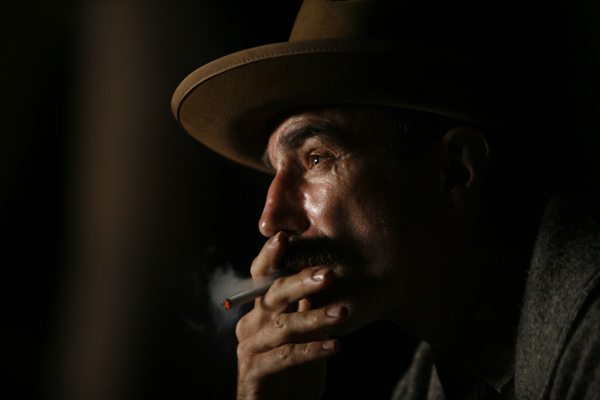
Daniel Day-Lewis' scrupulous absconding of the voice, cadence and manner of John Huston is not unlike Plainview's ruthless extraction of oil from the ground. Huston's dramatic power always lay in his measured tones that bespoke intelligence and Great Thought couched in a velvety roughness that combined Male Gruffness with Feminine Sensitivity. It's an orator's voice. An authority's voice. A voice of steel wrapped in leather. Day-Lewis's use of Huston's voice, combined with an unblinking wolf's glare lets you see the inner strength of the man, while at the same time not revealing too much of what's going on inside, which is a hard trick to pull off over a two hour movie running time--especially when Day-Lewis is on-screen almost the entire time.

At the same time, Anderson sets up a story about three pillars of American Strength: Industry, Faith and Family, and the perpetual war that those three engage in for the heart and soul of America.* In "There Will Be Blood," that the three are all based on falsehood and impression, makes the argument that that strength is a house of cards, an illusion as much as a businessman's power, the authority of God, or the ties that bind. They are all claims that are only good if they are freely given, and the protagonists of "There Will be Blood," are in a intellectual battle to take the Rights, the Faith, and the Authority--the Power. Quite the interesting film to make in an election year.

Playing the Faith base is Paul Dano, who was so great as the self-disciplining son in "Little Miss Sunshine." He first appears as twin brother Paul Sunday, who bargains with Plainview for knowledge of the oil-rich property his family owns. He turns up later as Eli Sunday, evangelist and leader of the Church of the Third Resurrection, sanctimony permanently plastered on his face, and the air of entitlement despite his humble surroundings. Both he and Plainview work to get their way, and when they don't, they become unhinged. They gravitate to each other, attracted to each other's Power, coveting it, and conspiring to take it for their own.

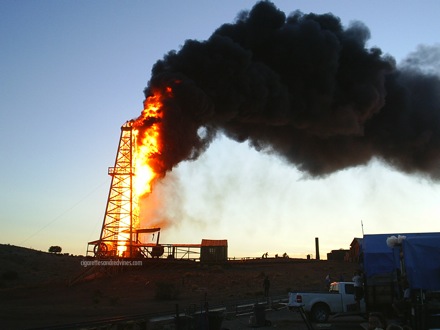
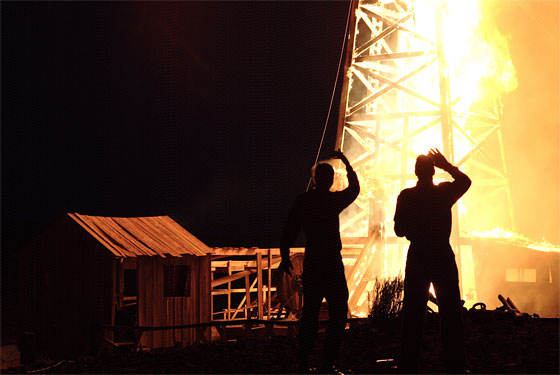
Technically, the film is a marvel. There are gorgeous scenes of well-fires, and many, many night shots of Plainview's face, where he is only one shade paler than the dark (the amazing cinematography is by Robert Elswit, who also shot "Michael Clayton"), the film is never less than beautiful to watch. Production design is by Jack Fisk, who excells at this sort of period piece. Johnny Greenwood's score is thuddingly heavy-handed, though, it's his first score so he hasn't learned that he's not the front-man, yet. Ultimately, though, the cumulative effect is underdone by Anderson's own screenplay. It's source novel (Upton Sinclair's "Oil!") continues the story to the corruption of the country's government by the Teapot Dome Scandal, but Anderson is content to stop at Plainview's own corruption. A good thing, too, as expanding the story to its biblical ends would have probably added another couple hours of screen-time. The bad thing is his ending feels truncated, hap-hazard and a little desperate.** It certainly doesn't feel like the ending for the measured film that has come before. Even though the larger scandal doesn't occur, it's weight is what is needed to complete this particular film, and so it feels lacking, like a phantom pain for a severed limb.

There has been a rush to Hosannah this film as a Masterpiece.*** If the film wasn't spending so much time obfuscating its point, it might be. As it is, its a glorified character study, richly appointed and lovingly produced, but with an obvious character arc and an air of self-importance that it never achieves. Or deserves.

"There Will Be Blood" is a Matinee
---------------------------------------------------------------------------
* Lest anyone think that Anderson is staking a new claim here, the same themes run throughout and typify the American gangster movie.

** (SPOILER) The more one thinks about the way the story turns--of Plainview going from the stationary silver mining, into the less physically restrictive oil-trade and expanding his reach, the ending seems to be focussing on the wrong story arc. Some critics are saying that Plainview is killing God at the end. Well, technically he's not, not even in his own mind, if he's been denying God's existence not five minutes before. No, Plainview bludgeons Sunday because once he's made him deny his faith, Sunday's threat, and thus Sunday himself, is dead already. But there are some critics who want to treat this movie the way some scholars have treated "Moby Dick" ("The bench is a metaphor for Calvinism"), when, like Freud, you have to concede that "sometimes a cigar is just a cigar." What's all that talk about milk-shakes a metaphor..uh...for?

*** Manohla Dargis wrote, in her review for the New York Times, "the film is above all a consummate work of art, one that transcends the historically fraught context of its making, and its pleasures are unapologetically aesthetic." Uh-huh...other than the "consummate work of art" part, one could say that about ANY film. I think she's saying that she likes it, that she can't explain why, and that it was tough to make.