The 5,000 Fingers of Dr. T(Roy Rowland, 1953) Marvelously odd-ball, bizarre fantasy film for kids that's as much fun for adults, and has the added benefit of a crazed performance by Hans Conreid and a script, songs and design (after a fashion) the eccentric Theodore Geisel, whose nom de plume was Dr. Seuss. Seuss was a definite, defiant genius,* in that he maintained throughout his complicated adulthood, the simplistic child-view, with all its neurotic simplicity, the well-ordered conservative traditionalism, swirled with a wildly anarchistic streak. Dr. T is a bit like The Wizard of Oz in that it's a vividly imagined fever-dream that reflects the real world pureed in eye-popping colors and shapes through a child's trauma filter. For Dorothy Gale, it's brought on by familial stress instigated by head-trauma. For Bartholomew Collins (Tommy Rettig), it's familial stress instigated by exhaustion created by piano drills imposed by the unholy alliance of his mother (Mary Healy) and his music teacher, the snooty Dr. Terwilliker (Conreid). The kid's got no allies, save for his dog, the audience—whom he regularly addresses—and the local plumber, Mr. Zabladowski (Peter Lind Hayes), whom he respects for his control over his life abd his ability to fix stuff—fixing stuff is important when you're a kid seeing the world broken. Bart sums up his predicament for us, then falls into a horrific exhausted slumber, where he pictures himself the lone victim in the machinations of Dr. T, secluded in his impossibly architectured institute, the first specimen in a regimented experiment to lead a slave-team of 500 kids to realize his ultimate composition.
Bart hides in plain sight in T's complex—making him look bug-like and squashable
For Bart, the job is simple: get out of the castle, rescue his mother (who is in thrall to the Professor as his assistant) and barring any escape, sabotage the Doctor's magnum opus. It may be the weirdest, most enjoyable leftist agenda movie that producer Stanley Kramer ever produced (even over It's a Mad, Mad, Mad, Mad World), If.... without machine guns, creating a passive-aggressive (through a "very atomic" silence producer) explosion of revolt to decimate the forces of regimentation and create a nuclear family out of the resulting chaos. Even if Bart can't escape his lot, he can at least do some damage in it, and make it work to his advantage. Sounds like any skill-set a kid would, should, and could have use of.
Bart climbs to the top of an impossible ladder, only to be found out by a searchlight.
Regimentation and the individual's right to be one's self—by any means necessary—is the story's theme, one that runs throughout Geisel's work through various guises and creatures. And even though Dr. T's denizens are fairly standard bi-ped's, the universe of Bart's Dr. T nightmares is one of wrong angles with no standard rules of design—a free-flowing construction, in danger of collapsing in on itself, even without a kid's help. The songs are fine, the language is wonderful, and the acting whimsical and uneven, but, who cares? It's the LOOK of the thing that creates the magic of the film, and makes it recognizable, along with some peripheral like the freakish "happy-hands"-beanies the kids are forced to wear, as Geisel...or, rather, Seussian. Geisel thought little of the film, either because he thought the product compromised, or because the response to it was lackluster to the extreme. And kid-star Tommy Rettig went on to become the first "Timmy" on the Lassie TV show, an unpromising career with drugs, but ended strong by becoming a pre-eminent software programmer, specializing in DBaseIII. All of which seems rather Seussian, as well.
Dr. Terwilliker's castle is full of oddities and Gehrey-esque angles
* For example, he labeled the film a "debaculous fiasco."
I realize I
am not the man to do a critical analysis of Les Misérables, the filmed version of the long
running staged presentation of the concept album produced by Claud Michel
Schönberg, Alain Boublil and Jean Marc Natel, (from the novel by Victor Hugo)
for many reasons: 1) I'm not terribly fond of musicals, finding the form
unnatural and artificial—the inclination to burst into song having the
requirement of being necessitated by the surge of emotion, which, if you do it
too much, is a bit unsufferable—but, if the words and music are clever, born
out of character and need, my prejudices can be batted away in the sweep of
sheer admiration; 2) I’ve never seen “Les Miz” on stage, so this is my first
exposure to the material, which I found musically strong, with nice linking
strains between songs, but the lyrics, for the majority of it, trite and of the
“Moon-June” variety, and the propensity to insert (with a guillotine) moments of
light-heartedness in the midst of the most dramatic moments; 3) I have never
liked the direction of Tom Hooper (who directed the mini-series “John Adams”
with a heavy emphasis on unnecessary dutch angles, tortured compositions, and camera
movement “baggage” for its own sake, and then directed The King’s Speech with a somewhat less gaudy eye, but a penchant
for “gilding the lily” of competent performances with camera and lens
tricks.
So, Les Misérables is almost a “perfect storm” of things I don’t like
in movies, making me feel a bit uncomfortable about even attempting to discuss
it without the need to eviscerate it like an after-meal chicken.Oh, there are things I thought were
marvelous—the grittiness of it, the general down-troddeness of the whole thing,
the brio of the effort in dragging it, naturalistically, to the screen, when
everything cries out to leave it on the stage where it seems the presentation
would be at its optimum.
So,
kids, let’s get started.I’ll leave out
the show itself, which has more than silenced its original critical drubbing by
becoming the wildly popular “people’s choice” at the box office, entirely appropriate
given its liberté/fraternité themes.Vive
“Les Miz” and all that.But the stage
presentation was already an odd ying-yang of performers belting out their inner
emotions to the cheap seats, confessing their shame at the top of their
lungs.To then bring it back down to
intimacy, forcing powerful song material to be played out with naturalistic
emotions—crying, snuffling, doubt—then compounds the confusion by compromising
the musical material from its original intentions.
Then,
director Hooper further piles on the emotional dissonance by shooting
everything in very tight close-up, so we have intimate emotions couched in
thundering expressiveness delivered at a timid range right in our faces.Hooper did no service to his actors here,
threatening to expose every mis-step of their performances (which, by the way,
was sung and recorded on set in real time) so close that the audience can’t
miss it.
How’d
they do?Admirably well,
considering.Anne Hathaway will surely
win an Oscar for the “I Dreamed a Dream” sequence alone, finding the right
balance of giving the song its due, while also expressing the grief,
humiliation and moments of rage in her character.*Towards the end of the film, Eddie Redmayne pulls
off a similar gift with “Empty Chairs at Empty Tables” and, surprisingly,
Amanda Seyfried makes the most of her moments with a high, feathery voice that
doesn’t betray fragility.Hugh Jackman
and Russell Crowe are other matters.Both great performers with musical pasts (the former on Broadway, the
latter with his vanity band), both are very capable, but the material,
production and presentation get the better of both of them, exposing Jackman’s reedy
voice (somewhere between Anthony Newley and David Bowie) and Crowe’s pop sensibility
to pitch to the note he’s seeking. The unlikeliest successes are Sascha Baron
Cohen and Helena Bonham Carter, as the unscrupulous Thénadier couple, because
their song is a knockabout one with lots of stage business letting them lose
from the trap of Hooper’s tight framing, and because Cohen is allowed to throw
in a couple of ad-libs (in beat, mind you) between lyrics, allowing a little
bit of fresh air into the proceedings.**
For me,
it was a train-wreck that seemed to go on forever, with only a couple of bright
spots to give me hope.But, given the
production’s history, I’m sure the people will rise above it all, despite the
tyranny of the direction on display.
Les Misérables is a Cable-Watcher…in
any language.
* One of the best lines at the
Golden Globes was Amy Poehler’s about Hathaway’s performance: “I have not seen someone so totally alone and abandoned
like that since you were on stage with James Franco at the Oscars."
**The creators of the stage version must have realized this, too, as they
keep turning up and their capering has a tendency to undercut the heavy drama.Entertaining, yes, but at the expense of the
rest of the play.
Yankee Doodle Dandy(Michael Curtiz, 1942) Of all the films in James Cagney's storied career, his favorite was his most unusual—not one of his gangster films (some of which revolted him) or his dramatic efforts, but this one, the one that won him his Best Actor Oscar, the musical biography (very loose) based on the life of George M. Cohan. Cagney always described himself as "a hoofer," starting out as a dancer in vaudeville, and the athleticism did him well in Hollywood. Cagney's energy, timing, and directness—his grace (even if he was playing a hood)—came from this background, and the compensatory toughness came from his growing up and observing the streets, providing "that unmistakable touch of the gutter," as he eloquently put it in his acceptance speech for the second AFI Lifetime Achievement Award.
Yankee Doodle Dandy begins with Cohan (Cagney) on Broadway playing Franklin Roosevelt in "I'd Rather Be Right" when he is summoned to the White House to receive the Congressional Gold Medal from FDR himself. The visit gives him a chance to tell his life-story to the President, which is presented in flash-back form, from his early days to performing with his family (Walter Huston, Rosemary DeCamp, Jeanne Cagney) to the lean years when stubbornness gets him blackballed in the theater community, and he has to struggle back to the stage by song-writing,*eventually coming back and becoming the King of Broadway.
It's still startling to see Cagney's dance moves; loose, limber below the waste, and ramrod straight above, his movements alternate between drunken sloppiness that looks like it could severely snap tendons if gone wrong, and stiff-legged woodenness, giving the impression that he's a puppet with the strings cut—not really in control of his own movements (and, of course, he always was—that was the illusion of it all, the mastery of it), but compelled to dance for the sheer energy of it forced him to do so. It's scary, but Cagney always is. He is, after all, the guy who shoots people by pumping the pistol forward, as if the movement puts more energy in the bullet to kill faster, make it more definite, more personal. His gangsters make the guns part of them, rather than just a tool.
Some of the moves look archaic, compared with the gymnastics-as-dance school today—the leaping and bouncing off a wall (as if there wasn't enough room on stage) looks tame now, even though it amazed me as a kid, but the high kicks I appreciate more, the toe-steps, the tap—all amazing. And they look spontaneous, which in itself is a marvel.*
It's a feel-good musical about celebrating the spirit of America, which we all do on the Fourth of July. That it happened during war-time, added mightily to the propaganda potential of it (and, although it's always been denied, might've helped Cagney get rid of the "pinko" label he was being saddled with at the time—my, how times haven't changed). But, it's a fine achievement, and Curtiz, who's known for hating unused space in a movie frame, overcrowds the stages—every theater-piece for this director was "SRO." And, although something of an autocrat, with musicals he let loose the reins (something Cagney appreciated) and allowed spirit to flow. Maybe that's why Yankee Doodle Dandy still seems fresh.
It was voted into the National Film Registry in 1993 for being "culturally, historically, and aesthetically significant."
* Cagney could relate. He was constantly battling the Warner Brothers brass, at one point suing the production company and staying away. Jack Warner called him "The Great Againster."
** Evidently Cohan's final tap down the White House staircase at the end, was improvised.
What better way to celebrate Robert Moog's 78th birthday (well, besides the fun synthesizer sig on the Google site) than a look at this fascinating 2010 film, which is just making its way to local theaters in my area?
Sound of Noise is right in my wheel-house (or more appropriately) bass-trap, and is fun for anyone who might be "into" music, sampling, and sound design. It, for certain, has my vote for best "sound design" of the films I've seen so far this year (despite the filmmakers using a lot of "sounds" that seem very familiar to me).
A product of Sweden (and released there in 2010), it involves artist-types (in this case, musicians, and more extremely, drummers) who've had it with a world being satiated and lulled with a steady stream of elevator music, whether in confined spaces, or piped onto the streets themselves. "Listen to this city, contaminated with shitty music!" fumes Sanna Persson (played by...Sanna Persson), after she and her partner Magnus (played by Magnus Börjeson) perform a piece that gets them in dutch with the police. That performance is to drive the van along the freeway while Magnus drums in the back and Sanna gears up and down through the van's transmission, driving over highway turtles, in effect playing a musique concrete piece...or should that be musique asphalt? A subsequent police pursuit causes a crescendo into a local embassy, attracting the attention of city's anti-terrorist unit, and investigator Amadeus Warnebring (Bengt Nilsson, in a terrific performance).
Warnebring has grown up in a musical family, steeped in the world, snooty with it, but for him, there was no interest. His brother became a world-class (and arrogant) conductor, and Amadeus is the silent black sheep of the family and developed a severe dislike of music, in general, which has strained their relationships.
But just because he isn't "musical," of note, doesn't mean he doesn't have gifts. Despite the hustle-bustle of the embassy crash site, while the rest of the scene is speculating whether there's a bomb in the van, he recognizes a sound, and stealthily approaches the ticking van. It's not an IED. It's a metronome, still swaying with the beat, a reminder of his youth staring at the keys of a piano.
That proclivity for silence will come in good stead on this investigation. For the musicians have composed a piece "for city and six drummers" in four parts that will wreak havoc on the city and disrupt life as we know it. Gathering up four rebel drummers (are there any other kind?) Sanna and Magnus plan four performances that "might be dangerous, certainly illegal" for the group to perform, each using "found" sound and the materials at hand to pull off.
This is where the film really gets good...and clever. Each performance (telling would be spoiling) is intricately planned and performed, each becoming simpler and more disruptive in its effects until it becomes personal for the detective, who is always just a step behind...until the third movement. To explain further would be spoiling the surprises, and the enjoyment of the thing, but the film-makers are extraordinarily clever in the creation of the piece as a whole, working in a variety of media (including animation) to pull it off.
This is the sort of film-making that gives one hope, and although some CGI is employed (there had to be), it's of the seamless variety that doesn't over-stage, but merely supports the idea. Sound of Noise is odd, wacky, and quite extraordinary, and rises above the static of most film-making being done today.
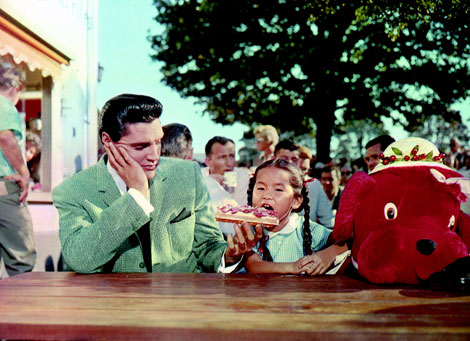
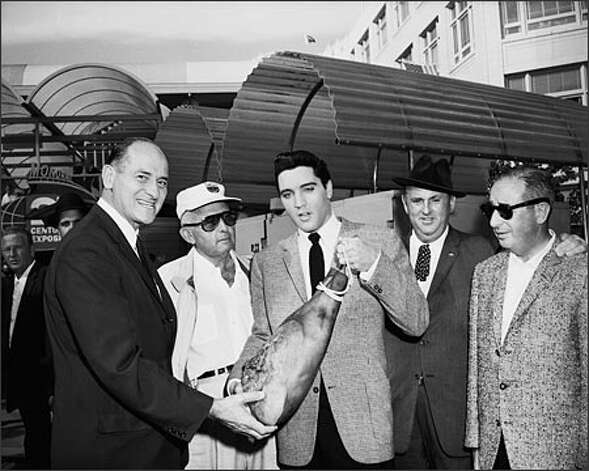
It Happened at the World's Fair(Norman Taurog, 1963) I'm something of a lunkhead about Elvis Presley, even though I grew up in the Elvisian Era. Fact is, I was born into the Presley presence—he was a fact of life and nothing revolutionary to me, and by the time I was actually cognizant of him, aware, he had moved on from being a rock n' roll revolutionary to being something of a lounge lizard. He'd evolved on to the Hollywood Elvis period, where there was less emphasis on picking good material and taking chances and more on banking on his success and name recognition, while also taking the edge off his persona to be more acceptable to "Mom and Dad America." The films started out somewhat inspired, even special, then settled into a pattern of sticking the King into formula scenarios pulled from the screenwriters' template that had the feel (and factory precision) of romance novels. They did the job, but had all the nutritional and aesthetic value of a TV-dinner, circa 1960.
Culturally, the U.S. had swiveled away from mambo (Castro's overthrow of Cuba being the main reason, as well as the inevitable momentum of faddishness) and gone Polynesian—the American Eagle had sunk its claws into Hawaii permanently, folding it into statehood, and Tiki had started to invade American dens and Trader Vic's was the big restaurant. At the same time, Seattle was looking to the future, Sputnik having launched America's fledgling space program into a panicky orbit, and the plastic revolution bombarding American kitchens. City fathers (one of whom was my father's employer) started a campaign to bring another World's Fair to the home of Boeing (its first being the Alaska-Yukon-Pacific Exhibition in 1910—on the site of what is now the University of Washington). This one would be more forward thinking, embracing science and technology, and the 1962 Seattle World's fair was dubbed "Century 21." It was surprisingly successful, managing to turn the city's "Warren Avenue slum" where the Armory was housed into a central hub of the downtown era...and—a rarity for World's Fairs—turn a profit.
The organizers were particularly good at attracting celebrities and entertainers to the Fair, and only the Cuban Missile Crisis kept President Kennedy from officiating over the closing ceremonies. They even managed to make a movie deal with M-G-M for Elvis to make a movie, no doubt paying the studio a handsome sum for the privilege, while also getting some of the corporate sponsors of the Fair to contribute towards the film (probably the reason why G-M's "car of the future" figures so prominently in the film—for no apparent reason). If it was to promote tourism and the Fair, they might have worked out the timeline a little better—The film opened in April of 1963, six months after it had closed!
It Happened at the World's Fair (It's rather tough to determine what "it" is) is a fairly lousy Presley programmer, short of plot (Elvis is a pilot of a crop-duster, in partnership with Gary Lockwood, and gambling debts force them to try and raise money to buy their plane "Bessie" back) but it's the gristliest of connective tissue between songs that were barely charting and love scenes for the fans. Director Norman Taurog was an efficient, if uninspired, director who moved from silent pictures through studio series—his peak years were directing the Martin and Lewis comedies before Lewis got the directing bug—who could be counted on to bring things in on-time and under-budget. He was good at logistics, and managed to keep the studio accountants happy that his films were managed enough to be able to make a profit at the box-office. And his experience with comedies made him a good candidate for making things light and airy and moving fast.
Which is what this one needed. Seeing it as a kid, I thought it was the dullest thing in the world and needed more shots of The Space Needle and, frankly, The Fair. Seeing it as an adult is a grim experience when noting that your tastes haven't changed much. There are faint flashes of wit once in awhile, but it goes without for long stretches of obvious, perfunctory film-making. But, face it, the thing was a commercial enterprise that had outlived its usefulness except to sell records for M-G-M, rather than break them. It does have one oddity worth noting for trivialists: in the role of a kid who kicks Elvis in the shins (to fake an injury to see a pretty nurse) is Kurt Russell, who would play Presley in John Carpenter's biographical film (produced by the late Dick Clark, by the way).
The Seattle World's Fair opened 50 years ago, this past weekend.
The Story: Harmony (noun): 1. agreement;accord;harmoniousrelations. 2. thesimultaneouscombinationoftones,esp.whenblendedintochordspleasingtotheear;chordalstructure,asdistinguishedfrommelodyandrhythm.
One of the things missing in most modern movies these days (possibly because audiences might find it "corny") is "the sing-along," where a group of characters participate in a collective musical performance that shows they can work together as a group to a common purpose. Corny? Maybe. But it's a great audio-visual short-hand for communicating a dramatic idea—the resolving of differences. Just as an orchestra can combine rhythm, brass, and strings to a unified whole, so, too, can disparate personalities and talents come together to create a sum greater than the parts. We see this work in music groups all the time, and there's no more obvious example in the movies than the Beatles documentary Let It Be, where the four writer-musicians bicker and back-bite, but manage to put it all together in their final concert on the Apple Studio roof-top, a meshing performance that shows just how good they could be.
Over the next four weeks in our "Don't Make a Scene" section, we'll present four sing-alongs from movies that display dramatically, through music, the putting-aside of differences in the creation of a unified effort—harmony. And as music is the important element here, and really doesn't work one note at a time, we will temporarily dispense with the usual frame-by-frame breakdowns, and present the scenes in their full 24 frames per second vitality.
Howard Hawks was the master of this musical sub-text (he was a master of sub-text, period). He used music, not only for its intrinsic entertainment value, but also to infer dramatic points that moved the story along.
Take this scene from his terrific —Only Angels Have Wings. In it, a group of pilots, charged with delivering mail and supplies by the only means possible—by air—battle the elements, all of them—Earth, Wind, Fire and Water—and the existential situation they have undertaken. The work is dangerous and competitive, and, as in war, if they lose one of their colleagues, little time is spent mourning the dead. The work goes on, and though the danger remains—those deaths emblematic of it—one doesn't falter, best to keep on going. Death happens every day; there's no use slowing the living because of it.
Into this environment lands Bonnie Lee (Jean Arthur), who finds this attitude cruel, uncivilized and brutal. To the pilots, it is what it is—survival. And her sentimentality risks everything. So, she's put through the gauntlet, and emerges a little beat-up, slapped around metaphorically (in a quid pro quo for the physical one delivered to group leader Jeff (Cary Grant). And rather than state the obvious ("Yeah, you were right, I was wrong, I see the error of my ways and I'm sorry"), she inserts herself back into the group, and participates in a group-effort. It's subtle, unpretentious, and it gets the story-telling heavy lifting done, even if audiences don't recognize it. That the song is an up-beat version of "One of These Days" (the next line is "you're gonna miss me, Daddy") is just the slightly ironic-tasting cherry on top.
And for that, she gets the highest compliment that can be bestowed in a Hawks film. She is newly greeted...as "a professional."
Here's a post requested by correspondent Andrew of the sweetly up-beat Encore Entertainment movie blog—a haven of civility in a slathering horde dominated by horror movie blogs. Sunday, he's hosting a blog-a-thon encompassing a great many writers cracking wise on one subject or theme: for this, he asked that we pick our favorite musical. That's a tough call as I count musicals I like on one and a half hands. But this one always makes me smile. And it's a great film, too.
A reporter once asked Lennon what he thought of a particular stop on a tour: "It was a train and a room, a car and a room and a room and a room." That's what scenarist Alun Owen found when he stayed with the four mop-tops during a stretch of concert tours: The Beatles were prisoners of their fame. They were so successful that any chance of a normal life was out of the question. If all four of them were together there was a riot and they'd have to run for their lives, call out security, work out internecine routes. Their lives were led at a runner's pace, with no finish line in sight. It was utter insanity. And if they weren't so young and going through it together, they might succumb to the madness (and who's to say they didn't?)
And that's what "A Hard Day's Night" is—a dramatic illustration of the life of the Beatles at the height of their success—managed, cajoled, used, stymied, interrogated, trying to be the calm in the center of their own hurricane.
That it's also a musical is without dispute. The story-line is interrupted every 15 minutes or so with a new Beatles song, and since the through-line of the story is to get The Beatles-collective to a broadcast-venue on time and in one piece, there's ample opportunity for practice and rehearsal. The songs do not necessarily spring out of the material of the story, but when has that ever been a requirement?
Critic Andrew Sarris, in his book "The American Cinema," off-handedly remarked that if The Marx Brothers were an insane tonic to a sane if corrupt world, then The cinematic Beatles were the sane tonic to an insane world, and this is true of both "Help!" and "A Hard Day's Night." The worlds of both films seem to be doing everything in their considerable power to stifle joy, through ritual, constraint, and even finding ways to bottle it up and sell it. In "Hard Day's Night," specifically, The Beatles are bright and clever and anarchically up-beat while being herded from one venue to another, caught between strict rules and screaming hysteria. Each has their own episodes of dealing with the world: Paul, the cheerily shallow cute one is burdened with the responsibility of dealing with his lecherous grandfather (Wilfred Brambell-"He's very clean"), John,the prickly clown, toys with his fame and badgers the management ("You're a swine..."), played by Norman Rossington and John Junkin, as highly fictionalized versions of Brian Epstein and roadies Neil Aspinall and Mal Evans, while George, the stonily introspective one, finds himself confronted with the marketing and exploitation of Britain's youth culture. Ringo, the diminutive ugly duckling, possessed of and hiding behind "a large hooter," and shackled to a distancing drum-kit ("They loom large in his legend," remarks George) is depressed and yearns to break free on his own, a dream which is only encouraged by Paul's scheming grandfather.
The sub-text (as it is in "Help!") is that the world is conspiring to splinter The Beatles apart, and it is only their efforts as a group—both involving the rescuing of Ringo—that keeps them together and the world at bay. That's pretty ironic, as the four's own bickering is what led the group to self-destruct and go their own ways once they were no longer forced to go together in the same direction by their hectic tour schedule. The only real idyll they have in "A Hard Day's Night" is in the antic "Can't Buy Me Love" sequence, where, in a rare moment of freedom, they caper about a play-field, which Lester films in an eclectic helter-skelter array of techniques, formal and informal: sped-up, slowed down, from the air, and hand-held.**Even that ends with an admonition ("I suppose you know this is private property!").
It all turns out right in the end, with the concert accomplished, the boys back together and taking the safest route away from a crazy chaos—up, with a reprise of the opening song that ends with a jangling guitar arpeggio...that never ends, but just fades.
It is a tantalizing, if fictional, glimpse of Beatlemania, that hysterical era when, as Harrison stated in "The Beatles Anthology," the world seemed to be given permission "to go mad." And, in the best description of their situation, goes on to pointedly say that that madness made them rich and set them up for life, and, in exchange, "we gave them our nervous systems."
The declaritive beginning of "A Hard Day's Night," with that opening chord that passes for a fanfare or clarion call in a rock environment. If you keep watching, at @ 05:10, Lennon makes a clever visual joke in reaction to being told to behave themselves—by taking a couple of snorts from a bottle of Coke.
* Where's Paul McCartney, you ask? Paul's not running in this scene. He's found his own way to avoid the mob, disguised with a moustache...and two "beards" of sorts, the other being his grandfather (played by "Steptoe and Son's" Wilfred Brambell). Since Brambell is accompanying McCartney on the train, you couldn't expect an elderly man to run in the opening. It should be noted that Mike Myers cribbed that joke (with no changes whatsoever) for "Austin Powers: International Man of Mystery."
** At one point, all rules are broken, and the sequence becomes even more over-the-top when Paul briefly snatches the camera from the director (There's your anarchy for ya, kids!) Todd Haynes, briefly, does his own tribute to this sequence in the Bob Dylan-house-of-mirrors bio-fiction "I'm Not There," as Dylan's meeting with the Beatles (where they were introduced to marijuana) is represented by a distant manic scampering, interrupted by chasing, screaming fans.
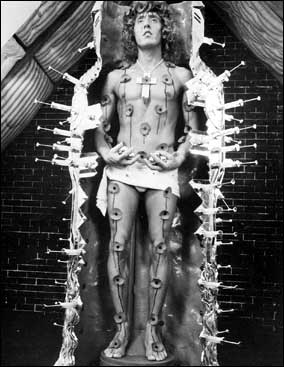
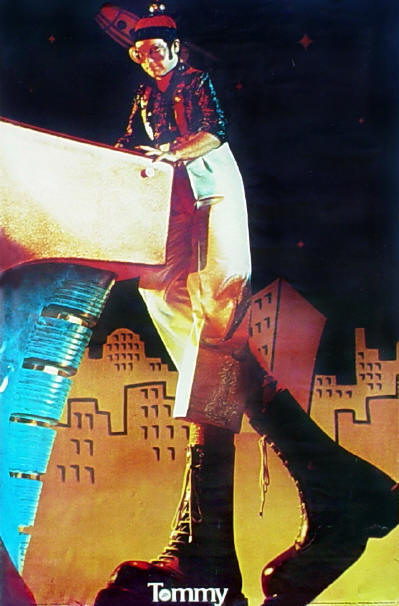
Pete Townsend and The Who's "rock-opera" (though it doesn't follow strict form requirements) barely held together as an album, but it was a fine conceit. And where there's conceit, there is Hollywood.
An excessive film, during an excessive time in Hollywood. This scattered and episodic movie actually has more in common with the episodic "Broadway Melody" revue films of the 30's and 40's—guest-stars are trotted out (Eric Clapton, Elton John, Tina Turner, Jack Nicholson) for one song, then they are shipped off, never to be seen again.
I don't remember much of "Tommy" except the excesses (purging does that), but I do remember the frequent use by director Russell of the distorted close-up, how the songs didn't flow into each other but kinda...stopped.
The "Eyesight for the Blind" sequence (the song by "Sonny Boy Williamson II", performed by The Who, Eric Clapton—quite stoned—and Arthur Brown). Like the movie, it is padded to just go on soooo long and director Ken Russell (and editor Stuart Baird) do what they can to keep things semi-lively. Best thing about the movie.
"Breaking Bad" (I Used to Be Somebody, Now I'm Somebody Else)
At the end of each filmic year, theaters are filled to their google-plexes with all sorts of movies. Because of the Holidays, there's plenty of people wandering around major areas of assembly with the occasional two hours to kill, so Christmas is as profitable a time to the studios as Summer. Every conglomerate pushes and shoves to squeeze in one more blockbusting crowd-pleaser to blacken the year-end red ink.
Then there are the films that have been positioned to impress the critics' societies and are launched into Los Angeles and New York, so they can be eligible for awards, most pointedly The Oscars. And in that sub-category, there are the waifs—the ones that open in those markets and take a little longer to reach Biloxi, because, frankly, the studios would rather launch heavier weights during the Holiday Crunch, then release the films they feel will have only a niche market, that might have a respectable run in the projection booth, before reaching a more sizable audience in the rental market. The reason they're there is for the Awards, and usually for an acting honor to someone who does consummately good work, but has never played a "disease" role, or worn heavy make-up to win.
The story of an alcoholic country singer-songwriter, on a Southwest tour of what they call (in the biz) "toilets," merely reflects the downward spiral "Bad" Blake (Jeff Bridges) has put himself into. Perpetually boozed up, touring in the same old station wagon (old "Bessie") he used in the early days when he was more successful, his life is comprised of using things up and tossing them away—cigarettes, bottles of booze, ex-wives (five of them, maybe four, he can't seem to remember), he still has the talent—his reporter-inquisitor, a single mother (Maggie Gyllenhaal) from a Santa Fe newspaper that he begins a relationship with, says he can still toss off a song instantaneously that most people would struggle years to write—hasn't completely left him. But, that may be the last thing to go. He hasn't written a new song in years—the writing skills are there, but the inspiration has long ago moved on. It's one more thing taken for granted in a career that brought easy success that couldn't be maintained in the living of it.
That extends to the story, too, which resists the epiphany lesser hands might have constructed. But like an old country song, the emphasis is on transitioning, rather than succeeding, maintaining rather than overcoming, in being rather than having dreams come true. Sometimes the triumph is in recognizing what one's taken for granted for so long.
Hope he gets that Oscar.*
"Crazy Heart" is a Rental.
* I say that with some caution because I know the "entertainment press" won't be able to resist saying that Bridges won for a "Bad" or "Crazy" performance.


.jpg)