Showing posts with label James Cagney. Show all posts

Thursday, October 17, 2013

Lady-Killer (1933)

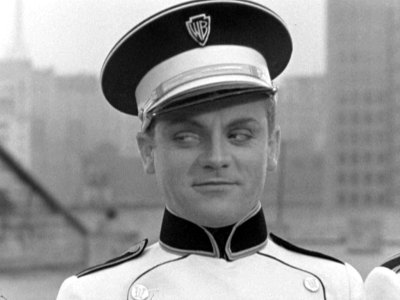
Lady-Killer (Roy Del Ruth, 1933) Light-hearted gangster picture in the same manner as the Humphrey Bogart All Through the Night.  Cagney plays Dan Quigley, an entrepreneur of sorts, who when we first see him is "in the picture business"—he's an usher in a Big Apple movie theater, in trouble for disappearing and running crap games on the side. He gets fired for telling a patron what she can do with her toy poodle, and out on the street, notices a dame (Mae Clarke) losing her billfold.  Nice guy Dan follows her to her apartment, returns it and finds a nickle-ante poker game in the back.  He helps himself, gets cleaned out and on his way out the hall, runs into a rube...returning another billfold.  It's a racket, but rather than getting sore, Dan laughs it off, and uses it to parlay himself in on the deal.

Before long, he and the girl, Myra, and the four poker grifters are running a crooked speak-easy, the 7-11 Club, while also doing some knockovers of ritzy swells from the casino on the side.  Dan stages traffic accidents outside the manses, gets himself taken inside to case the joint, then gets taken out on a stretcher and the other four do the same for the loot.  But, during one of the capers a maid gets her skull caved in and eventually (as they say in the movie) "croaks." The Club gets raided on the word of a stoolie and soon the whole bunch is on the lam.


Quigley and Myra high-tail it to L.A., only to have Dan picked up on suspicion by the LAPD, and when he calls Myra to cough up his bail, she's skipped, along with gang-leader Spade Maddock (Douglass Dumbrille).  With nothing to hold him on, the cops release Quigley and eventually he finds work as an extra in the movie business, at which point, life starts to get good, especially with frequent co-star Lois Underwood (Margaret Lindsay), until his old partners start making trouble for him.


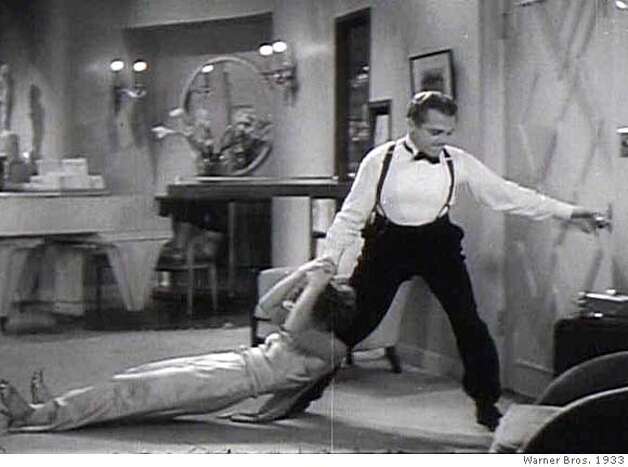
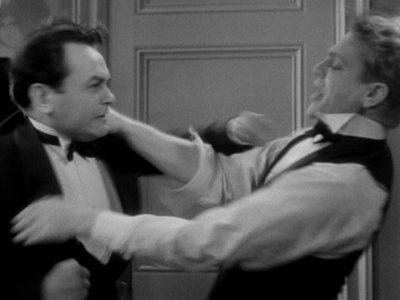
Very fanciful, but Cagney is lighter on his feet here than he is playing his "heavies," in fact, this movie is full of wise-acre slang and a lot of good laugh-lines, most of them coming from Cagney's Quigley, who laughs at every joke. He's a good-time charlie, not meaning any harm, but not wanting to do too much good, either.  And Cagney's paired with his co-star from The Public Enemy, Mae Clarke, who gets more than a grapefruit pushed in her face here. At one point, Cagney alarmingly grabs her by her hair and drags her out of his room and throws her bodily into the hallway.  The makers also have a lot of fun at Hollywood's expense, sending up the movie business and the extravagant lifestyle.  It's almost a romp for Cagney, only a couple years removed from The Public Enemy, and goes some way—but not too much—in rehabilitating his public image.  Still a tough guy, but not pure evil, either.


Tuesday, October 8, 2013

Each Dawn I Die

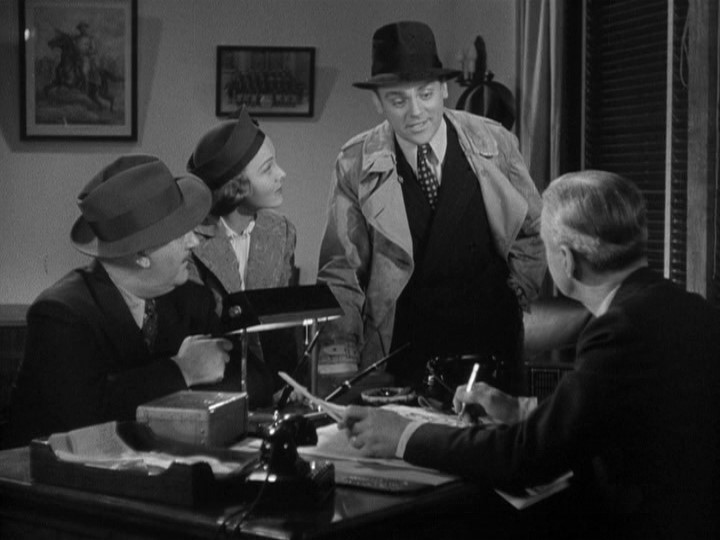
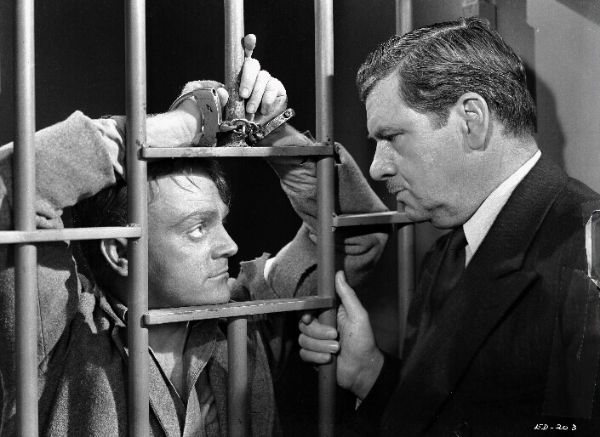
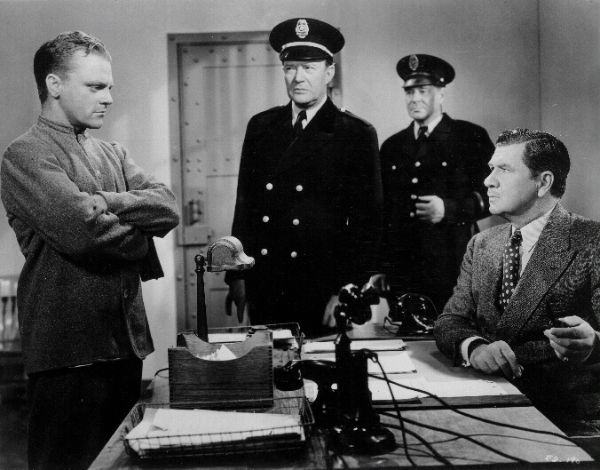
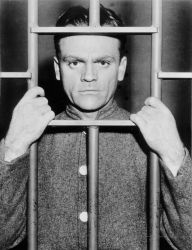
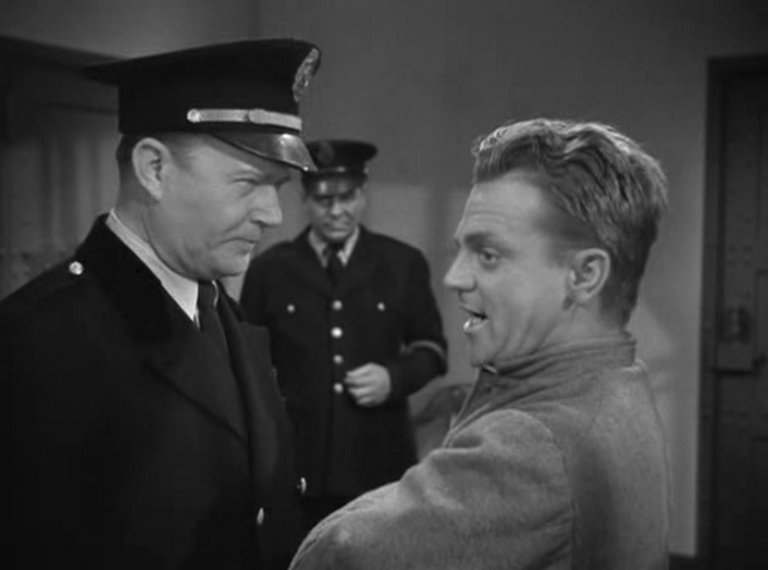
Each Dawn I Die (William Keighley, 1939) Edgy newspaper reporter Frank Ross (James Cagney) has a hot news lead, but it gets buried when the crooked assistant D.A. he's trying to get the goods on, knocks him cold, douses him in whiskey, and puts him behind the wheel of a car and sends it caroming down a city street, ultimately killing three innocents.  Ross is convicted of vehicular manslaughter and thrown in jail, his campaign against the crooked DA (who is trying to run for governor) quashed.  

On the outside the folks in the newsroom his reporting partner (Jane Bryan) and his editor are trying to dig deep to find out how to get around the lawyers, and inside Frank tries to stay alive, getting information from fellow prisoners in the sweat-shops, and even saving the life of "Hood" Stacey (George Raft), who, to repay the debt, cooks up a hair-brain scheme to find  who framed Ross.  When another inmate is killed, Ross names Stacey, in order for the gangster to be tried, and make it easier for him to escape.


Not very likely.  Stacey does escape, however, but reneges on his plan, making one more set-back for Ross, who is slowly going crazy with his prison-term, and the impossibility of finding out who's responsible while stuck behind bars.


No, it's not very credible, but the points of interest in the story are Cagney, who pushes the boundaries of what "good guy" behavior can entail and Raft, who's smooth, wry, likable, and utterly corrupt.  This makes him completely different from the crooked DA who isn't witty, isn't smooth, and is dully cruel, but is also utterly corrupt.  So, the difference between good and evil (in its shades of gray) in the audience's affection is that "bad" must also be personally bad, and incapable of entertaining us.  If you can entertain us, obviously you can't be that bad a guy, even capable of reforming.  But, what separates this from other Warner Bros. efforts of the period is that the authorities, although personifications of fear and threat, are also completely fallible and downright evil.  The "good guys" are the "bad guys" and that's something a little different in a post-"Code" gangster movie.


Thursday, June 13, 2013

Smart Money

Smart Money (Alfred E. Green, 1931) Done-on-the-cheap Warner Bros. programmer made the year after Edward G. Robinson's star-turn in Little Ceasar and the same year as Cagney's in The Public Enemy and is an version of the studios' series of spare, street-tough films that would dominate their output in the 30's and 40's, glamorizing the life of a gangster, but making sure that they came to a bad end.

Robinson plays Nick the barber, a lucky Greek son of a gun, who runs a gambling joint in the back-room of his tonsorial parlor (thus making both ends of his establishment a "clip-joint.") Nick is king of his own gambling castle, and while its good to be the king,there's the tendency to want to expand the fiefdom by conquering new territory.


With a stake firmly established from his cronies back home, he takes off for New York to take on the big city gamblers, wished well by all the lovable mooks he's already taken for a ride at the train station.  But, what he learns is its a whole new game in the tony high rises, where only part of the bluffing and double-dealing occurs at the table.  Why, even the hat-check girl is looking to separate you from your cash.  Nick learns to trust no one, and to bluff his way out of any situation with a cock-sure patter of platitudes.  But, that's a slippery slope, and he soon finds that success costs.  


Its a treat to see Robinson and Cagney play off each other, the only time they did so—Robinson all-voice and punchy delivery, and Cagney sly and bantamy, physically, in one of his rare supporting roles.  They're all chummy at the beginning, but when success shows up, they start to have territory issues, its murder.  This one is all performance, in varying styles, between character actors fresh out of the silent era, and the leads who were blazing new trails, and the director's hand is almost invisible.


Green is known, but mostly unknown, as the director of The Jolson Story, The Jackie Robinson Story, The Eddie Cantor Story...making that a "storied" career.  He was a fine director of women and coaxed terrific performances from Bette Davis and Barbara Stanwyck early in their careers—and they were already formidable.  He was fast, versatile and would direct up to five pictures a year.  He didn't shy away from racy material in the pre-Code era and would tackle it directly with shameless brio.  And he's remarkably free of the sort of Hollywood white-wash that was prevalent at the time.  Minorities were cast, and not caricatured or minstrelled in his films, but treated like any other character actor, which is quite remarkable to see in that day and age.  His output was undistinguished when you look at the titles (and there are 111 of them), but individually, it would be interesting to see a few more of them (I've seen this one, The Jackie Robinson Story and Baby Face) to see if that liberal sensibility is maintained throughout.


Thursday, September 27, 2012

The Public Enemy

The Public Enemy (William Wellman, 1931) "Learn your lines, find your mark, look 'em in the eye and tell 'em the truth."  That was James Cagney's recipe for good acting, succinct, humble, with plenty of lee-way to find your own path, and completely shy of the mark when it came to talking about how he did it.  This gangster film was Cagney's first starring role—in fact, up until two weeks before filming, Edward Woods (who plays Tom Powers' best friend) was going to play the lead.  But, there was something about the little guy with the bantam rooster's brio that made director William Wellman turn the tables on the roles.

It's the story of a rotten kid from a good family with all the contrary instincts to look out for a number one—himself—who has no moral compunctions about anybody else, that leads him down a precariously slippery slope at a time in history when society was providing an excellent opportunity for taking advantages of loop-holes in the law and morality.  Pretty soon, "Tommy" is a booze-runner during Prohibition, and anybody getting in his way, even some he'd pledged loyalty to earlier, would find their way on the wrong end of his fist or the business end of his gun (and curiously, Cagney's Powers employs both the same way, with a forward thrust of the arm, as if fist and firearm were interchangeable).

It's a pretty standard morality—or immorality—tale.  But, you watch Cagney do it his way and you never forget it.  He's extremely charismatic, and like James Dean, does so in a way that separates him from everybody else.  Where the rest of the cast—in one of the early talkies—is ramrod-stiff and talking with fine e-lo-cu-tion, Cagney is loose in everything, wrapping himself around furniture, spitting out his slang dialogue, and if there's a little dead-air, throws in a little wise-crack in word or gesture for good measure.  He's encouraged by Wellman, who takes a lot of chances in this pre-Code drama ("Did he just say what I think he said?"  "Is that gesture in the credits what I think it means?"), and who sets up the tenor of the times in one masterful shot from a street corner's vantage-point, moving from a distillery to a corner-bar, following a pole of beer-buckets that crosses the path of a Salvation Army band.  Wellman liked to play it rough—they used real bullets in a shot where masonry is picked off close to Cagney's head, and when Cagney is hit by the actor playing his sanctimonious brother, Cagney goes down like a ton of bricks—because Wellman told the other actor to clobber him, breaking a tooth in the process.  And there's the famous grapefruit-in-the-face shot (making Mae Clarke something of a legend extending far beyond her career), that Wellman came up with—because he always imagined doing that to his own wife, who habitually ate half a grapefruit in the morning.

But, it's Cagney that's the Big Show.  Watch the scene where he stands in the rain, luxuriantly eyeing his next targets, the guys who gunned down his buddy in the street.  With murder on his mind, a smirk comes over his face, that turns into a fierce grin, then disappears into a grimace as he moves forward and walks right into the camera, like a ball of fire that can never be put out. 

Cagney's so good, he's scary.  


Cagney's Tom Powers with murder on his mind—that not even a downpour can douse.


Wednesday, July 4, 2012

Yankee Doodle Dandy

Yankee Doodle Dandy (Michael Curtiz, 1942) Of all the films in James Cagney's storied career, his favorite was his most unusual—not one of his gangster films (some of which revolted him) or his dramatic efforts, but this one, the one that won him his Best Actor Oscar, the musical biography (very loose) based on the life of George M. Cohan.  Cagney always described himself as "a hoofer," starting out as a dancer in vaudeville, and the athleticism did him well in Hollywood.  Cagney's energy, timing, and directness—his grace (even if he was playing a hood)—came from this background, and the compensatory toughness came from his growing up and observing the streets, providing "that unmistakable touch of the gutter," as he eloquently put it in his acceptance speech for the second AFI Lifetime Achievement Award.

Yankee Doodle Dandy begins with Cohan (Cagney) on Broadway playing Franklin Roosevelt in "I'd Rather Be Right" when he is summoned to the White House to receive the Congressional Gold Medal from FDR himself.  The visit gives him a chance to tell his life-story to the President, which is presented in flash-back form, from his early days to performing with his family (Walter Huston, Rosemary DeCamp, Jeanne Cagney) to the lean years when stubbornness gets him blackballed in the theater community, and he has to struggle back to the stage by song-writing,* eventually coming back and becoming the King of Broadway.

It's still startling to see Cagney's dance moves; loose, limber below the waste, and ramrod straight above, his movements alternate between drunken sloppiness that looks like it could severely snap tendons if gone wrong, and stiff-legged woodenness, giving the impression that he's a puppet with the strings cut—not really in control of his own movements (and, of course, he always was—that was the illusion of it all, the mastery of it), but compelled to dance for the sheer energy of it forced him to do so.  It's scary, but Cagney always is.  He is, after all, the guy who shoots people by pumping the pistol forward, as if the movement puts more energy in the bullet to kill faster, make it more definite, more personal.  His gangsters make the guns part of them, rather than just a tool.  

Some of the moves look archaic, compared with the gymnastics-as-dance school today—the leaping and bouncing off a wall (as if there wasn't enough room on stage) looks tame now, even though it amazed me as a kid, but the high kicks I appreciate more, the toe-steps, the tap—all amazing.  And they look spontaneous, which in itself is a marvel.*

It's a feel-good musical about celebrating the spirit of America, which we all do on the Fourth of July.  That it happened during war-time, added mightily to the propaganda potential of it (and, although it's always been denied, might've helped Cagney get rid of the "pinko" label he was being saddled with at the time—my, how times haven't changed).  But, it's a fine achievement, and Curtiz, who's known for hating unused space in a movie frame, overcrowds the stages—every theater-piece for this director was "SRO."  And, although something of an autocrat, with musicals he let loose the reins (something Cagney appreciated) and allowed spirit to flow.  Maybe that's why Yankee Doodle Dandy still seems fresh.


It was voted into the National Film Registry in 1993 for being "culturally, historically, and aesthetically significant."


* Cagney could relate.  He was constantly battling the Warner Brothers brass, at one point suing the production company and staying away.  Jack Warner called him "The Great Againster."

** Evidently Cohan's final tap down the White House staircase at the end, was improvised.

Wednesday, July 1, 2009

13 Rue Madeleine

"13 Rue Madeleine" (Henry Hathaway, 1947) There are several good movies to be made based on the exploits of the American and British Secret Service during World War II. The OSS wasn't all encrypters and code-breakers listening over wirelesses in sterile little offices. There were field agents, double agents, and mis-information spreaders and they had at their disposal all sorts of spy ledgerdemain that has been cobbled for many of the traditional thrillers that came out after the war. No one that I know has ever made a movie about Camp X, where training was done, papers forged and weaponry created.

But "13 Rue Madeleine" is, at least, a good start. Directed by Henry Hathaway in a slightly more flashy style than his true-life crime dramas earlier in the war, it still employed a lot of photography "
in the field" as the movie explains, "often in the actual locations."

The story follows the training of Group 077 (the writers had to change the name over script objections), each one in non-specific training until they're called upon for "a job" in whichever corner of the world they're dropped.
Heading the training is Robert Sharkey (James Cagney), who has one complication—one of his agents-in-training is a Nazi agent, and during the course of training he has to find out who it is to exploit him. The film is surprisingly cold-blooded, with many agents dying in the process of carrying out their missions, and there's one case of "burning the village in order to save it." There's also a lot of appearance by well-known actors in small roles at the beginning of their careers including Karl Malden, E.G. Marshall, and Red Buttons. But, towering over all of them is Cagney, who still manages to show off a lot of grace in a role that's pretty rough. But he's also the perfect actor who you believe could kill with impunity and laugh at the enemy in the face of torture.