Showing posts with label Mae Clarke. Show all posts

Thursday, October 17, 2013

Lady-Killer (1933)

Lady-Killer (Roy Del Ruth, 1933) Light-hearted gangster picture in the same manner as the Humphrey Bogart All Through the Night.  Cagney plays Dan Quigley, an entrepreneur of sorts, who when we first see him is "in the picture business"—he's an usher in a Big Apple movie theater, in trouble for disappearing and running crap games on the side. He gets fired for telling a patron what she can do with her toy poodle, and out on the street, notices a dame (Mae Clarke) losing her billfold.  Nice guy Dan follows her to her apartment, returns it and finds a nickle-ante poker game in the back.  He helps himself, gets cleaned out and on his way out the hall, runs into a rube...returning another billfold.  It's a racket, but rather than getting sore, Dan laughs it off, and uses it to parlay himself in on the deal.

Before long, he and the girl, Myra, and the four poker grifters are running a crooked speak-easy, the 7-11 Club, while also doing some knockovers of ritzy swells from the casino on the side.  Dan stages traffic accidents outside the manses, gets himself taken inside to case the joint, then gets taken out on a stretcher and the other four do the same for the loot.  But, during one of the capers a maid gets her skull caved in and eventually (as they say in the movie) "croaks." The Club gets raided on the word of a stoolie and soon the whole bunch is on the lam.


Quigley and Myra high-tail it to L.A., only to have Dan picked up on suspicion by the LAPD, and when he calls Myra to cough up his bail, she's skipped, along with gang-leader Spade Maddock (Douglass Dumbrille).  With nothing to hold him on, the cops release Quigley and eventually he finds work as an extra in the movie business, at which point, life starts to get good, especially with frequent co-star Lois Underwood (Margaret Lindsay), until his old partners start making trouble for him.


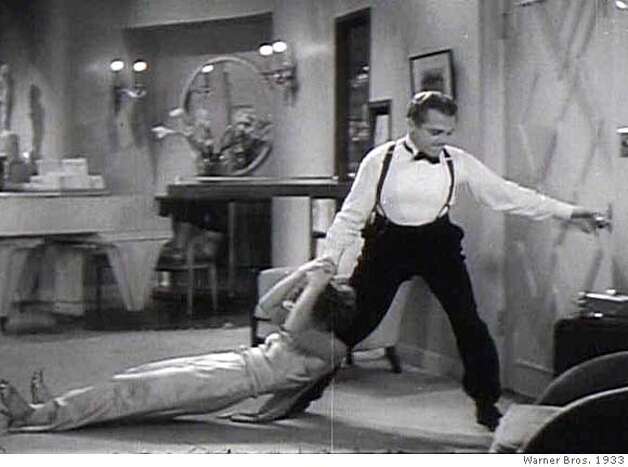
Very fanciful, but Cagney is lighter on his feet here than he is playing his "heavies," in fact, this movie is full of wise-acre slang and a lot of good laugh-lines, most of them coming from Cagney's Quigley, who laughs at every joke. He's a good-time charlie, not meaning any harm, but not wanting to do too much good, either.  And Cagney's paired with his co-star from The Public Enemy, Mae Clarke, who gets more than a grapefruit pushed in her face here. At one point, Cagney alarmingly grabs her by her hair and drags her out of his room and throws her bodily into the hallway.  The makers also have a lot of fun at Hollywood's expense, sending up the movie business and the extravagant lifestyle.  It's almost a romp for Cagney, only a couple years removed from The Public Enemy, and goes some way—but not too much—in rehabilitating his public image.  Still a tough guy, but not pure evil, either.


Thursday, September 27, 2012

The Public Enemy

The Public Enemy (William Wellman, 1931) "Learn your lines, find your mark, look 'em in the eye and tell 'em the truth."  That was James Cagney's recipe for good acting, succinct, humble, with plenty of lee-way to find your own path, and completely shy of the mark when it came to talking about how he did it.  This gangster film was Cagney's first starring role—in fact, up until two weeks before filming, Edward Woods (who plays Tom Powers' best friend) was going to play the lead.  But, there was something about the little guy with the bantam rooster's brio that made director William Wellman turn the tables on the roles.

It's the story of a rotten kid from a good family with all the contrary instincts to look out for a number one—himself—who has no moral compunctions about anybody else, that leads him down a precariously slippery slope at a time in history when society was providing an excellent opportunity for taking advantages of loop-holes in the law and morality.  Pretty soon, "Tommy" is a booze-runner during Prohibition, and anybody getting in his way, even some he'd pledged loyalty to earlier, would find their way on the wrong end of his fist or the business end of his gun (and curiously, Cagney's Powers employs both the same way, with a forward thrust of the arm, as if fist and firearm were interchangeable).

It's a pretty standard morality—or immorality—tale.  But, you watch Cagney do it his way and you never forget it.  He's extremely charismatic, and like James Dean, does so in a way that separates him from everybody else.  Where the rest of the cast—in one of the early talkies—is ramrod-stiff and talking with fine e-lo-cu-tion, Cagney is loose in everything, wrapping himself around furniture, spitting out his slang dialogue, and if there's a little dead-air, throws in a little wise-crack in word or gesture for good measure.  He's encouraged by Wellman, who takes a lot of chances in this pre-Code drama ("Did he just say what I think he said?"  "Is that gesture in the credits what I think it means?"), and who sets up the tenor of the times in one masterful shot from a street corner's vantage-point, moving from a distillery to a corner-bar, following a pole of beer-buckets that crosses the path of a Salvation Army band.  Wellman liked to play it rough—they used real bullets in a shot where masonry is picked off close to Cagney's head, and when Cagney is hit by the actor playing his sanctimonious brother, Cagney goes down like a ton of bricks—because Wellman told the other actor to clobber him, breaking a tooth in the process.  And there's the famous grapefruit-in-the-face shot (making Mae Clarke something of a legend extending far beyond her career), that Wellman came up with—because he always imagined doing that to his own wife, who habitually ate half a grapefruit in the morning.

But, it's Cagney that's the Big Show.  Watch the scene where he stands in the rain, luxuriantly eyeing his next targets, the guys who gunned down his buddy in the street.  With murder on his mind, a smirk comes over his face, that turns into a fierce grin, then disappears into a grimace as he moves forward and walks right into the camera, like a ball of fire that can never be put out. 

Cagney's so good, he's scary.  


Cagney's Tom Powers with murder on his mind—that not even a downpour can douse.