Showing posts with label William Wellman. Show all posts

Tuesday, December 10, 2013

The Next Voice You Hear...

The Next Voice You Hear... (William A. Wellman, 1950) Leo, the M-G-M lion doesn't roar in The Next Voice You Hear... probably so as not to offend any Christians with Roman Coliseum associations that might produce a "thumbs down."  But, that's not the oddest thing in a picture steeple full with them.  The wildest thing is to see William "Wild Bill" Wellman's name as director—maybe he's atoning for all those gangster pictures he did in the '30's—associated with its theme.  On a Tuesday, at 8:30 in the evening when Mary Smith ("American," as she's identified in the credits, and as well she should be as she's played by Nancy Davis, soon to be Nancy Reagan) is helping son Johnny (Gary Gray) with his long division, and Dad Joe ("American," played by James Whitmore) having finished doing the dishes for his pregnant wife after a typical pot-roast dinner, and settled down with a beer and his paper, that something peculiar happens on the radio.

Not that we get to hear it.  God speaks on the radio.  "This is the voice of God.  I'll be with you for the next five days."  Joe, a bit stumped, walks in to tell his family, and the first thing out of mother Mary's mouth is "Was it one of those Orson Welles things?"


Funny.  Joe thinks a local kid is pulling a stunt with a ham-radio kit, but a phone call reveals that another neighbor heard the same voice interrupting another program on another station.  "Did it sound like Lionel Barrymore?" asks Mary, out of the blue.  After the first night, Joe's pals at the Ajax Aeronautics factory have their own speculations "It's mass-psycho-orology. Only fat-heads are gonna fall for a gag like that!"


But, the next night, God shows up again.  The stations try to record it, but nothing shows up on the electrical transcriptions.  More people are hearing it, and it's determined that it's a global phenomenon.  And people are starting to seriously freak out.  Before the week is over, Joe "American" is going to go on a major bender, when all he wanted to do is buy a pack of smokes, and the resulting loss of stability splinters his family.


Not that he was any too stable to begin with.  What keeps The Next Voice You Hear from sinking into a sermon swamp is the casting of Whitmore and, yes, even Davis as the American couple.  Whitmore is no leading man material, but is a facile actor who pulls off charming even when he's a bit of a louse.  Here, he's impatient to a fault, perpetually late for work, flinty with co-workers, disparaging of supervisors, and even he and the wife do a little sniping back and forth at each other.  There's one sequence where son Johnny, so used to Dad's frustrating ritual of resuscitating a faltering car engine, mimes it for Mom split-seconds before the sound effects of the effort come clanking through the door.  It's not dysfunctional to any degree, but it is refreshingly a couple notches below "Father Knows Best."


Credit screenwriter Charles Schnee and Wellman for daring to throw a little real conflict (and a healthy dose of irony) into the thing to keep audiences out of a diabetic coma, and to make it as palatably earnest as one of Norman Corwin's inspirational radio-plays.  


And should one get all-blustery and harumph about the overt religious message, one should bear in mind that the next year The Day the Earth Stood Still would cloak the homilies in the shiny jump-suits of science-fiction.


Thursday, September 27, 2012

The Public Enemy

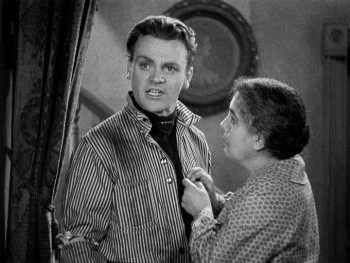
The Public Enemy (William Wellman, 1931) "Learn your lines, find your mark, look 'em in the eye and tell 'em the truth."  That was James Cagney's recipe for good acting, succinct, humble, with plenty of lee-way to find your own path, and completely shy of the mark when it came to talking about how he did it.  This gangster film was Cagney's first starring role—in fact, up until two weeks before filming, Edward Woods (who plays Tom Powers' best friend) was going to play the lead.  But, there was something about the little guy with the bantam rooster's brio that made director William Wellman turn the tables on the roles.

It's the story of a rotten kid from a good family with all the contrary instincts to look out for a number one—himself—who has no moral compunctions about anybody else, that leads him down a precariously slippery slope at a time in history when society was providing an excellent opportunity for taking advantages of loop-holes in the law and morality.  Pretty soon, "Tommy" is a booze-runner during Prohibition, and anybody getting in his way, even some he'd pledged loyalty to earlier, would find their way on the wrong end of his fist or the business end of his gun (and curiously, Cagney's Powers employs both the same way, with a forward thrust of the arm, as if fist and firearm were interchangeable).

It's a pretty standard morality—or immorality—tale.  But, you watch Cagney do it his way and you never forget it.  He's extremely charismatic, and like James Dean, does so in a way that separates him from everybody else.  Where the rest of the cast—in one of the early talkies—is ramrod-stiff and talking with fine e-lo-cu-tion, Cagney is loose in everything, wrapping himself around furniture, spitting out his slang dialogue, and if there's a little dead-air, throws in a little wise-crack in word or gesture for good measure.  He's encouraged by Wellman, who takes a lot of chances in this pre-Code drama ("Did he just say what I think he said?"  "Is that gesture in the credits what I think it means?"), and who sets up the tenor of the times in one masterful shot from a street corner's vantage-point, moving from a distillery to a corner-bar, following a pole of beer-buckets that crosses the path of a Salvation Army band.  Wellman liked to play it rough—they used real bullets in a shot where masonry is picked off close to Cagney's head, and when Cagney is hit by the actor playing his sanctimonious brother, Cagney goes down like a ton of bricks—because Wellman told the other actor to clobber him, breaking a tooth in the process.  And there's the famous grapefruit-in-the-face shot (making Mae Clarke something of a legend extending far beyond her career), that Wellman came up with—because he always imagined doing that to his own wife, who habitually ate half a grapefruit in the morning.

But, it's Cagney that's the Big Show.  Watch the scene where he stands in the rain, luxuriantly eyeing his next targets, the guys who gunned down his buddy in the street.  With murder on his mind, a smirk comes over his face, that turns into a fierce grin, then disappears into a grimace as he moves forward and walks right into the camera, like a ball of fire that can never be put out. 

Cagney's so good, he's scary.  


Cagney's Tom Powers with murder on his mind—that not even a downpour can douse.


Tuesday, May 29, 2012

Lafayette Escadrille

Lafayette Escadrille (William Wellman, 1958) Wellman's last film couldn't be more personal—the story of American flyers for the French Army during World War I.  The director was in a similar squadron during the war, and he's even a character in the movie (played by son William Wellman, Jr., who would go on to make a documentary about his dad called Wild Bill: Hollywood Maverick). It's your basic service adventure/comedy—part daring-do, part rollicking hi-jinks, part romance, with the first two provided by the collection of cocky Yanks dealing with the conditions (abysmal), looking for thrills (the flying and combat), and making a mockery of the de riguer training of the French military—the marching, the discipline, the rules—while simultaneously staying above the fray, plotting ingenious, diffident ways to get their flying hours while getting their way breaking the rules.  The Americans don't even learn the language making drilling a fait accompli with their harried D.I. (Marcel Dalio) It's the most entertaining aspect of the film.

It's a labor of amour, but it's bogged down with compromise.  For the lead, Wellman wanted Paul Newman, but Newman wanted respect and did Cat on a Hot Tin Roof instead—and so was saddled with a Warners contract player, Tab Hunter, who is so wooden and inexpressive in the part that all the drama called for, the conflicts, the love scenes, simply do not "play."  To be fair, Hunter could be fine in films and only got better with age, and his best scenes are the slightly comic interludes with the Maitre d' of his French girlfriend's walk-up.  That poor actress, Etchika Choureau, has to deal with emotional scenes where her co-star is no help, and evokes sympathy just from the wasted opportunity their scenes can't achieve, not that she doesn't try hard.*

But ultimately, despite Hunter, it's a good film, one clearly after the director's heart, as he lived it.  And he gets good work out of his son, as well as the sons of Andy Devine and Joel McCrea, and a couple of upstarts named David Janssen (who was starring in the TV Series "Richard Diamond" at the time) and Clint Eastwood—he's the tall scowling one in the back.

I'd never heard of this film until seeing the story of its making—which made up a good chunk of young Wellman's documentary of his father.  The other great chance to learn more about the man is the episode on him from critic  Richard Schickel's fine series "The Men Who Made the Movies."  I'll always remember the section where Wellman talks about interference with his film Buffalo Bill, to make it more heroic and less true to life.  After a scene where a young audience member says "God bless you, Buffalo Bill!", Schickel cut to a pained Wellman who succinctly states "That made me want to throw up!"

Lafayette Escadrille is by no means his best film, despite being his last, but it shows his gifts for pushing the envelope, tweaking the censors and, in general, being a professional pain in the ass.


"Wild Bill" Wellman at the time of his French service


* According to Tab Hunter's frank auto-biography "Tab Hunter Confidential: The Making of a Movie Star," he has remained close friends with Choureau ever since.


Thursday, April 5, 2012

The Ox-Bow Incident

The Ox-Bow Incident (William A. Wellman, 1943)  Guy (Henry Fonda) walks into a bar with his buddy (Henry—nee Harry—Morgan).  He just came off the trail and is a might ornery.  His girl's left town, without a word, he hasn't had a bath in...well, he can't remember...but, the whiskey's good, even if the company ain't.  Then the fight happens; before too long, Fonda's character is just full enough of piss and vinegar (and whiskey, which from the looks of the bar, could be the same thing) that he picks a fight with a local tough (Marc Lawrence) using the bar to support him while delivering a nasty double kick to his head, until the barkeep clobbers him with with a bottle which shatters over his thick skull, and sends him (rather blissfully) into the arms of Morgan, who drags him like a sack of potatoes to a waiting cane-chair.


Welcome to the rough-and-tumble world of "Wild" Bill Wellman, a director of such sensibilities that you can practically smell the sweat coming off the denizens of Bridger's Wells, Nevada.  In a simple scene, Wellman differentiates himself from the more genteel sensibilities of Ford and Hawks, and into his own greasier, meaner, no-nonsense view of the West.  He's the better choice to present an immorality tale like The Ox-Bow Incident. about rough, western "justice" being meted out for the murder of a local rancher by a team of cattle rustlers.  The Sheriff's out of town, the deputy's itching for action, the local judge is ineffective blow-hard, and the posse-in-lynch-mob clothing have motivations, diverse but petty, such as false moral rectitude, mean-spiritedness, opportunism, and just plain boredom.  Truth to tell, they're a pack of wolves waiting for prey to abuse.


They find three men—a new rancher nobody knows (Dana Andrews), who's had recent dealings with the dead man, an old, demented hand (Francis Ford, John's brother), and a Latino tough (Anthony Quinn) just corrupt enough to know not to play along...with anybody.  Lip-service is paid to justice, process, and prayers, but ultimately the purpose is to string the three up and get revenge as quickly as possible.  In this court by mob rule, the flimsiest of circumstantial evidence is not as important as the sturdiness of the rope, and waiting for facts just gets in the way of the excitement—it's a necktie party in all senses, except common ones.  The cooler heads are seen as weak, obstructing, or just plain kill-joys.


No good can come of it and Wellman (working with Lamar Trotti from Walter Van Tilburg Clark's 1940 novel) writes a case for due process whatever the cost, even if the only thing wasted is time.  Vigilance is not the same as vigilantism and the two should be frequently opposed.  And if one were to be so foolish to think that Westerns are no longer relevent to the issues of today, you haven't been reading the papers.


This was one of Henry Fonda's favorite films he appeared in, and in 1998, became part of the National Film Registry.

Tuesday, February 23, 2010

Ernie Pyle's Story of G.I. Joe

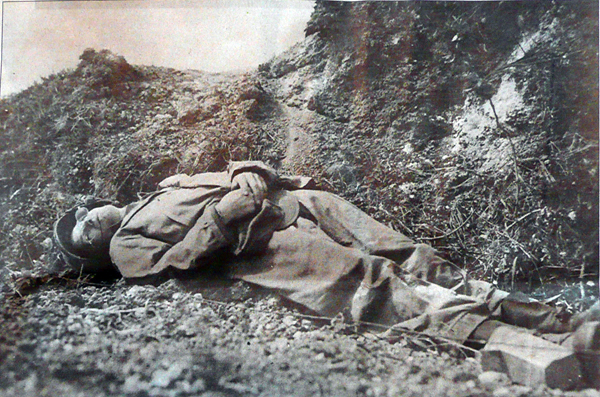
"Ernie Pyle's 'Story of G.I.Joe'" (William A. Wellman, 1944) One of 2009's films designated to be preserved by the Library of Congress—and boy, does it need it, the current DVD displaying scratches, bad splices, and scenes truncated in the middle of dialogue—"The Story of G.I. Joe" was an uncommon war movie, especially for one produced in the middle of the conflict it portrayed, showing a less-varnished portrait of war and the soldiers fighting it. Done with the co-operation of the military and advice from an office-load of war correspondents, the film is an unglamorous, non-propagandistic look at the life of the common infantryman. In it, the grunt's are grimey, muddy, ass-scratching, spitting dog-faces, who get exhausted, make mistakes, leave behind fallen comrades, but keep slogging.
But then, it had to be.
Ernie Pyle, a Scripps-Howard correspondent covering the European theater took the tough route with his reportage, staying out of the clean briefing rooms and jumping into the fox-holes with the entrenched common soldiers. Through the course of his work, he became a beloved go-between for the soldiers and the folks back home aching for something other than the Big Picture and the Campaign—there were plenty of other Corona jockeys to do that—but on the soldiers following orders, following dirt roads, punching through entrenched enemy forces—their kids. Pyle's writing was clear-eyed, unsentimental and just discreet enough for the censors, written usually with the help of a bottle. He won the Pulitzer for his correspondent work in 1944, and had a hand in shaping the film.

And he was the one to get
William "Wild Bill" Wellman to direct the film.

Wellman was an inspired choice, as he was the one who insisted on the weather-beaten look of the film. But the director was a fighter pilot in World War I, and was subject to the same inter-corps squabbling of most servicemen, and had a low opinion of the infantry, only stregthened by his run-ins with a recalcitrant Army adviser on his film "Wings." And the film has several instances of "mea culpa's" from the director,* extolling the scrappy courage of the guys with boots on the ground, as opposed to the guys with their heads in the clouds.

Burgess Meredith got a deferment to play the part of Ernie Pyle—he was picked over other actors because he wasn't well known and had an odd home-spun quality and a crusty voice that could make the tough joshing resonate with warmth. Every war film has a cuddly troop mascot, but not every film has someone ask (in humor) "Haven't you eaten this dog yet?" As the Captain in charge of the men, Robert Mitchum plays his role in the manner he used to the end of his days, looking authentic and undramatic, like he shipped in with the other ringers—only a lot taller—and hadn't slept in days, born with the weight of the world on his shoulders, but still balanced on his aching feet. Or maybe it was the mud that was holding him up.

It was the only time he was nominated for an Oscar for his acting.

Pyle never saw the movie. Two weeks before the premiere,
he was killed by a sniper on Ie Island off Okinawa in the Pacific. He was still with the troops, reporting their struggles.

* Besides a couple of on-the-nose comparisons between Army and Air Force—that seem to come out of nowhere—one of the various character arcs is for an infantryman dubbed "Wingless" (played by John R. Reilly), who starts the film depressed that he was drummed out of the Air Corps but soon comes around to a respect for the common foot-soldier.

Sunday, February 3, 2008

The High and the Mighty

"The High and the Mighty" (William Wellman, 1954) One of the few John Wayne pictures that he produced himself, and one of his best-known and respected films outside of his Westerns, I had never sat through "The High and the Mighty." Oh, I could whistle the vague Dimitri Tiomkin theme, but I'd never seen it. William Wellman was a no-nonsense director and flyer, who no doubt seized the opportunity to do a dramatic film about the then-tony luxury of flying transcontinentally, and turned it into one of the first "disaster" films involving flying (Hello, "Airport!"). Wayne's character was meant for an older Spencer Tracy, but after Tracy left the project, Wayne stepped in to take the role of the haunted co-pilot, who has to fight his past and the demons of his pilot (Robert Stack) to "get this baby on the ground." With an international cast of passengers, all with stories to tell, it's a bit like "Grand Hotel" in the sky with its engines on fire (or "Stagecoach"). The emphasis is on character as there's only so much rollickin' Wayne can do in a plane cabin, though there is an over-the top scene where Wayne decks his pilot to keep him from ditching the plane in the drink...with his hands on the controls! It's also a bit dated in the need to explain every little detail about "plane travel," but not at all in how, at that early stage before rolling luggage, airline personnel were still griping about the passengers.