Showing posts with label Dana Andrews. Show all posts

Thursday, July 25, 2013

Ball of Fire

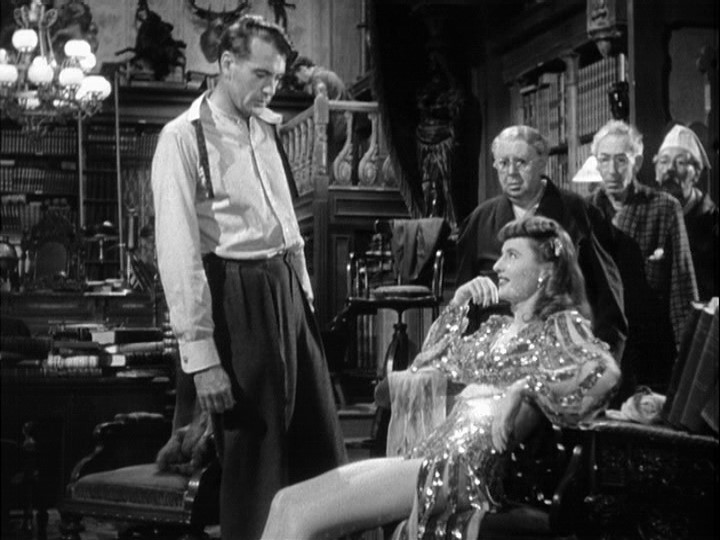
Ball of Fire (Howard Hawks, 1941) It doesn't get much better than this: screenplay by Charles Brackett and Billy Wilder (from a story by Wilder), produced by Samuel Goldwyn, photographed by Gregg Toland, music by Alfred Newman and directed by Howard Hawks.  Add that it's a swing-era version of "Snow White" stock-piled by anything-but-dwarvish character actors (Henry Travers, Richard Hayden, Oscar Homolka, S.Z.Sakall), some nifty up-and-comers like Dana Andrews and Dan Duryea, and top-lined by Gary Cooper (in pixie-ish Capra mode) and Barbara Stanwyck (who usually runs on all cylinders, but seems turbo-charged in this one) and you have the makings of a great, stylish and culturally-winking comedy, with lots of great musical material, too.*

Years in the making, the Dutton Encyclopedia, written by eight myopic scholars, is hitting the skids just as it's hitting the "S" words.  Professor Bertram Potts (Cooper) has just finished a 26 page treatise on "Slang," when a garbage-man walks in with some fancy (and utterly incomprehensible) patter that puts his research to shame.  Potts determines that he will leave his ivory tower and venture forth into the world to see what all the...what's the word? *flip/flip*..."rhubarb" is about.  He stumbles upon a nightclub (where Gene Krupa happens to be playing) and taking on the lead vocals is "Sugarpuss" O'Shea (Stanwyck, in full "bad-girl" mode), mob-girl to Joe Lilac (Dana Andrews) who's being investigated by the New York cops.  The focus of their investigation is Sugarpuss, who can give them a lot of inside information, so she has to go on the lam, and the professor's invitation to her to be a part of his slang symposium, gives her the perfect hideout, going "to the mattresses" with the eight encyclopediacs, but under the distrusting baleful eye of Miss Bragg, the housekeeper.


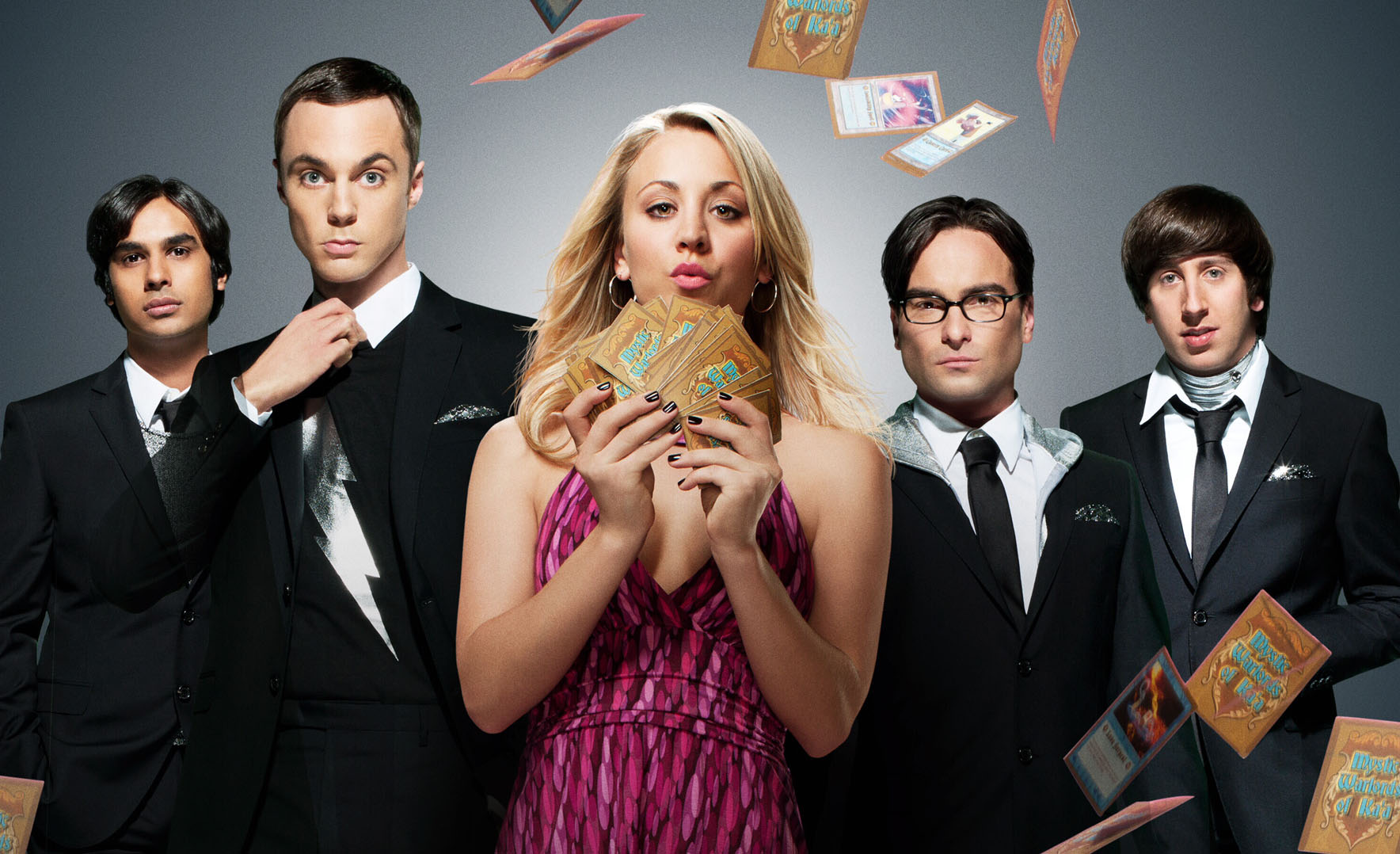
Complications arise, with the possibilities of broken and/or ventilated hearts, as it turns into a particularly pointy triangle between Potts, O' Shea and Lilac, with a suddenly energized Greek chorus of academics trying to deal, rather haplessly, with the real world.  "Snow White" is the inspiration, but fans of "The Big Bang Theory" will also see its roots in this and its Grimm ancestor. One also has Ball of Fire to thank for Billy Wilder's directing career, as Hawks let him sit in on the set, auditing during the making of the film, observing, taking notes, prepping for his own directorial turn that year with The Major and the Minor.

This is one of the great unsung Hawks movies, slightly different from his formula, thanks to Brackett and Wilder's script, but it still falls under the category where a team of different skilled people—in this case scholars—come together under circumstance to form a like-minded unit, even if, as here, it happens a little late in the proceedings.  It was Hawks' version of making a film about film-making, but obliquely, showing that any group of gypsies can unite under a common goal despite their differences.  It's part of the charm that makes Hawks one of the most American-minded of film-makers, those films being a reflection of the melting pot of the Great National Experiment.


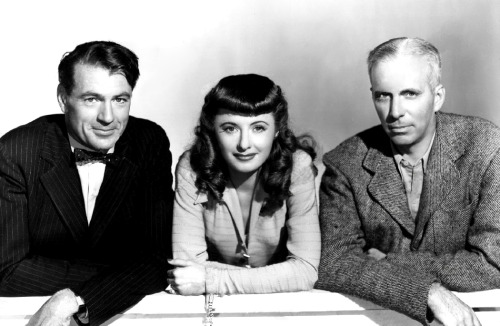
* One of Hawks' trademarks is a musical number in the proceedings, often by amateurs to show they're bonding in their efforts.   Ball of Fire was re-made eight years later by Hawks in a musical version called A Song is Born (also photographed by Toland, but this time in technicolor) starring Danny Kaye and Virginia Mayo.

Saturday, September 8, 2012

Tobacco Road

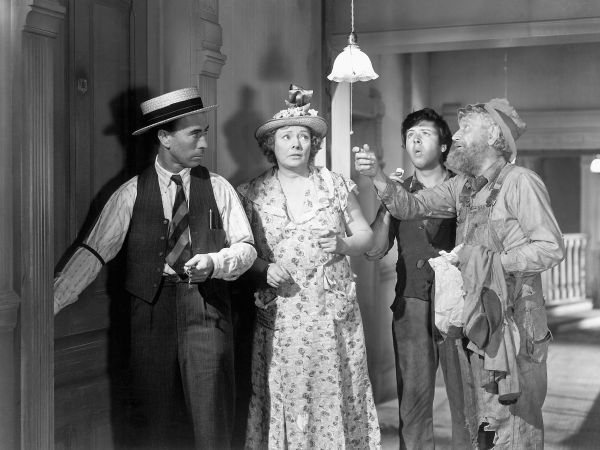
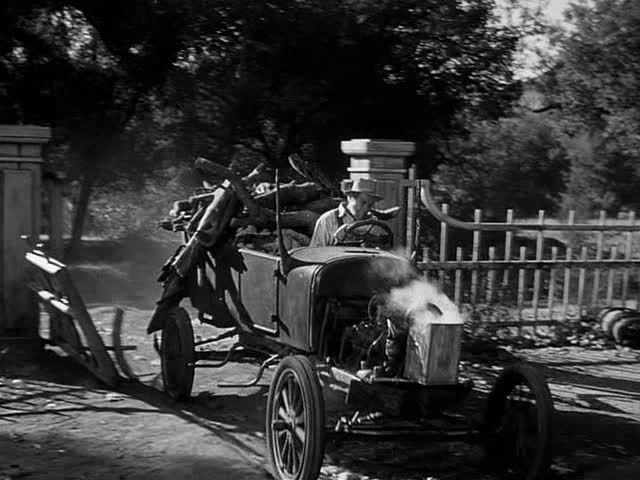
Tobacco Road (John Ford, 1941) The same year that Ford made the magnificent How Green Was My Valley (which won the Best Picture Oscar over Citizen Kane, a decision I'm still surprisingly ambivalent about) and after he'd made The Long Voyage Home, he made this oddity, an adaptation of the hit play that, itself, was an adaptation of Erskine Caldwell's scandalously bleak novel about the (to put it mildly) dysfunction among the Georgia poor.  I'm not familiar with either, but the material is so venal and hard-scrabble that with each level of the airing of its dirty laundry, compromises had to be made to reach the stage and the screen.  By the time producer Darryl Zanuck and Ford got hold of it, it was a bizzarro version of their collaborative effort on The Grapes of Wrath, an out-and-out comedy of the "Kettle" variety, with much slapstick and hee-hawing, the novel's displays of greed, selfishness, shiftlessness and hypocrisy and (let's call it what it is) its animalistic depiction of rural poor life, neutered by low comedy and high over-acting.  And to pass the censors and the Board of Review (not to mention the Catholic Legion of Decency), Caldwell's malicious intentions with its 13 year old brides, dead grammas, and apocalyptic "Wrath of God" fire (and no one would think of Gene Tierney possessing a cleft palate) is left by the way-side for lunk-headed males, religious loons, and the wholesale destruction of property.  The effect is to take Caldwell's metaphorical screed...and turn it into "L'il Abner."

It's a little dispiriting.  The material is so compromised as to be toothless, with no bite at all (although one might fear rabies), but any more mean-spirited and one couldn't see Ford—who could have trouble tackling tough subject matter head on—directing it.  It's a bit like how Ford started handling the production of Mister Roberts as a service comedy, rather than a barnacled "rust-and-all" look at the war-Navy.  But here, the strategy was sanctioned by Zanuck and the powers that be, not only at Fox, but at the Breen Office, just to get a hot property on the screen.

Compromise is not new to the movies, it's an integral part, actually (unless you're ideologically fundamentalist on the auteur theory).  But, as it was, the only reason to make this version of the film was to make hay, cashing in on the notoriety it had generated, while still getting away with it, something that must have appealed to the huckster-showman in Zanuck.  The producer loved a good story, liked to push the envelope, but also knew what chances he could take, before bringing down the ire of the blue noses.  And Ford could do comedy—he was better at it when it provided a relief from drama, or as texture inside of it—but he could do it, and economically, in a minimum of footage.

So Tobacco Road was made a comedy, curdled and dusty, and if some of Caldwell's malice got into it, so much the better, better than none at all.  Such compromise brought Maugham to the screen and Faulkner and Hemingway and Fitzgerald.  Not unadulterated, but some of it. 

One could make a case for Ford trying to desanctify his image of "the people," away from the respectful, earnest portrayals of The Grapes of Wrath, but Ford never painted with a wide brush and not all of his "po' folk" were saints.  Far from it, in fact.  So, there has to be some back-story to this one, some vital piece of information, but for now, the "get-it-on-the-screen-any-way-you-can" theory fits Occam's razor.

However, it has had one effect on me.  It's going to be tough to watch Ford's westerns with their solemn funerals with ragged voices singing "Shall We Gather at the River" after seeing what's done with it in this film.

Like I said, "compromise."


Ford still makes it look gorgeous, though.


Thursday, April 5, 2012

The Ox-Bow Incident

The Ox-Bow Incident (William A. Wellman, 1943)  Guy (Henry Fonda) walks into a bar with his buddy (Henry—nee Harry—Morgan).  He just came off the trail and is a might ornery.  His girl's left town, without a word, he hasn't had a bath in...well, he can't remember...but, the whiskey's good, even if the company ain't.  Then the fight happens; before too long, Fonda's character is just full enough of piss and vinegar (and whiskey, which from the looks of the bar, could be the same thing) that he picks a fight with a local tough (Marc Lawrence) using the bar to support him while delivering a nasty double kick to his head, until the barkeep clobbers him with with a bottle which shatters over his thick skull, and sends him (rather blissfully) into the arms of Morgan, who drags him like a sack of potatoes to a waiting cane-chair.


Welcome to the rough-and-tumble world of "Wild" Bill Wellman, a director of such sensibilities that you can practically smell the sweat coming off the denizens of Bridger's Wells, Nevada.  In a simple scene, Wellman differentiates himself from the more genteel sensibilities of Ford and Hawks, and into his own greasier, meaner, no-nonsense view of the West.  He's the better choice to present an immorality tale like The Ox-Bow Incident. about rough, western "justice" being meted out for the murder of a local rancher by a team of cattle rustlers.  The Sheriff's out of town, the deputy's itching for action, the local judge is ineffective blow-hard, and the posse-in-lynch-mob clothing have motivations, diverse but petty, such as false moral rectitude, mean-spiritedness, opportunism, and just plain boredom.  Truth to tell, they're a pack of wolves waiting for prey to abuse.


They find three mena new rancher nobody knows (Dana Andrews), who's had recent dealings with the dead man, an old, demented hand (Francis Ford, John's brother), and a Latino tough (Anthony Quinn) just corrupt enough to know not to play along...with anybody.  Lip-service is paid to justice, process, and prayers, but ultimately the purpose is to string the three up and get revenge as quickly as possible.  In this court by mob rule, the flimsiest of circumstantial evidence is not as important as the sturdiness of the rope, and waiting for facts just gets in the way of the excitement—it's a necktie party in all senses, except common ones.  The cooler heads are seen as weak, obstructing, or just plain kill-joys.


No good can come of it and Wellman (working with Lamar Trotti from Walter Van Tilburg Clark's 1940 novel) writes a case for due process whatever the cost, even if the only thing wasted is time.  Vigilance is not the same as vigilantism and the two should be frequently opposed.  And if one were to be so foolish to think that Westerns are no longer relevent to the issues of today, you haven't been reading the papers.


This was one of Henry Fonda's favorite films he appeared in, and in 1998, became part of the National Film Registry.

Tuesday, March 6, 2012

Boomerang! (1947)

Boomerang! (Elia Kazan, 1947) Not to be confused with the Eddie Murphy vanity project made 45 years later.  No, this one is an Elia Kazan film when he was still learning the ropes in film-making and experimenting with what he could do.  This one was shot on location in a semi-documentary style and based on a Reader's Digest article (written by the author of The Greatest Story Ever Told and the book the film Boy's Town was based on) about a true incident involving a murdered priest, a vagrant scapegoated for the crime after a public outrage, and a prosecutor ethical enough to not follow "procedure."

Boomerang! tells the story of the murder in Connecticut of a popular minister, gunned down in the street on a pleasant evening.  There are many witnesses, but the description—medium-build man in a dark coat and light hat—creates few helpful leads.  But, the public outcry for "justice" (or something like it), considering the slow speed of the investigation, fueled by an ambitious newspaper publisher, puts government officials in panic mode, and the resulting pressure on the police department—chief investigator played by Lee J. Cobb—creates too many suspects and the arrest of a drifter (Arthur Kennedy) who protests his innocence.

When the District Attorney (Dana Andrews) goes over the facts of the case for trial, he is unconvinced, but instead of doing the politically expedient thing—try the case on the flimsy evidence anyway and mollify the city—he decides to present the facts of the case as he sees them, in effect shouldering the roles of both prosecutor and defense, attempting to prove that the defendant could not actually have committed the crime.

It's an unusual chapter in jurisprudence, but, in reality, it's how the process should work. The norm is for the culprit (alleged) to be in the dock and the prosecutor makes the case, presents the evidence, states the facts of what happened.  The defense must refute or explain.  But, even if the prosecutor doesn't stand behind the facts, it's only for political reasons, laziness, ego, or protecting his job that would compel the P.A. to go ahead with a flimsy case.  By rights, such a case shouldn't even be brought forth, wasting court costs and time.  It's only because of the incorruptibility of this D.A. that events unfolded as they did and in a way, demonstrated in court, that paralleled the risks the official was taking in his efforts.

Kazan seems an unlikely director for the project—his penchant for heightened drama only displayed in the citizen's cries for justice, if only trumped-up justice.  But, as produced by Darryl Zanuck (for whom story was everything), Kazan takes a docu-drama approach, taking it to the streets, as he would throughout his work in the '50's, emphasizing the grit, even in the well-scrubbed and groomed city-squares of Connecticut.  And Kazan assembled a low-key group of character actors—Andrews, Cobb, Karl Malden, Sam Levene, Ed Begley, Kennedy—to underplay the drama.  Only Jane Wyatt betrays any genteel theatricality.  It ain't noir—too many foot-candles—and it's not cinema verite, as in the style of some of the Fox pot-boilers of this type.  No, this one's set on "simmer," but it's a good preamble to the director's work as he transitioned from theater, outside into the real world.

Saturday, July 26, 2008

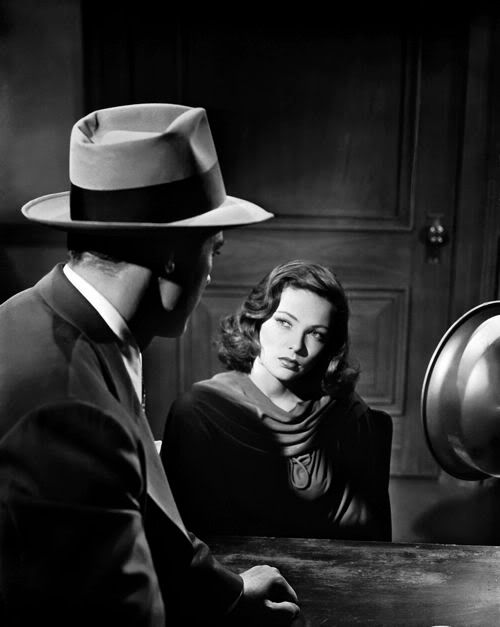
Laura

"Laura" (Otto Preminger, 1944) What can you say about a 25-year old advertising executive who died? That she was loved to the point of being despised, and beautiful enough to be utterly destroyed. That her life was mercurial enough to be inconvenient, and that it was easier to love her more when she was dead. A woman more ideal in memory than in life.

Women. Can't live with 'em. Can't shoot 'em in the head.

"Laura" is a mixture of film noir, murder mystery and working-girl-drama so oxidized as a classic that one could be forgiven for not recognizing the loopy movie this film really is. Both Tierney and Andrews underplay their roles while Clifton Webb, Vincent Price, and Judith Anderson over-play theirs (and what's the idea of Webb's character, Waldo Lydecker, inviting himself along as detective Mark McPherson (Dana Andrews) goes to interview suspects? Does McPherson think Lydecker's constant stream of sarcasm will badger a confession out of them?) all of them, just this far from scratching each others' eyes out.

It's the story of hustling advertising agency prodigy Laura Hunt (Gene Tierney), who counts among her friends the rich and powerful, none more so than Lydecker, whose mentorship and influence have catapulted Laura to the top of her profession. Now, the police are investigating her grisly late-night death by shotgun blast, with the lead detective suspecting no one and everyone, but the three folks most often in his cynical glare are Lydecker--whose jealousy of Laura's man-friends has led to extreme actions, her on-again-off-again fiancee ne'er-do-well Shelby Carpenter (Price) and Laura's aunt, Ann Treadwell (Anderson) who wants Carpenter for herself.

That's quite a tangled web. But things get stickier as McPherson spends more time than necessary investigating at Laura's apartment, staring at her portrait. In fact, McPherson becomes obsessed--or possessed--by the ghost of Laura.*


Then things get interesting.

The dialogue is arch, along with the performances, and Dana Andrews' barely expressive detective is a constant source of irritation to a group of people expert at irritation. The wise-cracks fly fast and loose, the cinematography (which justly won an Oscar) is lush and filled with shadows, and Preminger keeps the talk-y movie moving, right up to the shot of a splintered clock face that signals an end to a "timeless love." The whole movie could be the over-heated fever dream of a purple-prose life being flashed before your eyes.

High-toned, but low-down in the murk of motivation, "Laura" is just complicated enough to bear repeat viewing. And, besides "
Vertigo
," it's one of the rare Hollywood movies that dares to question the validity of that essential movie-dream, the "thing called love."

Plus, I always like to catch that moment when Dana Andrews barely smiles.


But she's only a dream....**


* Yeah, yeah, it's supposed to be romantic and all that, but I find it creepy--like those women who "fall in love" and marry axe-murderers in prison...because they can have the fevered romance, without having to actually live with the monster.

** I found interesting that this portrait that McPherson falls in love with is not a painting, per se--it's a studio photograph given the "Thomas Kinkade" treatment, with paint strokes added to make it appear to be a painting. And knowing how movie-cameras tend to make paintings appear real (the traditional trick behind matte shots), they had to "paint an inch thick" to fool the camera.