Showing posts with label Howard Hawks. Show all posts

Wednesday, September 25, 2013

The Big Sky

The Big Sky (Howard Hawks, 1952) A.B. Guthrie's novel about the exploration (and decimation) of the West by Eastern immigre's is considerably shortened by Hawks and Dudley Nichols, who start at the meeting of Jim Deakins (Kirk Douglas) and Boone Caudill (Dewey Martin) and their adventures of a keelboat going up the Missouri and leave it at that.  Nothing about how Boone's a little savage who ran away from home after nearly killing his father, nothing about the unpleasantness that would follow, or the results of Boone's bad temper.  No, this one's pretty much good times with some rough waters and bad rivals, and everybody gets along famously. It's vintage Hawks, but it ain't Guthrie.  In fact, Hawks eliminates the one character in Guthrie's trilogy ("The Big Sky", "The Way West", "Fair Land, Fair Land") who endure throughout—trapper and guide Dick Summers.

Re-writing is nothing new to Hawks (as a work habit, he'd re-write the next day's script the night before just to keep things fresh, sometimes abandoning the plot altogether if he thought it wasn't going in the right direction).  His great western, Red River, was completed four years previously, he followed it up with a musical remake of his own Ball of Fire with Danny Kaye, gone overseas with Cary Grant to make I Was a Male War Bride, then made his first foray into science fiction (but very much in the Hawks tradition of team-building) with The Thing (From Another World).  The Big Sky is different—the 50's would be something of an experimental phase for Hawks, going deeper into his subjects and philosophies than previously—in that cowboys and cattle aren't the prime motivation.  Fur trading is. And to do that, you don't go by horse, you go by boat and the challenges there are far different and maybe a bit more challenging than crossing the plains.   You go where the water goes and it's never a straight line and there are obstacles around every turn.


Guthrie's story is a bit like the Lewis and Clarke expedition (without the government funding), and both versions for page and film borrow the story of Sacagawea from the Corps of Discovery, whose presence (by coincidence) made acquiring ponies for the rugged trek across the Rocky Mountains from the Shoshones a foregone conclusion.  This came about as, unbeknownst to the Corps, Sacagawea had been stolen from the Shoshones as a child and her translating skills brought her face to face with the standing chief...who happened to be her brother.  In the same way, the character of "Teal Eye" (played by Elizabeth Threatt, in her only film) is brought back to her tribe to help in the fur negotiations.  She also serves as a point of rivalry between Dawkins and Caudill, but it all gets resolved to everybody's satisfaction.  


It fits into the Hawks template of disparate groups coming together for a single purpose: Hawkins finds Caudill, they're looking for Zeb Calloway (Arthur Hunnicutt, nominated for an Oscar for this performance, and he'd be playing, basically, the same role in Hawks' 67' Western El Dorado), who they meet in jail (problem solved, efficiently), then once Zeb is bailed out by the keel-boat Captain "Frenchy" (Steven Geray, and we don't know if he's related to "Frenchy" in To Have and Have Not), and the adventure meanders, like a river, with some tributaries involving a rival fur trading company, Deakins' ability to get hurt (and heal rapidly, apparently, and at one point, Hawks makes a comic episode out of amputating one of the character's fingers!).  He isn't nearly as concerned with ethnic authenticity as John Ford—he does use Ford's Hank Worden as a Shoshone guide as comic relief, but at least he's competent comic relief.


There have been a couple versions of this one floating around, and because it was done for RKO late in its life, and been passed from studio to studio, it's in fairly ragged shape.  Russell Harlan's black-and-white cinematography was nominated for an Oscar, but it's a little dim to see why, given the shape the film is in, even the "complete" version that TCM is running on.  It needs a major restoration, which is hard to come by if the film is in the second row seating of a director's Hall of Fame.  Perhaps one day, maybe, when someone mounts a Kirk Douglas retrospective, or decides to a DVD release of it, at all.


Thursday, July 25, 2013

Ball of Fire

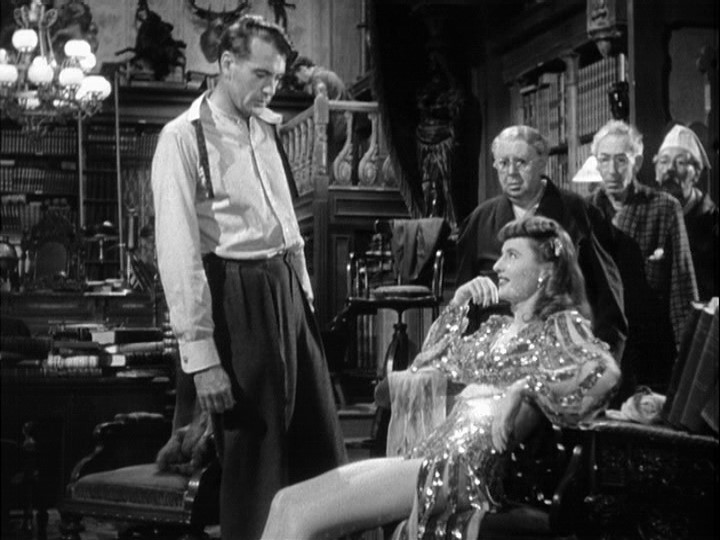
Ball of Fire (Howard Hawks, 1941) It doesn't get much better than this: screenplay by Charles Brackett and Billy Wilder (from a story by Wilder), produced by Samuel Goldwyn, photographed by Gregg Toland, music by Alfred Newman and directed by Howard Hawks.  Add that it's a swing-era version of "Snow White" stock-piled by anything-but-dwarvish character actors (Henry Travers, Richard Hayden, Oscar Homolka, S.Z.Sakall), some nifty up-and-comers like Dana Andrews and Dan Duryea, and top-lined by Gary Cooper (in pixie-ish Capra mode) and Barbara Stanwyck (who usually runs on all cylinders, but seems turbo-charged in this one) and you have the makings of a great, stylish and culturally-winking comedy, with lots of great musical material, too.*

Years in the making, the Dutton Encyclopedia, written by eight myopic scholars, is hitting the skids just as it's hitting the "S" words.  Professor Bertram Potts (Cooper) has just finished a 26 page treatise on "Slang," when a garbage-man walks in with some fancy (and utterly incomprehensible) patter that puts his research to shame.  Potts determines that he will leave his ivory tower and venture forth into the world to see what all the...what's the word? *flip/flip*..."rhubarb" is about.  He stumbles upon a nightclub (where Gene Krupa happens to be playing) and taking on the lead vocals is "Sugarpuss" O'Shea (Stanwyck, in full "bad-girl" mode), mob-girl to Joe Lilac (Dana Andrews) who's being investigated by the New York cops.  The focus of their investigation is Sugarpuss, who can give them a lot of inside information, so she has to go on the lam, and the professor's invitation to her to be a part of his slang symposium, gives her the perfect hideout, going "to the mattresses" with the eight encyclopediacs, but under the distrusting baleful eye of Miss Bragg, the housekeeper.


Complications arise, with the possibilities of broken and/or ventilated hearts, as it turns into a particularly pointy triangle between Potts, O' Shea and Lilac, with a suddenly energized Greek chorus of academics trying to deal, rather haplessly, with the real world.  "Snow White" is the inspiration, but fans of "The Big Bang Theory" will also see its roots in this and its Grimm ancestor. One also has Ball of Fire to thank for Billy Wilder's directing career, as Hawks let him sit in on the set, auditing during the making of the film, observing, taking notes, prepping for his own directorial turn that year with The Major and the Minor.

This is one of the great unsung Hawks movies, slightly different from his formula, thanks to Brackett and Wilder's script, but it still falls under the category where a team of different skilled people—in this case scholars—come together under circumstance to form a like-minded unit, even if, as here, it happens a little late in the proceedings.  It was Hawks' version of making a film about film-making, but obliquely, showing that any group of gypsies can unite under a common goal despite their differences.  It's part of the charm that makes Hawks one of the most American-minded of film-makers, those films being a reflection of the melting pot of the Great National Experiment.


* One of Hawks' trademarks is a musical number in the proceedings, often by amateurs to show they're bonding in their efforts.   Ball of Fire was re-made eight years later by Hawks in a musical version called A Song is Born (also photographed by Toland, but this time in technicolor) starring Danny Kaye and Virginia Mayo.

Tuesday, May 8, 2012

I Was a Male War Bride

I Was a Male War Bride (Howard Hawks, 1948) Hawks doing what he does best in a comedy—taking the finely chiseled speci-man that is Cary Grant and reducing him to a frustrated, humiliated wreck, robbing him of everything—dignity, decorum, manhood and sleep...mostly sleep.

In this one, Grant plays a Belgian in the French Army (in the same way he plays an American...as Cary Grant) in post-war Germany (it's actually based on a memoir—"I Was an Alien Spouse of Female Military Personnel en route to the United States Under Public Law 271 of the Congress" by the fellow this happened to) trying to break a black market operation with the help (and frequent hindrance) of Ann Sheridan.  They have history and start out loathing each other.  Along the way, he suffers bumpy rides in a motorcycle sidecar—in a rainstorm, no less—is nearly vaulted and scrunched by a barricade, paddles on the brink of a waterfall, climbs a pole (only to find that the sign, in German, says "Wet Paint"), is knocked off an awning from the second floor of a hotel, tossed in jail, and, in general, is made to suffer every indignity known to Man.

War is Hell, with several levels of humiliation, and its an everyday occurrence in this man's (and this woman's) Army.  If it's not a battle of the sexes. its a battle with bureaucracy, or the everyday battle with being a stranger in a strange land.  It is constant frustration, and Grant, outwardly so unflappable, is the master of its comic equivalent (as evidenced by such Hawks-Grant pairings as His Girl Friday, Bringing Up Baby, and the non-Marx Monkey Business.  Grant was the perfect test-subject for emasculation and the break-down of the cool customer.

As is typical Hawks, the camerawork is nothing fancy; set the camera up at chest-level and let the actors go and just try to keep up with everyone jumping over roadblocks, whether made or wood or red tape.  Typical situation—getting married.  She's American.  He's Belgian.  They're in Germany.  So, there are three wedding ceremonies and so many "I do's" that there's no time for a honeymoon—leaving him with one big "I don't" ("Get some sleep" says one of the hoteliers to him, to which he replies "That's ALL I'm getting," which is a pretty racy comment for the time, but Hawks always liked to push the envelope and tweak the censors)—plus, she's getting re-assigned to America, while he's fresh out of the Army, something that he'd been looking forward to but is now complicated by...all the complications.  But the mark of a professional in the Hawks world is the ability to punt, to improvise, and heal quickly...and move on, or around.  It was a constant with this director, in front of and behind the camera.  To persevere, do the job, despite set-backs and soldier on was the measure of a man...or a male war bride.

Saturday, October 29, 2011

Now I've Seen Every "Thing" Department

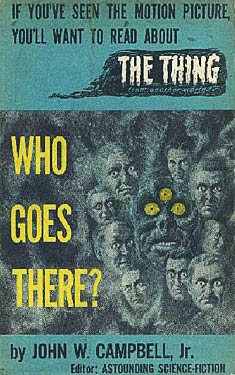
"Who Goes There?" by Don Stuart (a pseudonym for sci-fi pioneer John W. Campbell) is one of the acknowledged great stories in speculative fiction.  Part science-fiction, part horror and part psychological thriller, it tells of an isolated Antarctic research facility that discovers a flying saucer long buried in the ice.  Investigation leads to finding the saucer's sole inhabitant not too far away and taking the BEM-sicle back to the Ice Station for analysis.  Of course, it escapes and this particular ET has a special talent—it can "pretend" to be anyone it has killed and "absorbed."  Hiding in plain sight, the "Thing" starts picking off the scientists one by one, while the humans among them start to worry which of their (dwindling) number could be the wolf in sheep's clothing.  Paranoia strikes deep, but "The Thing" strikes deeper, able to replicate the men down to their blood-cells, which provides them with a nifty test to see who's genuine and who's a "Thing"-a-ma-job—take a blood-sample and dip a hot wire into it, and the alien-cells react and start to metamorphose, while the human hemoglobin merely sizzles.


Eventually, the alien is trapped by the scientists, while it is constructing an anti-grav ship to escape, forcing it outside into the cold, where it is torched by the scientists.  Humanity triumphs that the alien has been thwarted from fleeing or spreading itself to another outpost.  All's right with the world, especially considering that no other visit has occurred since the first ship crashed twenty million years before.  No other invasion is expected anytime soon.  The end.

From its origins in the August 1938 issue of "Astounding Stories," the tight, compact story was first adapted for the screen by Charles Lederer (with assists from Ben Hecht) and the film's producer, one of the great directors of American film, who put such a personal stamp on the film that, to this day, there is debate about just how much work on it the listed director of record actually did.  And that man's influence has taken over the DNA of his film's clones, so powerful is his influence and legacy.


The researchers take a measurement of the saucer.
Hawksian team-work in The Thing (from Another World)


The Thing (From Another World) (Christian Nyby, 1951).  Yes, it says "Christian Nyby" in the credits, but the film is such a prime example of Executive Producer Howard Hawks' style that folks just assume he had a hand in directing it, as well.  He almost certainly re-wrote the script, as it crackles with wit, banter, and includes the requisite "Hawks woman" who's tough enough to play with "the boys."  In fact, the dialogue and human interplay are better than the film deserves and is more entertaining than the "monster movie" that is at its frozen core. 

Hawks puts it in the arctic, then tossed out Campbell's psychological element—his military/scientific crew are Hawksian professionals and suspicions about each other would drive a wedge into that mix (it's enough that one scientist want to emphasize research over self-preservation to cause some heated exchanges*), fraying the team-spirit necessary for to get through the crisis and the simple goal of staying alive.  Nope.  It's simple.  The "Thing" is bad.  "It" wants to kill us.  We kill "it" before "it" kills us.  Research?  That's what autopsies are for!

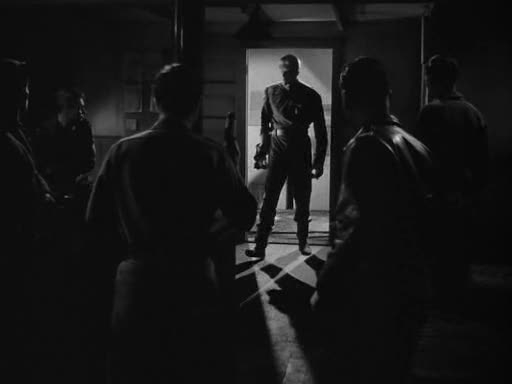
So, The Thing (From Another World) is much more of a monster movie than the study of paranoia the story is.  Teamwork towards a common goal is emphasized—you can say that a lot of Hawks' films are analogies to the disparate gypsy-camp of film-makers working together to create a single film—and it boils down to survival.  Besides the interplay of the characters, the film also boasts some iconic scenes: the Air Force officers and scientists spreading out on the ice to determine the size of the saucer; the sight of "the creature" (explained in simple unscientific jargon by one of the researchers as "an intellectual carrot") silhouetted in light as it kinetically bursts open the door of the room hiding the crew; the truly eerie scene of growing blood-sucking creature-clones like they were lethal daisies.

The Thing (From Another World) is a tough, no-nonsense monster movie with sides clearly drawn: us against them.  But the only hint of the original tale's paranoia comes from the film's final line: "Watch the skies!"


Braised carrots are on the menu at the arctic station tonight.
James Arness (in a role he hated) gets fried in The Thing (From Another World)


The Thing (John Carpenter, 1982) Carpenter has long been a disciple of Howard Hawks (his Assault on Precinct 13 is an urban remake of Rio Bravo, and Halloween is merely The Thing in costume), so it was only natural that he would take on the sole horror movie in Hawks' CV.  Bill Lancaster's script hews a little closer to Campbell's story, re-introducing the character conflicts and the assimilating alien (and eliminating Hawks' lone female character, making the station very much a "boys' club," comprised of Carpenter's "go-to" top-liner Kurt Russell—as chopper pilot McReady—and a "who's who" of veteran '80's character actors, Wilford Brimley, T.K. Carter, David Clennon, Richard Dysart, Charles Hallahan, Donald Moffat, Keith David, and Richard Masur).  In the Hawks version it was "us against them;" with Carpenter, it's back to "we have met the enemy, and he could be one of us."


Kurt Russell as MacReady in Carpenter's version


The tone is decidedly different, too.  Carpenter's film is dark and brooding and creepy, punctuated by sequences of crazily unnerving violence concocted by make-up wizard Rob Bottin's creative realizations of the creature's ability to turn any part of a human's anatomy into a potential source of weapon or defense.  It's icky and gooey and strangely goofy to see heads sprouting spider legs and skittering through the facility, or to see the detached head of one of the researchers pull itself along by whipping its tongue around a table leg and pulling itself out of harm's way.


Rob Bottin's creature creations for The Thing (1982) emphasize
a strange versatility when utilizing its human hosts.

Ultimately, though, for all the anarchic lunacy of the monster sequences, the movie boils down to a claustrophobic, paranoid fight between the men amongst themselves in their search for who is the monster among them, and Carpenter ends the film on a decidedly down note as the survivors of the carnage eye each other, each suspecting the other of being a creature, while they await certain death from the freezing elements, their previously secure station decimated by the events of the previous hours, providing no safety, no sanctuary or any warmth.  There are no winners in the decidedly small intergalactic battle zone.   And, though we're left with no ending and only a stalemate, we can be assured there will be no survivors, either.  Any victory is hollow, and one is left pondering if any "thing" human came out of it.


The Thing (Matthijs van Heijningen Jr., 2011) A direct prequel to Carpenter's film,** but basically the same plot.  Spaceship found.  Creature in the ice.  Thaws out.  Starts absorbing people.  What's interesting is that van Heijningen also pays tribute to Hawks, by turning the sex-tables on the story, making paleontologist Kate Lloyd (Mary Elizabeth Winstead from Scott Pilgrim, who looks unnervingly like Zooey Deschanel and can rock a flame-thrower) the "guy-in-charge" after the official authority structure breaks down.  Just as Hawks up-ended The Front Page by casting Rosalind Russell in one of the men's roles for His Girl Friday, van Heijningen provides an interesting dynamic by putting a woman in control of a station full of panicking men.

One doesn't have to have seen the Carpenter version to appreciate what is going on in the film, but if one has there are touchstones that one can appreciate (and check off if one is a "completist" or continuity-obsessive) along the way—especially at the end once the credits have started rolling—there's the merged double-creature that is briefly seen in the earlier film, the axe in the door, the suicide, the fleeing dog pursued by snipers.  But, the giddy, manic quality of the creature-creations has been muted for straight-out horror effects—van Heijningen even has a cheap-shot "Boo" effect early on that still makes one jump—but Carpenter's (and Campbell's) blood-test sequence is neatly sabotaged for a simpler, more organic, and slightly creepier, test that anticipates a potential attack every time someone opens their mouth.

It does its job well, but one is left feeling it really wasn't necessary to make this entry, as it its only function seems to be to ride the coat-tails of its predecessor and fill in some blanks of an already competent version that left some audience-members behind (in the same way that 2010 did for 2001).


Kate Lloyd (Mary Elizabeth Winstead) rocks a flame-thrower.

* And we all know how disastrous heated exchanges can be at an ice-station!

** The film literally ends where Carpenter's begins, with a Norwegian helicopter  and gunman chasing a dog over the Antarctic wastes.


Saturday, September 12, 2009

Come and Get It!

"Come and Get It!" (Howard Hawks, William Wyler, Richard Rosson* 1936) Edna Ferber's novel was purchased by Samuel L. Goldwyn to turn into a Hollywood blockbuster and Howard Hawks hired to direct. But Hawks was a maverick, and when Goldwyn came back from a long illness to see how things had progressed, he was shocked, shocked I tell you, to see that Hawks had drifted afield of the Ferber source novel. For one reason or another, Hawks was fired (or quit, depending who was asked) and replaced by Goldwyn favorite William Wyler (who was just finishing up "Dodsworth" for Goldwyn).

The result is a revelation on very many levels: that
Hawks' signature style was so evident it couldn't be mistaken for any other director; that the difference between Wyler's and Hawks' scenes are night and day; that Edward Arnold, known to modern audiences as a supporting player in Capra films could carry a movie so handily; Walter Brennan could be a versatile and nimble actor; and that Frances Farmer was an incredibly gifted actor of enormous facility and subtlety.

The story of a logging "pirate," Bernard Glasgow (
Arnold) falls in love with a saloon girl (Farmer), but gives her up to marry the boss's daughter, win himself a partnership and become one of the richest men in Missouri. Hawks's part is a fast-moving, rollicking story of rapacious men grabbing as much as they could to line their pockets. Shot in mostly waist-level fast set-up's, with a rarely moving camera, the emphasis is what's in the frame and not how it's framed, so most of the scenes are crowded with people, the actors stepping over each other's lines and character bits of business that are not called attention to (including the requisite cigarette lighting without being asked). Highlights are a saloon fight with serving trays used as dangerous flying discs, a couple of fights in which Arnold solidly smacks his opponents, a game of chance turned on its ear, and an Oscar-winning turn (the first to be given to a supporting actor) by Walter Brennan, rangy, ebullient and sporting a high Swedish accent.

But Farmer steals this section (she dominates the whole movie, actually) with her performance as the ultimate "
Hawks dame:" her Lotta Morgan is gum-chewing, moose-jawed, with big movements and a dusky drawled voice, with more than a hint of Marlene Dietrich's insolence (courtesy of frequent Hawks collaborator Jules Furthman, who'd written a couple Dietrich films). That Farmer then plays her daughter (also named Lotta) later in the film in a high-toned, fluttery manner—she even sings differently— with a more subdued jaw-line and a smile not so crooked as her mother's is one of those nuanced things of such complexity that you remember how clever these "old" movies can be.

Farmer is able to keep up the performance when Wyler takes over, and it's pretty obvious when that is—when the Bostrom clan and Glasgow (now smitten with the daughter of the woman he left behind) take a fancy trip to Chicago. The pace slows. The actor's get out of the way of each other's lines.** The
Gregg Toland photography is a bit more finicky and lush, not having to rush to make Hawks's schedule but accomodating to Wyler's. Scenes are staged more angularly and more obviously, telegraphing future camera moves and upcoming "business." And attention is paid to more obvious scene-fussiness, even to including cut-away's—a boy-girl flirtation is built around a taffy pull, and a later scene between Glasgow and his daughter doesn't communicate their "reflection of each other" relationship as Hawks did, but is, instead, based around a child's balancing toy. Wyler has enormous taste and style, but as much as he tries to emulate Hawks' off-the-cuff style, the more it feels staged and unnecessary, even making more of a Joel McCrea ad-libbed-over gaffe in Hawks's section than is necessary.

Hawks is more adept at making his points, too. Where he has a quick discussion of the duplicity of home-steading to acquire more timber land from the government for nothing ("Well...it's not illegal" says the company CEO), and shows Glasgow's utter disregard for re-planting ("Ah, nothin'll grow back there!"), whereas
Joel McCrea's son has the "planting for the future" line in Wyler's section—a conversation that puts the older Bostrow's to sleep.

It's an interesting study in contrasts in directing style—Hawks's attention to material and Wyler's attention to presentation—that may be lost on those caught up in Ferber's soapish story ("the famous novel by Edna Ferber" is how it's described in the credits. There's plenty of reason to go hunting for this film. And a hunt it will be; this film is notoriously snake-bit.*** Maybe because of the melodrama behind the scenes, or Goldwyn's lack of enthusiasm for the result—the film went way over budget, capping at more than a million 1935 dollars—and was not a box-office success. Then there's the troubled career of Frances Farmer, which no studio wanted to gamble on promoting. For whatever reason, "Come and Get It," holds up very well and seems downright prescient for its asides on ecological issues and corporate ethics. And it is the film that Farmer was proudest of, despite its many issues in front of and behind the camera. She would never be as satisfied with her work and the conditions to achieve it again in her life.

"
Come and Get it!" premiered in Seattle, Washington at The Liberty Theatre, where Frances Farmer had once been an usherette.


"Our Lady of Perpetual Rebellion:" Frances Farmer
Publicity Glamour photo by George Hurrell


* With all the attention made to Hawks' and Wyler's separate efforts there was a third director for "Come and Get It!"—Hawks's talented assistant director Richard Rosson who traveled to Idaho to photograph the incredible logging footage contained in the early part of the film.

** Is it preposterous for me to think that Wyler was taking a jab at Hawks' dialogue direction by having Brennan and Mady Christians—playing his niece—stop a conversation dead by saying the same thing over each other a couple times and then give up trying to inject into the conversation?

*** As an indication of this on a personal note, it took far more effort than normal to find a vintage poster of "Come and Get It!." Until the last minute, the best I could uncover was a newspaper ad.

Thursday, May 21, 2009

Anytime Movies Reloaded: - Only Angels Have Wings

It's Spring-Break for me. Times are busy. The Summer Movie Season is already begun (and I'll be writing about the new ones) and the Film Festivals are grinding away like creaky mills separating wheat from chaff. It's as good a time as any to re-boot a feature I started years ago, when it was suggested I do a "Top Ten" List.

I don't like those: they're rather arbitrary; they pit films against each other, and there's always one or two that should be on the list that aren't because something better shoved it down the trash-bin.

So, I came up with this: "Anytime" Movies.

Anytime Movies are the movies I can watch anytime, anywhere. If I see a second of it, I can identify it. If it shows up on television, my attention is focused on it until the conclusion. Sometimes it’s the direction, sometimes it’s the writing, sometimes it’s the acting, sometimes it’s just the idea behind it, but these are the movies I can watch again and again (and again!) and never tire of them. There are ten (kinda). They're not in any particular order, but the #1 movie IS the #1 movie.

While in college, I worked as a movie projectionist, and had an opportunity to show many great films for the various film courses being taught. But one film left a distinct impression—over the course of five days I had to show it eight times. I got to know it pretty well. Its name is “-Only Angels Have Wings” and it was directed by one of the great director-producers, Howard Hawks.

Hawks directed all types of movies, many of them classics of their genre: westerns (
Rio Bravo, Red River); mystery/noir (The Big Sleep); adventure (To Have and Have Not, Hatari!) and comedy (Bringing Up Baby, His Girl Friday). He even produced one of the first truly classic science fiction films (The Thing! [From Another World]), and an iconic musical (Gentlemen Prefer Blondes). Despite the genre, and despite the decade in which it was produced each film is unmistakably a Hawks film – a group of men (and women, but usually men) of diverse talents must come together to achieve a singular goal, be it to drive a huge herd of cattle to Missouri, or contain the alien threat, or capture a live rhinoceros, or get the bad guy to the Marshall (alive if possible) or ferry the refugees to safety, or find the dinosaur clavicle, or land a millionaire.

Conflict is achieved by introducing a newcomer to the mix who doesn’t understand the synergy of the group and who must learn “the code” to belong, and that keeps the group in cohesion. And so much the better if they do it without talking about it much.

That’s the Hawks formula, and he was able to create enough variations in the design that his films all seem different, even though they’re always telling the same basic story—a story that’s a metaphor for movie-making.
*

“Hello, professional”

Why “-Only Angels Have Wings” out of all those classics? It is the ultimate Hawks movie. Watch any of those others and you’ll hear similar lines and see similar situations, but in “Angels,” everything is distilled to the basic essence of the tale to become the best Hemingway story Hemingway never wrote. Distilled? The majority of the film takes place in one set! For this band of professionals, the goal is to fly the mail from the port city of Barancca through a narrow passage in the Andes utilizing one of a number of prop aircraft, all in need of repair. The men realize they’re merely links in a chain getting the mail…or a doctor…or a shipment of nitro-glycerin…to its destination with the threat of death flying right alongside. So hazardous is the job for these civilian-pilots that their base is a revolving door for the new blood who have to prove themselves. It’s "The Right Stuff” twenty years before Tom Wolfe popularized the phrase.

And it’s prime Hawks. For instance, watch the cigarettes. In a Hawks film, they’re visual short-hand for relationships—who’s in need and who can provide, who’s giving, who’s dependable, giving, taking, reading other's thoughts, . More than any other Hawks film, except perhaps “Rio Bravo,” the flame that’s there when you need it is a gambit that crams twice the information into the film, and reveals more about the characters than their deliberately circumspect dialog—what
Frank Capra called Hawks’s “three-corner dialog”—was allowed. To come right out and say things point-blank, well, not only would it be corny and unbelieveable…it just wasn’t done in Hawks's circles.

Hawks also liked to use music to convey mood. But it usually isn’t a Hollywood background score it's indigenous music—in this case, the bar band at Dutchy’s bar/mercantile and air terminal (this is a couple of years before “
Casablanca”). They set the mood, provide a little extra entertainment value, some local color for a set-bound movie and when the time is right and there’s a meeting of minds it’s reflected in a musical number in which everyone
participates. Again, no one has to come out and say ”We’re all thinking the same way.” They’re all singing the same song, so it’s understood.

"Boy, things happen fast around here, don't they?"

There’s also the unspoken ethos of the professional—you do your job to the best of your ability and you don’t talk about it. You don’t brag. You don’t cut corners and you don’t dwell on it. You do your job, you move on. You do your job right and people will notice. Do your job wrong and everyone suffers. In this way the group can depend on each other while staying out of their debt. In this movie-atmosphere, bit-players are allowed to shine. Yeah, the movie revolves around
Cary Grant (and the only role where he would be more stoic than he is here would be playing the icy spy Devlin in Hitchcock’s “Notorious”) and the delightful Jean Arthur—she could turn on a dime from tragedy to comedy and not miss a step— but even the lowliest of character-actors get great moments of screen-time. Also of note are a very young Rita Hayworth at the start of her career and Richard Barthlemess—a former silent screen star who didn’t make the transition to “talkies.” He plays a pilot who must prove himself to the others and that he can “cut” it in their world. Art imitates life.

And then there’s
Thomas Mitchell, who might well be the greatest character actor to never achieve name-above-the-title status. A veteran of many a Frank Capra comedy—and whose most prominent role would be as Scarlett O’Hara’s father in “Gone with the Wind”—here he plays a character with the title “The Kid,” even though he’s the oldest of the pilots. So much of the movie centers on him that his one character fulfills every plot device except love interest, although with Hawks one could never be too sure of that, either. **

Ultimately it’s Mitchell’s Kid who provides the means for Grant’s character to express his feelings, which, typically, he does without really having to, and in a way that makes it obvious to everybody involved. And as if anybody missed the point how dependent everyone is on each other, most of the pilots wind up injured, “winged” so that by the end of the movie, two pilots have to perform the job of one to fly each mail-run. Perhaps the better title may have been “-Only Angels Have Two Wings.”

It’s all done so economically, so breezily and with so little in the way of “action” that one may get through the entire movie before realizing that mostly everybody just talked…without really coming out and saying what they mean. Everything is shot at eye-level. There’s nothing fancy in the camera-work. The story is the King, and everyone is working towards making it work…like professionals.


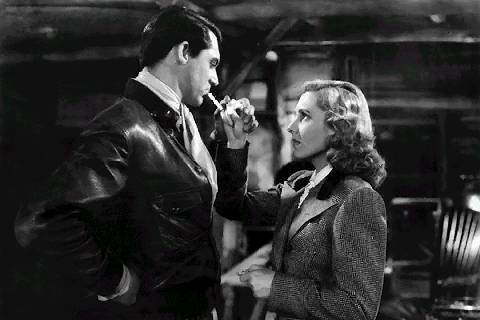
Cary Grant needs a match. Jean Arthur carries a torch.

* Hawks was well-known for taking different stories and turning them into the Hawks formula, sometimes rewiting the entire film on a day to day basis to get there. The most extreme example of this is “El Dorado,” which after ten minutes of one story suddenly veers into becoming a remake of the earlier Hawks-John Wayne western “Rio Bravo.” When Hawks called John Wayne to ask if he’d star in yet another western, “Rio Lobo,” Wayne knew exactly what he was getting into. “Do I get to play the drunk this time?” he drawled.

** Someday, someone far more intelligent than I is going to go through the Hawks filmography with an eye towards sexual politics—whether it’s the leering banter between
Montgomery Clift and John Ireland in “Red River,” or Cray Grant in drag in “Bringing Up Baby” (“I went GAY all of a sudden!!”) and “I Was a Male War Bride,” or some of the more bizarre stagings of musical numbers in “Gentlemen Prefer Blondes.” And then there’s the long line of husky-voiced women in his movies who are one of “the boys,” from Rosalind Russell to Lauren Bacall all the way up to future Paramount Studios exec Sherry Lansing. For all the macho posturing exhibited in his movies, there are hints that Hawks never completely “bought” into it and is enjoying winking at it. He may well be second only to James Whale in sneaking so much gay subtext into his movies.


-Only Angels Have Wings
Chinatown
Mr. Smith Goes to Washington
American Graffiti
To Kill a Mockingbird
Goldfinger
Bonus: Edge of Darkness

Monday, September 1, 2008

Rio Bravo

"Rio Bravo" (Howard Hawks, 1959) Rollicking pop-western that might be, along with "Only Angels Have Wings," the quintessential Howard Hawks movie. It's a drama with comedy. And if it was a mystery starring Humphrey Bogart, it would be acclaimed for its dexterous story-telling and depth of technique.

But because it's a "
John Wayne Western," it gets no respect, or retrospective. But who says life is fair? Certainly not a man hung with a moniker like John T. Chance.

The story goes that both
John Wayne and Howard Hawks hated "High Noon," but for differing reasons: Wayne, because it was a veiled slam at McCarthy and Hawks because of its basic story structure. Hawks found it appalling that Sheriff Will Kane (Gary Cooper) would ask for volunteers in his fight against the Miller boys. "It's his responsibility. Let him handle it," was Hawks' reasoning. "If he can't, he shouldn't have the badge."

It's a sound argument, and
Hawks makes it the cornerstone for the beginning of "Rio Bravo." Sheriff Chance (John Wayne) has a member of the Burdette gang (Claude Akins) jailed for murder, waiting for the Marshall to get to town. For help, he has his coot-ish old deputy "Stumpy" (Walter Brennan, sans teeth) and a former deputy named "Dude" (Dean Martin), who suffers from the shakes and dry heaves during an imposed drying out spell.

"That all you got?" says wagon-master Pat Wheeler (
Ward Bond), not really asking.

"That's what I got," says Chance.

Chance refuses all offers of aid from the townspeople; the guys he's got are at least deputized. They won't get in the way like "well-meaning amateurs." And the one guy from Wheeler's party he'd like to have help--
Ricky Nelson's "Colorado" (or as first, Wayne, then everybody pronounces it, "Colorada")--won't. It's the kid's good sense not to get involved with the fight that impresses Chance the most.

And this is why I prefer "
Rio Bravo" to an ideology-based western trying to make societal points, like "High Noon:" "Rio Bravo" is practical. All the protagonists have to do is wait out the Burdettes, who are always thinking up ways to breach the jail. There are also other concerns--Dude's alcoholism and self-esteem issues. Then there's "the girl," "Feathers" by name (Angie Dickinson), and she's a boiled-down bad good girl in the best "plays-with-boys" tradition of Hawks women. her exchanges with a flummoxed and humiliated Wayne are some of the best examples of Hawks' "three-corner" line of dialog in the director's canon (and despite the screen credits of Jules Furthman and Leigh Brackett--look at her resume some time--it was Hawks who wrote the dialog).

There are joys aplenty in the details of "Rio Bravo," if one is looking for them. For example:

--
The opening: A wordless mini-movie that establishes a lot of relationships with no one exchanging a word. "Dude's" alcoholism and his willingness to humiliate himself for a drink, countered by Chance's concern and disgust all told visually. Hawks shoots films the old traditional way of studio films--mid-shots of the participants centered at eye-level. But for the introduction of Wayne that rule is violated, with an up-angle shot of the Sheriff, shaking his head, from "Dude's" floor-perspective. It's just the first of many strong scenes featuring Martin, recently split from the Martin and Lewis duo, and determined to make it as an actor/singer in his own right.

--Despite the seemingly simplistic storyline, the film is rich in sub-text. For example, watch the oft-used Hawks device of cigarettes--who needs one, who offers, who lights--as an indicator of relationships and charity. Hawks did this in several films, but the tobacco flies fast and loose in "Rio Bravo."

--Half the fun of watching "Rio Bravo" is watching the other actors' reactions in scenes. A couple of favorites: Watch Wayne as "Colorada" confronts a fancy-vested gambler who might be cheating at cards.* Wayne's weapon of choice throughout the film is a carbine; he rarely doesn't have it in his hands. During this scene, he holds it lightly in his right hand. When "Fancy-Vest" reaches for a weapon, "Colorada" beats him to the draw. But, off to the side, Wayne has reacted by bringing his rifle to bear, then, once he sees the kid has the situation under control, continues the arc of the rifle to cradle it in his arms, as if that was his intention all along.

--At one point, "Dude" tries to keep information away from Chance, but has his subterfuge spoiled by "Colorada" walking up and blurting it out, while Martin seethes in the background.

--Music is an important component in Hawks' work. At one point, there is a sing-along between Martin, Nelson, and, improbably, Brennan. It might seem a hokey moment, but it means something. before this scene, the three were squabbling. Now, they're harmonizing as a unit, collaborating and getting out of each others' way. It's Hawks' way of showing barriers have been broken and a cohesive unit has been formed, something that was done in "
Bringing Up Baby," "Only Angels Have Wings," "To Have and Have Not," and countless others. (See that scene below)

"Rio Bravo" is a rich movie-experience, deeply rewarding, and demanding repeated screenings to catch all the details--not a hardship, as it's also fun. It's a distillation, summing-up and expansion of the elements that made Howard Hawks such a unique film-maker, and gifted story-teller.


Can't we all just sing-along?
Harmonizing indicates cohesiveness in "Rio Bravo"

* start watching at @2:50 in the embedded clip.


Monday, January 14, 2008

- Only Angels Have Wings

While in college, I worked as a movie projectionist, and had an opportunity to show many great films for the various film courses being taught. But one film left a distinct impression—over the course of five days I had to show it eight times. I got to know it pretty well. Its name is “-Only Angels Have Wings” and it was directed by one of the great director-producers, Howard Hawks.

Hawks directed all types of movies, many of them classics of their genre: westerns (
Rio Bravo, Red River); mystery/noir (The Big Sleep); adventure (To Have and Have Not, Hatari!) and comedy (Bringing Up Baby, His Girl Friday). He even produced one of the first truly classic science fiction films (The Thing! [From Another World]), and an iconic musical (Gentlemen Prefer Blondes). Despite the genre, and despite the decade in which it was produced each film is unmistakably a Hawks film – a group of men (and women, but usually men) of diverse talents must come together to achieve a singular goal, be it to drive a huge herd of cattle to Missouri, or contain the alien threat, or capture a live rhinoceros, or get the bad guy to the Marshall (alive if possible) or ferry the refugees to safety, or find the dinosaur clavicle, or land a millionaire.

Conflict is achieved by introducing a newcomer to the mix who doesn’t understand the synergy of the group and who must learn “the code” to belong, and to keep the group in cohesion. And so much the better if they do it without talking about it much.

That’s the Hawks formula, and he was able to create enough variations in the design that his films all seem different, even though they’re always telling the same basic story—a story that’s a metaphor for movie-making.*

“Hello, professional”


Why “-Only Angels Have Wings” out of all those classics? It’s the ultimate Hawks movie. Watch any of those others and you’ll hear similar lines and see similar situations, but in “Angels,” everything is distilled to the basic essence of the tale to become the best Hemingway story Hemingway never wrote. Distilled? The majority of the film takes place in one set! For this band of professionals, the goal is to fly the mail from the port city of Barancca through a narrow passage in the Andes utilizing one of a number of prop aircraft in need of repair. All the men realize they’re merely links in a chain getting the mail…or a doctor…or a shipment of nitro-glycerin…to its destination with the threat of death flying right alongside. So hazardous is the job for these civilian-pilots that their base is a revolving door for the new blood who have to prove themselves. It’s "The Right Stuff” twenty years before Tom Wolfe popularized the phrase.

And it’s prime Hawks. For instance, watch the cigarettes. In a Hawks film, they’re visual short-hand for relationships—who’s in need, who can provide, who’s giving, who’s dependable. More than any other Hawks film, except perhaps “Rio Bravo,” the flame that’s there when you need it is a gambit that crams twice the information into the film, and reveals more about the characters than their deliberately circumspect dialog—what
Frank Capra called Hawks’ “three-corner dialog”—was allowed. To come right out and say things point-blank, well, not only would it be corny and unbelieveable…it just wasn’t done.

Hawks also liked to use music to convey mood. But it usually isn’t a Hollywood background score but indigenous music—in this case, the bar band at Dutchy’s bar/mercantile and air terminal (this is a couple of years before “
Casablanca”). They set the mood, provide a little extra entertainment value, some local color for a set-bound movie and when the time is right and there’s a meeting of minds it’s reflected in a musical number in which everyone
participates. Again, no one has to come out and say ”We’re all thinking the same way.” They’re all singing the same song, so it’s understood.

"Boy, things happen fast around here, don't they?"


There’s also the unspoken ethos of the professional—you do your job to the best of your ability and you don’t talk about it. You don’t brag. You don’t cut corners and you don’t dwell on it. You do your job, you move on. You do your job right and people will notice. Do your job wrong and everyone suffers. In this way the group can depend on each other while staying out of their debt. In this movie-atmosphere, bit-players are allowed to shine. Yeah, the movie revolves around Cary Grant (the only role where he’s more stoic than he is here would be playing the icy spy Devlin in Hitchcock’s “Notorious”) and the delightful Jean Arthur--she could turn on a dime from tragedy to comedy and not miss a step, but even the lowliest of character-actors get great moments of screen-time. Also of note are a very young Rita Hayworth at the start of her career and Richard Barthlemess—a former silent screen star who didn’t make the transition to “talkies.” He plays a pilot who must prove himself to the others and that he can “cut” it in their world. Art imitates life.

And then there’s
Thomas Mitchell, who might well be the greatest character actor to never achieve name-above-the-title status. A veteran of many a Frank Capra comedy—and whose most prominent role would be as Scarlett O’Hara’s father in “Gone with the Wind”—here he plays a character with the title “The Kid,” even though he’s the oldest of the pilots. So much of the movie centers on him that his one character fulfills every plot device except love interest, although with Hawks one could never be too sure of that, either. **

Ultimately it’s Mitchell’s Kid who provides the means for Grant’s character to express his feelings, which, typically, he does without really having to, and in a way that makes it obvious to everybody involved. And as if anybody missed the point how dependent everyone is on each other, most of the pilots wind up injured, “winged” so that by the end of the movie, two pilots have to perform the job of one to fly each mail-run. Perhaps the better title may have been “-Only Angels Have Two Wings.”

It’s all done so economically, so breezily and with so little in the way of “action” that one may get through the entire movie before realizing that mostly everybody just talked…without really coming out and saying what they mean. Everything is shot at eye-level. There’s nothing fancy in the camera-work. The story is the King, and everyone is working towards making it work…like professionals.


*Hawks was well-known for taking different stories and turning them into the Hawks formula, sometimes rewiting the entire film on a day to day basis to get there. The most extreme example of this is “El Dorado,” which after ten minutes of one story suddenly veers into becoming a remake of the earlier Hawks-Wayne western “Rio Bravo.” When Hawks called John Wayne to ask if he’d star in yet another western, “Rio Lobo,” Wayne knew exactly what he was getting into. “Do I get to play the drunk this time?” he drawled.

** Someday, someone far more intelligent than I is going to go through the Hawks filmography with an eye towards sexual politics—whether it’s the leering banter between
Montgomery Clift and John Ireland in “Red River,” or Cray Grant in drag in “Bringing Up Baby” (“I went GAY all of a sudden!!”) and “I Was a Male War Bride,” or some of the more bizarre stagings of musical numbers in “Gentlemen Prefer Blondes.” And then there’s the long line of husky-voiced women in his movies who are one of “the boys,” from Rosalind Russell to Lauren Bacall all the way up to future Paramount Studios exec. Sherry Lansing. For all the macho posturing exhibited in his movies, there are hints that Hawks never completely “bought” into it and is enjoying winking at it. He may well be second only to James Whale in sneaking so much gay subtext into his movies.


Cary Grant needs a match. Jean Arthur carries a torch.


Anytime Movies are movies I can watch anytime, anywhere. If I see a second of it, I can identify it. If it shows up on television, my attention is focused on it until the conclusion. Sometimes it’s the direction, sometimes it’s the writing, sometimes it’s the acting, sometimes it’s just the idea behind it, but these are the movies I can watch again and again and never tire of them. There are ten. This is Number 4.


IV: -Only Angels Have Wings


V: The Searchers


X: Goldfinger