Showing posts with label Western. Show all posts

Tuesday, November 19, 2013

Go West (1925)

Go West (Buster Keaton, 1925) There have been a couple features with the title, but this is the one written, directed and starring Keaton as a woe-begone dweller of a podunk town who sells everything he owns at the Fade From Black, only to find (after buying food and buying back the family photo he'd forgotten in a drawer) that he's a completely free man (freedom being just another word for nothing left to lose).  Deterred and detoured, he hoboes a freight train and accidentally (not exactly the right word as Keaton's "accidents" are always complicated) finds himself on a working ranch out west.  A discraded set of chaps is all the references he needs to start working on the ranch and working the herd, starting from the ground up.  Removing a stone from a heifer's hoof gains him a friend and a constant companion in the work-a-day world, as the un-broco'd Buster and bovine look out for the other.  

It's a classic fish-on-the-prairie story as Keaton's tenderfoot and his tender-footed cow-friend find ways to get things done while not doing things in the normal cowboy fashion, and any mentioning of the lessons learned in milking, lassoing and branding a cow will only spoil the surprise.  Let's just say that PETA would be proud.

The way most silent comedies work is with a long series of short bits and then an extended sequence in the final couple reels, and that was Keaton's standard blue-print, as well.  The final complication involves getting the herd to market so that the ranch can pay its bills, while at the same time, saving the one cow that Keaton has become the guardian cowboy to.  It involves a train-trip (a Keaton specialty) as well as one logistical movie-making nightmare—a cow stampede through the streets of roaring '20's Los Angeles, but done at a pace with a tangential series of complications that amaze.

As always seems to be the case with silent comedies, especially those of Keaton, the fewer words the better.  Just seek it out and enjoy.


The first "Mexican stand-off" in movies is instantly defused with a pinkie finger.


Tuesday, November 12, 2013

Rancho Notorious

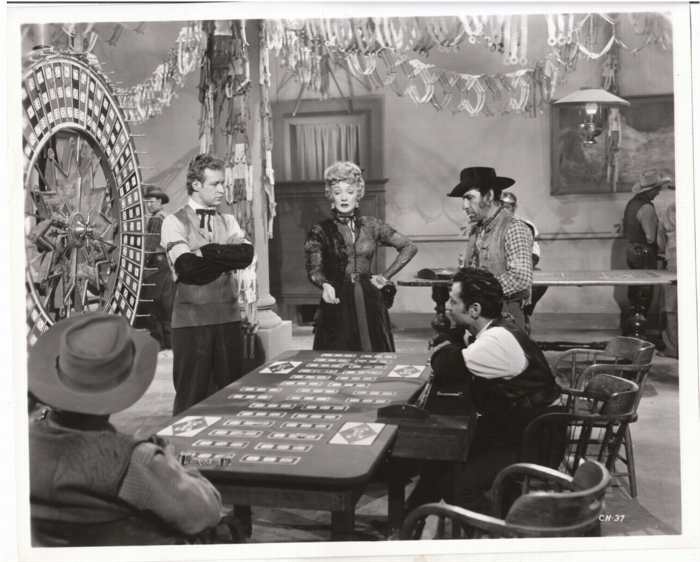
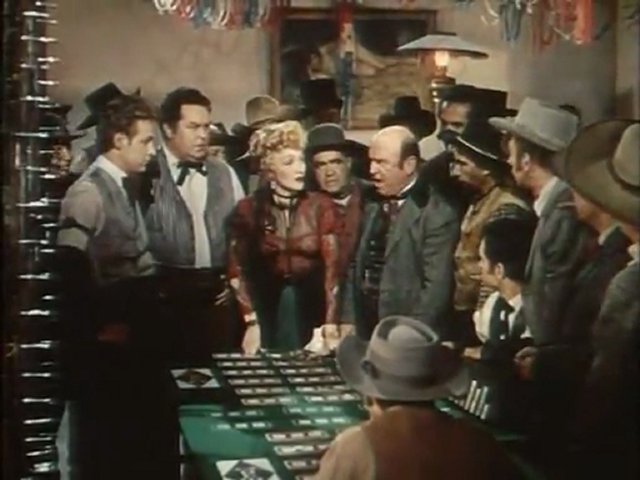
Rancho Notorious (Fritz Lang, 1952)  Hate!  Murder!  and Revenge!

After hearing about this one for oh-so-many years, I finally got a chance to sit down and luxuriate a while with Rancho Notorious, a film that offers so many surprises—subtleties and Big Statements—that work-outs were had by both my jaw (dropping) and the remote, which afforded me the essential ability to go back and "look at that again."

Rancho Notorious offers opportunities a-plenty for both.  You don't see very many movies where people are actively snarling at each other, but then there aren't many movies like this wildly expressionistic main-stream Western directed by the master of German Expressionism Fritz Lang. Preceding High Noon by a matter of months, it also has a song-based score, but an odd one, not so "on the nose" as "Do Not Forsake Me...", but one's that's haunting and echoes through your head like a warning (as it did mine) for days.

The song is "The Ballad of Chuck-a-Luck," (that was supposed to be the movie's title and there's a story for ya*) written by Ken Darby and plays over the titles and interstitially during the murder investigation that lasts the entire movie, each stanza ending with those words "Hate.  Murder.  And revenge."

So, what's the story, pilgrim?


Vern Haskell (Arthur Kennedy) is a ranch-hand in a small town in Wyoming and he only has eyes for Beth Forbes (Gloria Henry**), the girl who runs the counter at the dry-goods store.  But, right after he comes a-courtin' two strangers come into town, with an eye to robbing the store, and when the one sees Beth, things go too far.  She's raped and murdered by the outlaw when she screams and the two cowards escape.


Vern Haskell (Arthur Kennedy) doesn't like you

All Haskell wants is revenge, so he quits the ranch and, with a posse, heads in the direction the bastards left town.  After hours of riding, the posse gives up, but Haskell refuses to stop, and soon comes across one of the men, Whitey, shot in the back by the other desperado, who only says the words "Chuck-a-Luck" to Haskell with his dying breath.  Haskell travels on, gathering clues about the mysterious word that refers to a spinning "wheel of fortune" in gambling houses and a former dance hall girl named Altar Keane (Marlene Dietrich), who made a fortune on her departing spin of the wheel, and left town on the arm of the outlaw "Frenchy" Fairmont (Mel Ferrer), never to be heard of again.

But, "Frenchy's" in jail, so Haskell gets himself arrested, and once behind bars, ingratiates himself with Fairmont, and gets sprung on his coat-tails. The two make their way to the Flying C Ranch, also known...as "Chuck-a-Luck," a working ranch legitimate to the world, but in secret is actually a hideout-for-hire for any outlaw willing to offer up a 10% share of their loot to Altar Keane. Quite the little operation the lady has there, and at the moment, she's full up.


But she makes room for Haskell, whom she describes as "a man who stands in doorways." All the better to survey the room, looking for clues.  Is it the guy who's fast with the ladies (George Reeves) with those tell-tale scars on his face?  Is it the guy who keeps looking at him funny (Lloyd Gough, not credited due to The Black List), or the guy who's just funny-looking (wall-eyed Jack Elam in an early role, looking lean and mean).  He decides to hang out at Chuck-a-Luck, picking up clues, laying low, making himself handy while not necessarily doing anything...illegal, until he can determine who's the right (by saying the wrong) man.  It's a little bit like Poirot in spurs with a nasty disposition.  Of course, today, Haskell would be expected to lay waste to the room and let God deal with the details.  Here, revenge is tempered by justice and not hormones.


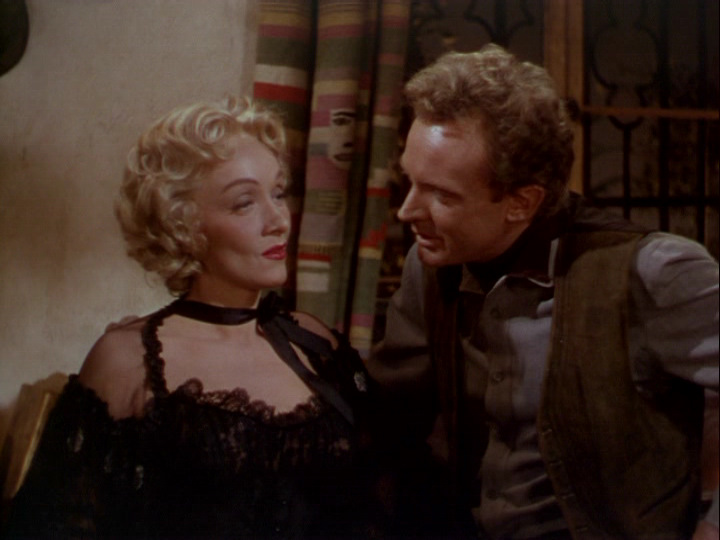
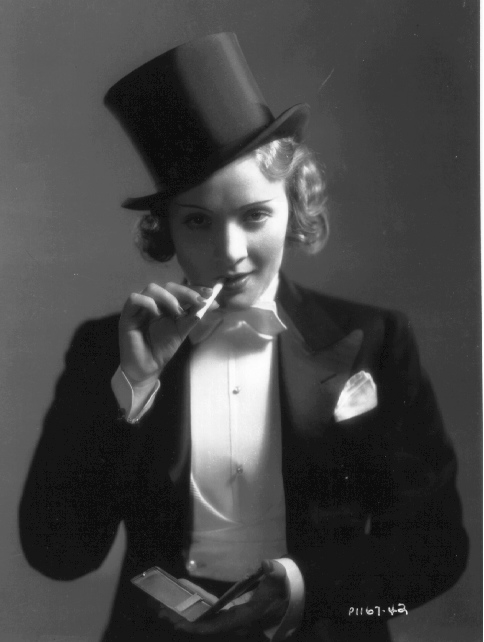
Russell Johnson and Marlene Dietrich in Rancho Notorious

Before we get onto the subject of Marlene Dietrich, we should probably discuss the wealth of character actors on the verge of hitting their defining roles: William Frawley, right before "I Love Lucy," George Reeves before "The Adventures of Superman," Mel Ferrer, only his fifth film and right before Scaramouche, Russell Johnson (Happy Birthday, sir), only his second movie, Jack Elam, Dan Seymour, John Doucette, the movie is top-heavy with great veteran character actors with recognizable faces.


Then there's Dietrich.  For those of a certain age (anyone born post-Blazing Saddles), one may not recognize what a force she was and continued to be throughout her career.  She was the preternatural "other" woman, capable of seducing men and (pre-Code) women, one is always hesitant to call her the first feminist, but she might have been in movies, and she certainly was before it became "cool," (and she always was in the role).  Put it this way, you'd never see Dietrich in a western riding side-saddle.  Rancho Notorious is her slightly softened (although barely—when was the last time you saw a dance-hall girl riding the town sheriff like a horse?), in partnership with a man, and acting out of love or loyalty (always hard to say which with her), but it's her ranch and her operation, and that's something you rarely see in even the most hard-core of Westerns.   And it's weird, but, in Westerns, Dietrich (sorry but it's a spoiler) always seems to take a bullet, as if the genre won't accept her (or any woman) as ruling the ranch.  That would change, as film-makers got more bold.**

Rancho Notorious is one of those odd Westerns of the Mainstream that took a decided bend in the river to do something else with the form.  There's no pretense at naturalism (Lang wouldn't toy with that until Clash By Night), but used the familiarity of westerns to work out some interesting conflicts about gender roles (Others on that list are Nicholas Ray's Johnny Guitar, Samuel Fuller's Forty Guns, and, to a lesser extent, Hawks' Red River).


It's not your usual oater.  It's something different and it's recognizable from the first watch.


* The story goes that Howard Hughes wanted to change the title from "Chuck-a-Luck" and Lang wanted to know why.  "Nobody'll understand it" was the reply, even though it was a familiar gambling game in the Southwest.  "Okay, so what's your alternative?" Lang asked.  "Rancho Notorious." came the reply.  "Rancho Notorious?!  Nothing's called 'Rancho Notorious' in this movie!  You think anybody'll understand THAT?!"

** There was a shock for me: I remember Gloria Henry as the mother of "Dennis the Menace" on TV.  Her presence was only the first of a long line of TV stalwarts who were paraded throughout Rancho Notorious—"Hey! there's...fill in the blank..."

*** Ford's frontier women usually ran the ranch, but let the men think they did.

Wednesday, September 25, 2013

The Big Sky

The Big Sky (Howard Hawks, 1952) A.B. Guthrie's novel about the exploration (and decimation) of the West by Eastern immigre's is considerably shortened by Hawks and Dudley Nichols, who start at the meeting of Jim Deakins (Kirk Douglas) and Boone Caudill (Dewey Martin) and their adventures of a keelboat going up the Missouri and leave it at that.  Nothing about how Boone's a little savage who ran away from home after nearly killing his father, nothing about the unpleasantness that would follow, or the results of Boone's bad temper.  No, this one's pretty much good times with some rough waters and bad rivals, and everybody gets along famously. It's vintage Hawks, but it ain't Guthrie.  In fact, Hawks eliminates the one character in Guthrie's trilogy ("The Big Sky", "The Way West", "Fair Land, Fair Land") who endure throughout—trapper and guide Dick Summers.

Re-writing is nothing new to Hawks (as a work habit, he'd re-write the next day's script the night before just to keep things fresh, sometimes abandoning the plot altogether if he thought it wasn't going in the right direction).  His great western, Red River, was completed four years previously, he followed it up with a musical remake of his own Ball of Fire with Danny Kaye, gone overseas with Cary Grant to make I Was a Male War Bride, then made his first foray into science fiction (but very much in the Hawks tradition of team-building) with The Thing (From Another World).  The Big Sky is different—the 50's would be something of an experimental phase for Hawks, going deeper into his subjects and philosophies than previously—in that cowboys and cattle aren't the prime motivation.  Fur trading is. And to do that, you don't go by horse, you go by boat and the challenges there are far different and maybe a bit more challenging than crossing the plains.   You go where the water goes and it's never a straight line and there are obstacles around every turn.


Guthrie's story is a bit like the Lewis and Clarke expedition (without the government funding), and both versions for page and film borrow the story of Sacagawea from the Corps of Discovery, whose presence (by coincidence) made acquiring ponies for the rugged trek across the Rocky Mountains from the Shoshones a foregone conclusion.  This came about as, unbeknownst to the Corps, Sacagawea had been stolen from the Shoshones as a child and her translating skills brought her face to face with the standing chief...who happened to be her brother.  In the same way, the character of "Teal Eye" (played by Elizabeth Threatt, in her only film) is brought back to her tribe to help in the fur negotiations.  She also serves as a point of rivalry between Dawkins and Caudill, but it all gets resolved to everybody's satisfaction.  


It fits into the Hawks template of disparate groups coming together for a single purpose: Hawkins finds Caudill, they're looking for Zeb Calloway (Arthur Hunnicutt, nominated for an Oscar for this performance, and he'd be playing, basically, the same role in Hawks' 67' Western El Dorado), who they meet in jail (problem solved, efficiently), then once Zeb is bailed out by the keel-boat Captain "Frenchy" (Steven Geray, and we don't know if he's related to "Frenchy" in To Have and Have Not), and the adventure meanders, like a river, with some tributaries involving a rival fur trading company, Deakins' ability to get hurt (and heal rapidly, apparently, and at one point, Hawks makes a comic episode out of amputating one of the character's fingers!).  He isn't nearly as concerned with ethnic authenticity as John Ford—he does use Ford's Hank Worden as a Shoshone guide as comic relief, but at least he's competent comic relief.


There have been a couple versions of this one floating around, and because it was done for RKO late in its life, and been passed from studio to studio, it's in fairly ragged shape.  Russell Harlan's black-and-white cinematography was nominated for an Oscar, but it's a little dim to see why, given the shape the film is in, even the "complete" version that TCM is running on.  It needs a major restoration, which is hard to come by if the film is in the second row seating of a director's Hall of Fame.  Perhaps one day, maybe, when someone mounts a Kirk Douglas retrospective, or decides to a DVD release of it, at all.


Thursday, July 11, 2013

Disney's The Lone Ranger

...A Cloud of Dust...
or
Depp in the Heart of Texas

The last time "The Lone Ranger" hit the big screen (1981's The Legend of the Lone Ranger, directed by cinematographer William A Fraker), it hit with a resounding thud.  It's not that the story wasn't any good, or that the basic idea isn't ripe for story-telling—it's just that the movie was dull, dull, dull, even as it was trying to be more "politically correct," giving John Reid's "Indian companion," Tonto, a bit more respect and hewing a little closer to a generically Native culture.

That was then.  This is now.  John Ford made the first modern Western in Stagecoach.  Sergio Leone and Sam Peckinpah made the "post-modern" Western in the 60's.  Then, after post-modernism came death.  People stopped making Westerns entirely, with hold-outs like Eastwood and Costner and Kasdan and Harris, the tropes of the genre falling into use in, cop movies and martial arts and space fantasy films.  But the form stayed pretty much dead and buried.  Given the history of the form, and with its emphasis on the spirit world, resurrection of dead men, and its manic quality (especially as its de rigeur for the creatures these days) maybe Gore Verbinski's film of The Lone Ranger (now Disney's) is the first zombie Western.

It fits.*  One of the themes galloping through this one is that "nature is out of balance," what with the "Wild" West being invaded by iron horses, the presence of "spirit horses," villains who will eat the hearts of their victims and manically carnivorous jack-rabbits out on the plains.  Zombies, okay.  But it's a bit of a Frankenstein monster, as well, made up of parts of what has gone before.  The final credits say that it was filmed "from Moab to Monument Valley," mostly Utah, and its true, with shots in Zion, Arches National Park, and the Monuments (looking slightly different from the time John Ford filmed them—the calved spires seem to have been digitally erased—although Verbinski has taken a lot of Ford's specific angles several times in the film). 


Verbinski's The Lone Ranger on the left; Ford's The Searchers on the right

But it seems like Nature isn't the only one with the problem.  The Lone Ranger is a Western out of balance, tipping from side to side and waving its arms frantically while standing on a line between olde Westerns and the post-modern varieties, with full-stops at the Leone era** and the silent era of comedic Westerns, specifically Buster Keaton's The General (not technically a Western, but go with me here) in the film's final bursts of energy.  The movie veers from queasy nastiness to whimsy to outright comedy and slapstick, without taking a break for water.  The villains are played absolutely straight, from Tom Wilkinson's rail baron to his nasty co-hort, Butch Cavendish  (a greasily unrecognizable David Fichtner), while the heroes are bumblers with good intentions, like Armie Hammer's rube of a Ranger,*** and top-billed (above the character and movie title) Johnny Depp's bizarre take on Tonto—well, it's bizarre for Tonto, but not for Depp, as this "Indian companion" would line up well with his other pasty-faced odd-balls like Edward Scissorhands and Barnabas Collins.  And, in action, his Tonto acts more like the Sam character in Benny & Joon, there's some Chaplin, but a lot of Buster Keaton in his stone-faced, article-challenged Tonto (the make-up for which is inspired by a painting by Kirby Sattler entitled "I Am Crow," which is neither authentic or historically accurate, but it looks distinctive, which suits Depp's purposes, I suppose). 

The movie runs on two parallel tracks of revenge—the Ranger, John Reid's, and Tonto's—as the two end up joining forces to deal with the guys who ambushed the Ranger's brother and posse, and the guys who wiped out Tonto's village, for which he feels responsible.  It's a little late in the game to plead weariness of the revenge scenario—it seems like every movie hero has to have a personal grudge as a pilot light, rather than to "do what they gotta do" through some sense of altruism.  Possibly that heroic quality is passé or considered foolish in today's culture, or maybe there's no sense of audience involvement if it isn't seen why the protagonists stand up for what's right.

But, it spends most of its running time moseying through origin stories and the whittling away at the uneasy alliance between Reid and Tonto.  Then, once things get going, there's an extended chase sequence featuring the two trains involved in the driving of the golden spike uniting the nation's railways, an "Indiana Jones" type of marathon that explores everything that you can possibly do with two trains running on occasionally parallel tracks (when did they find time to lay all that extra track, one wonders?).  The sequence would make the silent comedians gape, and propelled by variations of "The William Tell Overture," provides a lot of entertainment.  It's fun for quite awhile and Verbinski constructs some Rube Goldbergian scenarios that are, once or twice, ingenious.

But, instead of coming at the nick of time, it comes a might too late.  The focus there at the end comes after a lot of wandering aimlessly through the desert, looking for something to do.  Granted, its not as dull as the 80's attempt to put the spurs to the franchise, and in parts its entertaining, if one isn't looking for native axes to grind**** or is approaching the material with an already jaundiced eye.  One wonders if it was worth doing, or whether "The Lone Ranger" should be allowed to pass into legend, a relic of the thrilling days of yesteryear.

The Lone Ranger is a Rental.


My favorite appearance of Clayton Moore and Jay Silverheels as
The Lone Ranger and Tonto.
Kind of reminds me of how the movie plays them.*****


* Yeah, but one can see that as a strain running through Verbinski's work, especially considering the "Pirates" movies and Rango, where folks are coming back from the dead, or at least the crossing back from whatever spirit-world seems to fit the project.

** Composer Hans Zimmer does a lot of riffing off Ennio Morricone, the most notes taken from For a Few Dollars More (with its tinkling chime contrasting with a heavy-handed forward momentum theme), but also in the comedic grace notes that follow Tonto's shenanigans with a punctuating trill that Leone used for Eastwood's "Man with No Name" in A Fistful of Dollars.

*** Hammer is introduced like Jimmy Stewart's Ransom Stoddard in The Man Who Shot Liberty Valance, the "duded" pilgrim who stands out far too much in the rough West, in a suit so formal he's mistaken for a missionary...by a missionary.  It's one of his better performances, showing that he's at his best, comedically, despite (and maybe because of) his blandly handsome looks, in a way that's similar to Cary Elwes. 

**** Most of the talk is focused on Depp and his "white-face" portrayal of Tonto and how authentic it is (not very), which with the existing suspicions people have of the character as demeaned and inferior, has been mostly negative, because, like skin color, its very easy to see and remark upon with what one thinks of as authority.  One wonders if such a rehabilitation is possible, given the character's man-servant past, like Robinson Crusoe's "Friday," or The Green Hornet's "Kato" (although it certainly helped if Bruce Lee was in the role, bringing the character up several notches just on ability and charisma—should we mention that Brit "The Green Hornet" Reid is a descendant of The Lone Ranger?), and whether its even worth it to right the past's wrongs.  The alternative is to stay in place, and be content—although grousing—with the way things were and just leave it aside.  I think it says something that Depp thought Tonto was the more interesting character to play, as for authentic...is anything Depp does very authentic?  Short answer: No.  As for the whole racial thing, I thought the best line was Depp's Tonto griping about the ranger being a "stupid white man," and the Chinese railroad workers grinning and nodding in agreement at him—he's just another American...to them.  Now, that's some funny ethnic humor there.

**** It also is inherently racist as it paints Tonto in a bad light, obviously Natives are gluttonous. (*cough*)

Tuesday, December 25, 2012

3 Godfathers (1948)

3 Godfathers (John Ford, 1948) Ford's version of The Nativity Story set in the very wild West is a remake of his 1919 silent film Marked Men,* which starred Harry Carey. The son of John Ford's first star, Harry Carey Jr made his acting debut in this one as The Abilene Kid, who along with John Wayne and Pedro Armendáriz, play former cattle rustlers up-scaling to bank robbery.  After the meager heist, they escape a posse from Welcome, Arizona (led by Ward Bond's Sheriff B. Sweet, as well as Hank Worden and Ben Johnson) by taking a perilous escape route through the desert (it was filmed in Death Valley)—not the wisest of men or maneuvers.  Their flight leaves them wounded, their water supply draining and quickly losing every means of survival in the desert.

Things get complicated when, looking for water, they come across an established that a tenderfoot, in his ignorance and panic has dynamited in an an attempt to get more water, destroying it.  If that weren't bad enough, he's run off into the desert to find his stock, driven loco by alkaline poisoning, leaving behind his wife (Mildred Natwick) delirious and about to give birth.  Unbeknownst to them, she's the niece of Sheriff Sweet's.  


Armendáriz, Wayne and Carey Jr. don't know nuthin' 'bout birthin' no babies

The leader of the group Bob Hightower (Wayne) can't cope with the intricacies of the situation, leaving "Pete" Rocafuerte (Armendáriz) to deliver the baby, and when the mother dies, leaving the three with a promise to care for the child she has named Robert William Pedro, the three villains must learn the basics of child-care (thanks to a book written by "Doc Meechum"), but with limited supplies they must cross the desert, led by a single star to the town of New Jerusalem (the other choices are Cairo and Damascus).  It isn't long before The Kid tells them it's their Destiny, that they were led to this place, this child, this duty, this precedent.  

It is, after all, almost Christmas.

It's a sweet story, about how the spirit turns with the charge of a newborn, and how even those on a downward spiral can be lifted up by a lack of self.  And Ford, working with screenwriters Frank Nugent (a new find with his Fort Apache script) and Laurence Stallings (with whom Ford and Nugent would collaborate on She Wore a Yellow Ribbon) keeps the sentiment high, and the humor all over the map from leaden to subtle.  Even without its silent roots (Mae Marsh from TheBirth of a Nation has a large role!), the film, in tone, feels like a throwback to an earlier time, like Ford's work in the '30's circa Stagecoach—not a bad time at all.  And, in the timeline of his work this looks like a wave good-bye to his western work of the past, as Ford would subtly move on to the slightly more serious She Wore a Yellow Ribbon to the dire The Searchers within the space of seven years.  

It was about this time that Wayne's performance in Howard Hawks' Red River (playing "old" at 41 years of age) was noticed by everyone, and notably Ford, who had still been using Wayne in co-starring roles.  "I didn't know the big sonuvabitch could act!" Ford groused to Hawks.  3 Godfathers is Wayne stepping into the limelight of Ford's films, where he would stay (mostly) for the rest of Ford's career.  And, as with the humor of the film, Wayne's performance covers a lot of ground, leaden to subtle.  His physical work is unmatched, as usual, casually sitting on a horse as if it was an easy chair,  stumbling through the desert in an alarming drunk march (supposedly holding a baby, which throw some scary drama into it, if you think about it), doing little character things you only notice later, like the way Hightower trudges dumbly through an edge-of-town water collection at the start of the film before it becomes of the utmost importance, and something that seems peculiarly florid and over-the-top but pays off hugely throughout the film: Hightower is something of a jerk and mean-spirited and given to elaborate mock-formality when teasing others, especially the way he takes off his hat and does a too-formal presentation of it.  It looks phony (it is phony for this rough man of the West), but it turns into genuine acts of kindness and civility—the man grows into the gesture and becomes him, a signature of the man he has become through the trails and tribulations that have become the period to a life of bad manners, bad habits and bad choices.  And the film ends with that same gesture, sending the man off to his fate, but promising the return of a better man and a better future.

This is all done with pictures, part of the skein of direction that Ford imposes on the film that, combined with the exquisite cinematography of Winton Hoch, makes this odd, anti-Christmas Christmas film something of a precious gem for the Holidays.


The resonant gesture of John Wayne in its most practical usage:
Thanks to the Way of Seeing blog for noticing this one.


* There is also a harder edged 1936 version starring Chester Morris, Lewis Stone and Walter Brennan, directed by Richard Boleshawski.

Tuesday, December 18, 2012

The Man from Laramie

The Man From Laramie (Anthony Mann, 1955) "Hate's not becoming on a man like you." Hmm.  Then, they shouldn't have put this star and director again, as hate, obsession and (sometimes) disfigurement were the order of the screenplay. The last of the James Stewart-Anthony Mann pairings (the others being Winchester 73The Far CountryBend of the River, and The Naked Spur, all superior disturbing Westernsthat pushed Stewart's psychological boundaries in the Old West by pushing the traditional physical boundaries in the Old West.*

Stewart's Will Lockhart rolls into the town of Coronado with his small transport business delivering merchandise to the general store.  Along the way, he stops from his day job to indulge in his hobby—seeking revenge for his younger brother whose cavalry unit was ambushed by Apaches who were brandishing repeating rifles, too many to be acquired on raids.  The Apaches are another story.  He's after the man who sold them those rifles.

Coronado, though, is hardly welcoming.  He can't take a few steps into the street without being warned to leave the town the same way he went in—under his own power.  That advice, with intentions good or bad, stems from the town's controlling interest, a cattle baron by the name of Alec Waggoman (Donald Crisp), one of those autocratically protective father-figures who like things the way they are, are suspicious of any changes, and is a bit blind to how others see it.  He's particularly near-sighted when it comes to his entitled son Dave (Alex Nicol, in a thankless performance, rather dimly performed), a bully who's next in line to run the ranch—probably into the ground given his business acumen—and (as John Wayne used to put it) "if he lives."  To prevent those eventualities Waggoman has installed the only picket-wire he might approve of, his chief ranch-hand Vic Hansbro (Arthur Kennedy, who often provides the counterbalance in the Mann-Stewart westerns) as a nanny to keep Dave under control.


But Vic, with so much responsibility to the Old Man, always seems to be a day late and a dollar short, unable to keep Dave from single-handedly destroying Lockhart's business, burning his wagons and killing his mules, a rather contrary manner of getting him to leave town, by destroying the means.  And, of course, it just inspires Lockhart to get all-cussed and motivates him to stick his nose in everybody's business and his fists in Dave's mid-section.  Things don't get any better when Lockhart decides to take a job ranching for Waggoman's rival Kate Canady (Aline McMahon), a crusty woman-rancher who won't give an inch on territory or principle, or one hoof of cattle to the larger concern.


From any angle Lockhart is caught in the middle, guaranteeing a rise in tensions and an escalation of grievances.  And if the elder Waggoman wanted peace and quiet, he should have looked for the anarchy running wild in his own midst.   So, there's that familial element running through it.  And Mann and Stewart, through their collaborations, were exploring psychological depths that weren't mentioned between the gun-shots in the standard shoot-'em-up. All of their westerns involved Stewart's character going through a trial by fire—he's actually dragged through a campfire in this one—facing humiliation and crippling at the hands of the Waggoman's, the confrontations with the clan making up the best part of the film, with only Stewart's rather half-hearted interplay with Waggoman's neice (Cathy O'Donnell) seeming like time wasted, although it provides one more conflict for Lockhart to be distracted by.  Mann's use of location shooting is always imaginative and compositionally interesting, and he uses the Vistavision format to get as much horizon into the frame as possible.  Certainly worth a look-see, just don't go expecting Shakespeare.**

Maurice Thomas' Stewart portrait for some of the film's poster art.


  * The two also worked on the non-westerns Strategic Air Command and The Glenn Miller Story.

** Curiously, Shakespeare is on a lot of people's mind when they see this film, comparing it to "King Lear."  Um, okay, not the "King Lear" I'm familiar with, although there's a thematic string in there (actually there's a Shakespearean string in just about everything, isn't there?).  Actually, there's more "King Lear" in "Bonanza" than here (except that everybody gets along).   And, of course,  the movie Legends of the Fall has more than a bit of both in it.

Thursday, April 5, 2012

The Ox-Bow Incident

The Ox-Bow Incident (William A. Wellman, 1943)  Guy (Henry Fonda) walks into a bar with his buddy (Henry—nee Harry—Morgan).  He just came off the trail and is a might ornery.  His girl's left town, without a word, he hasn't had a bath in...well, he can't remember...but, the whiskey's good, even if the company ain't.  Then the fight happens; before too long, Fonda's character is just full enough of piss and vinegar (and whiskey, which from the looks of the bar, could be the same thing) that he picks a fight with a local tough (Marc Lawrence) using the bar to support him while delivering a nasty double kick to his head, until the barkeep clobbers him with with a bottle which shatters over his thick skull, and sends him (rather blissfully) into the arms of Morgan, who drags him like a sack of potatoes to a waiting cane-chair.


Welcome to the rough-and-tumble world of "Wild" Bill Wellman, a director of such sensibilities that you can practically smell the sweat coming off the denizens of Bridger's Wells, Nevada.  In a simple scene, Wellman differentiates himself from the more genteel sensibilities of Ford and Hawks, and into his own greasier, meaner, no-nonsense view of the West.  He's the better choice to present an immorality tale like The Ox-Bow Incident. about rough, western "justice" being meted out for the murder of a local rancher by a team of cattle rustlers.  The Sheriff's out of town, the deputy's itching for action, the local judge is ineffective blow-hard, and the posse-in-lynch-mob clothing have motivations, diverse but petty, such as false moral rectitude, mean-spiritedness, opportunism, and just plain boredom.  Truth to tell, they're a pack of wolves waiting for prey to abuse.


They find three mena new rancher nobody knows (Dana Andrews), who's had recent dealings with the dead man, an old, demented hand (Francis Ford, John's brother), and a Latino tough (Anthony Quinn) just corrupt enough to know not to play along...with anybody.  Lip-service is paid to justice, process, and prayers, but ultimately the purpose is to string the three up and get revenge as quickly as possible.  In this court by mob rule, the flimsiest of circumstantial evidence is not as important as the sturdiness of the rope, and waiting for facts just gets in the way of the excitement—it's a necktie party in all senses, except common ones.  The cooler heads are seen as weak, obstructing, or just plain kill-joys.


No good can come of it and Wellman (working with Lamar Trotti from Walter Van Tilburg Clark's 1940 novel) writes a case for due process whatever the cost, even if the only thing wasted is time.  Vigilance is not the same as vigilantism and the two should be frequently opposed.  And if one were to be so foolish to think that Westerns are no longer relevent to the issues of today, you haven't been reading the papers.


This was one of Henry Fonda's favorite films he appeared in, and in 1998, became part of the National Film Registry.

Tuesday, March 27, 2012

Blackthorn

The Long Return of Butch Cassidy
or
"The Blues They Send to Meet Me Won't Defeat Me"

Not that it matters, but this entire movie is pure speculation.

When "Butch" and "Sundance" made their way to Bolivia, they disappeared from the face of the Earth. There've been rumors, speculations, conjectures (and just plain lies), but nothing concrete—or perhaps we should say calcium. No one knows where the bodies are buried, or, indeed, if there are any bodies, and that distinct lack of evidence, is the spine of the movie—that perhaps Butch Cassidy, aka Robert LeRoy Parker, did the exact opposite of what made him famous by abandoning the outlaw lifestyle and going legit as a rancher and horse-trader in Bolivia, running for awhile with Longbaugh and Etta, but eventually finding himself alone (the fate of The Sundance Kid is speculated on and it is an intriguing possibility), finally fading into the Bolivian clay, respectable and unsought.

But, at some point, Parker—or James Blackthorn, as he's called himself in this tale—has the call to go home. Immediate family is the immediate reason, but the long trek from South America through Mexico to the American Southwest makes up the bulk of the film. The selling of stakes, the journey by horse, pursued by Pinkertons, posses and bandits and bad luck, in the company of a young, not exactly trusted, vaquero with a wealth of history and loot, is a perilous trip, and a constant source of loss, until all the man has left are his skills as a rogue, rider and sharp-shooter.

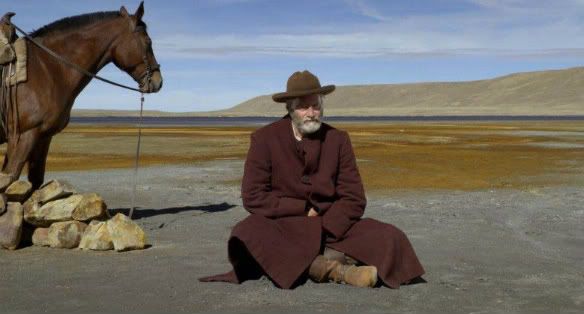
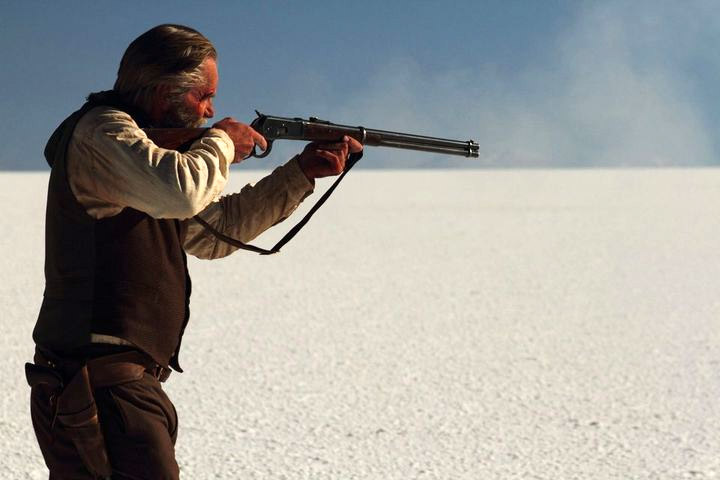
Blackthorn requires a lot of the actor playing Parker or Cassidy or Blackthorn, all measures of the man, and fortunately for the film, which relishes in flat, sun-blasted landscapes (and wouldn't be nearly as interesting without so wily an actor), it's dominated by a seemingly lived-in performance by playwright Sam Shepard. Tall, rangy, sun-scorched and grizzled, his Butch is always resourceful and perpetually prepared for whatever eventuality man and Nature can throw at him. Shepard is sunk down deep in the saddle in the role, squinting at the sun and the behavior of those around him—a lone wolf on the prowl and targetted on his goal, in a path, twisted and gnarled and certainly not on the straight and narrow.

It's a good yarn, if a little too cloistered in incident and character—the spaces may be wide and open, but we keep seeing the same characters over and over— and the kid (Eduardo Noriega) being something of an irritant, and just not interesting enough to be much against the lead. Director Mateo Gil (who wrote Abre Los Oros, The Sea Inside and Agora) has a nice spare style that really pays off in the salt desert scenes, but the best thing about the film is Shepard, who breathes life into the film whenever he's on-screen.

"The Sundance Kid" and "Etta Place" before South America

Saturday, July 30, 2011

Cowboys & Aliens


"This Galaxy Ain't Big Enough for the Both of Us"
or
"Just My Ray-Gun, Pony and Me..."

Good idea, this.  Two genres that have been around as long as there've been movies* and have served the same purpose—taking a theme that might be controversial if played in modern street-clothes, but dress it in rawhide or spandex and it takes some of the "edge" off.  You'd think the two would go together as well as Zero-G and sawdust, but there have been already some tentative steps in anti-gravity cowboy boots: There have been westerns with a touch of fantasy—The Valley of Gwangi—and Sci-Fi with a western foundation (Outland was High Noon in space suits) but the two haven't really been combined as equal parts as in Cowboys & Aliens (the ampersand is required).

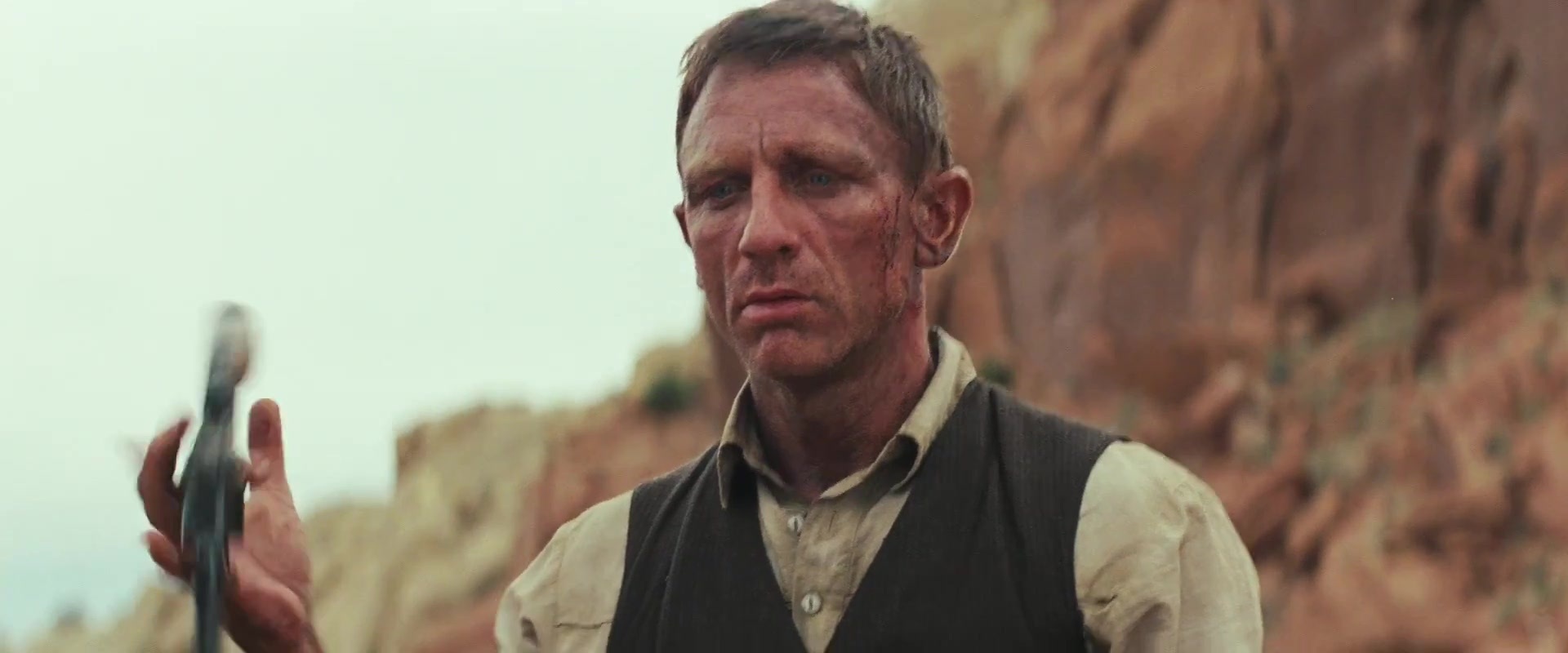
Loosely based on its comic source, it starts in familiar territory—a desert landscape, ancient river-beds long-since dried up and now sun-blasted bluffs and scrub.  Suddenly, a Man With No Name (Daniel Craig) lurches up into frame, sun-burned, bootless, bloodied with a wound in his side.**  He has no memory of who he is, where he is or why he's there (at one point a townie asks him "What DO you know?" "English" is the laconic reply).  One odd thing—a thick manacle from wrist to forearm on his left armSmashing it with a rock would work with hand-cuffs, but this thing won't budge.  He's set upon by riff-raff that he dispatches in a whirlwind of flying fists and gun-fire.  So much for outfitting.  With newly acquired boots, shirt, vest and hat, he climbs on top of a pilfered horse and rides to a nearby town...with a loyal dog in tow.  All the elements are in place.

A stranger in town (and everywhere, one assumes), he gets noticed and in trouble—mussing up the son (Paul Dano, really good) of the requisite town rich-guy-fascist (Harrison Ford, low and husky), and getting landed in the hoosegow by Sheriff John Taggart (Keith Carradine, whose Daddy appeared as a gambler in the granddaddy of Westerns, John Ford's Stagecoach).  That's sounding like Howard Hawks' Rio Bravo, but about the time Ford's Colonel Dolarhyde (nice name for a rancher) arrives with some hired rough-necks to spring his boy, new arrivals appear in town—blue lights in the sky, which turn into flying ships—they recall fighter-jets in the daylightthat start blowing things up and (in a neat touch) lasso people and yanking them into the skyThe attack sets off The Stranger's fancy bracelet, which starts to "queep," pops up a sight, and knocks one of the ships out of the sky.

Suddenly, The Stranger gets a lot more interesting.

Because the invaders have been nicely particular about who they took—Dolarhyde's son, the Sheriff, the wife of the town's doc/bar-keep (Sam Rockwell, not used well enough, sadly), a posse is formed to find the kidnapees and at this point the movie turns decidedly conventional.  It should.  It's The Searchers, which begat Close Encounters of the Third Kind.  And along the way, the posse manages to accumulate allies in a criminal gang, a tribe of Apaches (who are polite enough not to mention that "an invasion by strange aliens with weapons to take our resources" sounds vaguely familiar), and, for all I know, The Outlaw Josey Wales—who also accumulated an unlikely army that turned into family.  This is useful, because for the big battles with the Invaders,*** there needs to be a large number of red-shirts and red-bandanas to eliminate, so we don't lose the strays that make up the posse, which include a dog, the Sheriff's grand-son (Noah Ringer), and as Clancy Brown's Preacher (gotta have one of those, too) grouses, "We gotta dog and a kid, we might as well have a woman, too"   That woman is Olivia Wilde, who spends most of the movie looking enigmatically sultry, while doing things that make you go "eh?" throughout the movie, beyond just the fact that as Craig gets more and more beat-up, her make-up never gets smudged.  As welcome as Wilde's presence is in all this testosterone, her character is the most problematic, running inconsistently throughout the film—she's either "capable" or she isn't, and ultimately you realize that she's just a "device" that gets the screenwriters (a squad of them including the two that wrote Star Trek and the "Transformers" films—as opposed to the two who wrote the "Pirates of the Caribbean" movies) out of trouble.  Mention should also be made of Adam Beach, who keeps getting better every movie, and Craig who does "the Eastwood thang" real good.  Director Favreau (he of Iron Man fame, his chief skill seems to be impeccable casting), manages to direct it absolutely straight, with just enough of a hitch in the standard cliches to make things interesting, rather than well-trod.

Nothing is made of the irony of these new aliens making life difficult for "the natives," save for some terse nods of collaboration between members of the extended posse.  That doesn't sadden me too much as most movies these days seem to want to beat you over the head with their "message," in case you don't get it.  But, in so doing, Cowboys & Aliens manages to fulfill both the Western and Sci-Fi genre's abilities to put things in unique perspectives to throw a light onto our world. 

As I said, good idea.  A bit fun, too. 

Cowboys & Aliens is a very cheap Matinee.


* As in The Great Train Robbery (1903) and A Trip to the Moon (1902). 

** It's not too unlike the beginning of Silverado where Paden (Kevin Kline) is found by Emmett (Scott Glenn), alone in the desert, robbed of everything but his skivvies.

*** The Extra-terrestrials are nasty looking brutes, who run like apes, and have a physiognomy that makes me wonder if the design is based on some of the designs of director Jon Favreau's planned film of John Carter of Mars (which is now being filmed by Disney-Pixar, directed by Andrew Stantonthe trailer is out now).