Showing posts with label Harrison Ford. Show all posts

Tuesday, June 4, 2013

42

Changing the Face of the American Game
or 
The Saint of Swat

One of the great "unmade" movies is the story of Jackie Robinson of the Brooklyn Dodgers, the baseball player who broke the color barrier in the quintessential American game.

Oh, it has been made before: Robinson, himself, older and showing the effects of the strain the game and his task had put on him, starred in a B-movie version, The Jackie Robinson Story, in 1950;   Ken Burns' definitive documentary Baseball made his story the lynch-pin of the parallel stories of The Game and race relations in America in the 20th Century (and will probably always be the best telling of what happened).


But Robinson's story has been kicking the turf of home plate for a couple of decades lately—Spike Lee has been working tirelessly to make a film of his story for that long, and I've always wanted to see his version of it, as his directorial voice would absolutely put a distinctively personal philosophical spin on the heroics of it.  A Spike Lee "joint" might also provide some angry tension that was part and parcel of the Jackie Robinson Story, but could never be expressed, lest the long-delayed abolition of sanctioned (but unspoken) segregation of baseball fail in a double-play of racism posing as informed sports commentary (which still goes on today for some reason).


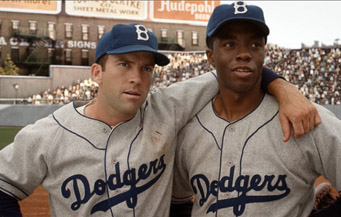
Brian Helgeland's film about Robinson, 42 (the number Robinson wore for the Dodgers and the only number permanently retired in the MLB), doesn't have the inflamed spirit that Lee might have imposed, and is content to stick to the facts, which are enough as the events were charged with over-laying race issues, prejudice posing as business politics, and the uneasy first faltering post-war steps to civil rights legislation.

Make no mistake.  It was a super-human task to be the first black man in an all-white league.  He was a fine hitter, a better runner, and a brilliant strategist who would earn runs without connecting bat to ball, merely by "freaking out" pitchers by stealing bases.  Plus, he had a defiant spirit that would not let prejudice stand.  He wouldn't "just take it."  But, the "handshake" part of his signing with the Dodgers was that he would have to "take it," whatever was thrown his way, be they death-threats, or murderous pitches.  He promised his manager that he would not fight back, show restraint, and be the model player. 


Oh.  The bottom line was that he had to perform, as well.


Robinson and Rickey on the day he signed with the Dodgers
Robinson knew the opportunity that his role would provide, not only for him but also for other "Negro players."  He was described as "a race man," passionate about the lot of African-Americans in a country with Jim Crow laws in place, segregated bathrooms, water faucets and diners, and prejudices not so public under the guise of "tolerance," that actually seemed to take pride in a sentiment like "separate but equal."  And he shouldered it, showing the humility and great generosity of his spirit, always saying the "breaking of the color barrier" was not his story but Branch Rickey's.

But, as dramatized in the film, it was also the story of everyone in the Dodgers organization, especially the players, initially reluctant to allow Robinson in, and upon seeing the rough treatment he was getting from fans, other teams, and previously friendly hotels and restaurants, becoming his ally, team-mate, friend, and first line of defense.  Robinson's imposed tolerance in the face of hate, naked or subtle, inspired empathy with his fellows, and his play raised their game, making all of them better players, and in the words of Dodger announcer Red Barber "better men."

Performances are uniformly excellent.  Harrison Ford is top-lined as Rickey, and Ford chews into the role the way John Wayne jawed Rooster Cogburn, growling and over-playing just a little bit to provide "character," Christopher Meloni of "Law and Order: SVU" does a fine job playing Dodgers coach Leo Durocher, soon replaced by "Barney Miller"'s Max Gail as Burt Shotton, Lucas Black plays Pee Wee Reese and Ryan Merriman plays Dixie Walker, and Nicole Beharie plays the devoted Rachel Robinson with a bracing mixture of grace and spine.  Alan Tudyk surprises with a particularly unsympathetic portrait of Philadelphia coach Ben Chapman, whose taunts on-field But special praise has to be given to Chadwick Boseman's performance as Robinson, which he has down cold.  There's enough footage of his play to copy, but what he nails is Robinson's expression, the enigmatic not-a-smile, and the wary eyes and darkened brow of the already burned and suspicious player, a bit of a caged lion not allowed to roar.

It's a good tribute to the man, if only missing a little bit of the fire that must have burned in the man to accomplish what he needed to, and that needed to be internalized amid so much pressure.  He (with Rickey's patronage) turned the puerile accomplishments of a kid's game (the wins, the records) into something far greater for humankind (American division).  He was the slugger who couldn't hit back, who turned the other cheek and turned America around.  Babe Ruth was baseball's "sultan of swat."  Robinson is its saint.

42 is a Matinee.


As dramatized in the film, Robinson posing with Phillies coach Ben Chapman who was criticized for shouting racial slurs at the player during a game.  This photo op was Chapman's way of trying to fend off charges of "unsportsmanlike conduct." He was fired by Philadelphia in 1948.  Looking at the smile on Robinson, casual and a bit cocky, "helping out" the guy by posing with him, always makes me smile.

Saturday, July 30, 2011

Cowboys & Aliens


"This Galaxy Ain't Big Enough for the Both of Us"
or
"Just My Ray-Gun, Pony and Me..."

Good idea, this.  Two genres that have been around as long as there've been movies* and have served the same purpose—taking a theme that might be controversial if played in modern street-clothes, but dress it in rawhide or spandex and it takes some of the "edge" off.  You'd think the two would go together as well as Zero-G and sawdust, but there have been already some tentative steps in anti-gravity cowboy boots: There have been westerns with a touch of fantasy—The Valley of Gwangi—and Sci-Fi with a western foundation (Outland was High Noon in space suits) but the two haven't really been combined as equal parts as in Cowboys & Aliens (the ampersand is required).

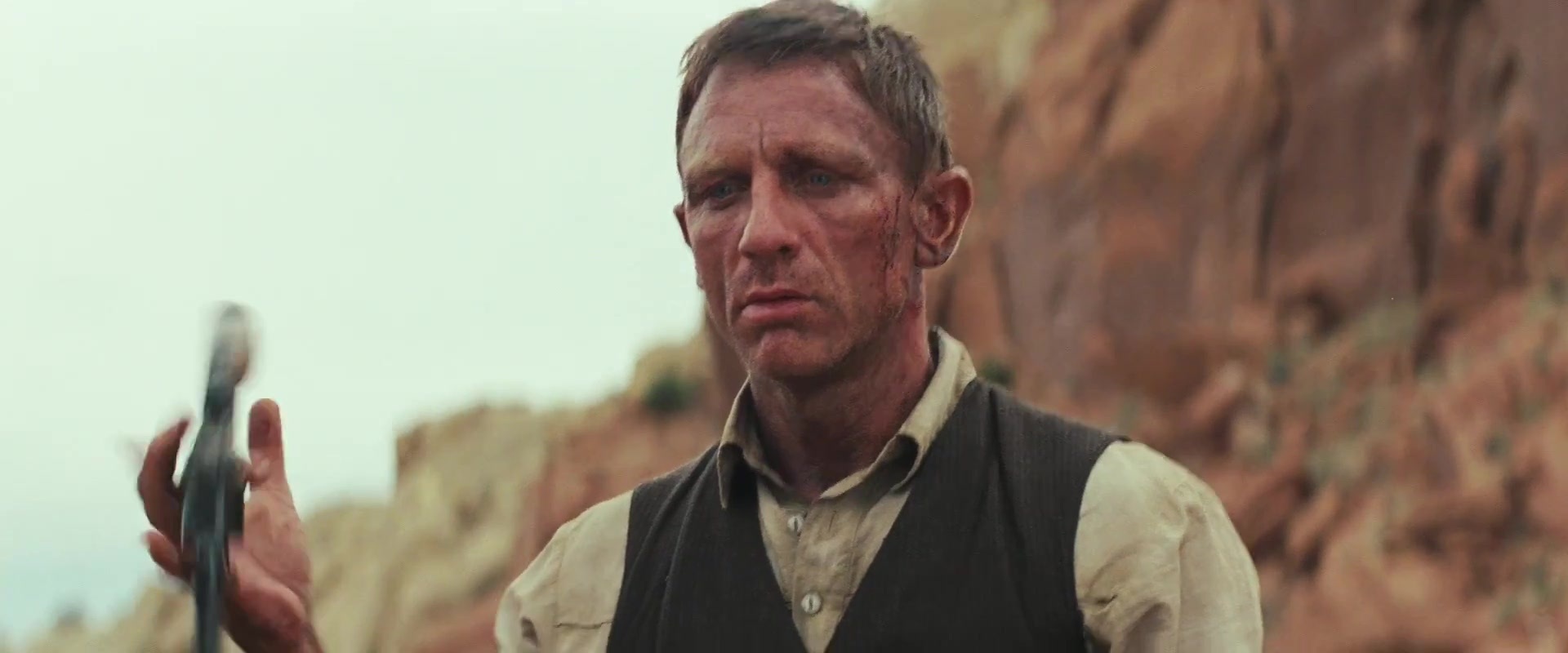
Loosely based on its comic source, it starts in familiar territory—a desert landscape, ancient river-beds long-since dried up and now sun-blasted bluffs and scrub.  Suddenly, a Man With No Name (Daniel Craig) lurches up into frame, sun-burned, bootless, bloodied with a wound in his side.**  He has no memory of who he is, where he is or why he's there (at one point a townie asks him "What DO you know?" "English" is the laconic reply).  One odd thing—a thick manacle from wrist to forearm on his left armSmashing it with a rock would work with hand-cuffs, but this thing won't budge.  He's set upon by riff-raff that he dispatches in a whirlwind of flying fists and gun-fire.  So much for outfitting.  With newly acquired boots, shirt, vest and hat, he climbs on top of a pilfered horse and rides to a nearby town...with a loyal dog in tow.  All the elements are in place.

A stranger in town (and everywhere, one assumes), he gets noticed and in trouble—mussing up the son (Paul Dano, really good) of the requisite town rich-guy-fascist (Harrison Ford, low and husky), and getting landed in the hoosegow by Sheriff John Taggart (Keith Carradine, whose Daddy appeared as a gambler in the granddaddy of Westerns, John Ford's Stagecoach).  That's sounding like Howard Hawks' Rio Bravo, but about the time Ford's Colonel Dolarhyde (nice name for a rancher) arrives with some hired rough-necks to spring his boy, new arrivals appear in town—blue lights in the sky, which turn into flying ships—they recall fighter-jets in the daylightthat start blowing things up and (in a neat touch) lasso people and yanking them into the skyThe attack sets off The Stranger's fancy bracelet, which starts to "queep," pops up a sight, and knocks one of the ships out of the sky.

Suddenly, The Stranger gets a lot more interesting.

Because the invaders have been nicely particular about who they took—Dolarhyde's son, the Sheriff, the wife of the town's doc/bar-keep (Sam Rockwell, not used well enough, sadly), a posse is formed to find the kidnapees and at this point the movie turns decidedly conventional.  It should.  It's The Searchers, which begat Close Encounters of the Third Kind.  And along the way, the posse manages to accumulate allies in a criminal gang, a tribe of Apaches (who are polite enough not to mention that "an invasion by strange aliens with weapons to take our resources" sounds vaguely familiar), and, for all I know, The Outlaw Josey Wales—who also accumulated an unlikely army that turned into family.  This is useful, because for the big battles with the Invaders,*** there needs to be a large number of red-shirts and red-bandanas to eliminate, so we don't lose the strays that make up the posse, which include a dog, the Sheriff's grand-son (Noah Ringer), and as Clancy Brown's Preacher (gotta have one of those, too) grouses, "We gotta dog and a kid, we might as well have a woman, too"   That woman is Olivia Wilde, who spends most of the movie looking enigmatically sultry, while doing things that make you go "eh?" throughout the movie, beyond just the fact that as Craig gets more and more beat-up, her make-up never gets smudged.  As welcome as Wilde's presence is in all this testosterone, her character is the most problematic, running inconsistently throughout the film—she's either "capable" or she isn't, and ultimately you realize that she's just a "device" that gets the screenwriters (a squad of them including the two that wrote Star Trek and the "Transformers" films—as opposed to the two who wrote the "Pirates of the Caribbean" movies) out of trouble.  Mention should also be made of Adam Beach, who keeps getting better every movie, and Craig who does "the Eastwood thang" real good.  Director Favreau (he of Iron Man fame, his chief skill seems to be impeccable casting), manages to direct it absolutely straight, with just enough of a hitch in the standard cliches to make things interesting, rather than well-trod.

Nothing is made of the irony of these new aliens making life difficult for "the natives," save for some terse nods of collaboration between members of the extended posse.  That doesn't sadden me too much as most movies these days seem to want to beat you over the head with their "message," in case you don't get it.  But, in so doing, Cowboys & Aliens manages to fulfill both the Western and Sci-Fi genre's abilities to put things in unique perspectives to throw a light onto our world. 

As I said, good idea.  A bit fun, too. 

Cowboys & Aliens is a very cheap Matinee.


* As in The Great Train Robbery (1903) and A Trip to the Moon (1902). 

** It's not too unlike the beginning of Silverado where Paden (Kevin Kline) is found by Emmett (Scott Glenn), alone in the desert, robbed of everything but his skivvies.

*** The Extra-terrestrials are nasty looking brutes, who run like apes, and have a physiognomy that makes me wonder if the design is based on some of the designs of director Jon Favreau's planned film of John Carter of Mars (which is now being filmed by Disney-Pixar, directed by Andrew Stantonthe trailer is out now).

Wednesday, December 1, 2010

Morning Glory


"You're Gonna Make it After Alllll"*
or
"Will Someone Tell Me Why I Logged Off 'BangingGrannies.com' For This?"

Becky Fuller (Rachel McAdams) has just rebounded from being fired from her Jersey TV station to being hired to produce an in-the-ratings-dumper morning news-klatsch in New York. The stipulation from boss Jeff Goldblum (whose heighth advantage over McAdams is used to good advantage) is that she has to turn the ratings around or the venerable TV-institution "DayBreak" will be cancelled.

But who wants to work in an institution?

The place is a mad-house.  Goofy weatherman, clueless reporters, a perv' anchor (he delivers the second headline above), and the Nurse Ratched is the veteran house-mother-anchor (Diane Keaton) who views Becky as just one more producer for a show that's "a revolving door for cretinous morons."  She's seen 'em come and go, while she's been "pulling the train up the hill(...with my TEETH!)" for fourteen years.  "DayBreak" needs to be fixed.

Becky starts to shake things up, and her first job is to find an anchor a little less orange.  She goes the credibility route and seeks out Mike Pomeroy (Harrison Ford, who hasn't done this much mugging since Return of the Jedi**), a veteran news-man (he lunches with Chris Matthews, Bob Schieffer, and Morley Safer), grumpily living out his golden parachute contract, and has no desire to lower his standards working on a show with "half an audience who've lost the remote, and the other half are waiting for the nurse to turn them over."  Warned that he is "the third-worst person in the world...after Kim Jong-Il and Angela Lansbury" by the movie's obligatory boy-friend (Patrick Wilson...slumming***), Becky finds a loop-hole in his contract and forces the pro to "lower his standards," but raise the bar on passive-aggressive behavior (he refuses to "banter, from the Latin word for 'gibber like a moron'")...as if the show needed any more of that.  Pretty soon, every surface at the station has Becky-forehead-sized dents from her beating herself into them—that and her seeming incapacity to open doors are the two consistent jokes of which no opportunity is passed.

It's got the TV-industry cynicism down, but raised to the bitchy level of the fashion industry (the writer, Aline Brosh McKenna, also wrote The Devil Wears Prada, ...and 27 Dresses , and Laws of Attraction, and Three to Tango...so this is the first movie of hers I haven't actively avoided...although I did see Prada, and admired it).  Director Roger Michell can do rom-com fine (Notting Hill), but he's capable of doing better stuff, and he keeps everything lively and semi-sunny, despite the rampant cruelty tossed around like so much unnecessary paper-shuffling on a news-desk.  But, he can't do much with the cliched material, from the "mmet cute" to the "slo-mo run through new York." 

Morning Glory is okay, but it breaks no boundaries (or news, for all that), it's another "working girl" comedy in the revolving door of them.

Morning Glory is a Cable-Watcher.

* Cue the hat-throw. Give credit where credit is due: I didn't notice this was basically "The Mary Tyler Moore Show" (and a two-hour stretch of the half-hour pilot, at that) until Ford's crusty news vet says to the young producer "You have a repellant moxie" in the same way that Ed Asner's Lou Grant said "You've got spunk....I HATE spunk!"  Where's Betty White when you need her?

** ...which makes me think something is wrong.  Ford is the master of the subtle slow-burn comic performance, but this one is at a hard-boil.  His lines delivered in a husky, phlegmatic drone, you start to wonder if Ford—like his character—just isn't happy to be there (y'know, like his narration in BladeRunner?).  Then, he manages to take what should have been the movie's worst scene, and make it shine, giving it depth, resonance and heart...while still not betraying his character.  Nice work.

*** Yeah, but on the other hand, I've felt so sorry for so many good actresses playing "the girlfriend" over the years, this is one for equal opportunity. 

Thursday, July 1, 2010

Indiana Jones and the Kingdom of the Crystal Skull (Take Two)

"Indiana Jones and the Terrible Age of Wonders"

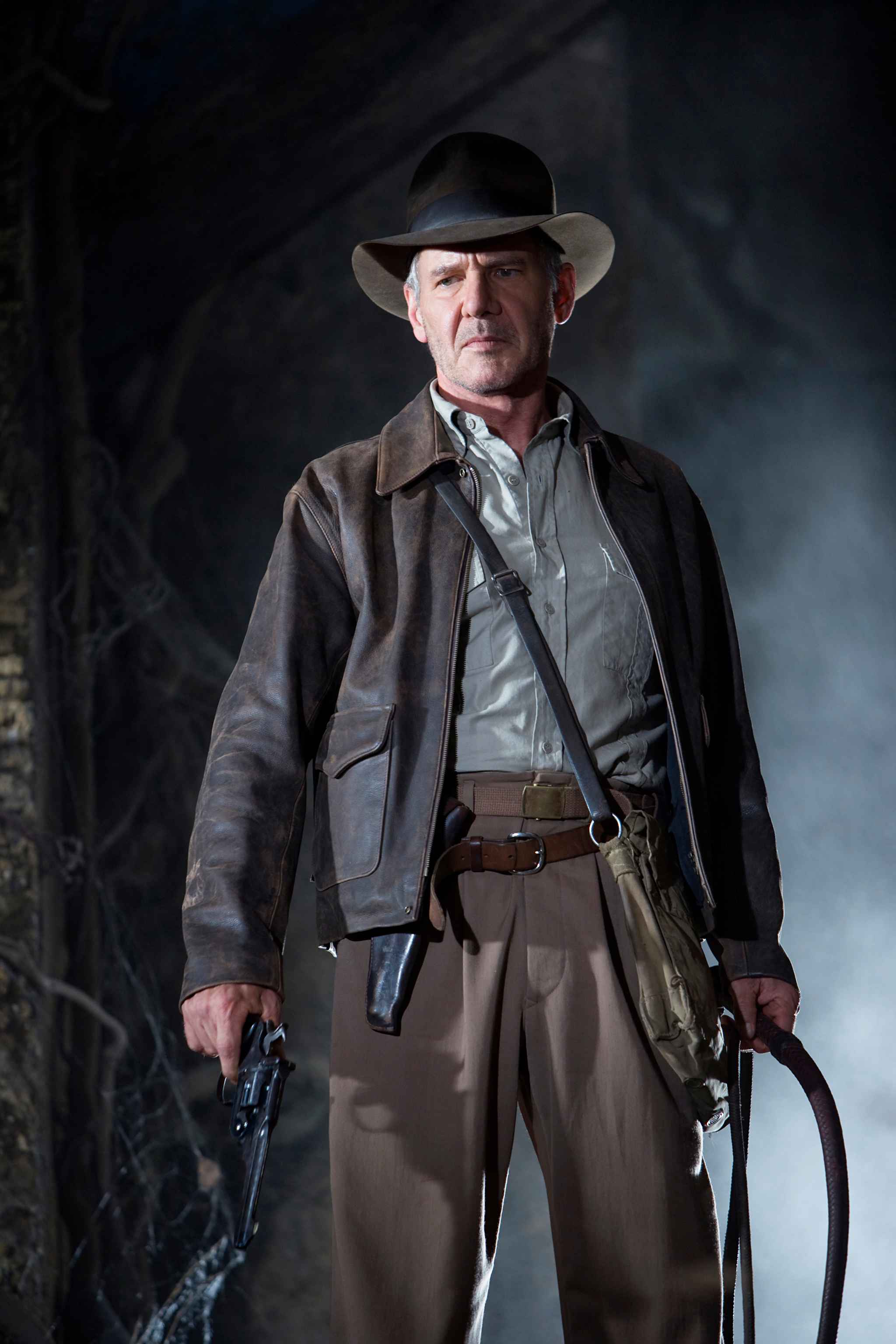
Last year's fourth entry in the "Indiana Jones" saga was met with derision while it raided a diamond mine at the box-office (making it to the top of many lists of 2009's more successful films—including a conservative publication that used its Commie villains to claim that it heralded a surge by the public to right-minded films, despite the fact that the rest of the films mentioned on the list flopped...and flopped badly; Indy 4 alone raised all boats).  There were complaints that it wasn't as good as the first three (a clear case of "Mom's Apple Pie" syndrome* among the fandom in fedoras—I felt it wasn't as good as the first one, but that's it): there was too much "Mutt" (Shia LaBeouf) and CGI, the familial complications too obvious, some characterizations a bit spurious,** and that it "nuked the 'fridge"—which briefly supplanted "jumped the shark" for hitting a false note in the national media (they always chortle when the fan-base eats its own) before they went back to not reporting the news. 

That last one stuck in my craw; it showed that the fan-base didn't "get" what the movies are—a post-modern, hi-tech take on the past and the low-ditch movies' past, in particular.  It didn't have to adhere to "reality"—it never did.  Look at Raiders of the Lost Ark, admittedly the best of the bunch—a 30's film filled with flying flap-jacks, Nazi's (Nazi's everywhere, even melting ones), Hitler myths, and tales of apocalyptic power. Nobody questioned "who" would put the rolling rock back after it crushes an intruder.  Nobody asked why a tomb unopened after centuries would still have live snakes in it.  One or two might have asked how Indy rode the back of a sub all the way to Nazi Island (It didn't submerge?  At all?  Then, why'd they take a SUB?!). Nobody questioned the ark.  It didn't have anything to do with reality, but rather with a mythic age of B-movies and wishful thinking that never existed, a cross-roads ("'X' marks the spot") between gritty, slithering reality and far-fetched fantasy, and the other films in the first trilogy followed that same map of fictional territory. 

But not as well.  Where the other two films, The Temple of Doom and The Last Crusade, failed to engage me were their wholesale abandonment of the what made the first film a Boy's Adventureland, and became a series of drawn-out chases, and half-hearted attempts at Mythos.  The Temple of Doom—a favorite among some film-critics, as it challenged Indy's hero-concepts and went to darker psychological places than mere musty caves—bugged me not so much for its inaccuracies (the long fall from a plane on a life-raft, the ripping out of a sacrificial victim's flaming beating heart to the SV's—and the audience's—disbelief), but it's insistence to present a Disneyland-like "mine-shaft ride" that looked for all the world that it was populated by puppetoons.  Then, there's the small detail of it being a prequel in which Jones "learns" that there's more to his mythic quests than robbing graves for fun and profit—which is intrinsic to the character, and is part of the make-up of the somewhat less-than-honorable "Indiana" Jones we first meet in the chronologically later Raiders.  That lesson must not have "stuck."

But, what they do have in common—what they all do—is slap the stubbornly reality-based Jones into a sense of wonder: Raiders... confronts "Indy" with a full-on-Wrathful presentation of something that he dismissed with a casual "if you believe that sort of thing."  ...The Last Crusade makes him take a literal "leap of faith" to save both his life and his father's, and also smashes his long-held preconceptions about his Dad.  "...Temple of Doom" has that previously mentioned quick-dissolving lesson of the Sankara stones and re-defines what "Fortune and Glory" can be to the doctor.  "Indiana" Jones is a teacher, but in his movies, he must learn things.  His character must start with a cherished "truism" and he must learn that although he may have all the answers, there are more questions that he hasn't even considered.  At one point in ...The Kingdom of the Crystal Skull, "Mutt" asks "Indiana:"  "You're a teacher?"  And Spielberg weights the reply down, as it's an important one: "Part-time."

The rest of the time, he's a student himself, still learning.

In Indiana Jones and the Kingdom of the Crystal Skull, Dean Charles Stanforth (Jim Broadbent), says to Dr. Henry Jones Jr. (Harrison Ford): "We seem to have reached the age where life stops giving us things and starts taking them away."  They have both aged, lost colleagues and parents, and their jobs are on the line.  And "Indy" has just ridden the crest of a nuclear shock-wave in the Nevada desert, where he has seen two amazing things, off and on the Earth: the corpse of an ancient astronaut, and the limit of Man's power in the form of the mushroom cloud of a hydrogen bomb.  This is the extent of our knowledge on Earth and it is a fearsome one, one that could mean our destruction at the hands of our abilities and our arrogance to use it.  Behold the power of knowledge and fear.


This is the first of two images (that Spielberg deliberately composed) of "Indiana" Jones in rapt observation of an unfathomable thing that buttress Indiana Jones and the Kingdom of the Crystal Skull.  In both, he is dwarfed by the event, small and helpless—all he can do is watch.  In the first, he is witness to the extent of Man's knowledge.  In the second, as he watches the launch of an alien race's*** craft to inter-dimensionally travel "the spaces between spaces," something far beyond his ken and catechism. The one represents all that we know, and the other opens up another Chamber of Secrets.  "Indiana" Jones can travel the four corners of the Earth, and there is still so much more territory to explore, and, indeed, more than he can know for certain. 


The personal myth that Jones must resolve is that of age and the taking away (the bomb) and the giving (the new experience).  For the loner Jones, that includes new worlds to conquer...and that is celebrated here...but he also, like The Outlaw Josey Wales, finds himself, in this one, acquiring a family he didn't know he had and never wanted, flying in the face of Stanforth's gloomy assessment of their lives as being "one foot in the grave" (like "Indy" hasn't been there before).  In this terrible age of wonders, there is always more to learn...more "treasure," translated by the Incas to "knowledge" and prized more than gold.  Life, no matter how old we get, never stops giving. 

Not if we're observant, anyway.
For me, ...The Kingdome of the Crystal Skull represented the best, most true, antecedent to the original Raiders of the Lost Ark, fully embracing the era it is set (the 50's) and the B-movie concepts being put out at the time, and it is the strongest presentation of the concept of the "learning teacher" since Raiders...  ...The Kingdome of the Crystal Skull represented, to me, the true sequel, while the others were just regurgitating concepts.  This one, like Raiders, raised the stakes.

MY only disappointment with it was, that if it's set in a 50's B-movie world, where's the giant scorpion that the hydrogen bomb creates—there were all sorts of "nukular monsters" in the films of the time, their own metaphors of the costly nature of Knowledge.  But Lucas and Spielberg's intentions were to turn that metaphor inside out.  Knowledge isn't destructive.  It inspires creation.  And new worlds to explore.

-----------------------------------------

There is talk (and only talk) of a fifth Indiana Jones movie, and while it has moved some to despair, for me it has given me fits of giggling anticipation. Imagine Indiana Jones in the B-movie drive-in 60's, with the good doctor investigating SDS students planning a lysurgic acid dump in a city resevoir, while a Beatle-browed Mutt has joined a Hell's Angels sect that practices Trascendental Meditation, and only an exploration of "The Silver Chord" can save Indy from the Ultimate Bad Trip. Meantime, there are rocket-packs, video-phones, IBM computer-rooms, and ESP experts, all figments of a 1960's that briefly sparked the imaginations of the time, but never seemed to catch on.  We were too busy going to the Moon, at the time.

I think it would be groovy, man.

Call it "Indiana Jones and the Electric Kool-Aid Acid Test."


* "Mom's Apple Pie" syndrome is the one where fan-boys says that the movies they liked as kids were better than anything that had come before or since (like "Mom's Apple Pie"), a clear indication that they have a narrow focus and experience.   The correllary is that expressed when a film-maker changes a movie for whatever reason and the fan can't come to grips with it—"They raped my childhood!"—a despicable sexually ignorant comment that indicates the person hasn't known anyone who has been (or might have been) raped or attacked.

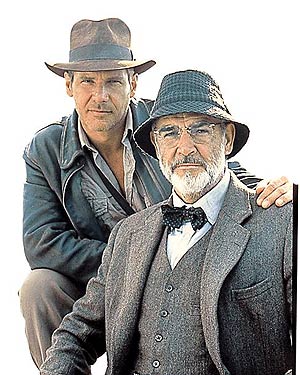
** Admittedly so, with the characters of  "Mac" (Ray Winstone) and Oxley (John Hurt)—the latter a last-minute re-write when a "retired" Sean Connery decided not to reprise his role as Indy's father.  He probably decided there weren't any golf courses near filming, or his dismal experience filming The League of Extraordinary Gentlemen in Prague left such a mark it didn't compensate for his affection for Spielberg, Lucas and Ford.

*** Here's another instance of last-minute tinkering.  Lucas wanted aliens, and Spielberg with three E.T. movies under his belt didn't want to go there.  So, the ancient astronauts became "interdimensional" beings, rather than space-aliens.  It actually works better that way.  Aliens = space.  We know all about space.  But, other dimensions?  That's a concept that expands the mind and the territory we inhabit.  "There are more things in Heaven and Earth..."  And even, in between.

Thursday, February 5, 2009

The Fugitive

"The name: Dr. Richard Kimble. The destination: Death Row, State prison. The irony: Richard Kimble is innocent. Proved guilty, what Richard Kimble could not prove was that moments before discovering his murdered wife's body, he saw a one-armed man running from the vicinity of his home. Richard Kimble ponders his fate as he looks at the world for the last time. And sees only darkness. But in that darkness, Fate moves its huge hand...."

As sepulchrally intoned by William Conrad (far removed from his narration of "The Rocky and Bullwinkle Show!"), you couldn't reach higher levels of melodrama than "The Fugitive" starring David Janssen as Dr. Kimble, running a cross-country race between the man who wants to capture him and the man he wants to capture. I was a devoted fan of the show when it had its initial four year run on ABC-TV in the States, and watched it more religiously than "Star Trek" in syndication.

When I heard there were plans to make a big budget movie with
Harrison Ford, I groaned. How could they possibly take a stretched out concept like "The Fugitive" where half the suspense is how long the man has been on the run and make it work as a compressed two-hour film?

Pretty damned well. Of course, there are changes. The crime is a conspiracy, rather than a random act of violence. Yes, there is a one-armed man. But there are other staples of the series, too.
Kimble must change his identity--he even uses the patented black hair-dye at one point. He toils at...acouple of jobs, posing as various hospital employees and, at one point, a janitor. Yes, he still dangerously acts the Saint, taking time out from his detective work at a hospital to help a kid with a chest condition that's counfounding the residents (one of whom is Julianne Moore). They have the incident from the first season where Kimble goes to see a one-armed man in the local lock-up only to be spotted by Lt. Gerard (Tommy Lee Jones in his Oscar-winning role as "Sam"—not "Philip"—Gerard*) and miss getting caught by that much. And they have the gambit where a fellow passenger on public transportation recognizes the guy across the aisle in the mug-shot on the front page.

But it's action that's been amped up for the film.
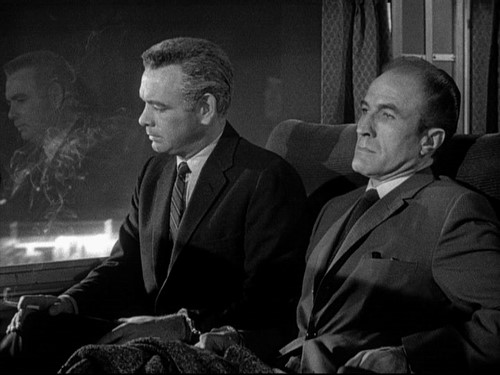
In the tv series, Kimble and Gerard are on their way to Death Row when their H-O scale train (in the model shots) jump the tracks and Kimble escapes.

It's a bit more complicated in the movies—Fate's "huge hand" is ginormous in this one. Kimble and the other prisoners are being transported on a bus,
when an escape attempt kills the bus-driver, sending the bus over a guard-rail and tumbling onto a set of railroad tracks...into the path of an on-coming train. Kimble has just enough time to save one of the guards before he leaps off the bus a split-second before the train hits it. The crash causes some of the cars to detach, derail and come careening after Kimble before crashing spectacularly into a culvert, sending its load of logs exploding into everything in sight. It is spectacular. And sets the audience up by 1) getting them prepared for some stuntly fire-works and 2) lets you know just how desperate Kimble is to avoid being caught so he can find his one-armed man.

The entire chase from escape to ending takes place in a period of less than a week, so he only has to go through a couple changes of clothes, his hair turns back to Harrison Ford brown, and Kimble never has enough baggage to have baggage as he did in the series. Plus, he never has to do anything for full employment for the short period he is free in the movie. Taut, a bit more realistic in maintaining anonymity in a modern world (though not so much with the stunts), "The Fugitive" does a great job of maintaining the integrity of the original and even surpassing it.

Dr. Kimble gets his (one-armed) man.

* One of the improvements in David Twohy and Jeb Stuart's fine script is the squad of deputies Marshall Sam Gerard has helping him investigate this case. In the series, Gerard, as played by Barry Morse, was an obsessive-compulsive lone wolf. He's no less dedicated here, but its sublimated by the way he runs his deputation ragged. It provides a lot of the comedy as well.

Friday, January 30, 2009

Olde Review: The Conversation

This was part of a series of reviews of the ASUW Film series back in the '70's. Except for some punctuation, I haven't changed anything from the way it was presented, giving the snarky, clueless kid I was back in the '70's a break. Any stray thoughts and updates I've included with the inevitable asterisked post-scripts.

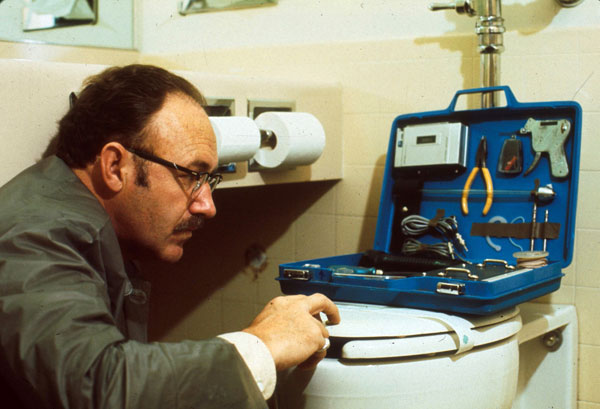
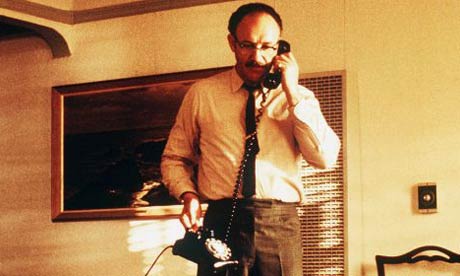
"The Conversation" (Francis Ford Coppola, 1975) Harry Caul (Gene Hackman) is an electronics expert dealing in surveillance. His latest assignment is to record a conversation between two very innocent young people in the park. It's a routine assignment, one that Harry handles with a perfectionist's care. But after he has the raw tape—after he has clarified it and re-channeled it—he hears a whispered fear that these two kids may get killed by Harry's employer. Old haunts plague Harry—past assignments he has carried out that led to his victim's deaths. And so he goes to confession to confess what may be a future sin. Confession—where one's private actions that are considered to be sins are revealed to a priest in order to free the sinner of guilt. But this too, is a surveillance—an invasion of one's privacy—ritualized in the name of religion. Surveillance is a part of our lives, then. And privacy is an illusion.

That scene in the confessional is about as close as
Francis Ford Coppola comes to really dealing with surveillance in his film, "The Conversation." Despite what many critics have said, Coppola makes no judgements on this subject. Surveillance is simply there as a device to be used for the movie. It's neither good nor bad. It's there to provide Coppola with a means of getting into a rather shallow appearances-are-deceiving mystery story—it's a very weak imitation of Antonioni's "Blowup." When Harry Caul is caught in a surveillance trap ala his own devising, are we supposed to feel some satisfaction in this? Just because he's getting screwed, like he screwed all the others? Is surveillance justified in retribution, in other words? No. How can we take satisfaction in that? For surveillance — the ripping open of one's privacy — is being used, and nothing, really, not even revenge should make us condone it.

Awright, already, W______is it a good movie?

Okay, okay. Yeah, it's a good movie. It's...entertaining, in a shock-lull-shock-lull sort of way. Coppola has made a good movie, despite my reservations as to his morality on the subject. It's an o-k script—a little spare at times—with a lot of loose ends, and his direction is always assured. Gene Hackman manages to flesh out Harry Caul enough to make him an interesting person to watch for the couple of hours we do. And there is fine supporting acting from
Allen Garfield, John Cazale (the weak brother, Fredo, in "The Godfather"), Frederic Forrest, Cindy Williams (she's good, despite the fact that she's totally mis-cast) and Robert Duvall (who is on for a very short time and doesn't receive a credit). But, the one thing that is technically outstanding is the sound of the film, produced by the work of its chief editor Walter Murch. Murch also worked on "The Godfathers" for Coppola, and creating what he terms "sound montages" for George Lucas' "THX-1138" and "American Graffiti." His talents with editing and sound mixing are outstanding,and hopefully Murch will, himself, be directing his own films.

Broadcast on KCMU-FM on January 27-28th, 1976

Murch would, indeed, direct one film (so far)—"Return to Oz," in 1985—and it tanked. His intention was to make a genuine adaptation of one of L. Frank Baum's "Oz" books, rather than what the public was expecting—a sequel to the 1939 classic "The Wizard of Oz." And his heart-felt, but scary, recreation of Baum's world didn't click with audiences. One would be sad if Murch didn't then personally supervise the entire post-production process of about one film per year. Films like "Julia," "The Godfather: Part III," "Romeo Is Bleeding," "The Unbearable Lightness of Being," "Ghost," "The English Patient," "First Knight," "The Talented Mr. Ripley," "K-19: The Widowmaker," "Cold Mountain," "Jarhead," and Francis Coppola's latest films. Busy guy. Eclectic talent.

This movie has dogged me my entire career, because it was assumed that, because Harry Caul could electronically filter out steel drums from the background of a murmured recording enough for you to hear what the people were saying that any sound facility could do it, too. No. Not really, you can't. You can tune, you can attenuate, you can try reversing the polarity of a channel to eliminate shared sounds on both channels of a stereo recording, but steel drums? That's a good one. They call that "Movie Magic."

But the kid is right...this is warmed-over "Blowup" without the illusion of film-making, or illusion of illusion that makes that film so compelling. At least it's better than cold, left-over "Blow-Up" like
Brian De Palma's "Blow OUT" (in that, film recordist John Travolta must piece together a Chappaquidick-like incident from his sound-recordings and pictures taken from a "Zapruder"-like film--it doesn't pass the incredulity test). And Coppola has to resort to a "cheat"—he changes the actual recording, the one element in the movie that has to be set in stone, to come up with his conclusions. One could make a case...blah blah blah, the fact is, interpretation or not, he planted a card in the deck.

It is, though, a really good paranoid thriller of the type that seemed to be born of the post-
Watergate era. And Hackman's insulated Caul is another example of how that actor can take an under-written part (deliberately, I should say--Caul doesn't talk much on purpose) and make him a living, breathing human being you can recognize and, despite his many failings, sympathize with. There is one actor I didn't mention because I didn't really know who he was...yet. He'd made a living doing parts on television, and done a small role in "American Graffiti," but after this film he was about to quit acting and go back to carpentry when a role in a sci-fi movie by Coppola's pal George Lucas changed things for him. Harrison Ford has a small role as "The Director's" menacing assistant.

Oh...the reason I made such a big deal of the confessional scene? I used that to start off the recorded version of this review.


In 1995, "The Conversation" was chosen to be a part of the National Film Registry by the Library of Congress seeing it as "culturally, historically, or aesthetically significant."


Monday, June 2, 2008

Indiana Jones and the Kingdom of the Crystal Skull

Making Mountains Out of Mole-Hills

I've heard this film being called "critic-proof", and I'm not even sure what that means, but it implies that whatever the reviews say, people are still going to line up to see it, as if it's a critic's job to discourage people from going to see something they want to see, like it's part of the job description to trash something on your "Must-See List." And that if something truly acidic and toxic is written about it (and a Big Tall Wish is made) nobody'll see it (And they call this movie unrealistic!) Even Ford, Lucas and Spielberg were all talking (before the film's premiere at Cannes) that it was going to get savaged, and, since these guys are pros who know their stuff, it has been in some circles, mostly by mouth-breathing fan sites where "sux" dominates the descriptors.

So, despite the lowering of the bar of expectations by the film-makers, does it suck?

No. No, it doesn't.

In fact, I have to say I haven't been this delighted with a film in a long time. I will even go so far as to say that "
Indiana Jones and the Kingdom of the Crystal Skull" fulfills the promises made by the very fine, original "Raiders of the Lost Ark," something that its two sequels, however enjoyable they are in parts and particulars, never did.***

Before we go further, let us go back and recap what happened in the previous chapters...

This series (like I shouldn't have to tell you) is based on pulp serials in the B-movie tradition--episodic, cheesy, toying with History and making it up as it goes along. This one, being set in the late 50's, has to have more of a sci-fi bent than the religious-themed stories of the past set in the 30's and the 40's. It is, after all, the first adventure we've seen of Indiana Jones in a post-nuclear world. Think on that for a moment. "Crystal Skull" fits the period, at least cinematically, however much it messes with folks' expectations of what the film "should be" about (and let's face it, the biggest obstacle Lucas' films have are people's expectations for the "next" installment, and whether it compares to the film they already have in their head--in that case, you can't compete with what they have in mind*). Indiana Jones' timeline has finally caught up with the memories of George Lucas and Steven Spielberg.

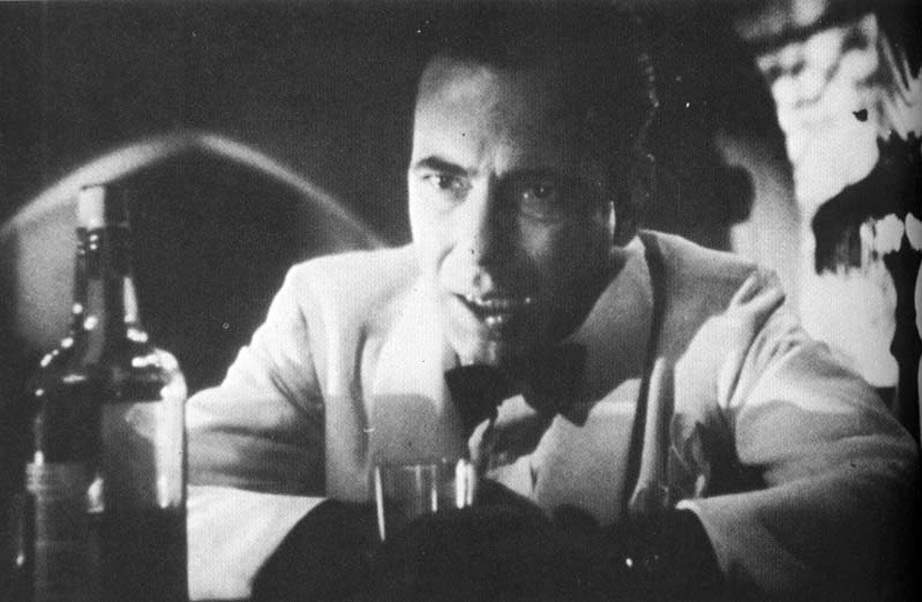
The filmmakers can't escape the fact that it's been 19 years since the last installment (and they've set it nearly twenty since the events of "Last Crusade"), and Harrison Ford's appearance is the nearly-constant reminder of it--he's broader, shlumpfier, more doughy in the face. But something magical happens a couple times in the film (once at a malt shop, once at a Mayan burial ground). Whether it's some CGI-gauze trick, or Ford's sense-memory playing the character kicking in, but once the dialogue turns to ancient civilizations and archaeology, the lines seem to disappear from Ford's face, and he slots back into the old/ young Indiana Jones the same way the camera "slotted" into the Bogart-drinking-his-sorrows "Casablanca" shot in "Raiders" after Jones has seen Marion supposedly killed in a truck explosion. It's eerie, but like the occasional forays into the transcendent in the series, it's a good kind of eerie.

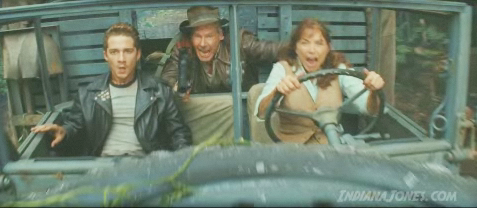
We've mentioned Marion, and, as the posters tell you, Marion Williams nee Ravenwood (Karen Allen) is back, and she's terrific--a breath of fresh air after Kate Capshaw's and Allison Doody's ingenues (the one too high-pitched, and the other tamped-down into irrelevance). The years have treated her far better than Ford, and she still has that incandescent smile and has been given a lot of "Dr. Jones-take-down" dialogue that suddenly snaps Ford's performance into a higher level of energy. Allen has remained well-versed in what Spielberg informed her during the first film was the "Sam Peckinpah School of Acting," something that Cate Blanchett is equally fine at--she's looser and more fun than she's been in years, and just the sight of her Commie commandant standing in a careening jeep during a bumper-cars jeep chase through the Amazon jungle is one of those things you think you'll never see.

So, Shia LaBoeuf. Is he "Short-Round"-irritating, or made too much a thing of? Neither, though he has a prominent role throughout. For some reason, whether it's the magnitude of the project, or Spielberg directing, LaBoeuf's not as energetic or inventive as he's been--maybe we should call his character "Short-Leash"--but, he's a good foil for Ford and their interaction, especially in one pause in a motorcycle chase deliberately recalls the Ford-Sean Connery relationship in "Last Crusade."** One is never sure if he'll be pulling out a comb or a switch-blade when he reaches into his motorcycle jacket (his aping of Marlon Brando's gear in "The Wild One" is a clever 50's variation of Indy's gear), and there is a great visual joke when he confronts an Amazonian resident with the same hair-cut.

As for director Spielberg, he reportedly re-studied his earlier "Indy" films to recall the way "kid-Spielberg" shot films and there are plenty of his early "headlights-into-the-camera" adrenaline shots (and even one of his "Sugarland Express" pans), but the takes are a bit longer-held, he's not quite so anxious to cut away, and his cinematographer Janusz Kaminski brings a new visual beauty that supplants the grit-in-the-lens of the earlier films. The elder Spielberg is also incessantly filling the film with visual ironies--grace-notes--that the younger Spielberg would save for a separate shot. There's an awful lot of stuff going on under the surface of the fire-fights, the explosions--some big ones--that betray the more mature film-maker, and man, Spielberg has become. And unlike the last two, which were short on background, and long on chase sequences, this film is over-stuffed with references, languages and the accustomed meta-recall of the past films.*** Not to say there isn't a lot of action. There is. That Amazon-chase between the particulars (the film is structured like a race--like "Raiders" and "Last Crusade"--with the good-guys and bad-guys all after the same thing and never too-far away from each other) is an invigorating combination of possibilities like a puzzle with every combination of inhabitant in vehicle and opponent in combat possible. It's dizzily constructed. And just when you start to think, "Wait a minute, where's..." your questions are answered.

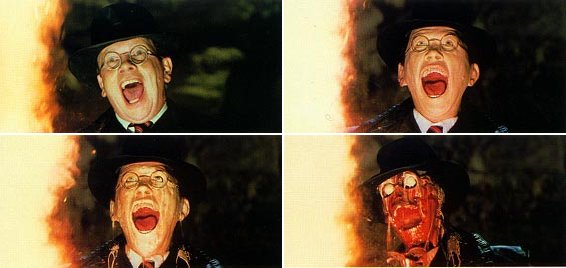
A lot of the action is outlandish, but, surprise! It always has been. How can you complain about verisimilitude when you've had melting Nazi's from the vampire-angels and God's death-ray of the Ark of the Covenant, or Thuggee priests pulling out sacrificial victim's flaming hearts, and how some victims in a lava pit burn, but the heroine-in-diaphenous pants doesn't, or 700-year old Knights Templar still guarding the Holy Grail. Get real, people. Because the movies aren't. Like Indy in "The Last Crusade" film-goers have to make a leap of faith, and it needs to be done with an open heart. Or at least an uncynical one. Or one open to the possibility of enjoying oneself.****

Okay now, go out there and have fun.

"Indiana Jones and the Kingdom of the Crystal Skull" is a full-price ticket.

-------------------------------------------------------------------------------------------------

* Somewhere along the way I've talked about "Mom's Apple Pie Syndrome"--where our memory of a cherished movie runs counter to the actual quality of the work, ie. "Nothing tastes as good as mom's apple pie," but only because that was your first run-in with the concept, and your impression of what "good" apple pie should be like may include a runny interior and scorched crust (I was blessed with a mother--God love her--who was a lousy cook, so I tend to be immune). So, too, the cherished movies of your youth may actually be crap, though we may delude ourselves otherwise, with our 'gee-whiz" innocent first impressions. The phenomenon became real for a few incredulously chagrined "Man from U.N.C.L.E." fans who, seeing the series for the first time in years on DVD last year, endearingly wondered why MGM chose to run the shows through a "crap filter" making the sets look like back-lot soundstages with cheap "foreign" localization, lousy effects, obvious writing and some horrible performances. Ah, deluded youth. Nothing is so sweet as a young man's fancy for a film of their childhood. And nothing is so rancid as the bitterness that follows a fan-boy's crush.

But it's not the film's fault. Ever. Beauty is in the mind of the beholder.

** And if you haven't figured our the "Indiana" Jones-"Mutt" Williams relationship yet, what can I say? You're either a) five years old, b) this is your first movie or c) "denial ain't just a river in Egypy, honey." Look at their names, kids, and remember where Dr. Henry Jones, jr. came up with the name "Indiana." These films are all about clues.

*** Sometime, when Summer is over and there are no more surprises, I'm going to do a big-old analysis of this movie and why it is the natural sequel to "Raiders." (Hint: It involves the clockwork-intricacies of ancient civilizations as well as the conflicts when a Man of Science is confronted with the "hard rain" of spiritual mythology) It's roots go pretty deep--which is refreshing after the previous two--and bear a full airing of the secrets buried within it. To do so now would give away far too much and contain too many spoilers of large and small varieties.

**** Do I have ANY complaints? Yes, the frankly extraneous character of "Mac" McHale played by Ray Winstone. McHale is designed as an untrustworthy character, but he is so untrustworthy that one wonders why he's not just shot by either party at any time during the proceedings. He's so greedy he's a bit reminiscent of Daffy Duck in a hall of treasures: "Mine, Mine, Mine!" The character is such an unnecessary plot contrivance that he might have earned the name "Aringarosa" if the name hadn't already been taken.

Wilhelm Alert: the book-carrying nerd in the library during the motorcycle chase.