This week, we're re-publishing some reviews of the films from the post 9-11 environment.
 The Lucky Ones (Neil Burger, 2008) Every war, every "police action," seems to have its "re-patriation" film. World War 1 had The Razor's Edge, 2—The Best Years of Our Lives, VietNam—Coming Home. The Lucky Ones involves returning troops in the ongoing Iraq War, different from their cinematic (and real) fellow troops in that they're not coming home. They're on a 30 day leave before going back as part of the "stop-loss" program. So, this takes place as more of an interruption to their service. What happens when the environment is not so regimented, or as dangerous. The three come back from the war altered, and all have specific goals in mind, all of which change when they actually touch boots to ground in the States.
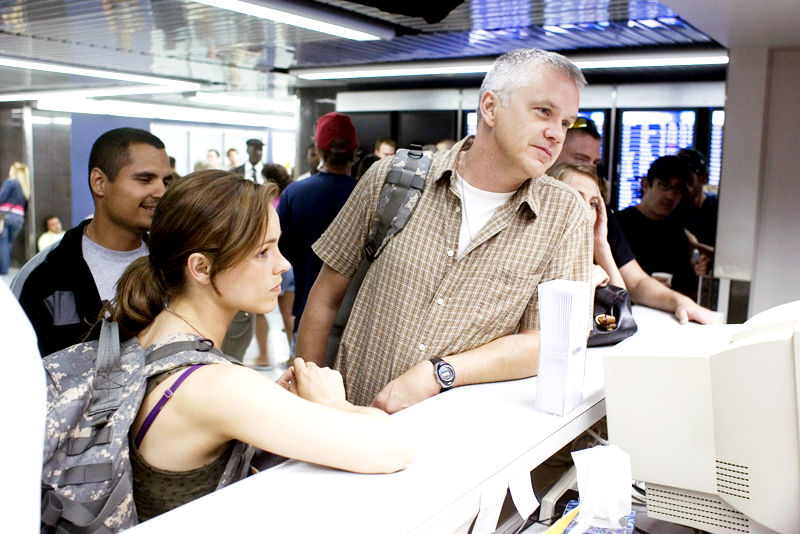
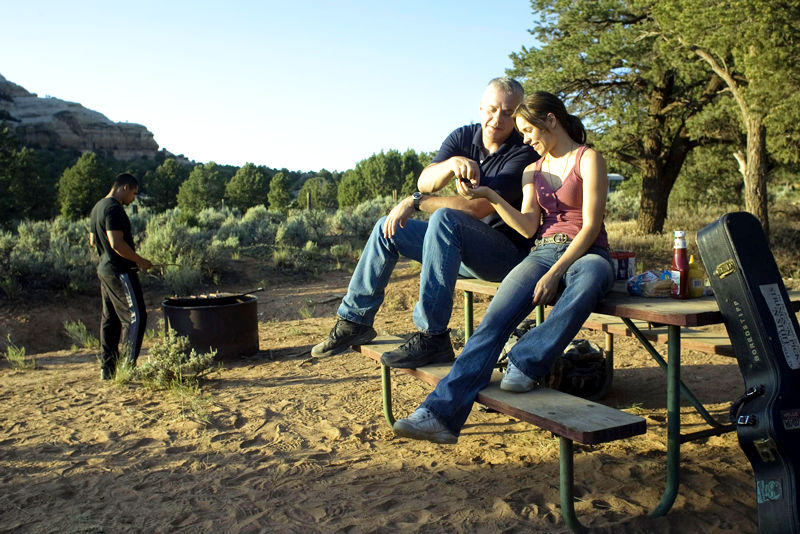
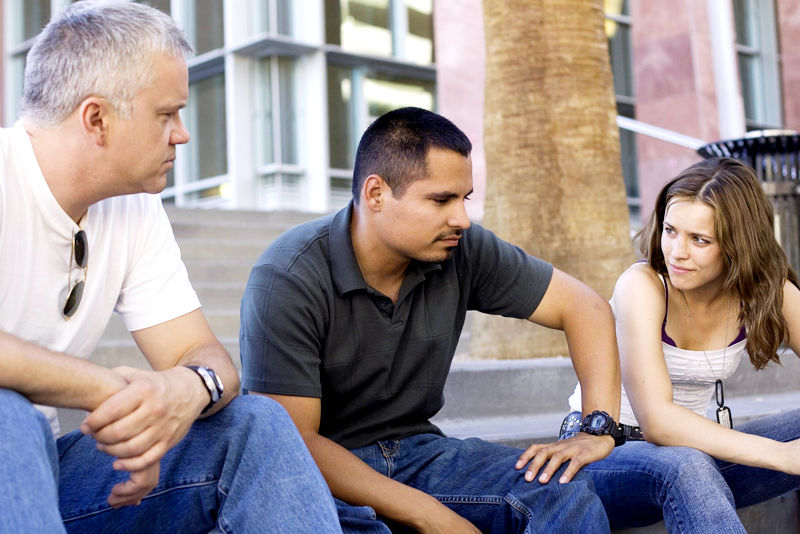
It follows three vets—Cheaver (Tim Robbins), an older sergeant just off his third and last tour, T.K. (Michael Peña), wounded, but gung-ho about going back, and Colee (Rachel McAdams), a neophyte coming back with a mission and a hole in her leg. They're all damaged: Cheaver is psychologically out-of-whack; T.K.'s purpose is to get back to his fiancee to see if "his equipment" still works after being wounded; Colee wants to find the family of the guy she hooked up with there and return his guitar to them. Meeting on the flight state-side, they decide to pool resources to get where they're heading. But, like any road-trip, there are detours, changes of plan, and the occasional loss of bearings. Stability is not to be found at home for any of them, and the trip only reinforces the perception that their fellow soldiers are the only ones who've "got their back."
Some of the episodes reach a bit, while some feel natural, and mostly the film avoids easy answers—less than it avoids mention of the war, except for a brief opening scene. The Lucky Ones is less concerned with Iraq, than it is with the soldier's plight, caught in the demilitarized zone of not fitting in either here or there. Putting them on the road—in transit—reflects that sense of rootlessness (as most road-movies do) that these perpetual soldiers must have that is unique to this era's soldiers. The film never really tackles that subject head-on, as it almost has a duty to do, instead relying on the various "missions" and destinations to define the characters. Ultimately, the film has nowhere to go once those stories are used up, and the film ends on a logical melancholy note.
Where it shines is in the performances. As with the war, Burger and his co-writer Dirk Wittenborn are quiet about the soldiers, presenting them as rather independent pawns in a much bigger game, their choices on the road sometimes unconventional, and not S.O.P. But McAdams, Pena, and especially Robbins (this is some of his subtlest work in the past decade and nice to see), breathe a likable humanity into their characters, buffering the moments of manipulation and contrivance. You like these guys and want them to succeed, even if they are a bit unreadable—enough so that some of their choices surprise, even deep into the movie. That The Lucky Ones manages to do that is no small accomplishment.
Saturday, September 17, 2011
The Lucky Ones



.jpg)




Thursday, June 9, 2011
Midnight in Paris
 "Gertrude Stein Punched Me in the Mouth"
or
"L'époque est toujours plus belle de l'autre côté du pont Einstein-Rosen"
I've been waiting for Woody Allen to make this film since before he asked to Play It Again, Sam (or even What's Up, Tiger Lily?).
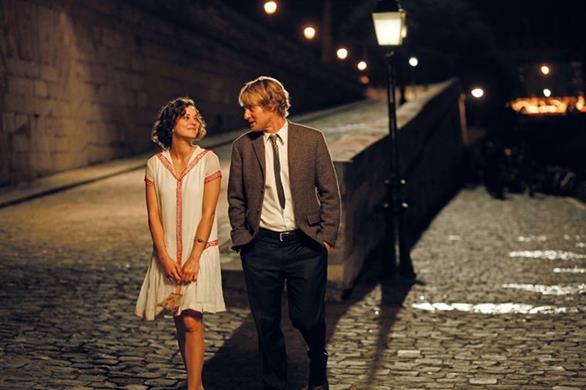
Based on a routine from his stand-up days,* which he later expanded for a piece in "The New Yorker" (see above), Midnight in Paris follows Gil (Owen Wilson) a self-absorbed, neurotically anxious writer of Hollywood fluff ("Wonderful, but forgettable...sounds like something I wrote"), who is obsessed with death,** as he travels to Paris from Pasadena with fiancee Inez (Rachel McAdams, but it could just as well have been Elizabeth Banks) and her conservative family. Gil is working on a novel, long in the gestation, and is distracted by the vapid shallowness that he is about to marry into. Paris is shops, restaurants, museums and snootiness, and to escape the jejeune de vivre, he takes a late-night walk through the streets of Paris and is approached by a vintage taxi. Entering the cab for Gil is a magical moment for him, on the same plane-breaking as when Tom Baxter (or is it Gil Shepherd) walks off the screen in The Purple Rose of Cairo. He is instantly transported to 1920's Paris and becomes lost in "The Lost Generation" (without the benefit of having survived World War I), meeting Cole Porter (Yves Heck), Ernest Hemingway (Corey Stoll), Zelda (Alison Pill) and Scott Fitzgerald (Tom Hiddleston), all the heroes of his favorite literary era and time, 1920's. He's enchanted...and as his novel is about the time...inspired. He goes back to Inez, gob-smacked, unable to explain where he's been all night, but "alibi's" his adventures as a dream (as they are, certainly in the aspirational sense). He tries to bring Inez to the party, but the magic doesn't work—she's as unthrilled with Gil's stories as he is with her wine-tasting adventures with acquaintance Paul (Michael Sheen).
She leaves. And the taxi arrives, bearing Gil and Hemingway to the apartment of Gertrude Stein (Kathy Bates) and Alice B. Toklas (Thérèse Bourou-Rubinsztein), who are playing judgemental hosts to Pablo Picasso (Marcial Di Fonzo Bo) and his enchanting mistress Adriana (Marion Cotillard). Gil gives his novel to Stein and Hemingway to critique, but he is drawn to Adriana, making her way through the 20's as best she can.
So, the two planes of existence for Gil are set up: his modern-day drudgery on the cusp of a marriage of inconvenience; and his fantasy past, where his dreams are reality and reality can make dreams. You know where this is going.
It doesn't matter, though. This is a "feel-good" Woody Allen picture—the kind people like—where the messages are still telegraphed the way they are in "obvious" Allen movies, the coincidences just a little too convenient, but so full of incident, grace and nuance (and quite a bit of humor) that it goes down well (as Allen groused throughout Stardust Memories, audiences "like his earlier, funnier [movies]"). That Gil is such a sunny presence in the past (and as played by Wilson, he has a guileless charm that doesn't sacrifice intelligence—he's the way you'd imagine Jimmy Stewart would play Woody Allen), even his kvetching is charming and not harsh. It doesn't matter that you be a history buff and "get" all the references,*** (and we meet Luis Bunuel, Man Ray, Salvadore Dali [Adrien Brody], and on a side-trip, Toulouse Lautrec, Gaugin and Degas). Of course, Gil is enchanted; he is an era when his heroes are still at the stage he is, becoming themselves, with their best work still ahead of them. His age of magic is their everyday life. The interesting lesson of the film (and what makes it special and wise) is that knife cuts both ways. The "lesson" is both sour and sweet, but not hope-crushing—a little bit of salt in the creamy fluff.
And no, nobody punches Gil in the nose—but you can't help noticing that Wilson's is a little broken.
"Midnight in Paris" is an enchanting Matinee.




* I mentioned before that I was in Europe. It's not the first time that I was in Europe, I was in Europe many years ago with Ernest Hemingway. Hemingway had just written his first novel, and Gertrude Stein and I read it, and we said that is was a good novel, but not a great one, and that it needed some work, but it could be a fine book. And we laughed over it. Hemingway punched me in the mouth.
That winter Picasso lived on the Rue d'Barque, and he had just painted a picture of a naked dental hygenist in the middle of the Gobi Desert. Gertrude Stein said it was a good picture, but not a great one, and I said it could be a fine picture. We laughed over it and Hemingway punched me in the mouth.
Francis Scott and Zelda Fitzgerald came home from their wild New Years Eve party. It was April. Scott had just written "Great Expectations," and Gertrude Stein and I read it, and we said it was a good book, but there was no need to have written it, 'cause Charles Dickens had already written it. We laughed over it, and Hemingway punched me in the mouth.
That winter we went to Spain to see Manolete fight, and he was... looked to be eighteen, and Gertrude Stein said no, he was nineteen, but that he only looked eighteen, and I said sometimes a boy of eighteen will look nineteen, whereas other times a nineteen year old can easily look eighteen. That's the way it is with a true Spaniard. We laughed over that and Gertrude Stein punched me in the mouth.
** Yes, this is the Woody Allen character. His films never fall too far from the analyst's couch.
*** I certainly didn't—I had to do some referencing for the line: "That was Djuna Barnes (I was dancing with)? No wonder she wanted to lead."
Wednesday, January 26, 2011
The Lucky Ones
The Lucky Ones (Neil Burger, 2008) Every war, every "police action," seems to have its "re-patriation" film. World War 1 had The Razor's Edge, 2—The Best Years of Our Lives, VietNam—Coming Home. The Lucky Ones involves returning troops in the ongoing Iraq War, different from their cinematic (and real) fellow troops in that they're not coming home. They're on a 30 day leave before going back as part of the "stop-loss" program. So, this takes place as more of an interruption to their service. What happens when the environment is not so regimented, or as dangerous. The three come back from the war altered, and all have specific goals in mind, all of which change when they actually touch boots to ground in the States.
It follows three vets—Cheaver (Tim Robbins), an older sergeant just off his third and last tour, T.K. (Michael Peña), wounded, but gung-ho about going back, and Colee (Rachel McAdams), a neophyte coming back with a mission and a hole in her leg. They're all damaged: Cheaver is psychologically out-of-whack; T.K.'s purpose is to get back to his fiancee to see if "his equipment" still works after being wounded; Colee wants to find the family of the guy she hooked up with there and return his guitar to them. Meeting on the flight state-side, they decide to pool resources to get where they're heading. But, like any road-trip, there are detours, changes of plan, and the occasional loss of bearings. Stability is not to be found at home for any of them, and the trip only reinforces the perception that their fellow soldiers are the only ones who've "got their back."
Some of the episodes reach a bit, while some feel natural, and mostly the film avoids easy answers—less than it avoids mention of the war, except for a brief opening scene. The Lucky Ones is less concerned with Iraq, than it is with the soldier's plight, caught in the demilitarized zone of not fitting in either here or there. Putting them on the road—in transit—reflects that sense of rootlessness (as most road-movies do) that these perpetual soldiers must have that is unique to this era's soldiers. The film never really tackles that subject head-on, as it almost has a duty to do, instead relying on the various "missions" and destinations to define the characters. Ultimately, the film has nowhere to go once those stories are used up, and the film ends on a logical melancholy note.
Where it shines is in the performances. As with the war, Burger and his co-writer Dirk Wittenborn are quiet about the soldiers, presenting them as rather independent pawns in a much bigger game, their choices on the road sometimes unconventional, and not S.O.P. But McAdams, Pena, and especially Robbins (this is some of his subtlest work in the past decade and nice to see), breathe a likable humanity into their characters, buffering the moments of manipulation and contrivance. You like these guys and want them to succeed, even if they are a bit unreadable—enough so that some of their choices surprise, even deep into the movie. That The Lucky Ones manages to do that is no small accomplishment.
Wednesday, December 1, 2010
Morning Glory

"You're Gonna Make it After Alllll"*
or
"Will Someone Tell Me Why I Logged Off 'BangingGrannies.com' For This?"
Becky Fuller (Rachel McAdams) has just rebounded from being fired from her Jersey TV station to being hired to produce an in-the-ratings-dumper morning news-klatsch in New York. The stipulation from boss Jeff Goldblum (whose heighth advantage over McAdams is used to good advantage) is that she has to turn the ratings around or the venerable TV-institution "DayBreak" will be cancelled.
But who wants to work in an institution?
The place is a mad-house. Goofy weatherman, clueless reporters, a perv' anchor (he delivers the second headline above), and the Nurse Ratched is the veteran house-mother-anchor (Diane Keaton) who views Becky as just one more producer for a show that's "a revolving door for cretinous morons." She's seen 'em come and go, while she's been "pulling the train up the hill(...with my TEETH!)" for fourteen years. "DayBreak" needs to be fixed.
Becky starts to shake things up, and her first job is to find an anchor a little less orange. She goes the credibility route and seeks out Mike Pomeroy (Harrison Ford, who hasn't done this much mugging since Return of the Jedi**), a veteran news-man (he lunches with Chris Matthews, Bob Schieffer, and Morley Safer), grumpily living out his golden parachute contract, and has no desire to lower his standards working on a show with "half an audience who've lost the remote, and the other half are waiting for the nurse to turn them over." Warned that he is "the third-worst person in the world...after Kim Jong-Il and Angela Lansbury" by the movie's obligatory boy-friend (Patrick Wilson...slumming***), Becky finds a loop-hole in his contract and forces the pro to "lower his standards," but raise the bar on passive-aggressive behavior (he refuses to "banter, from the Latin word for 'gibber like a moron'")...as if the show needed any more of that. Pretty soon, every surface at the station has Becky-forehead-sized dents from her beating herself into them—that and her seeming incapacity to open doors are the two consistent jokes of which no opportunity is passed.
It's got the TV-industry cynicism down, but raised to the bitchy level of the fashion industry (the writer, Aline Brosh McKenna, also wrote The Devil Wears Prada, ...and 27 Dresses , and Laws of Attraction, and Three to Tango...so this is the first movie of hers I haven't actively avoided...although I did see Prada, and admired it). Director Roger Michell can do rom-com fine (Notting Hill), but he's capable of doing better stuff, and he keeps everything lively and semi-sunny, despite the rampant cruelty tossed around like so much unnecessary paper-shuffling on a news-desk. But, he can't do much with the cliched material, from the "mmet cute" to the "slo-mo run through new York."
Morning Glory is okay, but it breaks no boundaries (or news, for all that), it's another "working girl" comedy in the revolving door of them.
Morning Glory is a Cable-Watcher.
* Cue the hat-throw. Give credit where credit is due: I didn't notice this was basically "The Mary Tyler Moore Show" (and a two-hour stretch of the half-hour pilot, at that) until Ford's crusty news vet says to the young producer "You have a repellant moxie" in the same way that Ed Asner's Lou Grant said "You've got spunk....I HATE spunk!" Where's Betty White when you need her?
** ...which makes me think something is wrong. Ford is the master of the subtle slow-burn comic performance, but this one is at a hard-boil. His lines delivered in a husky, phlegmatic drone, you start to wonder if Ford—like his character—just isn't happy to be there (y'know, like his narration in BladeRunner?). Then, he manages to take what should have been the movie's worst scene, and make it shine, giving it depth, resonance and heart...while still not betraying his character. Nice work.
*** Yeah, but on the other hand, I've felt so sorry for so many good actresses playing "the girlfriend" over the years, this is one for equal opportunity.


