Showing posts with label Iraq War. Show all posts

Tuesday, September 11, 2012

United 93

United 93 (Paul Greengrass, 2006) "The War on Terror" turned the tide before it was even declared.  The efforts of the crew and passengers of United flight 93 insured that, as they assessed the situation quickly, made decisive plans and executed them unselfishly, in the process saving an unimaginable number of lives.  Who knows, besides the dishonored dead, what the target was?  We don't know.  We can't know.  But, after that, every airline passenger became more vigilant, and everybody who didn't put their seats in an upright position (or try to light their shoes) was seen with suspicion.  Anyone who attempted anything—short of hogging the overhead compartments, blocking the aisles in conversation, stealing somebody else's honey-nuts, or (god forbid) talking incessantly about themselves THE ENTIRE FLIGHT—against the common good, would be taken down and taken down hard, if not by security officers, then by the passengers themselves (and you had better luck with the security officers).  Flight 93 was when the terrorists started losing 55 minutes after the battles had begun.

Greengrass' ingenious attempt to recreate the events on 9-11 leading up to and during that horrific flight (in real time, one might add) crackles and pops with a cinema verite energy that makes the most mundane of the circumstances take on an ironic heft.  We all know how the story went-only if merely how it ends—and it makes all the participants victims and their every action and utterance weighted with irony, their moments, being finite, that much more important.  The dawning realization that their rudimentary transport had become part of an organized plot to turn their flight into a weapon of targetted destruction is both horrific and inspiring, moving fast through the stages of grief, they decide to make the best of the situation in which they suspected they would not survive, and acted unselfishly to at least stop any further loss of life wherever they were heading, and, maybe, doubtfully, save their own.  In an unfolding world of uncertainty, they acted for the greater good.  


It's an amazing story—civilians becoming warriors, victims not settling for that role.  And Greengrass' version is done without stars, no grand-standing, just the director's insistence on verisimilitude and energy, not enhancing the story with false heroics, but only the genuine ones, enhanced by its own choice not to editorialize.


Saturday, September 17, 2011

The Lucky Ones

This week, we're re-publishing some reviews of the films from the post 9-11 environment.


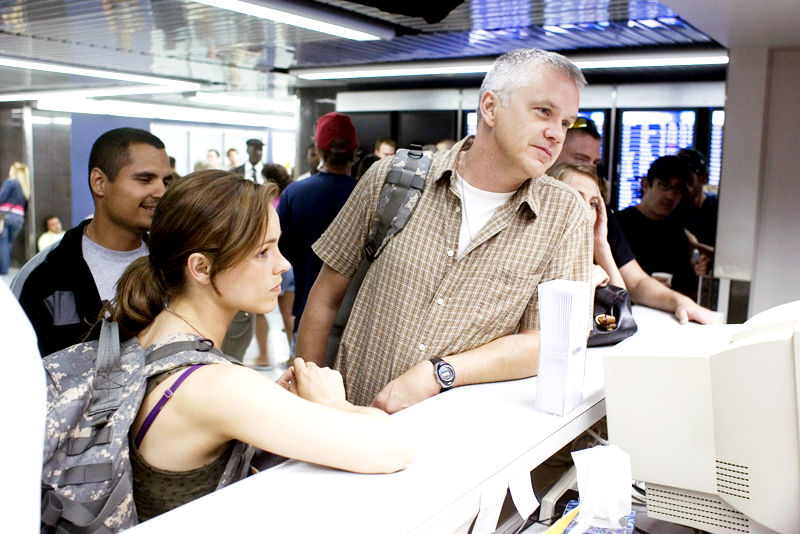
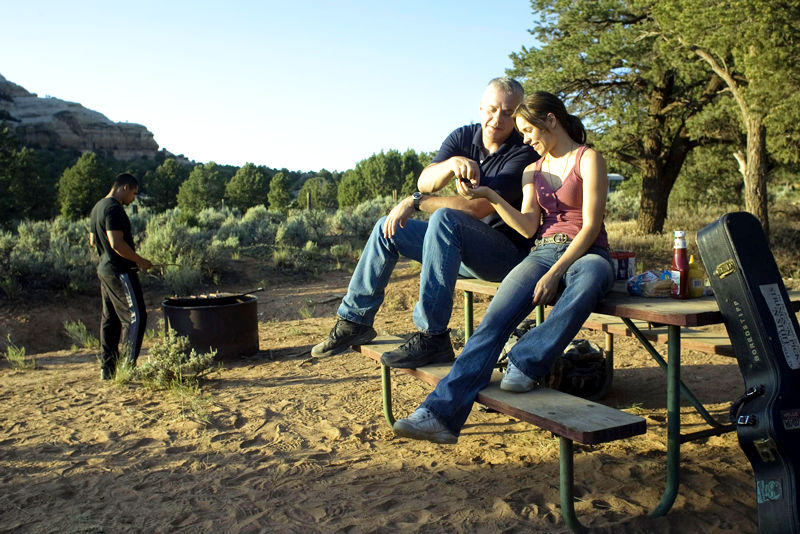
The Lucky Ones (Neil Burger, 2008) Every war, every "police action," seems to have its "re-patriation" film.  World War 1 had The Razor's Edge, 2—The Best Years of Our Lives, VietNam—Coming Home.  The Lucky Ones involves returning troops in the ongoing Iraq War, different from their cinematic (and real) fellow troops in that they're not coming home.  They're on a 30 day leave before going back as part of the "stop-loss" program.  So, this takes place as more of an interruption to their service.  What happens when the environment is not so regimented, or as dangerous.  The three come back from the war altered, and all have specific goals in mind, all of which change when they actually touch boots to ground in the States.

It follows three vets—Cheaver (Tim Robbins), an older sergeant just off his third and last tour, T.K. (Michael Peña), wounded, but gung-ho about going back, and Colee (Rachel McAdams), a neophyte coming back with a mission and a hole in her leg.  They're all damaged: Cheaver is psychologically out-of-whack; T.K.'s purpose is to get back to his fiancee to see if "his equipment" still works after being wounded; Colee wants to find the family of the guy she hooked up with there and return his guitar to them.  Meeting on the flight state-side, they decide to pool resources to get where they're heading.  But, like any road-trip, there are detours, changes of plan, and the occasional loss of bearings.  Stability is not to be found at home for any of them, and the trip only reinforces the perception that their fellow soldiers are the only ones who've "got their back."

Some of the episodes reach a bit, while some feel natural, and mostly the film avoids easy answers—less than it avoids mention of the war, except for a brief opening scene.  The Lucky Ones is less concerned with Iraq, than it is with the soldier's plight, caught in the demilitarized zone of not fitting in either here or there.  Putting them on the road—in transit—reflects that sense of rootlessness (as most road-movies do) that these perpetual soldiers must have that is unique to this era's soldiers.  The film never really tackles that subject head-on, as it almost has a duty to do, instead relying on the various "missions" and destinations to define the characters.  Ultimately, the film has nowhere to go once those stories are used up, and the film ends on a logical melancholy note. 

Where it shines is in the performances.  As with the war, Burger and his co-writer Dirk Wittenborn are quiet about the soldiers, presenting them as rather independent pawns in a much bigger game, their choices on the road sometimes unconventional, and not S.O.P.  But McAdams, Pena, and especially Robbins (this is some of his subtlest work in the past decade and nice to see), breathe a likable humanity into their characters, buffering the moments of manipulation and contrivance.  You like these guys and want them to succeed, even if they are a bit unreadable—enough so that some of their choices surprise, even deep into the movie.  That The Lucky Ones manages to do that is no small accomplishment. 


Friday, September 16, 2011

In the Valley of Elah

This week, we're re-publishing some reviews of the films from the post 9-11 environment.


The Quagmire at Home

This is Paul Haggis' first directorial effort since Crash. In the meantime he wrote three films for Clint Eastwood, The Last Kiss and Casino Royale. He wrote this one for Eastwood, too, but to star in, not direct, which Clintus declined, saying that he's retired from acting. Too bad. This one might have gotten him that Best Actor Oscar. As it is, Tommy Lee Jones has the role, probably does a better job of it, and is certainly deserving of an Oscar. His Hank Deerfield, ex-Army investigator, is a portrait of a guy so meticulous, so disciplined that you wait for him to crack the whole film. It's one of the joys of the film, along with another of Charlize Theron's fine "de-glammed" performances, and Susan Sarandon bringing maximum effort to a small but vital role, all doing great work in a film that tries to be too many things, though it does succeed in many of them.

Part mystery, part war-story, part psychological drama, "Elah," punctuates its story with fragments of media recovered from a cell-phone that, like "Blow-Up" and "The Conversation," give tantalizingly legible glimpses into Deerfield's son's tour in Iraq, and frustratingly opaque clues into his post-Iraq behavior. He's gone AWOL, and Dad Deerfield goes to New Mexico to get to the bottom of it, because that's what he does. Once there, he and a detective try to piece together the evidence, and fight the bureaucratic red tape that hinders their work. Just as Crash owes so much to La Ronde," Elah calls to mind Courage Under Fire, about the death of a Persian Gulf War veteran, where conflicting stories and the subject of post-traumatic stress disorder are dealt with tangentially. Here, it's more overt, but there is an underlying message of the power of doing nothing, or of passing the buck, even ignoring the buck, taking the easy way out, or as the phrase went in Chinatown, the futility of good intentions, when not backed with action. The characters of In the Valley of Elah do "as little as possible" until provoked, challenged and threatened, and its reach is all-pervasive. In the end there is no one perpetrator, but a constant thread of sins of omission, and therein lies the tragedy.

As he did so much in Crash, Haggis telegraphs too many things, with some pretty obvious set-ups that are none too subtle.** The man just doesn't believe in red herrings, and everything gets used. Maybe that's his buttoned-up-in-25-minutes television writing showing. He's become better at cloaking some, though, hiding them in plain sight until they're trotted out for weighty significance. Some will see his final statement as un-American (which they're looking for, I expect), but a careful reading of what's gone before* reveals exactly what he's saying, and its entirely appropriate and, frankly, completely non-controversial. But Haggis seems to invite mis-interpretation. It's what makes him interesting. On top of that, you'll never see better work out of Tommy Lee Jones and Susan Sarandon and their scenes together have a lived-in familiarity and friction that speaks volumes of history and experience. There's some awfully good work in this.

In the Valley of Elah is a solid Matinee.

* Easy for me to say, I take notes!

** According to the Addictionary, this is called "five-shadowing"


The Hurt Locker

This week, we're re-publishing some reviews of the films from the post 9-11 environment.


Moonwalking Through the Kill-Zone
or
"Cravin' a burger. Isn't that strange?"


A lone figure walks down an alien landscape in a space-suit of Kevlar and crash-helmet, his only companions are his breath and his thoughts. Death surrounds him, and he walks towards the only certain death he knows of: a make-shift explosive device, conceived in cunning and hate that he must dis-arm in order to save himself, his comrades, and the watching by-standers, one of whom just might be waiting to explode the device. It is not some forbidden planet, or an anarchic Western town, but it could be. It's downtown Iraq, and it comes down to one man walking and facing his fear.Kathryn Bigelow will probably never be considered a "superstar" director.

That's too bad, because she miles ahead of the so-called "young Turks" doing action movies these days. Instead of following current trends, she adheres to the rock-solid action direction styles of
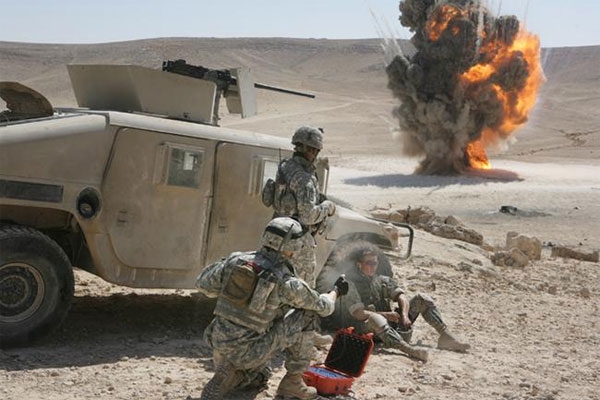
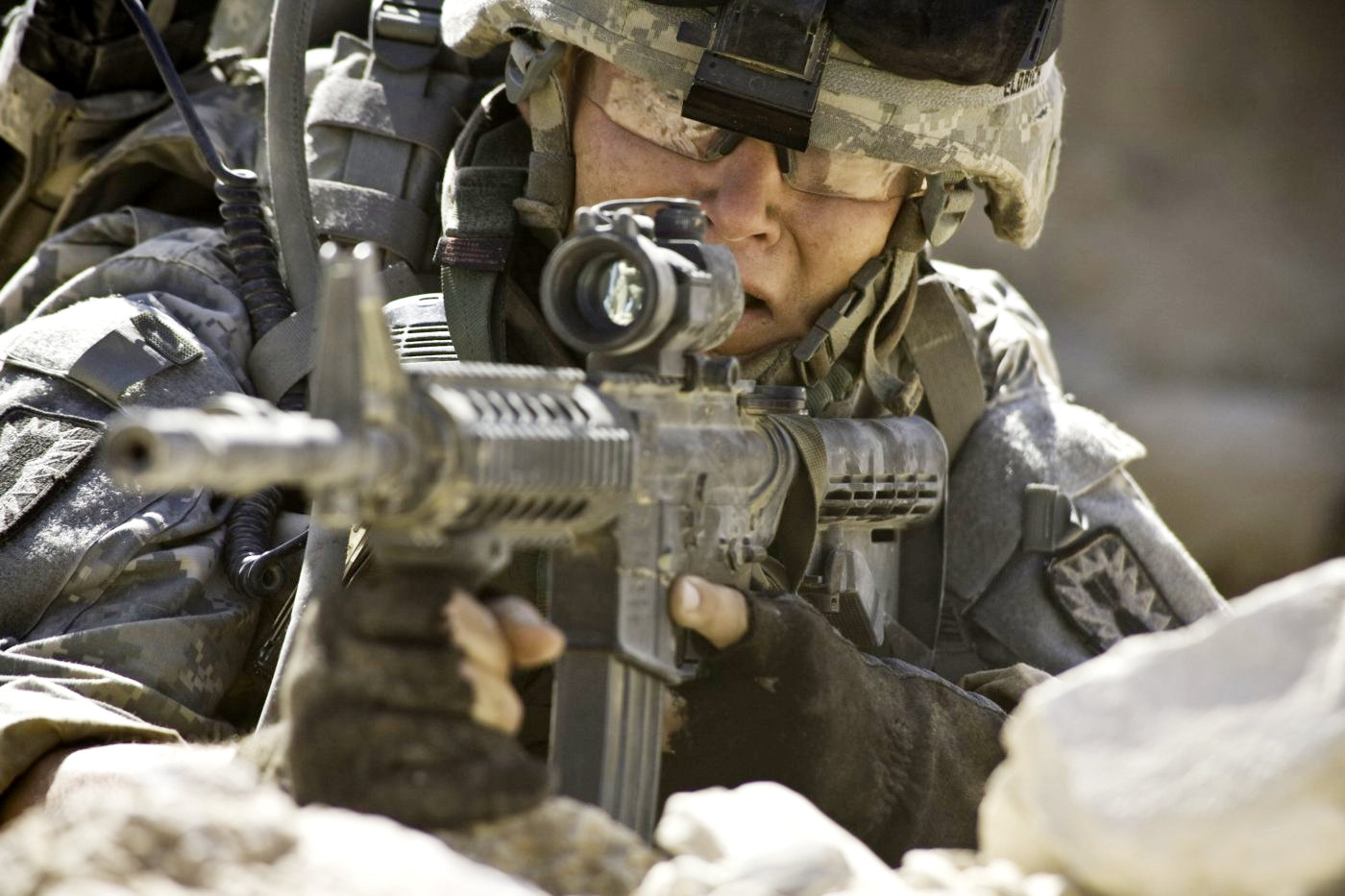
Anthony Mann and Don Siegel: let the audience know what's going on, and one other thing that too many directors these days forget—an audience has to know the territory their heroes walk through to fully present the dangers they face. In The Hurt Locker she may use a hand-held camera a bit too much to re-create the verisimilitude of war-footage, but it comes in handy to lock you into the searching point-of-view of Bravo Company's of Bomb "Tech's" and "Post-Bomb Assessors"—"The Blasters"—in Iraq's Camp Freedom ("They changed it from Camp Liberty to Camp Freedom because Camp Freedom sounds better," says veteran Sergeant JT Sanborn (Anthony Mackie) to the new Team Leader Staff Sergeant William James (Jeremy Renner, looking like a cross between Nathan Fillion and Brendan Fraser, like most of the principals of "The Hurt Locker," his performance is understated and full of small nuances). James is described as "a rowdy boy" and "reckless." Before his arrival, "the suit," that cumbersome Kevlar get-up which would protect anyone but the man who needs it most, has been the last resort in a disarmament situation. But that's not good enough for James. He likes to disarm the things by hand, and collect the odd bit of equipment for a trophy that "could have killed" him. He'll go in with "the suit" first, and puzzle the thing out, something that doesn't win him prizes with his team-mates, especially Specialist Eldridge (Brian Geraghty), because the longer it takes James to disarm a bomb, the more vulnerable his team-mates are to snipers.

It doesn't take long for the team to realize that James loves his work a little too much, and that it may kill them before their tour is up. Bigelow keeps a running track of the "
short-timer" count-down as the situations become more dire and the traps more intricate, electronically and ethically.

War films have gone through a weird evolution from the time they were conscious enough to move beyond the "good guys vs. bad guys" (while still acknowledging that both sides share their share of casualties. But it's been since the Korean conflict that movies started to go deeper into the psychosis of war—not the PTSD issues, but the psychosis of being inside the conflict. One of the counselors at Camp Freedom ineffectually tells Eldridge "You know, this doesn't have to be a bad time in your life." Easy for him to say. All Eldridge can think about is the best outcome of the war—surviving it. And when his orders come down to "Be smart. Make a good decision" it's tough to say what is a good day and what is a bad day. But lately, war-films have taken a look at the man on the line and what makes a good soldier, and it comes down to a blurred combination of self-sacrifice and controlled psychopathy. Whatever the motivations its the results that count. We've seen that theme in Hell is For Heroes, and Patton, Apocalypse Now, The Burmese Harp, Full Metal Jacket, and Flags of Our Fathers. How the soldier compartmentalizes the war experience to survive and even stay sane through the fire determines his ultimate worth as a soldier and as a human being. It is that perspective, of life is brief increments, that keeps a soldier walking alone in The Now, where "The Big Picture" is unseen in the limited view of his path, unknowable and brutally finite—the past a bitter memory, the future an empty promise, and today is walked with the high of High Noon.

The Hurt Locker is a Full-Price Ticket.


Thursday, September 15, 2011

Body of Lies

This week, we're re-publishing some reviews of the films from the post 9-11 environment.

"Killing the Future with the Past"
There have been a great-many films about The Iraq War; emphasis on the "many," not so much on the "great." None have penetrated the box-office top five, and the movie-going public, with a constant dose of it (when things are going badly) on the news, have made the conscious decision to avoid paying attention at every opportunity. It may seem a disparaging thing to note, but, the public seems to have better sense than the government representing it.
Body of Lies with the one-two star punch of DiCaprio/Crowe, under the direction of Ridley Scott did manage to gain an audience (though not enough to topple the reigning champ, Beverly Hills Chihuahua), and it's just as well—it's a summation of just about every "Bush-war" film that has gone before, without adding anything new.

Part of the problem is
Ridley Scott, who more often cares about how his films look than what they say. Part of the problem is William Monahan's script (which covers much of the same ground as the other films dealing with a high-tech war in a low-tech country, where boots on the ground see more than eyes in the sky--it just got there last, is all). And the other problem is that the war has gone on so long, that we might be running out of things to say about it, at least until some of the secrecy veil is lifted about the machinations going on in the marble halls and scrub rooms of Washington and Virginia.

Not to say the film doesn't have a lot to say. At one point--with a tight deadline to meet--I checked my watch to see if the film was about to wrap up, it being so full of incident and detail, and was shocked to see that an hour hadn't even gone by yet. There was still another hour to go! There is such a flood of realistic sounding information that it probably resembles the tsunami of information Homeland Security has to sift through with their Cray's. All of that research, all that sound and fury and the all the movie comes up with is "Tell the Truth."

Thanks. We knew that going in.

The points writer and director make are obvious:
DiCaprio, in the Sandbox, has more of a grasp of what's happening, despite his getting marching orders from puppet-master Crowe in Langley. Scott repeatedly makes the point as DeCaprio curses at Crowe over his ear-bud, while Crowe's character is dealing with domestic needs at home. While Dicaprio's Robert Ferris is doing wet-work, Crowe's Ed Hoffman is SUV-ing the kids to school, with all the icy coolness of the uninvolved. And that happens frequently.

Ultimately, it's a waste of time, and is another of the many Ridley Scott projects that looks good, but doesn't add up to much in the long run. We've seen this story before.

Now, give us a good ending.


Body of Lies is a rental


Wednesday, September 14, 2011

Green Zone

This week, we're re-publishing some reviews of the films from the post 9-11 environment.

"Weapons of Myth Destruction"

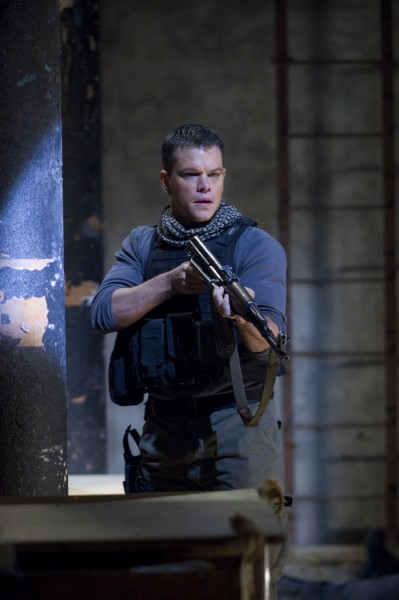
The team that brought you the more popular of the "Bourne" movies (Paul Greengrass, stunt coordinator Dan Bradley and star Matt Damon) basically take the same "run-and-shoot" scenario into the Iraq War in Green Zone—a government operative goes rogue and takes on the higher-ups with something to hide, who are willing to kill him in order to silence him. And just as The Bourne Ultimatum felt like a re-tread of The Bourne Supremacy,  Green Zone has the same worn been-there, fragged-that quality, owing more to tracts like  Body of Lies (which this one closely resembles, despite having an "original" screenplay by Brian Helgeland) and the earlier collaborations of this particular action troika. It's the Iraq War, but without the "shock-and-awe," unless the awe comes from a stifled yawn.
The same issues—the manufacture of intelligence to promote a "sellable" war scenario—are at play in both the Greengrass and Ridley Scott films. The main difference being that this one lands square in the middle of the early "dazed and confused" days of the Iraq War (having just passed its seventh Anniversary) with the first crews of Army inspectors coming up trumps in their search for the legendary Weapons of Mass-Destruction, the Holy Grail of this Crusade. Adapted freely—very freely—from the book "Imperial Life in the Emerald City" (which reads like a book version of the documentary No End in Sight), the screenplay posits American efforts to steam-roll a provisional government into Iraq by propping up their own Iraq partisan (based on Ahmed Chalabi) who hadn't set foot in Iraq for thirty years and was of dubious integrity, and the double-blind of an Iraqi general (played by Yigal Naor), whose reports of destroyed WMD's are falsified by the White House, and the promised assurances of participation in any new government for cooperating are ignored in the process of "De-Ba'athification."* Helgeland took the strategic failings of the Coalition Provisional Authority and used them as background for the cut-and-paste screenplay, constructing an "Army rebel" scenario in which Damon's "Roy Miller" is disgruntled with how his squad is continually sent on bogus WMD searches, chasing wild geese rather than chemical weapons. It becomes clear to the acronym-spewing MOP'd op that something is SNAFU, as the sites they fight to raid appear free of ordinance of any kind...and haven't for a very long time. Miller's investigation with the help of a frustrated CIA agent (Brendan Gleeson) becomes an effort to keep the SNAFU's from becoming FUBAR before he goes Tango Unicorn. Besides the angry and destabilized citizenry, they also have to fight a CPA op hard-wired to the White House (represented reprehensibly by Greg Kinnear) and the Special Forces commander who doesn't ask and doesn't tell, but merely re-loads (the terrific Jason Isaacs, nearly unrecognizable, looking like Bono in fatigues). You can't swing an HD camera (in simulated field-documentary fashion) without coming into conflict with somebody. **

It's one of those trope-heavy screenplays heavy on the "table-turning" dialogue ironically bantered back-and-forth during different stages of the screenplay—the big ones (delivered with the required dripping sarcasm) are "don't be naive," and "you didn't ask to confirm?" Ho-ho! Gotcha. You are so "occupied." These are the small PR victories lost in the cluster of the Iraq War.

It's not that Green Zone is bad. It is quite competent. But it is tired, and tired at its reckless pace feels silly and unnecessary...and a waste of time. Still, far more people will see Green Zone than
No End in Sight, so if the message has to be "Damonized" at least it's doing some good, though in 20/20 hindsight.

Now...about the next one...


Green Zone is a Rental.


* Although the process is a matter of public record as is the Coalition Provisional Authority's dissolving of the Iraqi Army, the "playing" of the general is more akin to President Bush's tactics in dealing with Democratic senators while he was governor of Texas—he'd make promises to get a crucial vote and renege on those promises.

** Like the "Bourne" films and Greengrass' United 93, the film doesn't have a still shot in it, or a held shot of more than four seconds, making Kathryn Bigelow's The Hurt Locker look serene by comparison, but it's not as bad as second-unit director Dan Bradley's work on. Quantum of Solace, which looked like it was filmed from the POV of a Mixmaster set to "discombobulate." The guy's who's turned this sort of stuff into a science is J.J. Abrams, who's designed a personal system for hitting the camera—actually whacking it—in a certain rhythm to give it a "shaky-cam" stutter while letting you follow the action and still identify the participants.


The Kingdom

This week, we're re-publishing some reviews of the films from the post 9-11 environment.

Cries and Whispers

On the American military compound in Rhiyadh, two terrorists command a security vehicle and open up machine gun fire on a family softball game leaving carnage before they are killed. But like the WTC attacks, it's a two-pronged assault, the first wave of terror providing the means for a devastating explosion during the rescue efforts. For four FBI investigators it becomes a personal duty to investigate the scene and find out what happened and who was responsible. They only have five days. They're under constant surveillance by the local police. Their movements are restricted, their presence resented and the attack zone compromised in the clean-up efforts. The only thing they do have is an Exit Strategy, which has been formulated before their arrival, and things have a way of changing. But it's personal, and they have to find a way, doing an impossible task, in an unfamiliar and hostile area, without leaving a trace because it's not exactly sanctioned by the U.S. government. Yeah, good luck with that.

The Kingdom is directed by Peter Berg, whose previous film was Friday Night Lights, a film I greatly admire. Berg shepherded that film over to a fascinating series on NBC, and unlike his previous series "Wonderland," has made it all the way to a second season. He started out as an actor-- was the slightly lump-headed first seduction of Linda Fiorentino in The Last Seduction, and he starred for several seasons on "Chicago Hope," where he first started directing. Berg is a genuine find--an intelligent director who communicates everything-- gives you all you need to know, keeps things logistically decipherable, and lenses with an oblique eye that takes everything in but doesn't beat you over the head with it. An action-director who gives his audience credit for intelligence and propels the film along, trusting that the audience will keep up.

Berg has a flashy cast for "CSI: Rhiyadh" (scripter Matthew Carnehan describes it as "Imagine a murder investigation on Mars") in Jamie Foxx, Chris Cooper, Jennifer Garner and Jason Bateman (as well as Danny Huston, Frances Fisher, and Jeremy Piven--who basically plays his "Entourage" character working for the State department). Everyone's performance is tamped down, but the fact is they're all stars--well, Bateman is there for comedy relief--and unlike the cast of "Friday Night Lights," they stand out like sore thumbs, which actually serves the film well. But the stand-out performance is by Ashraf Barhom, whose Col. Faris Al Ghazi takes his job of providing protection for the team so seriously that he hampers their efforts at every turn. And given that his job is to stand in for the entire Arab world (almost every other local is a bit of a cypher), he carries off the role with a subtlety that doesn't betray the heavy lifting.

Berg has stated that he didn't want to make a "message" film, saying that the ratio for a film to make a point and make an audience is "98% action, and 2% message." That may be overstating the case, as there's a lot more message in the film hidden between the frames. But...though the film does put a face to the Arab world, though it does reflect the heavy-handed presence of America there, though it may bring into sharp focus the folly of having a formalized military presence in a guerilla situation and the dangers that that presence can provide in escalating the conflict--though it may say all these things that point to the folly of invading Iraq, that 98% action still has the effect of having the audience jingo-cheer on the Americans (even with Arab back-up) in a fire-fight in a hotel building. You have to have your message and the action that belies it. That's troubling. But while one contemplates that, the film moves on and delivers a spoken coda that says that, really, we're all not so different after all.

Boo-yah.

"The Kingdom" is a cheap Matinee


Tuesday, September 13, 2011

Traitor

This week, we're re-publishing some reviews of the films from the post 9-11 environment.

"I Wouldn't Make Any Plans, Man..."

Traitor is a taut, tough little thriller about the FBI (yes, the FBI) trying to track down a group of Islamic jihadists with plans to pull off a continuing string of bombings throughout the world. Their focus is one Samir Horn (Don Cheadle), born in the Sudan, and who disappeared while working for the government in Afghanistan. Word is that he found his faith working for the mujahadin, and now he's been tracked selling detonators to a terrorist faction in Yemen.

There, two FBI agents, Clayton (Guy Pearce, this time with a convincing soft Southern accent) and Archer (Neal McDonough) are tracking the faction's movements, and during a raid, Horn is captured, but will not turn over any evidence to help the investigation. In prison, he is doubted by the jihadists as a possible informer to the U.S., and a target by some of the prisoners. Outside, he is not trusted at all, but as long as he's detained, he's not a threat.

Then, he breaks out.

At this point, to reveal any more of the plot might be unfair to anyone who wants to see a well-done "War on Terror" thriller, done in the shakiest "Bourne" style, with powerhouse performances by Cheadle, Pearce, McDonough and Jeff Daniels. Real tension is achieved throughout the story, as the stakes get increasingly higher. And writer-director Jeffrey Nachmanoff, working from a story by Steve Martin* (yes, that Steve Martin) keeps things simple and straight-forward--pretty amazing, given that his last credit was for screen-writing The Day After Tomorrow. Without much on his resume to indicate that he was capable of this, it will be interesting to see what he does in the future.

The other neat thing is seeing Don Cheadle in full "action-star" mode--tight, lean and fast, he pulls off several well-done fight scenes, while never sacrificing the wariness and intelligence in his eyes. At this point, it should be pretty obvious that Cheadle can play just about anything, and have the audience with him the whole way.

"Traitor" is a Matinee


* Sleeping on it, Martin's participation seems apt, rather than surprising. The denouement is the product of a Master of the Absurd, and thinking further on it, in the War on Terror, Absurdism is only a realization away from the insanity of the unthinking zealot. Maybe in the War on Terror, we need fewer strategists and more comedians. "Laugh? I killed 'em!"

No End in Sight

This week, we're re-publishing some reviews of the films from the post 9-11 environment.

"There are 500 ways of doing it wrong, and only 2 or 3 ways of doing it right. Little did we know we'd have to go through all 500 ways."

Charles Ferguson's comprehensive dissection of the Iraq War is as clinical as an autopsy--and just as much fun. It's the only movie in memory that has the bodyguards and security force listed in both the front and end credits. Using news footage from a variety of sources and interviews with a comprehensive number of people who had boots in the sand (but only one of the decision makers whohad their heads there), Ferguson precisely points to the errors made by the bureaucrats in the Bush administration, who made up their minds before they had the facts, and then cherry-picked the ones (however few) that skewed with their assumptions. It's a pattern that has represented this administration from...well, probably from its inception. Rather than look at the facts and draw conclusions (what's called the "scientific" method), these officials use an Academic approach, the lawyer's approach, the PR approach, and sift the facts that much their presumptions. Then to sell it, they spin it with homilies from the glib ("stuff happens!") to the ignorant ("there is no insurgency in Iraq, but there is a high degree of domestic violence") when the results are not what they expected. And the people in charge of carrying out these pipe-dreams are the bureaucrats and neophytes who are owed a favor, and under-perform in times of crisis.

And when they resign under a cloud, they get a medal.

One gets more than a sense of blundering from No End in Sight, one gets a sense of the arrogance in the face of incompetence, and lays blame on four individuals, Bush, Cheney, Rumsfeld and Rice, with able assistance from Paul Wolfowitz, none of whom served in the military, but asked that military to do the impossible while tying their hands.

The interviews are culled from both the U.S. and Iraq, reporters, military, active and retired, grunts and advisors, the haunted looks on their faces and the barely-contained disgust in their tones speak volumes of how success was constantly foiled by the decisions of the Bush administration and its cronies who seemed determined to follow the least effective, most destructive, most expensive path, leaving Iraq with sporadic electricity, water every other day, cities in ruin and a populace half of which is unemployed due to American actions, and the other half subject to violence and the constant threat of kidnapping and desperate to find a solution--any solution. In this chaos, with a voild in leadership, the desire for a strong leader is seen in the fundamentalist clergy, who seem destined to be the next elected leaders and the enemies of the U.S.

"I don't "do" quagmires," says Rumsfeld (twice) in the film. Wrong again. He does them exceedingly well.

No End in Sight> is a must-see, because it goes beneath the headlines that have hardly explained the war to the American public. And it goes a long way in explaining how corruption of the political system can lead to high levels of incompetence, as has been seen with both Iraq and New Orleans. And it does so without any snarky sarcasm, or cheap shots (at least none that aren't provided by the Administration's own words and actions). But there's no audience for the information. In the huge auditorium where I saw the film, there were only two people: me, and another guy.


No End in Sight is a full-price ticket.


Wednesday, January 26, 2011

The Lucky Ones


The Lucky Ones (Neil Burger, 2008) Every war, every "police action," seems to have its "re-patriation" film.  World War 1 had The Razor's Edge, 2—The Best Years of Our Lives, VietNam—Coming Home.  The Lucky Ones involves returning troops in the ongoing Iraq War, different from their cinematic (and real) fellow troops in that they're not coming home.  They're on a 30 day leave before going back as part of the "stop-loss" program.  So, this takes place as more of an interruption to their service.  What happens when the environment is not so regimented, or as dangerous.  The three come back from the war altered, and all have specific goals in mind, all of which change when they actually touch boots to ground in the States.

It follows three vets—Cheaver (Tim Robbins), an older sergeant just off his third and last tour, T.K. (Michael Peña), wounded, but gung-ho about going back, and Colee (Rachel McAdams), a neophyte coming back with a mission and a hole in her leg.  They're all damaged: Cheaver is psychologically out-of-whack; T.K.'s purpose is to get back to his fiancee to see if "his equipment" still works after being wounded; Colee wants to find the family of the guy she hooked up with there and return his guitar to them.  Meeting on the flight state-side, they decide to pool resources to get where they're heading.  But, like any road-trip, there are detours, changes of plan, and the occasional loss of bearings.  Stability is not to be found at home for any of them, and the trip only reinforces the perception that their fellow soldiers are the only ones who've "got their back."

Some of the episodes reach a bit, while some feel natural, and mostly the film avoids easy answers—less than it avoids mention of the war, except for a brief opening scene.  The Lucky Ones is less concerned with Iraq, than it is with the soldier's plight, caught in the demilitarized zone of not fitting in either here or there.  Putting them on the road—in transit—reflects that sense of rootlessness (as most road-movies do) that these perpetual soldiers must have that is unique to this era's soldiers.  The film never really tackles that subject head-on, as it almost has a duty to do, instead relying on the various "missions" and destinations to define the characters.  Ultimately, the film has nowhere to go once those stories are used up, and the film ends on a logical melancholy note. 

Where it shines is in the performances.  As with the war, Burger and his co-writer Dirk Wittenborn are quiet about the soldiers, presenting them as rather independent pawns in a much bigger game, their choices on the road sometimes unconventional, and not S.O.P.  But McAdams, Pena, and especially Robbins (this is some of his subtlest work in the past decade and nice to see), breathe a likable humanity into their characters, buffering the moments of manipulation and contrivance.  You like these guys and want them to succeed, even if they are a bit unreadable—enough so that some of their choices surprise, even deep into the movie.  That The Lucky Ones manages to do that is no small accomplishment. 


Tuesday, March 23, 2010

Green Zone

"Weapons of Myth Destruction"

The team that brought you the more popular of the "Bourne" movies (Paul Greengrass, stunt coordinator Dan Bradley and star Matt Damon) basically take the same "run-and-shoot" scenario into the Iraq War in "Green Zone"—a government operative goes rogue and takes on the higher-ups with something to hide, who are willing to kill him in order to silence him. And just as "The Bourne Ultimatum" felt like a re-tread of "The Bourne Supremacy, "Green Zone" has the same worn been-there, fragged-that quality, owing more to tracts like "Body of Lies" (which this one closely resembles, despite having an "original" screenplay by Brian Helgeland) and the earlier collaborations of this particular action troika. It's the Iraq War, but without the "shock-and-awe," unless the awe comes from a stifled yawn.

The same issues—the manufacture of intelligence to promote a "sellable" war scenario—are at play in both the Greengrass and Ridley Scott films. The main difference being that this one lands square in the middle of the early "dazed and confused" days of the Iraq War (having just passed its seventh Anniversary) with the first crews of Army inspectors coming up trumps in their search for the legendary Weapons of Mass-Destruction, the Holy Grail of this Crusade. Adapted freely—very freely—from the book "Imperial Life in the Emerald City" (which reads like a book version of the documentary "No End in Sight"), the screenplay posits American efforts to steam-roll a provisional government into Iraq by propping up their own Iraq partisan (based on Ahmed Chalabi) who hadn't set foot in Iraq for thirty years and was of dubious integrity, and the double-blind of an Iraqi general (played by Yigal Naor), whose reports of destroyed WMD's are falsified by the White House, and the promised assurances of participation in any new government for cooperating are ignored in the process of "De-Ba'athification."* Helgeland took the strategic failings of the Coalition Provisional Authority and used them as background for the cut-and-paste screenplay, constructing an "Army rebel" scenario in which Damon's "Roy Miller" is disgruntled with how his squad is continually sent on bogus WMD searches, chasing wild geese rather than chemical weapons. It becomes clear to the acronym-spewing MOP'd op that something is SNAFU, as the sites they fight to raid appear free of ordinance of any kind...and haven't for a very long time. Miller's investigation with the help of a frustrated CIA agent (Brendan Gleeson) becomes an effort to keep the SNAFU's from becoming FUBAR before he goes Tango Unicorn. Besides the angry and destabilized citizenry, they also have to fight a CPA op hard-wired to the White House (represented reprehensibly by Greg Kinnear) and the Special Forces commander who doesn't ask and doesn't tell, but merely re-loads (the terrific Jason Isaacs, nearly unrecognizable, looking like Bono in fatigues). You can't swing an HD camera (in simulated field-documentary fashion) without coming into conflict with somebody. **

It's one of those trope-heavy screenplays heavy on the "table-turning" dialogue ironically bantered back-and-forth during different stages of the screenplay—the big ones (delivered with the required dripping sarcasm) are "don't be naive," and "you didn't ask to confirm?" Ho-ho! Gotcha. You are so "occupied." These are the small PR victories lost in the cluster of the Iraq War.

It's not that "Green Zone" is bad. It is quite competent. But it is tired, and tired at its reckless pace feels silly and unnecessary...and a waste of time. Still, far more people will see "Green Zone" than "
No End in Sight," so if the message has to be "Damonized" at least it's doing some good, though in 20/20 hindsight.

Now...about the next one...


"Green Zone" is a Rental.

* Although the process is a matter of public record as is the Coalition Provisional Authority's dissolving of the Iraqi Army, the "playing" of the general is more akin to President Bush's tactics in dealing with Democratic senators while he was governor of Texas—he'd make promises to get a crucial vote and renege on those promises.

** Like the "Bourne" films and Greengrass' "United 93," the film doesn't have a still shot in it, or a held shot of more than four seconds, making Kathryn Bigelow's "The Hurt Locker" look serene by comparison, but it's not as bad as second-unit director Dan Bradley's work on "Quantum of Solace," which looked like it was filmed from the POV of a Mixmaster set to "discombobulate." The guy's who's turned this sort of stuff into a science is J.J. Abrams, who's designed a personal system for hitting the camera—actually whacking it—in a certain rhythm to give it a "shaky-cam" stutter while letting you follow the action and still identify the participants.

Tuesday, August 4, 2009

The Hurt Locker

Moonwalking Through the Kill-Zone
or
"Cravin' a burger. Isn't that strange?"


A lone figure walks down an alien landscape in a space-suit of Kevlar and crash-helmet, his only companions are his breath and his thoughts. Death surrounds him, and he walks towards the only certain death he knows of: a make-shift explosive device, conceived in cunning and hate that he must dis-arm in order to save himself, his comrades, and the watching by-standers, one of whom just might be waiting to explode the device. It is not some forbidden planet, or an anarchic Western town, but it could be. It's downtown Iraq, and it comes down to one man walking and facing his fear.

Kathryn Bigelow will probably never be considered a "superstar" director.

That's too bad, because she miles ahead of the so-called "young Turks" doing action movies these days. Instead of following current trends, she adheres to the rock-solid action direction styles of
Anthony Mann and Don Siegel: let the audience know what's going on, and one other thing that too many directors these days forget—an audience has to know the territory their heroes walk through to fully present the dangers they face. In "The Hurt Locker," she may use a hand-held camera a bit too much to re-create the verisimilitude of war-footage, but it comes in handy to lock you into the searching point-of-view of Bravo Company's of Bomb "Tech's" and "Post-Bomb Assessors"—"The Blasters"—in Iraq's Camp Freedom ("They changed it from Camp Liberty to Camp Freedom because Camp Freedom sounds better," says veteran Sergeant JT Sanborn (Anthony Mackie) to the new Team Leader Staff Sergeant William James (Jeremy Renner, looking like a cross between Nathan Fillion and Brendan Fraser, like most of the principals of "The Hurt Locker," his performance is understated and full of small nuances). James is described as "a rowdy boy" and "reckless." Before his arrival, "the suit," that cumbersome Kevlar get-up which would protect anyone but the man who needs it most, has been the last resort in a disarmament situation. But that's not good enough for James. He likes to disarm the things by hand, and collect the odd bit of equipment for a trophy that "could have killed" him. He'll go in with "the suit" first, and puzzle the thing out, something that doesn't win him prizes with his team-mates, especially Specialist Eldridge (Brian Geraghty), because the longer it takes James to disarm a bomb, the more vulnerable his team-mates are to snipers.

It doesn't take long for the team to realize that James loves his work a little too much, and that it may kill them before their tour is up. Bigelow keeps a running track of the "
short-timer" count-down as the situations become more dire and the traps more intricate, electronically and ethically.

War films have gone through a weird evolution from the time they were conscious enough to move beyond the "good guys vs. bad guys" (while still acknowledging that both sides share their share of casualties. But it's been since the Korean conflict that movies started to go deeper into the psychosis of war—not the PTSD issues, but the psychosis of being inside the conflict. One of the counselors at Camp Freedom ineffectually tells Eldridge "You know, this doesn't have to be a bad time in your life." Easy for him to say. All Eldridge can think about is the best outcome of the war—surviving it. And when his orders come down to "Be smart. Make a good decision" it's tough to say what is a good day and what is a bad day. But lately, war-films have taken a look at the man on the line and what makes a good soldier, and it comes down to a blurred combination of self-sacrifice and controlled psychopathy. Whatever the motivations its the results that count. We've seen that theme in "Hell is For Heroes," and "Patton," "Apocalypse Now," "The Burmese Harp," "Full Metal Jacket," and "Flags of Our Fathers." How the soldier compartmentalizes the war experience to survive and even stay sane through the fire determines his ultimate worth as a soldier and as a human being. It is that perspective, of life is brief increments, that keeps a soldier walking alone in The Now, where "The Big Picture" is unseen in the limited view of his path, unknowable and brutally finite—the past a bitter memory, the future an empty promise, and today is walked with the high of High Noon.

"The Hurt Locker" is a Full-Price Ticket.