Showing posts with label Documentary. Show all posts

Saturday, July 13, 2013

Stories We Tell

The Truths About Reality
or 
Who's Your Daddy?

Director Sarah Polley's third film Stories We Tell is a documentary all about her, and in which she barely appears.  In telling the story of her life, she manages to do it in the best way—by mentioning everybody else in her life, making her an observer, reporter, and a happy, but no less disinterested accident in the process. But, it is also one of a handful of films that dares to consider truth, and what its relationship is to reality.

The project started with a family joke (and, by the way, ends with one of the best last lines in a movie from the past couple years or so)—that Sarah looked nothing like her father.  When she was born, her mother Diane would say, probably too much and too loudly, "Look, she's a redhead.  How did that happen?"  And there was rampant speculation, never uttered in the family until every one had grown up, that maybe Sarah's dad wasn't...her dad.

So, what's the story?

We meet, through interviews and home movies (mixed in with Polley-generated 8mm simulation/recreations, which...when you finally realize it...makes it feel like cheating, but one gets over it) with friends and family of her parents, who give us some of the story.  Not all of it, and only what they know, their impressions of it, and their opinions.  Diane and Michael Polley were both former actors who came across each other in the Canadian theater circuit, fell in love and got married—his first, her second.  Despite the similarities in trade, they couldn't be less alike—she was effusive, bouncy, the life of the party and a general flibbertigibbit; he was studious, thoughtful, writerly, and maybe too dull for her.  When they married, she stayed home with the kids, and he quit acting to support them.

The marriage hit a rough patch, and Diane took an acting gig in Toronto and was gone for several weeks.  Michael went to visit and see the play, and they rekindled their marriage—when Diane came back home, she was pregnant with Sarah.  

The view-points vary greatly—the siblings are irreverent, but respectful of their mother, who died of cancer very young, and in the film feels like a free spirit in every sense of the word; the father, befuddled but not really caring because he loves his kids, his wife and it is what is; friends worry how much they're revealing about Diane, and the stories stay pretty consistent with minor deviations, except for one important detail—they don't know what happened, and can only offer idle speculation.  They movie comes down to a conclusion—Sarah wasn't biologically of Michael, and it must have been one of her co-stars in the play—suspicion falling immediately on the one redhead in the cast. 

But, that's just the beginning of the film, and the "hook" of it.  What we get is along the lines of the many sides and opinions of Citizen Kane, but the focus being Sarah's mother—whose effervescence belies a complexity and back-story that defies it.  The impression one initially gets of her as flighty, darkens and dissipates when one sees her past, and the figure of fun, often dismissed in the interviews with "well, that was Diane..." becomes one you can understand, empathize with, and, ultimately, root a bit for.  There's a video clip of her (the real one, not the recreation) singing a satire version of "Ain't Misbehavin'" (called "I'm Misbehavin'") sung with a somewhat "can't help it" ruefulness, that's charming.

But, it doesn't stop there.  Once we know best who's Father, it becomes an interesting tale of "who should tell this story/who owns it?" especially considering the effect it might have on the survivors, and how the participants feel about it and "What It All Means."  The film becomes Polley's attempt to "tell all sides" even though there are those who think it should be focused on one aspect, with a singular point of view.  Polley, the subject, has no axe to grind here, as she wasn't around when all this happened, and is familially invested in...everybody.  She displays the same sensitivity and odd humor that she brings to her fictional films, and her editing choices—what she shows and doesn't show, and the way she juxtaposes and does a "he said/she said" with the interviews—makes the film itself fun to watch, despite the twists and turns of the narrative.  Interesting, fascinating, and though-provoking.

Stories We Tell is a Matinee.


Sarah Polley—the origin story

Friday, October 12, 2012

Garbo the Spy

Garbo the Spy (Edmon Roch, 2010) Back to reality, but still dealing with spies, so "reality" is relative.  And the time-frame is similar—just as James Bond's creator, Ian Fleming, drew inspiration from his work with the OSS during the second World War, so, too comes this documentary—a true account of the work of Juan Pujol Garcia, a real-world double agent, who worked for the Nazis first, then after establishing credibility with them as a British-based spy (although he was actually living in Lisbon), offered his services to the Allies "for the good of humanity," and with the help of the OSS, creating for the Germans a funded network of 27 agents—all fictional.  To the Reich, he was known as "Arabel." To the West, he was "Garbo."  

His accomplishments were many.  First, he siphoned off considerable German funds to pay for his "network"—even establishing a pension for one of his phantom agents who had "died."  He was also able to send duplicate messages to both sides, allowing the British cyphers at Bletchley Park to have a "Rosetta stone" with which to check their round-the-clock de-coding efforts—an almost impossible task as the German changed their codes daily—and Garbo's writing style was so formal and distinct, his messages were easily identifiable.

But his coup was in spreading disinformation, the most successful instance being a big one—he managed to convince the Nazi's, particularly the CIC, Field Marshall von Runstedt, that the invasion of Europe would take place at the Pas de Calais under the command of the disgraced General Patton, rather than its actual location of Normandy—a ruse that was so successful, it was still believed in August of 1944, two months after D-Day, delaying an increased resistance to the Allied advancement to Berlin.  That's some trust.

The documentary is a potpourri of information—not unlike the hodge-podge of sources "Arabel" would cook up in his work—talking head interviews, vintage war-time footage, and recreations from such films as The Longest Day, Patton—big theater results of Garbo's deceptions.  The tone is slightly cheeky, with an emphasis on pulled quotes, especially from films like Our Man in Havana, Mata Hari, and an obscure Leslie Howard film called Pimpernel Smith, Howard being an impetus to the counter-intelligence efforts—his death in the war effort was both a cautionary tale and an exposure of Allied spy efforts.  Garbo is entertaining, as long as one can enjoy the breezy tone without darkening it with thoughts of the wholesale slaughter going on at the time.  But it is interesting in its tale of how world events can be shaped by one man with a lie and the razor's edge that is walked in times of conflict.


Juan Pujol Garcia or "Arabel," as he was known to the Germans

Tuesday, September 11, 2012

Farenheit 9/11


Farenheit 9/11 (Michael Moore, 2004) "Everyone’s getting along just fine backstage, the Teamsters are helping Michael Moore into the trunk of his limo,” cracked Steve Martin after Moore won Best Documentary at the 2002 Oscars (for Bowling for Columbine) and used his speech (accompanied by all the Documentary nominees) as a passionate speech against the Iraq War. The "Shame on you, Mr. Bush" speech was then expanded into this film, which debuted before the 2004 election, but didn't seem to make a dent in Bush's re-election over the swift-boated John Kerry.

It might have been the tone. Rather than educate or inform, Moore's documentary was a bit of a rant, although delivered in a calm, soothing, particularly patronizing tone. For all the juxtaposition of images—of Donald Rumsfeld complimenting the precision of aerial strikes while an Iraqi child's head is being sewn up, President George Bush making a "kill the terrorists" comment to the Press, and then (without an edit, mind you) returning to his golf game ("Now watch this drive"), the excruciating classsroom reading of "My Pet Goat" after being informed that "America is under attack" (Moore's narration muses: "Was he thinking, "I've been hanging out with the wrong crowd. Which one of them screwed me? Was it the man my daddy's friends delivered a lot of weapons to? Was it that group of religious fundamentalists who visited my state when I was governor? Or was it the Saudis? Damn, it was them.  Better blame it on [Saddam Hussein]")—Moore's narration hammers the point home, but comes off as snarky and maybe a little too calculating for a moment rife with unanswered questions and the burden of responsibility that must have weighed heavily on him.  He might also have thought of his personal safety—"they can't find me in a schoolhouse"—of who in D.C. was in charge, and if the attacks were limited to New York.  Or he might have just been contemplating the unbelievability of it (as we all did), even though there was a memo on Condoleeza Rice's desk at that moment—one of several, maybe—warning of an attack but not sure when.

Questions linger as History moves forward: the whisking away of Bin Laden's family members out of the States on the last flights out before the air-travel embargo (Why them? How did it happen so fast, and who had the foreknowledge that Bin Laden, specifically, was behind it that the families needed to be evacuated?  Where are they now?); the rush to Afghanistan to upend the tentative stranglehold of the Taliban who were providing training camps to Al Qaida (Understandable, given the intel and lack of cooperation coming out of the place); the wholly unnecessary push to Iraq to depose Saddam Hussein on trumped-up WMD suspicions (there have been no repercussions for that or the cherry-picked evidence); the decision to support Pakistan (ignoring the democratically-voting India, who was already an ally) when that country seemed unable and unwilling to control its borders, and were ultimately revealed to be harboring Bin Laden.  Whose decision was that?  Is that where Bin Laden's family fled to—or back to Saudi Arabia—did we know this?  Is this why—at one point—Bush stated that finding Bin Laden was no longer his highest priority?  One can spout maxims like "keep your friends close but your enemies closer" but at what point do you admit your alliances are stabbing you in the back?

The images that stick, though, are the war profiteers who saw a great opportunity for making big bucks once the soldiers who'd fought and bled to clear the area and make it safe for the carpet-baggers to exploit.  What's happened to those investors?  What's happening now in Iraq?  Are the lights on?  Is there potable water? Is there any evidence of the U.S. doing any good besides the scars and rubble?  In this election year, we're being asked:  Are we better off?  Shouldn't we also be asking—are they?  Do we just make a mess and have no moral obligation to cleaning it up?  And if anybody has profited from this, at the expense of the lives of our soldiers, why aren't they in jail?

But, back to Farenheit 9/11: the less important issue is should Moore's work be considered under the category of documentary.  To be sure, there is no objectivity in documentaries—every shot, every edit is informed and influenced by some editorial perspective—but Moore's out put is more in the line of illustrated advocacy, starting with a point of view and the content cherry-picked (that term again) to enforce that point (rather than letting the content drive the conclusions).  Moore's staged interviews and stunts are all strategically geared to his theses.  At that point, his films are no longer documents, but propaganda.  So what, you say?  It's an important distinction if you're searching for truth—to be informed—rather than being told what to think.


Tuesday, July 10, 2012

Directed by John Ford

Directed by John Ford (Peter Bogdanovich, 1971, 2006) Bogdanovich's primer is a "viewer's digest" of some big things that that made John Ford such a powerful director not only in individual films, but also across a career of experience.  Generous clips from throughout his acreer illustrate points, punctuated by talking head clips from the '71 version including Ford himself (who is not very helpful, to say the least—by saying the least*—and is deliberately dismissive of the doing the whole critical analysis thing, much like a comedian hates to explain a joke, or a magician a trick), John Wayne, Henry Fonda, and James Stewart.  The 2006 update folds in Harry Carey, Jr., Maureen O'Hara, and analysis from Clint Eastwood, Martin Scorsese, Walter Hill, and Steven Spielberg, as well as Bogdanovich.  

The update has everything from the original re-jiggered to add more points, but there's more of a "legacy" feel to the thing, now, as the casts Ford depended on have dwindled—Ford was still alive during the first version—and so the next generation who grew up and learned their craft sitting in the theater watching Ford's images talk about "what John Ford means to me."  Also, as the man is gone now, there's a bit more psychological analysis and more delving into the man's irascible personality, already on full display in his interview.


But there is one troubling aspect to this "new" version, something that stuck in my craw when I saw it (and no doubt would result in Ford caning Bogdanovich if he got wind of it).  There is a brief (very brief) examination of Mary of Scotland, Ford's only film with Katherine Hepburn, and the subject of much speculation over what their relationship was.  A sound clip is played of Hepburn's visit to Ford days before his death.  The tape was allowed to run continuously, and their parting words to each other are played, words that they had no way of knowing were being recorded, and words that might not have been said if known they'd been overheard (Ford specifically asks her "Are they gone?").  It's nothing scandalous or huge.  Ford merely says "I love you," and Hepburn says "it's mutual."  But it feels like a violation of the departed by the parties that recorded it and who have re-presented it.  And far too much is made of it (Really?  It was the inspiration for the names of O'Hara's and Wayne's characters in The Quiet Man?) in a gossipy, speculative fashion. These were, after all, words from people who must have known they'd never see each other again, and it's nice and it's lovely. But it's beneath the film, beneath Bogdanovich, and undercuts whatever scholarly impact the film might otherwise enjoy to make anything more of than the sweet parting gesture it is.  The worst part is...there's no one to rebut, no one to protest, no one to defend...or even better yet, to correct the speculation. Even Ford's maxim of "When the legend becomes fact, print the legend" doesn't cover this.

That aside (and it's my quibble, really), it's an invaluable first toe-dip into the films of Ford, and enriches the experience and appreciation of every film of his seen afterwards.  One thing Bogdanovich did right (besides getting Turner Classic Movies to bank-roll it, so more people would see it, the various clips from many sources being very expensive) is he kept the original's essential narration by Orson Welles, Ford fan and student.   The voices and faces and memories out of the past have as much weight and bearing as the films do, reverberating throughout history and time, feeling immortal and universal.


*

Wednesday, June 27, 2012

Hot Coffee

A Tort is a Tort (in Court, in Court)
Without It, You Have No Recourse (Of Course)
Your Legal Rights were Bought By Force
By the Corporate Life We've Led

or

"Warning: Do Not Throw Out Baby With Bath-water."


Just because you're paranoid doesn't mean they're not out to get you.  And even if you poo-poo "conspiricism," doesn't mean there aren't organized efforts to circumvent government statutes and foundations.

Like "inalienable" rights.  Or the right to confront your accuser.

Hot Coffee is a fascinating, if scalding, little documentary that got sold to HBO, and slowly, but surely, is making its way around to theaters.  It's something of a "must-see," not only for how it dispels the simplified myths we're being sold by playing on our emotions (and pocketbooks), but also how that short-term presentation (dare I call it a "fiscal" view?) is crumbling our basic rights for "the bottom line."  It's about the corporately structured efforts by our business leaders to quash an individual's rights to sue corporations in court for harmful practices that affect lives.  The title derives from the case of Stella Liebeck, whom you might not have heard of, but you certainly know her court case.  It's the poster-child for the tort reform movement and Liebeck has been villified by the corporate world after having the temerity to sue McDonald's Corporation for damages after spilling hot coffee in her lap.*

Just the mention of it probably creates judgments in your mind: "Well, she bought the coffee;" "Of course, it's going to be hot;" "what's she drinking coffee in a car for?"  All legitimate questions and all answered in the movie.  But, like any court-case, decisions should be based on facts, and not the impressions given in a 10 second news-"blurb."  And the evidence is there, in the court records, the hospital procedures, the photographic evidence (which is appalling), and the corporations' own history (700 previous complaints of scalding and burns).  It's why a jury of Liebeck's (and your) peers awarded her 2.75 millions dollars.  She didn't ask for it.  She asked for McDonald's to pay for her skin graft procedures (yes, the burns were that severe).  The jury awarded her that sum by taking a minute percentage of McDonald's coffee sales profits and giving her that.  It just so happens McDonald's sells a LOT of coffee.  The courts further reduced that amount to 1.25 million, and eventually Liebeck and McDonald's reached their own agreement—never revealed—but the damage on all sides was done; the clown at McDonald's had to pay up and the old lady got burned in the court of public opinion—through no fault of her own.

But, it set up an endless potful of corporations (and the politicians funded by them) to call for tort reform limiting the damages a plaintiff can win in such lawsuits.  It was one of the rallying cries of George W. Bush's political career (with the help of political weasel, Karl Rove) while first running for Governor of Texas, then President.  It set up an all-out assault on the checks and balances of the court system, in which courts were stacked in favor of corporate interests (courtesy of Rove and his cronies flooding out-of-state monies to local judicial campaigns) and the instigation of corporations to fill their legal contracts with stipulations for settling issues through "mandatory arbitrations," rather than the courts—the "arbitrator" hired by the corporation, thus making them a client looking for return business.  Good luck with that process.

Scattered throughout the doc are man-on-the-street interviews, there mostly to show everyday folk's ignorance of the situation ("A tort?  It's a pastry, right?"), and it's understandable.  Everyone hears about frivolous lawsuits, and few—except those addicted to playing the lottery—like them, thinking that the costs get pushed onto them, by rising costs due to crippling judgments.  It does.  But it will, anyway.  If the corporations don't dish out the funds to cover their negligence, it inevitably turns into a Medicaid case—Medicaid, being paid by you, the taxpayer.  You pay either way.  And claims about tort reform stopping, and even the decreasing the costs of medical insurance hasn't been born out in practice; the state of Texas which, under George Bush, rushed to tort reform and damage caps, has had just as many rate increases and is on a par with non-reform states.  You pay either way.

Nobody's saving money here.  Nobody benefits except the corporations who pocket the savings garnered by tort reform, and still raise rates.  Nice little business you got there.

And the public still buys what the corps are selling.  As I said, nobody likes the dumb law-suits.  Until they're the ones who get caught in the gears.  One of the interviewees ruefully admits to voting for tort reform in his state, only to find out that it affected him when he was in crisis.  And we're all affected by it: next time you get a contract for your cell phone, read—actually read—the terms and conditions, or look at your next job application to see if there is a mandatory arbitration clause.  More likely than not, it's there.

So, be careful with that coffee.  One way or another, you'll get burned.

Hot Coffee is a Full-Price Ticket (but in the interest of "full disclosure, your honor, I saw it for Free).


* The tort reformers might have been better off using the guy who sued McDonald's because eating their stuff made him fat.  Some good came of it—you'd've had to pry caloric information out of restaurants from their cold, dead, grease-encrusted fingers if he hadn't—but I think the whole thing would've been solved if the judge just told the guy "Why don't you keep your mouth shut?"  (Or go to another restaurant, since he always had one thing corporations would LOVE to take away from us—choice).

Friday, June 1, 2012

Bully

The Bully Pulpit
No man is an island,
Entire of itself.
Each is a piece of the continent,
A part of the main.
If a clod be washed away by the sea,
Europe is the less.
As well as if a promontory were.
As well as if a manor of thine own
Or of thine friend's were.
Each man's death diminishes me,
For I am involved in mankind.
Therefore, send not to know
For whom the bell tolls,
It tolls for thee.

John Dunne

Bully dredged up such feelings in me, things I hadn't felt in years.  The documentary, which follows several kids (hopefully surreptitiously, I worried that the cameras would just make their situations worse) through their days of being messed with, hassled, punched, tortured, abused by their erstwhile peers in school, recalled my own struggles in school.  A late bloomer, a scrawny kid who always looked too young for whatever grade I was in, I had my share of bullying, frequently by the low members of totem poles of cliques, the low hanging fruit of the popular gangs, the pilot fish, the bottom-feeders of the jocks, the shosh's, who couldn't punch their way up, and so punched their way down.  It always flows downhill.

The kids in the films are solitary, ill-defined.  Not really excellent at things, and maybe at the wrong things.  They're "weird."  And so they're pushed and kicked further into their roles, segregated, marginalized.  Food is stolen from their lunch trays.  Pushed out of chairs.  They're punished for just existing, for taking up space, breathing the same air.

A couple of them find Final Solutions for remedying those situations, leaving devastated heart-broken parents, who find it in themselves to fight back for their absent kids, against the institutions that allowed it, the thugs that took advantage of it, and the attitude that promoted it.  They've gone through all the grief steps of Kubler-Ross...except for one—acceptance.  The kids shouldn't have died, should have spoken out.  But shame, learned helplessness, and depression prevented it.  They never got out of the stage of self-blame, and their only solution was to eliminate the problem—themselves (in their mind)—and in so doing, end their pain.

A good night's sleep couldn't cure it.  Talking it out would have brought embarrassment and no solutions—they would have faced the same stone walls their older and wiser parents can't negotiate after their deaths.  They just took it...until they could take no more.

Efforts like "The Bully Project," and "It Gets Better" and other support systems can change the attitude of the afflicted to a limited degree...but not the attitudes of the afflicting.  That would be nearly impossible; there is no listening to reason for something that can't be defended.

I related.  I was picked on in school (although nothing to what is displayed in Bully).  To cope, I developed a wicked sense of humor—sardonic, and barbed if it needed to be.  I gravitated towards others who stood apart from the "A-Team" and formed a posse of sorts.  There's safety in numbers.  I developed a passive-aggressive attitude, combined with a quick temper, mercurial, fast and over-the-top, partially because it was so repressed and pent-up, but also because it was efficient.  If I was in trouble, it would flash, and if that didn't work, I'd run.  I also developed a chip on my shoulder and an effective sparking glare that would scare people, even girlfriends.  I'm a result of that bullying and the frustration in handling it (or not).  I've mellowed over the years.  But it's still there, under the surface, buried in my thoughts.  Long after the names of the bullies have left my mind, I still remember the slights and how I dealt with them.  I've developed the attitude to just not interact and I still do.  Life is short.  Why waste it in frustration?  Why waste it at all?  I've put away lots of childish things, but the armor developed by the bullying still remains, dormant, but a part of me.

Dormant, maybe, but Bully dredged all this up.  I won't be seeing it again.

Bully is a Rental.

Thursday, May 24, 2012

The Wrecking Crew! (2012)

Unsung Artists of Note
or
Who the Hell Played It

They're the recording artists you don't know.  The hit-makers. The band-members who never got credit.  The recording artists who never got royalties. The ones who didn't tour (although some did). The ones who made The Sound.  

You could call them The Beach Boys or The Monkees, Phil Spector's Wall of Sound, The Markettes, The T-Bones, The Byrds, The Tijuana Brass, Buffalo Springfield, The Association, The Mamas and the Papas, because they were playing the instruments for the recordings for all those groups.

They're the session musicians who walked in, got the sheet-music and made them sing through their playing, their economy, their versatility, and their incredible talent.  Then, they got paid, walked out, and went to their next gig at another studio.

But, they provided the tightness of the arrangements of "Good Vibrations," the thumping bass of "The Beat Goes On" and "These Boots Are Made for Walkin,'" the sass in the sax for "The Pink Panther Theme," the bristling guitars of the "Bonanza" Theme, "Batman," the "Mission: Impossible" Theme, and so many more, their style and fingerprints are etched in those sounds that are the authentic vibes that echo in our memories as "authentic."  And in so many cases, their sounds are irreplacable, unmatchable, unique.  Their breath and their fingerprints are all over the music of the songs of the '50's and the '60's.

And nobody knows their names.

Hal Blaine.  Karen Caye.  Plas Nelson.  Tommy Tedesco.  Just a handful of the corps of L.A. session musicians who made the hits and backed the famous and their inimitable recordings.  The name that was tossed around in the industry for them was The Wrecking Crew!

And the ultimate irony is that their presence in so much music is so pervasive, ever-present, and so essential to the telling of their story that it may make it impossible to see this movie celebrating them.  It's a labor of love for the director and instigator, Tedesco's son, Danny, and so it has to be done right, and thus the music has to be there—it (and the interviews that make up the core of the film) cannot be told without it.  But each one of those songs costs money to use in the film, and though the piper has been paid, the rights-holders to those songs must be satisfied.  

And there is so much music, integral to the telling of the tale, to lose anything would be to compromise...and that doesn't seem right with these artists.  The cost is prohibitive, and so Tedesco is raising money through small screenings—one of which I attended the other night—to raise funds to pay off the reproduction, mechanical and distribution rights for the soundtrack to put the show on the road and get it seen...and especially heard.  One screening at a time, one of those songs is cemented into the movie and its future, like the parts of an orchestra, the colors, creating a unified whole, the complete story in song.

It is so much fun to watch this movie—I had a big smile on my face throughout—that is a privilege to beat a tambourine in its praise.  It is the best outcome—in every aspect—if you get a chance to see this marvelous film.


The Wrecking Crew! is a Full-Price Ticket! (and the best money I spent at the movies this year)


Thursday, May 3, 2012

Walking Kurosawa's Road: The Most Beautiful

The inability to write about the films of Akira Kurosawa to my satisfaction led me to to take a different path: start at the beginning, take each film in sequence, one after the other, and watch the progression of the man from film-maker to Master.   I'm hoping I can write more intelligently and more knowledgeably about his work by, step by step, Walking Kurosawa's Road.


The Most Beautiful (aka 一番美しく, aka Ichiban utsukushiku) (Akira Kurosawa, 1944) Kurosawa's second film as director was one I was willing to skip for its reputation as a documentary.  That would have been a mis-step, as it's a curious combination of fiction and non-fiction—doing it's job, certainly, as a record of civilian efforts during the Japanese war effort, but Kurosawa used the documentary as a spine for a story about the workers, their motivations and their interaction, which did far more towards the purpose than merely showing parades and workers huddled over machines.

So, does that make it a documentary?  Not really.  Is any propaganda piece truly a documentary, or is it advocacy?  Across the ocean, the Americans were making documentaries (by film-makers like Frank Capra, John Ford, John Huston,   Darryl F. Zanuck, and George Stevens) that mixed real footage with special effects and dramatized scenes, so the issue seems moot, not even worth bringing up.  But, it seems an essential piece of the Kurosawa puzzle.


Tasked with showing the efforts of the Nippon Kogaku optics factory in Hiratsuke that provided lenses for gunsights for Japanese Zeros (the original subject for the documentary, but shelved for budgetary reasons). The factory gave its full cooperation—the actors lived in the workers' dormitories and trained on their equipment.  There are brief montages of the women workers at their jobs in the factory-settings and lots of shots of parading workers in formation with flags and instruments—a precision team showing off.  There are lots of shots of that so the documentary aspect is satisfied.

But, that wasn't enough for Kurosawa.  There's no story.  The women working is "different" (certainly for that time) and inspiring; the parades, decorative.  Fine for the results required by the government.  But, all the parades in the world won't create a sense of sacrifice for the "common" man (or woman) to work towards victory; those are just pictures.  What inspires those images?  What creates the precision, the dedication required for the effort?

So Kurosawa weaves a story of one dormitory of women who are given a goal: prove yourselves.  An emergency effort is set up for maximum performance: the men must put out 100% effort; the women, 50%.  The women (respectfully) revolt.  Why half the effort of the men, when they can do just as much?  The factory relents, granting permission to push the limits and see what they can do.  Emboldened, the women knuckle down and re-double the work.

But it comes at a cost.  The health of the women suffer.  One actually leaves, taken home by her strict father who fears for her safety.  The support for her by her co-workers impresses him, and he bows in respect, but she leaves anyway.*  Conflicts arise.  The women begin to bicker over their relative efforts.  But, the results are what matter, and the women win the respect of their peers, their supervisors and managers...and themselves.  


Kurosawa once said The Most Beautiful is the film of his "closest to my heart."  Whether that's because it's his favorite, or because it's where he met, directed, argued with on-set and married actress Yôko Yaguchi would be speculation.


* She returns later in the film, and prances around, giddy with her return, but the emotion is not met by her co-workers, who leave to see what happened to their supervisor, who journeyed to retrieve her.  "It's good you're back, but get to work."

Wednesday, April 18, 2012

Being Elmo: A Puppeteer's Journey

Being Elmo: A Puppeteer's Journey (Constance Marks, 2011) So, you're a kid. You grow up watching "Sesame Street" and (face it) the real reason you watch it isn't for the educational benefits, it's for The Muppets.  You fixate on the felt fellas and you wonder (once you realize something's going on beyond frame) "How do they do that?" How do you project personality through the hands and the cloth and create the simulation of life?  How do some puppeteers break through and perfect that illusion, while others get by on cute faces and elaborate cloth sculpture?  And for that matter, how does any actor—with or without a familiar riding them—do that?  By projecting personality through the trappings, just as differing actors produce different results through the exact same make-up and costume.  The same goes for voice-acting, too; nobody who's tried to add vocal range to characters once voiced by Mel Blanc can hold a candle to him and are immediately exposed as...different.  Not to get too philosophical here (I mean, we're talking about a documentary about Muppets here) but can "soul" be distinguished no matter how it's disguised?

The answer must be "yes" or else the difference wouldn't be so obvious.  And to prove the point, The Muppets have struggled, after Jim Henson's death and Frank Oz's career advancements, to re-find the "souls" of their characters, finally emerging with a slightly sassier variation of themselves.*  But just as characters evolve over story arcs, so do the people portraying them.  Puppets only fade, and cartoon characters are photographed eternally, but the people behind them advance in years, and at some point retire and leave the characters (because...they're jobs) behind.  And the kids who were first exposed to their creations grow up with their DNA mutated, brains twisted with experience to their movements and characters, and, if they're very, very lucky or obsessed, they may even take on those characters as second generational spawn.  So, the characters begin anew.

Or, perhaps the phrase should be "born again."  Born again, as new souls invigorate the old ones, while the outward appearance remains the same.  

So, the kid who grows up watching "Sesame Street" puts 2+2 together and sums up that Jim Henson is the guy behind (or underneath?  Inside?) "The Muppets" and begins to study everything the man has done in the past, tracing Henson's  growth from sock in hands with split ping-pong ball eyes to the more complex constructions.  The kid says "I can do this!" and so, the lining of Dad's good coat becomes the skin of a character which the kid has enough talent and personality to fill up.

That's really what this documentary—filmed rather perfunctorily, and one would even say artlessly—is all about.  The kid is Kevin Clash, and his inspiration that fueled his great talent, pays off big time for him, when a discarded character (known as "Baby Monster") is literally thrown into his lap by a frustrated "Muppeteer" ("I can't do anything with this guy" is the line), and in his hands (hand?), becomes one of the iconic characters of The Street, surpassing Big Bird and Cookie Monster and all the regulars in popularity.  Lucky.  But, it's luck fueled with inspiration and great talent and heart...and in a performance, that's only a few BTH's away from rocket-fuel.  

Being Elmo is a good show, full of Muppet history, hero worship (on both sides of it), the fulfillment of dreams, and building them anew.  Klass' interviews, spoken straight into the camera (just as the Muppets do), are full of amazement, gratitude, and giving, and the cost of it all is only briefly alluded to.  One can't help but think that the embodiment (if you will) of Elmo probably doesn't see a dime of the money generated from the merchandising of the character he's created.  Oh, sure, he probably has a job for life as an executive at Sesame's "Street" and Workshop, writing, producing, directing, but the hours must be long.  His commitments are many, and the toll it exacts from his family is in stark, ironic contrast to the attention he pays to his millions of fans...just by "Being Elmo."  Glad to see him get to emerge in front of the camera.


Clash's Elmo clashes with Ricky Gervias-The Outtakes
One of the reasons "Elmo" is so popular is Clash's cheeky charm that keeps
the character from getting too treacly—in the grand Muppet tradition.


* Uh...do I have to reinforce that I'm talking about the creators and not the puppets?  Okay, just checking...

Wednesday, September 14, 2011

Restrepo

This week, we're re-publishing some reviews of the films from the post 9-11 environment.


"Where the Road Ends, The Taliban Begins..."

There have been two exceptional documentaries coming out of the Bush War years, No End in Sight, the clinical analysis documenting the rememberances of the caring people who were stymied trying to bring some stability to the Iran conflict, and this, Restrepo, filmed by Tim Harrington and author Sebastian Junger ("The Perfect Storm"), about one year in the life of a troop in the deadliest section of the Afghanistan War, the Korengal Valley.

It's what they call a "killing zone" in war, the lowest spot in a valley surrounded by treacherous hills and mountains that defy any sense of uniqueness, with just enough green-belt to defy easy targetting.  When the soldiers of Battle Company first see it, their response is sickeningly bleak, their brio dissipating in the dust kicked up by the rotors of the Chinook delivering them to the sight.  "This is a shit-hole," says one of the men (boys, really), "And I thought 'I am going to die here.'"

They deploy with such bravado, broken and stripped down in basic training to become efficient weapons of our nation, only to see themselves further broken down by the constant beat-down of war.

And then the casualties come.  First one, and then Juan "Doc" Restrepo, who we meet at the beginning of the film, drunkenly, defiantly flexing his war-attitude on the way to deployment, a demoralizing blow to the Corps, as he was considered the best, most capable of the troop.  "Not this guy.  Not this guy.  Not this guy," mantras one of the soldiers in the post-rotation interviews.  If the Enemy could kill their best, what chance did they have?

To get more of an upper-hand, the soldiers, under the cover of night and snipers, hurriedly build a new operational post on high-ground, an "eagle's nest" with rudimentary protection—shells of dirt, basically—and their most powerful weapons to give them a vantage point, and an advantage to take them out of the bowl of death the original outpost is, strategically.  An Alamo, if you will. In simultaneous respect and defiance, they named the outpost after Restrepo, bringing a sense of permanence to his sacrifice, his first memorial, which is described as an up-raised middle digit to the unseen forces trying to kill them.

The shots are extreme hand-held moving with the nervous panic of war and long, carefully composed telephoto shots of the countryside, the plumes of explosions, while, in a reminder of where it all stands in The Scheme of Things, predator-birds glide through the shots.  Ever want to see what it's like to be inside an armored vehicle when it's up-ended by an IED?  It's here.  The language is raw as are the emotions, the cinematography iffy, often filmed in low-light conditions that defy clarity.  But, this is a necessary document of the Armed Forces in Afghanistan, showing how hope is also a casualty of war, and the evidence of it are in the haunted, even dead, eyes of the men in post-deployment interviews.  One can't look into them, without thinking that governments should be careful...as a sanctified task...to avoid such situations in the future.

In The Big Red One, Samuel Fuller's end statement was that the only victory in war was surviving it. True enough, simple as that is. But, it goes deeper than that, and is more complex. For war does more than kill the living, it also kills the future of the survivors, the wounds are internal, festering, healing far too slowly, leaving them—if total victory is not achieved—with the sense of no accomplishment, despite throwing their all, their "last full measure" into the blades of the abattoir.

Restrepo is often difficult to watch, but as an unvarnished, declassified document in the on-going revelation of the effect of war on men (and women), it is the kind of tough love it takes to quell the savage beast.

Restrepo is a Matinee.

His buddies and the filmmakers made sure he would not be forgotten.
May none of them be...

Co-director Tim Harrington was killed April 20, 2011 in Misrata, Libya
covering the uprising there. 


Tuesday, September 13, 2011

No End in Sight

This week, we're re-publishing some reviews of the films from the post 9-11 environment.

"There are 500 ways of doing it wrong, and only 2 or 3 ways of doing it right. Little did we know we'd have to go through all 500 ways."

Charles Ferguson's comprehensive dissection of the Iraq War is as clinical as an autopsy--and just as much fun. It's the only movie in memory that has the bodyguards and security force listed in both the front and end credits. Using news footage from a variety of sources and interviews with a comprehensive number of people who had boots in the sand (but only one of the decision makers whohad their heads there), Ferguson precisely points to the errors made by the bureaucrats in the Bush administration, who made up their minds before they had the facts, and then cherry-picked the ones (however few) that skewed with their assumptions. It's a pattern that has represented this administration from...well, probably from its inception. Rather than look at the facts and draw conclusions (what's called the "scientific" method), these officials use an Academic approach, the lawyer's approach, the PR approach, and sift the facts that much their presumptions. Then to sell it, they spin it with homilies from the glib ("stuff happens!") to the ignorant ("there is no insurgency in Iraq, but there is a high degree of domestic violence") when the results are not what they expected. And the people in charge of carrying out these pipe-dreams are the bureaucrats and neophytes who are owed a favor, and under-perform in times of crisis.

And when they resign under a cloud, they get a medal.

One gets more than a sense of blundering from No End in Sight, one gets a sense of the arrogance in the face of incompetence, and lays blame on four individuals, Bush, Cheney, Rumsfeld and Rice, with able assistance from Paul Wolfowitz, none of whom served in the military, but asked that military to do the impossible while tying their hands.

The interviews are culled from both the U.S. and Iraq, reporters, military, active and retired, grunts and advisors, the haunted looks on their faces and the barely-contained disgust in their tones speak volumes of how success was constantly foiled by the decisions of the Bush administration and its cronies who seemed determined to follow the least effective, most destructive, most expensive path, leaving Iraq with sporadic electricity, water every other day, cities in ruin and a populace half of which is unemployed due to American actions, and the other half subject to violence and the constant threat of kidnapping and desperate to find a solution--any solution. In this chaos, with a voild in leadership, the desire for a strong leader is seen in the fundamentalist clergy, who seem destined to be the next elected leaders and the enemies of the U.S.

"I don't "do" quagmires," says Rumsfeld (twice) in the film. Wrong again. He does them exceedingly well.

No End in Sight> is a must-see, because it goes beneath the headlines that have hardly explained the war to the American public. And it goes a long way in explaining how corruption of the political system can lead to high levels of incompetence, as has been seen with both Iraq and New Orleans. And it does so without any snarky sarcasm, or cheap shots (at least none that aren't provided by the Administration's own words and actions). But there's no audience for the information. In the huge auditorium where I saw the film, there were only two people: me, and another guy.


No End in Sight is a full-price ticket.


Tuesday, September 6, 2011

Project NIM

"More Human Than Human"
or
"If We Could Talk to the Animals (Speaking to a Chimp in Chimpanzee)"

"It was the 70's...," says one of the interviewees in Project NIM, as if in explanation.

"It was the species," says I, looking for my tranquilizer gun. 

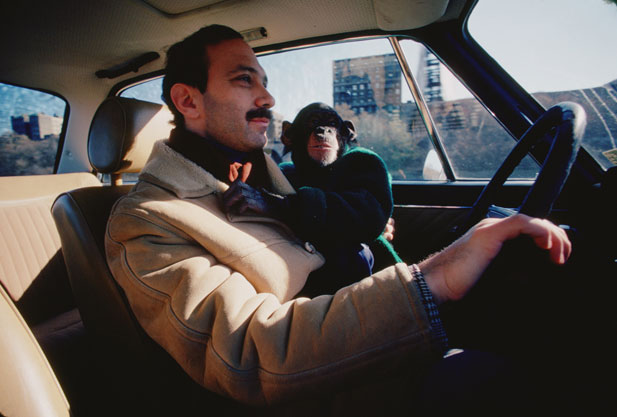
The new film by Man on Wire director James Marsh examines a scientific experiment by Columbia researchers to teach sign language to a chimpanzee.  The chimp, NIM (son of Carolyn) is taken from its mother almost at birth, to be raised by humans, and thereafter taught to communicate in a language that humans can understand (This immediately raises a red ethical flag—why not take the Goodall route and learn theirs, but if you're going to get all PETA on me, you might as well just picket the theater rather than watch it).

For just as Man on Wire is a study of hubris and the arrogance of man (which results in a marvelous, magical thing), Project NIM does the same thing, while showing just how lousy human beings are, even with the best (or most curious) of intentions.  We meet a lot of talking heads in Project NIM and few can be considered the best examples of our species to teach another anything.  In fact, Project NIM is more of a study of human behavior than it is anything to do with monkeys'.

The guy who devises the study is Dr. Herbert Terrace (after Project Washoe which was an earlier, more disciplined study and was more convincing of anecdotal evidence), and one wonders what his motivations are, besides the obvious personal ambitions of getting attention and using it as a means of attracting young interns.*  The first person to raise NIM is Stephanie, a self-described "hippie-chick," and it's a mystery that Terrace picked her to be the initial teacher for NIM, as she had no desire to keep notes and records, did not know sign language, and eventually grew impatient with all the insistence on "process," preferring to just interact with NIM as a member of her family.  Terrace makes some comment about her being a "warm," "empathetic" person and then drops the bomb that the two had had a previous "relationship,"  (which will prove to be a common—all-too common—theme throughout the documentary, as the humans seem more concerned with "hooking up" than concentrating on their charge—"it was the 70's, after all").  Eventually another trainer is found for NIM, Laura-Ann, and it's readily apparent that there is no love lost between her and Stephanie, as some mutual passive-aggressive sniping occurs between the two.  Laura-Ann is much more successful in teaching sign to NIM (Stephanie says on-camera "Words are a fucking nightmare to communication..." which makes one wonder about her qualifications even more) and the chimp's knowledge of ASL increases at an fast clip.  Terrace and she also begin "a relationship," just as two other therapists begin working in the study.  Also, at this point, Terrace steps out of the day-to-day monitoring, that is, unless a camera shows up for a photo op, or a news-story, and there are some amusing out-takes of Terrace trying to handle NIM, but being quite incapable of it.  "Herb Terrace was an absentee landlord" grouses one of the researchers.

It becomes readily apparent in Marsh's timeline and necessary compression of the events that the humans were far more concerned with their own lives, and that, however much affection and wonder is expressed at NIM's progress, he is little more than an amusing lab-rat, albeit one you can talk to about food.  And, as with "Frankenstein," pretty soon the subject of the study is considered less valuable, and, ultimately, disposable.

It cannot end well and it doesn't, even with the best of intentions, and the heroes of the story, if there can be any, come from the most unlikely of places.

What I find amazing is that Marsh, as he did with Man on Wire, can coax such naked honesty in a documentary that makes the researchers look like such creeps.  Philippe Petit, the subject of Man on Wire came across as something of a jerk, but his accomplishment was so amazing one could forgive his idiosyncracies and foibles.  These men and women have no such stunts to hide behind, and although they may act like the end justifies the means, in the end, they simply abandoned a project and left the life they'd altered on its own, not quite chimp, not quite human.  That ivory tower looks a little less spotless in the aftermath.

Makes one wonder if this evolution "thing" is all it's cracked up to be, given the evidence.

Project NIM is a Full-Price Ticket.


Two of "the good guys"—Bob Ingersoll and Nim Chimpsky


* I seem to be coming down hard on Terrace ("That's DR. Terrace..."), but he comes across as smug, arrogant...and a tad clueless in Marsh's film (Don't these folks know how they're going to come off?).  Also, slightly retributive.  After his slap-dash study, heavy on the personal agenda, ends he writes a book about the study sayin "Nah...chimps don't use language because they have no syntax"—merely parroting words they've been taught to get what they want, without proper senetence structure, or tense.  True.  It's the same way I communicate with my dog, Smokey.  We pick up on each other's "cues" of behaviors and words we recognize and respond appropriately.  For example, if I command my dog to go to the bathrrom (he does this by suggestion) and he doesn't "have to go," he'll simply sit.  Which tells me "No, really, it's not necessary.  How about a cookie, though?"  NIM was doing this with his trainers and with other apes...and taught other apes basic ASL (shades of "Planet of..."), just as he communicated with ape-cues to other apes.  The thing that struck me about NIM (which I remember from some of the docs made when the study was going on), was that he cursed.  If he got mad at something, he'd make the sign for "Dirty," which was related to his toilet training.  Nobody taught him that "Shit!" was an expression of frustration.  He came up with that on his own.