Showing posts with label 1944. Show all posts

Wednesday, July 3, 2013

Ministry of Fear

Ministry of Fear (Fritz Lang, 1944) So, here's the joke: a man walks out of an insane asylum and finds the world is crazier than he is.  

But, then, it usually is in Lang's films.  The forces of evil or nature are such that we don't stand a chance unless our own better natures or our just plain "stick-to-it-ive-ness" allows us to survive and move through.  And in Lang's directorial vision, the film frame is as much a trap as anything else, one that can be violated by unseen dangers that will drop into frame as if materialized by a malicious God out of nowhere to threaten those within it.


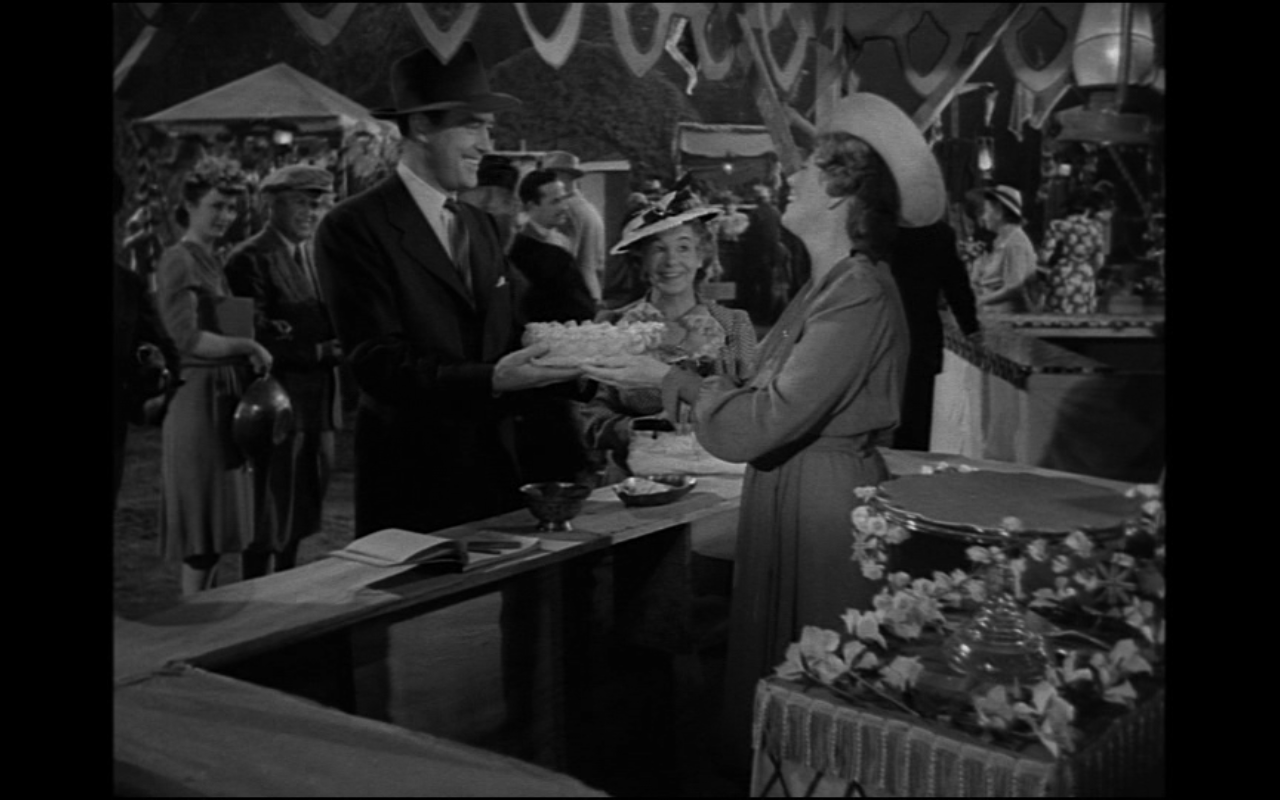
Ministry of Fear, based on a Graham Greene novel published the previous year, follows the dogged tracks of Stephen Neale (Ray Milland) as, having been released from Lembridge Asylum, he awaits a train to London and decides to pass the time at a charity fête supporting "The Mothers of Free Nations" where there is a booth for guessing the weights of cakes.  After dropping a shilling on a wrong guess, his next stop is a fortune teller's booth, where he's astonished to find the woman giving him the exact weight of one of the cakes at the booth across the way.  Neale can't resist using his knowledge (and testing the medium's prediction) and is astonished to find that he's guessed correctly and won.  


Everything's a little off-kilter in Fritz Lang's world.

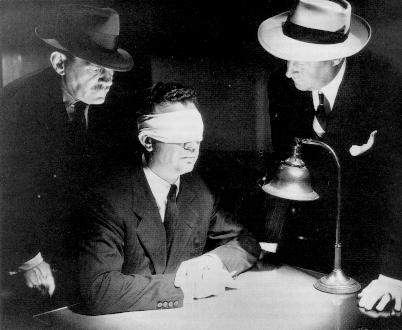
Off to his train he goes, not knowing that his taking the cake has caused a commotion back at the tents and exhibits.  The cake has "gone" to the wrong man, intended for another (Dan Duryea).  On the train, Neale's cabin-mate is a blind man to whom he offers a slice.  But, Neale is astonished to find that instead of eating his portion, he's crumbling it in his hands.  The blind man is no blind man, and he attacks Neale, steals the cake and jumps off the train, pursued by Neale.  But it is the time of the Blitz, and as the two chase through a field in the night, bombs begin dropping, targetting their train.

Okay.  We'll stop there.  But, already, things are not what they seem, people are not who they say they are, and nobody can be trusted...not even a damn pastry.  It's not a cake, at all.  It's a MacGuffin, the movie-making slang for the object that the players in a movie seek (and has a sliding scale of relevance and importance*). 

The subsequent fandango has Neale involved with "The Mothers of Free Nations," a seance, dodging bullets with the police and secret service, and all sorts who pretend to be something they're not.  It's enough to drive a sane man crazy—if one hadn't already left an asylum.  That time in crazy-land might actually have steeled Neale for his subsequent adventure, which is no piece of cake.  Lang was the master of the paranoid thriller (at least until Alan J. Pakula teamed up with Gordon Willis in the post-Watergate 70's) and his ordinary man caught in the extraordinary is the very DNA of a Hitchcock thriller—in fact, Ministry of Fear might have been one of those that "got away" from The Master of Suspense.  With its seances, wolves in bureaucratic clothing and things that go boom in the night, all it needs is a national monument to be pure Hitchcock.  It's a fun, terrible ride, well worth seeking out.


*

Thursday, May 3, 2012

Walking Kurosawa's Road: The Most Beautiful

The inability to write about the films of Akira Kurosawa to my satisfaction led me to to take a different path: start at the beginning, take each film in sequence, one after the other, and watch the progression of the man from film-maker to Master.   I'm hoping I can write more intelligently and more knowledgeably about his work by, step by step, Walking Kurosawa's Road.


The Most Beautiful (aka 一番美しく, aka Ichiban utsukushiku) (Akira Kurosawa, 1944) Kurosawa's second film as director was one I was willing to skip for its reputation as a documentary.  That would have been a mis-step, as it's a curious combination of fiction and non-fiction—doing it's job, certainly, as a record of civilian efforts during the Japanese war effort, but Kurosawa used the documentary as a spine for a story about the workers, their motivations and their interaction, which did far more towards the purpose than merely showing parades and workers huddled over machines.

So, does that make it a documentary?  Not really.  Is any propaganda piece truly a documentary, or is it advocacy?  Across the ocean, the Americans were making documentaries (by film-makers like Frank Capra, John Ford, John Huston,   Darryl F. Zanuck, and George Stevens) that mixed real footage with special effects and dramatized scenes, so the issue seems moot, not even worth bringing up.  But, it seems an essential piece of the Kurosawa puzzle.


Tasked with showing the efforts of the Nippon Kogaku optics factory in Hiratsuke that provided lenses for gunsights for Japanese Zeros (the original subject for the documentary, but shelved for budgetary reasons). The factory gave its full cooperation—the actors lived in the workers' dormitories and trained on their equipment.  There are brief montages of the women workers at their jobs in the factory-settings and lots of shots of parading workers in formation with flags and instruments—a precision team showing off.  There are lots of shots of that so the documentary aspect is satisfied.

But, that wasn't enough for Kurosawa.  There's no story.  The women working is "different" (certainly for that time) and inspiring; the parades, decorative.  Fine for the results required by the government.  But, all the parades in the world won't create a sense of sacrifice for the "common" man (or woman) to work towards victory; those are just pictures.  What inspires those images?  What creates the precision, the dedication required for the effort?

So Kurosawa weaves a story of one dormitory of women who are given a goal: prove yourselves.  An emergency effort is set up for maximum performance: the men must put out 100% effort; the women, 50%.  The women (respectfully) revolt.  Why half the effort of the men, when they can do just as much?  The factory relents, granting permission to push the limits and see what they can do.  Emboldened, the women knuckle down and re-double the work.

But it comes at a cost.  The health of the women suffer.  One actually leaves, taken home by her strict father who fears for her safety.  The support for her by her co-workers impresses him, and he bows in respect, but she leaves anyway.*  Conflicts arise.  The women begin to bicker over their relative efforts.  But, the results are what matter, and the women win the respect of their peers, their supervisors and managers...and themselves.  


Kurosawa once said The Most Beautiful is the film of his "closest to my heart."  Whether that's because it's his favorite, or because it's where he met, directed, argued with on-set and married actress Yôko Yaguchi would be speculation.


* She returns later in the film, and prances around, giddy with her return, but the emotion is not met by her co-workers, who leave to see what happened to their supervisor, who journeyed to retrieve her.  "It's good you're back, but get to work."

Saturday, November 27, 2010

The Great Moment

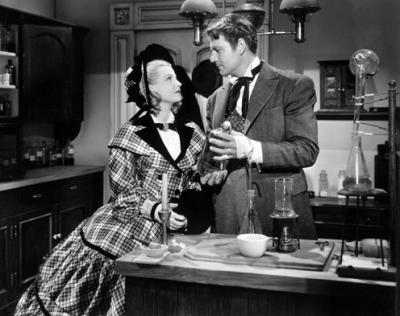
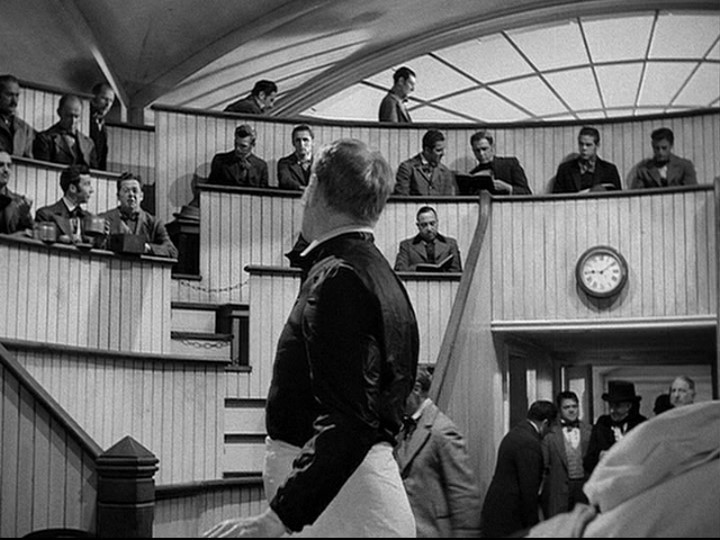
 The Great Moment (Preston Sturges, 1943) I'm sure there were many dust-ups in the relationship between movie-maker Preston Sturges and the studio financing his films, Paramount Pictures, but this is the one that soured the deal. Not really a comedy (but not a straight historical film, either) The Great Moment tells the story of Dr. W.T.G. Morton (Joel McCrea) the dentist who is credited (amongst a great many dis-creditors) of perfecting painless surgery, or what we now refer to as the practice of anesthesiology, at the time an accomplishment as fanciful as breaking the sound barrier, much less powered flight.

It provided another exercise for Sturges to explore non-linear story-telling, and, indeed, Sturges jumps all over the place in the story, starting first* with Morton in triumph over the Main Titles, then moving to the end of the story with the doctor dead, unheralded and even vilified, and his widow recalling the struggles that the dentist went through, after the discovery and the challenges to his claims, including an ill-advised patent pursuit (done at the urging of President Franklin Pierce who passed the matter onto Morton to create a federal test-case). Only after an explanation of the down-fall, does Sturges then tell the tale of the days before the discovery, with the dentist's work and struggles, the comedic failures and the life-threatening ones, ending with the acknowledgement of the scientific community of his discovery and methods. "Here, everything changes" are the last words of the movie.

They might just as well have been "No good deed goes unpunished."

Seeking a patent for the method, Morton is forced to reveal his secret in order to save a life and it is then appropriated by the military during the Civil War. With the cat out of the medicine bag, Morton pursues the unresolved patent question, and is castigated in the Press for his selfishness and anti-humanitarianism. It would hardly be an inspiring story in chronological order, and would influence anybody to walk out of a theater muttering "Guess I'd better stop messing around with that cold fusion idea."

For Sturges, it was a challenge to make a popular entertainment out of what is a downer story in a straight chronological timeline and, instead, taking the audience to a more satisfying conclusion, going from tragedy to triumph (even if he has to bend time to do it). But, its flashback structure irked the Paramount brass, and they withheld the film for two years (during which Sturges would make
The Miracle of Morgan's Creek and Hail the Conquering Hero to much acclaim), finally releasing it after Sturges' contract had run out and he'd moved on to potentially sunnier pastures. In those two years, the film had been re-edited, re-titled, and comedic elements added—I detect a clumsily inserted women's scream (and the same one) inserted three times in the film for use in both horrific and comedy situations.

How much of what we now know as The Great Moment is actually part of Sturges' plan and how much is studio interference is readily apparent from a reading of Sturges' original screenplay.** It was Sturges' intention to tell the story in an intricate flashback structure, while, simultaneously making Morton's work relatable to modern audiences.  It still resonates to this day, with the privatization of medical breakthroughs through the study of cell and DNA research; should an entity, corporate or individual, profit from work that could benefit mankind, or even save a life?

In the meantime, there is this film, slightly disjointed by design or by malice,*** the last of Sturges' Paramount films to be released, and the only film Sturges made for the studio that did not make a profit (although it was brought in ahead of schedule and below its budget). Its reputation, like the Morton patent lawsuit, would hang over its extraordinary creator for the rest of his career, which never achieved the same heights as it once had. 


No good deed goes unpunished.


Dr. Morton and Preston Sturges


* Well, not so much.  You can't trust anything in the Paramount botched version of Sturges' film, which he intended to call "Triumph Over Pain."  Sturges' screenplay starts in modern times as a young boy is about to go into surgery.

** The screenplay has been published and can be found here. -->

*** Paramount can be counted on to completely botch a film from time to time.  I remember going to the Seattle International Film Festival, specifically, to see Sergio Leone's long-in-the-preparation gangster film Once Upon a Time in America and was horrified to find a disjointed, flawed film that seemed to go on forever.  What was presented there was a re-edited Paramount Pictures version, cut in chronological order, completely destroying Leone's intentions to present it in a complicated flashback structure—that managed to give away a central mystery, and robbed the film, which would prove to be Leone's last, of almost all of its resonance and power.  Years later, I went to see it at a repertory theater—mostly because the show-times indicated a longer cut—and was amazed to see a version that retained the flashback structure, and, although it was an hour longer than the SIFF presentation, seemed to be a much shorter film experience.  OUATIA is still a flawed film, but Leone's amazing work as a film-maker was never more apparent.

Wednesday, May 5, 2010

The Miracle of Morgan's Creek

"The Miracle of Morgan's Creek" (Preston Sturges, 1944) In the perpetual mating dance that writer-director Preston Sturges did around the blue-noses of the Breen Office, there was never a more sassy tango than "The Miracle of Morgan's Creek," as sonorous a razzberry, as flagrant a nose-thumbing as any director has done to his oppressive censors.

Censors. It may seem odd in this "anything goes" era of film-making—where even dismemberment gets a pass for 13 year olds (but bare breasts get an "R"), where the foulest of epithets are uttered from the mouths of babes, fart jokes are in kids' movies—that at the time this movie was made, you couldn't say the word
"pregnant," or "virgin," men and women could not appear in the same bed, the subject of sex was merely metaphorical (as opposed to mythical in a teen movie), represented by a camera pan to crashing ocean waves, burning fires, or shattered mirrors.

Yes, kids, we were
Amish. At least, actresses weren't asked to wear veils...unless they were over 40 and the vaseline on the lens didn't hide the crow's feet.*

In this the script is an intricate little puzzle of studio "issues" that interlock to form a script that should have raised so many red-flags (and did), but take any of them out of the story and
it would look like you were unpatriotic, immoral, or a perfect candidate for ex-communication.

Of course, it's a comedy. Set and produced during war-time. And the sacred subjects of that war—God, Country, and Troops—are all given a jaundiced eye that would come from living with a bellyful of bromides while just trying to eke out a living. Though clear-eyed and sentimental in the right places, "
The Miracle of Morgan's Creek" can look at a manufactured convenience and still call it "bologna," and then acknowledge that, sometimes, bologna'll do the job. Even the movie poster has a conspiratorial wink in it. Like any good love story.

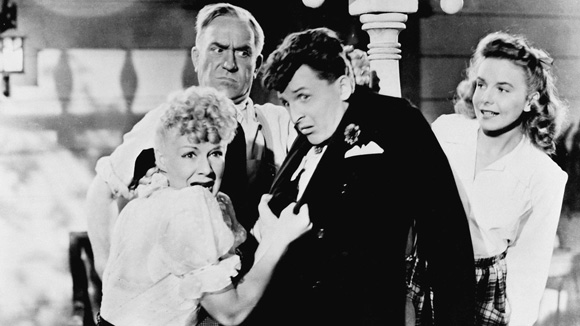
Poor Norval Jones (Eddie Bracken). He's been in love with Gertrude Kockenlocker (Betty Hutton) since they were kids, and he's got it bad. "I wish you were in a lot of trouble, Trudy, so I can help you."

Note to Norval:
You, uh...you've REALLY got to be careful what you want.

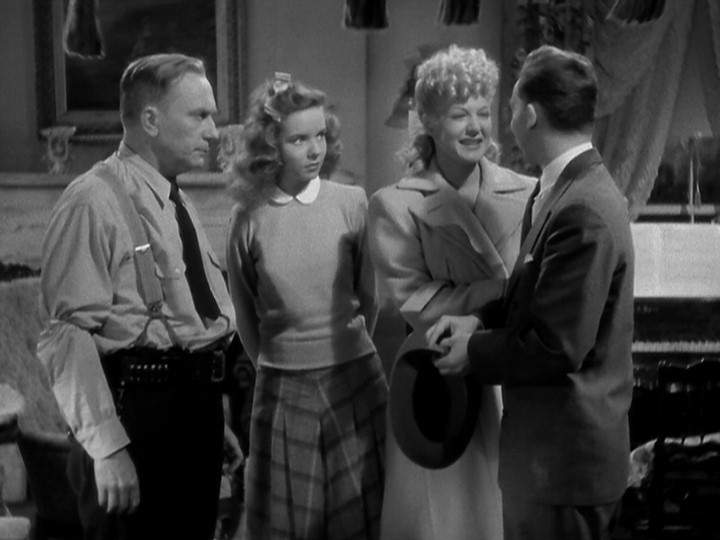
Especially when it comes to Trudy. She's only got eyes for the servicemen going overseas. She wants to do her part for our "fine and clean young men" and to give 'em a good time before they go off to war, over the objections of her constable father (Sturges pillar
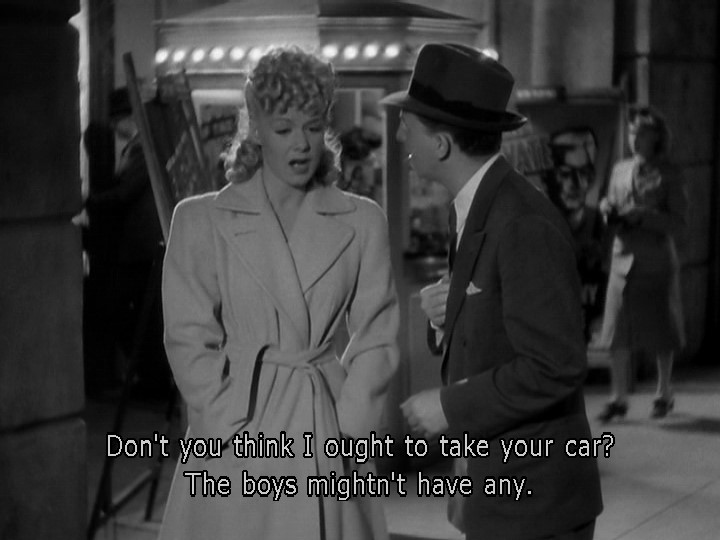
William Demarest). He forbids her to go to the USO dance on Tuesday, because as a veteran of The War to End All Wars, he knows servicemen have their minds on only one thing. "Oh no," says Trudy. "They're not like that any more! These are good boys, noble boys." But Pappy is unconvinced. So she conspires with Norval to take her to the movies, and once there, she dumps him, takes his car, and does a pub-crawl with the "nice boys," telling Norvel she'll meet him back at the flicks at 1:15.

She doesn't make it back until 8:00 am, with the car in tatters, her memory a little shaky, and Norval in the Kockenlocker gun-sights to take the blame when they get her home. With legitimate reasons.

Or even illegitimate ones.

Evidently, she did more than her part for the troops. Trudy doesn't remember a lot about what happened that night, it's kind of a blur. She thinks she might have gotten married, but she's not sure—she can't remember the guy's name. So, she keeps it to herself—the boys are shipping out, who'll know?
Then, there's the little matter of her being pregnant. So, there's a double puzzle: she can't tell anybody she's married without a husband, but she's pregnant without ever having been married. Maybe. What to do, what to do?

It's a scandal. The kind that small towns hush up and don't talk about; but what fun would that be? There's a way out of the problem—don't even go there—but it can't go smoothly, and before the solution can be found, it has to get more complicated—
at the top of its lungs. It even turns political, with guest appearances by "The Great McGinty" (Brian Donlevy) and "The Boss" (Akim Tamiroff), from Sturges' directorial debut.

I've never liked
Betty Hutton. I've always found her loud and grating and usually playing scatter-brained simps. Well, her Trudy Kockenlocker is a scatter-brained simp, but Hutton makes her sympathetic and funny, with a perpetual look of comic confusion, exhausted with dis-belief. She's all too willing to do physical comedy in an extremely unladylike fashion (one of which involves her getting clocked by one of those mirror-globes at an out-of-control jitterbug dance). She's a complete joy in this movie, whether by herself, matching stammers with the brilliant Bracken (who moves so fast in this movie, I'm surprised he's not a perpetual blur), or sharing sisterly woes with her wise-acre sister (the nifty Diana Lynn), who is the Horatio to her densley populated Hamlet. Never has a movie had such fun in being irreverent about such American ideals as The War Effort, and even motherhood.

In 2001, "
The Miracle of Morgan's Creek" was selected for the National Film Registry. This American classic is also #54 on the AFI's "100 Years...100 Laughs" list of the funniest movies ever made. And it's somewhere near the top of the most boldly audacious movies ever created in a climate of repression. Add the caveat of taking such subversive gleefulness in its presentation, and it would be #1.

* It should be noted that once the Breen Office died the death of a thousand indignities in the late '50's and 60's, and subject matter was freed up for public consumption, There have been waves of motion picture permissiveness—we approach a line of the verboten and then back off, a few years later we creep up to the line and slink back in a cycle that seems more like evolution than revolution. There is still censorship, but the censor is the marketplace, and a film-maker must consider the box-office potential of his choices, as filtered by the specious and contrary dictates of the MPAA. Except for the screw-balls at the Ratings Board, it seems a more fair system: "Yeah, you can do that...but it's gonna cost ya."

Tuesday, February 23, 2010

Ernie Pyle's Story of G.I. Joe

"Ernie Pyle's 'Story of G.I.Joe'" (William A. Wellman, 1944) One of 2009's films designated to be preserved by the Library of Congress—and boy, does it need it, the current DVD displaying scratches, bad splices, and scenes truncated in the middle of dialogue—"The Story of G.I. Joe" was an uncommon war movie, especially for one produced in the middle of the conflict it portrayed, showing a less-varnished portrait of war and the soldiers fighting it. Done with the co-operation of the military and advice from an office-load of war correspondents, the film is an unglamorous, non-propagandistic look at the life of the common infantryman. In it, the grunt's are grimey, muddy, ass-scratching, spitting dog-faces, who get exhausted, make mistakes, leave behind fallen comrades, but keep slogging.

But then, it had to be.
Ernie Pyle, a Scripps-Howard correspondent covering the European theater took the tough route with his reportage, staying out of the clean briefing rooms and jumping into the fox-holes with the entrenched common soldiers. Through the course of his work, he became a beloved go-between for the soldiers and the folks back home aching for something other than the Big Picture and the Campaign—there were plenty of other Corona jockeys to do that—but on the soldiers following orders, following dirt roads, punching through entrenched enemy forces—their kids. Pyle's writing was clear-eyed, unsentimental and just discreet enough for the censors, written usually with the help of a bottle. He won the Pulitzer for his correspondent work in 1944, and had a hand in shaping the film.

And he was the one to get
William "Wild Bill" Wellman to direct the film.

Wellman was an inspired choice, as he was the one who insisted on the weather-beaten look of the film. But the director was a fighter pilot in World War I, and was subject to the same inter-corps squabbling of most servicemen, and had a low opinion of the infantry, only stregthened by his run-ins with a recalcitrant Army adviser on his film "Wings." And the film has several instances of "mea culpa's" from the director,* extolling the scrappy courage of the guys with boots on the ground, as opposed to the guys with their heads in the clouds.
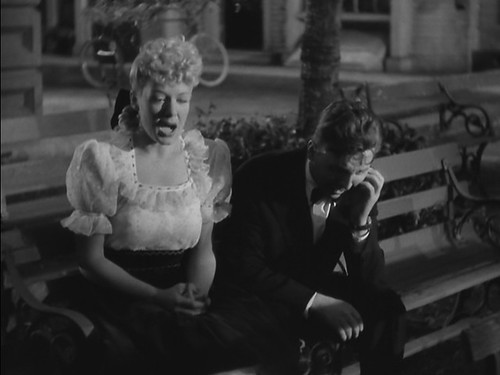
Burgess Meredith got a deferment to play the part of Ernie Pyle—he was picked over other actors because he wasn't well known and had an odd home-spun quality and a crusty voice that could make the tough joshing resonate with warmth. Every war film has a cuddly troop mascot, but not every film has someone ask (in humor) "Haven't you eaten this dog yet?" As the Captain in charge of the men, Robert Mitchum plays his role in the manner he used to the end of his days, looking authentic and undramatic, like he shipped in with the other ringers—only a lot taller—and hadn't slept in days, born with the weight of the world on his shoulders, but still balanced on his aching feet. Or maybe it was the mud that was holding him up.

It was the only time he was nominated for an Oscar for his acting.

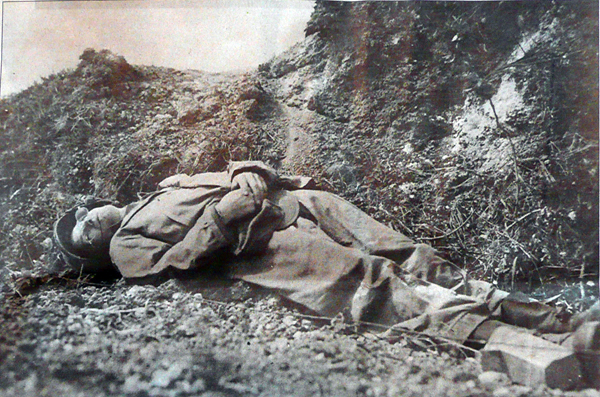
Pyle never saw the movie. Two weeks before the premiere,
he was killed by a sniper on Ie Island off Okinawa in the Pacific. He was still with the troops, reporting their struggles.

* Besides a couple of on-the-nose comparisons between Army and Air Force—that seem to come out of nowhere—one of the various character arcs is for an infantryman dubbed "Wingless" (played by John R. Reilly), who starts the film depressed that he was drummed out of the Air Corps but soon comes around to a respect for the common foot-soldier.

Thursday, February 11, 2010

Hail the Conquering Hero

"Hail the Conquering Hero" (Preston Sturges, 1944) You can take "Semper Fi" just a little too far sometimes. Small-town schnook Woodrow Lafayette Pershing Truesmith (Eddie Bracken) is drinking alone in a bar. Washed out of his beloved Marine Corps for chronic hay fever, he's been working in a San Diego shipyard ever since and writing letters, full of fiction, to his Mom, a Marine widow, that he's fighting overseas. He spots a group of jarheads (led by Sturges regular William Demarest) trying to buy a communal beer with 15¢ between 'em, and buys them a round.

When they hear his tale of woe and subterfuge, the Marines take sympathetic pity on Woodrow, and concoct a story that reads like an invasion plan. Just back from Guadalcanal, they pin their medals on the kid, insist on escorting him home, and make up a cock-and-bull story about him being a hero. Anything for dear ol' Mom. But, as things tend to do in Sturges comedies, things accelerate in a dither of cross-purposes and crushed dialogue. Caught up in the manufactured patriotic fervor, the whole town sings Woodrow's praises, the bank forgiving Mom's mortgage and nominating him for Mayor (with the election only two days away!). Woodrow's genuinely appalled, but the Marines are steadfast in seeing Woodrow's dreams come true, no matter how much he protests, no matter how much he whines. No matter how much guilt he feels.

It took some guts for Sturges to make a story about blind hero-worship and unquestioning patriotic fervor during war-time, but emboldened by a basic cynicism, Sturges does a strafing run on a veritable gallery of targets (with the military even cooperating with the filming!) Sturges takes pot-shots at bankers, small-town in-bred politicians and the insanity of mob-rule, yet still manages to make a fairly sunny picture with a lot of laughs and a hero who's anything but.

Part of the charm of "
Hail the Conquering Hero" is Truesmith as played by Eddie Bracken. Not much to look at, kinda dumpy with a nose that follows the slope of his fore-head without benefit of eyebrow ridges, Bracken has the same voice and manner of Mickey Rooney, a ferocity of energy and a quick way of delivering lines with maximum inflection. That he spends the entire movie frustrated, bitter and cynical doesn't lessen his appeal one jot, which is, frankly, amazing—it's something even James Stewart couldn't pull off in "The Philadelphia Story."

"
Hail, the Conquering Hero" has a couple of Northwest connections: the ingenue is played by Ella Raines, who was born in the little town of Snoqualmie Falls, Washington, and is something of a noir icon for her titular role in "Phantom Lady"; and one of the Marines is played by a mug with a mushed-in face named Freddie Steele.

Steele was a professional middleweight boxer in the Pacific Northwest with an astounding record of wins-losses and draws of 125-5-11. Noted for his pile-driver punches, he was known as "The Tacoma Assassin," before a punch broke his breast-bone (ouch!) and he gave up the ring for the movies. He ran a legendary restaurant in Westport for many years, and his role as the one Marine who thinks that Trueblood may not deserve the false-god praise he gets is the most satisfying of the emotional through-lines in "Hail, the Conquering Hero"


Thursday, April 23, 2009

Murder, My Sweet

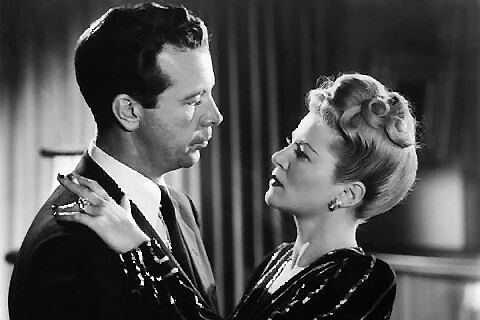
"Murder, My Sweet" (Edward Dmytryk, 1944) A neat trick, this. Although the third Chandler adaptation to make it to the screen—the first being "The Falcon Takes Over" (taken from the same source novel as this—"Farewell, My Lovely") co-opted as a story-line in the George Sanders "Falcon" movie series, and the second "Time To Kill" (based on "The High Window") featuring Lloyd Nolan's Michael Shayne character, it is the first to feature Raymond Chandler's slumming angel, Philip Marlowe*

Dmytryk and writer John Paxton do a fair job of keeping the first-person narration intact (Marlowe is being grilled by the usual suspicious police and he's giving his side of it), and although they didn't use Chandler's exact phraseology, they do a nicely watered down, tightened-up version of it for cinema audiences for whom thinking too much of the cleverness of a metaphor as it passes might slow down a film's momentum. Call it "Chandler Lite."

It works, especially for the speed of this film. For Marlowe, an odd choice:
Dick Powell, an A-lister in musicals. He's got a lived-in face, like a hound's, not a matinee idol's, slightly doughey (as is his body-type, depite being told he's "in good shape"—that's Marlowe to a wife-beater "T."), and you believe that Powell would be a reflexive weisenheimer—something about the hoofer background.

And Dmytryck has the noir feeling down, being as he was one of the architects of the style. Begin your movie in transition so the audience has a lot of questions it has to answer, go heavy on the atmosphere and always exit the scene with a sardonic quip. You already know you're in the hands of a master with
the sequence that introduces "Moose" Malloy (Mike Mazurki) who just suddenly appears. It's as disconcerting...well, as disconcerting as a tarantula on an angel food cake, thank you very much! Dmytryck also has fun dancing around the brim of the Hayes Code in the two knock-out sequences of Marlowe being knocked out—always a hallmark of Marlowe stories and fans of inky pools of blackness, Long Goodbyes and Big Sleeps (or "Big Lebowski's," if you'd rather, later).

Indispensible in the mix is a high concentration of sass which is provided by that queen of the form, Claire Trevor, whose performance as an evil step-monster is almost too much of a good thing. "Murder, My Sweet" would have been a rich enough story without her. Her presence and its tilting of the sexual equation slams this one deep onto the classic shelf. Powell would play Marlowe again on television, but this initial outing made him definitive...until Bogart came along.


* "The Big Sleep" with Bogart as Marlowe was made the same year, but not released until two years later.

Saturday, July 26, 2008

Laura

"Laura" (Otto Preminger, 1944) What can you say about a 25-year old advertising executive who died? That she was loved to the point of being despised, and beautiful enough to be utterly destroyed. That her life was mercurial enough to be inconvenient, and that it was easier to love her more when she was dead. A woman more ideal in memory than in life.

Women. Can't live with 'em. Can't shoot 'em in the head.

"Laura" is a mixture of film noir, murder mystery and working-girl-drama so oxidized as a classic that one could be forgiven for not recognizing the loopy movie this film really is. Both Tierney and Andrews underplay their roles while Clifton Webb, Vincent Price, and Judith Anderson over-play theirs (and what's the idea of Webb's character, Waldo Lydecker, inviting himself along as detective Mark McPherson (Dana Andrews) goes to interview suspects? Does McPherson think Lydecker's constant stream of sarcasm will badger a confession out of them?) all of them, just this far from scratching each others' eyes out.

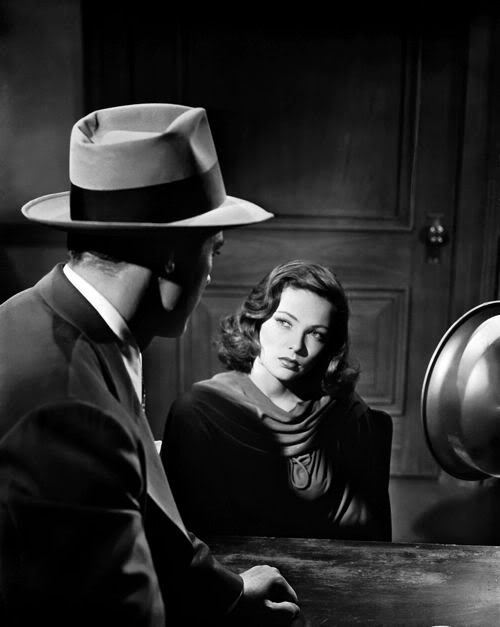
It's the story of hustling advertising agency prodigy Laura Hunt (Gene Tierney), who counts among her friends the rich and powerful, none more so than Lydecker, whose mentorship and influence have catapulted Laura to the top of her profession. Now, the police are investigating her grisly late-night death by shotgun blast, with the lead detective suspecting no one and everyone, but the three folks most often in his cynical glare are Lydecker--whose jealousy of Laura's man-friends has led to extreme actions, her on-again-off-again fiancee ne'er-do-well Shelby Carpenter (Price) and Laura's aunt, Ann Treadwell (Anderson) who wants Carpenter for herself.

That's quite a tangled web. But things get stickier as McPherson spends more time than necessary investigating at Laura's apartment, staring at her portrait. In fact, McPherson becomes obsessed--or possessed--by the ghost of Laura.*


Then things get interesting.

The dialogue is arch, along with the performances, and Dana Andrews' barely expressive detective is a constant source of irritation to a group of people expert at irritation. The wise-cracks fly fast and loose, the cinematography (which justly won an Oscar) is lush and filled with shadows, and Preminger keeps the talk-y movie moving, right up to the shot of a splintered clock face that signals an end to a "timeless love." The whole movie could be the over-heated fever dream of a purple-prose life being flashed before your eyes.

High-toned, but low-down in the murk of motivation, "Laura" is just complicated enough to bear repeat viewing. And, besides "
Vertigo
," it's one of the rare Hollywood movies that dares to question the validity of that essential movie-dream, the "thing called love."

Plus, I always like to catch that moment when Dana Andrews barely smiles.


But she's only a dream....**


* Yeah, yeah, it's supposed to be romantic and all that, but I find it creepy--like those women who "fall in love" and marry axe-murderers in prison...because they can have the fevered romance, without having to actually live with the monster.

** I found interesting that this portrait that McPherson falls in love with is not a painting, per se--it's a studio photograph given the "Thomas Kinkade" treatment, with paint strokes added to make it appear to be a painting. And knowing how movie-cameras tend to make paintings appear real (the traditional trick behind matte shots), they had to "paint an inch thick" to fool the camera.