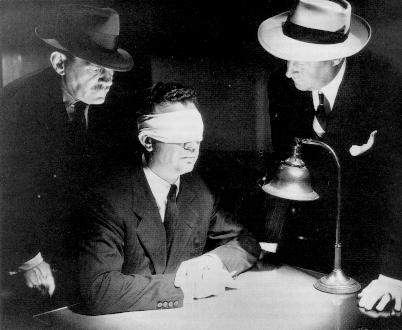
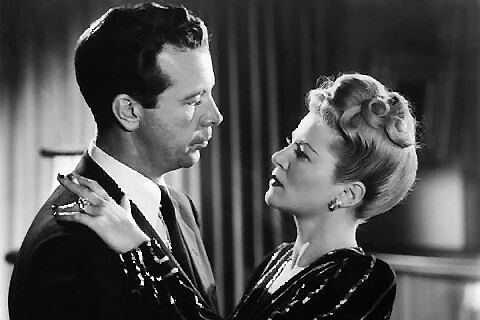
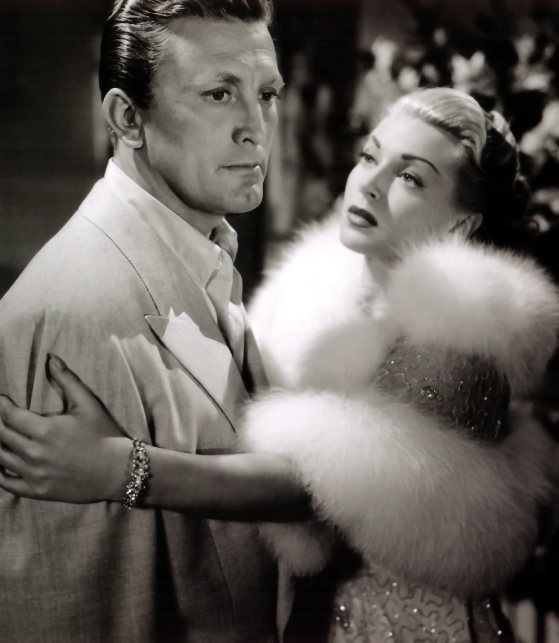
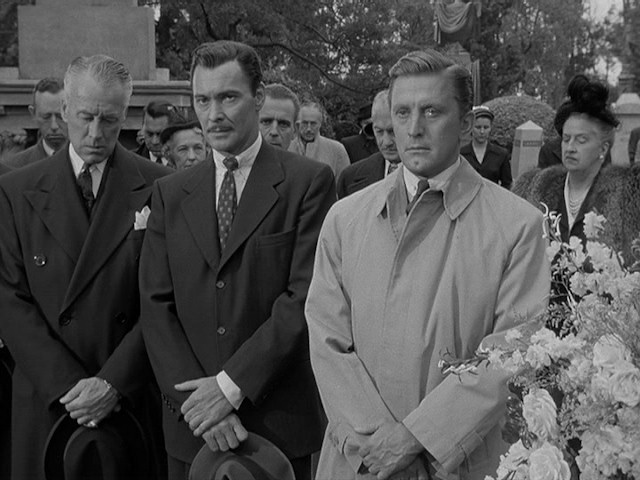
"The Bad and the Beautiful" (Vincente Minelli, 1952) Hollywood movies about Hollywood generally stink; the best ones (and they're usually by Howard Hawks) make their odd collections of professionals in a field of endeavor working toward a single goal act as a metaphor for a film-team. But, when Hollywood hits the nail on the head it's usually with a gilt sledge-hammer, giving off the air of bitterness and back-stabbing lit by klieg lights—as opposed to merely doing it behind the scenes. "The Bad and the Beautiful," produced by John Houseman, could be about many Hollywood inmates, one can see allusions to Houseman's old partner (and bitter enemy) Orson Welles here—the structure is basically that of "Citizen Kane," (also produced by Houseman) with the story told by the principals in multiple flash-backs. Louis B. Mayer (the former head of the studio that produced "The Bad and the Beautiful" seems familiar in the penny-pinching sanctimony of studio head Harry Pebbel (Walter Pidgeon), Irving Thalberg (who would be the model of F. Scott Fitzgerald's "The Last Tycoon") could be part of the personality of demon-producer Jonathan Shields (Kirk Douglas), but it's also a bit of Darryl F. Zanuck. You could drive yourself gossipy in this guessing game.
Three toilers in the Hollywood Valley—director Fred Amiel (Barry Sullivan), box-office sensation Georgia Lorrison (Lana Turner) and screen writer James Lee Bartlow (Dick Powell) are summoned to Shields Productions by studio head Pebbel. He wants to take them to task for avoiding the phone-calls of Shields, whom they've all had run-ins with. Shields is responsible for their success, but it has always come at a cost. Amiel had a dream-project taken from him by Shields, Lorrison was promoted and prepped for stardom by him, but rejected becoming romantically involved with her, and Bartlow still blames Shields for the death of his lusty wife (Gloria Grahame), while he and Shields were on a screen-writing retreat.
All of these stories are told in flashback sequences that recall the ones in "Kane" by the surviving partners and wives. But where the "Kane" stories interlock and enhance each other, the ones in "The Bad and the Beautiful" sir apart with little connective tissue between them. It plays like "The Three Faces of Jonathan Shields" as opposed to the stories being facets of the same character, building to a whole. In "Kane," the stories are all aspects of Kane's quest for love. In "Bad..." what unites them is that Shields is a manipulative producer—one would think that would go without saying. Amiel's story hints that Shields has "Daddy" issues owing to his Father's resentment in Hollywood ("I'm going to take the name of Shields and ram it down their throats!"—you can hear Douglas saying that). There may be something of the "sins of the Father" storyline here, but even that is undercut by the film's ending, a contrivance that makes a mockery of everybody's motivations.
"The Bad and the Beautiful" won five Academy Awards: best Supporting Actress for Grahame's fine work, and for the Black-and-White categories of Costuming, Art Direction and Cinematography (Robert Surtee's work is amazing in this), as well as a screenplay award for writer Charles Schnee (presumably in black and white, as well). Why this ad hominem pot-boiler would win Best Screenplay is beyond me.
But, that's me. "The Bad and the Beautiful" was one of the 2002 selections for inclusion in the National Film Registry.
Wednesday, April 28, 2010
The Bad and the Beautiful








Wednesday, December 23, 2009
Christmas in July
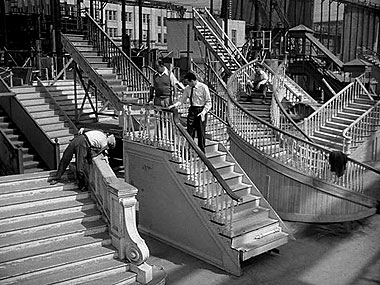
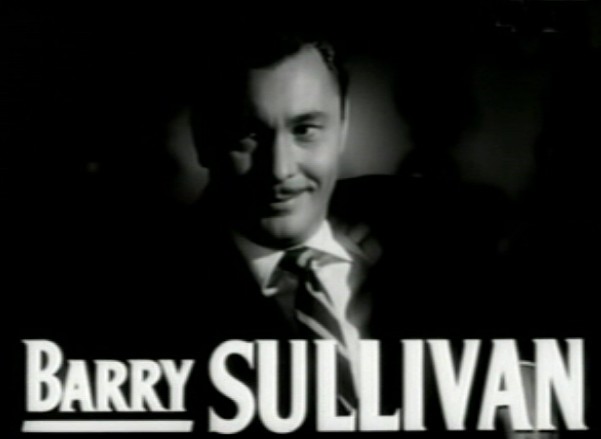
 "Christmas in July" (Preston Sturges, 1941) James MacDonald (Dick Powell) lives a life of pretense and dreams. A bean counter for a coffee company, he's just won the $25,000 prize in the slogan contest for rival caffeine-pushers, Maxford House. The winning entry: "Can't sleep at night? It's not the coffee. It's the bunk."
Well, it is the bunk and the pretenses are false ones. MacDonald didn't win any contest. It's all an impractical joke played on him by co-workers, that manages to sneak under the radar due to a contest SNAFU. But by the end of his perfect day, he's got a promotion, a new raise and an office, and bought presents for everybody on the block without spending a dime yet. You've got to have good luck to get good luck it seems, but it all comes crashing down when the check and everything with it bounces. Jimmy almost loses his new job because, let's face it, he only got it because he won the contest and, his boss, liking sure things and having made a ton of mistakes himself, needs to have something he can count on. Now that he can't count on MacDonald being a proven winner, well...
That twisted logic—the very basis of our banking credit system (You can only get money if you don't need it) forms the curvature of the spine of Sturges' short (68 minutes) winning second film. Another moral, Sturges-style is a familiar one, except in Hollywood: No good deed goes unpunished. MacDonald buys presents for everybody but himself and ends up humiliated in front of his neighbors. But at least he gets to keep his new job if he succeeds at it because "it's one thing to muff a chance once you've had it... it's another thing never to have had a chance."


Powell does measured work far subtler than his musical gigs and ingenue Ellen Drew is delightful. But the stand-out amond the Sturges stock company in this film is Raymond Walburn as the perpetually frustrated and passive aggressive Dr. Maxford, head of Maxford House Coffee. Usually these big business CEO's are played with comedy bluster, but Walburn fumes and fusses as if its as part of his everyday routine as a cup of coffee, roasted and aged. The entire movie has a fresh comic timing that's a bit off-kilter, and the results are hilarious. It's Frank Capra turned on his ear, but far more cynical and with less of a "reach" at the end.
Thursday, April 23, 2009
Murder, My Sweet
 "Murder, My Sweet" (Edward Dmytryk, 1944) A neat trick, this. Although the third Chandler adaptation to make it to the screen—the first being "The Falcon Takes Over" (taken from the same source novel as this—"Farewell, My Lovely") co-opted as a story-line in the George Sanders "Falcon" movie series, and the second "Time To Kill" (based on "The High Window") featuring Lloyd Nolan's Michael Shayne character, it is the first to feature Raymond Chandler's slumming angel, Philip Marlowe*
Dmytryk and writer John Paxton do a fair job of keeping the first-person narration intact (Marlowe is being grilled by the usual suspicious police and he's giving his side of it), and although they didn't use Chandler's exact phraseology, they do a nicely watered down, tightened-up version of it for cinema audiences for whom thinking too much of the cleverness of a metaphor as it passes might slow down a film's momentum. Call it "Chandler Lite."
It works, especially for the speed of this film. For Marlowe, an odd choice: Dick Powell, an A-lister in musicals. He's got a lived-in face, like a hound's, not a matinee idol's, slightly doughey (as is his body-type, depite being told he's "in good shape"—that's Marlowe to a wife-beater "T."), and you believe that Powell would be a reflexive weisenheimer—something about the hoofer background.
And Dmytryck has the noir feeling down, being as he was one of the architects of the style. Begin your movie in transition so the audience has a lot of questions it has to answer, go heavy on the atmosphere and always exit the scene with a sardonic quip. You already know you're in the hands of a master with the sequence that introduces "Moose" Malloy (Mike Mazurki) who just suddenly appears. It's as disconcerting...well, as disconcerting as a tarantula on an angel food cake, thank you very much! Dmytryck also has fun dancing around the brim of the Hayes Code in the two knock-out sequences of Marlowe being knocked out—always a hallmark of Marlowe stories and fans of inky pools of blackness, Long Goodbyes and Big Sleeps (or "Big Lebowski's," if you'd rather, later).
Indispensible in the mix is a high concentration of sass which is provided by that queen of the form, Claire Trevor, whose performance as an evil step-monster is almost too much of a good thing. "Murder, My Sweet" would have been a rich enough story without her. Her presence and its tilting of the sexual equation slams this one deep onto the classic shelf. Powell would play Marlowe again on television, but this initial outing made him definitive...until Bogart came along.
* "The Big Sleep" with Bogart as Marlowe was made the same year, but not released until two years later.