Showing posts with label Preston Sturges. Show all posts

Friday, August 9, 2013

The Sin of Harold Diddlebock

The Sin of Harold Diddlebock (Preston Sturges, 1947) (aka Mad Wednesday, 1950) Sturges' first film out of his Paramount Studios contract, and with his film company California Films in partnership with millionaire polyglot Howard Hughes. Sturges adapted his script idea "The Sin of Hilda Diddlebock" (about a young girl's misadventures in Hollywood) for a favorite silent film star, Harold Lloyd—who was under the impression that he'd get to direct some sequences.  

It must have been "going around," as Sturges was under the impression he had free reign over the film.  But when it opened "soft," Hughes took over control of the film, re-editing it (in his painstaking way), finally releasing it in 1950 as "Mad Wednesday" (because a title with "sin" in it might not appeal to audiences throughout the nation—although it was probably that very enticing nature that led Sturges to title it that way in the first place).


The version we saw is the Sturges version, in desperate need of some sort of care and restoration—the black and white images are soft and dark looking, like it was shot in perpetual twilight, several splices mar the flow and interrupt a couple jokes here and there, and making one want to see the mangled version just to see if it's (ironically) in better shape.


It's hard to determine what "sin" Sturges is talking about. The film starts with a sequence from Lloyd's The Freshman (made in 1925) intercut with some recent scenes that act as bridging sequences as Lloyd's water boy manages to score a winning touchdown, impressing a business owner who (in new scenes filmed by Sturges) hires him on the spot.  Sturges keeps the sequence silent and primitive to mesh with the earlier filmed sequences and Lloyd looks young enough to pass for his younger self.


But, that's where the film starts.  Diddlebock's moment of glory results in his getting a job as an accountant for the man's firm.  Twenty years later, he's still there, passed by by other employees, including a series of sisters he admired and all moved on, leaving the youngest as Diddlebock's work colleague.  He's laid off, given a severance, and kicked out without prospects and no goal posts to run towards.


Already, the film is a commentary on American business, its spoiling of potential through pigeon-holing and compartmentalization, and the efficacy of "glory days."  But this is the first ten minutes.


Out on the street, Diddlebock gets way-laid by a racetrack tout (Jimmy Conlin) who sees him as a case of arrested development—one with a lot of disposable income—and after a two decades recess, Diddlebock goes back to school, as taught on the street.  First step: a bar, where he has his first adult beverage, an event that inspires the bartender (Edgar Kennedy)—"You arouse the artist in me"—to create a grand concoction of mixology, the sipping of which elicits a primal scream somewhere between the ubiquitously used red-tail hawk cry and a high-pitched ape roar.  A couple of toots of those and it's a trip to the barber's for a complete make-over, including a garishly nightmarish checkered suit, and the investment in short-term futures at the horse track, which pays off huge dividends, further inspiring high living, a blackout for an indeterminate length of time, and the investment in a defunct circus, including a menagerie of animals and one particularly cranky male lion that becomes Diddlebock's nearly constant companion and chief collateral throughout the rest of the movie.  Hilarity—and Sturges' unique brand of hysterical panic—ensues.


It's the maddest of screwball comedies with Diddlebock a cyclone of disruption wherever he goes, trying to unload the results of his bleary recent past and only finding himself with more problems, more prospects and an ever-growing number of acquaintances...the freak accidents of American success.

Even with Sturges' frenetic timing, the results are a bit off in tone and pace, as if somewhere along the way, the directorial edict became "faster..." (which, for Sturges, approaches the super-sonic).  Still, even though its uneven, it's still full of bizarre child-like invention and scrupulously drawn character types.

The dialogue is snappy and so is the lion—a couple of times making a lunge for LLoyd's hand, while the plucky silent star (probably to avoid further takes with the animal which he was terrified of) keeps going with the take, not missing a beat.  Amazing.

No, it wasn't successful; Sturges might have lost some of his homespun touch after so many frustrating years in Hollywood, despite his successes for Paramount.  Parallels can be found with Diddlebock, who hits the jackpot and keeps on hitting, despite being beset by day-to-day "small stuff" that he has to sweat.  But Sturges can still mine comedy gold out of his self-analysis, as he did with Sullivan's Travels.  He would continue to struggle, while still walking the thin line between message and entertainment.  He would only make three more films.


Saturday, November 27, 2010

The Great Moment

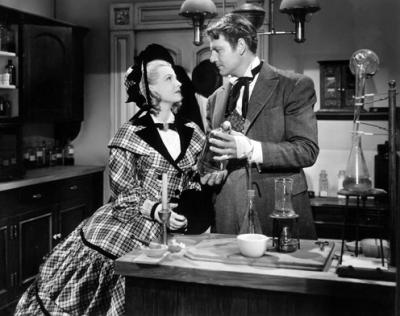
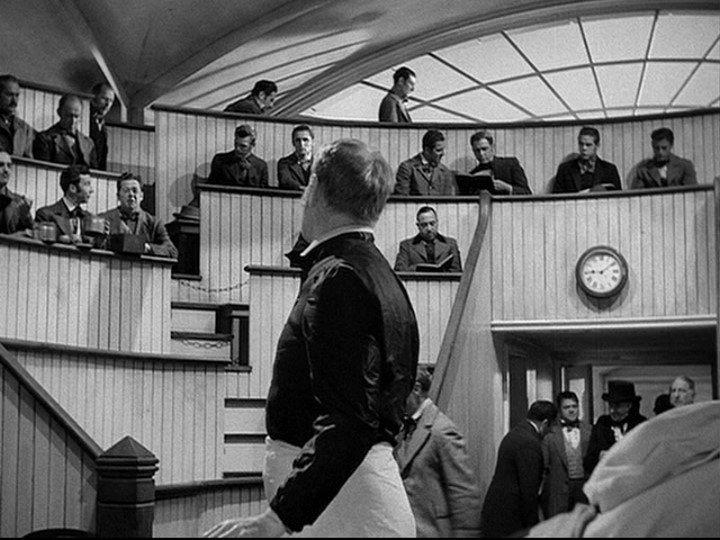
 The Great Moment (Preston Sturges, 1943) I'm sure there were many dust-ups in the relationship between movie-maker Preston Sturges and the studio financing his films, Paramount Pictures, but this is the one that soured the deal. Not really a comedy (but not a straight historical film, either) The Great Moment tells the story of Dr. W.T.G. Morton (Joel McCrea) the dentist who is credited (amongst a great many dis-creditors) of perfecting painless surgery, or what we now refer to as the practice of anesthesiology, at the time an accomplishment as fanciful as breaking the sound barrier, much less powered flight.

It provided another exercise for Sturges to explore non-linear story-telling, and, indeed, Sturges jumps all over the place in the story, starting first* with Morton in triumph over the Main Titles, then moving to the end of the story with the doctor dead, unheralded and even vilified, and his widow recalling the struggles that the dentist went through, after the discovery and the challenges to his claims, including an ill-advised patent pursuit (done at the urging of President Franklin Pierce who passed the matter onto Morton to create a federal test-case). Only after an explanation of the down-fall, does Sturges then tell the tale of the days before the discovery, with the dentist's work and struggles, the comedic failures and the life-threatening ones, ending with the acknowledgement of the scientific community of his discovery and methods. "Here, everything changes" are the last words of the movie.

They might just as well have been "No good deed goes unpunished."

Seeking a patent for the method, Morton is forced to reveal his secret in order to save a life and it is then appropriated by the military during the Civil War. With the cat out of the medicine bag, Morton pursues the unresolved patent question, and is castigated in the Press for his selfishness and anti-humanitarianism. It would hardly be an inspiring story in chronological order, and would influence anybody to walk out of a theater muttering "Guess I'd better stop messing around with that cold fusion idea."

For Sturges, it was a challenge to make a popular entertainment out of what is a downer story in a straight chronological timeline and, instead, taking the audience to a more satisfying conclusion, going from tragedy to triumph (even if he has to bend time to do it). But, its flashback structure irked the Paramount brass, and they withheld the film for two years (during which Sturges would make
The Miracle of Morgan's Creek and Hail the Conquering Hero to much acclaim), finally releasing it after Sturges' contract had run out and he'd moved on to potentially sunnier pastures. In those two years, the film had been re-edited, re-titled, and comedic elements added—I detect a clumsily inserted women's scream (and the same one) inserted three times in the film for use in both horrific and comedy situations.

How much of what we now know as The Great Moment is actually part of Sturges' plan and how much is studio interference is readily apparent from a reading of Sturges' original screenplay.** It was Sturges' intention to tell the story in an intricate flashback structure, while, simultaneously making Morton's work relatable to modern audiences.  It still resonates to this day, with the privatization of medical breakthroughs through the study of cell and DNA research; should an entity, corporate or individual, profit from work that could benefit mankind, or even save a life?

In the meantime, there is this film, slightly disjointed by design or by malice,*** the last of Sturges' Paramount films to be released, and the only film Sturges made for the studio that did not make a profit (although it was brought in ahead of schedule and below its budget). Its reputation, like the Morton patent lawsuit, would hang over its extraordinary creator for the rest of his career, which never achieved the same heights as it once had. 


No good deed goes unpunished.


Dr. Morton and Preston Sturges


* Well, not so much.  You can't trust anything in the Paramount botched version of Sturges' film, which he intended to call "Triumph Over Pain."  Sturges' screenplay starts in modern times as a young boy is about to go into surgery.

** The screenplay has been published and can be found here. -->

*** Paramount can be counted on to completely botch a film from time to time.  I remember going to the Seattle International Film Festival, specifically, to see Sergio Leone's long-in-the-preparation gangster film Once Upon a Time in America and was horrified to find a disjointed, flawed film that seemed to go on forever.  What was presented there was a re-edited Paramount Pictures version, cut in chronological order, completely destroying Leone's intentions to present it in a complicated flashback structure—that managed to give away a central mystery, and robbed the film, which would prove to be Leone's last, of almost all of its resonance and power.  Years later, I went to see it at a repertory theater—mostly because the show-times indicated a longer cut—and was amazed to see a version that retained the flashback structure, and, although it was an hour longer than the SIFF presentation, seemed to be a much shorter film experience.  OUATIA is still a flawed film, but Leone's amazing work as a film-maker was never more apparent.

Wednesday, May 5, 2010

The Miracle of Morgan's Creek

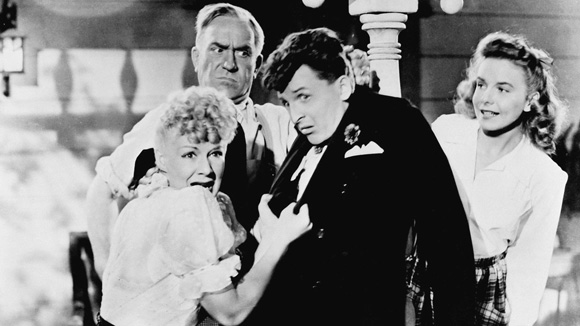
"The Miracle of Morgan's Creek" (Preston Sturges, 1944) In the perpetual mating dance that writer-director Preston Sturges did around the blue-noses of the Breen Office, there was never a more sassy tango than "The Miracle of Morgan's Creek," as sonorous a razzberry, as flagrant a nose-thumbing as any director has done to his oppressive censors.

Censors. It may seem odd in this "anything goes" era of film-making—where even dismemberment gets a pass for 13 year olds (but bare breasts get an "R"), where the foulest of epithets are uttered from the mouths of babes, fart jokes are in kids' movies—that at the time this movie was made, you couldn't say the word
"pregnant," or "virgin," men and women could not appear in the same bed, the subject of sex was merely metaphorical (as opposed to mythical in a teen movie), represented by a camera pan to crashing ocean waves, burning fires, or shattered mirrors.

Yes, kids, we were
Amish. At least, actresses weren't asked to wear veils...unless they were over 40 and the vaseline on the lens didn't hide the crow's feet.*

In this the script is an intricate little puzzle of studio "issues" that interlock to form a script that should have raised so many red-flags (and did), but take any of them out of the story and
it would look like you were unpatriotic, immoral, or a perfect candidate for ex-communication.

Of course, it's a comedy. Set and produced during war-time. And the sacred subjects of that war—God, Country, and Troops—are all given a jaundiced eye that would come from living with a bellyful of bromides while just trying to eke out a living. Though clear-eyed and sentimental in the right places, "
The Miracle of Morgan's Creek" can look at a manufactured convenience and still call it "bologna," and then acknowledge that, sometimes, bologna'll do the job. Even the movie poster has a conspiratorial wink in it. Like any good love story.

Poor Norval Jones (Eddie Bracken). He's been in love with Gertrude Kockenlocker (Betty Hutton) since they were kids, and he's got it bad. "I wish you were in a lot of trouble, Trudy, so I can help you."

Note to Norval:
You, uh...you've REALLY got to be careful what you want.

Especially when it comes to Trudy. She's only got eyes for the servicemen going overseas. She wants to do her part for our "fine and clean young men" and to give 'em a good time before they go off to war, over the objections of her constable father (Sturges pillar
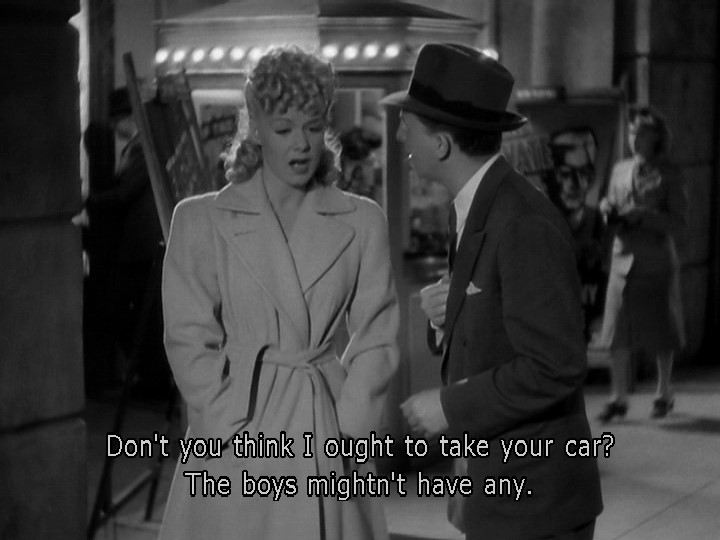
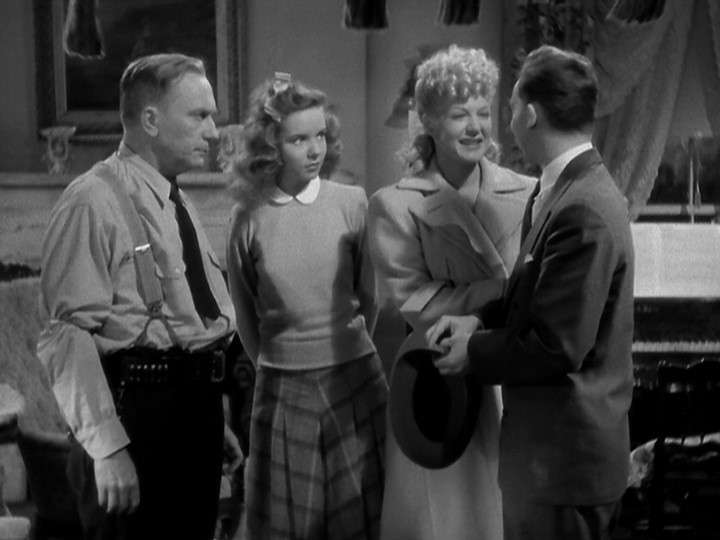
William Demarest). He forbids her to go to the USO dance on Tuesday, because as a veteran of The War to End All Wars, he knows servicemen have their minds on only one thing. "Oh no," says Trudy. "They're not like that any more! These are good boys, noble boys." But Pappy is unconvinced. So she conspires with Norval to take her to the movies, and once there, she dumps him, takes his car, and does a pub-crawl with the "nice boys," telling Norvel she'll meet him back at the flicks at 1:15.

She doesn't make it back until 8:00 am, with the car in tatters, her memory a little shaky, and Norval in the Kockenlocker gun-sights to take the blame when they get her home. With legitimate reasons.

Or even illegitimate ones.

Evidently, she did more than her part for the troops. Trudy doesn't remember a lot about what happened that night, it's kind of a blur. She thinks she might have gotten married, but she's not sure—she can't remember the guy's name. So, she keeps it to herself—the boys are shipping out, who'll know?
Then, there's the little matter of her being pregnant. So, there's a double puzzle: she can't tell anybody she's married without a husband, but she's pregnant without ever having been married. Maybe. What to do, what to do?

It's a scandal. The kind that small towns hush up and don't talk about; but what fun would that be? There's a way out of the problem—don't even go there—but it can't go smoothly, and before the solution can be found, it has to get more complicated—
at the top of its lungs. It even turns political, with guest appearances by "The Great McGinty" (Brian Donlevy) and "The Boss" (Akim Tamiroff), from Sturges' directorial debut.

I've never liked
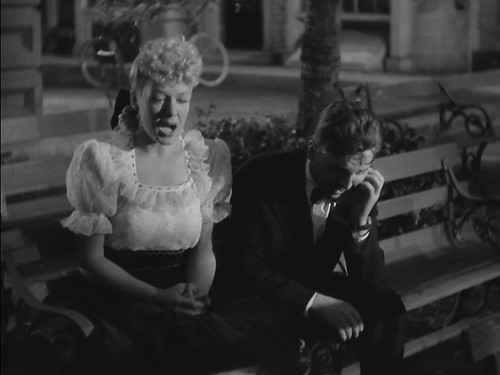
Betty Hutton. I've always found her loud and grating and usually playing scatter-brained simps. Well, her Trudy Kockenlocker is a scatter-brained simp, but Hutton makes her sympathetic and funny, with a perpetual look of comic confusion, exhausted with dis-belief. She's all too willing to do physical comedy in an extremely unladylike fashion (one of which involves her getting clocked by one of those mirror-globes at an out-of-control jitterbug dance). She's a complete joy in this movie, whether by herself, matching stammers with the brilliant Bracken (who moves so fast in this movie, I'm surprised he's not a perpetual blur), or sharing sisterly woes with her wise-acre sister (the nifty Diana Lynn), who is the Horatio to her densley populated Hamlet. Never has a movie had such fun in being irreverent about such American ideals as The War Effort, and even motherhood.

In 2001, "
The Miracle of Morgan's Creek" was selected for the National Film Registry. This American classic is also #54 on the AFI's "100 Years...100 Laughs" list of the funniest movies ever made. And it's somewhere near the top of the most boldly audacious movies ever created in a climate of repression. Add the caveat of taking such subversive gleefulness in its presentation, and it would be #1.

* It should be noted that once the Breen Office died the death of a thousand indignities in the late '50's and 60's, and subject matter was freed up for public consumption, There have been waves of motion picture permissiveness—we approach a line of the verboten and then back off, a few years later we creep up to the line and slink back in a cycle that seems more like evolution than revolution. There is still censorship, but the censor is the marketplace, and a film-maker must consider the box-office potential of his choices, as filtered by the specious and contrary dictates of the MPAA. Except for the screw-balls at the Ratings Board, it seems a more fair system: "Yeah, you can do that...but it's gonna cost ya."

Thursday, February 11, 2010

Hail the Conquering Hero

"Hail the Conquering Hero" (Preston Sturges, 1944) You can take "Semper Fi" just a little too far sometimes. Small-town schnook Woodrow Lafayette Pershing Truesmith (Eddie Bracken) is drinking alone in a bar. Washed out of his beloved Marine Corps for chronic hay fever, he's been working in a San Diego shipyard ever since and writing letters, full of fiction, to his Mom, a Marine widow, that he's fighting overseas. He spots a group of jarheads (led by Sturges regular William Demarest) trying to buy a communal beer with 15¢ between 'em, and buys them a round.

When they hear his tale of woe and subterfuge, the Marines take sympathetic pity on Woodrow, and concoct a story that reads like an invasion plan. Just back from Guadalcanal, they pin their medals on the kid, insist on escorting him home, and make up a cock-and-bull story about him being a hero. Anything for dear ol' Mom. But, as things tend to do in Sturges comedies, things accelerate in a dither of cross-purposes and crushed dialogue. Caught up in the manufactured patriotic fervor, the whole town sings Woodrow's praises, the bank forgiving Mom's mortgage and nominating him for Mayor (with the election only two days away!). Woodrow's genuinely appalled, but the Marines are steadfast in seeing Woodrow's dreams come true, no matter how much he protests, no matter how much he whines. No matter how much guilt he feels.

It took some guts for Sturges to make a story about blind hero-worship and unquestioning patriotic fervor during war-time, but emboldened by a basic cynicism, Sturges does a strafing run on a veritable gallery of targets (with the military even cooperating with the filming!) Sturges takes pot-shots at bankers, small-town in-bred politicians and the insanity of mob-rule, yet still manages to make a fairly sunny picture with a lot of laughs and a hero who's anything but.

Part of the charm of "
Hail the Conquering Hero" is Truesmith as played by Eddie Bracken. Not much to look at, kinda dumpy with a nose that follows the slope of his fore-head without benefit of eyebrow ridges, Bracken has the same voice and manner of Mickey Rooney, a ferocity of energy and a quick way of delivering lines with maximum inflection. That he spends the entire movie frustrated, bitter and cynical doesn't lessen his appeal one jot, which is, frankly, amazing—it's something even James Stewart couldn't pull off in "The Philadelphia Story."

"
Hail, the Conquering Hero" has a couple of Northwest connections: the ingenue is played by Ella Raines, who was born in the little town of Snoqualmie Falls, Washington, and is something of a noir icon for her titular role in "Phantom Lady"; and one of the Marines is played by a mug with a mushed-in face named Freddie Steele.

Steele was a professional middleweight boxer in the Pacific Northwest with an astounding record of wins-losses and draws of 125-5-11. Noted for his pile-driver punches, he was known as "The Tacoma Assassin," before a punch broke his breast-bone (ouch!) and he gave up the ring for the movies. He ran a legendary restaurant in Westport for many years, and his role as the one Marine who thinks that Trueblood may not deserve the false-god praise he gets is the most satisfying of the emotional through-lines in "Hail, the Conquering Hero"


Thursday, January 28, 2010

The Palm Beach Story

"The Palm Beach Story" (Preston Sturges, 1942) Why did the maid scream and faint? Why is the bride trying to hail a taxi? Why did the maid scream and faint-again? Why is there a woman bound and gagged in the closet? Why are both the bride and groom late for the wedding? Why did the maid faint--again?

And that's just what happens in the credits!

Sturges is having fun with movie conventions, that is the conventions of screwball romantic comedies that involve the idle rich, the ones that
George Cukor liked to direct and Katherine Hepburn liked to star in, where the couple getting married at the beginning of the movie might not be the the couple connecting at the end...or will they? Maybe they'll get back together. Don't like the answer? Wait two hours. It will probably change.

Sturges thinks (rightfully) that if such capricious creatures did hook up, their eccentric screwballishness would self-destruct their union within a matter of months, in which case this is Preston Sturges is making a sequel to "The Graduate" twenty-four years before "The Graduate." Such pairings can't work for love or money: when the money runs out the love goes out the window, and the love isn't enough to sustain a relationship under such pressures.

Meet
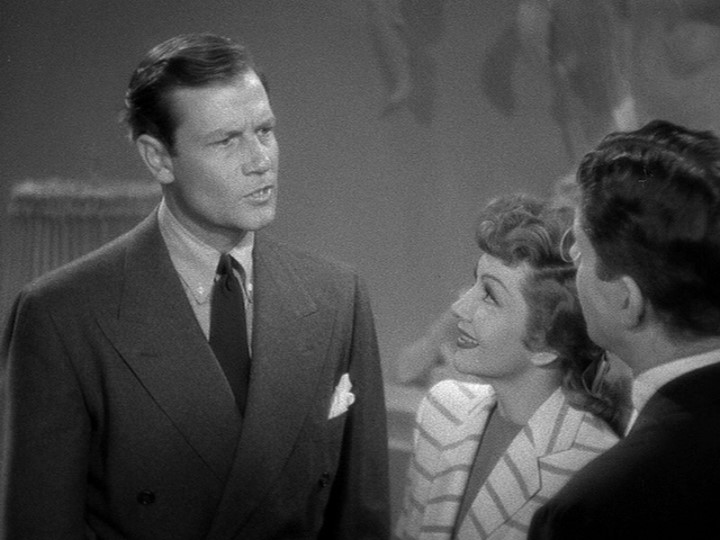
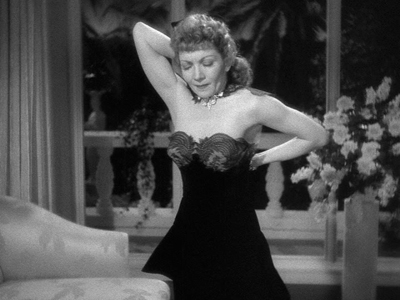
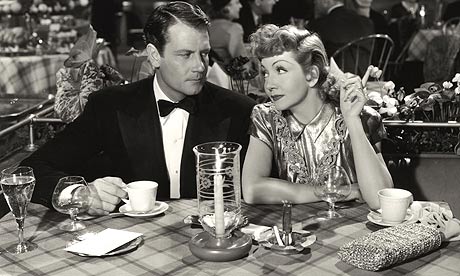
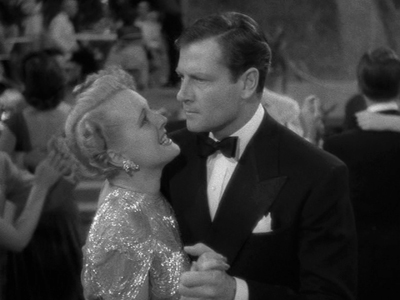
Tom (Joel McCrea) and Gerry (Claudette Colbert), a cute movie couple who fight like cats and mice. We meet them in the kerfluffle that is the Opening Credits, and when next we see them five years later, they're splitting up. She's an eccentric heiress with a taste for the High Life and has this knack for attracting men—this could be the further adventures of Colbert's character in "It Happened One Night"—and he's an eccentric dreamer who can't make a nickel selling his "Big Idea" of taking those camouflage nets they build over airplane plants and reversing the idea by putting airstrips across the building tops of cities. The kids are broke, and she knows she can always attract some guy lousy with money and relieve him of trying to keep her in the style to which she is accustomed. So, because they're both so headstrong, she leaves and he pursues, all the way to Palm Beach, Florida, where the two (now posing as brother and sister) hook up with two rich-nicks in the Hackensacker clan, played by Rudy Vallée and Mary Astor. The Hackensackers are two of the oddest peas growing up in a single pod: he's bookish and wormy and has never been married, she's flighty and flirty and been married five times. Neither one seems to have a brain in their heads and are all-surface. He's careless with money; she's careless with love. They were made for Gerry and Tom.

But, this is still a screwball comedy, so complications arise, such as the married couple still being a married couple;
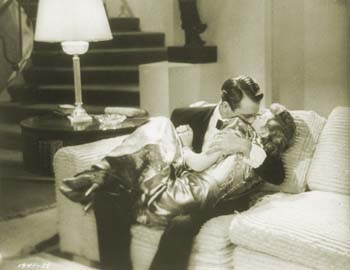
"This is going to cost us millions," groans Gerry as they go into a clinch.

Sturges is already busting through the movie-screen to hold a fun-house mirror to those romantic comedies. But he still has one or two aces up his sleeve that manages to resolve the situation and still remain true to the "Anything Goes" spirit of them, the "Love is Anarchy" and Convention Be Damned attitude that keeps digging pot-holes into the Path of True Love. By the end, he's created a scenario as convoluted as a Shakespeare play in the classical comedy sense.

The principals are all having fun.
Colbert and Astor frolic with their images and McCrea gets to perfect his slow burn. The only dirt in the gears of the fun machine is Rudy Vallée, who plays his role of dunderhead John D. Hackensacker III, as if he was playing it for real. His funny lines are brushed aside, his physical comedy made minor annoyances: one wonders exactly what Sturges saw that he would cast the 20's crooner in such a role—after having guided Henry Fonda expertly in such a role in "The Lady Eve"—and then have the man get a contract from the studio as a result of it. Vallée was a phenomenon not unlike "Pee-wee Herman"—a little goes a long way— and his fame having ebbed to be re-discovered here, he would again fade until the 1960's and "How To Succeed in Business (Without Really Trying)." One wonders where Ralph Bellamy was—he could play guilelessness without sliding into cluelessness. But then, Sturges would often hire dull actors to play the dull love interest.

He's the only fly in this ointment to film comedy conventions. Funny and absurd and a bit surreal at the beginning and end, "The Palm Beach Story" is a fine film to enjoy pre-, post-and during a love affair.


Wednesday, December 23, 2009

Christmas in July

"Christmas in July" (Preston Sturges, 1941) James MacDonald (Dick Powell) lives a life of pretense and dreams. A bean counter for a coffee company, he's just won the $25,000 prize in the slogan contest for rival caffeine-pushers, Maxford House. The winning entry: "Can't sleep at night? It's not the coffee. It's the bunk."

Well, it is the bunk and the pretenses are false ones. MacDonald didn't win any contest. It's all an impractical joke played on him by co-workers, that manages to sneak under the radar due to a contest SNAFU.
But by the end of his perfect day, he's got a promotion, a new raise and an office, and bought presents for everybody on the block without spending a dime yet. You've got to have good luck to get good luck it seems, but it all comes crashing down when the check and everything with it bounces. Jimmy almost loses his new job because, let's face it, he only got it because he won the contest and, his boss, liking sure things and having made a ton of mistakes himself, needs to have something he can count on. Now that he can't count on MacDonald being a proven winner, well...

That twisted logic—the very basis of our banking credit system (You can only get money if you don't need it) forms the curvature of the spine of Sturges' short (68 minutes) winning second film. Another moral, Sturges-style is a familiar one, except in Hollywood: No good deed goes unpunished. MacDonald buys presents for everybody but himself and ends up humiliated in front of his neighbors. But at least he gets to keep his new job if he succeeds at it because "it's one thing to muff a chance once you've had it... it's another thing never to have had a chance."

Powell does measured work far subtler than his musical gigs and ingenue Ellen Drew is delightful. But the stand-out amond the Sturges stock company in this film is Raymond Walburn as the perpetually frustrated and passive aggressive Dr. Maxford, head of Maxford House Coffee. Usually these big business CEO's are played with comedy bluster, but Walburn fumes and fusses as if its as part of his everyday routine as a cup of coffee, roasted and aged. The entire movie has a fresh comic timing that's a bit off-kilter, and the results are hilarious. It's Frank Capra turned on his ear, but far more cynical and with less of a "reach" at the end.

Friday, December 4, 2009

The Lady Eve

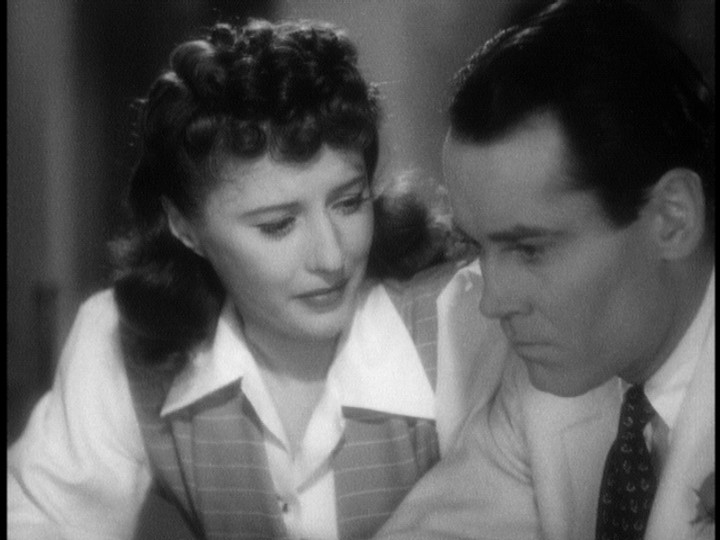
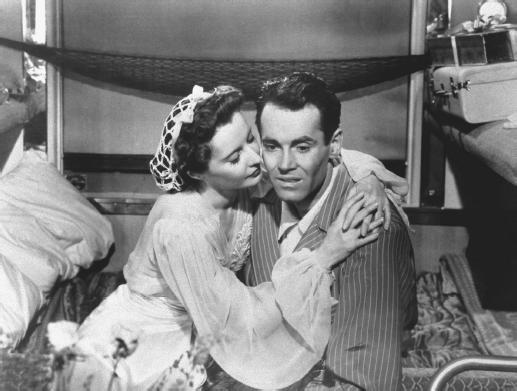
"The Lady Eve" (Preston Sturges, 1941) Ale heir Charles "Hopsey" Pike (Henry Fonda) has been up the Amazon for a year as an ophiologist (emphasis on the "oaf."). It must have been without a paddle because he can't tell two snakey grifters (Charles Coburn, Barbara Stanwyck playing a father-daughter con artist team—the family that preys together...) are trying to collect him...and his dough...on the cruise back to the States. She's already beaned him with an apple as he was boarding ship—it's not exactly Cupid's Arrow, but it'll do, in theory. After he gets hit, well, he's not a lot wiser.

Sturges' third film (and first big hit) is a distillation of every screwball romance that had come down the pike previously. As with the best screwball comedies, the woman has all the power and nobody could play power better or with more cruel humor than the ungainly
Barbara Stanwyck, here as fast as quicksilver and, frankly, a bit tough to keep up with—you want to watch it twice just to see all of her nuances you missed. Her opponent...object of affliction...affection...is a combination of every man-handled man-type that you can have in these comedies. "Hopsey" Pike is well-off, a specialist in his field but a tenderfoot out of it—he can spot snakes in the jungle but not in the grass—somewhat sheltered and clumsy, and saves money on casting Ralph Bellamy by playing his own stuffed shirt. And being on a boat ensures that the ground is never too sure under his feet, the better for the sweeping off of. And the best guy to "take" in a "confidence" game is somebody who doesn't have any.

Confidence, that is.

Henry Fonda didn't play many rubes, as there was always something steely under his baby-blues; you couldn't hide his intelligence and Sturges doesn't try, making Hopsey book-smart, but virginally inexperienced and shy. One would say clumsy, given the right circumstances, which is where Stanwyck's Eugenia comes in, with her foot in the aisle to trip him up, literally. Pretty soon, that becomes Sturges' short-hand for letting you know that "Hopsey" is falling for Eugenia, a 40's comedy substitute for attraction being physically evident.

But the best un-laid plans... Pretty soon, Eugenia is falling for Hopsey, as evidenced by her getting hot and bothered by his chosen field of study. "Slimey snake!" she yells as she wakes up from a nightmare.
Preston Sturges was always one for tweaking the censors, and with "The Lady Eve," he's more than suggesting by associations of culture and psychology what's going on here in a knowing way—the biblical way of knowing, complete with snakes and apples and falls from innocence.

Things get complicated as Eugenia must thwart her father's plans for fleecing the golden boy—she does actually care about him, but when Pike finds out what the two are up to, he breaks off with her, leaving her in a huff. If she was honest with him, he'd probably have done the same thing, so with that moral quandary and his making her feel cheap and all, she plots her revenge, with one of the best lines of spite to come out of Hollywood: "I need him like an axe needs a turkey!" Appropriate vindication mixed with a vindictiveness chaser ensues.

Well worth the time and effort to seek out, "The Lady Eve" is a shining example of how sophisticated and down-and-dirty Hollywood comedy could get. In 1994, "The Lady Eve" became part of The National Film Registry as being "culturally, historically or aesthetically significant."

Funny as the devil, too.


Wednesday, November 25, 2009

The Great McGinty

"The Great McGinty" (Preston Sturges, 1940) Guy walks into a bar in a "banana republic" and tries to ventilate his own head. Turns out he's an embezzler on the lam who's made one mistake and wants to end it all. The bartender manages to stop him, but doesn't give him any sympathy. He thinks he has problems? He used to be Governor of the State.

The rest of the movie is
Sturges' tall tale told in flashback that turns around the bar's doubters and the rolling eyes. Dan McGinty (Brian Donlevy) is a bum. He finds out that if he votes for a candidate for Mayor at a polling place, the candidates' "political advisers" will pay him two bucks. Sounds good to McGinty. But if he votes for the guy at 37 different polling places. he'll get 74 bucks! The politico's can't believe it. They're petty criminals. They don't think "big" like McGinty. So, after a brief turner as a mob "collector," he goes to the next logical career step—politics!

Once Mayor,
McGinty starts shaking down city fathers and handing out favored construction contracts, his "tough guy" tactics backed up by mayoral power. And nobody can argue with him, save the mob boss (Akim Tamiroff) that McGinty regularly has knock-down-drag-outs with. Oh, and his "married-to-look-good-for-the-lady-voters" wife/former secretary (Muriel Angelus), she gives him a kick in the pants every so often. But, when McGinty becomes governor, she talks him into doing some good for a change, and...well, you know that "no good deed goes unpunished."

The characters are Dickensian, the fable is
Aesop turned on his toga. And drama turned on its head. A tragedy is a good man who does something wrong. And in Sturges' street-wise script, tragedy befalls a bad man who does the right thing. No moral codes are being broken—McGinty is taken down. But Sturges' view is a cock-eyed, if soberly cock-eyed, story of moral growth and the trouble it can cause, especially if you're working for the people. Told with brass and a smart alecky humor, it's a criss-crossed morality play told from the other side—an anti-Capra film, told with that director's straight-forwardness, but with more of a knockabout flavor.

This was the first film Sturges directed, and it has sophisticated ideas (which seem quite contemprary) told in a scruffy manner. If there's pretentiousness, it's all in the background and the sub-text, buried where no one can nod sagely at it. One gets the impression Sturges would look at a movie aiming for the handkerchiefs and blow it a raspberry. Before the year fades away, we're going to be looking at a lot more
Preston Sturges, a director who doesn't get near enough acknowledgement in the movie history books. There's not enough Sturges in my head, and we're going to rectify that.

Thursday, August 21, 2008

Sullivan's Travels

"Sullivan's Travels" (Preston Sturges, 1941) Entertaining 1941 "message picture" "with a little sex in it." Director John L. Sullivan has a case of "Hamlet disease,"* and wants the studio to bankroll a serious picture about poverty--"Oh Brother, Where Art Thou?"**--but while the brass haggle over whether they want to do it or not, "Sully" (Joel McCrea) dresses the part and goes amongst the poor and down-trodden for research. There, a girl (Veronica Lake, playing "The Girl") down on her own luck trying to get acting jobs, uses her last thirty cents to buy him breakfast. Sully gets the guilts, and tells her of his idea, and ropes her into the scheme.

The two then skip the studio publicity-mill bus that's been set up to track their moves as they spend the next few days hopping freights, eating at soup kitchens, and sleeping at flop-houses. The movie fairly careens with changes of tone from earnest pathos to roaring comedy--the poor are saintly (though one thief is particularly verminous), while the rich Beverly Hills folk, they are a foolish bunch. And Sully's "experiment" falls a bit short when he and The Girl can abandon it at a moment's whim (although Sturges does insure a more authentic experience, just to ensure that his point gets made).

Ultimately, the film seems a bit self-justifying in that a comedy film-maker makes a comedy about why comedies are needed. One would think that Sully could read the trades and see how well his movies were doing and come to the same conclusion. But let's not quibble. The movie is a great construction with Sturges' rock solid writing delivering a punch or punch-line every third line or so, all delivered at a break-neck pace by his stable of regulars and
McCrea, whose sense of light comedy was impeccable, and Veronica Lake
, who was never better than the breezy blonde who goes along for the ride.


"Sullivan's Travels" is the brightest star of the Preston Sturges series of Paramount comedies. If it can lead one to seeking out the rest of this too-overlooked writer-director's films, then that's gravy.

"Sullivan's Travels" is in the United States National Film Registry.

* When a comedian yearns to play Hamlet.

** Yes, this is where the Coen Brothers got it.