Showing posts with label Silent. Show all posts

Thursday, November 28, 2013

Upstream

Upstream (John Ford, 1927) Somewhere in New Zealand, there was a film archive that contained a spate of nitrate films that were not returned to the United States after their initial showings in the 20's. They sat there, waiting to either disintegrate or explode in flames, until they were discovered in 2009.  Among the treasures were one of the first films ever to be worked on by Alfred Hitchcock, as well as one trailer and one feature directed by John Ford for the Fox Corporation (before their merger with 20th) that up 'til then had thought to be lost.

Early Ford is still deeply Ford country.  This backstage drama takes place in a players' boarding house, where touring performers could rent lodgings for their seasons in vaudeville houses.  The current residents are a motley troupe: a mother-daughter "sister act," Irish vaudevillians Callahan and Callahan (Ted McNamara and Sammy Cohen—yes, you read that right, it's part of the gag), the faded Shakesperean (Emile Chautard), the medicine show jugglers (and distillers), the "Star Boarder" (Raymond Hitchcock)—his reputation gained by inserting himself into every situation, the least talented member of a famous acting family, the Brashinghams (Earle Foxe), and a knife-throwing act with the Castillian expert Juan Rodriguez—real name Jack La Velle (Grant Withers)—and his lovely target Gertie Ryan (Nancy Nash).  

Any community in a Ford film is complicated and this one is tangled like a cat's cradle.  Jack's in love with Gertie, but Brashingham is on the make as well.  Everybody is in everybody's business, but when one word comes from London that a Brashingham (even a lousy one) must be booked to play "Hamlet," it throws the whole household in an uproar.  The vain Brashingham couldn't act his way out of a wet paper sack, but the experienced thesp' gives him lessons that seem to bring out the best in him as an actor, while bringing out the worst in him as a human being.  There are the various tactics to avoid paying rent with the Landlady, the torn loyalties of Gertie, and the "Star Boarder's" proclivity to flirt with anything in a skirt—it's Ford affectionately poking fun at the phoniness and the keeping up of appearances of show folk, but also of how a disparate group of individuals can still mutually raise each other up.  The performances are remarkably restrained for a silent film (and one about a bunch of hams), and Ford pulls a couple of tricks with a smoothly moving camera that impresses, considering how bulky the things were back then.

Made three years after his landmark The Iron Horse and a year before his first talking picture, Upstream is worth seeing for an atypical prototype of what Ford would produce later in his career.


Emile Chautard, Earle Foxe, and Nancy Nash all have things
that need to be discussed Upstream


Thursday, September 26, 2013

Safety Last! (1923)

Safety Last! (Fred C. Newmeyer, Sam Taylor, 1923) Boy (Harold Lloyd) leaves home to achieve fame and fortune in the Big City, so that he can then call for his girl (Mildred Davies) so they can marry and make a life together.  She should know better.  He almost misses the train in his zeal, first stealing a child instead of grabbing his luggage, then, realizing his mistake, he grabs the first thing in his path—a passing car—instead of the train.

The film starts playing with expectations (and morbid ones, at that) from the first shot, as we see Lloyd behind a bars, his mother and a clergyman bidding him good-bye, as a policeman looks at his watch while a noose hangs in the background.   No, he's not about to die.  He's leaving home, the bars to keep people from crossing over onto the tracks and the noose a delivery system for pass-by messaging. But the camera trickery and stunt-work—at about 50% Keaton speed—is very much in evidence right from the beginning, and does not flag throughout the film for its 70 minute running time, up to and including a sequence so iconic—with effects trickery so effective—that it stands as one of the great representations of the silent era.


Lloyd's "Boy" (his pay-checks come to him as Harold Lloyd, however) after weeks of making do and hiding from his landlady, manages to land a job at the fancy-schmancy DeVore department Store as a counter boy.  His letters home paint a different picture, saying he's a successful manager, and though he keeps trying, it always seems that something—including the snooty floorwalker of the store, Mr. Stubbs (Westcott Clarke)—gets in his way.


Then, disaster strikes.  His girl comes to visit and he has to work overtime trying to impress that he's "big" at the store, then he overhears the general manager wracking his brain how he can get more bodies to the store (which doesn't appear to be a problem as the counters are always over-crowded with fighting customers).  Harold says he'll climb the side of the building like a human fly for enough money to stake a wedding, and puts his room-mate—a high-rise construction worker—up to the task.

Last minute complications set in, as the room-mate is trying to run from the law, so it's up to Harold to climb the building, but only for one floor until they can switch clothes and his buddy can take it the rest of the way.

Doesn't happen that way.  It's still an impressive sequence, no matter how—and there is still some conjecture about that—they did it.  But between Lloyd and stunt man Robert Golden the sequence is hilariously nerve-wracking, constantly inventive, and keeps building complication upon complication.  it is deservedly one of the most remembered films of the silent era (and not just for the last twenty minutes), and made it into the National Film Registry in 1994, five years after they started making the selections. 


Friday, August 9, 2013

The Sin of Harold Diddlebock

The Sin of Harold Diddlebock (Preston Sturges, 1947) (aka Mad Wednesday, 1950) Sturges' first film out of his Paramount Studios contract, and with his film company California Films in partnership with millionaire polyglot Howard Hughes. Sturges adapted his script idea "The Sin of Hilda Diddlebock" (about a young girl's misadventures in Hollywood) for a favorite silent film star, Harold Lloyd—who was under the impression that he'd get to direct some sequences.  

It must have been "going around," as Sturges was under the impression he had free reign over the film.  But when it opened "soft," Hughes took over control of the film, re-editing it (in his painstaking way), finally releasing it in 1950 as "Mad Wednesday" (because a title with "sin" in it might not appeal to audiences throughout the nation—although it was probably that very enticing nature that led Sturges to title it that way in the first place).


The version we saw is the Sturges version, in desperate need of some sort of care and restoration—the black and white images are soft and dark looking, like it was shot in perpetual twilight, several splices mar the flow and interrupt a couple jokes here and there, and making one want to see the mangled version just to see if it's (ironically) in better shape.


It's hard to determine what "sin" Sturges is talking about. The film starts with a sequence from Lloyd's The Freshman (made in 1925) intercut with some recent scenes that act as bridging sequences as Lloyd's water boy manages to score a winning touchdown, impressing a business owner who (in new scenes filmed by Sturges) hires him on the spot.  Sturges keeps the sequence silent and primitive to mesh with the earlier filmed sequences and Lloyd looks young enough to pass for his younger self.


But, that's where the film starts.  Diddlebock's moment of glory results in his getting a job as an accountant for the man's firm.  Twenty years later, he's still there, passed by by other employees, including a series of sisters he admired and all moved on, leaving the youngest as Diddlebock's work colleague.  He's laid off, given a severance, and kicked out without prospects and no goal posts to run towards.


Already, the film is a commentary on American business, its spoiling of potential through pigeon-holing and compartmentalization, and the efficacy of "glory days."  But this is the first ten minutes.


Out on the street, Diddlebock gets way-laid by a racetrack tout (Jimmy Conlin) who sees him as a case of arrested development—one with a lot of disposable income—and after a two decades recess, Diddlebock goes back to school, as taught on the street.  First step: a bar, where he has his first adult beverage, an event that inspires the bartender (Edgar Kennedy)—"You arouse the artist in me"—to create a grand concoction of mixology, the sipping of which elicits a primal scream somewhere between the ubiquitously used red-tail hawk cry and a high-pitched ape roar.  A couple of toots of those and it's a trip to the barber's for a complete make-over, including a garishly nightmarish checkered suit, and the investment in short-term futures at the horse track, which pays off huge dividends, further inspiring high living, a blackout for an indeterminate length of time, and the investment in a defunct circus, including a menagerie of animals and one particularly cranky male lion that becomes Diddlebock's nearly constant companion and chief collateral throughout the rest of the movie.  Hilarity—and Sturges' unique brand of hysterical panic—ensues.


It's the maddest of screwball comedies with Diddlebock a cyclone of disruption wherever he goes, trying to unload the results of his bleary recent past and only finding himself with more problems, more prospects and an ever-growing number of acquaintances...the freak accidents of American success.

Even with Sturges' frenetic timing, the results are a bit off in tone and pace, as if somewhere along the way, the directorial edict became "faster..." (which, for Sturges, approaches the super-sonic).  Still, even though its uneven, it's still full of bizarre child-like invention and scrupulously drawn character types.

The dialogue is snappy and so is the lion—a couple of times making a lunge for LLoyd's hand, while the plucky silent star (probably to avoid further takes with the animal which he was terrified of) keeps going with the take, not missing a beat.  Amazing.

No, it wasn't successful; Sturges might have lost some of his homespun touch after so many frustrating years in Hollywood, despite his successes for Paramount.  Parallels can be found with Diddlebock, who hits the jackpot and keeps on hitting, despite being beset by day-to-day "small stuff" that he has to sweat.  But Sturges can still mine comedy gold out of his self-analysis, as he did with Sullivan's Travels.  He would continue to struggle, while still walking the thin line between message and entertainment.  He would only make three more films.


Tuesday, August 6, 2013

Steamboat Bill, Jr.

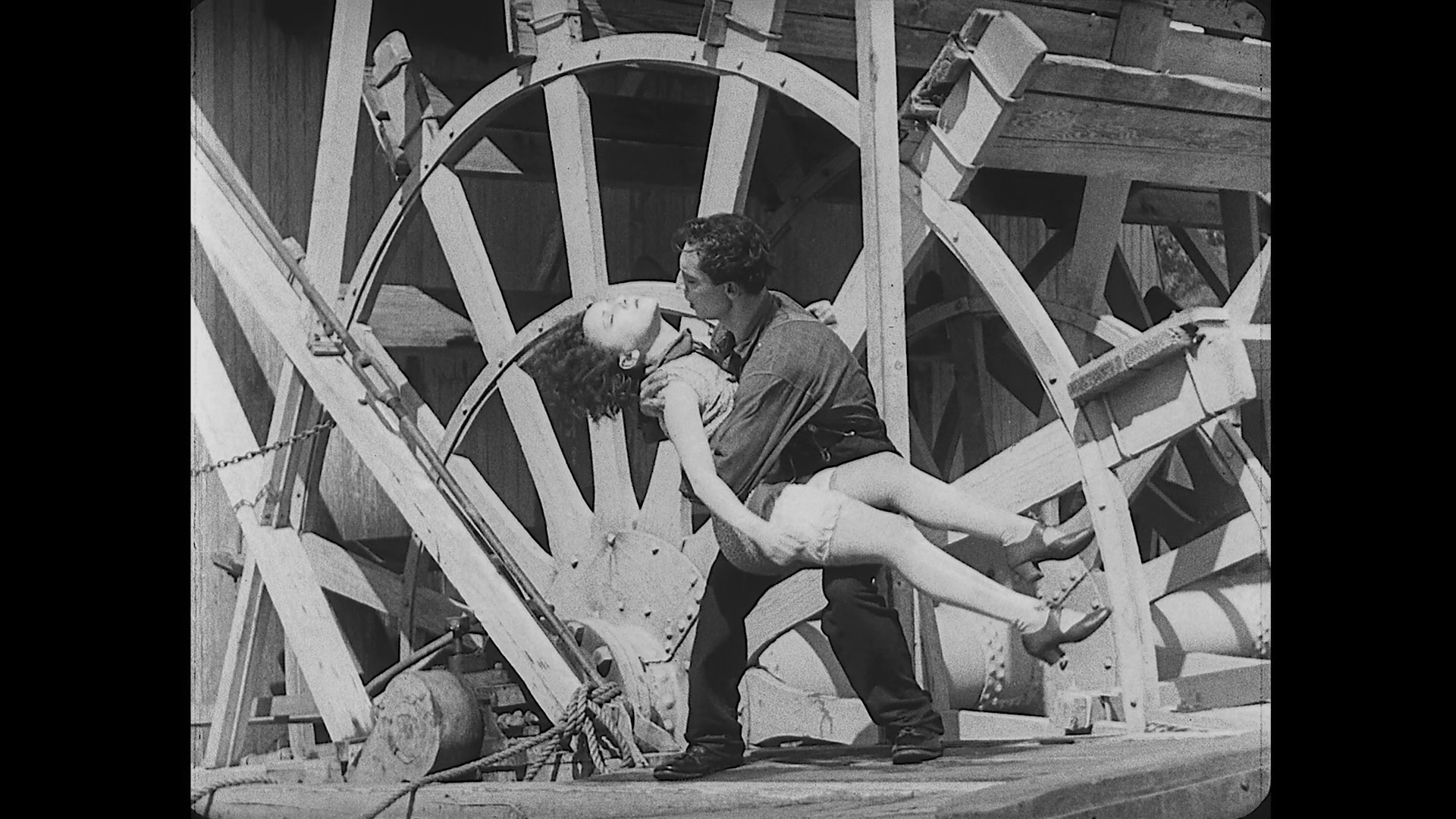
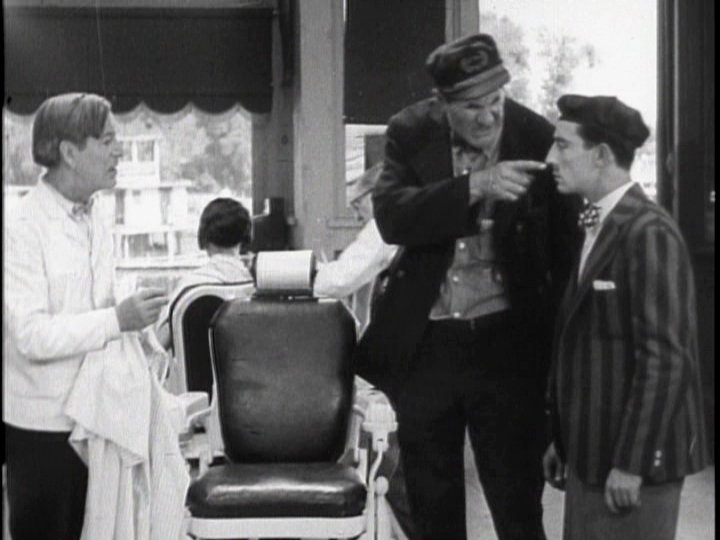
Steamboat Bill, Jr. (Charles Reisner/Buster Keaton, 1928) Keaton's last film as an independent (before signing onto an ultimately disastrous contrect with M-G-M) is a variation of "Romeo and Juliet," but instead of bickering families in Verona, Italy, it's two riverboat owning-fathers in the city of River Junction who object to William Canfield, Jr. (Keaton) and Kitty King (Marion Byron) finding any happiness together.

At 71 minutes, this one is feature length (for a silent film), with the story revolving around the son of "Steamboat Bill" coming back from college to spend time with his father, who he never knew growing up.  The rough-and-tumble paddle wheel captain is chagrined to find a slight, mustachioed ukulele player getting off the train, with the two not even recognizing each other for an entire sequence of the film.  Bill's hopes of Bill, Jr. helping his lackluster boat business try to stay afloat are soon dashed, and he's even more horrified that junior is fond of the daughter of a rich man, J.J. King, who's latest venture is a fancy riverboat business that attracts riders away from his own.


The two riverboat barons try to keep the two apart, and barring that, try to sink each others' businesses.  King gets Bill's boat condemned, and the flinty steamboat captain's subsequent rage gets him incarcerated, leaving junior to try to spring his father which ultimately fails in execution, and lands the son in the hospital.


Keaton, given a window of opportunity, bringing the house down.

Then, the winds come.  

In one of Keaton's (and cinema's) most elaborate stunt sequences, a typhoon hits River Junction wreaking havoc and destroying buildings, tossing denizens around as they scramble for shelter—all except for young Bill, still unconscious in a hospital...until there isn't one, anymore.  It has been ripped from its foundation by the tornado winds that come down upon a town like a deus ex machina to bring the warring parties together in the end.  It's also one of the most elaborate of the Keaton constructions that dominate the last acts of his films, where story is abandoned and the film accelerates to its final resolution by throwing at its hero any number of hurdles and obstacles that he must dance, pivot, and somersault up, over, around and through.  This one is a marvel, using high-powered wind machines and a massive crane, the river town is calved, halved, blown away and blown down, depending on which direction opposite to it Keaton is propelling through.  Even without the abundance of splintering buildings, Keaton's stunt work (against the push of six powerful wind machines) is still thrilling to watch, as he bends, corkscrews and leans impossibly forward in an impossible effort to stay on his feet.

It's thrilling, ingenious, often surrealist stuff to watch, even more amazing when you realize that Keaton did the stunts himself, designed the sequence and directed it, a tour de force of Nature, real and imagined, on all fronts.