Showing posts with label Buster Keaton. Show all posts

Tuesday, November 19, 2013

Go West (1925)

Go West (Buster Keaton, 1925) There have been a couple features with the title, but this is the one written, directed and starring Keaton as a woe-begone dweller of a podunk town who sells everything he owns at the Fade From Black, only to find (after buying food and buying back the family photo he'd forgotten in a drawer) that he's a completely free man (freedom being just another word for nothing left to lose).  Deterred and detoured, he hoboes a freight train and accidentally (not exactly the right word as Keaton's "accidents" are always complicated) finds himself on a working ranch out west.  A discraded set of chaps is all the references he needs to start working on the ranch and working the herd, starting from the ground up.  Removing a stone from a heifer's hoof gains him a friend and a constant companion in the work-a-day world, as the un-broco'd Buster and bovine look out for the other.  

It's a classic fish-on-the-prairie story as Keaton's tenderfoot and his tender-footed cow-friend find ways to get things done while not doing things in the normal cowboy fashion, and any mentioning of the lessons learned in milking, lassoing and branding a cow will only spoil the surprise.  Let's just say that PETA would be proud.

The way most silent comedies work is with a long series of short bits and then an extended sequence in the final couple reels, and that was Keaton's standard blue-print, as well.  The final complication involves getting the herd to market so that the ranch can pay its bills, while at the same time, saving the one cow that Keaton has become the guardian cowboy to.  It involves a train-trip (a Keaton specialty) as well as one logistical movie-making nightmare—a cow stampede through the streets of roaring '20's Los Angeles, but done at a pace with a tangential series of complications that amaze.

As always seems to be the case with silent comedies, especially those of Keaton, the fewer words the better.  Just seek it out and enjoy.


The first "Mexican stand-off" in movies is instantly defused with a pinkie finger.


Tuesday, August 6, 2013

Steamboat Bill, Jr.

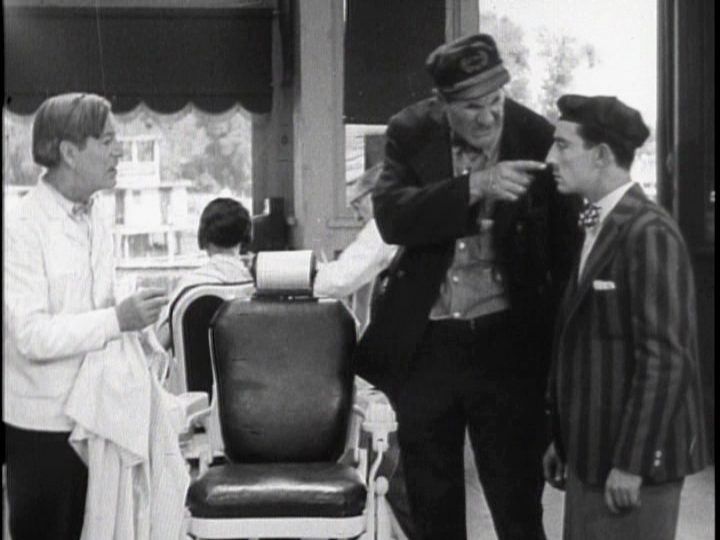
Steamboat Bill, Jr. (Charles Reisner/Buster Keaton, 1928) Keaton's last film as an independent (before signing onto an ultimately disastrous contrect with M-G-M) is a variation of "Romeo and Juliet," but instead of bickering families in Verona, Italy, it's two riverboat owning-fathers in the city of River Junction who object to William Canfield, Jr. (Keaton) and Kitty King (Marion Byron) finding any happiness together.

At 71 minutes, this one is feature length (for a silent film), with the story revolving around the son of "Steamboat Bill" coming back from college to spend time with his father, who he never knew growing up.  The rough-and-tumble paddle wheel captain is chagrined to find a slight, mustachioed ukulele player getting off the train, with the two not even recognizing each other for an entire sequence of the film.  Bill's hopes of Bill, Jr. helping his lackluster boat business try to stay afloat are soon dashed, and he's even more horrified that junior is fond of the daughter of a rich man, J.J. King, who's latest venture is a fancy riverboat business that attracts riders away from his own.


The two riverboat barons try to keep the two apart, and barring that, try to sink each others' businesses.  King gets Bill's boat condemned, and the flinty steamboat captain's subsequent rage gets him incarcerated, leaving junior to try to spring his father which ultimately fails in execution, and lands the son in the hospital.


Keaton, given a window of opportunity, bringing the house down.

Then, the winds come.  

In one of Keaton's (and cinema's) most elaborate stunt sequences, a typhoon hits River Junction wreaking havoc and destroying buildings, tossing denizens around as they scramble for shelter—all except for young Bill, still unconscious in a hospital...until there isn't one, anymore.  It has been ripped from its foundation by the tornado winds that come down upon a town like a deus ex machina to bring the warring parties together in the end.  It's also one of the most elaborate of the Keaton constructions that dominate the last acts of his films, where story is abandoned and the film accelerates to its final resolution by throwing at its hero any number of hurdles and obstacles that he must dance, pivot, and somersault up, over, around and through.  This one is a marvel, using high-powered wind machines and a massive crane, the river town is calved, halved, blown away and blown down, depending on which direction opposite to it Keaton is propelling through.  Even without the abundance of splintering buildings, Keaton's stunt work (against the push of six powerful wind machines) is still thrilling to watch, as he bends, corkscrews and leans impossibly forward in an impossible effort to stay on his feet.

It's thrilling, ingenious, often surrealist stuff to watch, even more amazing when you realize that Keaton did the stunts himself, designed the sequence and directed it, a tour de force of Nature, real and imagined, on all fronts. 


Wednesday, June 26, 2013

Seven Chances

Seven Chances (Buster Keaton, 1925) In this 56 minute feature, Buster Keaton must survive the rocky road to getting married...or else.  Seven Chances is a few films in one: it starts with a brief prologue in tableau'd fades of a stalled romance between Jimmy Shannon (Keaton) and Mary Jones (Ruth Dwyer) as they don't communicate as the seasons change around them, and Mary's puppy becomes a full-grown dog.

Then, the plot thickens.  A financial broker on the verge of bankruptcy, he is informed that his grandfather has bequeathed him seven millions of dollars on one condition—he must be married by 7 pm on his 27th birthday (which happens to be that day).  His first instinct is to marry Mary, but circumstances force him to look elsewhere, and he spends the day trying desperately to get married, but is refused at every drop to his knees.  


Next, an ad is placed in the paper for a bride, which produces an entire church-load of potentials, which, once panic ensues, begins a long drawn out chase, first through the streets of 20's Los Angeles (in scenes highly reminiscent of Keaton's 1922 short Cops, but with the added joke of runners in white dresses and long veils).  As is typical with Keaton, the ideas build, usually logically from barriers and obstructions and passers-by thrown into the mix, the silent equivalent of a parkour course which the dexterous (and seemingly boneless) Keaton must dodge, duck and dance around while skampering at full tilt.


Of course, there must be a chase...
But, once out of the city limits, Nature starts to come into play with expected and unexpected obstacles that keep piling on, literally, in an extended sequence where Keaton, running down an impossibly long hill, must avoid an avalanche of boulders, that seem bent on pushing him around.  The sequence came out of a preview, where a scene of a flopping Keaton dislodging some rocks, start following him down hill, which he quickly tries to avoid.  The shot garnered the biggest laugh of the preview, so Keaton went back and shot some more footage and built another routine out of it, building, building, building, extending the momentum, and the resulting audience reaction until he was satisfied.

There are a couple of brief un-PC moments (one of which will fly by modern audiences, but it involves the mentioning of a '20's female impersonator), and there's just a whiff of misogyny here—a mob of women is still a mob, though—but, then part of the joke is that if Jimmy can't have "his" girl, any girl will do, but it's belied by all of the "any" girls rejecting him outright.  Also of interest is a brief peak at a young Jean Arthur in the role of a country club receptionist.

Anything involving Keaton on-screen is worth seeing, and good for quite a few laughs...when one isn't gaping in wonderment of what the man was capable of, and capable of doing.


The country portion of the Seven Chances chase scene.
The scene at :30 inspired the extended avalanche scene.

Friday, July 9, 2010

Personal Heroes: Buster Keaton


Buster Keaton

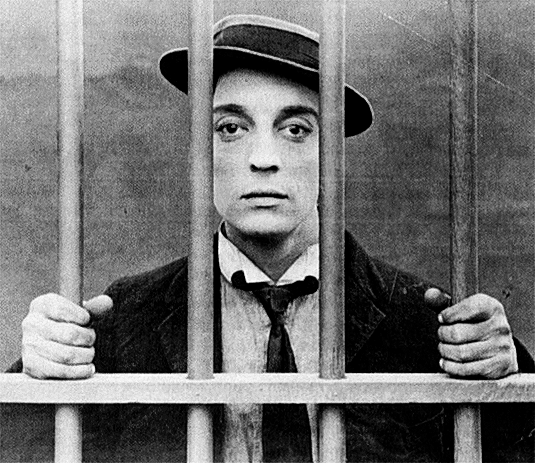
As I negotiate the corridors of the "1's&0's" Ranch, I occasionally have to do a pivot down a hallway or make a lateral move to avoid a wrangler taking a corner too tight. Instinctively, a leg flies up clownishly, unnecessarily. It's a habit, and every once in awhile I notice it, and think about where I got it. It's a Buster Keaton move--one of the simplest things he did. He'd stick out a leg as he was hopping around a corner, or yank it out way too far if he had to change direction fast, sometimes 180°. I started doing this in college after I fell in love with Keaton films. I don't know if I can break myself out of the involuntary jag that I do in tribute. I don't know if I want to, really.

Words fail me when it comes to Keaton, so singular is his art—and his work in "the Silents" never had much use for words.  Actions speak louder than.  And his actions, in a world that seemed specifically designed to kill him, were heroic in determination and amazing in execution.  The best I could do is free verse.

Buster'd

Man alive, look at 'im run so fast, so far, so wide
cart-wheeling, feet-peeling, stop on a dime and take off
Over the fences, under the legs, climb the ladder and tilt
What must it feel like with the Whole World as a prop?

Sputtering, he'd launch, like his body exploded
His feet and hands going as wide as they could
Exaggerated movement. Exaggerated stops. He'd skid.
And hang--like on the edge of a cliff--he'd wobble

And fall?
The very definition of "SPLAT!"
He'd land flatter'n humanly possible
All crumpled up in an angular ball,
an arm and a leg left dangling.
He wouldn't bounce. He'd jump right up.
To start the whole process again.

Bandy-legged sad-sack, the old stone-face takes a fall
The legs cartwheel in a circle--a carousel in the air.
Never in your wildest dreams would you attempt a stunt like that
but he'd had it all planned out--made it look hard, like it hurt.

He never, ever showed a smile
At the most a look of surprise
A smile would've made it look easy
and he worked for every laugh.

He didn't beg for your sympathy like the Tramp
He wasn't a victim of the chase like Lloyd
More often than not he chose to be where he was
He leaped at the chance, he ran full-speed.

He worked best in the Silents with his Old Man's Voice
And think of the commotion he would have made, crashing, thundering,
As it is, the only sound you hear
is your own jaw, dropping.


For More About Buster Keaton:


Tuesday, January 15, 2008

Buster Keaton

Buster Keaton

As I negotiate the corridors of the "1s&0s" Ranch, I occassionally have to do a pivot down a hallway or make a lateral move to avoid a wrangler taking a corner too tight. Instinctively, a leg flies up clownishly, unnecessarily. It's a habit, and every once in awhile I notice it, and think about where I got it. It's a Buster Keaton move--one of the simplest things he did. He'd stick out a leg as he was hopping around a corner, or yank it out way too far if he had to change direction fast, sometimes 180°. I started doing this in college after I fell in love with Keaton films. I don't know if I can break myself out of the jag. I don't know if I want to, really.

Buster'd


Man alive, look at 'im run so fast, so far, so wide
cart-wheeling, feet-peeling, stop on a dime and take off
Over the fences, under the legs, climb the ladder and tilt
What must it feel like with the Whole World as a prop?

Sputtering, he'd launch, like his body exploded
His feet and hands going as wide as they could
Exaggerated movement. Exaggerated stops. He'd skid.
And hang--like on the edge of a cliff--he'd wobble

And fall?
The very definition of "SPLAT!"
He'd land flatter'n humanly possible
All crumpled up in an angular ball,
an arm and a leg left dangling.
He wouldn't bounce. He'd jump right up.
To start the whole process again.

Bandy-legged sad-sack, the old stone-face takes a fall
The legs cartwheel in a circle--a carousel in the air.
Never in your wildest dreams would you attempt a stunt like that
but he'd had it all planned out--made it look hard, like it hurt.

He never, ever showed a smile
At the most a look of surprise
A smile would've made it look easy
and he worked for every laugh.

He didn't beg for your sympathy like the Tramp
He wasn't a victim of the chase like Lloyd
More often than not he chose to be where he was
He leaped at the chance, he ran full-speed.

He worked best in the Silents with his Old Man's Voice
And think of the commotion he would have made, crashing, thundering,
As it is, the only sound you hear
is your own jaw, dropping


For More About Buster Keaton:

Tha Annual Keaton Celebration in Iola Kansas (September 29-30, 2006. Plan now!)