Showing posts with label Silent Film. Show all posts

Tuesday, November 19, 2013

Go West (1925)

Go West (Buster Keaton, 1925) There have been a couple features with the title, but this is the one written, directed and starring Keaton as a woe-begone dweller of a podunk town who sells everything he owns at the Fade From Black, only to find (after buying food and buying back the family photo he'd forgotten in a drawer) that he's a completely free man (freedom being just another word for nothing left to lose).  Deterred and detoured, he hoboes a freight train and accidentally (not exactly the right word as Keaton's "accidents" are always complicated) finds himself on a working ranch out west.  A discraded set of chaps is all the references he needs to start working on the ranch and working the herd, starting from the ground up.  Removing a stone from a heifer's hoof gains him a friend and a constant companion in the work-a-day world, as the un-broco'd Buster and bovine look out for the other.  

It's a classic fish-on-the-prairie story as Keaton's tenderfoot and his tender-footed cow-friend find ways to get things done while not doing things in the normal cowboy fashion, and any mentioning of the lessons learned in milking, lassoing and branding a cow will only spoil the surprise.  Let's just say that PETA would be proud.

The way most silent comedies work is with a long series of short bits and then an extended sequence in the final couple reels, and that was Keaton's standard blue-print, as well.  The final complication involves getting the herd to market so that the ranch can pay its bills, while at the same time, saving the one cow that Keaton has become the guardian cowboy to.  It involves a train-trip (a Keaton specialty) as well as one logistical movie-making nightmare—a cow stampede through the streets of roaring '20's Los Angeles, but done at a pace with a tangential series of complications that amaze.

As always seems to be the case with silent comedies, especially those of Keaton, the fewer words the better.  Just seek it out and enjoy.


The first "Mexican stand-off" in movies is instantly defused with a pinkie finger.


Wednesday, June 26, 2013

Seven Chances

Seven Chances (Buster Keaton, 1925) In this 56 minute feature, Buster Keaton must survive the rocky road to getting married...or else.  Seven Chances is a few films in one: it starts with a brief prologue in tableau'd fades of a stalled romance between Jimmy Shannon (Keaton) and Mary Jones (Ruth Dwyer) as they don't communicate as the seasons change around them, and Mary's puppy becomes a full-grown dog.

Then, the plot thickens.  A financial broker on the verge of bankruptcy, he is informed that his grandfather has bequeathed him seven millions of dollars on one condition—he must be married by 7 pm on his 27th birthday (which happens to be that day).  His first instinct is to marry Mary, but circumstances force him to look elsewhere, and he spends the day trying desperately to get married, but is refused at every drop to his knees.  


Next, an ad is placed in the paper for a bride, which produces an entire church-load of potentials, which, once panic ensues, begins a long drawn out chase, first through the streets of 20's Los Angeles (in scenes highly reminiscent of Keaton's 1922 short Cops, but with the added joke of runners in white dresses and long veils).  As is typical with Keaton, the ideas build, usually logically from barriers and obstructions and passers-by thrown into the mix, the silent equivalent of a parkour course which the dexterous (and seemingly boneless) Keaton must dodge, duck and dance around while skampering at full tilt.


Of course, there must be a chase...
But, once out of the city limits, Nature starts to come into play with expected and unexpected obstacles that keep piling on, literally, in an extended sequence where Keaton, running down an impossibly long hill, must avoid an avalanche of boulders, that seem bent on pushing him around.  The sequence came out of a preview, where a scene of a flopping Keaton dislodging some rocks, start following him down hill, which he quickly tries to avoid.  The shot garnered the biggest laugh of the preview, so Keaton went back and shot some more footage and built another routine out of it, building, building, building, extending the momentum, and the resulting audience reaction until he was satisfied.

There are a couple of brief un-PC moments (one of which will fly by modern audiences, but it involves the mentioning of a '20's female impersonator), and there's just a whiff of misogyny here—a mob of women is still a mob, though—but, then part of the joke is that if Jimmy can't have "his" girl, any girl will do, but it's belied by all of the "any" girls rejecting him outright.  Also of interest is a brief peak at a young Jean Arthur in the role of a country club receptionist.

Anything involving Keaton on-screen is worth seeing, and good for quite a few laughs...when one isn't gaping in wonderment of what the man was capable of, and capable of doing.


The country portion of the Seven Chances chase scene.
The scene at :30 inspired the extended avalanche scene.

Wednesday, December 5, 2012

Sherlock Holmes (1922)

Sherlock Holmes (Albert Parker, 1922) Sir Arthur Conan Doyle's great detective (consulting) given the silent treatment with John Barrymore in the title role, based on the William Gillette play (redrafted from Conan Doyle's original) that was the defining presentation of the character for folks who had never read the early stories.  

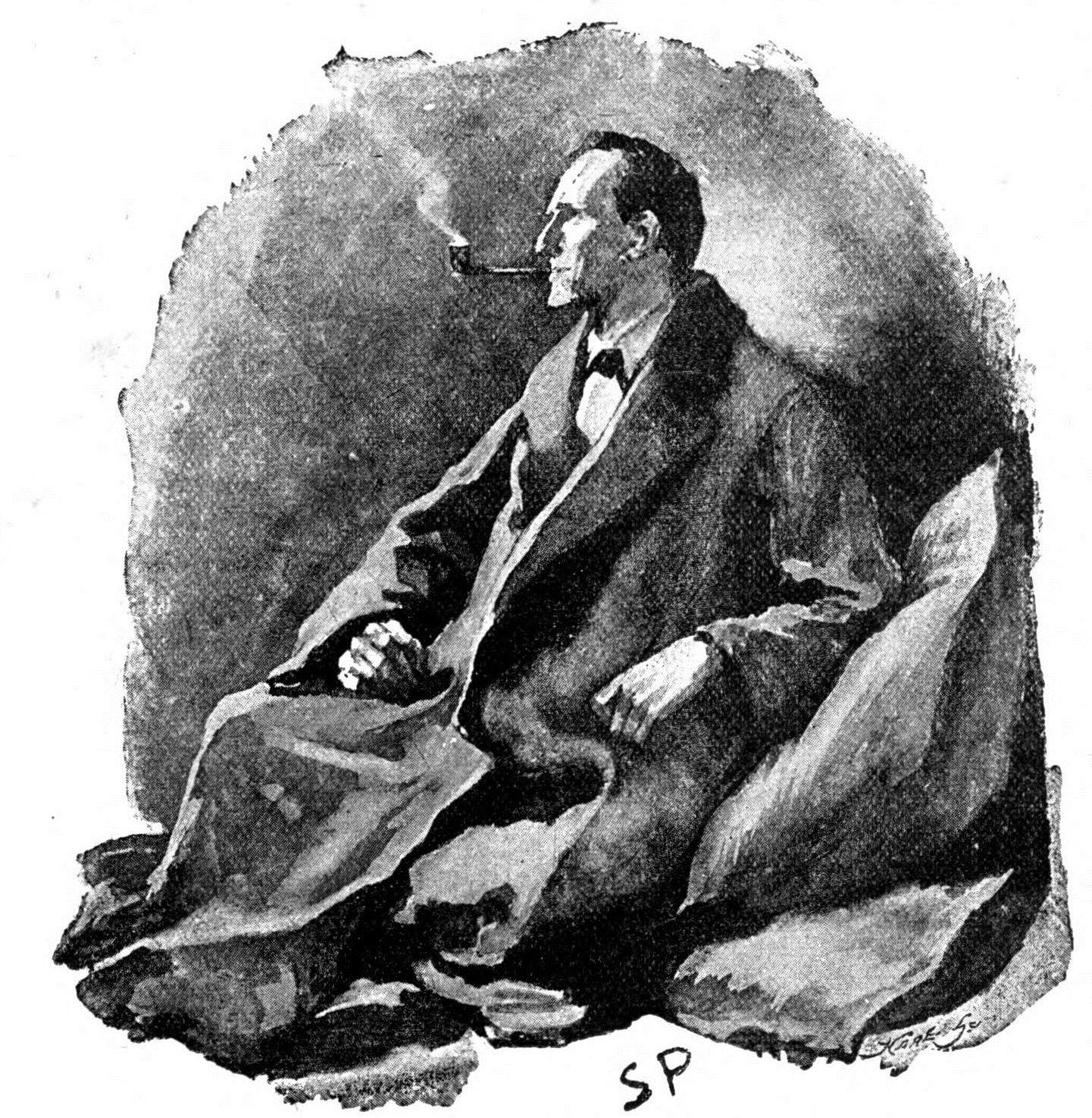
First things first, Barrymore is great, looking the very image of Holmes as seen in the original Sidney Paget drawings that accompanied the first publication of the cases in The Strand Magazine.  His Holmes is cunning, contemplative and very rarely wears a deerstalker.  The story presents a complicated tale (actually several mysteries in one) spanning years of evil deeds perpetrated by Holmes' nemesis, Professor Moriarty (played by an actor with the wonderful name of Gustav von Seyffertitz) on the more young, innocent members of British society (including a young William Powell—this was his first film).  It's up to Holmes (and to a much lesser extent, Roland Young's Watson) to get to the bottom of the case.


It's based primarily on the first Holmes story "A Scandal in Bohemia" (which presents Holmes in full flower and deals with the one opponent he could not best and whom he came to admire, Irene Adler.  But that's all changed here.  There's no Adler, but instead the Faulkner sisters, both of whom Holmes becomes infatuated with, first in his youth at the the time of his first encounter with Moriarty, and later, after the one's sister's death, and the other sister's possession of her love letters that could result in scandal and repercussions for a European King's reign.  But, it is Moriarty and his network of thugs and assassins that want to seize the letters.  The extant Faulkner sister is merely keeping them hidden.  And Moriarty is set on both getting the letters and assassinating Holmes, the latter done in rather melodramatic ways, luring him into a trap, or shooting him at 221B Baker Street.  


It's a silent film, the particulars told in title cards, which is problematic as Holmes, once coerced to reveal the methodology of his deducations, can be a verbose creature.  So it falls on the title card authors to show the process in a kind of dense short-hand.  Those moments are few and far between.  Mostly, it's standard melodramatic fare, without the Doyle back-stories that tie everything together, and explain the gears that set the whole thing in motion (This is done at the beginning and inserting Holmes into it).  It's all pretty surface-stuff, befitting a stage presentation (although Parker manages to cross the Victorian era and motor car era in his production design), with Barrymore's performance breaking the silent tradition by being more interior, more cerebral, setting Holmes' detective apart from the usual over-emoting that was the tradition and chief weapon in communicating emotions during the  silents.


Granada's Holmes, Jeremy Brett, used to talk about a conversation he'd had with Robert Stephens, who played the role in Billy Wilder's The Private Life of Sherlock Holmes, where Stephens commented "There's nothing there inside the character, just a big empty space that you must fill any way you can."  Essentially, he's right.  There are lots of Sherlock's who are bland and impenetrable—in fact, the BBC had a rough time with a revolving door of actors who couldn't live up to Brett's version, even when the actor was deathly ill, and didn't until the character was revamped in modern times and played by Benedict Cumberbatch.  A "silent" Holmes makes the portrayal even tougher to pull off, as Holmes' theatricality is easiest portrayed with his voice and phrasings, weapons not available in silent films.  But Barrymore still manages to make a memorable Holmes, if slightly diluted by a tendency to become romantically involved with his clients.  Gillette did so in his play to win audiences and make Holmes a more romantic hero.  And although it's slightly unnerving to see, Barrymore makes it acceptable.


Thursday, July 17, 2008

The Man Who Laughs

"The Man Who Laughs" (Paul Leni, 1928) Silent film from Universal of the Victor Hugo novel, that in this incarnation inspired two, maybe three kids working in comics (Bill Finger and Robert Kahn, and Jerry Robinson) to create Batman's Moriarty, The Joker.

Conrad Veidt plays Gwynplaine, the orphaned child of a dissident noble during King James II's rule, whose face is carved into a hideous smile, and makes a wretched existence as a clown in a travelling show. What makes him stay is the love of the blind girl he rescued in the snow, and his own disgust at his ravaged face. Billed in the carny as "The Man Who Laughs" Gwynplaine has the ability to make any local rabble laugh at his ghoulishly smiling face—except for an evil countess who he encounters in his old town. This leads to problems with his love, as he's torn between the woman who's never seen his face, or the one who's intrigued with him despite his affliction.
The fact that, unbeknownst to him, she's living on his lost estate complicates things even further.

It's high melodrama of the "melo-est" sort, and Leni crafts it with an artists' eye for lighting, and a trickster's way with camera movement. It's far more subtle than most films of the silent era, while glorying in the dramatic gestures of the era, and makes for a compelling fusion of the German and American film sensibilities.