Showing posts with label Sherlock Holmes. Show all posts

Wednesday, December 5, 2012

Sherlock Holmes (1922)

Sherlock Holmes (Albert Parker, 1922) Sir Arthur Conan Doyle's great detective (consulting) given the silent treatment with John Barrymore in the title role, based on the William Gillette play (redrafted from Conan Doyle's original) that was the defining presentation of the character for folks who had never read the early stories.  

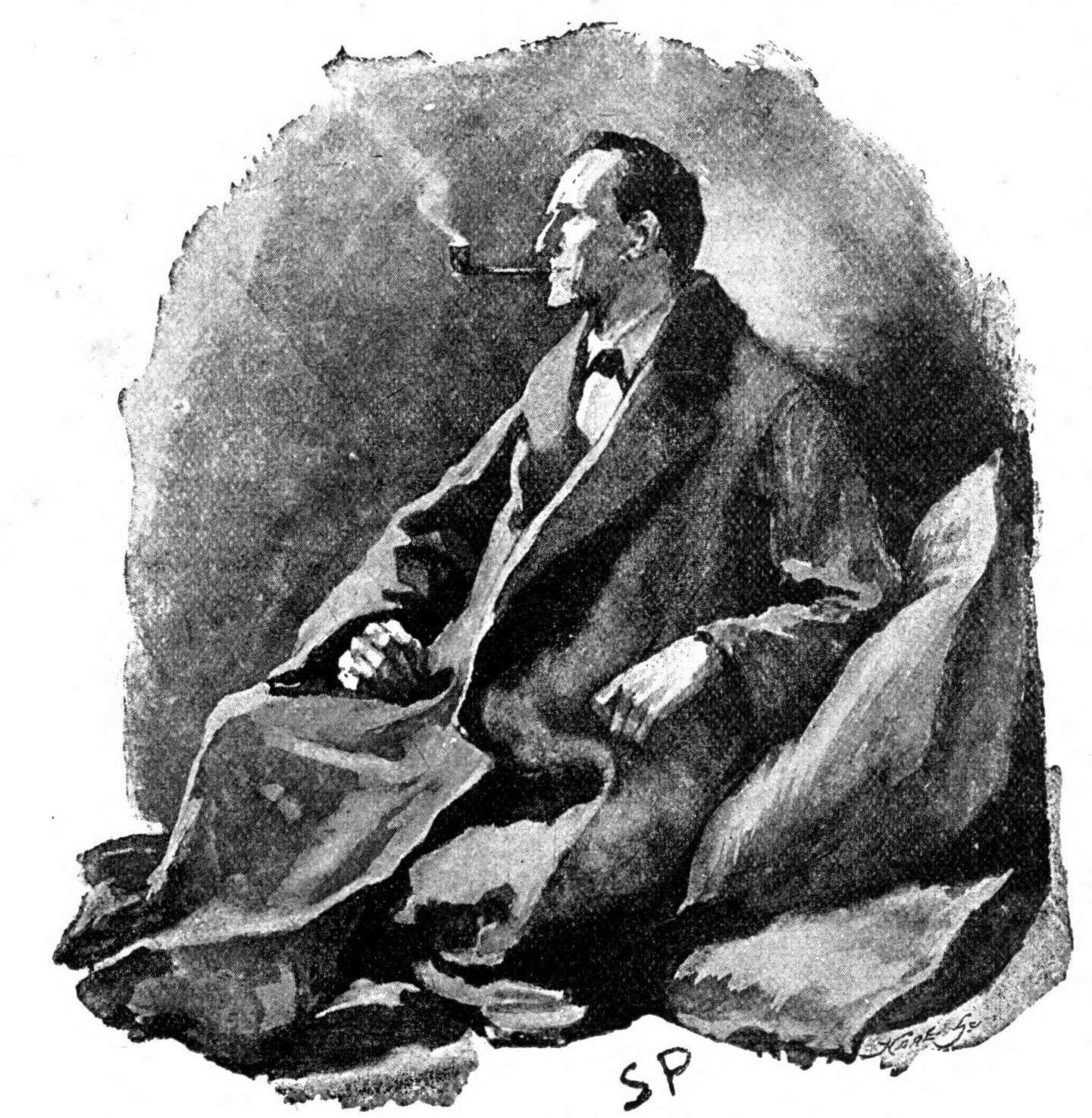
First things first, Barrymore is great, looking the very image of Holmes as seen in the original Sidney Paget drawings that accompanied the first publication of the cases in The Strand Magazine.  His Holmes is cunning, contemplative and very rarely wears a deerstalker.  The story presents a complicated tale (actually several mysteries in one) spanning years of evil deeds perpetrated by Holmes' nemesis, Professor Moriarty (played by an actor with the wonderful name of Gustav von Seyffertitz) on the more young, innocent members of British society (including a young William Powell—this was his first film).  It's up to Holmes (and to a much lesser extent, Roland Young's Watson) to get to the bottom of the case.


It's based primarily on the first Holmes story "A Scandal in Bohemia" (which presents Holmes in full flower and deals with the one opponent he could not best and whom he came to admire, Irene Adler.  But that's all changed here.  There's no Adler, but instead the Faulkner sisters, both of whom Holmes becomes infatuated with, first in his youth at the the time of his first encounter with Moriarty, and later, after the one's sister's death, and the other sister's possession of her love letters that could result in scandal and repercussions for a European King's reign.  But, it is Moriarty and his network of thugs and assassins that want to seize the letters.  The extant Faulkner sister is merely keeping them hidden.  And Moriarty is set on both getting the letters and assassinating Holmes, the latter done in rather melodramatic ways, luring him into a trap, or shooting him at 221B Baker Street.  


It's a silent film, the particulars told in title cards, which is problematic as Holmes, once coerced to reveal the methodology of his deducations, can be a verbose creature.  So it falls on the title card authors to show the process in a kind of dense short-hand.  Those moments are few and far between.  Mostly, it's standard melodramatic fare, without the Doyle back-stories that tie everything together, and explain the gears that set the whole thing in motion (This is done at the beginning and inserting Holmes into it).  It's all pretty surface-stuff, befitting a stage presentation (although Parker manages to cross the Victorian era and motor car era in his production design), with Barrymore's performance breaking the silent tradition by being more interior, more cerebral, setting Holmes' detective apart from the usual over-emoting that was the tradition and chief weapon in communicating emotions during the  silents.


Granada's Holmes, Jeremy Brett, used to talk about a conversation he'd had with Robert Stephens, who played the role in Billy Wilder's The Private Life of Sherlock Holmes, where Stephens commented "There's nothing there inside the character, just a big empty space that you must fill any way you can."  Essentially, he's right.  There are lots of Sherlock's who are bland and impenetrable—in fact, the BBC had a rough time with a revolving door of actors who couldn't live up to Brett's version, even when the actor was deathly ill, and didn't until the character was revamped in modern times and played by Benedict Cumberbatch.  A "silent" Holmes makes the portrayal even tougher to pull off, as Holmes' theatricality is easiest portrayed with his voice and phrasings, weapons not available in silent films.  But Barrymore still manages to make a memorable Holmes, if slightly diluted by a tendency to become romantically involved with his clients.  Gillette did so in his play to win audiences and make Holmes a more romantic hero.  And although it's slightly unnerving to see, Barrymore makes it acceptable.


Thursday, December 22, 2011

Sherlock Holmes: A Game of Shadows

Bullet-Time
or
"Forewarned is Fore-armed (and Don't Call Me 'Shirley')"

"'Well, well,' said he, at last. 'It seems a pity, but I have done what I could. I know every move of your game. You can do nothing before Monday. It has been a duel between you and me, Mr. Holmes. You hope to place me in the dock. I tell you that I will never stand in the dock. You hope to beat me. I tell you that you will never beat me. If you are clever enough to bring destruction upon me, rest assured that I shall do as much to you.'

"'You have paid me several compliments, Mr. Moriarty,' said I. 'Let me pay you one in return when I say that if I were assured of the former eventuality I would, in the interests of the public, cheerfully accept the latter.'

"The Final Problem" Sir Arthur Conan Doyle


Sherlock Holmes: A Game of Shadows is the inevitable (and one should say quick-on-its-heels) follow-up to Guy Ritchie's Sherlock Holmes, and as an adaptation of Conan Doyle's "The Final Problem," It has as much source-relationship as the later Bond films have to Fleming—the bare-bones structure is there, but it's pumped, plumped, and trumped-up to fulfill the needs of action, humor and modern audience identification.  Really, "The Final Problem" is enough, we don't need the world-conquering machinations of Professor Moriarty (The Napoleon of Crime, the Scourge of London, and Holmes' best match) to make him a worthy adversary.  He merely needs to be omnipresent by means of his web of chicanery, rather than an omniscient history-maker.  In fact, Conan Doyle's Moriarty would rather his bad work went undetected, as opposed to this movie's version producing a shattering World War.  Here, in the words of Robert Downey Jr.'s Holmes, the plot is "so overt, it's covert," involving twins who aren't twins, TB, the Romany, anarchists, darts for various purposes, intricate explosive devices and not-so-intricate shell-firing ones, countries that can't be named ("although they speak French and German"), and the prospect of "war on an industrial scale."

20/20 hindsight always looks like genius when set in the past.

Actually, it's pretty clever how the doom-laden inevitability of "The Final Problem" is translated into the fore-shadowing of the war-torn 20th Century (the screen-writers are the wife-husband team Michele Mulroney and Kieran Mulroney*), and its focus on large artillery and semi-automatic "machine-pistols" has a nice hard edge as opposed to the original film's emphasis on the psuedo-occult.  But, director Ritchie seems to have lost of his somewhat, the fight-sequences (there are many) are nicely fore-shadowed with flash-cut Holmsian cognitive pre-functioning, but when the fisticuffs and baritsu moves start flying, the action is hard to follow, even when the action is slowed to a crawl—there is far too much ramp-editing and Matrix-y "bullet-time" FX in the film for no good purpose other than to slow down the practical and digital effects and give us the illusion of "wow, that was close." (Thanks, we assume that fire-fights and shellings are dangerous things).  However fast the editor can manipulate images, one still gets the impression of the film being a bit too "fussy" for its own good, delaying information or simply obfuscating it for a later time, giving one the impression that one is seeing a lot of the movie twice.  Efficient, it ain't, even if the titular character is supposed to be the heighth of it.

Also, although the first of Downey's adventurings could be seen as being a nicely nuanced (if scruffy) interpretation of The Great Detective, here the character is allowed to go a little more broad, dressing in comedic drag ("I admit, it's not my best disguise") and another, which is actually taken from The Pink Panther series (mind you, Steve Martin's "Pink Panther" series), the comedy is played up and not necessarily in character, and Holmes is seen to be practically infallibleeven his getting seriously hurt is all part of his plan.  

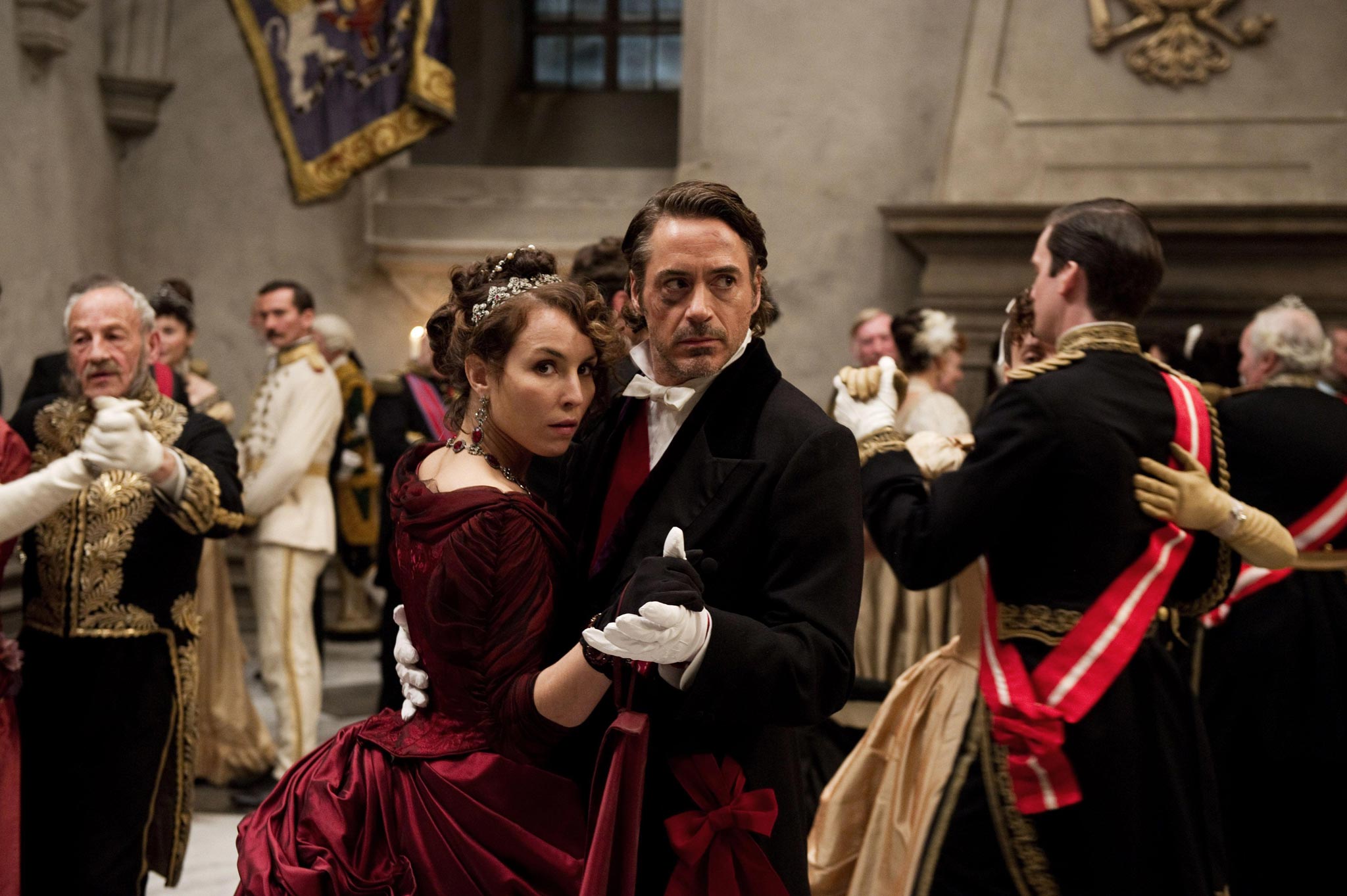
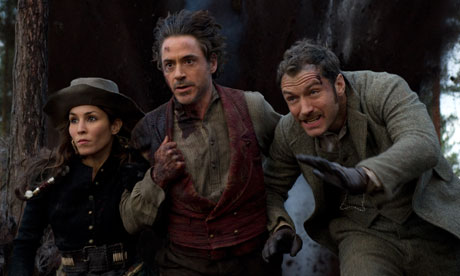
Downey, Jr. is great at playing this, even if it's a more absurd version of Holmes, and Jude Law again plays Dr. Watson (now with a severe limp and who is only now about to be married to Mary Morston, again played by Kelly Reilly) and it's one of Law's best performances, quick as Downey and capable of the slowest of "burns." Law's role is expanded somewhat and he makes the most of itThe two are joined (briefly) by Rachel McAdams, reprising her role as "the woman" Irene Adler, but is soon replaced by Noomi Rapace's gypsy princess Simsa.  Aiding and abetting is Stephen Fry, as Holmes' smarter, drier brother Mycroft (it might actually be considered type-casting), with Jared Harris as the coolest of Moriarty's (Brad Pitt was initially considered for the role), as well as being one of the youngest.

As fun as it is, one can't help but look at it as a step down—the filmmakers are getting further afield of the Holmes characterization, and it's only a matter of time before the Downey, Jr. version is locked into buffoonery and slapstick, and it comes perilously close to teetering off the edge here.  As it is, this plot is more reminiscent of the Basil Rathbone films set during WWII, entertaining if anachronistic fluff.

Sherlock Holmes: A Game of Shadows is a Matinee.


Paget's Strand Magazine illustration of the first of two Holmes-Moriarty encounters.

* Kieran is the brother of Dermot Mulroney, husband of Michele, and you may best remember him from "Seinfeld" as the fellow who gets bent out of shape at a funeral reception when he see George Costanza double-dipping a chip.

Sunday, May 30, 2010

Don't Make a Scene: Sherlock Holmes

The Story: Never invite Sherlock Holmes to dinner.

And if you do, don't treat him like an amusing parlour game. You'll lose. Every time.

In Guy Ritchie's steam-punk version of Sherlock Holmes, Holmes is still recognizable as Sir Arthur Conan Doyle's consulting detective—the blazing intellect, the restlessness, the bad habits, the weakness for drama, the misogyny he disguises as motive-psychology, all recognizable as canon, the game afoot played by rules according to Doyle.

But, this scene added an aspect to the character that I hadn't realized before—Holmes is a collector of observations, so any adventuring into the public circle must be like jumping into the Thames (which he also does in the film). So many people, so many things to see and overhear and deduce, it must be maddening to be assaulted with all that...all those...clues. Like a mind-reader for whom the most important lesson is to learn to not listen to the thoughts invading his head, Holmes' knowledge of minutiae and behavior makes him anticipate aberrant behavior wherever he looks. The raised voices, the style of jewelry, the cut of a knife, the set of a head--everything is grist for the mill of his pre-disposed mind. The world is full of motivations, even without the presence of a crime. No wonder he's so eccentric. It's like knowing you're the only unaffected member of a leper colony.

Below the break is the scene as it was originally written—the screenplay dated March 14, 2008 by Johnson, Peckham and Wigram), with a far less together Holmes, who lets his emotions get the better of him (rather than his intellect), arriving late at the dinner arranged to meet Dr. Watson's fiancee,* and leaving early. It's a weaker Holmes there, and not a very accurate one, if you've read the books. This version of the script would have you believe that Holmes, interrogator and investigator, panics at the presence of crowds. Not bloody likely. The re-write makes Holmes stronger, less vulnerable and prone to panic attacks. In the final film, it is Holmes who waits for the happy couple and has his patience tested by the melee of modus operandi surrounding and swirling about him. And rather than having his concentration get the better of him, as in the earlier draft, it is Holmes' arrogance and tendency to deduce the worst about people (especially women) that douses the evening's happiness (and Holmes' face). Hit 'im again, Mary!

Holmes, you see, is distrustful of women. In the Doyle story "The Sign of Four," the one where Mary Morstan is a client, he states: "Women are never to be entirely trusted, -- not the best of them." And, elsewhere, "I am not a whole-souled admirer of womankind" and "the motives of women... so inscrutable... How can you build on such quicksand? Their most trivial actions may mean volumes... their most extraordinary conduct may depend upon a hairpin." Yet, he was chivalrous to them and polite...the one women—"THE woman"—who he admired was the one who bested him in "A Scandal in Bohemia," Irene Adler, who also figures in the screenplay.

But, his churlish behavior at the dinner table goes beyond distrustfulness and devotion to obtaining the truth, as Mary Marston/Morstan represents isolation to Holmes; she is marrying his fellow lodger and adventurer Watson and understandably proud of the fact--which gets under Holmes' skin like a seven percent solution. Mary throws her triumph in Holmes' face; he retaliates by questioning her motivation; Mary throw her drink in Holmes face. Tit for tat. Perhaps they should get a room, or have a bout in the ring...which is Holmes' next destination in the film, and both versions of the screenplay.

It should be noted—not that I'm questioning anyone's motivations—that Mary Morstan Watson was not married to the good Doctor for very long, as Doyle vaguely hinted that she had died. That she met her demise while Holmes was supposedly dead—suspected by Watson killed by Moriarty at the Reichenbach Falls—when he was actually travelling the world incognito (a journey that Holmes describes only in the most general of terms), I'm sure is only a coincidence. I'm just saying....

The Set-Up: Wedding bells are breaking up that old detecting duo of Sherlock Holmes (Robert Downey Jr.) and Dr. John Watson (Jude Law): Watson is moving from 221B Street in preparation for marrying Mary Marston (Kelly Reilly). Although he has been avoiding it, Holmes has finally agreed to meeting her...in public...at a fine restaurant.

The Game is Afoot!


INT. THE ROYALE - NIGHT

A romantic French restaurant in a fine hotel.

Almost every table is occupied by happy couples, or groups. The kind of place you take the woman you want to marry to
meet a difficult friend. Unless the difficult friend doesn’t show up.

WATSON Holmes!
Holmes looks up.

WATSON You're early.

HOLMES Fashionably.

Holmes pockets his watch.

WATSON Mary Morstan...

HOLMES Ah, my goodness! What a pleasure.

Holmes kisses her hand.

HOLMES For the life of me, I can't undertsand why it's taken him so long to introduce us properly.


Holmes smiles at Watson.

MARY The pleasure is mine..

Mary is a pretty, well-turned-out woman in her mid-20’s. Not spoiled, not silly, not ephemeral. A clear-eyed,modern woman -- with whom Watson is very much in love. They all sit.

MARY (CONT’D) It really is quite a thrill...

MARY ...to meet you, Mr. Holmes.

MARY I've heard so much about you.

MARY I have a pile of detective novels at home. Wilkie Collins, Poe...

WATSON It's true.

MARY It can seem a little far-fetched, though, at times.

MARY Making these grand assumptions out of such tiny details.

HOMES That's not quite right, is it?

HOMES In fact, the...

HOMES ...little details are by far the most important.

HOLMES Take Watson.

MARY I intend to.

Holmes laughs, surprised.

HOLMES See his walking stick?

HOLMES A rare African...

HOLMES ...snakewood hiding ...

HOLMES ...a blade...

HOLMES ...of high tensile steel.

HOLMES A few were rewarded...

HOLMES ...to veterans of the Afghan wars...

HOLMES...so I can assume he's a decorated soldier.

HOLMES Strong, brave. Born to be a man of action.

Mary chuckles.

HOLMES And neat, like all military men.

HOLMES Now...I check his...

HOLMES ...pockets.

HOLMES Ah! A stub from a boxing...

HOLMES...match.

HOLMES Now...I can infer that he's a bit of a gambler.

HOLMES I'd keep an eye on that dowry if I were you.

WATSON Those days are behind me.

HOLMES Right behind you. He's cost us the rent more than once.

MARY Well, with all due...

MARY ...respect, Mr. Holmes. You know John very well.

MARY What about a complete stranger?

MARY What can you tell about me?

HOLMES You?

WATSON I don't think that's...

HOLMES I don't know that's...

WATSON Not at dinner.

HOLMES Perhaps some other time.

MARY I insist.

HOLMES You insist.

WATSON You remember we discussed this..

HOLMES The lady insists.

Watson looks uncomfortable. Holmes adjusts his chair and scrutinizes Mary.

HOLMES You're a governess.

MARY Well done.

WATSON (rushing things along) Yes, well done...Shall we?!

HOLMES Your student...is a boy of eight.

MARY Charlie's seven, actually.
HOLMES Charles, ah...

Watson pours some more water.

HOLMES Then he’s tall for his age. He flicked ink at you today.

MARY (horrified) Is there ink on my face?

WATSON There's nothing wrong with your face.

HOLMES There are two tiny drops on your ear.

HOLMES Almost invisible. (trying to soften the blow) India blue’s nearly impossible to wash off.

HOLMES Anyway, a very impetuous act by the boy.

HOLMES But you're too experienced to react rashly, which is why the lady for whom you work leant you that necklace.

HOLMES Oriental pearls, diamonds, a flawless ruby. Hardly (beat)... the gems of a governess.

HOLMES However...

HOLMES ...the jewels you are not wearing tell us rather more.

WATSON(angry) Holmes...

HOLMES You were engaged. The ring is gone, but for the lighter skin where it once sat...

HOLMES ...suggesting that you spent some time abroad wearing it proudly.

Mary is beet red with embarrassment.

HOLMES That is, until you were informed of its...

HOLMES ...true and rather modest worth in which time you broke off the engagement...

HOLMES ...and returned to England for better prospects.

Mary is past embrassment. Now she is angry. Holmes turns to Watson.

HOLMES ..A doctor, perhaps.

Mary throws her wine in Holmes' face.

MARY Right on all counts, Mr. Holmes.

MARY Except for one.

MARY I didn't leave him. He died.

Mary gets up from the table and leaves. Watson nods at her.

WATSON Well done, old boy.

Watson gets up and leaves, leaving Holmes to dine alone.


Sherlock Holmes

Words by Michael Robert Johnson, Anthony Peckham, Simon Kinberg, and Lionel Wigram

Pictures by Philippe Rousselot and Guy Ritchie

Sherlock Holmes is available on DVD from Warners Home Video.

* Here is where this film and Conan Doyle's stories differ: Mary Morstan (that's how her name is spelled in the stories) had, indeed, met Holmes before—she hired him in the classic "The Sign of Four." That is where she and Watson met. Subsequently, they wed.-------------------------------------------------------------

INT. THE ROYALE - NIGHT
A romantic French restaurant in a fine hotel. Almost
every table is occupied by happy couples, or groups. The
kind of place you take the woman you want to marry to
meet a difficult friend. Unless the difficult friend
doesn’t show up.
We find Watson and MARY MORSTAN seated at a table made up
for three. Watson has run out of patience.
WATSON We’ll just eat without him.
MARY Let’s wait a little longer.
Mary is a pretty, well-turned-out woman in her mid-20’s.
Not spoiled, not silly, not ephemeral. A clear-eyed,
modern woman -- with whom Watson is very much in love.
MARY (CONT’D) I think it’s important that I meet him.
WATSON So do I. Evidently Holmes disagrees.
But a ripple through the room pulls their attention to
the entrance -- where Holmes stands, looking out over the
crowded room. He has shaved, he has dressed, his hair is
overlong, but clean and corralled.
ON HOLMES as he looks across a sea of happy faces. He
was more at home fighting in the sewer than he is in the
Royale.
He finds Watson and Mary, and crosses the restaurant
towards them, with the air of a wolf moving through a
flock of sheep. All eyes on him.
Mary suddenly looks a little nervous.
WATSON We’d almost given up on you.
HOLMES (clearly a lie) I had trouble with my tie.
WATSON May I present Miss Mary Morstan.
Mary extends her hand.
MARY I’ve heard so much about you.
Holmes leans down, takes Mary’s hand, awkwardly.
HOLMES And I ... um I ...
Holmes’ failed attempt at small-talk becomes not-such polite
scrutiny. Still holding her hand, he examines
Mary with a prolonged, acute gaze.
Mary shifts, doesn’t know what to do.
Watson clears his throat. Holmes realizes what he’s
doing, releases Mary’s hand immediately.
HOLMES Yes, well ... I’m glad to see that you didn’t punish your student today. It never worked on me.
Mary is stunned by Holmes’ insight. Watson sighs.
WATSON Why don’t you sit.
But Holmes feels compelled to explain, not sit.
HOLMES Watson told me you’re a governess.
MARY Yes, I am.
HOLMES Your student’s a boy of 8.
MARY Charlie’s 7, actually.
HOLMES Then he’s tall for his age. He flicked ink at you today.
MARY (horrified) Is there ink on my face?
WATSON No, your face is perfect.
HOLMES There are two tiny drops on your ear. Almost invisible.
(trying to soften the
blow)
India blue’s nearly impossible to wash off, anyway.
WATSON Please sit down.
MARY How do you know I didn’t punish him?
HOLMES Well, because --
And then Holmes notices Watson glaring at him.
HOLMES -- perhaps I should sit down.
Holmes sits.
MARY I’d like to know. Really.
Holmes shoots Watson an apologetic look, but he’s in too deep to stop.
HOLMES Your necklace and bracelet are matched South African diamonds from Asprey’s, flawless. Not ...
(beat)
... not the jewels of a governess. The lady you work for lent them to you. She wouldn’t’ve done so if you’d punished her son, not even if he deserved it -- human nature being what it is.
Mary is beet red with embarrassment.
WATSON(angry)Some human nature is unaccountable. In my professional opinion.
MARY Well ... I did ask.
Holmes and Watson sit in silence. Watson’s anger brings out the haughty worst in the detective. The awkwardness is rescued when the WAITER arrives with three menus.
WAITER Mam’selle, messieurs ...
Watson and Mary read their menus together. Holmes does not. Instead, he looks at Watson and Mary deciding what to eat. They look every inch the happy couple. Holmes looks around at the room.

HOLMES POV: happy couples eating, laughing, talking.
Suddenly, Holmes hears no words. He just sees their
mouths moving. The sound of silverware clinking and
scraping on fine china rises to an orchestral roar.
WATSON (sharply) Holmes!
Holmes jerks back to reality.
WATSON (CONT’D) Would you like to order?
The waiter stands, poised. Holmes discovers that he is sweating.
HOLMES Perhaps ... Excuse me. My appetite ...
Holmes bolts, unable to stay in the Royale a second longer. Mary is visibly concerned.
MARY Was it something I said?
WATSON No, it was something I said.

OVER, WE HEAR the roar of a BLOOD-THIRSTY MOB and the
MEATY THUD of a fist smashing into a face.