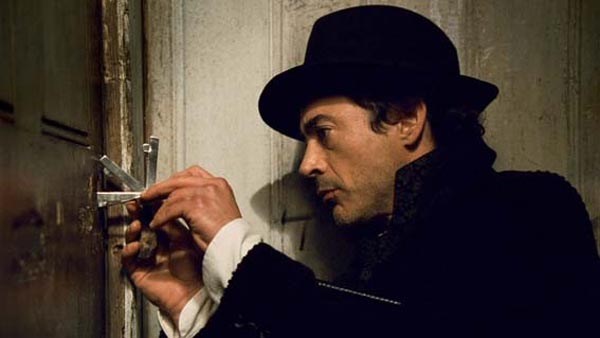
Showing posts with label Jude Law. Show all posts

Tuesday, May 7, 2013

Side Effects

First, Do No Harm
or
Physician, Heal Thyself


One of my great joys in life is watching happy-pharm' commercials that spend ten of their thirty seconds extolling the virtues of their chemicals ("It stops your brain from telling you you're SAD!"), then the last 20 of them warning about all the dire side effects of said chemicals up to and including death (and maybe beyond).  That's comedy gold right there, masquerading as serious medical advice, wrapped in ad hucksterism.*

Now, prolific director Steve Soderbergh, who started his career twenty four years ago with Sex, Lies, and Videotape is saying he will end his commercial film career** with Side Effects, an odd mixing of genres that has as its basis all those little warnings for the mystery "miracle" pills that are being foisted on the public for the slightest of symptoms and moods, with the tentative approval of the FDA, and a library of law-suits, concerning their consequences on real human beings.  In that way, it plays on a public's paranoia and trust of just what kind of human experiments might be being financed by the drug cartels, in much the same way as Hitchcock messed with our minds with our basic fears in his long career.  Soderbergh has never been this direct in his work before, making something akin to a traditional suspense-thriller, instead of a character study with sociological underpinnings (The Informant!,  Contagion,  S, L, and V, Traffic) as we're used to from his previous work.

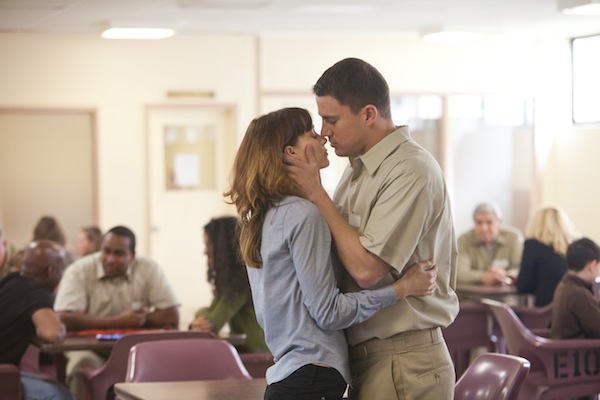
It's a pretty basic story, with some nicely diverting echoes of recent headlines:  Emily Taylor (Rooney Mara) works for a New York marketing agency and is dealing with a lot of stress in her life.  Her husband (Channing Tatumis being released from prison after four years for insider trading.   She's been struggling with these issues for awhile, and being treated for depression over the circumstances.  But, once husband comes home, things take a turn for the worst.  

Or actually, don't take a turn—Emily drives her late-model car directly into a garage wall—rather than heading for the "Exit" arrow, she runs INTO the "Exit" arrow.


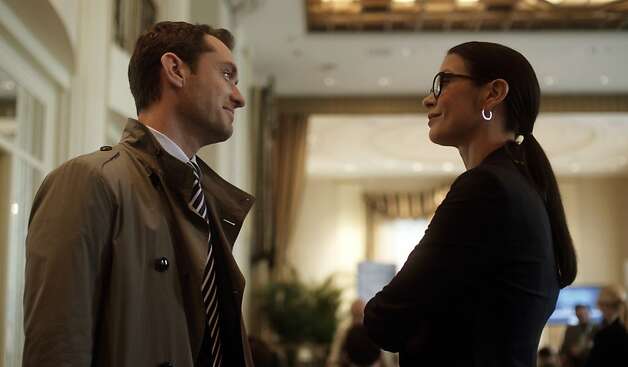
She suffers a concussion and is taken to the hospital, where she comes under the watchful eye of Dr. Jonathan Banks (Jude Law) who knows exactly what's wrong by deducing "usually when someone hits a brick wall, there are skid marks."  Emily doesn't want to be a bother, and bargains her way out of the E.R. by promising to visit Dr. Banks for therapy.


At this point, a responsible reviewer should say: "Warning: complications may occur, consult your physician."  Let's just say "things get messy" and merely suggest that a nasty case of medical ethics can turn into...a really nasty case of all kinds of ethics.  To say any more would spoil the bumpy ride the film provides, but one doesn't risk too much by sharing a particularly nifty exchange around which the whole film hinges: "Did the person do it?  Are they guilty?" "In the present case, those are two very different things."  Nice little piece of writing, that.  


The screenwriter is Scott Z. Burns (who also wrote Contagion and The Informant!) and he's constructed a medical thriller that takes a few hairpin turns and manages to avoid the guardrails of audience expectations and movie cliches.  And Soderbergh (who shot and edited the film) has cast it impeccably with folks he's worked with before: Law, who's usually fared better at smaller character parts, here finally shows he can carry off a "leading man" role, dominating the film, while making "normal" interesting; Catherine Zeta-Jones shows (again) how versatile she can be in a small but crucial role as a consulting shrink; Channing Tatum makes the most of his part as the husband caught up in a world that he's just re-entered but can't understand.  And Soderbergh rookie Rooney Mara gives a complex performance that's more than a little unpredictable (not surprising, given her history of moving from a straight performance in The Social Network to anything-but in Fincher's version of The Girl with the Dragon Tattoo) looking like what you'd imagine Sandra Bullock's creepy little sister might look like, Mara convincingly pulls off mood shifts that might require an exorcist rather than a prescription.

In many ways, Side Effects is the film many expected last year's Flight to be: instead of a straight-forward look at addictions and their crises, a lot of viewers were expecting there to be some mystery that would neatly tie loose ends and vindicate its protagonist.  But, Side Effects plays with societal responsibility and legalities in a time when the very nature of people's natures is being altered, in the same way that Michael Crichton used to explore science's impacts on us in his books and films, provoking such tough questions and "Are we prepared for this?" "Just because we can do this, should we, and how will we deal with the fall-out?"

In any case, in the theater or after-movie discussions, Side Effects will not cause drowsiness.

Side Effects is a Matinee.


Jude Law learns his practice isn't perfect in Side Effects

* SNL did a fine parody of this type of advertising with a fictional toy-product, the generically-labelled "Happy Fun Ball:"


**  We'll see how long that lasts, but Soderbergh has long grated against turning out commercial product (the one-two punch last year of Haywire and Magic Mike, notwithstanding) for the sake of commercial product, wanting to experiment with non-box-officey topics and distribution avenues.

Friday, December 14, 2012

Anna Karenina (2012)

Artificial Intelligence
or
Anna! Karenina! The! Musical!

Tolstoy's "Anna Karenina" is considered by many the greatest novel ever written, and has been adapted so many times (two of them starring Greta Garbo!), one is tempted to name any version "The Last Remake of Anna Karenina."  So, the task for director Joe Wright and scripter Tom Stoppard must have seemed daunting, or as one of Zsa Zsa Gabor's later husbands stated it: "You know what you have to do, you just have to find a way of making it interesting."

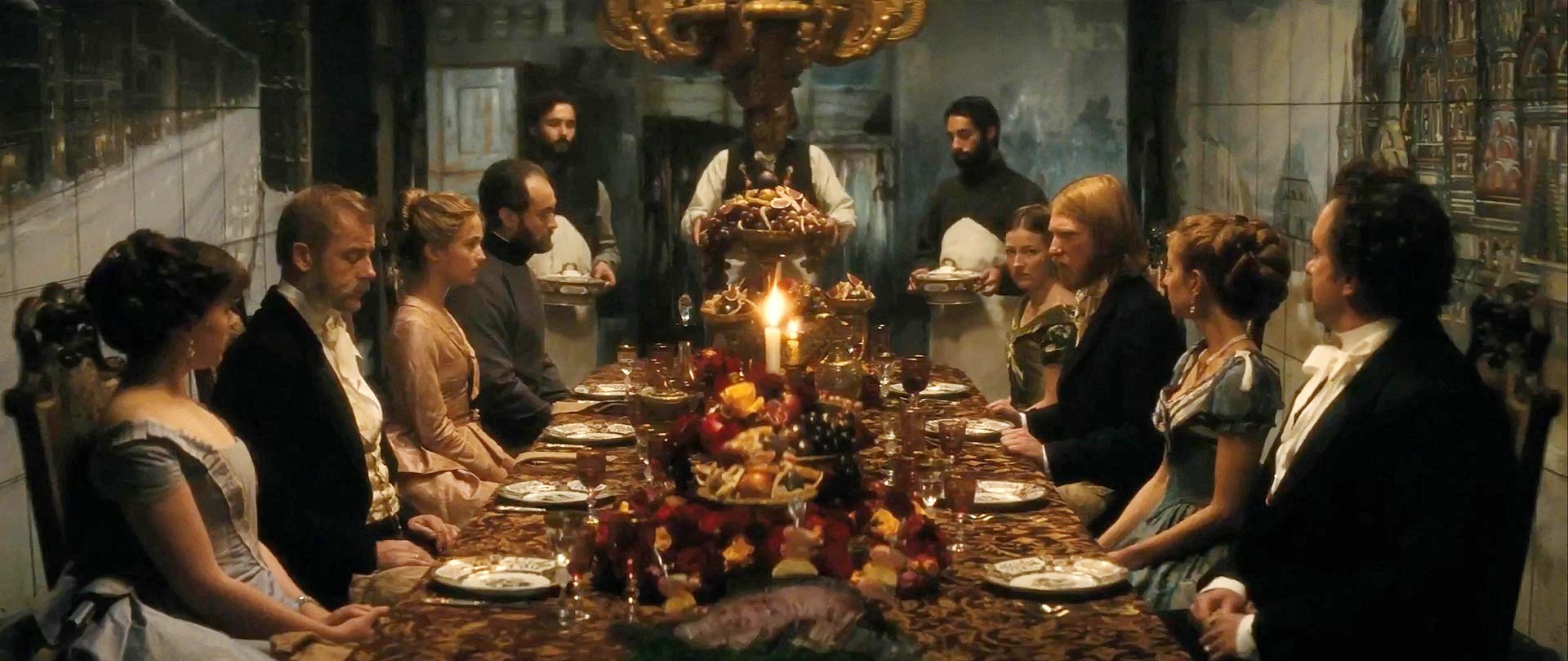
Well, this one is interesting, alright.  And it hues closely to Tolstoy's novel in the way that a CliffsNotes Edition sticks close.  All the plot points are there, the characters whittled down to their bare essences, or eliminated altogether, and breezily delivered in a theatrical manner, save some significant exceptions.  Truth is, Wright makes this version of Anna Karenina the way Baz Luhrmann would, as a grand, operatic experience staged in an extraordinarily choreographed with the emphasis on the "arch" (as in "playfully and affectedly roguish") in Proscenium Arch.
  

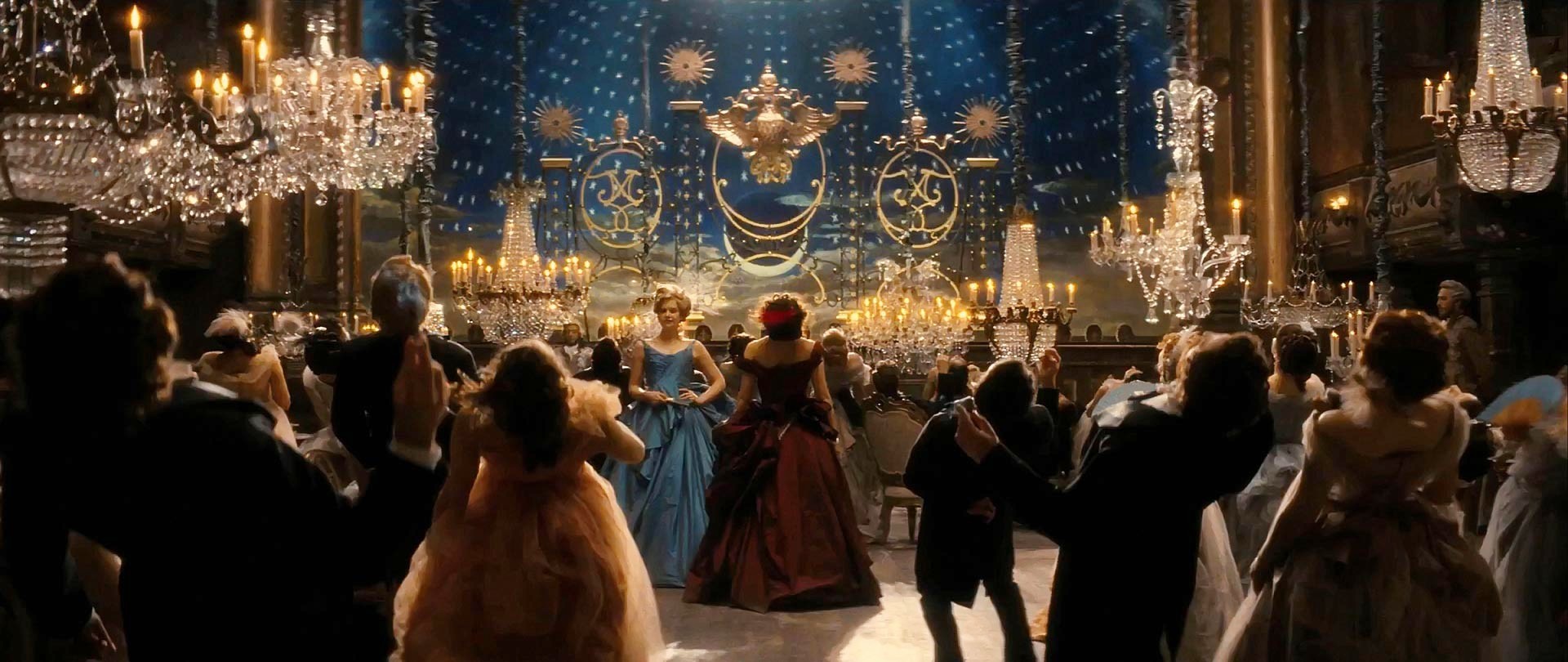
Jim Emerson had a fascinating article (based around Skyfall) on his "Scanners" blog on the difference between a "theatrical" film and a theatrical film and its use of space as defined by the limitations of the frame and a stage directors' tendency to reflect that frame with its own limitations resembling the dimensions of a stage.  Wright fully embraces that concept and goes further; for the main story of the hoi-polloi and their social and political gamesmanship, all of the action takes place within the false spaces of a theater (at times even using the rafters as locations for traditional street-scenes): train and carriage scenes are decidedly set-bound with no effort made to reflect a "real" world outside the windows; transitions are made "in-camera" without editing, so a very stagy and choreographed bureaucratic work set-up with synchronized rubbing stamping (set to Dario Marianelli's interesting score) segues to a restaurant scene by merely having the "extras" trade in their black business suits for waiter-whites; a formal society ball is not an intricate commingling of dancers that Wright so effectively engineered in Pride and Prejudice, but is an elaborate ballet, where the participants barely touch and their hand movements are intricately swanning in nothing that approaches a traditional dance (at times, to keep track of the principals, the foreground dancers in our field of vision "freeze" to better make out the focus of our attention).  Like Francis Ford Coppola's set-bound version of Bram Stoker's Dracula, It's all very elaborate, "stagey," false, and at times clever but, a lot of the time, merely "showy," like a musical with no libretto, something to separate this "Anna" from the more realistic, even if filmed in-studio, versions.  

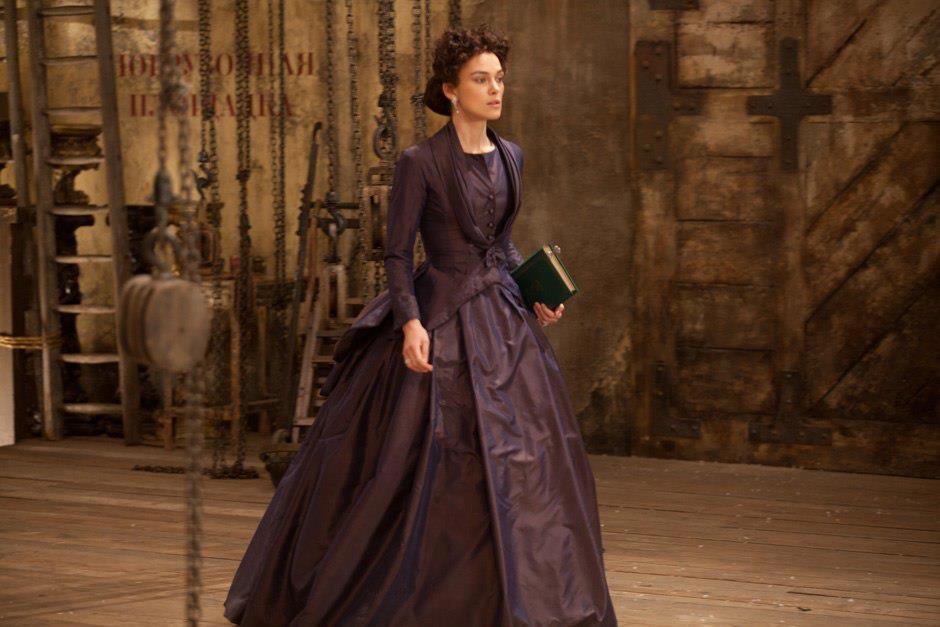
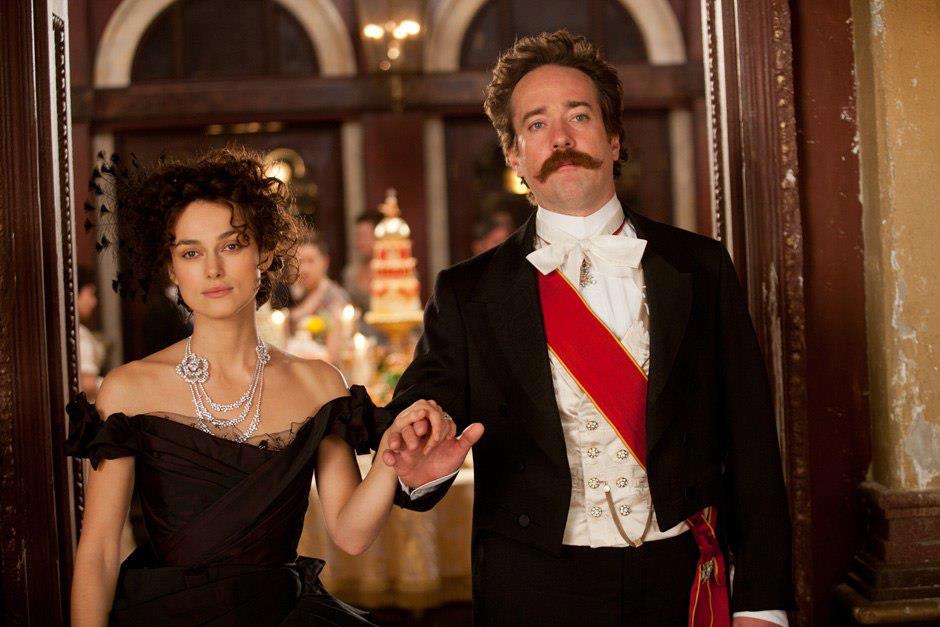
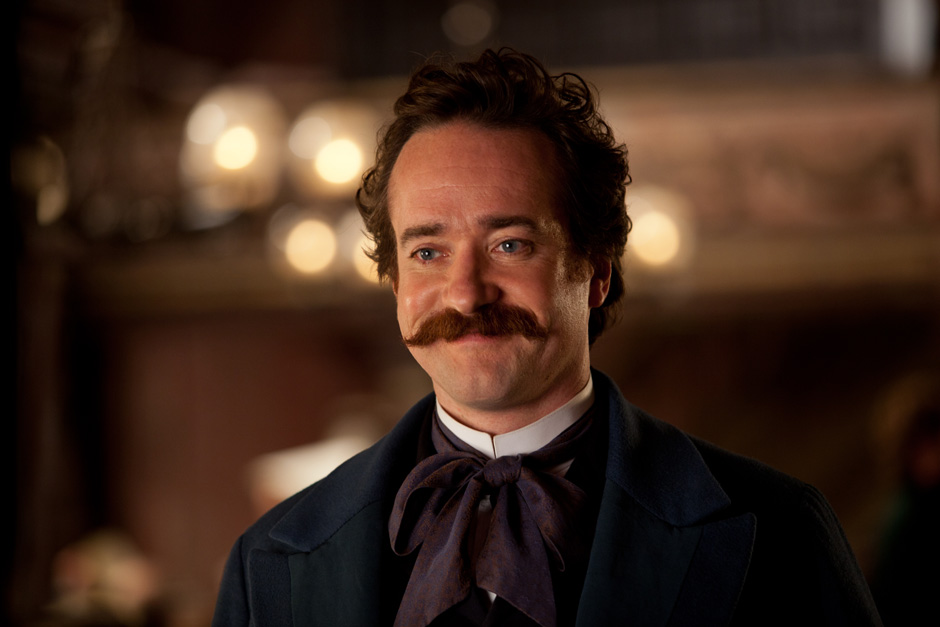
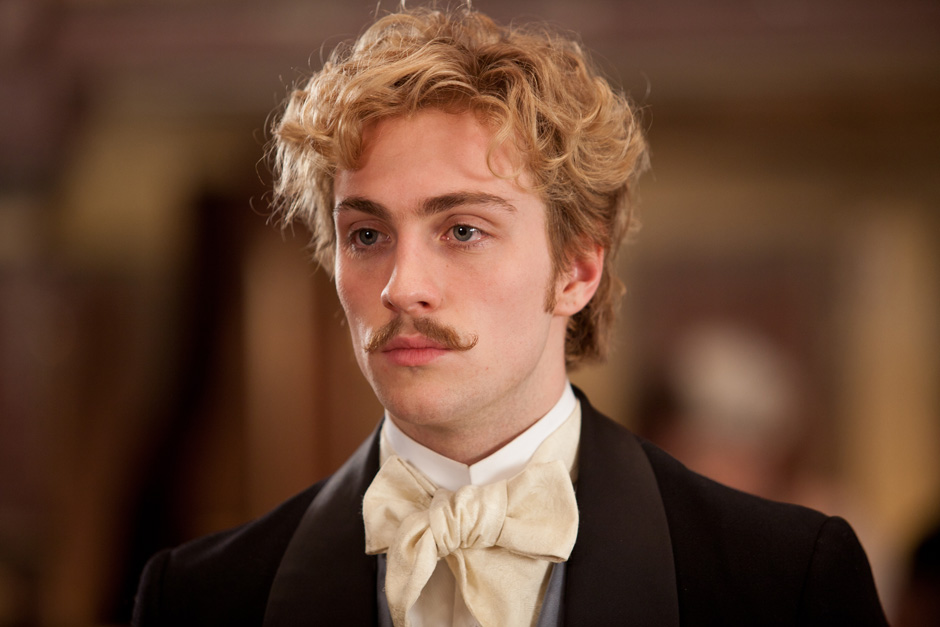
The performances run that way, too.  Keira Knightley is an exasperating Anna, conflicted but fatally committed to fully expressing whatever is on the surface of her heart.  Her P & P co-star, Matthew McFadyen is a burlesque cousin Oblonsky, fatuously showy in a way that reminds of Kevin Kline performing a burlesque role.  Jude Law—not one of my favorite performers—here is exceptional as Anna's cuckolded husband, and is so restrained and non-theatrical, that it sets him apart from almost every other performer, isolating him, and is a good short-hand way of showing why Anna might be dissatisfied with him.  Olivia Williams has a small part as the Countess Vronsky, whose son (Aaron Taylor-Johnson) is the very florid object of fascination for Anna.

Anna (Keira Knightley) runs from Vronsky at the Ball
and experiences a little fore-lightening from an approaching train.

It's dangerous in a Joe Wright theater.

But, almost the entire film is deliriously fascinated with the artificial that it undercuts the very real passion and consequences of actions of the people in the film, reducing them to "players" as opposed to human beings.  I say "almost" because Wright does change things up to "open up" the segments featuring Levin (Domhnall Gleeson) and Kitty (Alicia Vikander), who already have their disappointing encounter with Vronsky and move on.  When they reunite, their segments are set in a real world of sky, clouds and fields befitting the couple who exemplify wisdom, forbearance and patience.  Wright puts them in our world, relegating the others to an artificial world that is essentially stage-managed (even at the end with a coda of Karenin and the remains of his family, it is contained in the stage-world that Wright has chosen to house his film.

It's different, even interesting in an oddly disrespectful manner, as the flightiness of the bourgeoisie and their concerns are merely shadow-play and window-dressing—it is true to an extent—but by pushing the metaphor so aggressively, it undercuts any feeling one has for the players in the majority of the film itself, and reveals itself as resembling the tut-tutting of the hypocrites who turn against Anna.  I'm not sure that Tolstoy had that intention (even strained through Stoppard), and this film might have benefited  from a less facile presentation that required less stage-craft and something more resembling (I don't know) empathy?


Anna Karenina is a Cable-Watcher.


Thursday, December 22, 2011

Sherlock Holmes: A Game of Shadows

Bullet-Time
or
"Forewarned is Fore-armed (and Don't Call Me 'Shirley')"

"'Well, well,' said he, at last. 'It seems a pity, but I have done what I could. I know every move of your game. You can do nothing before Monday. It has been a duel between you and me, Mr. Holmes. You hope to place me in the dock. I tell you that I will never stand in the dock. You hope to beat me. I tell you that you will never beat me. If you are clever enough to bring destruction upon me, rest assured that I shall do as much to you.'

"'You have paid me several compliments, Mr. Moriarty,' said I. 'Let me pay you one in return when I say that if I were assured of the former eventuality I would, in the interests of the public, cheerfully accept the latter.'

"The Final Problem" Sir Arthur Conan Doyle


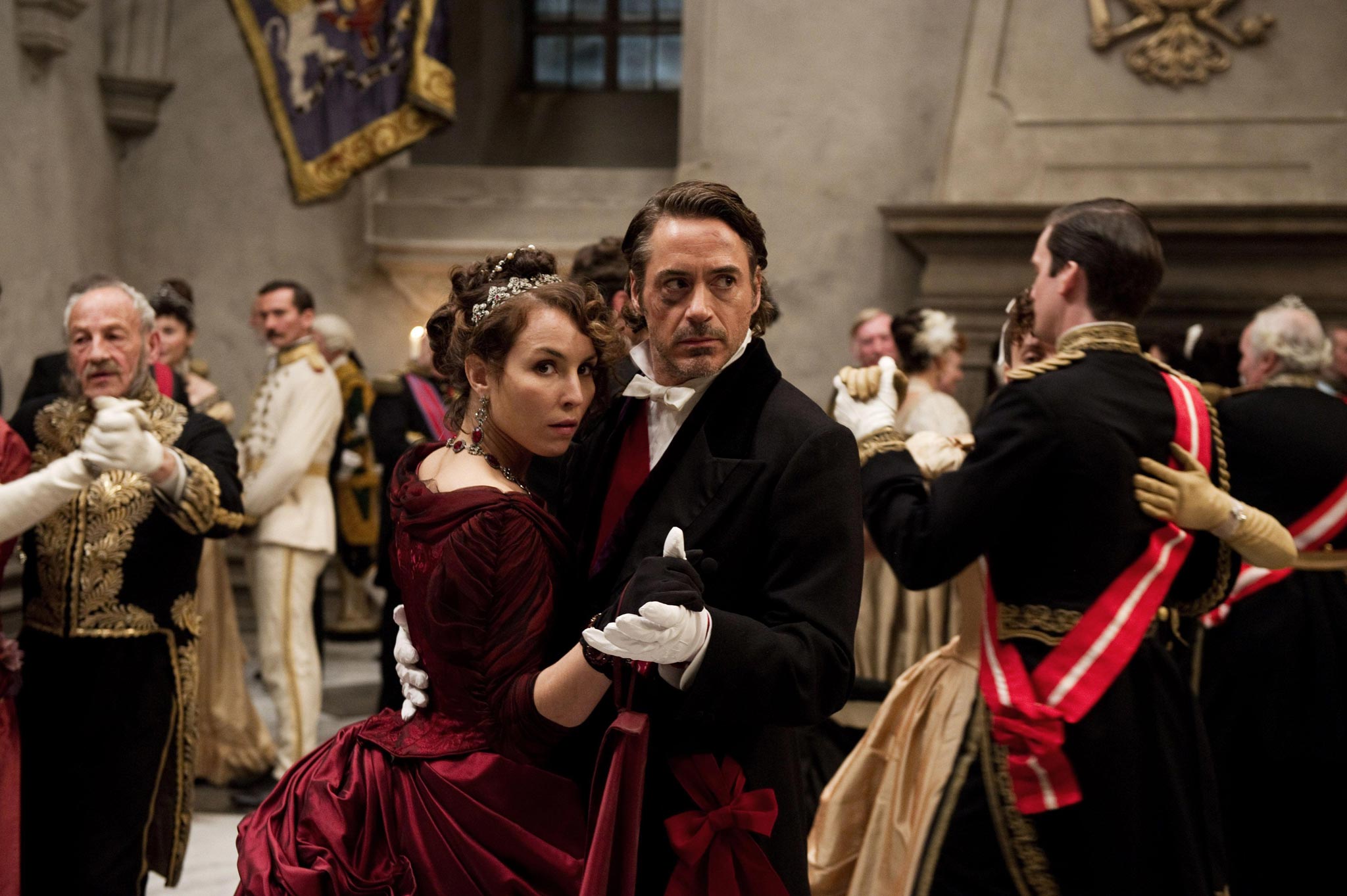
Sherlock Holmes: A Game of Shadows is the inevitable (and one should say quick-on-its-heels) follow-up to Guy Ritchie's Sherlock Holmes, and as an adaptation of Conan Doyle's "The Final Problem," It has as much source-relationship as the later Bond films have to Fleming—the bare-bones structure is there, but it's pumped, plumped, and trumped-up to fulfill the needs of action, humor and modern audience identification.  Really, "The Final Problem" is enough, we don't need the world-conquering machinations of Professor Moriarty (The Napoleon of Crime, the Scourge of London, and Holmes' best match) to make him a worthy adversary.  He merely needs to be omnipresent by means of his web of chicanery, rather than an omniscient history-maker.  In fact, Conan Doyle's Moriarty would rather his bad work went undetected, as opposed to this movie's version producing a shattering World War.  Here, in the words of Robert Downey Jr.'s Holmes, the plot is "so overt, it's covert," involving twins who aren't twins, TB, the Romany, anarchists, darts for various purposes, intricate explosive devices and not-so-intricate shell-firing ones, countries that can't be named ("although they speak French and German"), and the prospect of "war on an industrial scale."

20/20 hindsight always looks like genius when set in the past.

Actually, it's pretty clever how the doom-laden inevitability of "The Final Problem" is translated into the fore-shadowing of the war-torn 20th Century (the screen-writers are the wife-husband team Michele Mulroney and Kieran Mulroney*), and its focus on large artillery and semi-automatic "machine-pistols" has a nice hard edge as opposed to the original film's emphasis on the psuedo-occult.  But, director Ritchie seems to have lost of his somewhat, the fight-sequences (there are many) are nicely fore-shadowed with flash-cut Holmsian cognitive pre-functioning, but when the fisticuffs and baritsu moves start flying, the action is hard to follow, even when the action is slowed to a crawl—there is far too much ramp-editing and Matrix-y "bullet-time" FX in the film for no good purpose other than to slow down the practical and digital effects and give us the illusion of "wow, that was close." (Thanks, we assume that fire-fights and shellings are dangerous things).  However fast the editor can manipulate images, one still gets the impression of the film being a bit too "fussy" for its own good, delaying information or simply obfuscating it for a later time, giving one the impression that one is seeing a lot of the movie twice.  Efficient, it ain't, even if the titular character is supposed to be the heighth of it.

Also, although the first of Downey's adventurings could be seen as being a nicely nuanced (if scruffy) interpretation of The Great Detective, here the character is allowed to go a little more broad, dressing in comedic drag ("I admit, it's not my best disguise") and another, which is actually taken from The Pink Panther series (mind you, Steve Martin's "Pink Panther" series), the comedy is played up and not necessarily in character, and Holmes is seen to be practically infallibleeven his getting seriously hurt is all part of his plan.  

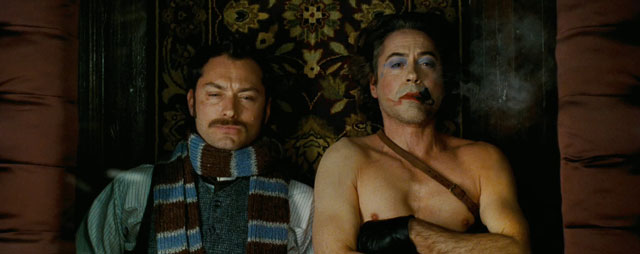
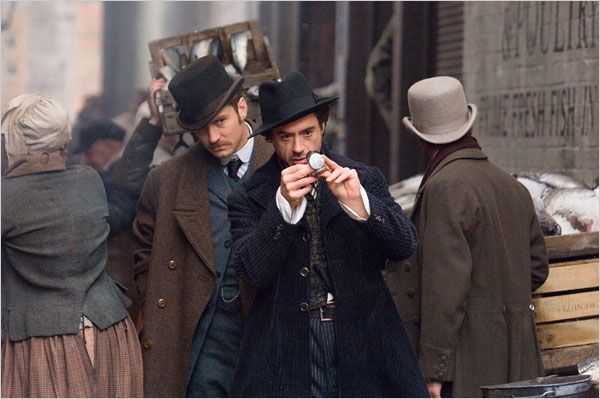
Downey, Jr. is great at playing this, even if it's a more absurd version of Holmes, and Jude Law again plays Dr. Watson (now with a severe limp and who is only now about to be married to Mary Morston, again played by Kelly Reilly) and it's one of Law's best performances, quick as Downey and capable of the slowest of "burns." Law's role is expanded somewhat and he makes the most of itThe two are joined (briefly) by Rachel McAdams, reprising her role as "the woman" Irene Adler, but is soon replaced by Noomi Rapace's gypsy princess Simsa.  Aiding and abetting is Stephen Fry, as Holmes' smarter, drier brother Mycroft (it might actually be considered type-casting), with Jared Harris as the coolest of Moriarty's (Brad Pitt was initially considered for the role), as well as being one of the youngest.

As fun as it is, one can't help but look at it as a step down—the filmmakers are getting further afield of the Holmes characterization, and it's only a matter of time before the Downey, Jr. version is locked into buffoonery and slapstick, and it comes perilously close to teetering off the edge here.  As it is, this plot is more reminiscent of the Basil Rathbone films set during WWII, entertaining if anachronistic fluff.

Sherlock Holmes: A Game of Shadows is a Matinee.


Paget's Strand Magazine illustration of the first of two Holmes-Moriarty encounters.

* Kieran is the brother of Dermot Mulroney, husband of Michele, and you may best remember him from "Seinfeld" as the fellow who gets bent out of shape at a funeral reception when he see George Costanza double-dipping a chip.

Friday, September 30, 2011

Contagion

"Night of the Coughing Superstars"
or
"Please Wash Your Hands Before Exiting the Theater"

It's not nice to fool Mother Nature.  Or even to crowd The Bitch.  Because, sooner or later, she's going to look at all that nice smooth asphalt we've laid across her, and send up some crab-grass to seek out the weak spots and crack it.

"How do you like them pot-holes, Ozymandias?"*

Steven Soderbergh's "pandepic" Contagion fits quite well in the movie medical chest that includes such plague-filled films as Panic in the Streets, The Satan Bug, and The Andromeda Strain (one could also mention "The Stand," I Am Legend and the recent Rise of the Planet of the Apes—even, if we're talking Gaia's uprising, such natural disasters as The Happening (2008) and The Birds)—an organized, technologically advanced, scientifically-disciplined infrastructure is helpless against a simple organism that spreads through the sheer inevitability of exponentiality.**  It also cross-germinates into the "Butterfly Effect" genre (see Babel, 21 Grams, Crash)—you know, where we're all so interconnected that if a butterfly sneezes in China, we'd better cover our mouths in the United States or else we'll keel over into the Stone Age.***  And with so many stars (all very good, actually), it also reminds of one of those Irwin Allen SAG-slaughter disaster movies of the 1970's, that featured tag-lines like: "Who Will Survive?"

Contagion comes a few years after the majority of us could dismiss SARS and H1N1 in the real world with a blithe "where's the pandemic?" (completely dismissing such very real threats as AIDS and the hair-trigger Ebola and Marburg viruses).****  But, it is chilling that with all our research capabilities, we'd still be running behind any new threat, simply because the little suckers can evolve faster in the gut than we can be creationists in the lab.  And Scott Z. Burns (who wrote Soderbergh's The Informant! and is updating "The Man from U.N.C.L.E." for him) has taken an...er...clinical approach with his screenplay, starting moments after "first contact," following the progress of the disease from China, to the United states, its spread and detection by the Center for Disease Control and their efforts to isolate the cause, and, possibly, find a cure.  However fast they go (and it's a process hampered by testing schedules and production runs...and which pharmaceutical companies will profit from it), it's not enough to prevent wide-spread death and a near-collapse of societal structures throughout the world.  "It's figuring us out faster than we're figuring it out," says one of the techs (Jennifer Ehle) to her boss at CDC (Laurence Fishburne)...and it doesn't have a bureacracy to work through.  The drama is situational, so don't go in expecting ambulance chases and LED countdowns to disaster, but situations where families are ripped apart, investigators become victims, and desperation becomes just another symptom.  It's a procedural with a widely-flung spray pattern.

The cast is amazing...Matt Damon, Gwyneth Paltrow, Jude Law, Fishburne, Marion Cotillard, Kate Winslet...and just when you think they've run out of actors, up turns John Hawkes, Elliott Gould, Demetri Martin, and Bryan Cranston...you half-expect the full cast of Ocean's 13 to show up and cough out cameos.  No one dominates, everybody underplays, and the heroics are human and low-key. 

Nicely done, and food for thought, just wash your hands before eating.

Now, if you'll excuse me, I have a 2:00pm appointment for a flu shot.

Contagion is a...*cough*...Matinee. 

* "Ozymandias" by Percy Bysshe Shelley

I met a traveller from an antique land
Who said: `Two vast and trunkless legs of stone
Stand in the desert... Near them, on the sand,
Half sunk, a shattered visage lies, whose frown,
And wrinkled lip, and sneer of cold command,
Tell that its sculptor well those passions read
Which yet survive, stamped on these lifeless things,
The hand that mocked them and the heart that fed.
And on the pedestal these words appear --
"My name is Ozymandias, king of kings:
Look on my works, ye Mighty, and despair!"
Nothing beside remains. Round the decay
Of that colossal wreck, boundless and bare
The lone and level sands stretch far away.'


** We could also mention "The War of the Worlds," but there, the bugs are the good guys.

*** A better example would be: "If Greece doesn't raise its debt-ceiling, should I rollover my 401k into doubloons?"

**** And yesterday, I heard people are dying from Listeria-infected cantaloupes! 

Wednesday, March 24, 2010

Repo Men

"I Sold My Soul to the Company Store"

Who is Miguel Sapochnik and why haven't I heard of him before?

The reason is simple—he's been attached to a lot of projects that fell by the way-side for one reason or another, not the least of which is probably studio cold-feet at risking a lot of dollars on a director whose only previous credit has been a 15 minute short ("The Dreamer," 2000).

The release of
"Repo Men" will, hopefully, change that. Sapochnik's sci-fi noir (based on the novel "The Repossession Mambo" by Eric Garcia, who co-wrote the screenplay with Garrett Lerner) posits a future corporatocracy (the credited "futurist" is Ben Bova) in which everything is for sale. You think unrestrained capitalism in health-care is bad now, you just wait. The scenario here is that rather than having diseased patients waiting for organ donors to supply replacement parts, manufactured items are used instead, manufactured by several bio-mechanics corporations. A franchise called "The Union" arranges the transplants and supplies the tickers and goo-gah's to be implanted, at a cost that is extremely prohibitive. But, that's okay, there's an easy payment plan to fit any budget (the APR is 19.6%, which elicited knowing whistles in the audience). But you'd better read the fine print. After 90 days your account goes into arrears, and The Union has the right to repossess your equipment. They hunt you down, taser you (at which point they read to you that you have a right to an ambulance or any emergency medical care if you can afford it, not that it'll do you any good while stunned) and then proceed to saw, scissor, scalpel their equipment out of you (and maybe it's just me, but I find this scenario very plausible).

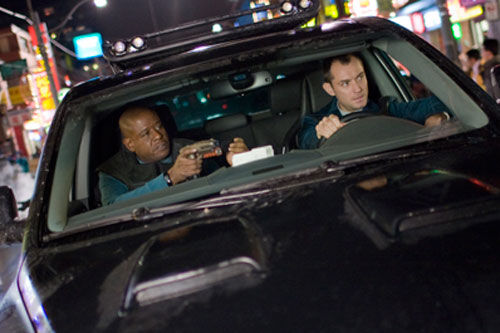
The best repo-man The Union has is Remy Stark (Jude Law, he's terrific in this, for once bringing a strong presence to a starring role), partnered odd-couple style with Jake (Forest Whitaker, clearly having fun), but Remy is getting pressure from home to get out of the repo biz and into sales, which has more regular hours and solves that nasty blood-stain problem with the laundry. The decision is made for him on one job recalling a heart, when his portable defibrillator used to stop the victim's heart back-fires and ends up stopping his.

In one of those ironies that they teach in Screenwriting 101, Remy winds up in the hospital possessed of his own ticking time-bomb in his chest, and, having a literal change-of-heart, suffers sympathetic pains with his victims and
can no longer...operate. Complications pile up: his wife, because he's now stuck in the repo job kicks him out, his weakened condition makes work harder even if he can get the gumption to start cutting, and he soon runs out of money and, yes, time.

As if there would be any doubt.

"
Repo Men" is "Logan's Run" cross-stitched with "Coma," and the Urban Legend of the guy in the bath-tub of ice, but it's in the telling of the tale that the movie sails through the material like a hot knife through butter. Sarcastic, caustic and beating to an eclectically quirky soundtrack (everything from Rosemary Clooney with Perez Prado to Mama Cass), the movie is rude, ironic and fiendishly funny, almost gleefully detailing the trap that Stark puts himself into, and not conceding to the squeamish in the cracking of chests, the popping of knees and the squirting of arteries (there's a protracted operation that plays almost like a love scene late in the film that had people fidgeting and crossing their legs throughout the theater). The action scenes become a bit unbelievable as the movie goes on, and steadily more blood-thirsty. Plus a third-act change of tone—the humor drops about 40% 'round about the time the fights start—hampers some of the nasty enjoyment of the thing. But Sapochnik (who started out in the art department) makes the movie go a long way on a limited budget, and his odd future hybrid—there are blimps, light-rail and overhead lines in the same shot—keeps things down to Earth. Whitaker and Law are helped by a wonderful dead-pan performance by Liev Schreiber, and Alice Braga's third sci-fi damsel role in as many years (after "I Am Legend" and "Blindness").

Definitely not for the squeamish, but "
Repo Men" is a promising feature debut for the director. The only reason it doesn't get a (coveted) "Full-Price Ticket" is because of the derivative climax. It'd be nice if a science fiction movie ended with something other than a fight every once in a great while.

"Repo Men" is a Matinee.

Tuesday, January 12, 2010

The Imaginarium of Dr. Parnassus

"Ladies and Gentlemen, This World is Full of Wonderment for Those with Eyes to See it."

One must consider the momentum of publicity when one talks about James Cameron's "Avatar." The tsunami of NewsCorps force-fed publicity and societal group-think has done its job on the populace and the majority are of one mind. At this point, I've heard too many smart people saying that nobody will ever make movies the same way again, that it's ground-breaking, and (okay) the story isn't much, but the visuals are so spectacular it compensates for the stunning more-of-the-sameness of the blah-blah-blah.

You don't know what you're missing.
There is more imagination, thought and, gosh, genuine wit going on in the "mirror" sequences of "The Imaginarium of Dr. Parnassus" than in anything in "Avatar." Hell, even the non-CGI "live" sequences are amazing to look at.

But...nobody's lining up to see "
Imaginarium." And that's a shame. For, if you want a fantasy film brimming with ideas, some of them quite provocative, it is this one, directed by that most snake-bit of directors, Terry Gilliam.

It has been abundantly documented ad nauseum the tragic story of this film:
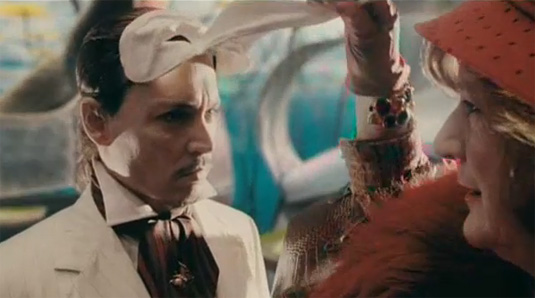
how star Heath Ledger died in the middle of filming, and how a corps of Ledger-Gilliam supportersJohnny Depp, Jude Law, and Colin Farrell—stepped up to play the visages of Ledger in the "Imaginarium" sequences (actually it seems perfectly natural the way Gilliam does it), but what isn't reported is that Gilliam was hit by a bus and broke his back during the filming.* Despite these alarming developments that would halt anyone other than a crazy "Monty Python" alum, the film is rich in detail, bursting with context, and doesn't have that "scrimping" footage-stretching feel that so many films-in-trouble give off.

It's basically a fairy-story set in our world (or
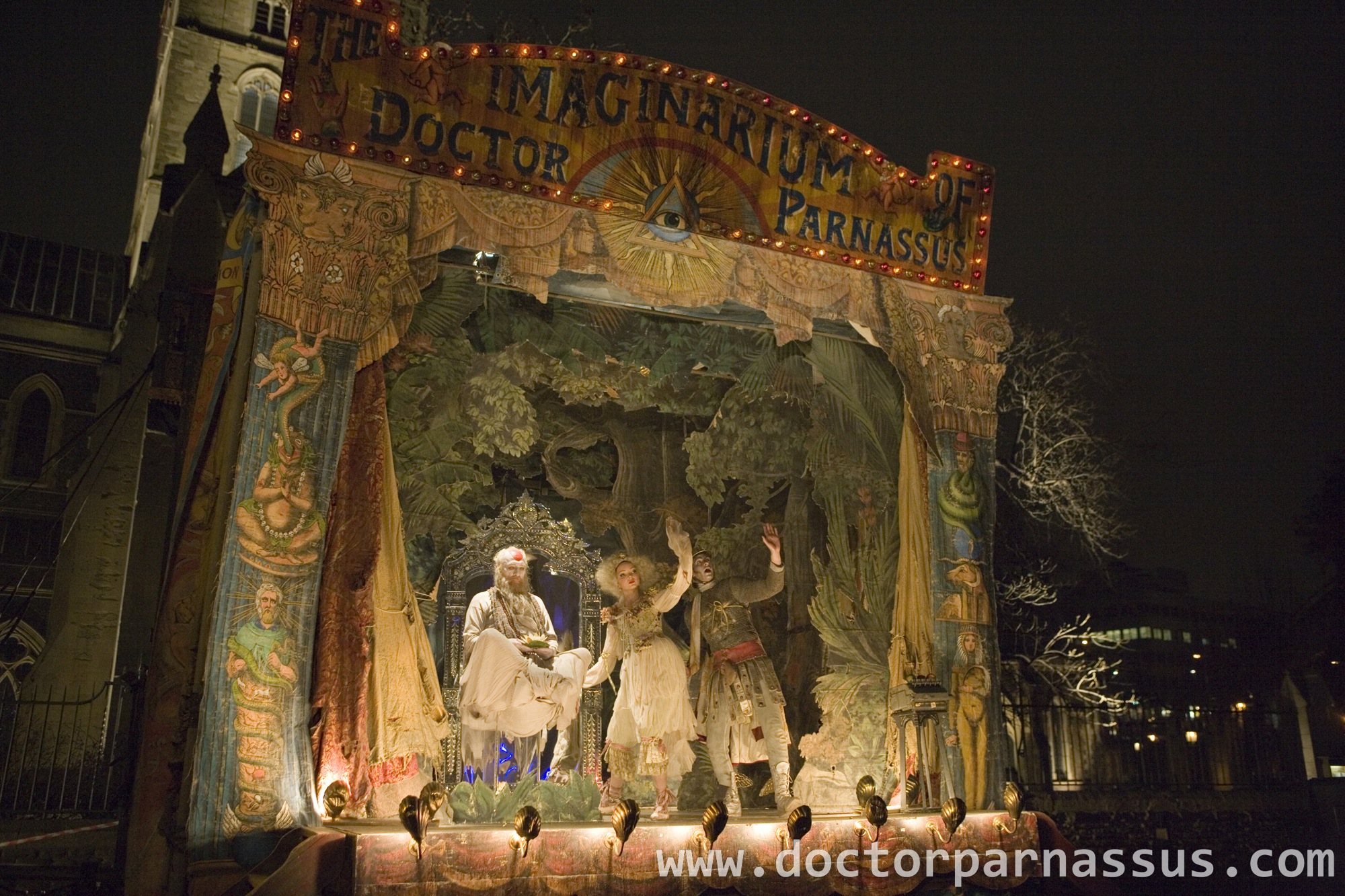
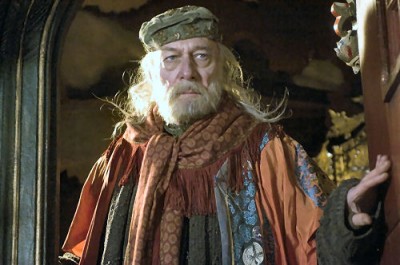
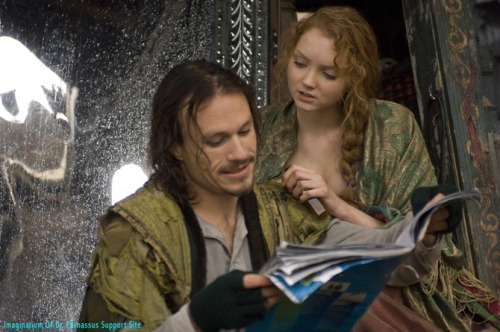
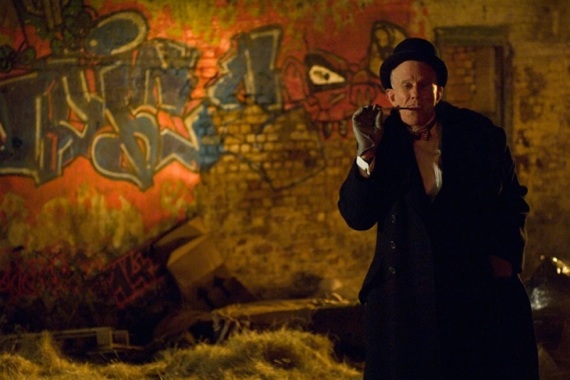
a delirium dream, not sure) where Dr. Parnassus (Christopher Plummer) is an immortal, who, with his rag-tag theater troupe—assistant Percey (Verne Troyer), barker Anton (Andrew Garfield) and daughter Valentina (model Lily Cole, whose alarming face is that of an alabaster porcelain doll)—travels in an out-sized Bergman-crossed-with-Joad horse-drawn wagon/convertible stage, enticing marks to enter his "Imaginarium," a mirror that sucks the hapless into Parnassus' bizarre mind-scapes, where they either live...or die. Parnassus, you see, has made a deal with the Devil. Inhabiting the old man's mind, as he does most of ours, is Mr. Nick (Tom Waits...of course), who has his own lures to the impure of heart. Enter one of Nick's speak-easy's or one-night-stand motels that stick out like sore toad-stools in the landscape and BOOM! the Devil takes your soul. And the bottom line of the Devil's deal is a certain number of souls before Valentina's sweet 16th birthday ("The age of consent" she trills) or her day of freedom becomes her day of imprisonment, as the Devil claims her for her own. A situation as Grimm...and familiar...as can be.

But Gilliam's Devil is in the details.
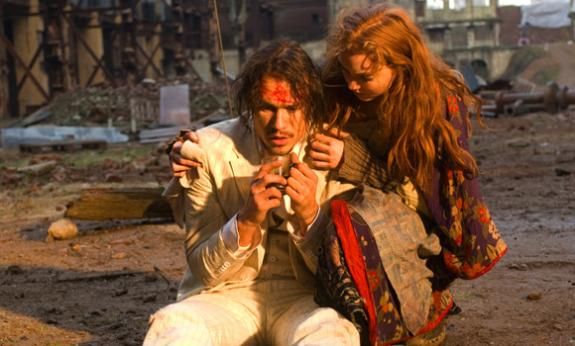
The little band are aided in their quest by an amnesiac named Tony (Heath Ledger) whom they save and who, in turn, tries to save them, but whose past comes back to haunt and threaten them. Ledger is at his quick-silver best here, his accent wavering through several dialects, his eyes darting (all qualities picked up by his capable alter-ego's), for Tony is a chameleon, a huckster, the trickster of Myth—which Gilliam uses to savage satiric effect—and is a devil of his own, capable of destroying what he seeks to save. The battle between Good and Evil, Duty and Temptation turns complicated, and Parnassus must bargain again, at great sacrifice, to save that which he loves most, whether it's wished for or no.

The Devil's in the details for the look of the film, too. The "real-world" that the "
Imaginarium" wagon trundles through is our world, but it's a world of extremes: back-alley garbage-lands with trash-fires that litter the scene (where the rag-tag group seems to fit most) and vast temples of commerce-malls, where Tony, with a marketer's zeal attempts to bring new customers. Each of these victims have their own "Imaginarium" realms: a wealthy dowager emerges into a vision of giant fashion-shoes, another a 2-D pop-up book forest. At one point, a falling "Imaginarium" customer takes an incredible fall, and Gilliam cuts to an improbable "Python" joke—a giant thumb-tack—sitting in the middle of nothingness (Gilliam mercifully, for the moment, has the hapless mark miss the point). And even outside the mirror, there are wonders of movie-making brio. In a scene where Percey walks away from Parnassus with his usual bluster, Gilliam shoots the diminutive Troyer at a heroic looking-up angle—the camera had to be scraping the street.

Now, a confession. It may sound like I'm gushing about Gilliam here, but I've always had a problem with his films: I fall asleep through them. It's not that I'm bored, but there's something about the richness of detail, the constant flow of new things to look at, and the murky lighting that induces narcolepsy in me. Before seeing a Gilliam film, I try to load up on coffee and sugar to get through it. I have no idea why this occurs (maybe it's
Rapid Eye Movement caused from the orbs darting about the screen), but it is inevitable—it occurred here through the Jude Law sequences—but I managed to keep my eyes open throughout the whole thing this time.

If the film is flawed, it is that it tries to do too much. Even with a simple story, derived from old fairy-tale tropes, Gilliam again attempts to fit 10 pounds of story into a 5 pound film. Complications begin to pile up, revelations are delayed, little troubling details are revealed—there's a convenient pitch-pipe here—and everything becomes resolved in an ambiguous and hasty manner. Like most Gilliam films, a second viewing may make murky matters clearer. Plus, the overall story has a premise open to interpretation...
is it a "God versus Devil" story, or merely a fairy tale? The Christian Science Monitor's Peter Rainer thinks it may even be autobiographical with Parnassus a mask for Gilliam, "a mad dreamer forever riven between his imagination and the necessity to sell it."** And like his "Python" fraternity, there's a streak of dark running through this, as with all Gilliam films (remember how Kevin's parents are killed at the end of "Time Bandits?"), that may be off-putting for some viewers. Fans of Gilliam's films should expect it, but those who prefer their fantasy milkier may not like the taste of the dark stuff. "Avatar" is far less subtle, more a punch "on the nose," and although dark, gives the impression of a happy-ish ending.

So, it is doubly appropriate that "Imaginarium" brings me back to "
Avatar." For what is Gilliam's film but a re-working of the caution "You can fool some of the people all the time, and all the people some of the time," and that includes the Devil, but the Devil gets his own.

What's Gilliam's next movie? Well, he's determined to go back and film his
Don Quixote movie, come hell or high water. It is only appropriate for this most quixotic of film-makers, forever charging against the impossible odds at realizing the incredible visions wind-milling in his head.

"The Imaginarium of "Dr. Parnassus" is a Matinee.

* Here, the endlessly inventive also Gilliam made lemonade—convincing the bus company to provide transport rather than face a law-suit, thus saving lots of production money. And, if all of this wasn't enough, producer William Vince died right after filming. The film is dedicated to Ledger and Vince, and credited as "A Film by Heath Ledger & Friends."

** Nice observation, that. But Rainer also thinks Ledger looks "dispirited" in the film--well, yeah, the character's just gone through a painful transition, but Ledger's performance of it is never less than audacious and energetic. I'm guilty of it, too, but critics shouldn't try to read actor's minds--they're chameleons, after all, when they're doing it right, and we should speculate cautiously when ascribing motivations to surface appearances on film.
Wednesday, December 30, 2009

Sherlock Holmes

"The Lord, The Woman, the Ginger Midget and the Parisian Giant"
or
"The Peripatetic Plot of the Madonna's Husband"


The wife and I have been looking forward to the new "Sherlock Holmes" with anticipation and dread. We're both fans, though hardly "Baker Street Irregulars," and Robert Downey Jr. is always worth watching—even when he's not, able to suck nuance out of even claustrophobic camera set-ups and able to project a fiendish intelligence out of every role. Fans of the Great Victorian Detective, we've liked several incarnations—particularly Jeremy Brett's encyclopedic and eccentric interpretation, and suffered through the attempts to get another Holmes series started. Brett left a long shadow—one that not even a good choice like Rupert Everett could dispel.* And clues in the trailer led one to deduce that they would try and make Holmes more of an action figure than Conan Doyle might have intended—more like a Bourne-again Holmes than the amateur pugilist of the books.

There are elements of that here, but done cunningly by writers Michael Robert Johnson, Anthony Peckham, and Simon Kinberg; Holmes, ever the synthesizer of information-bits diagnoses his battles first using his observations of his opponents, then carries them off with judicious speed, making note of their potential recovery time, both physical and psychological. Neat touch that, as is a nice summing up of Holmes' misanthropic characteristics—sitting at a restaurant table awaiting Watson (Jude Law,** as good as Law has ever been) and his intended, Mary Morstan (Kelly Reilly),*** Homes observes every argument, every petty theft, every peculiarity of his fellow diners—without his mind disciplined in pursuit, the vagaries of the world must drive him mad. Both Robert Stephens and Brett maintained that the difficulty in playing Holmes is that there is no center to him—a brain with no heart. Bur even an unbridled intellect must react to the world, and in Downey, jnr. there is quicksilver in those reactions.

The game that is afoot is one that will challenge Holmes to his core in a battle of facts and logic against magic and the dark forces.**** When we first see Holmes and Watson in action, they disrupt a ritual sacrifice by the fiendish Lord Blackwell (Mark Strong), who is already responsible for three murders before the fourth is disrupted. Sentenced to hang, Blackwell informs Holmes he will rise from the dead to usher in a new destiny for England. Holmes is skeptical, but intrigued, especially after Blackwell is hanged, declared dead (by Watson), then escapes his coffin. At a time in History, when engineering marvels such as London Bridge are being accomplished, it seems more imperative than ever for Holmes to dispel the superstitious.

Disrupting his concentration is a visit by
the one woman who has out-foxed Holmes, Irene Adler (Rachel McAdams, far too contemporary an actress for the part—one expects her to huff and say "whatever..." at any moment), in the story "A Scandal in Bohemia." Adler is an adventuress, to be sure, but she is almost a secret agent here, more in line with the fictional series of stories that been built up around her by Carole Nelson Douglas.

There is far less drawing-room discussion and far more darting about and cane-dashing than in previous incarnations.
The humor is amped up considerably, and the effects of injury down-played, but for all that it's a good representation of Holmes, adrenalized and puffed up as it is. Guy Ritchie shows that he has evolved from mumbling street-thug films to something with more than empty panache. His breathlessly paced opening half of the film stumbles somewhat with an extended fight with a Parisian giant, but manages to regain its footing with some genuinely well-done sequences that manages to clue the audience in to eke out its suspense. There has been some criticism of late that Ritchie doesn't have the depth or focus to pull off a big-budget film, although he's been angling for them for years. "Sherlock Holmes" is his defiant reply.

And not only are
Law and Ritchie showing their best games here—composer Hans Zimmer, long an adherent of the generically grinding over-the-top symphonic score (he supervised all three "Pirates of the Caribbean" scores, which, frankly, are hard to tell apart), his work for "Sherlock Holmes" is folk-song based, with clever rhythms and instrumentation—kudos to orchestrator Kevin Kaska—that keeps the period alive amidst the clutter of the art direction.

Fans of Sherlock Holmes can relax.

"Sherlock Holmes" is a Full-Price Ticket.


* Although I'd like to see Ralph Fiennes, or better, Daniel Day-Lewis, try.

** Law appeared in the Granada version of Doyle's "The Adventure of Shoscombe Old Place."

*** Although why Watson feels the need for Holmes to meet her in the first place is rather odd. She did, after all, hire him in "The Sign of Four."

**** Conan Doyle's stories focussed on matters that challenged the societal structures of Victorian England and elaborate plots of thievery, and rarely dealt with the occult, although some of the modern stories—like "Young Sherlock Holmes" (1985), which also featured an occult presence, as it was produced by Steven Spielberg, not long after "Indiana Jones and the Temple of Doom," have featured Holmes against more supernatural threats. There was always that element to Doyle—such as the monstrous "Hound of the Baskervilles"—but they were usually explained away in bursts of Holmesian fact-checking.