Showing posts with label Noomi Rapace. Show all posts

Wednesday, June 13, 2012

Prometheus

Going to Meet Your Maker 
or 
"Eloi, Eloi, lema sabachthani?"*

Every time I see a poor copy of a good idea become the latest pop darling out there, I get the inevitable useless reply from someone who takes it personally: "There aren't any original ideas anymore!  Just because it's been done before doesn't make it bad!"  (And it certainly doesn't make it "good!")  It's missing my point.  I don't care that it's been done before (and I'll identify where if anybody wants to look it up), what I care about is that it isn't done as well.  Jean-Luc Godard said "It doesn't matter where you take things from, it matters where you take things to."  

Succinct and right on.

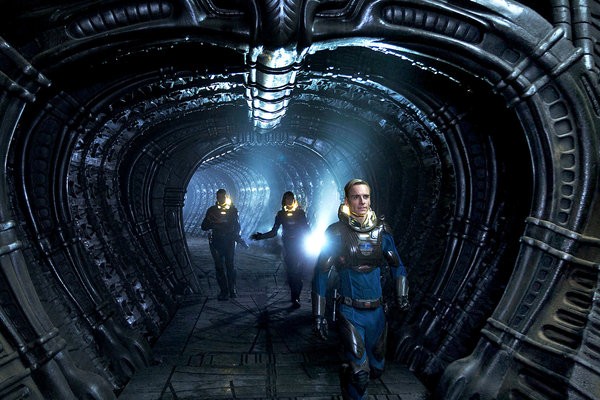
So, now, Prometheus—Ridley Scott's return to SCI-FI, and the world he created in Alien.  If one goes in seeking another "Alien" movie, one might come out a little disappointed.  Oh, there are chases with disoriented POV's, conflicted crews and amoral androids, "hair-in-the-drain" icky effects, H.R. Giger designs, shocks and revelations, but this isn't Alien.

It's better, richer, and more thought-provoking...while still being a rather nifty action-horror-science-fiction hybrid.  It must be a hybrid, as Scott (and screenwriters Jon Spaihts of The Darkest Hour and "Lost"'s Damon Lindelhof) have stolen just about every science-fiction idea in the Universe.  

But, again, where they take it is original in its implications.  SCI-FI always asks "What if...?"  This one goes one question further in the interrogation and asks "But why?"  Yes, it's a monster movie, but like so many of those, God plays a role. 

There's a significant amount of religion in this film, and speculation about God and our origins, but it still manages to find room for Faith in settings that remind one of Hell.

Dr. Elizabeth Shaw (Noomi Rapace, the first "Girl with the Dragon Tattoo") is an archaeologist who stumbles on the latest of a series of cave paintings that have the same image even though originating from different parts of the globe.  This new one is in the Isle of Skye in Scotland.  The paintings show a group of primitives praying to a huge humanoid figure who is gesturing towards a configuration of six planets.

It's enough to fund Shaw and her lover-colleague Dr. Holloway (Logan Marshall-Green, in a performance that's trying too hard to find significance) on a trillion dollar excursion to find the only place in the Universe where the planets have that configuration at that point in the sky (??) aboard the good ship USCSS Prometheus, captained by Janek (Idris Elba, even more impressive than he was in Thor, in fact, I'd enjoy a movie centered around this character), overseen by Meredith Vickers (Charlize Theron, in brittle ice-queen mode) of The Weyland Corporation, caretakered by David (Michael Fassbender, in a terrific heavily-influenced performance), an android who serves as ships' H.A.L. in all manners, including a slightly unctuous air, but in movie choices fancies David Lean over Kubrick.**  Once they get planet-side, a holographic image of the CEO of the Weyland Group (Guy Pearce, in extreme old-age make-up) introduces Shaw and Holloway to the dubious crew—the mission: to find that planet in the cave paintings and see if we can find the humanoids pointing us there.  In simple terms, we want to find that ancient "god."  They find a landing strip of sorts and settle there because "God does not build in straight lines."

Upon landing they find a semi-hostile environment with two ancient dome-like structures.  They enter and begin digital cartographing with laser mapping drones.  As they go deeper into the structures, things seem somewhat familiar to the sequel-oriented movie-goer, but not really.  It's a clean environment, protected against savage wind-storms, snaking corridors and the occasional dead body of an alien species.  What happened here?

If you think you know where it's going, you're wrong.  This one's going somewhere else than running down a neon-lit corridor being chased by a monster (well, there's some of that, in fact quite a bit of it). But, it's a much bigger Universe than the Xenomorph of the first one (I've started calling them "glitches" after this movie), and if there is a sequel to Prometheus, it's going to be along a different track than Alien, and has bigger fish to light up with a flame-thrower.

It's technically stunning, and fun to see how they took all the unused stuff left on the drawing room floor in Alien and incorporated it here.  And lest you think that this is a high-philosophy movie, no, it's scary, designed to make you jump and gross you out.  It is a horror film, after all, but for all the shock stuff, it might also make you think, as it toys with big sci-fi ideas—"A Shaggy God Story" as acerbic critic John Simon called 2001: A Space Odyssey.  But, it's Scott's best film in years, retracing old steps, sure, but finding a new path to go somewhere else, some place a lot more interesting.

Prometheus is a Full-Price Ticket.


"The answer, Dear Brutus, is not in our stars, but ourselves"


* No, it's not Klingon. It's Aramaic.

** In fact, he watches a scene that we featured in a "Don't Make a Scene" article.

Thursday, December 22, 2011

Sherlock Holmes: A Game of Shadows

Bullet-Time
or
"Forewarned is Fore-armed (and Don't Call Me 'Shirley')"

"'Well, well,' said he, at last. 'It seems a pity, but I have done what I could. I know every move of your game. You can do nothing before Monday. It has been a duel between you and me, Mr. Holmes. You hope to place me in the dock. I tell you that I will never stand in the dock. You hope to beat me. I tell you that you will never beat me. If you are clever enough to bring destruction upon me, rest assured that I shall do as much to you.'

"'You have paid me several compliments, Mr. Moriarty,' said I. 'Let me pay you one in return when I say that if I were assured of the former eventuality I would, in the interests of the public, cheerfully accept the latter.'

"The Final Problem" Sir Arthur Conan Doyle


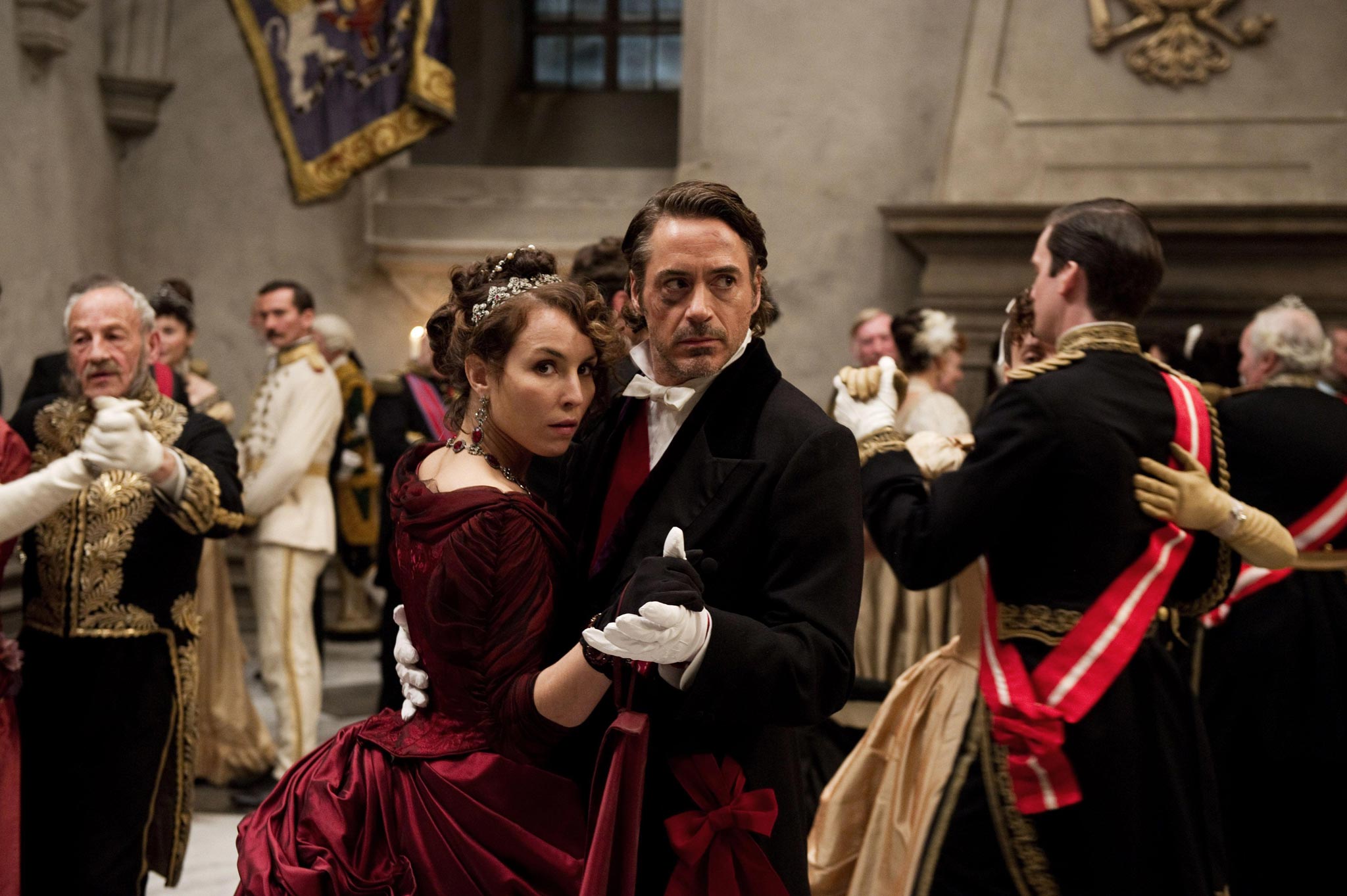
Sherlock Holmes: A Game of Shadows is the inevitable (and one should say quick-on-its-heels) follow-up to Guy Ritchie's Sherlock Holmes, and as an adaptation of Conan Doyle's "The Final Problem," It has as much source-relationship as the later Bond films have to Fleming—the bare-bones structure is there, but it's pumped, plumped, and trumped-up to fulfill the needs of action, humor and modern audience identification.  Really, "The Final Problem" is enough, we don't need the world-conquering machinations of Professor Moriarty (The Napoleon of Crime, the Scourge of London, and Holmes' best match) to make him a worthy adversary.  He merely needs to be omnipresent by means of his web of chicanery, rather than an omniscient history-maker.  In fact, Conan Doyle's Moriarty would rather his bad work went undetected, as opposed to this movie's version producing a shattering World War.  Here, in the words of Robert Downey Jr.'s Holmes, the plot is "so overt, it's covert," involving twins who aren't twins, TB, the Romany, anarchists, darts for various purposes, intricate explosive devices and not-so-intricate shell-firing ones, countries that can't be named ("although they speak French and German"), and the prospect of "war on an industrial scale."

20/20 hindsight always looks like genius when set in the past.

Actually, it's pretty clever how the doom-laden inevitability of "The Final Problem" is translated into the fore-shadowing of the war-torn 20th Century (the screen-writers are the wife-husband team Michele Mulroney and Kieran Mulroney*), and its focus on large artillery and semi-automatic "machine-pistols" has a nice hard edge as opposed to the original film's emphasis on the psuedo-occult.  But, director Ritchie seems to have lost of his somewhat, the fight-sequences (there are many) are nicely fore-shadowed with flash-cut Holmsian cognitive pre-functioning, but when the fisticuffs and baritsu moves start flying, the action is hard to follow, even when the action is slowed to a crawl—there is far too much ramp-editing and Matrix-y "bullet-time" FX in the film for no good purpose other than to slow down the practical and digital effects and give us the illusion of "wow, that was close." (Thanks, we assume that fire-fights and shellings are dangerous things).  However fast the editor can manipulate images, one still gets the impression of the film being a bit too "fussy" for its own good, delaying information or simply obfuscating it for a later time, giving one the impression that one is seeing a lot of the movie twice.  Efficient, it ain't, even if the titular character is supposed to be the heighth of it.

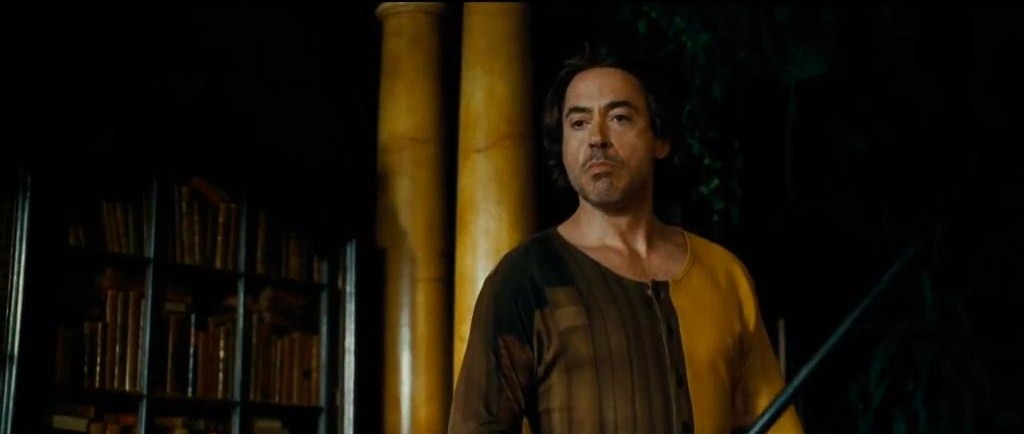
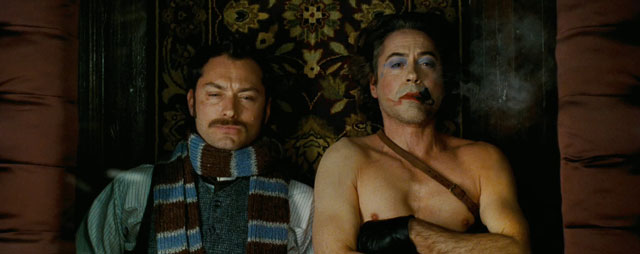
Also, although the first of Downey's adventurings could be seen as being a nicely nuanced (if scruffy) interpretation of The Great Detective, here the character is allowed to go a little more broad, dressing in comedic drag ("I admit, it's not my best disguise") and another, which is actually taken from The Pink Panther series (mind you, Steve Martin's "Pink Panther" series), the comedy is played up and not necessarily in character, and Holmes is seen to be practically infallible—even his getting seriously hurt is all part of his plan.  

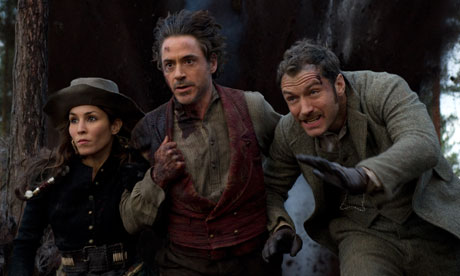
Downey, Jr. is great at playing this, even if it's a more absurd version of Holmes, and Jude Law again plays Dr. Watson (now with a severe limp and who is only now about to be married to Mary Morston, again played by Kelly Reilly) and it's one of Law's best performances, quick as Downey and capable of the slowest of "burns." Law's role is expanded somewhat and he makes the most of it.  The two are joined (briefly) by Rachel McAdams, reprising her role as "the woman" Irene Adler, but is soon replaced by Noomi Rapace's gypsy princess Simsa.  Aiding and abetting is Stephen Fry, as Holmes' smarter, drier brother Mycroft (it might actually be considered type-casting), with Jared Harris as the coolest of Moriarty's (Brad Pitt was initially considered for the role), as well as being one of the youngest.

As fun as it is, one can't help but look at it as a step down—the filmmakers are getting further afield of the Holmes characterization, and it's only a matter of time before the Downey, Jr. version is locked into buffoonery and slapstick, and it comes perilously close to teetering off the edge here.  As it is, this plot is more reminiscent of the Basil Rathbone films set during WWII, entertaining if anachronistic fluff.

Sherlock Holmes: A Game of Shadows is a Matinee.


Paget's Strand Magazine illustration of the first of two Holmes-Moriarty encounters.

* Kieran is the brother of Dermot Mulroney, husband of Michele, and you may best remember him from "Seinfeld" as the fellow who gets bent out of shape at a funeral reception when he see George Costanza double-dipping a chip.

Thursday, November 11, 2010

The Girl Who Kicked the Hornets' Nest


"Staten kontra Lisbeth Salander"
or
"The Girl with the Dragon Tat 3"

The final film of the Swedish versions of the "Millennium" series* satisfies, but in the same way that most final films in a trilogy satisfy: loose ends get tied up, the story concludes, we get to say good-bye and leave.

But The Girl Who Kicked the Hornets' Nest (aka Luftslottet som sprängdes or "The Air-Castle that Blew Up"**) is the least of these films (the last two directed by Daniel Alfredson, the first more atmospheric one directed by Niels Arden Oplev), partially because the source novel by the late Stieg Larsson is full of detail and waiting for an outcome, and not much else.  Also, its lead character starts this one (its story begins mere moments after the last entry's finish) suffering from the horrors she endured in the last quarter of The Girl Who Played with Fire.  With a bullet in the brain and the long recovery that entails, the audience is left in the waiting room, for its star attraction to do the voodoo she does so well.  But the fine-grinding gears of the plot, and all the complications the series has set up, tends to gum up the works and makes it all seem like a slow-moving version of "Law and Order: Special Victim's Unit." 

It is what the novel is, but the book has the advantage of throwing surprises at you all the time, keeping you busy thumbing back through it to keep the details straight.  The movie plods along with everyone talking about the one thing that has made the series shine, but is kept somewhat off-stage with only tantalizing glimpses now and then: goth-girl/hyper-hypenate Lisbeth Salander (Noomi Rapace).

That character (and the way Rapace plays her) is what the audience cares about.  It's why the "Millennium" series, when it was published in America, replaced the oblique Swedish book-titles (like the first's, which translates aptly as "Men Who Hate Women") to focus on "the girl with the dragon tattoo."  It is also why Rapace (though it isn't evident from posters and IMDB listings) is top-billed in the film over her more accomplished co-star Michael Nyqvist (I wonder if Rooney Mara will be so lucky to eclipse Daniel Craig in the English-language versions).  She's the ace in the hole, but the film keeps her comatose, cloistered, incarcerated, and quiet for 3/4 of its length.  As Rapace 's performance is so interior anyway, one is focussed on every twitch of her lips, fashion statement, or flicker of an eye to sustain interest.  

Meanwhile the rest of the world is running around, dealing with conspiracies, death-threats, assassinations, dances with automatic weapons, car-chases, and cartoonish muscle-men in an unsuccessful attempt to compete with the smallest Salander reaction.  After two movies watching her running rough-shod out of those who get in her way, the film-makers should have known they couldn't fight their own creation.  Only a Final Heat with a Loose End gives the audience its requisite amount of brutal grrrl-action.

Worth seeing, if, like me, you got hooked on the sordid Swedish underpinnings of the story, but don't be surprised if you want to see more when it's done.

The Girl Who Kicked the Hornet's Nest is a Rental.


* Even as I write this, David Fincher is directing the Big Hollywood version of the first book with Daniel Craig, Rooney Mara, Stellan Skarsgård, and Christopher Plummer.

** We'll get into these translations later, but if that title confuses you Englishers, substitute "The Ivory Tower" for "Air Castle" and you'll get the idea.

Tuesday, July 27, 2010

The Girl Who Played With Fire


"If You're Going to Have a Nasty Habit, You Might As Well Do It in Style"

It has been a year since Lisbeth Salander (Noomi Rapace), the multi-hyphenated* titular anti-hero of the "Millennium" series (or "The Girl with the Dragon Tattoo") skipped off with a fortune to travel the world on the run from the slugs of Swedish officialdom who might exact revenge.

As if...

Now, she is pulled back to Sweden, against her better judgement, moving in relative obscurity; her only connection to her partner-in-investigating Mikael Blomqvist (Michael Nyqvist) is virtual, connected to his computer hard-drive.  Though she continually scours what he's investigating and reads his columns, there hasn't been contact, e-mail, text, or ping between them in that entire year.

She's been busy enough, though.  The events of the first film perpetrated by "The Girl Who Played With Fire" are coming back to haunt her, as she is evidentially linked to the murders of a "Millennium" journalist (Hans Christian Thulin) and his girlfriend, who have been working on exposing Swedish sex-traffickers with some highly placed officials as customers.  That those homicides also lead to the murder of Salander's former "guardian" (in name only) Nils Erik Burman (Peter Andersson), on whom Salander exacted a brutally appropriate revenge in the last film, only make the hunt for her more intense.

This time it's personal (as they say in the trailers).  And the fascinating Salander becomes the focus of this story that has her confronting her demons while tangentially attempting to clear her name.  In the center of the story, while simultaneously watching from the sidelines, Blomqvist can only dog the elusive hacker's trail, learning more about his enigmatic co-hort/lover and what stokes the fire in her belly, a fire that actually turns the calm, collected Blomqvist into one very angry man, staunchly defending her, while coming to grips with the reasons she "despises men who hate women."

"The Girl Who Played with Fire" (directed by Daniel Alfredson) is not as good a film, or as fine a mystery as "The Girl With the Dragon Tattoo," being much less convoluted (and thus intriguing) and a little more by-the-numbers as far as plotting.  There's no real mystery here, as opposed to the first film (and book), but it focuses on what fascinated—and made one vaguely uncomfortable—about the first part of what will ultimately be a trilogy:  Salander's burning desire to not just see justice done, but to exact her personal revenge—coldly, clinically, savagely.  That it has a feminist slant (and one winces at using the word—these are crimes against human beings, sexually and power-abuse based, that just happen to be women) of turning the tables gives it a certain satisfaction, but I've seen too many Eastwood-directed movies (...heh...) to be entirely comfortable with the vigilante justice angle. 

What makes it work, finally, are the lead characters, especially the unconventional renegade that is Salander.  Her heart's in the right place, even though her soul is damaged, and the mandarin restraint that Rapace brings her is only betrayed a notch here, but even that still ends up breaking your heart.  You can't help but root for her, despite the kindling she leaves in her wake.
And she does leave kindling.  The violence that made one queasy about the first film is only slightly muted here, and concentrated to the back-end of the story—a set-piece of violence and tension that contains no catharsis but merely stops, unresolved, leaving the fate of Salander up in the air.

Not to worry, though.  The last book, "The Girl Who Kicked the Hornet's Nest" rides the top of the New York Times Best Seller List and looks to be there for quite awhile.  The third film comes out in the Fall.  Can't wait.

"The Girl Who Played with Fire" is a Matinee.


* In my review of the first film I described her thus: "a 22 year old full-time goth-punk chain-smoking, bi-sexual, PTSD'd borderline-schizophrenic, sociopathic, fire-fixated security-investigator-computer-hacker...and part-time judge, jury and executioner.  Add to that Blomqvist's inadequate (and slightly hilarious) description of her as "...a very private person."

Thursday, April 29, 2010

The Girl with the Dragon Tattoo

"Tinker, Tailor, Soldier...Spy"

Investigative reporter Mikael Blomqvist (a nom de plume purloined from the fictional detective Kalle Blomqvist) has just been found guilty of libel for an article he wrote about a powerful Swiss indutrialist. In six months he's set for the barry hotel, but in the meantime, he has down-time. He gets an invitation for a job—the coldest of cases, literally and metaphorically—on the remote wintry island that serves as a compound for the Vanger family.

The Vangers are the Swiss cousins of all the encrusted old-money families of British and American detective fiction. Be they Baskervilles or Armstrongs or Sternwoods, the "storied" elite families stood in for the Rothschilds and Lindberghs and Morgans and Rockefellers in a literary class warfare that assured the punters that bad things happened to the rich, as well. In fact, it was more than likely to happen to them as money is the root of all things evil. Perhaps.

Money was on the family's mind that
Children's Day weekend on the Island, as a family board meeting was taking place, when one of the daughters disappeared, and her father drowned in a boating accident.
One of the patriarchs wants to know, finally, forty years after the fact, what happened to the girl, who killed her, and charges Blomqvist (Michael Nyqvist) with the task. For the discraced newsie, it's a case of interviews and solitary visits to the caked-in-dust morgues of newspaper offices and libraries. But, though isolated on the Island, he's being watched, not only by the family, but by a security investigator who's hacked his computer.

She's
Lisbeth Salander (Noomi Rapace),"The Girl With the Dragon Tattoo,"* a 22 year old full-time goth-punk chain-smoking, bisexual, PTSD'd borderline schizophrenic, sociopathic, fire-fixated security-investigator-computer-hacker...and part-time judge, jury and executioner. And where Mikael is dusting off old store-rooms, she's mining hard-drives through the back-door for any information that might be useful, like, say, on the creep who's been appointed her guardian. Life has rumpled Mikael, but it's deeply scarred Lisbeth, and the two tarnished angels are linked by more than cyberspace in a mutual interest making peoples' forgotten pasts their field of play.

They were made for each other, and, as both are incapable of seeing a mystery
without inserting themselves, fated to team up to solve the question, if it is to be solved.

"The Girl With the Dragon Tattoo" is one of those whodunnit's much in love with
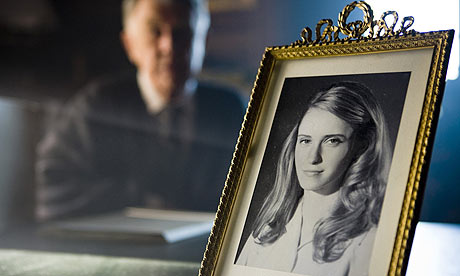
every squeaking trope, and dangling aringarosa of the detective literary genre, and the puzzle is of the classic "Closed Room" variety—a traffic accident cut off the one exit to the bridge when the skull-duggery happened, so the scope of the search is limited to who might have been on that island to perpetrate it. The clues are varied in sources and nature, an old diary the girl kept with no entries that might lend suspicion, the few photographs taken that week-end...and Blomkvist's own memories—the girl was his nanny on Island holidays—provide nagging evidence, as does a single portrait that haunts him, like the Mona Lisa.

There are so many referrals to past films noir and sleuth-cinema that one could get lost in many a blind-alley (not that there are many on a rural Swedish island), but there are more than enough cousins and butlers and drawing rooms to go around—as with the best mysteries, no one is a suspect, but everyone is.

It is violent—there are two upsetting rape scenes that are essential to the plot, ultimately—
but there is a cross-running sub-theme of sexual tyranny equating male sexism and domination as a form of fascism (it's an in-bred cousin to the feminism issues that made "The Silence of the Lambs" more important than a "boogey-man" story) that makes the film interesting philosophically in the genre. Director Niels Arden Oplev stages those scenes in a brutal manner that divorces them from any sexual act and makes them sadistic acts of violence, but one should be warned that there is rough stuff, far beyond cloak-room murders and high tea. The film is unrated, but consider it a hard "R."
It's a cracking pastiche, with the best thing about it being the (English version's)titular character. A product of the very brutality embodied by the mystery itself, the stakes are personal for Salander (and Blomkvist, certainly), but, like the Hannibal Lecter character in "Silence of the Lambs," she is such a wild-cannon on deck during the proceedings that her motivations keep your thinking cap distracted from the mystery at hand. As played by Rapace, she is a kabuki-like presence than can turn ninja on a dime, a literal smoking gun, who can make things better or worse, depending on her buried mood, making the film categorical as "Suspense" as well as "Mystery."

The other films in the trilogy will be released later in the year. Then, an American remake is planned...
at this writing starring Brad Pitt and Carey Mulligan.
"The Girl with the Dragon Tattoo" is a Matinee.
* That's what it is known as in English-speaking publishing circles where mysteries series need a unifying "hook" like John D. McDonald's colorful titles for the Travis McGee novels, or "Cat" series of Lilian Jackson Braun. In its native Sweden, the title—"Män som hatar kvinnor "— translates to the more straight-forward and to-the-point, "Men Who Hate Women." The popular series of novels, dubbed the "Millennium Trilogy" (for the publication Blomqvist works for) stopped at three due to the untimely death of its reporter/author Stieg Larsson of a heart attack at age 50, before the first could be published.