Showing posts with label Ridley Scott. Show all posts

Friday, November 15, 2013

The Counselor (2013)

Couples Therapy
or
How to Get a Head in Business

The Counselor is not "The Worst Movie Ever Made" (as some would have it) nor should such a withering condemnation (from a critic? *pfft*) warrant it any sort of pity-praise to escalate it above what it deserves.  Pity is the last thing on the mind of The Counselor.

What it is is the first original screenplay by Cormac McCarthy—he also exec-produced—and directed, with a lavish budget for just about everything, including dirt, by Ridley Scott, who one should now probably call a "stylist," rather than a director. Everything looks great.  But, again, one wonders if Scott read the script beyond descriptions.  


Like so much of McCarthy's work, it is dark and gritty and nihilistic—in a hopeful, moral kind of way; in other words, it's a story or very bad people doing very bad things from the point of view of a person who is tsk-ing in the background.  Perfect director for this would have been Martin Scorsese.  But, it's Ridley Scott who, given his past, seems to have a lot of sympathy for the devil (Blade Runner, Legend, Hannibal, Matchstick Men, American Gangster, Prometheus), indeed, in his last movie, the hero was, once again, a synthetic human being with its own sense of ethics.  That synth was played, rather brilliantly, by Michael Fassbender, which is why he's the titular lead.


The thing about novelists doing screenplays and writing for the movies is they're slumming, unless they see themselves as legitimate film-makers (see the Coen Brothers or John Sayles).  Maybe McCarthy couldn't flesh out his characters for the novel form.  Maybe he wanted to see what a film-maker wanted to do with a work he wasn't happy with and see what the collaborative process would produce.  Maybe he wanted to make some money.  But, for whatever reason, McCarthy chose to do this as a film, and not a fully thought out novel.


"...red in tooth and claw"
Maybe he just didn't like it.  It's extraordinarily simplistic—The Counselor spends the first half warning its protagonist "Don't do this" and casually mentioning ways in which people can be killed, usually involving decapitation ("it's just business").  Once he's "locked in," it spends the second half eliminating most of the cast in precisely the ways that have been described in the first half.  It answers the question that is contained in a couple iof questions in that first half—"Why am I telling you this?"  Obviously, so we can anticipate it being used later and knowing what's happening.  In other words, literally, the first half of The Counselor is a prolonged "you just don't get it, do you?" speech.  The second half, he gets it (I'd warn about spoilers here, but everything is telegraphed fairly early on, even "the surprise" puppet-master of the thing).

One interesting aspect of The Counselor is the cast...or, at least, the cast as it once was.  Fassbender was always going to be in it, evidently, but the others were going to be real-life couples Brad Pitt and Angelina Jolie and Javier Bardem and Penélope Cruz, but slightly scrambled so that Bardem and Jolie would be a couple and Fassbender and Cruz would be paired.  At some point, Jolie dropped out and Cameron Diaz was cast in her role.  She's as fine as everybody else in the cast, but the dialog is difficult for swallow.  Take for example, this:


I suspect that we are ill-formed for the path we have chosen. Ill-formed and ill-prepared. We would like to draw a veil over all the blood and terror that have brought us to this place. It is our faintness of heart that would close our eyes to all of that, but in so doing it makes of it our destiny... But nothing is crueler than a coward, and the slaughter to come is probably beyond our imagining.
I remember a scene from the Elia Kazan film of The Last Tycoon where movie mogul Monroe Stahr in a fit of pique exits a screening saying "'And I, you...' nobody TALKS like that."  Everybody talks like that in The Counselor, everybody's vocabulary is up to snuff, and everybody has the time to ponder and philosophize.  But what their philosophy centers around is Nature, "red in tooth and claw."  But Nature doesn't have the time to think about what it is doing, except strategically.  If there is a slaughter to come for the human race, the meek won't inherit the Earth, but evidently the pretentious will. 

Everybody talks a good game in The Counselor, but it makes a bad movie.

The Counselor is a Cable-Watcher. 

Wednesday, June 13, 2012

Prometheus

Going to Meet Your Maker 
or 
"Eloi, Eloi, lema sabachthani?"*

Every time I see a poor copy of a good idea become the latest pop darling out there, I get the inevitable useless reply from someone who takes it personally: "There aren't any original ideas anymore!  Just because it's been done before doesn't make it bad!"  (And it certainly doesn't make it "good!")  It's missing my point.  I don't care that it's been done before (and I'll identify where if anybody wants to look it up), what I care about is that it isn't done as well.  Jean-Luc Godard said "It doesn't matter where you take things from, it matters where you take things to."  

Succinct and right on.

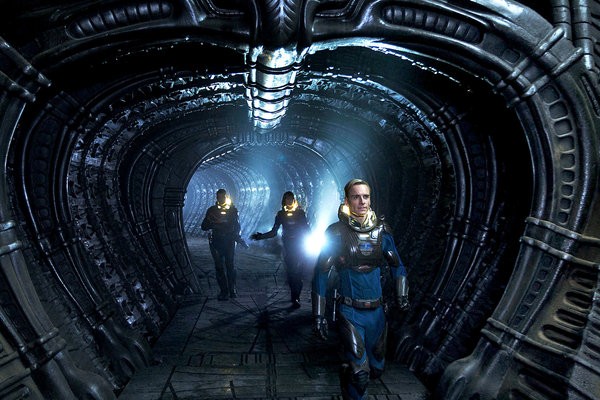
So, now, Prometheus—Ridley Scott's return to SCI-FI, and the world he created in Alien.  If one goes in seeking another "Alien" movie, one might come out a little disappointed.  Oh, there are chases with disoriented POV's, conflicted crews and amoral androids, "hair-in-the-drain" icky effects, H.R. Giger designs, shocks and revelations, but this isn't Alien.

It's better, richer, and more thought-provoking...while still being a rather nifty action-horror-science-fiction hybrid.  It must be a hybrid, as Scott (and screenwriters Jon Spaihts of The Darkest Hour and "Lost"'s Damon Lindelhof) have stolen just about every science-fiction idea in the Universe.  

But, again, where they take it is original in its implications.  SCI-FI always asks "What if...?"  This one goes one question further in the interrogation and asks "But why?"  Yes, it's a monster movie, but like so many of those, God plays a role. 

There's a significant amount of religion in this film, and speculation about God and our origins, but it still manages to find room for Faith in settings that remind one of Hell.

Dr. Elizabeth Shaw (Noomi Rapace, the first "Girl with the Dragon Tattoo") is an archaeologist who stumbles on the latest of a series of cave paintings that have the same image even though originating from different parts of the globe.  This new one is in the Isle of Skye in Scotland.  The paintings show a group of primitives praying to a huge humanoid figure who is gesturing towards a configuration of six planets.

It's enough to fund Shaw and her lover-colleague Dr. Holloway (Logan Marshall-Green, in a performance that's trying too hard to find significance) on a trillion dollar excursion to find the only place in the Universe where the planets have that configuration at that point in the sky (??) aboard the good ship USCSS Prometheus, captained by Janek (Idris Elba, even more impressive than he was in Thor, in fact, I'd enjoy a movie centered around this character), overseen by Meredith Vickers (Charlize Theron, in brittle ice-queen mode) of The Weyland Corporation, caretakered by David (Michael Fassbender, in a terrific heavily-influenced performance), an android who serves as ships' H.A.L. in all manners, including a slightly unctuous air, but in movie choices fancies David Lean over Kubrick.**  Once they get planet-side, a holographic image of the CEO of the Weyland Group (Guy Pearce, in extreme old-age make-up) introduces Shaw and Holloway to the dubious crew—the mission: to find that planet in the cave paintings and see if we can find the humanoids pointing us there.  In simple terms, we want to find that ancient "god."  They find a landing strip of sorts and settle there because "God does not build in straight lines."

Upon landing they find a semi-hostile environment with two ancient dome-like structures.  They enter and begin digital cartographing with laser mapping drones.  As they go deeper into the structures, things seem somewhat familiar to the sequel-oriented movie-goer, but not really.  It's a clean environment, protected against savage wind-storms, snaking corridors and the occasional dead body of an alien species.  What happened here?

If you think you know where it's going, you're wrong.  This one's going somewhere else than running down a neon-lit corridor being chased by a monster (well, there's some of that, in fact quite a bit of it). But, it's a much bigger Universe than the Xenomorph of the first one (I've started calling them "glitches" after this movie), and if there is a sequel to Prometheus, it's going to be along a different track than Alien, and has bigger fish to light up with a flame-thrower.

It's technically stunning, and fun to see how they took all the unused stuff left on the drawing room floor in Alien and incorporated it here.  And lest you think that this is a high-philosophy movie, no, it's scary, designed to make you jump and gross you out.  It is a horror film, after all, but for all the shock stuff, it might also make you think, as it toys with big sci-fi ideas—"A Shaggy God Story" as acerbic critic John Simon called 2001: A Space Odyssey.  But, it's Scott's best film in years, retracing old steps, sure, but finding a new path to go somewhere else, some place a lot more interesting.

Prometheus is a Full-Price Ticket.


"The answer, Dear Brutus, is not in our stars, but ourselves"


* No, it's not Klingon. It's Aramaic.

** In fact, he watches a scene that we featured in a "Don't Make a Scene" article.

Thursday, September 15, 2011

Body of Lies

This week, we're re-publishing some reviews of the films from the post 9-11 environment.

"Killing the Future with the Past"
There have been a great-many films about The Iraq War; emphasis on the "many," not so much on the "great." None have penetrated the box-office top five, and the movie-going public, with a constant dose of it (when things are going badly) on the news, have made the conscious decision to avoid paying attention at every opportunity. It may seem a disparaging thing to note, but, the public seems to have better sense than the government representing it.
Body of Lies with the one-two star punch of DiCaprio/Crowe, under the direction of Ridley Scott did manage to gain an audience (though not enough to topple the reigning champ, Beverly Hills Chihuahua), and it's just as well—it's a summation of just about every "Bush-war" film that has gone before, without adding anything new.

Part of the problem is
Ridley Scott, who more often cares about how his films look than what they say. Part of the problem is William Monahan's script (which covers much of the same ground as the other films dealing with a high-tech war in a low-tech country, where boots on the ground see more than eyes in the sky--it just got there last, is all). And the other problem is that the war has gone on so long, that we might be running out of things to say about it, at least until some of the secrecy veil is lifted about the machinations going on in the marble halls and scrub rooms of Washington and Virginia.

Not to say the film doesn't have a lot to say. At one point--with a tight deadline to meet--I checked my watch to see if the film was about to wrap up, it being so full of incident and detail, and was shocked to see that an hour hadn't even gone by yet. There was still another hour to go! There is such a flood of realistic sounding information that it probably resembles the tsunami of information Homeland Security has to sift through with their Cray's. All of that research, all that sound and fury and the all the movie comes up with is "Tell the Truth."

Thanks. We knew that going in.

The points writer and director make are obvious:
DiCaprio, in the Sandbox, has more of a grasp of what's happening, despite his getting marching orders from puppet-master Crowe in Langley. Scott repeatedly makes the point as DeCaprio curses at Crowe over his ear-bud, while Crowe's character is dealing with domestic needs at home. While Dicaprio's Robert Ferris is doing wet-work, Crowe's Ed Hoffman is SUV-ing the kids to school, with all the icy coolness of the uninvolved. And that happens frequently.

Ultimately, it's a waste of time, and is another of the many Ridley Scott projects that looks good, but doesn't add up to much in the long run. We've seen this story before.

Now, give us a good ending.


Body of Lies is a rental


Tuesday, May 18, 2010

Robin Hood (2010)

"Rise...and Rise Again...and Again...and Again"

Every fifteen years or so, there must be a big budget remake of the "Robin Hood" legend—that's a bit less than the turnaround cycle for The Compleate Works of Jane Austen. The last time the fletches flew on the big screen there were two competing Hoods—the flashy Kevin Reynolds/Kevin Costner version and one starring Patrick Bergin. Before them was "Robin and Marian," various series, and "The Adventures of Robin Hood," the Warner Bros. classic with Errol Flynn, which was itself a remake of silent versions. Then, there have been satiric vignettes in "Shrek" and "Time Bandits,"* Mel Brooks has done a movie ("Men in Tights") AND a series ("When Things Were Rotten")—Mel loves his Public Domain. Disney has touched on it a couple times as well, including an animated funny animals version.

The character and his ancillary co-stars have a long oral tradition with many variations of "The Hode," so it's natural that someone drums him up for another "Have at ye" every few years, each reflecting the times in which they were made. Robin has been yeoman and nobleman, Crusader and thief, trickster and military man, young and old. Although we've been down this well-trod pathe in the glenne before, it was interesting to think about what the "
Gladiator" team of Ridley Scott and Russell Crowe could do with the story, and how they would approach it.

And the answer is: with a little bit of everything.
Scott with the help of scenarist Brian Helgeland** has a Robin Hood, an orphan Saxon Crusading with Richard the Lionheart (Danny Huston-he's great in this), who's an expert bowman and strategist by day, and a grifter by night. At the end of the Crusades, he is given a task, the complications of which lead him to Nottingham and the masquerade of being Robert Loxley, slain son of Sir Walter Loxley (Max von Sydow) and spouse of Lady Marian Loxley (Cate Blanchett)—this Robin is both commoner and gentry. The Sheriff of Nottingham (Matthew McFadyen) is not given much to do this time 'round, instead the intrigues are by Sir Godfrey (Mark Strong) and King Phillip of France, who plot to undermine the already shaky reign of the new King John (
Oscar Isaac), the last son of King Henry and Eleanor of Aquitaine (Eileen Atkins), and invade England.

The general structure of "Robin Hood" is superficially similar to “Gladiator” with big battles at both ends, and Scott uses the same stutter-shutter technique to give some verve to the action scenes. But there it ends. Crowe is considerably lighter as Robin Hood, though he does summon up genuine moments of drama. Performances are fine all around withCate Blanchett and William Hurt being stand-outs. But the best performance is by Max von Sydow as the elderly Sir Walter. Blind, but nobody’s fool, Sir Walter takes the news of his son’s death with grim determination and courtesy for its messenger, and comes up with the Robin-as-Loxley ruse to protect Marion from having their land confiscated should he die. Von Sydow has been ill-used of late, playing teutonic villains of similar coldness, but this role shows him at full thespian power, and it would be robbery if he was not nominated for an Oscar for this performance.

The film boasts good values all around, with Scott’s keen eye for cinematography and detail, the writing is clever and often ingenious (I think the fact that it's
another Robin Hood movie sours a lot of people's expectations). The film never drags and offers considerable entertainment value. Only at the end does it falter, with a beach battle that seems overly-stretched in terms of production value and credibility. Either there was not enough planning or extras, but it looks to be constructed to not show something as opposed to creating an epic battle. Too much is made of the presence of landing craft as obstacles, and of one particular participant in the clamor, which seems to be done for scoring political points rather than good story-telling.

But that is twenty minutes out of 140. For the most part, this new “
Robin Hood” hits its mark. Yes, it might be superfluous (we can say this—with a straight face—with so many sequels headed our way?), but what's there on the screen is an interesting "take" on the legend that has lasted so long.

"Robin Hood" is a Matinee.

* John Cleese's immaculate nobleman with a "Bonny Prince Charlie" manner is one of my favorites.

** The original script, by the team of Ethan Rieff and Cyrus Voris, called "Nottingham," was more radical, but interesting in a concept-twist kind of way, but once Ridley Scott came on board, the concept changed.


Thursday, November 6, 2008

Body of Lies


"Killing the Future with the Past"

There have been a great-many films about The Iraq War; emphasis on the "many," not so much on the "great." None have penetrated the box-office top five, and the movie-going public, with a constant dose of it (when things are going badly) on the news, have made the conscious decision to avoid paying attention at every opportunity. It may seem a disparaging thing to note, but, the public seems to have better sense than the government representing it.

"
Body of Lies" with the one-two star punch of DiCaprio/Crowe, under the direction of Ridley Scott did manage to gain an audience (though not enough to topple the reigning champ-"Beverly Hills Chihuahua"), and it's just as well—it's a summation of just about every "Bush-war" film that has gone before, without adding anything new.

Part of the problem is
Ridley Scott, who more often cares about how his films look than what they say. Part of the problem is William Monahan's script (which covers much of the same ground as the other films dealing with a high-tech war in a low-tech country, where boots on the ground see more than eyes in the sky--it just got there last, is all). And the other problem is that the war has gone on so long, that we might be running out of things to say about it, at least until some of the secrecy veil is lifted about the machinations going on in the marble halls and scrub rooms of Washington and Virginia.

Not to say the film doesn't have a lot to say. At one point--with a tight deadline to meet--I checked my watch to see if the film was about to wrap up, it being so full of incident and detail, and was shocked to see that an hour hadn't even gone by yet. There was still another hour to go! There is such a flood of realistic sounding information that it probably resembles the tsunami of information Homeland Security has to sift through with their Cray's. All of that research, all that sound and fury and the all the movie comes up with is "Tell the Truth."

Thanks. We knew that going in.

The points writer and director make are obvious:
DiCaprio, in the Sandbox, has more of a grasp of what's happening, despite his getting marching orders from puppet-master Crowe in Langley. Scott repeatedly makes the point as DeCaprio curses at Crowe over his ear-bud, while Crowe's character is dealing with domestic needs at home. While Dicaprio's Robert Ferris is doing wet-work, Crowe's Ed Hoffman is SUV-ing the kids to school, with all the icy coolness of the uninvolved. And that happens frequently.

Ultimately, it's a waste of time, and is another of the many Ridley Scott projects that looks good, but doesn't add up to much in the long run. We've seen this story before.

Now, give us a good ending.

"Body of Lies" is a rental

Thursday, March 27, 2008

Charlie Wilson's War

I walked out of Charlie Wilson's War feeling fully entertained. It had flaws, but also strokes of genius. I quickly pegged it as a 4 stars out of 5 film. But something kept bugging me about CWW. The more I thought about it, the less comfortable I felt with its glibness.

Aaron Sorkin, also the engine behind The West Wing, wrote a smart, sexy script. It's full of political intrigue, back door dealings, and power plays settled more by wit than brute strength. We get the thrill ride of imagining a world where the history of the Cold War was being written by a drunken, womanizing Texan. And the film coaxes better than average performances from a host of better than average actors (except Philip Seymour Hoffman who I will not damn with such faint praise; the man is outstanding.) Overall, there's a lot of fun to be had with this recipe.

This film suffers from an agonizing fatal flaw however. It does concede the point that America screwed up by not helping the Afghanis rebuild after their successful war against the Soviets... and even tries to tack on a touching ending where we see an increasingly red-eyed Charlie trying to convince political allies to spend a few million on building schools for the survivors in Afghanistan. But this is crap. Not because it isn't true... it IS true that 9/11 could have been avoided with an ounce of prevention in parts of the world that we exploit. And it's probably even true that Charlie Wilson advocated for those programs. It's crap because the film just spent two hours showing us how sexy and exciting warmongering can be. It just gave you an adrenaline ride about how deft political maneuvers lead to shooting down Russian assault helicopters... all while watching a rippling American flag in the background and feeling secure in the knowledge that the Russians were the evil empire.

This sort of tactic reminds me of Ridley Scott's "Kingdom of Heaven"... an epic warfare film that tries to make the point that war is bad. This feels hypocritical to me... don't try to tell me war is bad after titillating me with two hours of exciting battle footage. Similarly, Mr. Sorkin, don't try to tell me we should have a kinder, gentler foreign policy after showing me how exciting it is to engage the gears of war. You're a liar Mr. Sorkin, and I will destroy your movie by taking back one star. You reached for meaning without believing in that meaning yourself. Now your film can rot with all of Tom Hank's other films: In three star oblivion.

Still worth a rental. :)

Wednesday, November 14, 2007

American Gangster

"That's What's Wrong with America. You can't Find the Heart of Anything to Stick the Knife In"

"American Gangster" tells the story of Frank Lucas, who, for a time in the 60's and 70's, ran the most successful narcotics operation in Harlem. The film is based on a "New York" magazine article from an interview with the real-life Lucas, so it must be based on fact, right?*

Ridley Scott's played fast and loose with facts before (1492, Black Hawk Down), so one should take the credit "Based on a True Story" with a kilo of salt. But, that aside, how is the movie?

It tells the parallel stories of Lucas' rise in power on the Harlem streets by "cutting out the middle-man" smuggling in raw opium from Thailand, and manufacturing a concoction called "Blue Magic" that had twice the potency, but at half the cost, with the story of the cop who eventually busted him, a down on his luck detective named Richie Roberts who's too honest to be trusted by the New York Police. While Lucas starts to make his version of the American Dream, Roberts continually has his legs knocked out from under him--his wife leaves him, takes his kid, he struggles with classes to better himself (public speaking, law), his partner turns junkie, and implicates him in a murder. The movie drips with irony at every turn, constantly showing the easy path of Crime and the tough road of Law Enforcement, that recalls that epitome of the thesis-"The French Connection."** In a montage of Thanksgiving, Lucas is shown with his entire family at a stereotypical Thanksgiving spread (and in one of the more heavy-handed of Scott's directorial choices frames it like Norman Rockwell's "Freedom from Want" painting, while Roberts, makes a cold sandwich of canned turkey-spread and potato chips over the kitchen sink. But then the director re-ups it by showing junkies shooting up between their toes in grimy bathrooms, and a mother passed out in bed, while her child is screaming in the room. Whatever glamour Lucas may enjoy, Scott is particular about showing the cost in human misery. No one gets off Scott-free.

Sometimes the tables are turned. Lucas occasionally has troubles in the operation, and however much he may espouse core-values of honesty and integrity, the very nature of his business starts to rot his dreams for his family. And the more Roberts investigates, the closer he comes to his target, the more his team of "Untouchables" gel, and his investigation and life begin to come into focus.

Ridley Scott misses as much as he hits. For every good film (The Duellists, Alien, Black Hawk Down, Thelma and Louise), there is a terrible one (Legend, 1492, Someone To Watch Over Me, G.I. Jane, Hannibal, A Good Year), and some that have just enough quality in them (Blade Runner, Gladiator, Matchstick Men) that his directorial brio can compensate for weaknesses and messy scripts. But here, he has a cracker-jack script by Steve Zaillian, no worries about creating "a world" out of whole cloth, and a stunning cast that includes Clarence Williams III (uncredited), Joe Morton, Armand Assante, Josh Brolin, Cuba Gooding, Jr., the magnificent Ruby Dee, Ted Levine, Roger Bart, Carla Gugino, Chiwetel Ojiofor, and top-lined by Russell Crowe, but especially Denzel Washington. When these two heavy-weights get together, their scenes crackle with invention. Everybody does incredibly lived-in work.

And nobody less than the director. This is Ridley Scott's best film in ages. At times the details get a bit murky, but Scott does so to keep a multi-faceted story moving at a brisk pace. And he pulls off some amazing little camera tricks that stun, and some of the most unpretentious action-sequences put to film. Those action sequences are rough stuff--the film begins with the immolation and point-blank gundown of a mob rival--and the junkie sequences are harrowing, so one should be warned. But missing it would be missing a great film.

"American Gangster" is a full-price ticket

* a casual glance at the internet will disprove a lot of myth from fact. Lucas did not work for crime boss "Bumpy" Johnson for 15 years, but five (he's been in prison before), he was not with him when he died, did not marry "Miss Puerto Rico," or own "Small's" nightclub. And that's just the start for Lucas. The real Roberts is a bit miffed that to attract Crowe, they beefed up his part by making him more of a loser. Lucas admits that the film is "about 20% true."

** The names "Eddie Egan" and "Sonny Grosso" are invoked early on, and Crowe's Roberts employs a foot-chase under the "El" that figured so prominently in the movie.