Showing posts with label Cate Blanchett. Show all posts

Thursday, August 29, 2013

Blue Jasmine

Depending on the Kindness (Enabling) of Strangers
or
Being Entitled to Your Opinion

Blue Moon/You saw me standing alone/
Without a dream in my heart/Without a love of my own/
Blue Moon/You know just what I was there for/
You heard me saying a prayer for/Someone I really could care for/
And then there suddenly appeared before me/

The only one my arms will hold/
I heard somebody whisper please adore me/
And when I looked to the Moon it turned to gold
Blue Moon/Now I'm no longer alone
Without a dream in my heart/Without a love of my own


Woody Allen's 21st century version of Tennessee Williams' "A Streetcar Named Desire," Blue Jasmine, is a contemporary version of the play's tragedy in an unsympathetic post-Bernie Madoff/Wall Street Bail-Out world, turning it into a moralistic comedy.  It may seem a little misogynistic to be so mocking to someone as Williams' Blanche DuBois who has suffered a cataclysm, but when the someone is as cluelessly entitled and myopic as Allen's Jasmine (nee Jeanette) Francis (Cate Blanchett), there is a very real glee to see them get their, as the term is used in The Magnificent Ambersons, "comeuppance."

It's a brilliant conceit, combining Allen's love for classic literature and forms, tossing his own hang-dog spin onto it, while, for once, being refreshingly contemporary—something Allen hasn't really done of late, as he's had a depressive's obsession with the past for the past couple of decades (no matter how fresh the cast may be).

Allen starts his film (after the standard black background with white credits backed this time by '30's depression era rhythm and blues) with an (unusual for him) CGI shot of a jet approaching the camera, sailing by and moving away.  Jasmine Francis ("I fell in love with the 'Jasmine.' 'Jeanette' has no panache") is on that jet flying from New York to San Francisco to move in with her sister Ginger (Sally Hawkins—her second film for Allen) for a fresh start after losing everything in her life.  They're both adopted and couldn't be more different (As Sally says "She got the good genes."); Jeanette is all high cheek-bones and au couture, while Sally is low class and all teeth, surrounded by Guido's and roughnecks. Jasmine has suffered a reversal of fortune as her husband Hal (Alec Baldwin) has been caught wheeling and dealing in real estate schemes, ending up in prison, and committing suicide.  Her extended visit delays Ginger's boyfriend Chili (Bobby Cannavale) moving in with her and her two kids by Augie (Andrew Dice Clay), he ex-husband.  There's a bit of a sandpaper quality to Ginger and Jasmine's relationship; when Ginger and Augie were married, they lost a lottery nest-egg investing in one of Hal's "get-rich-quick" investment schemes, something Jasmine forgets when she drama-queens over her own plight, and dismisses entirely when confronted with it.


Jasmine (Blanchett) and Ginger (Hawkins)
So it rankles when Jasmine pulls a Mrs. Madoff and claims victim-hood about the money she's lost. Jasmine has no plans, no prospects, and there are hints of a nervous breakdown after she was found wandering the streets talking to herself.  Now, she's popping Xanax with a vodka chaser and barely keeping ahead of anxiety attacks and comatose fugue states as she barrels through the lower echelons of San Francisco, trying to latch onto opportunities.

She decides to go back to school, learning computers so she can go "into" interior design, taking a job at a dentist's (Michael Stuhlbarg)—for which she is totally ill-suited (anything with the words "customer" and "service" in any combination would be)—to fund the courses.  In the meantime, from her lowly status, she lords it over the family and friends she finds beneath her.  That meaning everyone.


The flip-side to this is that people still find her attractive, as she puts up a great, if shallow, front, speaking of her glory days—which segue into flashbacks of her privileged happy life, only to find that once the flashback has ended, that she's still carrying on the conversation inside the flashback, and whoever she was talking through previously has left.*  It's a clever use of flashback as psychosis, a clever, nearly invisible off-shoot of the film-star (played by Jeff Daniels) stepping out of the film in The Purple Rose of Cairo. Where Allen has been living in the past the last few films, Jasmine is doing the same thing, to her detriment, as, whether in flashback or real life, it comes back to haunt her and take her away from the present and any future she might aspire to.

It's a return to near perfect form without the tricks and conceits that Allen used (during his "earlier, funny" films) and nicely merges the bi-polar extremes of comedy and tragedy that the more mature filmmaker in Allen has aspired to.  It also feels less fussy and musty than the after-taste some of the lesser Allen films have left of late.  After a lifetime of making good films, some classic and some merely pedantic, and eschewing his earlier stylistic tricks, one wonders if, at the age of 78, Allen's best films might still be ahead of him and that's an exciting prospect.


Blue Jasmine is a Full-Price Ticket.


Jasmine in her "fugue" state


* It's a bit like the Larry David monologues-to-the-camera in Whatever Works, only there's no child around to ask "Who's that man talking to, Mommy?"

Wednesday, December 19, 2012

The Hobbit: An Unexpected Journey

Getting to Be a Hobbit With Me
or
There and Back Again...and Again...And A-GAIN.

Peter Jackson returns to Tolkien's Middle-Earth, the scene of his greatest triumphs as a film-maker.  And it hasn't been easy for him.  "The Lord of the Rings" trilogy took the film industry by storm, changing all sorts of accepted things, like "sittable" film length, production timetables (filming three films simultaneously), elaboration of production design, and whether a "fantasy" film can ever be taken seriously by the Oscar Academy for anything other than technical awards.  In fact, when The Lord of the Rings: The Return of the King won Best Picture a few years back, more than one gossip-monger (or as they're known, "industry press") suggested it was for the entire series of films, rather than for the merits of the final one.  I believe that.  So, pressure immediately started to bring Tolkien's "The Hobbit" to the screen in as much the same way as possible, with Jackson producing and Guillermo del Toro directing, a good choice, actually (and the film benefits from his bizarre creature designs).  

But, "The Hobbit"'s past caught up with it, and the several (animated) versions of it came into play over who owned the film rights, and so The Hobbit: An Unexpected Journey has a complicated production titles sequence with Warner Brothers the (North American) distributor and New Line Cinema and M-G-M as the production facilities.  M-G-M's financial troubles (now long forgotten in the wake of Skyfall's nearly billion dollar take) caused del Toro to drop out, leaving Jackson and his orc-army of New Zealanders to once again handle the short-duties for the assembled hobbitage.


And how is it?  Much as you'd expect.  It's as if they'd never stopped production on the first series, and so sure of the continuity are they, that the moments immediately preceding the start of The Fellowship of the Ring are presented, as if it was the easiest thing in the world to do.  The film's been getting lukewarm reviews, and I can't can't quite fathom why. Nothing's really different.  The supporting cast is uniformly the same (there's no Viggo, but Frodo is briefly there, and Martin Freeman takes over the role of the younger Bilbo Baggins in a way that seems to suggest a more spry Ian Holm with much faster and more comedic reaction-sense), but the main criticism seems to be a more leisurely pace.  This, I don't mind.  Jackson has always regretted not showing more of Hobbiton, which might have given "The Lord of the Rings" more of a sense of "home," and as something worth fighting for—a theme played in spades in TH:AUJ.*

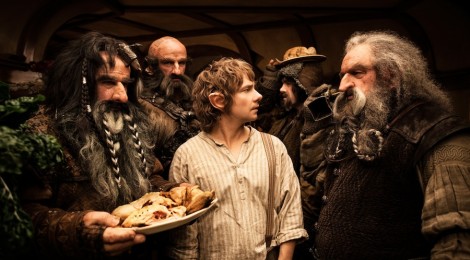
Seeing as so much of it is set in the Hobbit's land, and that the cast is dominated by a baker's dozen of knock-about dwarves (see below for a guide) that have a propensity for one-liners and malapropisms, the tone is considerably lighter and larkier (and dare I say "precious") than the Doom-laden "Rings" trilogy, and it is only once the band of adventurers get going that things change to the previous series' denatured color schemes, brooding skies, ugly thuggery and general bad-assery ensues.**  The pace may be slower, but the film is considerably richer for all of that, and with so many characters in this arc, it's rather a luxury to get to know them before they are threatened in all sorts of ghastly ways.

The other issue with this Tolkien adaptation is technological.  Films, since the frame-rate has been standardized, have traditionally been projected at twenty four frames per second, the estimated time that an image is retained by the eye.  Now that film is mostly passé, the video standard is 30 frames per second, but it's largely an arbitrary rate to match the traditional film experience.  During the late 70's, special effects wizard Douglas Trumbull offered up something he called "Showscan" which was 70mm film projected at 60 frames per second, which produced a larger, sharper image with less "streaking" of movement, due to the higher frame rate.  I saw one of these "Showscans" at the Vancouver World's Fair and the effect was like watching a richer, more beautiful version of videotape.  It was still film, with its photo-chemical reaction to light, but far more relatable to a "life-image" than film.

TH:AUJ is photographed digitally, but at a frame rate of 48 frames per second (what is being called HFR, or "Higher Frame Rate"), twice that of standard film, and in 3-D (to make what Jackson calls a more "immersive" film experience).  The effect, once one has adjusted to it, is quite magical.  Jackson doesn't try to do the 3-D tricks that Ang Lee does in Life of Pi, but the faster frame rate does improve the effect of things moving close by in 3-D; there is no longer the "stutter" effect, if something is moving by in the "near-field" at any rate of speed, which is something of a relief.  And given that Jackson employs even more helicopter shots over New Zealand terrain here than in the "Rings" trilogy (as well as parallel swooping "crane" shots during the many sequences underground), that's a big help.  Where it has its drawbacks are in some scenes that make the CGI characters look like toys figures, some of the impressive building constructs look like play-sets, and a slight mismatch of CGI (particularly during flying scenes) melded with terrain.

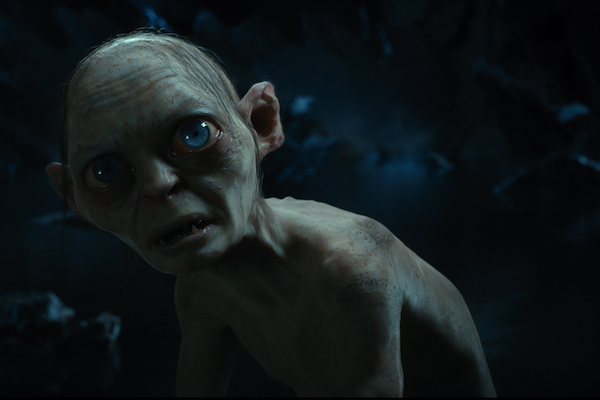
Still, it is hard to quibble when the image is so sharp, Jackson's color sense is eye-popping, and he still manages to keep a shimmering image through murky 3-D glasses.  It doesn't look like videotape (as so many reviewers seem to think), as the lighting is more graded and subtle, but the movement recalls a better videotape image, and even something moving fast still has a better chance of being registered by the naked, or glasses-hampered, eye.  It also allows the telling detail in even the CGI-est of images, like the moistness in Gollum's eyes, or the deep crags under Gandalf's.  It is oddly transporting, and given the care that everyone has put into it, it's a very rewarding experience.


The Hobbit: An Unexpected Journey is a Full-Price Ticket (worth it in 3-D and HFR).


Wilhelm Scream Alert: at 02:05 and 02:35


Ya can't tell a dwarf from a halfling without a program.


* Thauj...sounds like a character name.

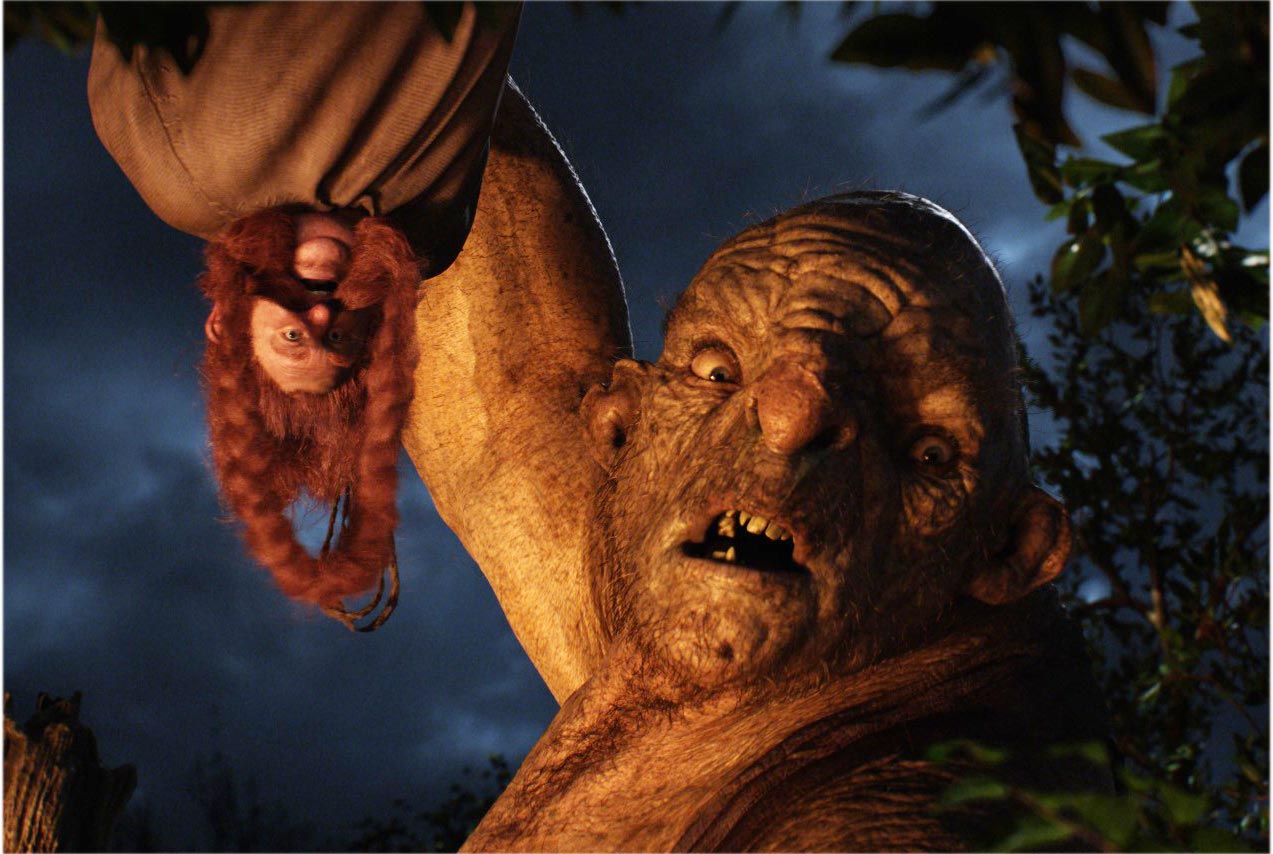
** Speaking of which, things have now approached and gone past the "Indiana Jones" threshold for physical believability here.  There's one particularly Rube Goldbergian sequence fighting trolls in an underground mine that strains credulity—but then, we're talking about a movie with dwarves, trolls, elves, ancient wizards, fire-breathing dragons, giant spiders, animated cliff-sides, and orcs riding big dogs.  That's enough to throw any griping fan-boys off their dyspepsia.  "Dude, this movie troll-kinged the bridge..."

Thursday, April 28, 2011

Hanna

"Grimm's Fairy Spy"
or
"Better Living Through Chemical Brothers"

Hanna isn't like any movie you've seen, if you managed to miss some of the more stylish spy thrillers at the end of the 1960's.  When the spy-craze went more mainstream more A-list directors started to get into the fray and suddenly the thrills started to be taken over by style as those film-makers attempted to impose some of their own creative instincts into the genre.  Sometimes the results were a sub-par thriller, others were just plain pretentious.  Some...were interesting (like this one is, and like The American was last year).

Joe Wright is one of the better British directors coming out BBC television work.  He's done his bit for the classics, old and new (Pride & Prejudice, Atonement) quite deftly handling the drawing room choreography and even putting a nicely modern spin on things.  But, his 2009 film of The Soloist showed a director who wanted to experiment with the form, break out of the stodgy "Beeb" way of doing things and shake the story-telling up a bit (in that film, he turned Los Angeles into a living, breathing, rumbling sci-fi character looming over its strata of citizenry).  It was interesting to see him attached as director to what looked like a common "actioner," and one wondered what he might bring to it, given his three previous films and how he appeared to be changing his style.

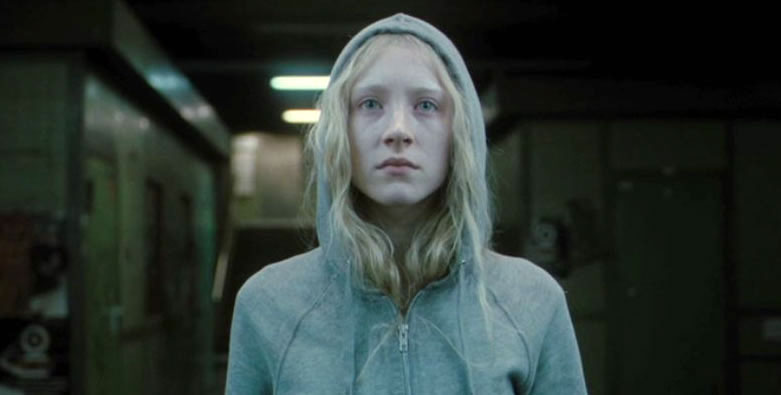
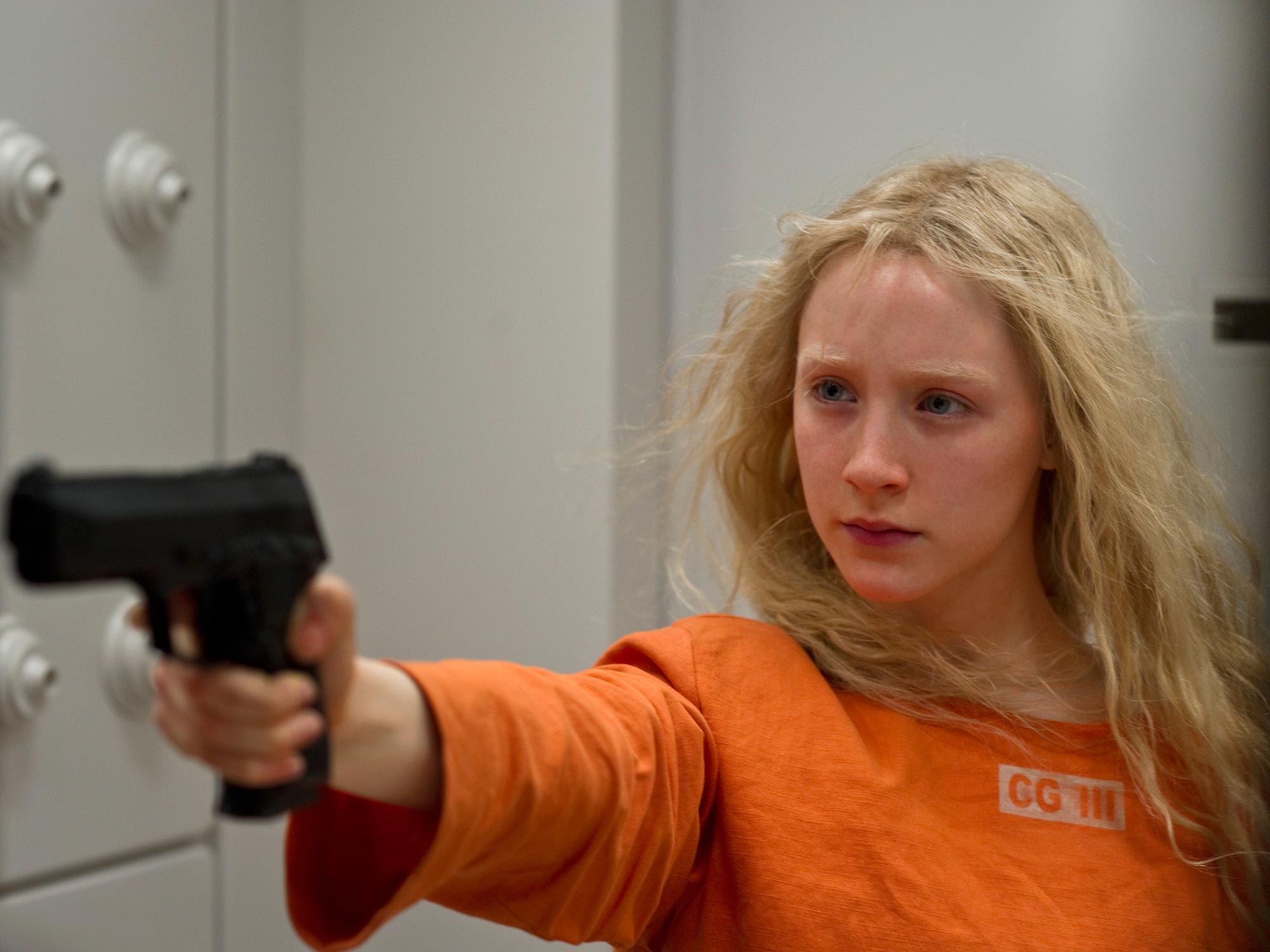
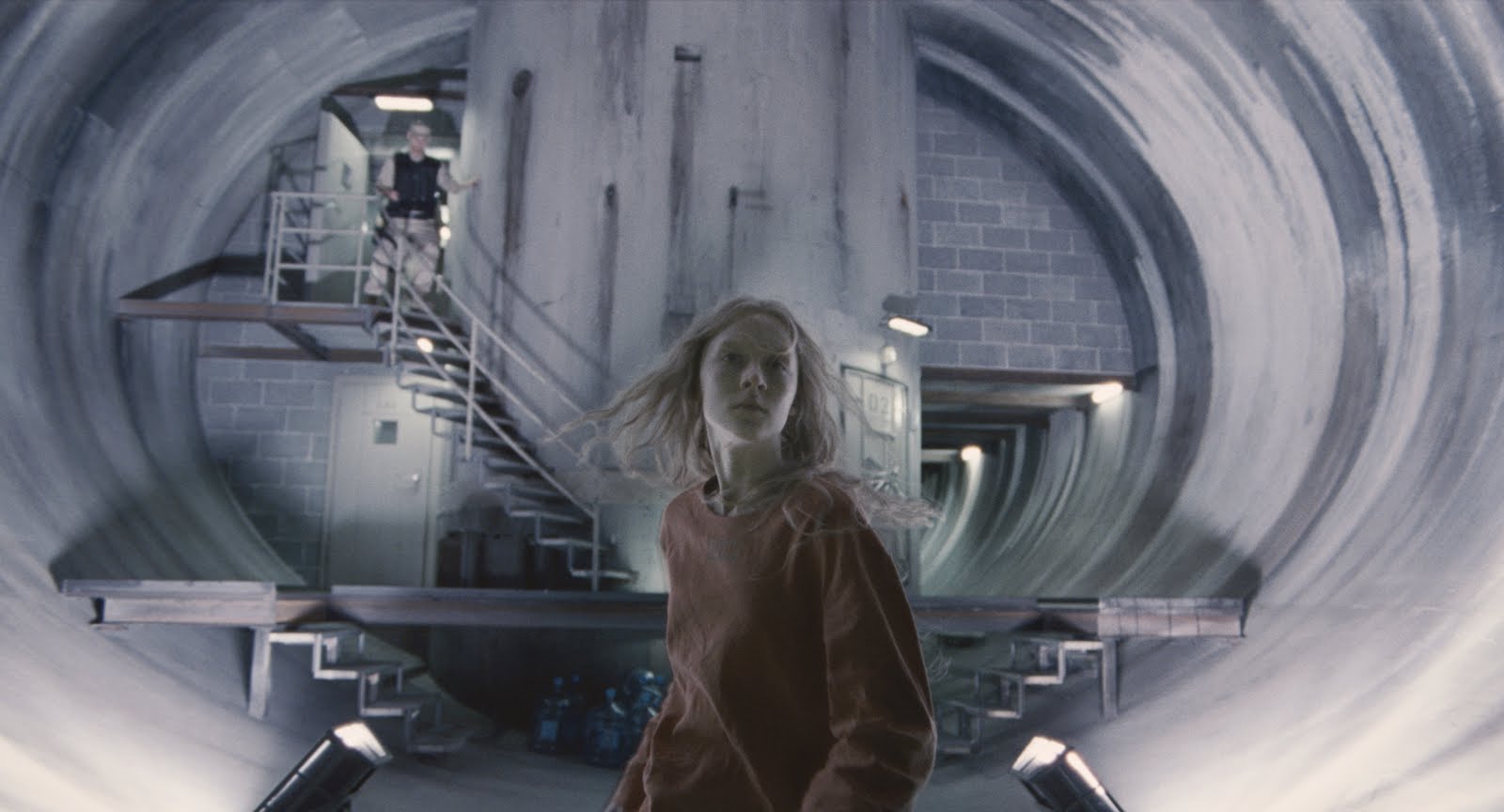
Change it, he did.  Hanna is a weird mixture of gloss and QT-perversion, with some very strange camera work that, somehow, never manages to not tell you what is going on, to whom, where and why.  No matter how over-the-top the theatrics become, Wright never forgets the basic job of keeping the audience informed, and with a screenplay spare on details and depending on the visual to tell the story, his discipline is critical (imagine, for instance, if Tom Hooper had directed it!) for any basic understanding of the film.  Hanna  heaps on the atmospherics, not only with a brazen fairy-tale sub-text, but an all-encompassing sound-design/Euro-electronica musical score by The Chemical Brothers,* that recall some of the '60's/'70's work of such composers as Mikis Theodorakis and Giorgio Moroder.  But the thumping, edgy noises permeate the entire soundtrack, not just the music, from the sweet tune that one of the Hanna-hunters (Tom Hollander, cast completely against type) whistles, quite nullifying any element of surprise,** to the pounding chase music that keeps the attention focused while Wright spins his camera or shifts perspective, *** to the creepy metal noises and animal sounds that permeate this world. 

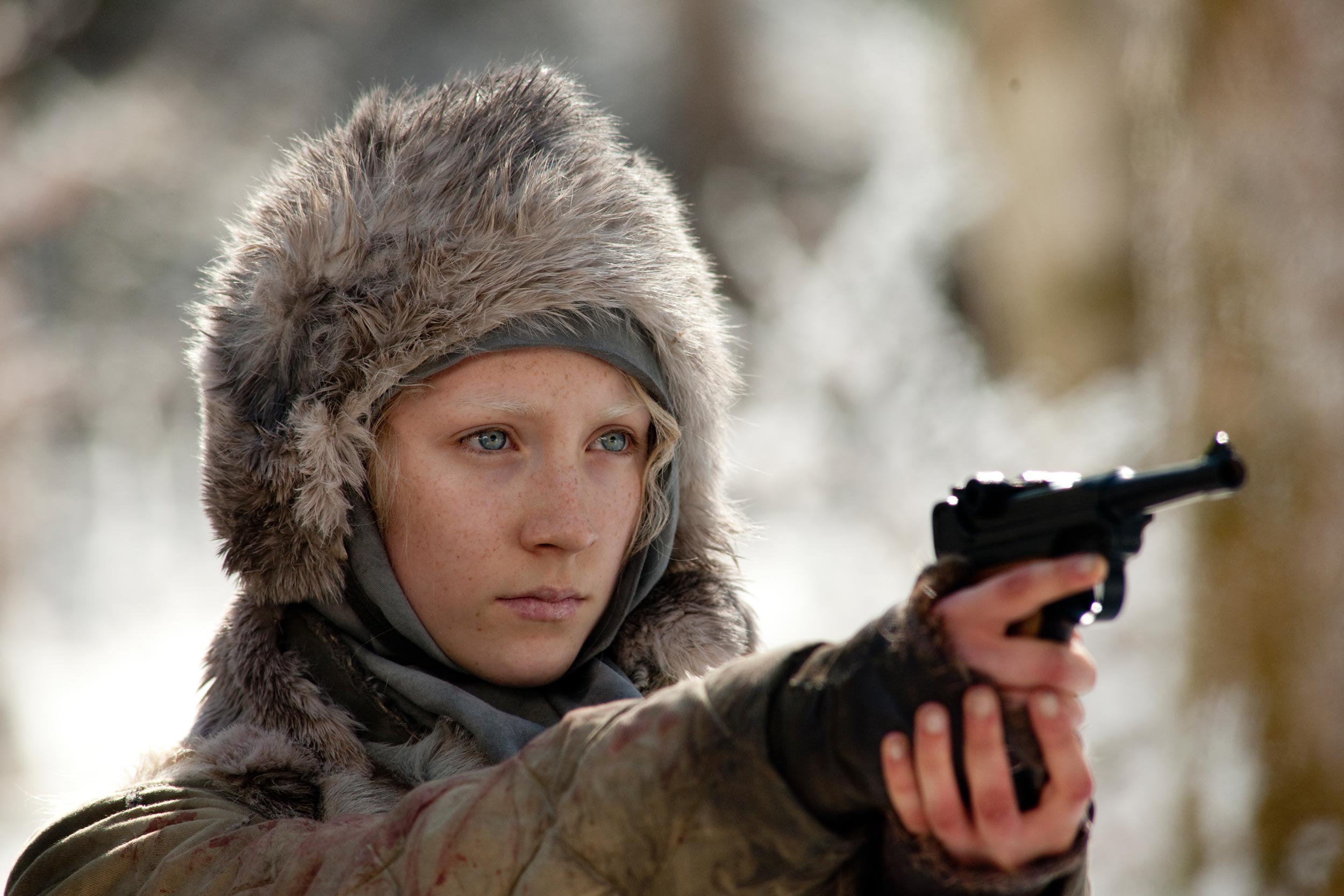
It begins in Finland, in the snow as a caribou is being hunted by a lone figure in fur.  She dispatches the animal with one arrow shot ("I just missed your heart"), and begins to dress the animal for food.  "You're dead!" says a figure behind her, and a rapid brutal fight breaks out, dependent less on fast editing than rhythm, and she is soon slammed to the ground, a snow angel against her will.  "Drag the deer back yourself," says the man, who it turns out is Hanna's father (Eric Bana).

She is Hanna Heller (Saoirse Ronan—pronounced "Seersha"—and she worked with Wright in Atonement, and specifically asked that he direct this) and it is all survivalist training.  Hanna has been raised to live on the land, kill and cook her own food, have an encyclopedic knowledge of everything (except electronics, apparently) given that her schooling is from the encyclopedia, speak several languages and have a detailed history that is nothing like her own.

What is her history?  What is her father's?  We don't get too deep into the film before we learn he's a rogue security agent gone missing, and he's a bee in the bonnet of Marissa Viegler (Cate Blanchettimagine her being creepy and then go a few steps further), an operative high up the chain of command.  And she is Hanna's target.  And Hanna must get to her before Marissa can find her.  The why's will come, eventually, but already we've invaded a fairy-tale landscape with the sheltered princess (who can snap your neck) and an evil step-mother who stays only a few evil steps behind the whole movie.  And given Ronan's goose-like grace throughout the film, one can't help but call to mind all sorts of folk-tales of changelings and bargains and revenge.  But it's a spy thriller, too, as cold as they come, so don't expect "happily ever after."

For me, it was a simple story told well that impressed me throughout.

But it just missed my heart.

BANG!  Hanna is a Matinee.


* Their impact on the film is incredible.  I kept imagining what the film would be like with a "standard" thriller score, and always came up with a duller, less propulsive film.

** This recalls Peter Lorre's child killer in Fritz Lang's M (1931).  Hollander vaguely recalls Lorre's look, and, later,  Wright stages a fight to the tune "M" whistled from Peer Gynt—"In the Hall of the Mountain King," (after The Social Network, this piece is getting a lot of traction).

*** "What does music feel like?" Hanna asks at an early stage of the script.  Here, it feels like having a heart attack in zero-g.  One of the reasons this film DOESN't have a traditional score is that Hanna, the character, doesn't know music, and as we're following her struggles, the music reflects her mood, whether placid or on the run.  It's rather interesting where those moods show up.

Tuesday, May 18, 2010

Robin Hood (2010)

"Rise...and Rise Again...and Again...and Again"

Every fifteen years or so, there must be a big budget remake of the "Robin Hood" legend—that's a bit less than the turnaround cycle for The Compleate Works of Jane Austen. The last time the fletches flew on the big screen there were two competing Hoods—the flashy Kevin Reynolds/Kevin Costner version and one starring Patrick Bergin. Before them was "Robin and Marian," various series, and "The Adventures of Robin Hood," the Warner Bros. classic with Errol Flynn, which was itself a remake of silent versions. Then, there have been satiric vignettes in "Shrek" and "Time Bandits,"* Mel Brooks has done a movie ("Men in Tights") AND a series ("When Things Were Rotten")—Mel loves his Public Domain. Disney has touched on it a couple times as well, including an animated funny animals version.

The character and his ancillary co-stars have a long oral tradition with many variations of "The Hode," so it's natural that someone drums him up for another "Have at ye" every few years, each reflecting the times in which they were made. Robin has been yeoman and nobleman, Crusader and thief, trickster and military man, young and old. Although we've been down this well-trod pathe in the glenne before, it was interesting to think about what the "
Gladiator" team of Ridley Scott and Russell Crowe could do with the story, and how they would approach it.

And the answer is: with a little bit of everything.
Scott with the help of scenarist Brian Helgeland** has a Robin Hood, an orphan Saxon Crusading with Richard the Lionheart (Danny Huston-he's great in this), who's an expert bowman and strategist by day, and a grifter by night. At the end of the Crusades, he is given a task, the complications of which lead him to Nottingham and the masquerade of being Robert Loxley, slain son of Sir Walter Loxley (Max von Sydow) and spouse of Lady Marian Loxley (Cate Blanchett)—this Robin is both commoner and gentry. The Sheriff of Nottingham (Matthew McFadyen) is not given much to do this time 'round, instead the intrigues are by Sir Godfrey (Mark Strong) and King Phillip of France, who plot to undermine the already shaky reign of the new King John (
Oscar Isaac), the last son of King Henry and Eleanor of Aquitaine (Eileen Atkins), and invade England.

The general structure of "Robin Hood" is superficially similar to “Gladiator” with big battles at both ends, and Scott uses the same stutter-shutter technique to give some verve to the action scenes. But there it ends. Crowe is considerably lighter as Robin Hood, though he does summon up genuine moments of drama. Performances are fine all around withCate Blanchett and William Hurt being stand-outs. But the best performance is by Max von Sydow as the elderly Sir Walter. Blind, but nobody’s fool, Sir Walter takes the news of his son’s death with grim determination and courtesy for its messenger, and comes up with the Robin-as-Loxley ruse to protect Marion from having their land confiscated should he die. Von Sydow has been ill-used of late, playing teutonic villains of similar coldness, but this role shows him at full thespian power, and it would be robbery if he was not nominated for an Oscar for this performance.

The film boasts good values all around, with Scott’s keen eye for cinematography and detail, the writing is clever and often ingenious (I think the fact that it's
another Robin Hood movie sours a lot of people's expectations). The film never drags and offers considerable entertainment value. Only at the end does it falter, with a beach battle that seems overly-stretched in terms of production value and credibility. Either there was not enough planning or extras, but it looks to be constructed to not show something as opposed to creating an epic battle. Too much is made of the presence of landing craft as obstacles, and of one particular participant in the clamor, which seems to be done for scoring political points rather than good story-telling.

But that is twenty minutes out of 140. For the most part, this new “
Robin Hood” hits its mark. Yes, it might be superfluous (we can say this—with a straight face—with so many sequels headed our way?), but what's there on the screen is an interesting "take" on the legend that has lasted so long.

"Robin Hood" is a Matinee.

* John Cleese's immaculate nobleman with a "Bonny Prince Charlie" manner is one of my favorites.

** The original script, by the team of Ethan Rieff and Cyrus Voris, called "Nottingham," was more radical, but interesting in a concept-twist kind of way, but once Ridley Scott came on board, the concept changed.


Thursday, September 10, 2009

Elizabeth: The Golden Age, Take Two

"Elizabeth: The Golden Age" (Shekhar Kapur, 2007) Like its 1998 predecessor, "The Golden Age" is sumptuously produced, ornate in both costuming and production design, but also in filming and conceptual work. It is one of the most beautiful films I've seen in a longish time—excepting the sequences of torture and carnage—but the material feels a bit shallow (if not altogether juggled, shuffled and finagled*), like one of those bio-pic's that attempt to tell a tumultuous life in 90 minutes; no one likes to have their life, especially a Queenly one, summed up in Cliffs Notes.

"When last we left"
Elizabeth I, she had ascended the throne, unmarried and without heir, but unbowed as "The Virgin Queen." Catholics to the right of her, Mary, Queen of Scots (Samantha Morton) to the left of her, and a seemingly endless line of suitors brought before her. No one has her back except her adviser Francis Walsingham (Geoffrey Rush returning to the role) and lady in waiting Bess Throckmorton (Abbie Cornish).

But there's one angle overlooked, although director Kapur has it covered with a dizzying number of overhead shots. Since the issue in "The Golden Age" boils down to whose side is God on—between the Protestant England and the Catholic Spain—a lot of time is spent from His point of view.**


Kapur, who started his career in Bollywood, uses color more imaginatively than most current directors (rather than embracing the current trend of leeching the color from films, he adheres to using it as another communicative tool). At the end of "Elizabeth" the audience was confronted with Elizabeth "the Virgin Queen" symbolized in all her alabaster glory. We see that same white Queen often in "The Golden Age" but are also confronted with different aspects of Elizabeth. Here, with the issue of finding a proper husband and the potential of an heir, she is frequently seen behind closed doors in far rosier tones than the alabaster appearance—"the divine here on Earth," in the words of Walsingham—that she uses for regal functions. She tells the Archduke Charles, a negligible suitor: "I have a secret, my dear. I pretend there's a pane of glass between me and them. They can see me, but they cannot touch me."

In times of regal impartiality, that "pane of glass" informs itself as the color blue in Kapur's direction. It sets Elizabeth apart and keeps her coolly disengaged and formal, as in the scene below, her she visits her former suitor, Sir Walter Raleigh (Clive Owen), and wife, her former lady-in-waiting to bestow her blessing on their first-born. The rest of the room, in slightly gloomy but warm colors, are off-set by her glowing in a frosty light.


And here, leaving the death-bed of a trusted advisor, she shows no emotion as Queen, allowing the man to know that he can die in peace, his work preserving her Monarchy—and her—is done.


The shot is also centered and composed like a Baroque painting, with many tableau layered in three-dimensions within it, each with their own lighting scheme. Kapur and his production designers fill the movie with such images (when the camera isn't flitting from one side of the room to the other), especially in the climactic sea-battle where some of the battle sequences look like they could have been copied from the cover of a Patrick O'Brian novel.

Ultimately, the cold blues and alabasters give way to "the golden age," and Elizabeth is bathed in a warm glowing sunlight, holding the child of Raleigh and Bess—her position of Queen finally legitimized in reality and defended in battle—and the child that might have been hers, a subject—part of her charge, with no man her master and all of England under her protection.


* The Wikipedia entry on "Elizabeth: The Golden Age" has a nice run-down of the shuffling of events in the Queen's reign. One wonders if they'll be more accurate in the inevitable sequel—after all, we haven't seen Essex yet.

** Before I get e-mails from the indignant, we'll use the paternalistic designation...because the participants of the film did.

Tuesday, January 6, 2009

The Curious Case of Benjamin Button

"...I'm Younger Than That Now"

Roger Ebert once wrote that "No good movie is depressing; all bad movies are depressing."

"The Curious Case of Benjamin Button"is such a fine film, it's painful to watch. Part of that has to do with the central conceit (and this is a conceit, as opposed to a premise) from the originalF. Scott Fitzgerald short story of a man who is born old and dies as an infant. One suspects that Fitzgerald was reaching to show the arc of a life in stark contrast to the norm, and how similar to the norm that extreme is ("We all end up in diapers," says his life-partner Daisy...another Fitzgerald Daisy), But Button's life, if anything, is even more tragic for it. When he shows up late in the film, after an extended leave-taking he's told "You're so young." "Only on the outside" is his quiet reply. It's the perfect riposte to that old saw "Youth is wasted on the young."

One worried when approaching this movie that it would be a "
Forrest Gump" situation, where the technology would call attention to itself, and the story would be another collection of paint-by-numbers history awash in the easy sentimentality of the simple-profound. I wasn't a big fan of "Forrest Gump," and watched its clumsy march to a Best Picture Oscar with a certain bemusement.

"
The Curious Case of Benjamin Button" is nothing like that (even though it shares a screenwriter, Eric Roth). While director David Fincher came from the special effects area of film-making, he has now long moved past the days when he would pass the camera through the handle of a coffee pot, and uses the technology at his disposal to create invisible wonders throughout the film. It may come as a shock that during the first 30 minutes of "Benjamin Button" the character is a seamless merger of Brad Pitt's heavily-made up head and another actor's body. Another thing they say is that a good movie takes some kind of a miracle. This film brings about miracles every few minutes. And Fincher's rigorous direction is assured and formal, juggling the demands of the effects work with the very real human drama of lives that pass in the night.
This film has been in development for a long time. Usually that means trouble. in this one, it must have been logistics.

Fincher's moments of magic include a dead-on recreation of old-film look* that has a amazing pay-off for a running joke that wouldn't be nearly as hilarious if it wasn't done as a series of silent movies. I've already talked about the invisible technology behind Button's early/elderly years
, but that same CG magic puts Cate Blanchett's face on a prima ballerina and ages or de-ages the principles. It was Red Barber who said that God doesn't count the toys accumulated at the end of a life, He counts the scars. No movie has been so careful as to keep a running track of the lines in a face...or the scars. And when that "only on the outside" moment happens, the face we see is that of Brad Pitt circa "A River Runs Through It." I don't know how they did it. It's amazing. As it must be for the people in the movie.

Let's talk about the actors now.
Cate Blanchett is a given. She weaves through the movie note-perfect, putting the stages of a life out there to be remembered--the naivete, the coltish confidence, the iron strength necessary for healing. Tilda Swinton is there, though her part isn't as rich as Blanchett's, but she makes an impression. Julia Ormond is there, as Daisy's daughter, perfectly American with just a twinge of her French accent creeping in, as her character hails from Louisiana. And Brad Pitt, who's always seemed to me to be a slightly limited actor, proves himself as adept as Blanchett in showing the arc of a life--but in reverse: playing an innocent in old age make-up, but as he gets younger--the eyes get older and wiser. This and his hilarious work in "Burn After Reading" shows that Pitt has moved beyond depending on a slightly ethereal quality to suggest depth. There is a scene where Button is informed by Daisy that she's pregnant and the response from Pitt is a wordless mixture of love and pity.

But, my favorite performer is someone who delights me every time she's on-screen. I've talked about her before. The moment Taraji P. Henson turns up, "The Curious Case of Benjamin Button" turns into a different movie. She does the same thing as Pitt and Blanchett, but you see her less, and she creates more of an impression than either of them. Her Queenie is a force of Nature, and Henson gives you the impression she's making it all up as she goes. In a film of fine performances, her's stands out.

Finally, "The Curious Case of Benjamin Button," finds its place as one of those rare films that takes a middling book by a writer of some note, and turns it into a classic film, far surpassing the meager accomplishments of its source.

"The Curious Case of Benjamin Button" is a full-price ticket and may very well be the best film of the year.

* Towards the end of the film, I noticed a scratch running down the left quadrant of the film and wondered if Fincher was doing that deliberately!

Wednesday, August 27, 2008

Elizabeth (1998)

'Kiss Me, Cate.'

Elizabeth, (1998, Kapur)

A costume drama in the best Hollywood tradition that distorts the historical record and slips into anachronism at will in order to offer an insight into transformation of the young Queen Elizabeth into the Virgin Queen. There is amour amid the armor as Cate Blanchett learns the rules of realpolitik that she will need to keep herself on the throne and off the block. But she does it well and she is well supported by her court including Geoffrey Rush as Sir Francis Walsingham and Joseph Fiennes as her lover, Sir Robert Dudley. The compression of so many events into a two-hour movie does lead to some confusion at times but Shakhar Kapur can always be relied upon to give your eyes something to feast upon while you're trying to keep up with the plot. It is not quite a feminist re-writing of history as much as The Godfather with frocks, and for every heaving brocaded bosom there is a severed spiked head.

Elizabeth also features Christopher Eccleston, Fanny Ardant, Kathy Burke, John Geilgud and Richard Attenborough and is available on DVD from Universal Studios.

Monday, June 2, 2008

Indiana Jones and the Kingdom of the Crystal Skull

Making Mountains Out of Mole-Hills

I've heard this film being called "critic-proof", and I'm not even sure what that means, but it implies that whatever the reviews say, people are still going to line up to see it, as if it's a critic's job to discourage people from going to see something they want to see, like it's part of the job description to trash something on your "Must-See List." And that if something truly acidic and toxic is written about it (and a Big Tall Wish is made) nobody'll see it (And they call this movie unrealistic!) Even Ford, Lucas and Spielberg were all talking (before the film's premiere at Cannes) that it was going to get savaged, and, since these guys are pros who know their stuff, it has been in some circles, mostly by mouth-breathing fan sites where "sux" dominates the descriptors.

So, despite the lowering of the bar of expectations by the film-makers, does it suck?

No. No, it doesn't.

In fact, I have to say I haven't been this delighted with a film in a long time. I will even go so far as to say that "
Indiana Jones and the Kingdom of the Crystal Skull" fulfills the promises made by the very fine, original "Raiders of the Lost Ark," something that its two sequels, however enjoyable they are in parts and particulars, never did.***

Before we go further, let us go back and recap what happened in the previous chapters...

This series (like I shouldn't have to tell you) is based on pulp serials in the B-movie tradition--episodic, cheesy, toying with History and making it up as it goes along. This one, being set in the late 50's, has to have more of a sci-fi bent than the religious-themed stories of the past set in the 30's and the 40's. It is, after all, the first adventure we've seen of Indiana Jones in a post-nuclear world. Think on that for a moment. "Crystal Skull" fits the period, at least cinematically, however much it messes with folks' expectations of what the film "should be" about (and let's face it, the biggest obstacle Lucas' films have are people's expectations for the "next" installment, and whether it compares to the film they already have in their head--in that case, you can't compete with what they have in mind*). Indiana Jones' timeline has finally caught up with the memories of George Lucas and Steven Spielberg.

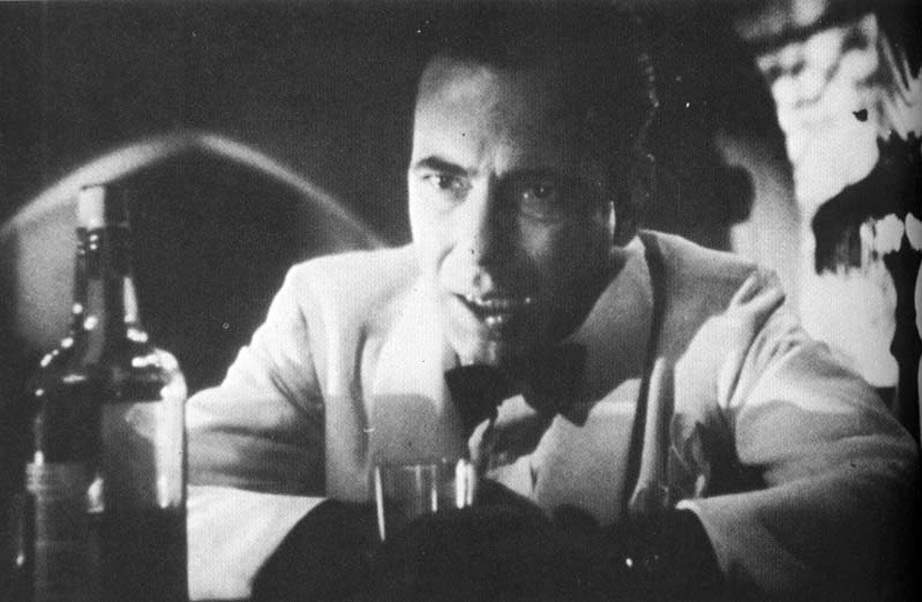
The filmmakers can't escape the fact that it's been 19 years since the last installment (and they've set it nearly twenty since the events of "Last Crusade"), and Harrison Ford's appearance is the nearly-constant reminder of it--he's broader, shlumpfier, more doughy in the face. But something magical happens a couple times in the film (once at a malt shop, once at a Mayan burial ground). Whether it's some CGI-gauze trick, or Ford's sense-memory playing the character kicking in, but once the dialogue turns to ancient civilizations and archaeology, the lines seem to disappear from Ford's face, and he slots back into the old/ young Indiana Jones the same way the camera "slotted" into the Bogart-drinking-his-sorrows "Casablanca" shot in "Raiders" after Jones has seen Marion supposedly killed in a truck explosion. It's eerie, but like the occasional forays into the transcendent in the series, it's a good kind of eerie.

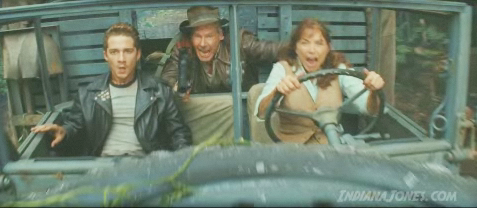
We've mentioned Marion, and, as the posters tell you, Marion Williams nee Ravenwood (Karen Allen) is back, and she's terrific--a breath of fresh air after Kate Capshaw's and Allison Doody's ingenues (the one too high-pitched, and the other tamped-down into irrelevance). The years have treated her far better than Ford, and she still has that incandescent smile and has been given a lot of "Dr. Jones-take-down" dialogue that suddenly snaps Ford's performance into a higher level of energy. Allen has remained well-versed in what Spielberg informed her during the first film was the "Sam Peckinpah School of Acting," something that Cate Blanchett is equally fine at--she's looser and more fun than she's been in years, and just the sight of her Commie commandant standing in a careening jeep during a bumper-cars jeep chase through the Amazon jungle is one of those things you think you'll never see.

So, Shia LaBoeuf. Is he "Short-Round"-irritating, or made too much a thing of? Neither, though he has a prominent role throughout. For some reason, whether it's the magnitude of the project, or Spielberg directing, LaBoeuf's not as energetic or inventive as he's been--maybe we should call his character "Short-Leash"--but, he's a good foil for Ford and their interaction, especially in one pause in a motorcycle chase deliberately recalls the Ford-Sean Connery relationship in "Last Crusade."** One is never sure if he'll be pulling out a comb or a switch-blade when he reaches into his motorcycle jacket (his aping of Marlon Brando's gear in "The Wild One" is a clever 50's variation of Indy's gear), and there is a great visual joke when he confronts an Amazonian resident with the same hair-cut.

As for director Spielberg, he reportedly re-studied his earlier "Indy" films to recall the way "kid-Spielberg" shot films and there are plenty of his early "headlights-into-the-camera" adrenaline shots (and even one of his "Sugarland Express" pans), but the takes are a bit longer-held, he's not quite so anxious to cut away, and his cinematographer Janusz Kaminski brings a new visual beauty that supplants the grit-in-the-lens of the earlier films. The elder Spielberg is also incessantly filling the film with visual ironies--grace-notes--that the younger Spielberg would save for a separate shot. There's an awful lot of stuff going on under the surface of the fire-fights, the explosions--some big ones--that betray the more mature film-maker, and man, Spielberg has become. And unlike the last two, which were short on background, and long on chase sequences, this film is over-stuffed with references, languages and the accustomed meta-recall of the past films.*** Not to say there isn't a lot of action. There is. That Amazon-chase between the particulars (the film is structured like a race--like "Raiders" and "Last Crusade"--with the good-guys and bad-guys all after the same thing and never too-far away from each other) is an invigorating combination of possibilities like a puzzle with every combination of inhabitant in vehicle and opponent in combat possible. It's dizzily constructed. And just when you start to think, "Wait a minute, where's..." your questions are answered.

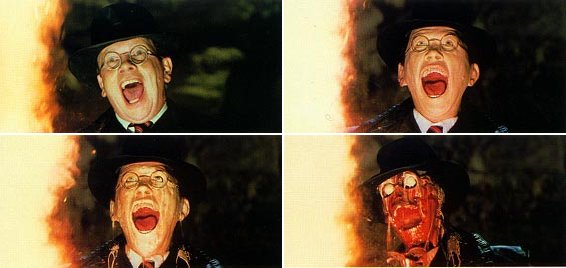
A lot of the action is outlandish, but, surprise! It always has been. How can you complain about verisimilitude when you've had melting Nazi's from the vampire-angels and God's death-ray of the Ark of the Covenant, or Thuggee priests pulling out sacrificial victim's flaming hearts, and how some victims in a lava pit burn, but the heroine-in-diaphenous pants doesn't, or 700-year old Knights Templar still guarding the Holy Grail. Get real, people. Because the movies aren't. Like Indy in "The Last Crusade" film-goers have to make a leap of faith, and it needs to be done with an open heart. Or at least an uncynical one. Or one open to the possibility of enjoying oneself.****

Okay now, go out there and have fun.

"Indiana Jones and the Kingdom of the Crystal Skull" is a full-price ticket.

-------------------------------------------------------------------------------------------------

* Somewhere along the way I've talked about "Mom's Apple Pie Syndrome"--where our memory of a cherished movie runs counter to the actual quality of the work, ie. "Nothing tastes as good as mom's apple pie," but only because that was your first run-in with the concept, and your impression of what "good" apple pie should be like may include a runny interior and scorched crust (I was blessed with a mother--God love her--who was a lousy cook, so I tend to be immune). So, too, the cherished movies of your youth may actually be crap, though we may delude ourselves otherwise, with our 'gee-whiz" innocent first impressions. The phenomenon became real for a few incredulously chagrined "Man from U.N.C.L.E." fans who, seeing the series for the first time in years on DVD last year, endearingly wondered why MGM chose to run the shows through a "crap filter" making the sets look like back-lot soundstages with cheap "foreign" localization, lousy effects, obvious writing and some horrible performances. Ah, deluded youth. Nothing is so sweet as a young man's fancy for a film of their childhood. And nothing is so rancid as the bitterness that follows a fan-boy's crush.

But it's not the film's fault. Ever. Beauty is in the mind of the beholder.

** And if you haven't figured our the "Indiana" Jones-"Mutt" Williams relationship yet, what can I say? You're either a) five years old, b) this is your first movie or c) "denial ain't just a river in Egypy, honey." Look at their names, kids, and remember where Dr. Henry Jones, jr. came up with the name "Indiana." These films are all about clues.

*** Sometime, when Summer is over and there are no more surprises, I'm going to do a big-old analysis of this movie and why it is the natural sequel to "Raiders." (Hint: It involves the clockwork-intricacies of ancient civilizations as well as the conflicts when a Man of Science is confronted with the "hard rain" of spiritual mythology) It's roots go pretty deep--which is refreshing after the previous two--and bear a full airing of the secrets buried within it. To do so now would give away far too much and contain too many spoilers of large and small varieties.

**** Do I have ANY complaints? Yes, the frankly extraneous character of "Mac" McHale played by Ray Winstone. McHale is designed as an untrustworthy character, but he is so untrustworthy that one wonders why he's not just shot by either party at any time during the proceedings. He's so greedy he's a bit reminiscent of Daffy Duck in a hall of treasures: "Mine, Mine, Mine!" The character is such an unnecessary plot contrivance that he might have earned the name "Aringarosa" if the name hadn't already been taken.

Wilhelm Alert: the book-carrying nerd in the library during the motorcycle chase.