Showing posts with label 1998. Show all posts

Wednesday, September 11, 2013

The Siege

The Siege (Edward Zwick, 1998) Creepily omniscient film made three years before 9/11 (notice the WTC in the poster) in which terrorism comes home to roost in America, specifically with well-timed, somewhat improvised suicide bombers blowing up buses, theaters, and populous areas in the heart of New York City.  Zwick (and screenwriter Lawrence Wright, with dialogue tweaks by Zwick and Menno Meyjes) showed us something that Americans didn't want to see (and believed impossible): America under terrorist attack.   

No one went to see it, and critics attacked it as being xenophobic and unrealistic.  After 9/11, it was reality.  And one of the last films to feature radical Islamists as terrorists.  Now, studios shy away from such depictions because, in their infinite bravery, they're afraid of reprisals. 


But, here, they weren't, not even when the Arab-American Anti-Discrimination Committee and the Council on American-Islamic Relations started picketing the theaters, for the film being offensive and promoting stereotypes of Islamic terrorists.  


Evidently Al Qaeda didn't get the communiques.  Might've helped "the cause."

And despite some lip-service to Islam and Arab-Americans being just as aghast at terrorist activities and giving their full cooperation with the investigation—and Tony Shalhoub plays a Islamic Arab on the FBI task force—one gets the distinct impression that some of the film's best friends are Arab-Americans.  


But, that's the sideshow.  


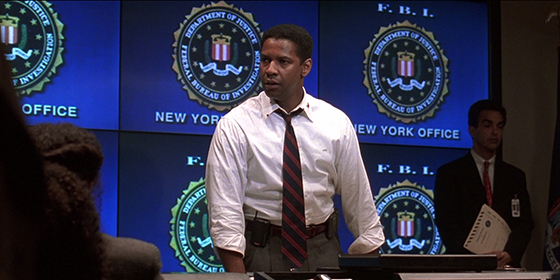
What the film boils down to is not who's doing what to whom, but in meeting the enemy and it being ourselves.  New York becomes the target of accelerating attacks when a bus is hijacked with no demands—and no explosives it turns out, the passengers are merely splattered with blue dye. The FBI's lead investigator Anthony Hubbard (Denzel Washington) thinks it's more than a prank, or, as it's dismissed, "assault with a deadly color."  He knows two things that worries him: "they" know explosives and "they" know the FBI's response time now.


Inserting herself into the investigation is Elise Kraft (Annette Bening), an NSA investigator who doesn't like to share information, as much as take it. She and Hubbard spar over jurisdiction and ownership.  The FBI is new to the investigation and Elise has been at this for quite some time. "In this game, the most committed wins."  While they're bickering and throwing down threats, another bus gets hijacked, and negotiations begin.  But the results are different, attracting the Feds, especially the Army in the person of General Devereaux (Bruce Willis), who we have seen earlier overseeing the investigation of an Arab cleric (of whom the United States does not officially know the whereabouts).  He's nosing around just to make sure that, although the NSA and FBI seem to bungling and out of their depths at this point, his operation isn't compromised. 


But, the atrocities accelerate and get bigger—The FBI's New York headquarters is attacked, resulting in 600 victims, many of them Hubbard's colleagues, and at that point, the President declares Martial Law. 


Despite his earlier protests in committee ("The Army is a broad sword, not a scalpel. Make no mistake, Senator. We will hunt down the enemy, we will find the enemy, and we will kill the enemy. And no card-carrying member of the ACLU is more dead set against it than I am. Which is why I urge you - I implore you. Do not consider this as an option. Trust me, senator - you do not want the Army in an American city.") Devereaux heads up the operation, cordoning off Brooklyn and gathering up all Arabic-speaking young men and detaining them in Yankee Stadium.  Profiling isn't second-guessed, habeas is suspended, citizens are marched out to camps, and torture is the order of the day—specifically water-boarding.


Must have seemed pretty nightmarish in 1998.  Now, that the "ethics" of water-boarding have been discussed endlessly by the cable-news pundits (to the point where I want to drown them), Guantanamo (or the more friendly "Git-mo!") has been holding prisoners for...how many years now?...we've been living with no-fly lists, and even gone to such silly extremities as taking off our shoes at airports (while "they" have gone the way of planting underwear bombs) over the last eleven...ELEVEN...years.  And a lot of people have died, and Americans—loyal Americans—are coming back to a backlog of unanswered help, and we're now losing more of them to suicide (as we did in Vietnam) than to the actual war.


The crackdown will be televised

"We have met the enemy, and they are us."  That was the message of The Siege and no one listened.*  And here we are, on the anniversary of 9/11, and the longest war in our history, and conflicts have not been resolved.  They're only getting more complicated.  The situation has gotten even more fractured, and the wars are internal as well as external, looking more like the Mexican stand-off that ends the film. 
Now, here we are, a dozen years after the fact, and there are folks amidst the current host of Syria chatterers, who want to bomb Damascus, take out their leader, and replace him with the rebels opposing him, and in the glib words of Willis' commander "be back at base in time for the play-offs."


Trouble is, some of the factions among the rebels are Al Qaeda, who we've been fighting over these last dozen years and trillions of dollars.  As the movie says "It's easy to tell the difference between right and wrong. What's hard is choosing the wrong that's more right." 


Orwell is in his grave...creating his own spin zone.


* Anthony 'Hub' Hubbard: [upon learning Devereaux's plans to torture Tariq] Are you people insane? What are you talkin' about?
General William Devereaux: The time has come for one man to suffer in order to save hundreds of lives.
Anthony 'Hub' Hubbard: One Man? What about two, huh? What about six? How about public executions?
General William Devereaux: Feel free to leave whenever you like, Agent Hubbard.
Anthony 'Hub' Hubbard: Come on General, you've lost men, I've lost men, but you - you, you *can't* do this! What, what if they don't even want the sheik, have you considered that? What if what they really want is for us to herd our children into stadiums like we're doing? And put soldiers on the street and have Americans looking over their shoulders? Bend the law, shred the Constitution just a little bit? Because if we torture him, General, we do that and everything we have fought, and bled, and died for is over. And they've won. They've already won!
General William Devereaux: Escort him out.

Saturday, May 5, 2012

The Avengers

The Avengers (Jeremiah Chechik, 1998) "Mrs. Peel, we're needed..." in a much better movie.

I know, not what you expected, but, then, neither was this movie to me.  "The Avengers" were a proven property, a memory (fond) of my youth, especially when it was on American television, during the height of the "Bond craze" of the 1960's.  It started out in its early "video" days as a fairly straight-ahead detective procedural with Patrick Macnee as John Steed, who worked with Dr. David Keel (Ian Hendry), then Venus Smith (Julie Stevens), then Cathy Gale (Honor Blackman).  The shows became increasingly bolder, cheekier and more in the spy realm, reaching its zenith during the "Emma Peel" years, when Diana Rigg played Steed's partner.  By that time, the show was practically a comedy, with odd off-kilter conspiracies, sci-fi and fantasy elements.  Most folks tuned in for the repartee, as the plots became fairly disposable; Steed and Emma became the focus of the show, he of the fusty suits and bowler hat, she of the catsuits and judo fights.  It was fun, disposable, and a joy to watch.

The movie version gets one out of the three.  The blunders begin by miscasting Ralph Fiennes as Steed and Uma Thurman as Peel.  Fiennes fares slightly better, but he plays Steed as withdrawn and a bit docile, whereas the Steed of the series was a proud extrovert.  Ms. Thurman's Mrs. Peel is everything the series' Rigg wasn't—pale, inexpressive and...American.  As if to overcompensate for the lack of joie de vivre in the leads, the movie goes overboard with elements of goofiness in a plot about robotic clones, Teddy bear conspiracists, mechanical bees, and a plot to—dare I say it?—rule the world...by controlling...the weather?

Sean Connery had been saying for years that he'd wanted to play a Bond villain, but knew those producers would never go for it—or pay the salary he wanted.  This is the movie where he gets to, and his August DeWynter, is played hammily and with much brio.  He gets the best lines and looks like he's having fun.  Fiennes looks miserable most of the time, and Thurman is mostly unreadable.  There's also an interesting supporting cast, largely wasted, featuring Jim Broadbent, Fiona Shaw, John Wood, Eddie Izzard, Eileen Atkins, and a cameo by MacNee...who plays a character who's invisible.  He's the lucky one in the cast.

The script—by Don McPherson—is a mess, and Jeremiah Chechik (who made National Lampoon's Christmas Vacation and Benny & Joon) tries to bring some style to it at the sacrifice of pace and, after the film was slashed from two hours to 90 minutes following a disasterous preview, coherence.  It's one of the few movies where I walked out with a feeling of contempt for the whole rotten show.


"No, really, have you read this script?"
MacNee and Rigg as "The Avengers"


Friday, August 5, 2011

Psycho (1998)

Psycho (Gus Van Sant — after Alfred Hitchcock, 1998) What is good about Gus Van Sant's color version of the original can be laid at the feet of that film's creator, Alfred Hitchcock: the relentless pace, the choreography of the camera (matched by Van Sant and his cinematographer—the great Christopher Doyle), the various set-pieces that alternately tease and deepen the mystery manipulating the audience's needs and tensions "like an orchestra," and that the film maker breaks the director-audience "trust" by the film's mid-point.  Danny Elfman, Bernard Herrmann's No. 1 fan, lovingly recreates his score in stereo. And modern film techniques allow Van Sant to make that opening pan across Phoenix, Arizona (2:48 pm), seamlessly locate the apartment where Marion Crane (Anne Heche) and Sam Loomis (Viggo Mortensen) play out their melancholy nooner and then crawl (with no cuts) through the window.


*


Van Sant's semi-scrupulous recreation (right) of Hitchcock's original shot-plan (left).

Everything that's wrong with Psycho '98 can be blamed on Van Sant: the kitschy color schemes, the bizarre inserts (see below) and the casting. Vince Vaughn had his hands full having to follow in Anthony Perkins' sashaying foot-steps as Norman Bates, so kudos to him for even showing up on-set, although he's lousy. What's surprising is how poorly Anne Heche and Julianne Moore step in for Janet Leigh and Vera Miles, even though both seem to be working harder. And it's that way down the line, including—startlingly, Viggo Mortenson's poor standing next to John Gavin (??!) and Robert Forster's shrink monologue next to...Simon Oakland? Where there is parity (or is it parody, it's hard to say how much Van Sant is taking this seriously...did Hitchcock?) is William H. Macy's Detective Arbogast compared to Martin Balsam's original, and Philip Baker Hall for John McIntire.


So, why even do it? Van Sant, in his commentary, cites several reasons: today's generation of movie-goers don't know from Psycho...or Hitchcock, making this a sort of a remedial version—Hitchcock for Dummies; some movie-goers don't like black and white films, hence the move to color; changes in movie technology allow the sorts of things that Hitchcock wanted to achieve technically with Psycho but could not (and the ratings system allows for a post-censor version—lines cut by Hitchcock are re-inserted, and there is a bit more blood-and-gore); and, the most compelling reason for Van Sant—nobody'd ever done it before—at least as scrupulously.  He basically follows Hitchcock's story-boards (and carried a portable DVD player with the film for reference while shooting on-set), so it is mostly a matter of interpretation, which is not that radical a concept.  After all, how many different interpretations of "Hamlet" have there been?  And as Hollywood seems to be running out of ideas (or continues its policy of playing it safe) we've seen remakes, re-boots and re-imaginings of Planet of the Apes, True Grit, Solaris, The Taking of Pelham 1-2-3, any book by Jane Austen or the Brontë sisters, and we've seen movie versions of teleplays, such as Traffic, State of Play, Edge of Darkness, and we'll see one of The Girl With the Dragon Tattoo and Tinker, Tailor, Soldier Spy in December.  Is this necessarily a bad thing?  NoThe Maltese Falcon had been filmed twice before when John Huston made his classic version in 1941.  It is interesting that Van Sant not only remade Psycho, but also made it in Hitchcock's style using his shooting plan, acknowledging that the movie and the man who made it are inseparable.

What's different?  Van Sant follows Hitchcock's ideas pretty well...but does a sort of skewed version of them in terms of color, angle and performance. Some scenes have a more modern spin on then—for example, Lila and Sam wait for word from Arbogast (Martin Balsam in Hitchcock's version, William Macy in Van Sant's) at Sam's business, a hardware store in the 1960 version, but a flea-market in 1998, notice Sam reading the liner notes on a Judy Garland record.


In 1960, while investigating the Bates house, Lila finds children's books in Norman's room, but in 1998, it's porn.


And Mrs. Bates is found sitting in the dull basement, but in 1998, she's seen sitting in front of a diorama with live birds.


The biggest difference has a more feminist slant: rather than sitting back and watching the final fight, 1998's Lila takes part kicking her assailant.


But, Van Sant's entirely new additions are, frankly, unnecessary.  Sure, the first shot of the fly might have suggestions of bringing things full-circle, but the other shots—quick cut-aways (no pun intended—??) during the murders are merely distractions taking us out of "the moment" of the victims' deaths, and seem pretty frivolous.  Hitchcock does establish a "mind's eye" kind of cinema with his "voices in my head" sound overlays, and his "see that I look"/"see what I look at"/"see my reaction to it" style of silent story-telling might allow it, but it seems superfluous, and more than that, confusing, especially when we're having a shocking thing happening on-screen.


During the opening scene in the hotel room, an image of a fly on a half-eaten sandwich is inserted, paralleling the lucky fly who won't be killed in the prison cell at the end of the film.
During the first murder, a shot of a dilating pupil (presumably in the victim's eye) and a quickly moving storm-scape which presumably was witnessed previously.  
The second murder victim's flash-frames are (given that person's profession) a sleazy vice scene...
...As well as a stray cow in the middle of a road (A memory?  A potential victim?)

As well as a quick, obfuscating shot of the murderer approaching.

So...the Van Sant version of Psycho is an interesting experiment, Hitchock through the sensibilities of Van Sant, respectful but different.  Does it do harm to the original? 

Well, no.  Interesting story: the pulp novelist James M. Cain was told once by a person "too bad what Hollywood has done to your books," and Cain took them into his library and pointed to his own novels. "Hollywood hasn't done anything to my books. They're right there on the shelf." 


The original—Alfred Hitchcock's Psycho—will always be there.


Cameo's: Hitchcock on the left (1960) and a portly Hitchcock stand-in points at Gus Van Sant (1998).

The final card of Van Sant's Psycho—taking us beyond Hitchcock's raising of a car from the bog for a bit of perspective: all that horror has gone on just off the highway.  The distant traffic sails by, indifferent and unsuspecting of what lies out of their attention.  There's an element of that in all of Van Sant's movies—horror and secret lives occur just out of sight of normalcy.


*  In-joke (there are lots) here: The sign on The Bates Motel says "newly renovated" (a cutting remark)

Tuesday, February 15, 2011

"What Dreams May Come" and Frequent Cryer Miles

What Dreams May Come (Vincent Ward, 1998) One cannot divorce oneself from who we are when we see a movie.  Our day-to-day existence informs but also colors our perceptions. 

It's like recording a sound in an environment.  My other job is as a sound designer.  Recording a sound takes a certain kind of awareness; you must keep in mind that when you record the sound of something in the world, you are also recording the world it is in.  I can't calculate how many people have approached me with a recording they made and asked "can you take out the echo?"  No.  You can't.  "Where did you record it?"  "My kitchen."  All those reflective surfaces.  It would have been much better and easier (not to mention more possible) to have taken the recording out of the kitchen than to take the kitchen out of the recording.   

So, too, with watching movies.  Our environment, both spatial and emotional, at a particular moment in time in our lives affects the perception of that movie, changing it in our eyes and our minds.  It is another example of the Observer Effect, and one who watches a lot of movies (or writes about them) would do well to try to hit "reset" in one's expectations before seeing a film.

But one can't always do that.  I first encountered What Dreams May Come—an adaptation of Richard Matheson's fantasy/psychological novel by New Zealand director Vincent Ward—on an airplane while on a long polar flight to Copenhagen, the first leg of a trip to Scotland with my wife.  18 hour airplane rides are brutal—you're trapped in a tube mere inches from instant death, doing something humans don't naturally do in an area of space where they don't naturally survive.  If something goes wrong, pffft.  But, things rarely go wrong, in less proportion than highway accidents do, and the vast majority of people get where they want to go.  Competence with small measures of brilliance improve our odds.  So planes, which are constantly in the air, rarely crash...which is what makes it news when it happens.

But the vulnerability must weigh on you. 

So, this film, What Dreams May Come: Dr. Christian Nielsen (Robin Williams), a pediatrician, meets and marries Annie Collins (Annabella Sciorra), a painter.  They have a couple of kids and live an idyllic life, until the children are killed in a car crash, sending Annie into a crippling depression that institutionalizes her and threatens the star-crossed marriage of "soul-mates."  Christy's dedication to her pulls her through, but when he is also killed, she spirals into a suicidal fugue state.  Christy's spirit monitors her for awhile but, sensing he's doing more harm than good, moves on to Heaven...or his version of Heaven.


It is a vision shared between his painter-wife and himself—landscapes that she has created—and, initially at least, it is made of paint. 


It's a vivid sequence* (for no small reason What Dreams May Come won that year's Oscar for Best Visual Effects), a combination of photo-realism and impressionism: flowers are crushed and dissolved into gooey oils, foot-prints smear into mud-consistency rainbows, the sky is filled with moving van Gogh-style clouds.


But one man's Heaven... In the land of the living, Annie cannot cope with the loss.  In a heart-breaking sequence, she paints a single purple-tinged tree with appears in Christy's after-life, then, despairing, she destroys it with solvent, and Christy watches, horrified as the tree sheds its blooms and dies.


Annie ultimately commits suicide, which condemns her to her own Hell, and Christy risks everything to, Orpheus-like, rescue her from her fate.  The smearing of real-life and various after-life myths may have been too many leaps of disbelief for modern audiences to hurdle and the film, despite its many visual splendors, did poorly at the box-office.

Truth is, it's something of a wallow, a morose contemplation of life, death and mythic love.  Seeing it now, one notices the ardent manipulation and contrivance that informs the scenario, however masked it is with wonder and amazing conceptual imagination.  It borders on the hysterical—the sort of film that I usually dismiss with a churlish "Why doesn't everybody get a good night's sleep and start fresh in the morning?"  Or, that's what I say when my feet are planted on terra firma.

But, in the sky, in the lower stratosphere between 29,000 and 39,000 feet, it had a different effect.  Both my wife and I were reduced to choking, burbling sobs as the struggles of the souls on-screen turned us to puddles of goo—not unlike the flowers Christy squeezes in his hands.  You'd think someone had really died as we were inconsolably grieving in our little pity-party in coach, tears streaming down our cheeks, noses running, tissues shredding, and hearts breaking—and this was the last film shown before landing.  We were going to be hollow-eyed, snuffling little woebegones getting off the plane—and, indeed, when the lights came up, a stewardess glanced at us in a way that suggested there wasn't enough glazed peanuts in the world she could give us to cheer us up.

I have been thinking about this off and on the last ten years, wondering why What Dreams May Come was so powerful in-flight and not so much on the ground, when an episode of Chicago Public Radio's "This American Life
" recently offered up some anecdotal evidence of elevated emotionalism on flights in a segment entitled "Contrails of My Tears." In it, frequent flyers talk about the incidents of crying at sentimental movies, making mountains out of mole-hills, and generally acting like they'd just had a hit of steroids...or any performance enhancers.  That may be the answer.  It might not, but I'll take an explanation of why this film had such an effect that one time...and that one time only.

Beautiful movie, though.
Post-script: The issue of emotional movies on flights has not gone unnoticed. Virgin Atlantic now offers "weep warnings" before the showing of "emotional movies." The last time I felt really emotional during a movie was when I realized I'd spent $28.00 on a 3-D double bill of Cars 2 and Transformers: Dark of the Moon. Wonder if that qualifies...

Reminds me of a story of a man who took a flight with his wife who was suffering from Alzheimer's Disease. At one point during the in-flight, she leaned over to her husband. "If you don't like this movie," she said, "we can always leave." I'm just glad they weren't seated near the exits.


* Part of the reason for that vividness is the film stock that Ward used making the film, Fuji
Velvia film, known among photographers for its color reproduction properties.  The colors pop out on the screen and are some of the most beautiful, fanciful images ever to grace a theater screen, an extreme example of what can be accomplished with the twin media of art and science.  Isn't that what photography, boiled down to its basics, is?