Showing posts with label Annette Bening. Show all posts

Wednesday, September 11, 2013

The Siege

The Siege (Edward Zwick, 1998) Creepily omniscient film made three years before 9/11 (notice the WTC in the poster) in which terrorism comes home to roost in America, specifically with well-timed, somewhat improvised suicide bombers blowing up buses, theaters, and populous areas in the heart of New York City.  Zwick (and screenwriter Lawrence Wright, with dialogue tweaks by Zwick and Menno Meyjes) showed us something that Americans didn't want to see (and believed impossible): America under terrorist attack.   

No one went to see it, and critics attacked it as being xenophobic and unrealistic.  After 9/11, it was reality.  And one of the last films to feature radical Islamists as terrorists.  Now, studios shy away from such depictions because, in their infinite bravery, they're afraid of reprisals. 


But, here, they weren't, not even when the Arab-American Anti-Discrimination Committee and the Council on American-Islamic Relations started picketing the theaters, for the film being offensive and promoting stereotypes of Islamic terrorists.  


Evidently Al Qaeda didn't get the communiques.  Might've helped "the cause."

And despite some lip-service to Islam and Arab-Americans being just as aghast at terrorist activities and giving their full cooperation with the investigation—and Tony Shalhoub plays a Islamic Arab on the FBI task force—one gets the distinct impression that some of the film's best friends are Arab-Americans.  


But, that's the sideshow.  


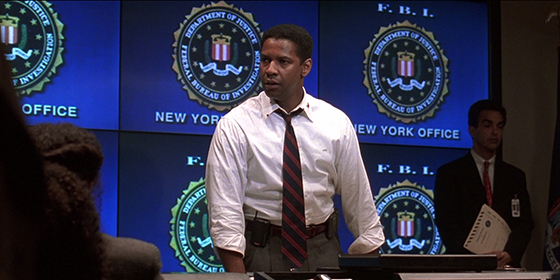
What the film boils down to is not who's doing what to whom, but in meeting the enemy and it being ourselves.  New York becomes the target of accelerating attacks when a bus is hijacked with no demands—and no explosives it turns out, the passengers are merely splattered with blue dye. The FBI's lead investigator Anthony Hubbard (Denzel Washington) thinks it's more than a prank, or, as it's dismissed, "assault with a deadly color."  He knows two things that worries him: "they" know explosives and "they" know the FBI's response time now.


Inserting herself into the investigation is Elise Kraft (Annette Bening), an NSA investigator who doesn't like to share information, as much as take it. She and Hubbard spar over jurisdiction and ownership.  The FBI is new to the investigation and Elise has been at this for quite some time. "In this game, the most committed wins."  While they're bickering and throwing down threats, another bus gets hijacked, and negotiations begin.  But the results are different, attracting the Feds, especially the Army in the person of General Devereaux (Bruce Willis), who we have seen earlier overseeing the investigation of an Arab cleric (of whom the United States does not officially know the whereabouts).  He's nosing around just to make sure that, although the NSA and FBI seem to bungling and out of their depths at this point, his operation isn't compromised. 


But, the atrocities accelerate and get bigger—The FBI's New York headquarters is attacked, resulting in 600 victims, many of them Hubbard's colleagues, and at that point, the President declares Martial Law. 


Despite his earlier protests in committee ("The Army is a broad sword, not a scalpel. Make no mistake, Senator. We will hunt down the enemy, we will find the enemy, and we will kill the enemy. And no card-carrying member of the ACLU is more dead set against it than I am. Which is why I urge you - I implore you. Do not consider this as an option. Trust me, senator - you do not want the Army in an American city.") Devereaux heads up the operation, cordoning off Brooklyn and gathering up all Arabic-speaking young men and detaining them in Yankee Stadium.  Profiling isn't second-guessed, habeas is suspended, citizens are marched out to camps, and torture is the order of the day—specifically water-boarding.


Must have seemed pretty nightmarish in 1998.  Now, that the "ethics" of water-boarding have been discussed endlessly by the cable-news pundits (to the point where I want to drown them), Guantanamo (or the more friendly "Git-mo!") has been holding prisoners for...how many years now?...we've been living with no-fly lists, and even gone to such silly extremities as taking off our shoes at airports (while "they" have gone the way of planting underwear bombs) over the last eleven...ELEVEN...years.  And a lot of people have died, and Americans—loyal Americans—are coming back to a backlog of unanswered help, and we're now losing more of them to suicide (as we did in Vietnam) than to the actual war.


The crackdown will be televised

"We have met the enemy, and they are us."  That was the message of The Siege and no one listened.*  And here we are, on the anniversary of 9/11, and the longest war in our history, and conflicts have not been resolved.  They're only getting more complicated.  The situation has gotten even more fractured, and the wars are internal as well as external, looking more like the Mexican stand-off that ends the film. 
Now, here we are, a dozen years after the fact, and there are folks amidst the current host of Syria chatterers, who want to bomb Damascus, take out their leader, and replace him with the rebels opposing him, and in the glib words of Willis' commander "be back at base in time for the play-offs."


Trouble is, some of the factions among the rebels are Al Qaeda, who we've been fighting over these last dozen years and trillions of dollars.  As the movie says "It's easy to tell the difference between right and wrong. What's hard is choosing the wrong that's more right." 


Orwell is in his grave...creating his own spin zone.


* Anthony 'Hub' Hubbard: [upon learning Devereaux's plans to torture Tariq] Are you people insane? What are you talkin' about?
General William Devereaux: The time has come for one man to suffer in order to save hundreds of lives.
Anthony 'Hub' Hubbard: One Man? What about two, huh? What about six? How about public executions?
General William Devereaux: Feel free to leave whenever you like, Agent Hubbard.
Anthony 'Hub' Hubbard: Come on General, you've lost men, I've lost men, but you - you, you *can't* do this! What, what if they don't even want the sheik, have you considered that? What if what they really want is for us to herd our children into stadiums like we're doing? And put soldiers on the street and have Americans looking over their shoulders? Bend the law, shred the Constitution just a little bit? Because if we torture him, General, we do that and everything we have fought, and bled, and died for is over. And they've won. They've already won!
General William Devereaux: Escort him out.

Thursday, August 30, 2012

Ruby Sparks

Hearts and Minds
or
"The Situation is Crazy.  I Am Not."

Stephen King will see this one and slap his forehead for an opportunity missed for a seven hundred page novel.  I've known enough authors of fiction that have mentioned a scary thing: they'll start writing, fleshing out the skeleton of an idea, the characters take shape, become three-dimensional, and then suddenly, they live. In fact (and fiction), they become so alive they'll start doing things and going in directions that the author never intended or had even planned for. The figments of the author's imagination take on a life of their own, rebel and...rather than the author changing them, they change the author, or at least his intentions for them.

Eerie.  And the basis for Ruby Sparks, the latest film from Jonathan Dayton and Valerie Faris, the folks who directed Little Miss Sunshine.  That film I wasn't too crazy about, as it seemed to scream "Indie Sensibilities" from every tortured writerly "quirk" that was tossed in.  Ruby Sparks, however, is different—a nicely buttoned-up movie that reverberates with all sorts of echoes that ripple through the film and cross over in a concentric series of folded back references, self- and otherwise. 

Author Calvin Weir-Fields (Paul Dano) is struggling with a follow-up novel after an initial success—struggling for 10 years, in fact.  His shrink (Elliott Gould) gives him an assignment to take the pressure off, and Calvin is inspired, writing about an idealized, neurotic woman named Ruby Sparks.  But, he's not just inspired, he's energized, so much so he can't wait to get back to his typewriter (it's this old piece of technology before a PC, or what was known in the Pleistocene era as a "word processor") to continue the work, spend more time with her, creating her.  So much so that he starts to fear that he's falling in love with her.  His brother reads the pages and his criticism is harsh: "You haven't written a person.  You've written a girl.  Geeky, messy girls are not what people want."  He remains undeterred, writing all night and into the morning.  Imagine his horror when he wakes up from his QWERTY keyboard, runs downstairs and finds Ruby (Zoe Kazan) in one of his shirts, eating cereal.

He freaks, naturally, much to her consternation, and then is shocked to discover that everybody can see her, too.  She's just not a figment of his imagination; his imagination walks amongst us.

This is the stuff of male fantasy rom-com's.  But, Ruby Sparks takes it into some dark places, ala Hitchcock, in the realms of identity, manipulation, male wish-fulfillments, and the odd idealization and expectations that love creates and blinds us to.  We all create an object of affection (on both sides, sending and receiving), but whether that object has anything to do with reality depends on both parties and how much they want to compromise to achieve that...whatever it is..."more perfect union," let's say.

The script (by Kazan herself) explores some uncomfortable territory in that regard and Kazan has a knack for writing dialogue that is spot-on, but containing deep echoes that weight them further.  It's one of the better rom-com/fantasy scripts to come along in awhile—at least it has a thought in its head—and the performers, while still showing an abundance of the too-eager "cutes," its not enough to keep you wondering how it all could end.  Yes, the film has its moments of coy cloyness—for example, when Ruby goes to a family dinner with Calvin's hippy-dippy step-parents (Annette Benning and Antonio Banderas), that amounts to a side-bar, and just lets us know what we already know, that Calvin is a bit of stick-in-the-mud and a buzz-kill, and (surprise, surprise) less capable of change than his own creation, which, if he wanted to, he could correct with a new sentence, or some Liquid Paper.

It doesn't go there (and only for revelation purposes, any more and it might be a good vehicle for Adam Sandler), nor does it end "Happily Ever After" as rom-com's do (but only because they choose to).  Ruby Sparks chooses another way, fully committed to not committing and finding the fine balance of compromise.

Ruby Sparks is a Matinee


Tuesday, May 17, 2011

Being Julia

Being Julia (István Szabó, 2004) "My, this is getting complicated!" says Julia Lambert (Annette Bening) ad-libbing from the stage.  She should know; she lives for drama and theater.  But, it isn't enough.  Weeks into a production set up by her impresario husband Michael (Jeremy Irons) she is having a crisis of...something.  She's been playing the same part for what seems like ages.  She's bored, yet exhausted and desperately needs a holiday.

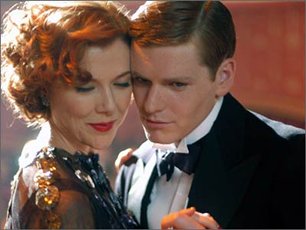
But a diva can never take a holiday from drama, or turn away from being the center of attention, and once the run of the play has been shortened she can turn her attention to other things.  Like an affair with a much younger American (Shaun Evans) besotted with her.  He shows up, the son of another theater investor and Michael, hoping for some input of the cash variety, encourages Julia to give him some attention.  Initially cool to the young man, Julia begins a passionate fling with the lad, falling deeply, passionately in love with him.  Anyway, it plays like love.  It's not like this hasn't happened before, as her deep friendship with Lord Charles (Bruce Greenwood) attests.  But, what's real for Julia has a tendency to blur between reality and the fantasy of the stage, something the spirit of her acting mentor Jimmy Langton (Michael Gambon) constantly pops in to remind her.  Then, just when things are going so well, her young Romeo takes up with a beginning actress (Lucy Punch) who wants to use his influence with Julia to get her a part in Julia's new play, written for her by a boozy playwright (the late, great Maury Chaykin).  Said actress is also cosying up to Michael (not that that really matters).  Whatever is Julia to do? 

Being Julia sounds like a "ladies'" picture, perfect for the LOL's attending their matinees after luncheon, but, written by Somerset Maugham (adapted here by Ron Harwood) it has more in common with a caper movie—we're constantly getting Julia's inner thoughts, as she is habitually throwing them out loud enough for the balcony to hear.  But, a great actress never reveals too many secrets—just enough to make her fascinating for her audience.  So, the final "heist" sequence has all the satisfaction of being a surprise and deliciously cathartic.

And it's fun to see Bening have fun with it in a performance in its high manner almost camp, were it not for the moments of reasonableness, which seem natural until you realize Julia's "acting." And Bening dives in, running the gamut from barely tolerant basilisk stare to "cry-me-a-river" deep diving.  Sure, she was nominated for an Oscar for this—who wouldn't be as it has the potential of being a one-woman show—but Bening brings such a savage nature to this creation, a moth who lives best in the glare of her own spotlight, that one wonders how the Academy escaped giving her this one.*  It is enjoyable, marred only by too many song interludes that provide period commentary that is completely unnecessary.


* Hilary Swank won that year for Million Dollar Baby.  Bening should meet Eastwood.