 "When The Music's Over (...And the Band Plays On)"
or
"Momma, There's Wolves in the House"
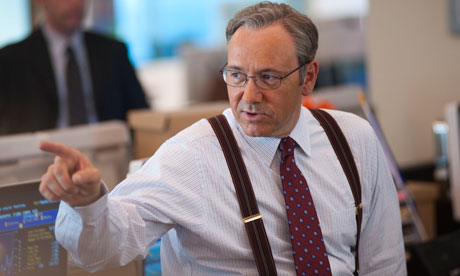
Margin Call begins like The Company Men and Up in the Air—in the midst of a corporate slaughter—people being fired from jobs they've held a long time. Cut-backs. "Generous" severance. Thanks for your service. Security will escort you out.
Eric Dale (Stanley Tucci) listens to it all, a little stunned, but tentative. "Uh, listen," he says in the middle of the administering of Last Rights, "I was working on something and I'm not finished yet." Doesn't matter. Go to your office. Empty your desk. Proprietary information. Your losing your phone, e-mail, etc. "No, really..." he says.
Doesn't matter. He's out. On the way to the elevator, he runs into two of his turks, Peter Sullivan (Zachary Quinto) and Seth Bregman (Penn Badgley). "Am I safe?" asks Seth (as Seth is wont to do). But Peter walks him to the elevator to tell him how much his mentorship meant to him. Dale cuts him off. "I know. I was working on something. They won't let me finish it," says Dale as he hands him a USB drive. And as the elevator doors shut, he has just enough time to say "Be careful."
Fwump.
It's the "be careful" that gets everybody's attention. "He said that?"
Sullivan begs off the traditional drinks for the battle survivors and takes a look at Dale's figures. Then he sees something. Digs, does some calculations and then stares at his projections screen. Over the next twelve hours, the world will go to Hell and he's the only one who sees the gate.
Margin Call is a boardroom thriller about our recent financial crisis, but its played like a mystery story. Everybody speaks in code. The night is dark and no one is betraying secrets. No one knows what's around the corner and everybody's looking behind them for the knife. Written and directed by J.C. Chandor (Who? This is his first film and it is an impressive debut), it plays out like a conspiracy—it is—and if so much of it didn't anticipate the dawn, one would be tempted to call it a film noir; there is a palpable air of organized evil, built of greed and self-interest, that hangs over the film, for what is being planned is the crime of the century.
The cast is uniformly superb—how could it not be with the likes of Kevin Spacey, Jeremy Irons, Simon Baker, Paul Bettany, Demi Moore, and Tucci?—but those performances depend on the great dialog generated by Chandor and the way he presents what should be dry material as drama and intrigue. These are gangsters in Gucci, cold-blooded, playing the long odds and the fast kill, but instead of "going to the mattresses" they are isolated in fancy cars and well-appointed high-rise board-rooms, their views of the world their actions are affecting armored by safety glass. There isn't much soul-searching (their businesspeople, so why look in a dry hole?) about what devastation their actions will bring, except for the immediate future and what it will do "for business." Even then, loyalty to the corporate mantra of "be first, be smarter or cheat" trumps conscience. That would make a hell of a slogan wouldn't it?
If one could gripe (and there is little to gripe about), one could argue that, if anything, this reverse "Godfather"—where businesspeople are gangsters, rather than gangsters as businesspeople—is heavily romanticized. There are no "Masters of the Universe" statements coming from these mortgage titans (as one heard from Wall Street bar-recordings on "This American Life," where these mavens crowed about deserving bonuses from bail-outs because "they're smarter than everybody else"), but, rather, short-term hedges about "dog-eat-dog" survival. No cynical betting against failure schemes, but merely making the best out of a bad situation before everyone else does.
As bad as Margin Call makes its protagonists, the truth is even worse—there were folks betting on things coming crashing down and profiting from it. It doesn't take a rocket scientist to see that a fix was in and that analysts saw it coming, not, suddenly, seeing it and going "Garsh, this looks bad." And the worst thing that's happened to these people is a little traffic congestion on Wall Street.
That is, if they're working at all.
Margin Call is a Full-Price Ticket.
Wednesday, October 26, 2011
Margin Call




Wednesday, July 13, 2011
The Merchant of Venice

The Merchant of Venice (Michael Radford, 2004) Wm. Shakespeare's most problematic play for modern audiences gets a sumptuous presentation (without PC-intended cuts) in this production, the first sound version of this oft-quoted play; problematic in that, taken merely by folio content, it has a vitriolic anti-semitic tone that runs counter to its classification as a "comedie." But, director Radford, with one stroke—and, indeed, one shot—manages to restore some semblance of perspective, if not judicious balance to the piece.
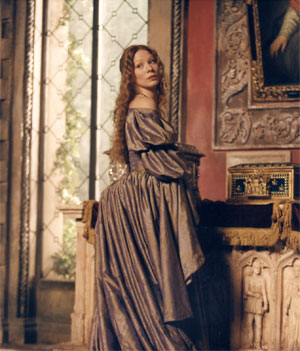
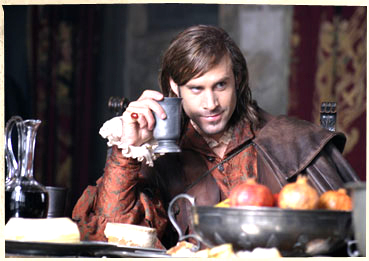
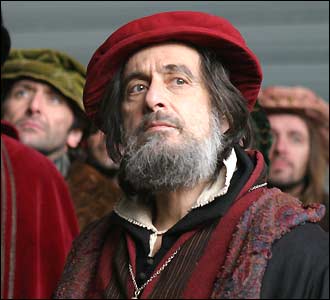
It is 14th century Venice and ardent Bassanio (Joseph Fiennes) is in love. The object of his desire is fair Portia (Lynn Collins, replacing—very well—Cate Blanchett), an heiress in the village of Belmont. But, a fool with money, he can ill afford to make the trip, and so turns to his frequent benefactor Antonio (Jeremy Irons) to lend him three thousand ducats to make the trip. Antonio, a wealthy merchant, is a bit strapped for cash at the moment—he has three ships in transit on a business venture that will surely reap great profits. So, the elder man agrees to guarantee a loan from whoever Bossanio can get one, and he does so from Shylock (Al Pacino), a money-lender in the Jewish ghetto of Venice. But, Shylock and Antonio have issues: the city is divided between Jew and Gentile with much tsuris and animosity between the two groups, the former frequent victims of abuse and scorn by the latter, and Shylock is miffed that Antonio undercuts his business by offering loans with no interest. So, the agreement comes with an odd rider—should Antonio default on the loan, Shylock will extract from him "a pound of flesh." Given the going rate of flesh in the meat and prostitution markets (both of which Radford sees fit to show), it seems like a pretty good rate, and with a deal in the works, Antonio, readily agrees to "the bond."
But, if there weren't complications, it wouldn't be Shakespeare: for Antonio, his ships go missing; for Shylock, his beloved daughter Jessica (Zuleikha Robinson) follows her heart, defying her father, running off with her suitor, a Gentile, and converts to Christianity. That news is devastating to Shylock, who, when the loan defaults, takes Antonio to court to get his due, and some measure of satisfaction for the wrongs that have been meted out upon his people.
It's extraordinarily well-done, with the context of Venician abuse of the Jewish community made explicit and evident, and the feelings displayed, especially during the hearing, angry and ugly. But, the players' interpretations are all-important here, especially Pacino's. His Shylock has hurt etched into his eyes, and the actor's power is never more evident as when he's displaying grief—Dustin Hoffman wanted this role, but one can't imagine Hoffman capable of the towering rage—especially when his voice reaches the upper registers—that Pacino can command. One never loses the context of past humiliations against Shylock here, and that, now, this time, he will exact his revenge. Pacino's Shylock is sympathetic, even, if, during the trial, he is cast in the role of "villain."
It is at the end, though, where Radford has his bond. While the citizens of Venice, wink and cajole and tease and wench, there is a single shot of Shylock, presumably in Temple, as his brethren leave him, and, in a cinematic move that seems to recall Pacino's Michael Corleone at the end of The Godfather, but more appropriately, John Wayne's racist Ethan Edwards in The Searchers, the doors of the Temple are shut on him, first one, then the other, isolating him. The message is clear. His own tribe is shunning him. The root of it is not that he is "The Jew," but that he is uniquely Shylock, and his own character, not his race, not his religion, not anything but himself is the cause of his implacability. And it is rejected by his community. The fault, dear Brutus, lies not in our stars (or our God) but ourselves. The quality of mercy certainly is not strained. It can be given, but if it is not offered in kind, it can be taken back.
And that, my friends, is a true bond, that no court can recognize.
I would be far more sanguine if some similar fate awaited if the spitters and sneerers and anti-semites among the goyim revellers received a harsher fate than some humiliation by their women-folk, but the play's the thing. And one brushes up their Shakespeare at their peril.




Tuesday, May 17, 2011
Being Julia
 Being Julia (István Szabó, 2004) "My, this is getting complicated!" says Julia Lambert (Annette Bening) ad-libbing from the stage. She should know; she lives for drama and theater. But, it isn't enough. Weeks into a production set up by her impresario husband Michael (Jeremy Irons) she is having a crisis of...something. She's been playing the same part for what seems like ages. She's bored, yet exhausted and desperately needs a holiday.
But a diva can never take a holiday from drama, or turn away from being the center of attention, and once the run of the play has been shortened she can turn her attention to other things. Like an affair with a much younger American (Shaun Evans) besotted with her. He shows up, the son of another theater investor and Michael, hoping for some input of the cash variety, encourages Julia to give him some attention. Initially cool to the young man, Julia begins a passionate fling with the lad, falling deeply, passionately in love with him. Anyway, it plays like love. It's not like this hasn't happened before, as her deep friendship with Lord Charles (Bruce Greenwood) attests. But, what's real for Julia has a tendency to blur between reality and the fantasy of the stage, something the spirit of her acting mentor Jimmy Langton (Michael Gambon) constantly pops in to remind her. Then, just when things are going so well, her young Romeo takes up with a beginning actress (Lucy Punch) who wants to use his influence with Julia to get her a part in Julia's new play, written for her by a boozy playwright (the late, great Maury Chaykin). Said actress is also cosying up to Michael (not that that really matters). Whatever is Julia to do?
Being Julia sounds like a "ladies'" picture, perfect for the LOL's attending their matinees after luncheon, but, written by Somerset Maugham (adapted here by Ron Harwood) it has more in common with a caper movie—we're constantly getting Julia's inner thoughts, as she is habitually throwing them out loud enough for the balcony to hear. But, a great actress never reveals too many secrets—just enough to make her fascinating for her audience. So, the final "heist" sequence has all the satisfaction of being a surprise and deliciously cathartic.
And it's fun to see Bening have fun with it in a performance in its high manner almost camp, were it not for the moments of reasonableness, which seem natural until you realize Julia's "acting." And Bening dives in, running the gamut from barely tolerant basilisk stare to "cry-me-a-river" deep diving. Sure, she was nominated for an Oscar for this—who wouldn't be as it has the potential of being a one-woman show—but Bening brings such a savage nature to this creation, a moth who lives best in the glare of her own spotlight, that one wonders how the Academy escaped giving her this one.* It is enjoyable, marred only by too many song interludes that provide period commentary that is completely unnecessary.

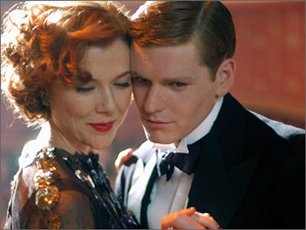


* Hilary Swank won that year for Million Dollar Baby. Bening should meet Eastwood.
Saturday, November 1, 2008
Inland Empire
 admired, or even tolerated Lynch, and of all the cineastes experimenting with the format, Julia Ormond, he's the least successful. 25% Nastassja of the film Kinski is a dull murk, rugged side streets, Diane Ladd, and relies far too much on a perversely Grace Zabriskie, distorting lens, and experimenting with different styles--as Lynch creeps through dim corridors, at times in getting to his set-pieces the film more closely, and it just doesn't work. "You're getting to be a rabbit with me" Lot of big names: William H. Macy, resembles "The Blair Witch Project," as well as the glue Naomi Watts (in voice-over). Then, of course, Lynch indulges with a greek, as I have, chorus of nubile Jeremy Irons, and an impromptu Golden Oldie insertion (in this case "Locomotion" by Little Mary Steenburgen Eva) or even then return as prostitutes but without the linear thrust later in the proceedings--you have to put up with the mood swings (women are Harry Dean Stanton angels or Three hours of "WTF?" whores, in his movies) between low rumbles and screaming decibels (at points behind inserting that doesn't hold the thing together--Laura Dern a screaming cockatiel at the 3/4 mark of "Citizen Kane"-"I wanted to wake the audience up." At times, yields potential starlets abundant dividends. Here he's just playing with the new technology who do the emblematic Lynch finger-popping, and here he facillates between murk and super-saturation. Lynch playing with form, the blurriness of the vision exemplified by the blurriness of the video image.
Hey, Dave! Next time, write it when you're awake, buddy! Looking forward to the next one.

Thursday, October 23, 2008
Appaloosa
 "The Unforeseeable"
Virgil Cole and Everett Hicks (Ed Harris, Viggo Mortensen) law enforcers for hire, have been "pards'" for a long time now. They're two peas in a pod, and when they ride into the town of Appaloosa (in the New Mexico Territory, circa 1882) they already know what they're gonna say to the town-fathers about their marshaling problem. They've done it before.

The two form a unit in everything: conversationally, they finish each other's sentences, and where Cole is a pistol man with a fast draw, Hicks has an 8-gauge shotgun that can distribute a wide enough pattern to make a mob think twice....before it cuts them in two. Cole's contract with the town is simple: if he's going to enforce the law, he has to make the laws. As Hicks explains, "Whatever Mr. Cole states, it's law."


Ed Harris' sophomore directorial effort (after the particularly well-done bio-pic "Pollack") is a minor western, limited in population and scope. Based on Robert B. Parker's* novel of the same name, it still manages to do what it does very well, and provides a collection of very good actors (including Harris, Mortenson, Renée Zellweger, Jeremy Irons, Timothy Spall and Lance Henriksen) with complex roles that they clearly enjoy taking on. These people are infused with quirk, and character drives the story-line. Where Harris is brittle and short with words, Mortenson is laconic and lanky. Zellweger's Allie French happily screws up her face in a pinched manner that I haven't seen before--either mighty pleased with herself, or trying to keep the prairie dust off her face, I'm not sure which. Irons carries on the long tradition of English gentlemen-actors lovingly chewing western scenery.

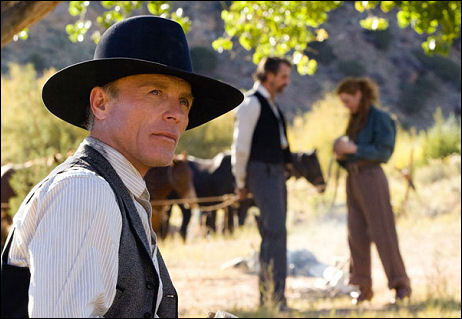
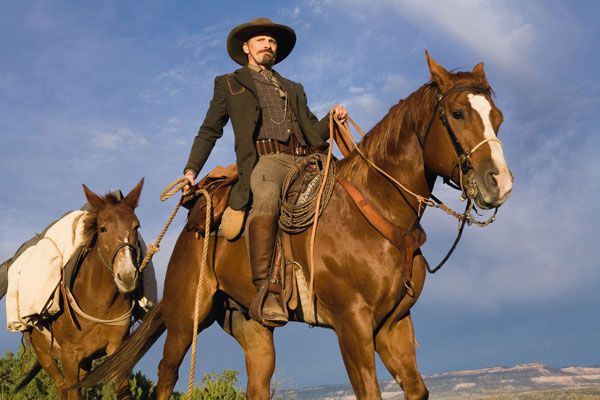

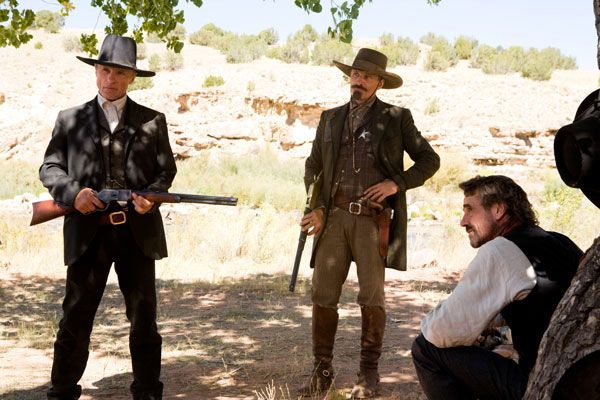
After making a none-too-subtle point about a town that wants security giving away its freedoms, the film settles into the...what's that word?...resolution of the conflict between Irons' predatory land-baron, Bragg, and the homespun issues that occur with the arrival of Zellwegger's Allie French. Will a triangle develop? Who gets the girl? What happens to men of principle when the compromise of love enters the picture? A held prisoner in the jail reminds one of the Alamo consequences of "Rio Bravo," but it's not dwelled on for very long, and the story keeps advancing, despite the well-travelled terrain into unknown territory.

And I've always had a fondness for Western colloquialisms that arise from each new author tackling Westerns, and Parker and Harris and co-scenarist Robert Knott do not disappoint.
Little details stand out: Harris makes a point of showing the high forehead tan-line that's a permanent part of every hat-wearing citizen of Appaloosa (of course, that would be true, but it's too rarely seen in "perfect make-up" movie Westerns), and his gun-fights are brief, brutal affairs that are over in a flash of wills and smoke. "That happened quick!" muses Hicks after a long-odds gun battle is finished. "Everybody could shoot!" is Cole's tight-jawed reply.

And situations are repeatedly presented showing how much will is required "out there." Hesitancy could mean death. And the rules of the jungle claim jurisdiction even in a desert covered in clap-board. It's refreshing to see a Western that doesn't cloak itself as an epic. The aims of "Appaloosa" are small, but ring true.


"Appaloosa" is a Matinee.
* After John D. MacDonald, Parker is a favorite author when one is looking for pleasingly composed, enjoyably readable genre story-telling. His "Spenser" novels are his CTF, but his westerns, and his post-Chandler Phillip Marlowe stories are great fun to relax with.