Showing posts with label Stanley Tucci. Show all posts

Tuesday, December 24, 2013

The Hunger Games: Catching Fire

Feeding the Beast
or
To Kill a Mocking-jay

I mocked The Hunger Games rather mercilessly when it came out (as if it would prevent a single sou from entering its coffers) , because even though it was a hot publishing phenom' and a breathlessly anticipated movie, the original concept was a bit derivative without being very divergent (yeah, that's a snark for a future film there).  So now, the second of The Hunger Games films (of four total) Catching Fire has come out (with a new director, Francis Lawrence, of Water for Elephants and I Am Legend as a bit of an improvement over Gary Ross, even with Steve Soderbergh assisting) and this one's a better film.  For one thing. "this time it's political," and the easy targets of reality TV and the excesses of the rich (with an eye towards the Roman Empire and its parallels of bread and circuses) are a bit less strident, although they haven't disappeared.  They're just presented a little better this time.  And the politico's of the Capitol are being a bit more cagey than they were previously.

Katniss Everdeen (Jennifer Lawrence) now finds herself the most watched human in Panem.  Her victory in the 74th Hunger Games along with Peeta Mellark (Josh Hutcherson) has earned her and her family a cushy residence in Victor's Village and the vulture-like scrutiny of Panem's leader, President Snow (Donald Sutherland, as creepily confident as if he were selling you orange juice).  He sees the way that Katniss has reached out to Panem's people and now she's the centerpiece of a swelling revolutionary movement.  A personal presidential visit amounts to a threat that she'd better be convincing in her devotion to the State.  "I'll convince them." assures Katniss.  "No." replies Snow slowly.  "Convince me."


And with that, the stakes are raised.  A "Victory Tour" is planned for the remaining districts (the ones that haven't been nuked), but at each appearance of Katniss and Peeta something happens that brings out the riot police.  At the suggestion of the Capitol's new gamesmaster (check out this name) Plutarch Heavensbee (Philip Seymour Hoffman, keeping a straight face), who comes up with a plan to put more pressure on Katniss and speeding the inevitable moment when the public turns against her.  Then, with the next Hunger Games competition occurring (the 75th), it is decided that, rather than having a "Reaping" lottery among the populace, the competition will be between past Victors, considered by the State now to be potential inspirations and inciters to riot.

So now, the Games are between past champions (including Jeffrey Wright, Jena Malone, and Amanda Plummer), some of whom are just as determined to win, while others are angry at being targeted again, but there will be only one survivor.  


It's a better film with more tricks up its sleeve, and the media manipulation is played by all sides—it may be an illusion but Stanley Tucci's teeth actually look whiter this time—with a terrific set-up for the next films that comes out of left field...if you haven't read the books.  It's an entertaining change-up from the situations of the original, and promises to be even more intersting next time out.


The Hunger Games: Catching Fire is a Matinee. 


Wednesday, November 6, 2013

The Fifth Estate

Assuaging Assange
or
Jury Tampering in the Court of Public Opinion

Julian Assange is not a happy camper...camping in the Ecuadorian embassy ("behind Harrod's" as his portrayer Benedict Cumberbatch describes it) in London. He has let it be known in his own little publicity campaign that he does not like The Fifth Estate, and that it is entirely propaganda from unreliable and untrustworthy sources.  I'll take his word for it, as that's been his business model for Wikileaks for quite a few years. 

The problem is that Assange would not be happy with ANY movie of the story unless HE wrote, produced and directed it, so that he could control the information flow to fit his view of events.* Anyone would, really, in the best of all possible worlds. The difference between anyone and Assange is that he actually thinks he could, and not only that, that he should.

The trouble is, Mendak, it may be your story, but it's not your money financing it, and you're kind of a bad risk, if you know what I mean.  

And, if he would do it, he would insist on doing it himself, even though film is a collaborative medium.  Collaboration, however, might dilute the message, and so, really the only person who could be trusted with it is Assange.  Wait for his version in a couple of decades.  That's the trouble with hubris and megalomania, you always get your message out last and console yourself that you got The Last Word.


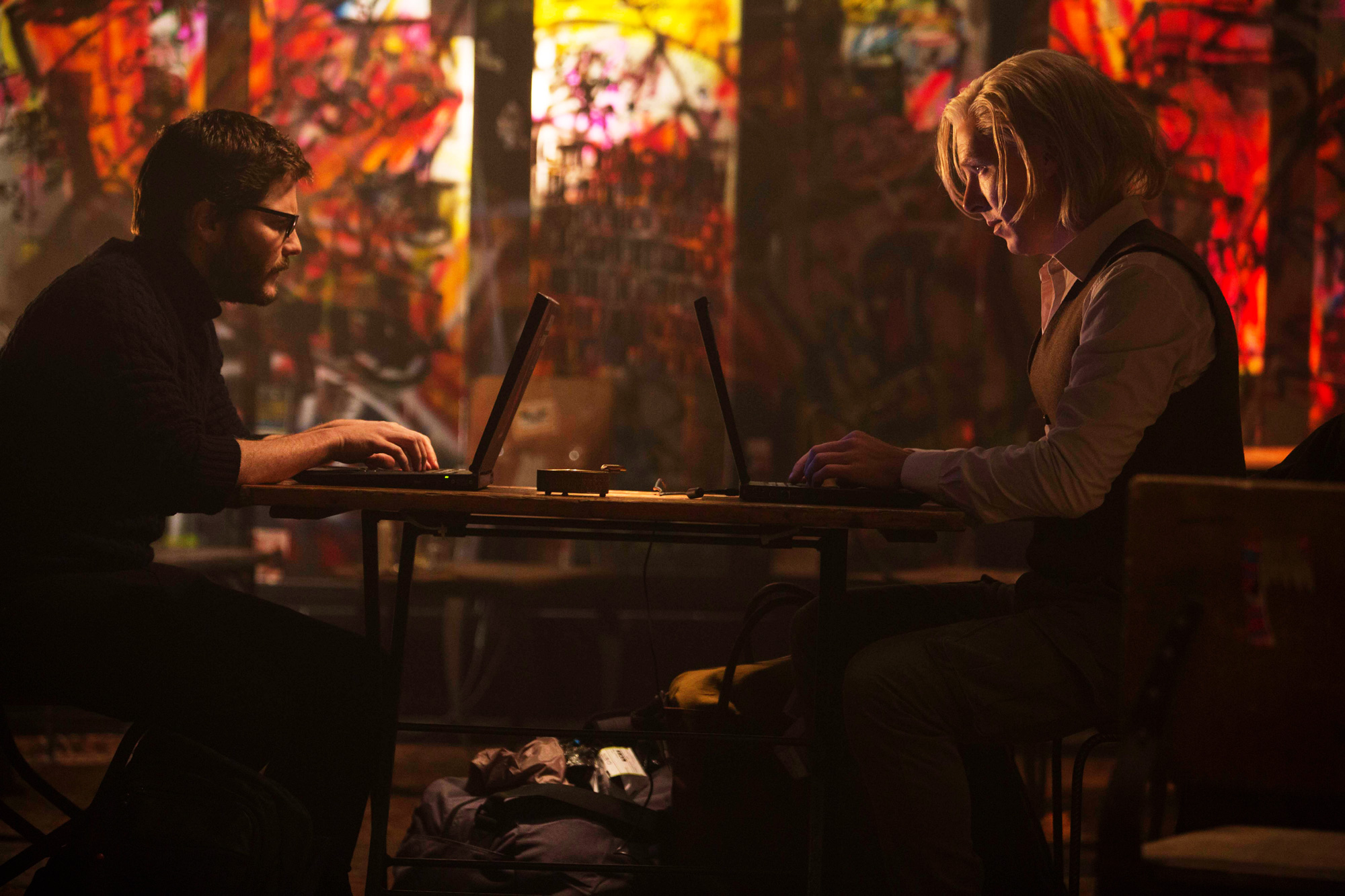
(Well, now that I've revealed my prejudices that I think Assange is a creep and something of a deluded creep...) Bill Condon's film is a return to form on the controversial biographical films he's done in the past (Kinsey, Gods and Monsters), and after mucking about in the very black and white"Twilight" series, here struggles to have any sort of perspective, controversial or otherwise, for a story that is still in process.  It also sweats to make something dramatic out of typing away at laptops, which is intrinsically dull, and about as engrossing as watching a movie about a writer who's writing—good in book form, maybe, but unless you go off into some sort of fantasy-land, it's a completely no-thrills scenario.  

For anyone who's been following the Assange story—which was several headline-making revelations ago—The Fifth Estate does less with the recent Iraq War revelations (some of which—like the "Collateral Murder" video weren't even revelations, having already been published in other sources) than it does with the early ground-breaking days of WikiLeaks, Assange's recruiting of Daniel Domscheit-Berg (Daniel Brühl)—whose book "Inside WikiLeaks" is one of the sources on which Josh Singer (former writer for "The West Wing" —during the non-Sorkin years—and "Fringe") based his screenplay—and the heady days when it exposed corruption in Kenyan elections and dummy-accounting in the Caymans at Julius-Baer.  The worst-kept secret of all was who was running WikiLeaks. Although Assange was the very public face of the site, he would state that there were hundreds of people behind the site, doing due diligence, checking sources, and vetting information that was see the light of day there.

Truth was, there were no "hundreds of people;" it was Assange and Berg and whatever server cluster the two could configure, cobble and co-habit.  Vetting was cursory phone calls, or maybe a clandestine meeting beforehand.  As far as redacting anything that might threaten lives,** that was nearly impossible (and logistically impossible with the release of diplomatic communications that numbered 400,000 in 2010).  As WikiLeaks' revelations become bigger and broader in cope and size, the tiny staff is overwhelmed, keeping an Oz-like public face (Assange's), but not even willing to acknowledge that they might be overwhelmed and out of their depth.  Thus, the "open" source hides the biggest secret of all—there's no infrastructure to the web-site other than Assange and Berg.

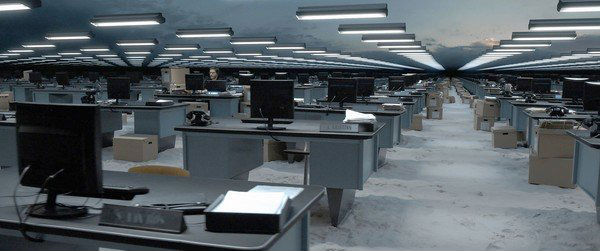
The "reveal" of this information is done in a "cutesy" illustrative manner.  At one stage, Berg wants to talk to the other WikiLeaks members that he's been trading communiques with about sources and information, something Assange is initially reluctant to do.  Then, when it becomes a "make or break" request, he gives in, showing Berg his "hold card"—that the other people Berg has been instant-messaging and e-mailing have merely been alternate Assange accounts.  He's only been talking to Julian, which Berg imagines as a scene out of Being John Malkovich crossed with The Apartment of an infinite number of desks in an office, all with Julian Assange sitting behind them.  It's a little too literal and maybe just a little condescending to spell it out so baldly to the audience, but ultimately that visual metaphor is stretched as, at critical junctures, that infinite number of Assange's keeps coming back to make fantasy-narrative points that seem unnecessary (other than to conjure up that all those Assange's are going to write the complete works of Shakespeare someday).  

The acting is, across the line, superb: Cumberbatch does a fascinating Assange, adroit, and self-contained, like a chess-player, usually thinking about something else than the topic of conversation, and his final bit—an in-character dismissal of "the two films" coming about WikiLeaks (presumably this film and Alex Gibney's documentary) is a cautionary warning; Brühl, seems to be the go-to guy to play Germanic naifs after Good bye Lenin!, Inglourious Basterds, and Rush, and here plays Berg as an all-too-willing apprentice looking for a mentor; Laura Linney, Stanley Tucci, and Anthony Mackie play American diplomats trying to deal with the fall-out, while David Thewliss and Peter Capaldi play two reporters for The Guardian with suspicious hesitance about their "source."


It's a good dramatization, filling in character holes which Gibney's documentary left unexplored.  The two together make a good summary of events that, as yet, have no ending, but have managed to rock the world, making the cyber-world look frighteningly like a glass-house sitting in a field filled with stones.

The Fifth Estate is a Matinee.


* The same attack came from Assange about this year's Alex Gibney documentary We Steal Secrets: The Story of WikiLeaks, which tells the same story, but through interviews and through Gibney's journalistic sensibilities (which produced Enron: The Smartest Guys in the Room, Taxi to the Dark Side, Gonzo: The Life and Work of Hunter S. Thompson, Casino Jack and the United States of Money, and Park Avenue: Money, Power and the American Dream).  Critics have been far harsher on The Fifth Estate than We Steal Secrets, either because 1) the documentary is considered more "legitimate" than the dramatic version; 2) Assange's attacks seem to "stick" better to a dramatic recreation than a documentary, or 3) they actually (at a rate of 95% to 37%—which is quite a swing) prefer the techniques of the documentary to The Fifth Estate . But, then, according to Rotten Tomatoes, they've been harsher on The Fifth Estate than the Stallone-Schwarzenegger yarn Escape Plan, which is just inconceivable, and brings Rotten Tomatoes' validity as an indicator of quality and worth as a taste aggregator into suspicion.

** Assange has said that no "outed" operative has been killed, due to the leaks (although The Fifth Estate fictionalizes one such source (Alexander Siddig) being forced to evacuate with his wife and children (in the same way that Patton fictionalizes what might have happened in WWII if, because of Eisenhower's decision to send gasoline to British tanks instead of American ones, if a tank company all of a sudden ran out of fuel behind enemy lines).  1) Assange is probably not a good source for that kind of information as he'd only get it from "whistle-blowers" who might not want to take claim for any deaths (nor would Assange).  2) It's not going to come from American sources who might not want to further risk others (ie "known associates") of anyone affected by it, despite making the case that there WAS some "collateral murder" (to coin a phrase) and making assange and WikiLeaks look bad.  As someone far more Machiavellian once said "The absence of evidence does not mean the evidence of absence."

Wednesday, October 26, 2011

Margin Call

"When The Music's Over (...And the Band Plays On)"
or
"Momma, There's Wolves in the House"

Margin Call begins like The Company Men and Up in the Air—in the midst of a corporate slaughter—people being fired from jobs they've held a long time.  Cut-backs.  "Generous" severance.  Thanks for your service.  Security will escort you out.

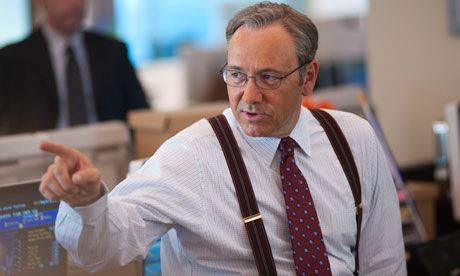
Eric Dale (Stanley Tucci) listens to it all, a little stunned, but tentative.  "Uh, listen," he says in the middle of the administering of Last Rights, "I was working on something and I'm not finished yet."  Doesn't matter.  Go to your office.  Empty your desk.  Proprietary information.  Your losing your phone, e-mail, etc.  "No, really..." he says.

Doesn't matter.  He's out.  On the way to the elevator, he runs into two of his turks, Peter Sullivan (Zachary Quinto) and Seth Bregman (Penn Badgley).  "Am I safe?" asks Seth (as Seth is wont to do).  But Peter walks him to the elevator to tell him how much his mentorship meant to him. Dale cuts him off.  "I know. I was working on something.  They won't let me finish it," says Dale as he hands him a USB drive.  And as the elevator doors shut, he has just enough time to say "Be careful."

Fwump. 

It's the "be careful" that gets everybody's attention.  "He said that?"

Sullivan begs off the traditional drinks for the battle survivors and takes a look at Dale's figures.  Then he sees something.  Digs, does some calculations and then stares at his projections screen.  Over the next twelve hours, the world will go to Hell and he's the only one who sees the gate.

Margin Call is a boardroom thriller about our recent financial crisis, but its played like a mystery story.  Everybody speaks in code.  The night is dark and no one is betraying secrets.  No one knows what's around the corner and everybody's looking behind them for the knife.  Written and directed by J.C. Chandor (Who? This is his first film and it is an impressive debut), it plays out like a conspiracy—it is—and if so much of it didn't anticipate the dawn, one would be tempted to call it a film noir; there is a palpable air of organized evil, built of greed and self-interest, that hangs over the film, for what is being planned is the crime of the century.

The cast is uniformly superb—how could it not be with the likes of Kevin Spacey, Jeremy Irons, Simon Baker, Paul Bettany, Demi Moore, and Tucci?—but those performances depend on the great dialog generated by Chandor and the way he presents what should be dry material as drama and intrigue.  These are gangsters in Gucci, cold-blooded, playing the long odds and the fast kill, but instead of "going to the mattresses" they are isolated in fancy cars and well-appointed high-rise board-rooms, their views of the world their actions are affecting armored by safety glass.  There isn't much soul-searching (their businesspeople, so why look in a dry hole?) about what devastation their actions will bring, except for the immediate future and what it will do "for business."  Even then, loyalty to the corporate mantra of "be first, be smarter or cheat" trumps conscience.  That would make a hell of a slogan wouldn't it?

If one could gripe (and there is little to gripe about), one could argue that, if anything, this reverse "Godfather"—where businesspeople are gangsters, rather than gangsters as businesspeople—is heavily romanticized.  There are no "Masters of the Universe" statements coming from these mortgage titans (as one heard from Wall Street bar-recordings on "This American Life," where these mavens crowed about deserving bonuses from bail-outs because "they're smarter than everybody else"), but, rather, short-term hedges about "dog-eat-dog" survival.  No cynical betting against failure schemes, but merely making the best out of a bad situation before everyone else does.  

As bad as Margin Call makes its protagonists, the truth is even worse—there were folks betting on things coming crashing down and profiting from it.  It doesn't take a rocket scientist to see that a fix was in and that analysts saw it coming, not, suddenly, seeing it and going "Garsh, this looks bad."  And the worst thing that's happened to these people is a little traffic congestion on Wall Street.

That is, if they're working at all.

Margin Call is a Full-Price Ticket.

Wednesday, August 12, 2009

Julie & Julia

"Too Many Cooks Spoil the Froth"

Nora Ephron directed movies have the same half-circle trajectories as "Star Trek" films: you get a good one, the next one stinks. Whether by virtue or vice of over-confidence or coasting, it seems you can't have two good Nora Ephron movies back to back. For every "Sleepless in Seattle," there's a "Mixed Nuts" and for every "You've Got Mail" there's a "Michael."

That's if you're a normal person. For me, I have yet to see an Ephron effort that hasn't made my toes curl inward in their shoes. There's a slap-happy spunkiness to her movies that just make me want to plunge my fore-head into the seat-back in front of me. Her nadir came with her last movie: how in the Hell can somebody screw up "
Bewitched?" It wasn't due to the Kidman Komedy Kurse, but a clear case of a writer-director trying too hard, "Bewitched" showed the ruination of tailoring material to attract a star—Jim Carrey as Darren—and then not going back to Square One to re-tool it when they don't get him. Will Farrell could be an astonishingly good Darren, but in another movie, not so driven by his character. And her efforts to make it a one-off "Bewitched" just seemed pitifully neutered—here's a concept where the woman has all the power, and Ephron compromised it. I know a lot of women who were fans of the TV show could not believe how badly the movie botched the premise. They felt betrayed.

Fans of Julia Child and "The French Chef" might feel the same way, but at least the effort was made to make a better film. "Julie & Julia" is based on the book written by Julie Powell cribbed from her Salon.com blog, a breezy chatty thing done for the same reasons as the blog you're currently reading: to write. And the only way to improve your writing is by writing, and then writing more. I don't write about cooking (but I know people who do), and it is that discipline to produce and take stock and put it Out There that (supposedly) makes you better at it, whether it's writing or cooking or (non-committal generality). Sometimes, like Powell, you get an audience, but it doesn't matter: becoming a better (non-committal generality) is what matters. This is my way of giving kudos to Powell, who's gotten a lot of stick lately for a) not being a good cook—she blogged about cooking out of a recipe book (doy!) and b) being successful when there are a lot of food-bloggers out there who aren't (see a).*

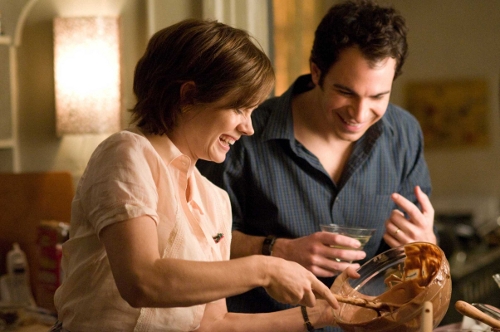
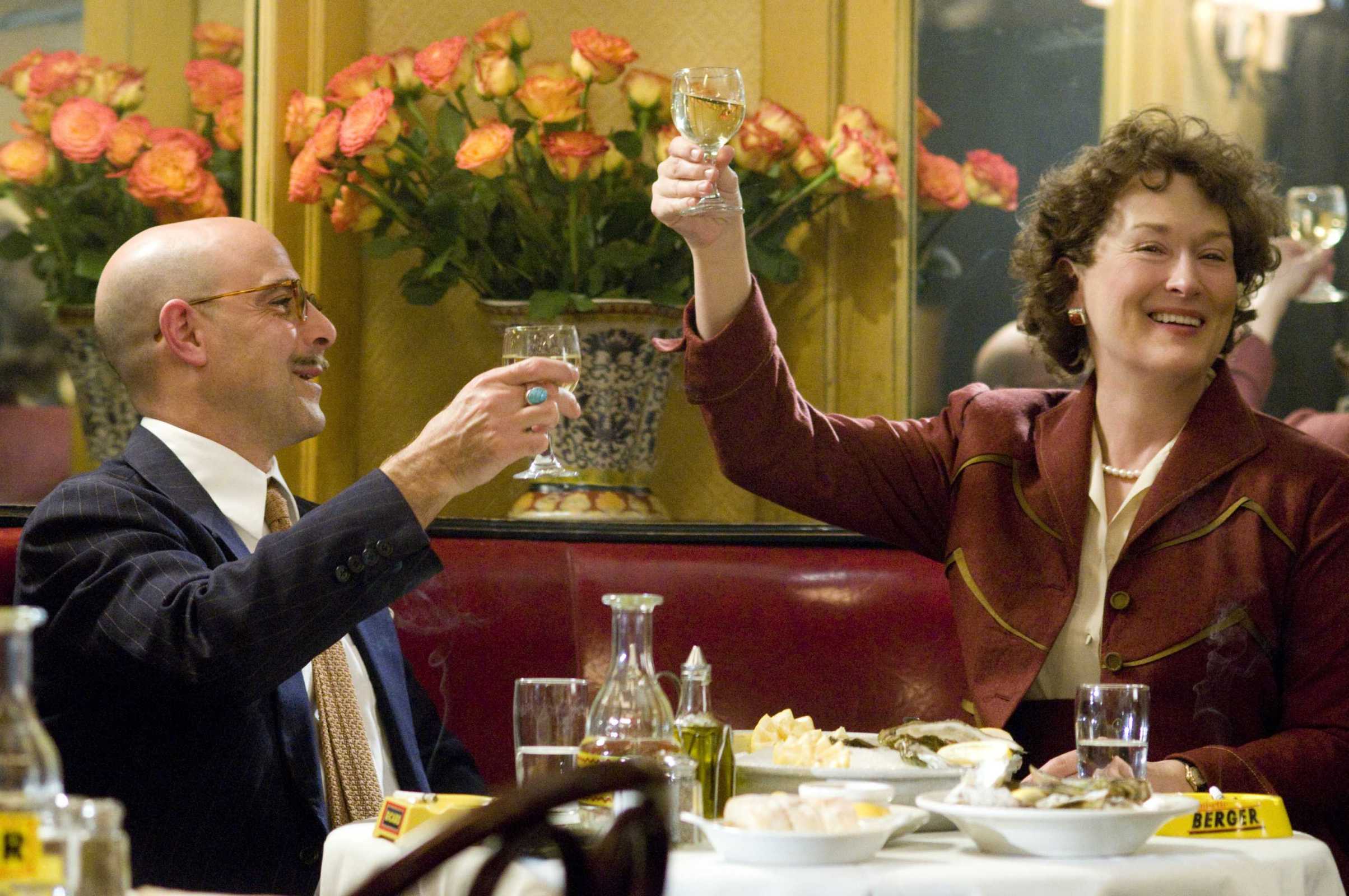
Having said that, Ephron made a stupendously wise choice to actually combine Powell's story with that of 1948 Parisian based Julia Child (Meryl Streep) on a parallel course. Both women find themselves tethered and adrift: Julia, after working for the OSS, and married to diplomat/spy Paul Child (Stanley Tucci's best role in years) does not know what to do in Paris other than effuse, and Julie Powell (Amy Adams) finds herself in a bad Queens apartment,** at a bad job (at a post 9/11 Lower Manhattan management company), and with nothing satisfying in her life—her dream of writing a distant memory. JC decides to take cooking classes—in a class entirely of men, while JP decides that since she finds solace in cooking she's going to spend a year following Child's recipes and writing about the experience. Ephron's film then follows the two women through their various experiences until reaching their final triumphs—both of which involve being published.

Good enough. Enticing enough, actually. But, truth to tell, despite the best efforts of
the impeccable Amy Adams (trooper that she is—she's perfected a mono-syllabic babble in moments of confusion), the movie just stops being interesting every time we jump to the present day story, probably because that story goes through the Ephron story-grinder—get a goal, have your effervescent highs, have your debilitating lows, but everything works out in the end (Cue Uplifting Standard Song).

The
Julia Child sections fare much better because Child was doing something a bit revolutionary and she was a fascinating personality and is played wonderfully well by Meryl Streep. But it's like banging the oven door on the soufflé every time we move away from the past because like a good balloon, you can't take your eyes off something that defiantly floats. That Child has interesting people to play off of—Tucci's husband and, in what might be the acting scene of the year, Streep bouncing off the brilliant Jane Lynch playing her sister—while Adams struggles in relative self-involved*** isolation, might be part of the problem.

But, truth be told, just as Julie falls in love with Julia the person, the audience does, too, and the movie falls victim to its own story; when the person keeps stating over and over what a great person "blank" is, you tend to believe it, even over the person who's stating it. And Streep's Child is far more child-like than the real person, finding the charm in everybody and everything, head-strong and a foot taller than everybody else in the vicinity (they did some careful casting and set design for this), crowing with delight and bouncing in triumph, you can't help but love her...and admire, once yet again, how Streep can take ordinary reactions and make them extraordinary.


"Julie & Julia" is a Rental.

* Not to belabor the point, but look, she did it for self-improvement—that she made a success of it and is surfing her high tide well is just, well...gravy. Or just desserts.

** That I think New Yorkers might kill for.

*** Ephron hammers the "self-involved" blogger bit a might hard considering the number of bloggers and facebookers and Twitterers in her audience (so says this self-involved blogger).