Showing posts with label F. Show all posts

Thursday, December 19, 2013

Frozen (2013)

Ice-Ice, Baby
or
(The Cold Never Bothered Me, Anyway...)

Disney's latest animated feature—not in the flat 2-D classic animation, but in the 3-D pixilated version ala Tangled—is "inspired" by Hans Christian Anderson's "The Snow Queen," according to the credits.  That's a whole new interpretation of the word "inspired" because Frozen has next to nothing to do with "The Snow Queen" other than...there's a Queen...and she makes snow.  But Tangled wasn't exactly "Rapunzel," either.

But, it's a quibble (And it's Disney).

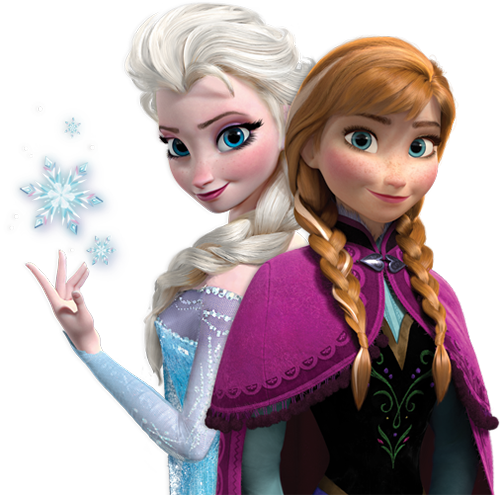
Disney, who just put the first female (albeit co-director) on one of their female-dominated animated films. Based on a screenplay by, and co-directed by Jennifer Lee (with Chris Buck), it's another "Princess" movie that will expand the Disney marketing franchise (with two of them), but as with Pixar's Brave it dares to up-end some story-book conventions, making the royal sisters Elsa (Idina Menzel) and Anna (Kristen Bell) the emotional hub the story revolves around, and relegating the two hunky guys that are standard love interests pretty much transportation tools. This is a good thing.  And especially when the movie sets up "the guys" (one prince/one working stiff) as the solution to the problems and then very briskly pulls the cloth-simulated tapestry out from underneath that cliché.  I like that.  And I like how the solution to "the problems" is bundled very tightly in one unexpected moment that, frankly, shocks, and takes one aback emotionally.  I like that even better.

So, it's not "The Snow Queen."  What is it?  Elsa and Anna are princesses in the kingdom of Arendelle and they're by no means twins—Elsa is older by a couple years, and she has the telekinetic power to freeze things and project snow and ice from thin air.  This delights Anna, but a childhood accident forces the King and Queen to seek the assistance of trolls who save Anna's life, but take away her memory of Elsa's power to prevent such a tragedy from ever happening again.  The Royals also lock up Elsa, keeping her from her sister...and everyone, until she learns how to suppress her powers, usually brought on by her emotions.

The two sisters grow up apart under the same roof, even after tragedy strikes the household.  The two don't see each other until Elsa's coronation day as Queen of Arendelle, but the two are distant even when inches apart, and when the scattered Anna becomes enamored of a visiting prince (Santino Fontana), upsetting Elsa and exposing her powers to the Kingdom.  Elsa flees, now that her frightening powers are out there for all to see.  

You couldn't miss it.  She's dropped Arendelle into a permanent winter, with no way to get it out.  It's up to the plucky Anna to go after her and try and mend fences and thaw her relationship with her sister and the town.

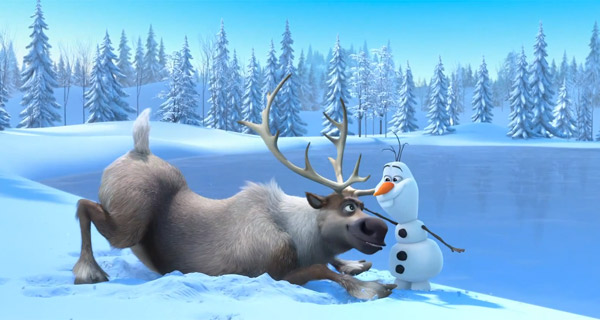
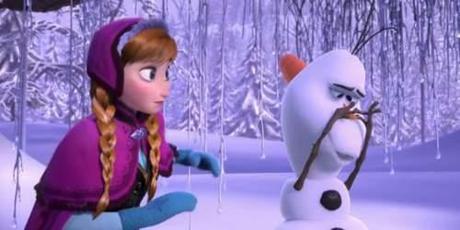
Prince Hans is a love interest, but so is an ice-cutter that Anna finds on her journey (voiced by Jonathan Goff), whose best pal is an anthropomorphized reindeer named Sven.  There's also a walking, talking snowman (created by Elsa) named Olaf.  The revelation of a goofy snowman in the movie was enough to give me a brain-freeze, but, as voiced by Josh Gad (he of "The Book of Mormon"), he's pretty danged funny.  The songs have the same show-connection, as well, as they're a collaboration between Robert Lopez (who co-composed both "Mormon" and "Avenue Q") and wife Kristen Anderson.  That's very much in the tradition of bringing the song-writing team of "The Little Shop of Horrors," Ashman and Menken, to Disney.  The songs are decidedly less Broadway, however, and more "pop" oriented—and will be appearing on the many reality-talent shows on the air in the not-too-distant future—and geared more for a cartoon audience than a theater one.

Again, quibbles.  And if Frozen didn't exactly warm my heart, my brain had some warm thoughts towards it.

Frozen is a Full-Price Ticket (I wouldn't spring for the 3-D, though).


One of three "I Want" songs in Frozen (four if you count Olaf's "In Summer").
Going in...er, "cold," the power-ballad approach makes one cringe, but given the back-story 
preceding it, it's a break-out moment...and a little scary.  In fact, the Elsa character was 
slated to be the villain of the movie until this song's themes of empowerment changed everything.

Wednesday, November 6, 2013

The Fifth Estate

Assuaging Assange
or
Jury Tampering in the Court of Public Opinion

Julian Assange is not a happy camper...camping in the Ecuadorian embassy ("behind Harrod's" as his portrayer Benedict Cumberbatch describes it) in London. He has let it be known in his own little publicity campaign that he does not like The Fifth Estate, and that it is entirely propaganda from unreliable and untrustworthy sources.  I'll take his word for it, as that's been his business model for Wikileaks for quite a few years. 

The problem is that Assange would not be happy with ANY movie of the story unless HE wrote, produced and directed it, so that he could control the information flow to fit his view of events.* Anyone would, really, in the best of all possible worlds. The difference between anyone and Assange is that he actually thinks he could, and not only that, that he should.

The trouble is, Mendak, it may be your story, but it's not your money financing it, and you're kind of a bad risk, if you know what I mean.  

And, if he would do it, he would insist on doing it himself, even though film is a collaborative medium.  Collaboration, however, might dilute the message, and so, really the only person who could be trusted with it is Assange.  Wait for his version in a couple of decades.  That's the trouble with hubris and megalomania, you always get your message out last and console yourself that you got The Last Word.


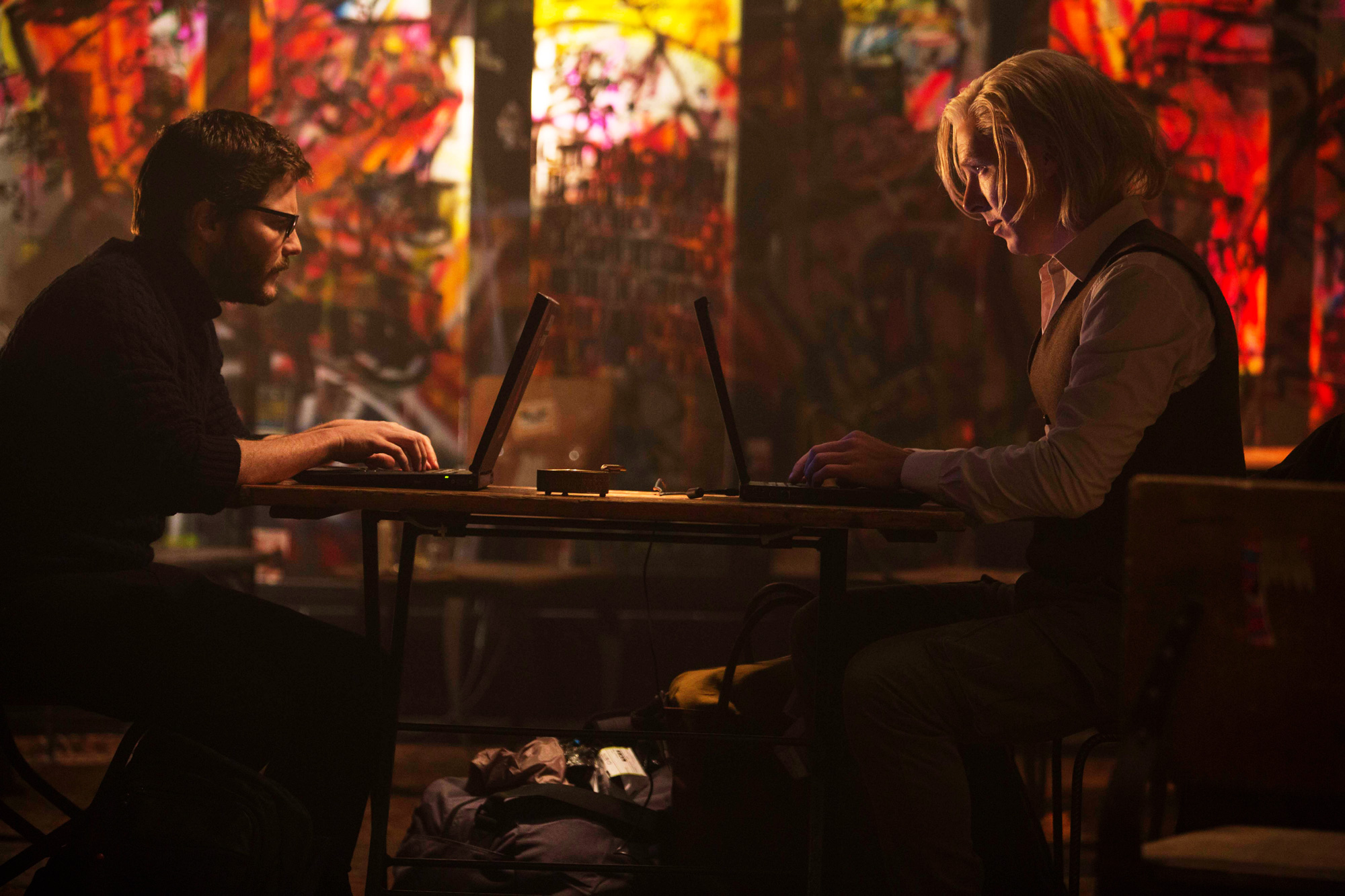
(Well, now that I've revealed my prejudices that I think Assange is a creep and something of a deluded creep...) Bill Condon's film is a return to form on the controversial biographical films he's done in the past (Kinsey, Gods and Monsters), and after mucking about in the very black and white"Twilight" series, here struggles to have any sort of perspective, controversial or otherwise, for a story that is still in process.  It also sweats to make something dramatic out of typing away at laptops, which is intrinsically dull, and about as engrossing as watching a movie about a writer who's writing—good in book form, maybe, but unless you go off into some sort of fantasy-land, it's a completely no-thrills scenario.  

For anyone who's been following the Assange story—which was several headline-making revelations ago—The Fifth Estate does less with the recent Iraq War revelations (some of which—like the "Collateral Murder" video weren't even revelations, having already been published in other sources) than it does with the early ground-breaking days of WikiLeaks, Assange's recruiting of Daniel Domscheit-Berg (Daniel Brühl)—whose book "Inside WikiLeaks" is one of the sources on which Josh Singer (former writer for "The West Wing" —during the non-Sorkin years—and "Fringe") based his screenplay—and the heady days when it exposed corruption in Kenyan elections and dummy-accounting in the Caymans at Julius-Baer.  The worst-kept secret of all was who was running WikiLeaks. Although Assange was the very public face of the site, he would state that there were hundreds of people behind the site, doing due diligence, checking sources, and vetting information that was see the light of day there.

Truth was, there were no "hundreds of people;" it was Assange and Berg and whatever server cluster the two could configure, cobble and co-habit.  Vetting was cursory phone calls, or maybe a clandestine meeting beforehand.  As far as redacting anything that might threaten lives,** that was nearly impossible (and logistically impossible with the release of diplomatic communications that numbered 400,000 in 2010).  As WikiLeaks' revelations become bigger and broader in cope and size, the tiny staff is overwhelmed, keeping an Oz-like public face (Assange's), but not even willing to acknowledge that they might be overwhelmed and out of their depth.  Thus, the "open" source hides the biggest secret of all—there's no infrastructure to the web-site other than Assange and Berg.

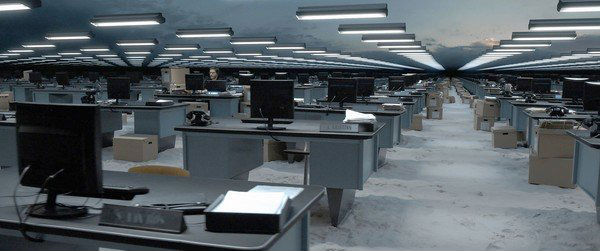
The "reveal" of this information is done in a "cutesy" illustrative manner.  At one stage, Berg wants to talk to the other WikiLeaks members that he's been trading communiques with about sources and information, something Assange is initially reluctant to do.  Then, when it becomes a "make or break" request, he gives in, showing Berg his "hold card"—that the other people Berg has been instant-messaging and e-mailing have merely been alternate Assange accounts.  He's only been talking to Julian, which Berg imagines as a scene out of Being John Malkovich crossed with The Apartment of an infinite number of desks in an office, all with Julian Assange sitting behind them.  It's a little too literal and maybe just a little condescending to spell it out so baldly to the audience, but ultimately that visual metaphor is stretched as, at critical junctures, that infinite number of Assange's keeps coming back to make fantasy-narrative points that seem unnecessary (other than to conjure up that all those Assange's are going to write the complete works of Shakespeare someday).  

The acting is, across the line, superb: Cumberbatch does a fascinating Assange, adroit, and self-contained, like a chess-player, usually thinking about something else than the topic of conversation, and his final bit—an in-character dismissal of "the two films" coming about WikiLeaks (presumably this film and Alex Gibney's documentary) is a cautionary warning; Brühl, seems to be the go-to guy to play Germanic naifs after Good bye Lenin!, Inglourious Basterdsand Rush, and here plays Berg as an all-too-willing apprentice looking for a mentor; Laura Linney, Stanley Tucci, and Anthony Mackie play American diplomats trying to deal with the fall-out, while David Thewliss and Peter Capaldi play two reporters for The Guardian with suspicious hesitance about their "source."


It's a good dramatization, filling in character holes which Gibney's documentary left unexplored.  The two together make a good summary of events that, as yet, have no ending, but have managed to rock the world, making the cyber-world look frighteningly like a glass-house sitting in a field filled with stones.

The Fifth Estate is a Matinee.


* The same attack came from Assange about this year's Alex Gibney documentary We Steal Secrets: The Story of WikiLeaks, which tells the same story, but through interviews and through Gibney's journalistic sensibilities (which produced Enron: The Smartest Guys in the Room, Taxi to the Dark Side, Gonzo: The Life and Work of Hunter S. Thompson, Casino Jack and the United States of Money, and Park Avenue: Money, Power and the American Dream).  Critics have been far harsher on The Fifth Estate than We Steal Secrets, either because 1) the documentary is considered more "legitimate" than the dramatic version; 2) Assange's attacks seem to "stick" better to a dramatic recreation than a documentary, or 3) they actually (at a rate of 95% to 37%—which is quite a swing) prefer the techniques of the documentary to The Fifth Estate . But, then, according to Rotten Tomatoes, they've been harsher on The Fifth Estate than the Stallone-Schwarzenegger yarn Escape Plan, which is just inconceivable, and brings Rotten Tomatoes' validity as an indicator of quality and worth as a taste aggregator into suspicion.

** Assange has said that no "outed" operative has been killed, due to the leaks (although The Fifth Estate fictionalizes one such source (Alexander Siddig) being forced to evacuate with his wife and children (in the same way that Patton fictionalizes what might have happened in WWII if, because of Eisenhower's decision to send gasoline to British tanks instead of American ones, if a tank company all of a sudden ran out of fuel behind enemy lines).  1) Assange is probably not a good source for that kind of information as he'd only get it from "whistle-blowers" who might not want to take claim for any deaths (nor would Assange).  2) It's not going to come from American sources who might not want to further risk others (ie "known associates") of anyone affected by it, despite making the case that there WAS some "collateral murder" (to coin a phrase) and making assange and WikiLeaks look bad.  As someone far more Machiavellian once said "The absence of evidence does not mean the evidence of absence."

Thursday, November 15, 2012

Flight

Flying Inverted
or
Cracking the Whip

It's been years since Robert Zemeckis made a live-action film (the last being Cast Away, all the way back in 2000, the time being taken up with his three motion capture animated films) and this one, Flight, is an interesting choice, quite unlike anything the director has done, but falling in line with his other films about people being left up in the air about fundamental choices in their lives.  

Captain Whip Whittaker (Denzel Washington) is a pilot on cruise-control.  Unfortunately, it's a path that will ultimately crash and burn.  An alcoholic and coke-head, he'll do a layover with a stew (in this instance, Nadine Velazquez), get wasted, and then to get himself #1 on the runway will do a line, so he can do the "pilot walk" to the cabin—all confidence and casualness for the launching of "souls" into the wild-blue yonder.


Even before he takes off, Whip is flying.  But his nonchalance and bon homie gets him through, even through a difficult take-off through low turbulence.  He pushes the plane, but clears the clouds early and restores order to the flight, then settles back to cadge some booze samples, smuggle them into his orange juice and catch some sleep.  He wakes up just in time for a crisis: the plane bangs, then goes into a steep dive that terrifies the passengers and crew (and me) and merely gives Whip a much needed shot of adrenaline.  The only way he can take the plane from pile-driving into the ground is to bank it until he's flying upside down, then skimming the Earth until he can find a clear place to land, then cork-screw right side up and ditching for a landing.

Six people die, two on the crew.  Whittaker wakes up in the hospital with torn ligaments in his knees, lacerations around his eye and no idea how he got there.  First visitor is the pilot's union rep (Bruce Greenwood), then the NTSB who are all "just the facts" and deferential.  Next is Whip's "connection" (John Goodman), a Dr. Feelgood who waltzes in (to the tune of the Stones' "Sympathy for the Devil;" Whip's is "Feelin' Alright"), tells Whip he's a hero, that reporters are hunting him, and criticizes the doctors' choice in pain-killers: "Amateur night!"  All Whip can think about is getting out, but it's not as simple as that.  He's under investigation for the crash (his simple response is "it was a broken plane"), has been lawyered up with an attorney (Don Cheadle) who doesn't like him, thinks he's a creep, but is going to do his job, and on top of it all, Whittaker must deal with a pissed-off ex-wife and a son who doesn't know him, and has no intentions to.

In the hospital, he meets Nicole (Kelly Reilly, you'll remember her as Dr. Watson's wife in the Robert Downey, Jr. Sherlock Holmes movies), who's recovering from an overdose and not in a good way.  Whip is attracted—she's female and weak, which seem to be all that's required—and he whisks her away to his family's small farm and failed crop-dusting business in rural Georgia.  He's already ditched all the alcohol, but after a couple days, he's back in the bag, drinking himself into oblivion while Nicole goes to AA meetings.  Whip visits, too, but when things get personal, he takes off.

Washington is brilliant in all of this, showing both the pilot's strengths and pitiful weaknesses.  His scenes of bleary drunkenness feel real and incomprehensible, and one watches his constant crashing after attempts to bring himself up are painful to watch.  The balance of the film is Whip's cart-wheeling from sober to sloshed, his best instincts superseded by his addictions—a man in constant denial, addicted to lying (and pulling himself out of a crisis) and risk-taking as much as to the hooch.  It's a rough ride to be a part of and even observe, Whittaker constantly pulling himself out of his dives, then going into another tailspin, and you just know the only time he'll level off is when he crashes.  The parallels between flight and addiction are obvious (how far can you push yourself before everything breaks and if you survive, how much further can you push?) and audiences who gripe about all the action being in the first 20 minutes, may not realize that they're watching a parallel course throughout the rest of the movie, only far more personal, and maybe (hopefully) not as relatable.  

It is a tough, emotional roller-coaster to be a part of, but everything is of a piece.  At one point, Cheadle's lawyer puts it succinctly: "Death demands responsibility," and responsibility is one thing Whittaker has never known.  The old Irwin Allen disaster movie posters used to scream "Who Will Survive?" The same applies here, even if the audience-grabbing disaster only occurs at the beginning, and we white-knuckle it to see who'll surface from the rubble.  This is a smart, troubling, painful movie to watch.  But, you can't turn away, either in horror or fascination.

Flight is a Full-Price Ticket.


Whip Whittaker's sobering flight is just the first leg on the itinerary.

Friday, October 19, 2012

Freaks

Freaks (Tod Browning, 1932)  During the pre-Code days, the director of Dracula was given an edict by Irving Thalberg of M-G-M to "outdo" Frankenstein and so produced this mind-blowing soap opera about dysfunction in a circus, with the ambition to show that "they" are as normal as "us" (even though that's hardly a three-ringing endorsement!).  The film was deemed "exploitive," despite casting the human rarities as "good guys" and the venal "normals" as "bad guys," as folks couldn't get past the visuals and pay attention to what the film was actually saying.  Thus, the film was banned in some countries for many years (and there are still probably some antiquated laws on the books in some U.S. states prohibiting the showing of it—in which case, tough luck TCM!)

We are introduced to the story in flashback as a carnival "barker" presents one particular exhibit, the story of it being what makes up the bulk of the movie.  And despite the physical hardships of the various displays, the human rarities seem more concerned with the gossipy interactions, than with dealing with, or suffering, their handicaps.  The mongoloids (called "pinheads") are happily in a family unit, the siamese twins are dealing with in-law problems (as well you could imagine), the half-man/half-woman sets him/herself apart from the others, eyeing in the various male/female conflicts by looking inward, and the midget couple are squabbling—he has eyes for the beautiful trapeze artist (but then, he's a social climber), while she has set her sights considerably lower.

Browning has measured, semi-respectful fun with the populace, saving his contempt for the true freaks at the circus—the angry strong-man and the high-flying trapeze artist.  They're mean-spirited, wicked people out to exploit weakness—and there's a lot of it in this circus.  The metaphor is pushed hard, the lessons imposed in a Grand Guignol style that climaxes in a thunderstorm when the oppressed take on their oppressors (there's one image that's particularly striking—Prince Randian "the Human Torso," born without arms and legs, unstealthily but menacingly approaches his intended victim with a knife between his teeth.  One wonders if he can accomplish the task, but one is quite sure he will and it won't be pleasant, having seen how dexterously he opens a box of matches and lights his own cigarettes).  Exploitative?  Certainly.  But it's also a radical statement of revolution meant to make the complacent less so, given the context with which the film operates—one only imagines an updated version for these times with the Strong Man berating the half-man for the "entitlement" of having arms (ignoring that he has no legs).  A bizarre, though-provoking film—if one can get past the distractions up-front, and get into the tent where the real show is.    

Wednesday, October 17, 2012

Frankenweenie (2012)

Recycled Material From the Grave
or
"I Can Fix This..."

Really, it's a little soon for Tim Burton to be re-making one of his own films—albeit his first live-action short for Disney.  One worries that maybe he's run out of ideas, or that he's simply doing what he's always done—take a property and combine it with that goofy blend of the kinky and ghoulish that he has made his own...it's just that this time the property is his...and he's already made it his own once.  Maybe, he looked at this product of his younger self with limited resources and thought "I can do better. I can do more."  Or along the lines of young Victor Frankenstein, he looked at it his earlier creation and vowed "I can fix this."

At the time of the live-action short, Disney looked at the product of their young animator...and promptly dumped it...only acknowledging it when Burton became an A-list director (with some studio hesitancy) with the first "Batman" film.* Now, Disney is crowing about its brand new Burton movie, and one can only imagine the wry smile that must produce for the director.  It was natural for Disney to want an expansion—they owned the property—and although this new version of Frankenweenie has a lot of (dare I say) re-animation of material, it did give Burton a chance to give it a little more depth and play around without the inhibitions of live action.

I say inhibitions rather than limitations because the differences are exhibited in a weird and rather contrary way, given that the film is done with puppet figures: emotion.  The character of Sparky exhibits a far greater depth of moods than a trained pit-bull terrier could exhibit in live action, not only in its darker moments, but especially in moments of joy—the animation of the dog running elicits fond feelings immediately, as the puppet is rarely touching the ground in motion, not unlike Charles Schulz's "Peanuts" kids who hover over the ground in transit.  And although the human figures are Burton cyphers (resembling the human character designs of his first film Vincent) they are still soulful, their eyes expressing more emotions than their faces will betray. Given that the subject matter is about a mad scientist of a little boy who runs the parallel path of his literary namesake to re-animate his beloved dog, killed in a traffic mishap, there's a lot of room for high emotion there, and far more than in the motivations of the original story.

But, Burton takes it further and makes it more than about young Victor.  Taking pages from The Nightmare Before Christmas and Batman Returns, he stages the denouement at a city festival that brings all parties together in one spot, the communal experience gone awry.  Seems that Victor's work has attracted a lot of attention among his classmates, and as there's a science fair going on, all the kid's are doing the same thing—literally, the same thing, bringing to life their dead pets with very mixed results, and providing Burton a chance to explore other species of monster movies (and recreating scenes from them) than just the one, paying tribute to each, just as he does by including a scene from friend Christopher Lee's turn as "Dracula."  Like Victor's experiment, this is a labor of love as Burton—just as with the earlier short—resurrects the movies he loved as a kid, long-buried memories that never really leave, and have influenced Burton throughout his career.  It's a fun, resonant electrification of his earlier work, with just enough fresh in it to make it worth the effort and bring it back to new life in leeched black-and-white (which Burton always manages to make look sumptuous).  Now, if only we could see something wholly new and original from him, that would be some experiment.


The original Frankenweenie


Brad Bird's "Family Dog" (based on animation designs by Tim Burton)

* It did find it's way to Paul Reubens who'd been trying to find a suitable director to collaborate on his long-in-the planning Pee-Wee Herman movie he'd been dreaming about.  Frankenweenie convinced him to contact Burton.


Friday, June 29, 2012

Fat City

Fat City (John Huston, 1972) Fat City got a lot of positive critical attention when it came out in '72 and one sees why.  It must have been surprising for a lot of critics that, after a couple of movies (The Kremlin Letter, Sinful Davey, A Walk with Love and Death) that seemed to be desperate to reach a youth market or cater to the looser restrictions on subject matter, that the veteran director could still pull off a gritty down-on-your-heels story and make something new out of it—the old dog still had some tricks up his sleeve, and could do a change-up of genre and tone and come up with something as impressive as the young turks starting to enter the field, like Friedkin and Coppola.  

But it shouldn't have surprised anybody.  Huston was a gambler by trade and by hobby, and was never afraid of taking on different approaches to telling a story.  Sure, he could take a mis-step here and there, especially when he tried to do somthing "of the times," rather than in his own perenneal classicism.  It was always story for Huston, and he was never afraid to take things in complex directions.


Fat City is a tale of two boxers—Tully (Stacy Keach) and Ernie (Jeff Bridges) one on the way up and one on the way down, but the only difference between the two, career-wise, is in the timing.  Ernie is in the early rounds of the bout, all pupptish energy and vigor.  Keach's Tully is in the later stages of the fight, battered, bruised, and tired, having known defeat and the ocassional victory, always just out of reach of a right jab.  When we first encounter them, Ernie has yet to have his first professional fight.  Tully is a couple years out of the ring, barely subsisting.  He's scarred over, but that hardening of tissue, mostly keeps the sense-memory of past victories ringing in his head.  Both mean are trying to get into the ring, one with no way of knowing what will come when he's in it, and the other all too aware of the toll it will take...but, anything is better than his current situation.  As it's said in The Shawshank Redemption, you either gotta get busy living or get busy dying.  In this case, living is fighting.  And for the older pugilist, there's still some fighting to be done, rounds to go before he sleeps.

Huston has had many great male performances under his direction, from such as Bogart, Gable, Clift, Brando, Connery, Finney, but I don't think I've ever seen a better performance in one of Huston's films than Stacy Keach in this.* In whatever you've seen him in, nothing prepares you for the internalized pain that Keach conveys in every aspect of his performance. And there's one moment that will stay with me for the rest of my life. During the fight-centerpiece of the film, when Tully makes his comeback, he's knocked to the canvas, but never counted out. He spends an interminable nine seconds on his knees and elbows, head hanging—and there's a moment, a long moment, when you wonder if he's going to get up—if he even wants to get up. Then, he rolls up into a rickety stance to complete the last few seconds of the round. The fighters retreat to their corners and Keach sprawls on his stool, as the cut-men treat a bleeding gash over his left eye.

Huston stays on Keach's face, and there is no expression on it—none.  So, you go to his eyes, which are dead, betraying no light and no spark.  There may be nothing going on in his mind except the most primal reptile instincts to survive; his head is a black hole, nothing leaves, and there may be nothing to leave.  He's a shell, hollow and broken.  That look will show up again in the film, as a final note, lacking in grace, the soundtrack empty, giving a brief glimpse of death, a living one, yes, but a death that still haunts.


Keach in Huston's Fat City
* Everybody is good in this, but one should also note Susan Tyrrell's feisty, free-wheeling performance of a drunk bar-fly that is on par with Keach's and  feels so real you want to throw up your hands and give up.

Tuesday, April 26, 2011

The French Connection

The French Connection (William Friedkin, 1971) Peripatetic police thriller with discernible street-grit in the film-emulsion, The French Connection, adapted freely from Robin Cook's "True Crime" book, tells the story of two New York police detectives Eddie "Popeye" Doyle and Buddy Russo (Gene Hackman and Roy Scheider, playing the noms de film of real-life detectives Eddie Egan and "Sonny" Grosso) tracking a high-level cocaine operation from overseas. 

The French Connection won the Best Picture Oscar, which seems like a good choice until you realize it was in contention with A Clockwork Orange and The Last Picture Show (as were Fiddler on the Roof and Nicholas and Alexandra).*  Then, the choice feels as safe and conservative as can be.  Yes, it's gritty.  Yes, it's "edgy," but does it have anything to say, besides that sometimes the good guys have to be rough with the bad guys in order to break even on the law and order scales, and that outlaws have an easier time of it simply because they're outlaws, bending the rules?

Not really.  But The French Connection did take police procedurals in another direction.**  The cops were less formal in their attire and language, and tougher in their asking questions.   Friedkin took a near-documentary approach to the subject matter (with the help of Owen Roizman's inelegant constantly searching subjective cinematography), while conveying the frustration that cops, though maybe not crossing the "T's" and dotting the "i's" on the letter of the law, go through to try to achieve a legitimate, legally-binding collar.  One is left with a morally ambiguous ending in which lines are crossed to merely achieve a semi-positive result, as opposed to the greater good.

And everyone remembers the car chase.


But, the biggest through-line of The French Connection is Friedkin's constant contrasting of the cops and drug-dealers as diametrically opposed in almost every way.  Charnier (Fernando Rey) and his traffickers travel and conspire unimpeded, while the detectives skulk and blend in with the savage streets and observe their targets working out in the open.  The criminals live the high-life, dining and dressing elegantly, while the cops sit in the cold, eating stale sandwiches and swilling bad coffee on their stake-outs, dealing with bureaucracies and competing enforcement agencies, as the bad guys routinely handle such impediments punctually with gun-fire.

It is only at the end when a police road-block stops the conspirators in their tracks that the tables are turned, and the lines blur, and the ambiguities become real.  And what is essentially a police chase has no discernible finish line.


The real-life Eddie "Popeye" Egan with the fictional Sonny Russo  (Roy Scheider)


* It was also the year of Straw Dogs, Dirty Harry, McCabe and Mrs. Miller, Walkabout, Carnal Knowledge, Klute, and Harold and Maude, none of which made the Best Picture category and in some cases, received no nominations, at all.

** Wikipedia has a funny story about Friedkin's behind-the-scenes decision-making.   The director was living with the daughter of legendary director Howard Hawks, who suggested that since Friedkin's pictures were "lousy," he should put a good chase in the movie "better than anyone's ever done."

Saturday, March 26, 2011

Fire in the Sky


Fire in the Sky (Robert Lieberman, 1993) I once remarked to a family in distress that they'd gone through "everything except alien abduction." Not the most comforting of consolements.

But, if you believe Fire in the Sky (and that's not easy...), alien abduction can be pretty dull.

"Based on the (proverbial) True Story"—but trumped up by screenwriter Tracy Tormé from Travis Walton's account, evidently because studio executives found the story boring—Fire in the Sky tells the story of Walton's disappearance in 1975 around the area of Snowflake, Arizona.  What's different about the Walton story is that it was witnessed by several of his co-workers who were clearing brush for the Forest Service.*  They didn't actually see Walton lifted by the bright blue-green light into the bright disk that attracted them to the area.  He was lifted a couple feet into the air, then knocked to the ground, prompting his friends to gun their truck and get the hell out of there...like the friends they were.  They came back for him...but the disc and Walton were gone.

Cue the theremin.

The initial phone call to the police merely said that Walton was "missing." The abduction story didn't come up until they actually met with the local constabulary to report that he was gone.  An extensive search ensued, lasting five days, until Walton called from a phone booth to ask to be picked up at a gas station—he was fully clothed, wearing the same clothes as the last time he'd been seen, and not naked as the movie depicts.

So...what happened?  The "story" had attracted attention, not only from police, but also "ufologists" from around the country, who flew to Arizona as if it was Mecca.  The story became bigger than the described spacecraft (8 feet high, 20 feet across) could contain.

And that's what Fire in the Sky is about—the turmoil on the ground between the friends and Walton's relatives and the police and the "experts."  It's a tale of suspicion, speculation, confused facts, guilt, and accusation....with elements of torture by black-eyed beings that looked like fetuses.  Of course, the latter is the most interesting part, so they save it for near the end—with Travis kept in a huge honey-combed hive until he escapes and starts making the aliens' lives difficult.  It bears little resemblance to his story, which involves actually moving the controls of the ship, and visits by smiling human-resembling "ambassadors."  The movie's sequence involves horror elements and probes and sticky shrouds.  The rest resembles a Lifetime movie with aliens instead of oxycontin.

Whether it's true or not seems irrelevent.  The story and the movie made from it is dull.  It only leads to wondering why advanced aliens choose to scope out the limited life-forms on Earth in rural areas at night, why they avoid cities or cultural centers (maybe they saw how well it went in The Day the Earth Stood Still?) or even people with a phD or a Master's degree...in anything.  There's only one thing sure, and that is, while the upper 1% of this country have 38% of the wealth, the lowest seem to get all the alien abductions.


* One of the things that brings up red glowing pulsating flags is that the job they were doing was running behind in schedule, and the crew had been working quite long hours to make up time.  There was some speculation that the whole thing was cooked up because the job couldn't be finished, and the disappearance was a convenient distraction.  But, that the contractor never invoked the "act of God" clause to get out of it, flies in the bug-eyed face of that theory.

Saturday, February 5, 2011

From Dusk Till Dawn

From Dusk Till Dawn (Robert Rodriguez, 1996) Quentin Tarantino had just won an Oscar for co-writing Pulp Fiction, and followed it up by writing this mocking over-the-top vampire movie.  He grabbed Desperado director Rodriguez to direct it (so he could concentrate on his acting—and he's not bad here), starting a career-long association, and George Clooney used it to re-start his movie career while still in his "E.R." bobblehead days, back before he decided he'd take his movie choices seriously

He wasn't doing that here.  This one's a black-crested lark of comic violence and obscene intentions, a nihilistic exploration of...well, absolutely nothing.  It's what Rodriguez and Tarentino do at their worst—make crap they like, but is so "inside" as to be a private joke for their own giggling pleasure.

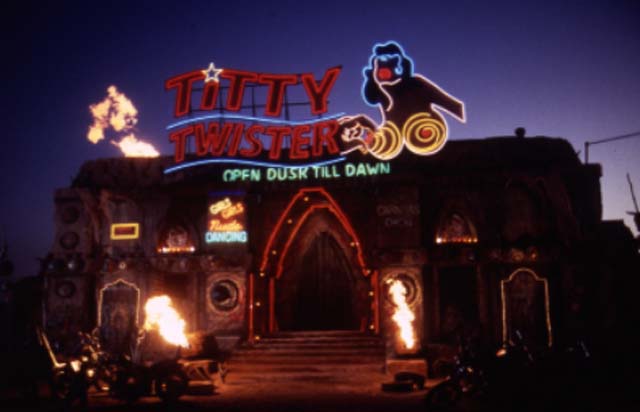
The Gecko brothers (Clooney, Tarantino) are nihilistic criminals trying to make their way over the Mexican border.  After an incendiary one-stop robbery, they kidnap a family, the Fullers (Harvey Keitel, Juliette Lewis, Ernest Liu), to smuggle them across the border where they end up at the infernal strip-club, The Titty Twister, which holds a deep dark secret once the sun goes down—it's run and jobbed by vampires.  Yup, an 24 hour-a-day joint filled with blood-suckers.  But, for some reason, opening up the saloon doors doesn't eliminate the staff and add a new layer of dust to the floor.  Nor, would the nightly slaughter of customers fail to attract a new clientele.

Odd, that.

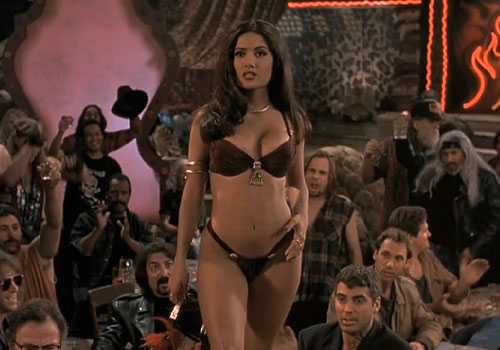
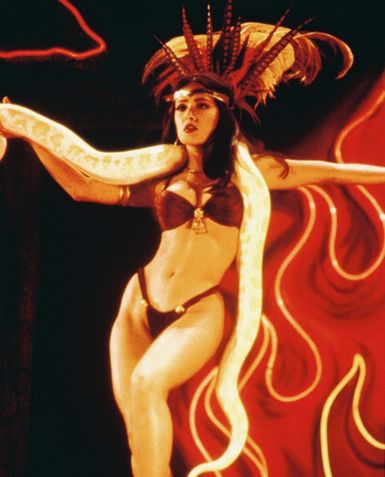
But, it does provide a lot of bulbous make-up effects, a lot of ultra-squishy violence done to living and dead alike, and appearances by B-movie stalwarts Fred Williamson, Cheech Marin, and make-up maven Tom Savini—who didn't do any of the make-up.  By the end, there are so many holes in people that it almost outnumbers the holes in the plot (QT's Richard Gecko sustains an early gunshot clean through his hand—you can see through it—and yet he keeps using that hand in the film, even though the bones in his palm have been blasted through, which is a nice trick—howdy dood that?).  Richard's a creepy sleezoid, while Clooney's Seth Gecko is just a cocky little bastardIt must have felt good to get that out of his system, but the results are so thoroughly hackneyed and cock-eyed and cartoonishly vile that one has to have a pretty bad day kicking puppies to get any real enjoyment out of it.  A highlight is Salma Hayek's stripper performancewhere she doesn't strip

Fortunately, nearly everyone in the movie has gone on to better things.  So should you.

Friday, January 21, 2011

The Fighter

"Put Back What You Use"
or
"I-Yi-Yi-Yi-Yi'm Not Your Stepping-Stone"

The family that preys together, stays together.  For the extended family of boxer Micky Ward (Mark Wahlberg), the preying is mostly internal although they have the illusion that they're getting the best of everybody else.

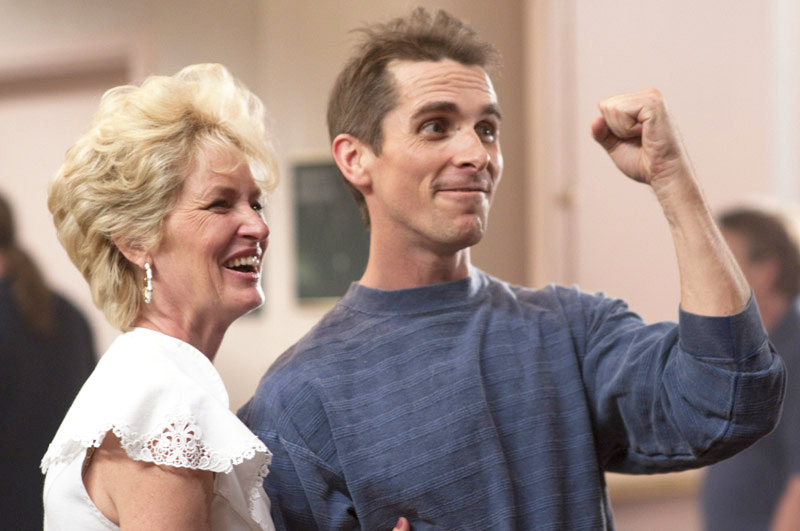
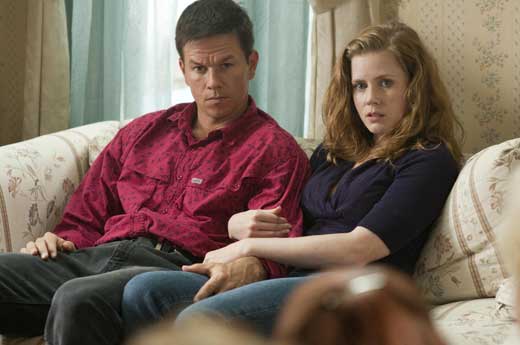
Micky is the younger brother (step-brother, actually) of Dickie Eklund (Christian Bale), former up-and-coming boxer, who had one glory moment: knocking down Sugar Ray Leonard in a match some years before.  Now, he's a part-time trainer for his half-brother and a full-time crack addict.  HBO is making a documentary about Dickie, who, despite his years and habits, still thinks he's on the comeback trail.  But the pipe keeps him missing training sessions with Micky, leaving the heavy lifting to his trainer (Mickey O'Keefe playing himself).  While the boys' lioness of a mother (Melissa Leo) manages Micky and enables Dickie, it leads to some bad decisions on matches for Ward, leaving him battered and disillusioned.  The higher-ups at the sports networks have Ward pegged as a "stepping-stone," the fall-guy they use to advance other fighters in the winning circle to boost ratings, and that reputation follows him around his home-town of Lowell, Massachusettes.  Ward's on a downward spiral, and any outside help is treated with suspicion.  "You can't trust that guy.  He ain't family." says Dickie, lounging in the limo his brother's money rented, sucking a beer.

Yeah.  About that...

Perspective is all in The Fighter.  And the boxing motif is the perfect setting.  Micky is caged by his relations with his family, but every time he tries to strike out on his own, he gets attacked by Mom (playing the suffering card), step-brother hangs back and then takes his licks, and a coven of sisters and half-sisters are a unified greek-chorus of mom-ditto-speak.  All you need to make this a match is a soft canvas to fall on, so Micky's a fighter always on the defensive.  It's no reason he doesn't say much, but the eyes are far away, looking for a way out, looking for an opportunity to make a move, looking for anything.

"Your fahther looks at my ass, too, but at least he tawks ta me," says Charlene (Amy Adams, while not looking at him), the "bah-girl" Micky keeps staring at.  Micky's so down for the count, he thinks even she's out of his league.  And she might be, but she keeps showing up in his corner, alarmed at the punishment he's taking.  When she questions it, Micky tells her everybody's not concerned.  "Who's 'everybody?'" she asks.  "My mother, my brother," he replies.

Yeah.  About that...


The Fighter is a mostly true story.  Ward is a better, tougher fighter than the movie wants to give credit for (the underdog status makes for a better story, I'm sure, but the dismissive commentary on the soundtrack during the fight sequences is the real thing...taken from the actual broadcasts...Ward was considered an underdog), and Dickie DID do all those things, but his timing was a bit better in real life.  One wants to say that the best character arc in the movie is Dickie's, but that would be falling into the appreciation trap the movie sets up.

Because Micky's is the best character arc, although it seems a very simple Rocky-like success story on the surface.  It's the approach that Micky takes with the forces in his life that are tearing each other apart which is the most interesting aspect of the story.  Micky has been wronged by his family, but he won't discount their worth, or their place in his life, even over the objections of his new supporters—they have to find a way of dealing with each other and their conflicts, with or without him.  For a fighter to take the stance that he does, reaching compromise with the warring factions in his life—to stand up and take control, risking everything from everybody—is a complete negation to what he does for a living and how he was raised.*  The acting kudos are going to go to Bale (who is incredible, not to slight him) and Leo and Adams (who has two great scenes involving an intercom, and throws some nice punches in a chick-fight), but Wahlberg is the champ in this movie, with the tougher part (he trained for this through his last six roles), which he does almost purely physically.  Micky is a man of few words, and not too many moods, but Wahlberg, restrained and less showy, does all of it with body language and does the difficult fight scenes, as well—in the latter taking a lot of body-blows that are not hidden with oblique camera angles or trickery.  Wahlberg has worked with director David O. Russell before—in fact it was Russell's war pic Three Kings that first showed how good an actor Markey-Mark could be.  Russell keeps the movie on edge with quick cutting and an improvised feel, even managing to make the final fight scenes nerve-rattling, despite the suspicion that one is going to see a typical boxing picture ending.  But, his assurance with good material, performed by such a dedicated cast, manages to keep the movie on its feet, even at the final bell.

The Fighter is a Full-Price Ticket.


Micky and Dickie at the time of the events of the film

* The real-life Ward did much the same thing, often befriending his opponents, including Arturo Gatti, the fellow he boxed in his last three epic fights, often described as the greatest in the sport.  Ward was a dedicated, fearsome fighter, but admired his opposites in the ring, and their talents.  The two fighters, who put each other in the hospital, continue to be good friends.  I find that amazing...and admirable.