Showing posts with label Mark Wahlberg. Show all posts

Friday, January 21, 2011

The Fighter

"Put Back What You Use"
or
"I-Yi-Yi-Yi-Yi'm Not Your Stepping-Stone"

The family that preys together, stays together.  For the extended family of boxer Micky Ward (Mark Wahlberg), the preying is mostly internal although they have the illusion that they're getting the best of everybody else.

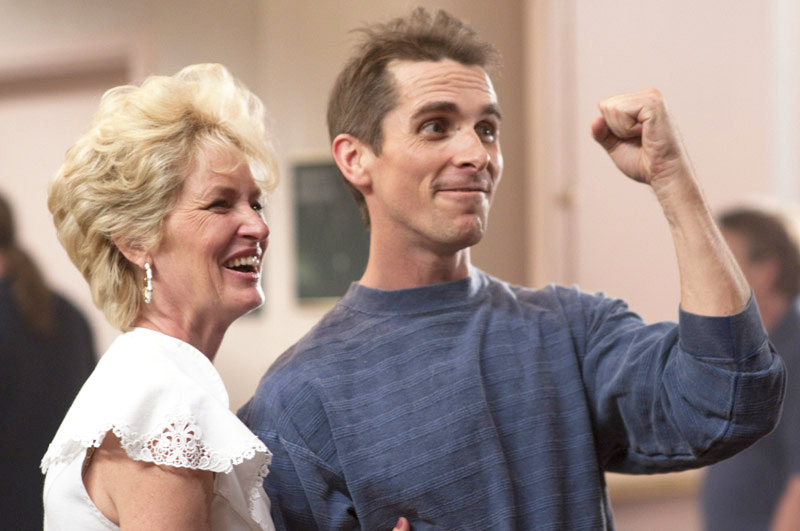
Micky is the younger brother (step-brother, actually) of Dickie Eklund (Christian Bale), former up-and-coming boxer, who had one glory moment: knocking down Sugar Ray Leonard in a match some years before.  Now, he's a part-time trainer for his half-brother and a full-time crack addict.  HBO is making a documentary about Dickie, who, despite his years and habits, still thinks he's on the comeback trail.  But the pipe keeps him missing training sessions with Micky, leaving the heavy lifting to his trainer (Mickey O'Keefe playing himself).  While the boys' lioness of a mother (Melissa Leo) manages Micky and enables Dickie, it leads to some bad decisions on matches for Ward, leaving him battered and disillusioned.  The higher-ups at the sports networks have Ward pegged as a "stepping-stone," the fall-guy they use to advance other fighters in the winning circle to boost ratings, and that reputation follows him around his home-town of Lowell, Massachusettes.  Ward's on a downward spiral, and any outside help is treated with suspicion.  "You can't trust that guy.  He ain't family." says Dickie, lounging in the limo his brother's money rented, sucking a beer.

Yeah.  About that...

Perspective is all in The Fighter.  And the boxing motif is the perfect setting.  Micky is caged by his relations with his family, but every time he tries to strike out on his own, he gets attacked by Mom (playing the suffering card), step-brother hangs back and then takes his licks, and a coven of sisters and half-sisters are a unified greek-chorus of mom-ditto-speak.  All you need to make this a match is a soft canvas to fall on, so Micky's a fighter always on the defensive.  It's no reason he doesn't say much, but the eyes are far away, looking for a way out, looking for an opportunity to make a move, looking for anything.

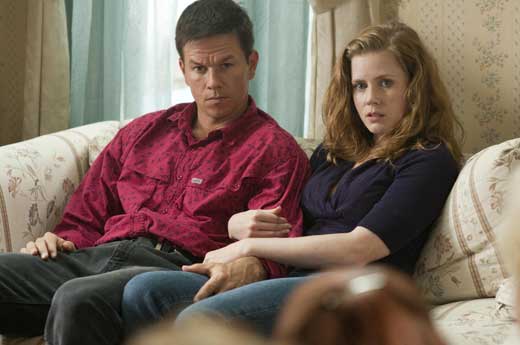
"Your fahther looks at my ass, too, but at least he tawks ta me," says Charlene (Amy Adams, while not looking at him), the "bah-girl" Micky keeps staring at.  Micky's so down for the count, he thinks even she's out of his league.  And she might be, but she keeps showing up in his corner, alarmed at the punishment he's taking.  When she questions it, Micky tells her everybody's not concerned.  "Who's 'everybody?'" she asks.  "My mother, my brother," he replies.

Yeah.  About that...


The Fighter is a mostly true story.  Ward is a better, tougher fighter than the movie wants to give credit for (the underdog status makes for a better story, I'm sure, but the dismissive commentary on the soundtrack during the fight sequences is the real thing...taken from the actual broadcasts...Ward was considered an underdog), and Dickie DID do all those things, but his timing was a bit better in real life.  One wants to say that the best character arc in the movie is Dickie's, but that would be falling into the appreciation trap the movie sets up.

Because Micky's is the best character arc, although it seems a very simple Rocky-like success story on the surface.  It's the approach that Micky takes with the forces in his life that are tearing each other apart which is the most interesting aspect of the story.  Micky has been wronged by his family, but he won't discount their worth, or their place in his life, even over the objections of his new supporters—they have to find a way of dealing with each other and their conflicts, with or without him.  For a fighter to take the stance that he does, reaching compromise with the warring factions in his life—to stand up and take control, risking everything from everybody—is a complete negation to what he does for a living and how he was raised.*  The acting kudos are going to go to Bale (who is incredible, not to slight him) and Leo and Adams (who has two great scenes involving an intercom, and throws some nice punches in a chick-fight), but Wahlberg is the champ in this movie, with the tougher part (he trained for this through his last six roles), which he does almost purely physically.  Micky is a man of few words, and not too many moods, but Wahlberg, restrained and less showy, does all of it with body language and does the difficult fight scenes, as well—in the latter taking a lot of body-blows that are not hidden with oblique camera angles or trickery.  Wahlberg has worked with director David O. Russell before—in fact it was Russell's war pic Three Kings that first showed how good an actor Markey-Mark could be.  Russell keeps the movie on edge with quick cutting and an improvised feel, even managing to make the final fight scenes nerve-rattling, despite the suspicion that one is going to see a typical boxing picture ending.  But, his assurance with good material, performed by such a dedicated cast, manages to keep the movie on its feet, even at the final bell.

The Fighter is a Full-Price Ticket.


Micky and Dickie at the time of the events of the film

* The real-life Ward did much the same thing, often befriending his opponents, including Arturo Gatti, the fellow he boxed in his last three epic fights, often described as the greatest in the sport.  Ward was a dedicated, fearsome fighter, but admired his opposites in the ring, and their talents.  The two fighters, who put each other in the hospital, continue to be good friends.  I find that amazing...and admirable.

Thursday, August 26, 2010

The Other Guys

"Did That Go the Way You Thought It Was Gonna Go? Nope."
or
"Anything You Say Can and Will Be Used...(what's the rest?)" "As a Flotation Device..."

More comedy, and this one's even very funny for its first half, but then, once one scene goes sideways and doesn't work, the whole thing falls apart like a hostage situation gone wrong.  And the audience is the hostage, waiting for it to kick back in...but it never does.

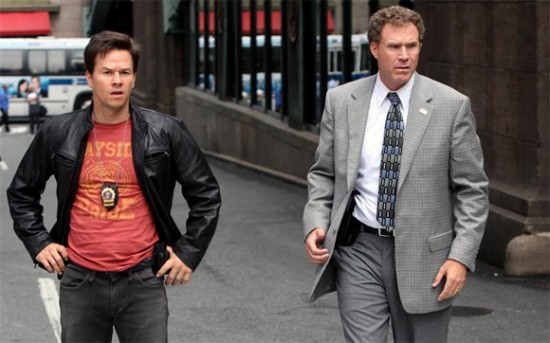
Allen Gamble (Will Ferrell) and Terry Hoitz (Mark Wahlberg) are two New York City detectives working in the considerable shadow of detectives Danson and Highsmith (Dwayne Johnson and Samuel L. Jackson in nice parodies of their "serious" screen-work), a team of glory-hounds for whom property damage is all in a day's conflagration, but who refuse to do the paperwork.  Gamble is self-described as "an accountant for law-and-order," and Hoitz is riding a desk-job after a shooting that goes wrong.*  Gamble loves the mundane filing, but his partner Hoitz, itches to be "in the field."  "I'm a peacock!" he is fond of remonstrating.  "You've got to let me fly!"   At which point, he is reminded that peacocks do not fly.**

Unperturbed, and when advancement in the ranks becomes possible, the two glom onto a white-collar crime that Gamble has discovered that has connections to a series of high-profile robberies.  The mis-matched pair (Hoitz is volatile, Gamble is eerily up-beat) are completely street-dumb and their investigation is constantly being dis-railed (sometimes literally) by distractions and their lack of ability to resist the charms of their high-rolling suspect's lifestyle.  Their increasing frustration with the case and each other (as well as Hoitz's relationship problems, in contrast with the milquetoast Gamble's inexplicable attractiveness to women) is fertile ground for situations that explode in conflict.

It works and works gang-busters for the first hour.  The combination of loose script and improvisation is beefed up by all the actors (especially Ferrell and Michael Keaton,*** who does quick-silver wonders with the cliche "harried Captain" role), especially when the story is building and we're getting to know the characters.  The "left-field" surprises come fast and loose, and the timing by the actors (and the editing) is crack.  One senses trouble early on when Anne Heche (uncredited, by the way) is given a thankless role in which she's really not allowed to do anything funny...or much of anything.  But Ferrell, for the most part, is at the top of his game playing the contrary stiff in a room full of crazies, and Wahlberg who, depending on the material, can be brilliant, plays pathetic frustration hilariously.  Even Eva Mendes acquits herself well in the mix, milking laughs out of the role of Gamble's absurdly perfect wife—Gamble's sexual magnetism makes for a great series of running gags throughout the movie.

But, right at the point where Bob, the union rep, gets dissed and leaves the room, the entire movie goes flat.****  Maybe the improv was getting too expensive and they decided to "coast."  Maybe the assurance of an "action-filled" finale made them scrimp on the script.  Maybe the irrelevant story-line getting in the way changed the tone.  Maybe everyone got tired.  But, for whatever reason, "The Other Guys" is two movies..."Good Cop" comedy and "Bad Cop" comedy.

Interestingly, the most useful part of the movie is the end credits where the increasing disparity between the incomes of the top 1% earners and the rest of us is presented in chilling graphic detail.

"Wilhelm" Alert @ 1:30

"The Other Guys" is a Rental.

* Hint:  He's called "The Yankee Clipper" around the squad-room.

** What can I say?  It's New York, and the Bronx Zoo is the closest they come to a peacock.  Peacocks do indeed fly, but it's a brief, clumsy, scary thing to watch—which I think was the point of bringing it up in the movie.

*** Yeah, yeah, I know, it won't happen and it would be recast with Tom Cruise and Denzel Washington in the roles, but I'd love to see Keaton and James Woods go head-to-head with each other...in anything.  It would be dizzying...and probably only discernible at half-speed.

**** It's funny I can pinpoint it, because that's where the movie became NOT funny, and I thought to myself..."Well, THAT didn't work..." and watched to my amazement as very little worked after.

Saturday, January 16, 2010

The Lovely Bones

"My Name is Salmon. Like 'Swimming Upstream.'"

I had a heated movie discussion with a friend about "Mystic River" one evening. "Explain to me why you don't like it," I said, genuinely curious.

For those who haven't seen it (and it is a tough slog), it's Clint Eastwood's film of the Dennis Lehane novel about the death of a hoodlum's daughter and his steps to exact revenge. The object of the hood's scrutiny becomes his childhood friend who was kidnapped by pedophiles as a child, a violent act that has colored his adulthood. Tough stuff, but I have high regard for the film, despite the broad (and Oscar-winning) acting by Sean Penn and Tim Robbins.

But the friend couldn't abide it. "Why?" I kept persisting. And finally it boiled down to "there are some subjects—like the victimization of children—that have no place in movies. Now, I could point out all sorts of films, from "
The Wizard of Oz" to "Empire of the Sun," that, unpleasant though they might be at times, convey the theme and are still great films. However, Peter Jackson's film of "The Lovely Bones" had me recalling this conversation, and sympathizing with my friend's attitude.

The award-winning and best-selling novel tells the story of a murder victim—a child of 14—and her experience after death, watching the effects her non-existence has on her family and murderer, as her sense of unfinished business keeps her tied to a "between-place," unwilling to move on, until there is some sense of closure on several fronts, those being her family's efforts to find her killer, her killer's obsession with her and with other family members, the internment of her corpse, and that first kiss with the boy she was falling in love with.

Eh?

Uh...we'll get back to that.

Jackson film differs slightly from the novel (the parents' story is given an upbeat resolution and it's a first kiss, rather than a sexual experience with the boy), but, however much he tries to perfume it, it's still the story of a rotting corpse in a bank-safe. That may sound brutal, but that's what "The Lovely Bones" is, constantly winging back and forth from the girl's conception of heaven (which Jackson conveys as an ever-evolving series of candy-colored landscapes depending on the girl's mood, somewhat reflective of her earthly experiences) and the mordant reality back on terra firma. The lack of satisfying resolutions in some of the cases has a cruel feel to them and, perversely, that may be the only saving grace from the relentlessly oppressive pity-party of "The Lovely Bones"—there is no justice, shit happens and sometimes it happens appropriately in some karmic equation, but it's not the Universe's job to make us feel good by balancing the scales. Jackson provides some lex talionis (at the demand of preview audiences, bless their little Roman hearts), but it's an indifferent cosmos, not a buttoned-up drama, and certainly not a wonderful after-life.

That's the underlying theme of the story, which is creepy and morbid enough, but
you throw in Jackson's interpretation and it turns downright cloying. Jackson and his writing collaborators Fran Walsh and Philippa Boyens make it dreamy and moony in that hormone-addled manner that appeals to young teenage girls (and made the "Twilight" series a phenom') and (lest I be accused of being sexist) not far from the über-romantic manner Francis Ford Coppola filmed his gang story "The Outsiders."* And Jackson is a precise director, one who delves into the details, rather than the over-arching idea. This helps when given a vague impressionistic series of novels like Tolkien's, but it also leads to things like his monstrous 3-hour "King Kong" (Jackson's favorite film is the 1933 version), where the journey to Skull Island is interminable, sequences that flew by in the original drag on and on, and the general deep-love lethargy of the thing drops it like the big ape to the side-walk. "The Lovely Bones" is a series of close-ups, swooping camera moves that graze the edges of things and catch life in clusters and clumps and fussy little details. It has jokey little references to Jackson's other films and a cameo of him that seems indulgent. It's in those little moments that you wonder if the director has forgotten he's making a movie about a girl who's been raped and murdered.

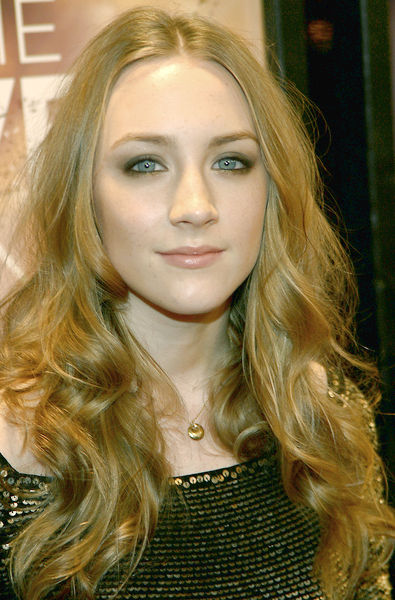
The audience is spared the actual attack (in a spiritual slight-of-hand that sets up the way she can interact with the living that's a wee a bit...convenient), no thanks for small favors. But the creepiest thing about the movie, beyond the trivialization of an After-Life as merely a CGI Disney Channel fantasy (or worse, it reminded me of the land of the Teletubbies), the brutish smugness of its tone, or its moony-goony morbid romanticism is that, of all the characters in the scenario, the one we are given the most information about is the killer. Despite the herculean work of Saoirse Ronan (she was the youngest of the Briony's in "Atonement"**) as Our Girl in Purgatory, Susie Salmon, where the film-maker gets his jollies is showing the planning, the drafting, the intricate handiwork and the general creepiness of the serial killer hiding in plain sight. That he is portrayed by one of the better actors in the cast doesn't help. Mark Wahlberg, who can be quite good, here has the same puppy-earnestness that threatens to turn him into this generation's Steve Guttenberg, Rachel Weisz seems lost and her complicated motivations are lost between edits somewhere. Worst of all is Susan Sarandon as Susie's grandmother, meant to be comic relief, but who is so cluelessly self-centered and destructive, one can't help the stray thought that she had a hand in the killing.

I haven't read the novel, so I can't account for the interest—evidently it is written well, but that doesn't translate to the screen. It shares one unique aspect that Jackson is a bit successful in communicating—the empathetic relationship that victims of the same attacker must feel for each other. It stems from author
Alice Sebold's own violent attack, and her learning subsequently that an earlier victim had been killed. Certainly a novel life-experience, and probably too common in these berserk days. But, whatever empathy in the original is ground up in the film-making machinery. Perhaps it shouldn't have been made at all.

The only reason I can think of for the film to exist (outside of the monetary gain of the makers) is as a cautionary tale of warning to gullible teens...and fulsome directors.

"The Lovely Bones" is a Cable-Watcher.

* Coppola filmed two S.E. Hinton "young adult" stories, "The Outsiders" and "Rumble Fish." "The Outsiders," he said, was filmed in the romantic way teenagers would make it, "Rumble Fish" the way he wanted to make it.

** It is a fine performance, and Roran at the time of filming two years ago, still had the awkward duckling look of a developing teen. At the premiere, she looks like she could be a Redgrave
.


Monday, June 16, 2008

The Happening

It's a Mighty Wind that's Blowing, and it's Blowing You and Me

The premise for this latest film by M. Night Shyamalan was probably inspired by this mass-prank coordinated and executed in New York's Grand Central Station. To vid:


It's a chilling little conceit. And so simple. Suddenly a hub of activity comes to a dead, inexplicable stop. And for long moments, those left out of the freeze, are of several minds. Why is everybody stopping? Are they paralyzed? Why am I not stopping? Will I "stop" soon?

What's going on? What's happening?

And writer-director M. Night Shyamalan is adept at exploiting such a mood, and sometimes even seeing it through to a thought-provoking, even transcendant conclusion.


Not this time.


Here, the whole idea of the movie is just its entirely creepy opening sequences, then the movie meanders along with some vague characterizations and even vaguer stabs at explanations that come down to being as underwhelmingly non-committal as "Hey, shit happens." Hitchcock got away with "bird-shit happens" in "The Birds," but that was because he had some interesting character conflicts to resolve and to test. Here, the main focus of the film, the young troubled couple, Elliott and Alma, are as drab and dreamy as can be, and her problem--she's unable to emotionally commit--isn't enough to hang the whole movie on.

Mark Wahlberg can be terrific. I thought he was the best thing, along with Alec Baldwin, in the star-heavy Scorsese film "The Departed." Here, he plays a science teacher, who, when confronted with something outside his ken, is at a loss. He's a smarty-pants who suddenly has his intellect pulled out from under him, and even though he can accept a non-explanantion as theory, he doesn't quite believe, and keeps trying to depend on scientific inquiry as his security blanket. Wahlberg plays this by amping up the uncertainty, but he's always just a tad too strident. Zooey Deschanel is the perfect actress for this kind of movie--she starts with the whites showing all around her eyes, and when she begins to panic the eyes only get wider, which in itself is alarming. But unfortunately, in an uncertain situation (and an uncertain movie), you're looking for someone who can pull it together, and these two can't. Even when some kind of explanation starts to emerge from the murk, you don't really believe it, as if expecting something better to come along.

And it never does. An audience member might well identify with the Deschanel character--the movie doesn't seem to want to commit, either. And while the prospect of a modern American refugee situation amidst a crumbling infrastructure I find to be an interesting hook to hang a movie on (ala "War of the Worlds" or "I Am Legend"), the basic airiness behind this film saps it of any kind of urgency.

It's indicative of where the film is going (or not) that the title* gives you absolutely no idea what it's about, it is so generic and vacuous, and when the adjective "the" is the only thing giving it some dramatic weight or uniqueness...well, you hope the film will be a bit more clear. One might just as well have called this film "The Vagueness." Shyamalan clearly cares as little about the why and mechanics of his little crisis as he did about the aliens invading the world in "Signs." What he does care about doesn't sustain the movie.

But one must admit it's a great opening. You half-way expect a good time just from the title sequence with its powerful graphics and another terrific thumping score by James Newton Howard (Shyamalan's regular composer--Howard really does wonders with what the director gives him). But however good the music is, it can't cover up the murmurs of disappointment from the exiting audience.


If you're looking for plausability or even a good stab at coming to terms with the basic premise in the movie you're seeing, it's just not "Happening."

"The Happening" is a cable-watcher. And basic cable at that.

* I was hoping I wouldn't have to mention the hippy-dippy (emphasis on the "dippy") 1967 comedy starring George Maharis, Michael Parks and Faye Dunaway kidnapping Mafia don Anthony Quinn (or for that matter the 2005 film I'd never heard of), but then the theme song (sung by The Supremes) kept coming up in my head, and then it hit me. This song could fit the 2008 movie like a glove, probably because its equally vague.

Hey life look at me, I can see the reality
Cause when you shook me, took me out of my world
I woke up, suddenly I just woke up to the happening.

When you find that you left the future behind
Cause when you got a tender love you don't
Take care of, then you better beware of the happening.

One day you're up, then you turn around
You find your world is tumbling down
It happened to me and it can happen to you.

I was sure, I felt secure, until love took a detour
Yeah, riding high on top of the world
It happened, suddenly it just happened.

I saw my dreams torn apart, when love walked away from my heart
And when you lose that precious love you need to guide you
Something happens inside you, the happening.

Now I see life for what it is
It's not all dreams, it's not all bliss
It happened to me and it can happen to you

Ooo, and then it happened
Ooo, and then it happened.

Is it real, is it fake, is this game of life a mistake
Cause when I lost the love I thought was mine
For certain, suddenly I started hurting.

I saw the light too late, when that fickle finger of fate
Yeah came and broke my pretty balloon
I woke up, suddenly I just woke up to the happening.

So sure, I felt secure, until love took a detour
Cause when you got a tender love you don't
Take care of, then you better beware of the happening.