Showing posts with label Peter Jackson. Show all posts

Wednesday, December 18, 2013

The Hobbit: The Desolation of Smaug

Maintaining Good Working Hobbits
or
A Dense Overlay of Smaug

The second of Peter Jackson's three "Hobbit" films, The Hobbit: The Desolation of Smaug is, predictably, more of the same.  It's a three hour ramble, a complication and a darkening of the tone of the first film—as usually happens with the second of a trilogy, so that we, the audience, can climb out of our emotional valley in time for the resolution of conflicts in the third.  Standard Operating Procedure.  We are given a quick recap of the first film—going back in time to when Gandalf the Gray (Ian McKellan) first put the idea into the head of Thorin Oakenshield (Richard Armitage) and getting the dwarf crusade rolling.  Once the summary is done (in brief: Gold, Mountain, Dragon, Dead King, Arkenstone, New King, No Elves Allowed), they skip over An Unexpected Journey and head back to the Gandalf, Bilbo and the dwarves on the path to Lonely Mountain (Sindarin Erebor), orcs still snapping at their behinds and making their way to the entrance of Mirkwood.

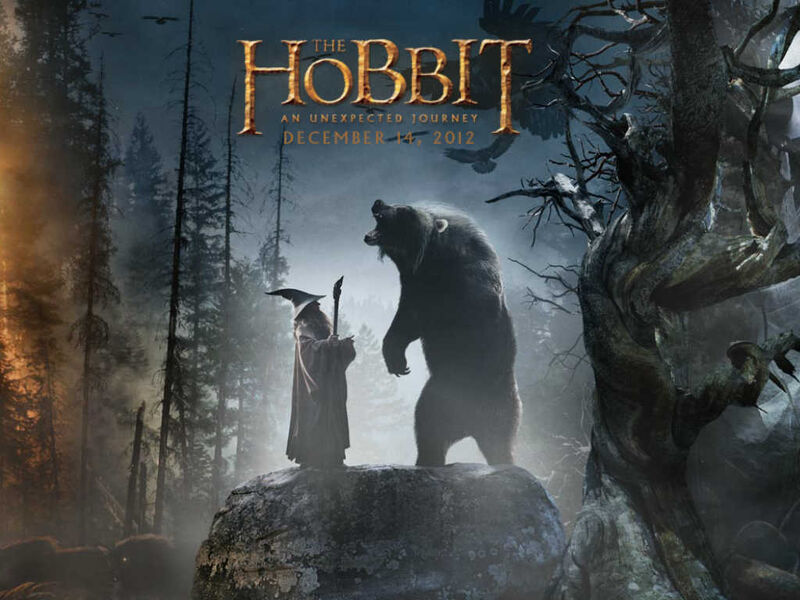
A quick visit to the skin-changer Beorn (Mikael Persbrandt), who usually appears in the form of a bear—not much is made of him, even though he got his own poster with Gandalf last time—and they get to Mirkwood (by pony), at which point Gandalf goes "walkabout"—he does this every movie and they probably split the story to accommodate a "Gandalf disappearance"—so the wee folk must enter the spooky forest alone, with a promise from the wizard that he'll meet them at "the Lookout."
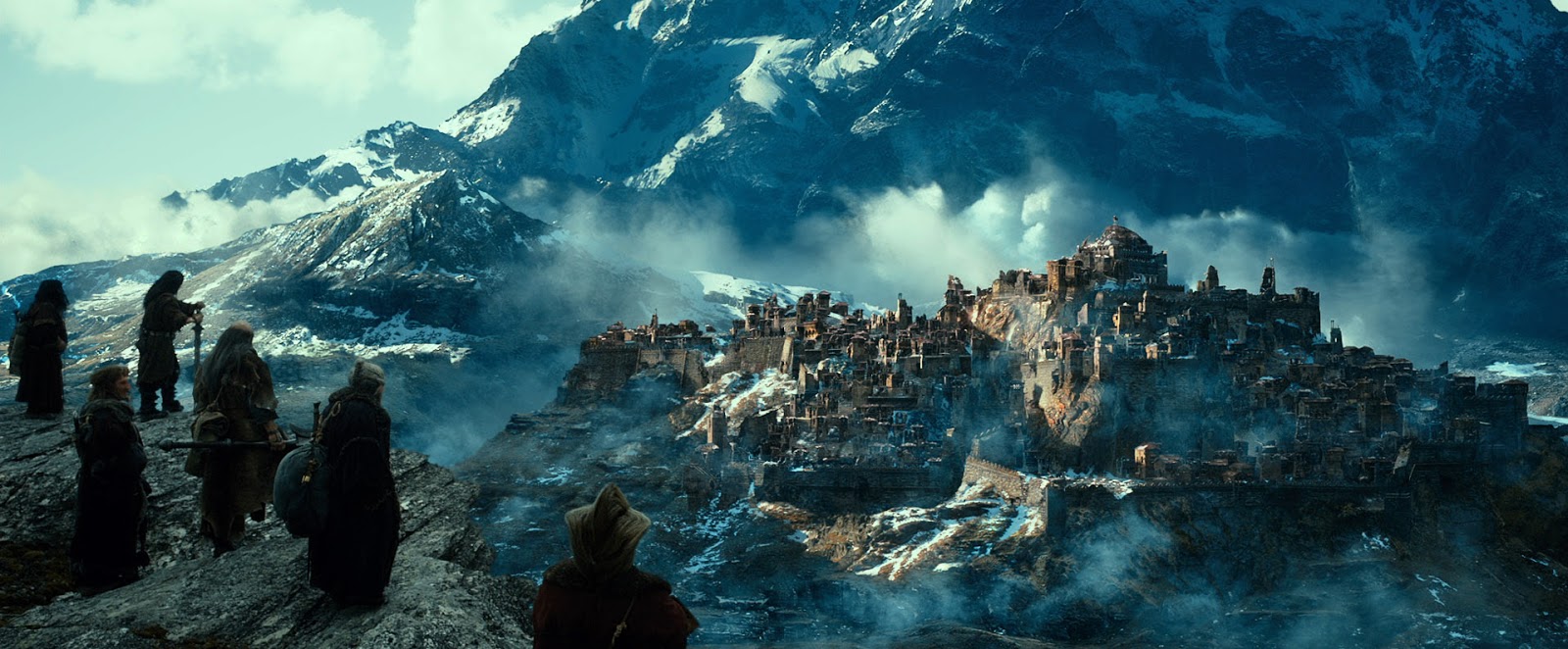

"The Lookout"—he said he'd meet us; he should be easy to find...

Anyone familiar with the book knows that you don't find out where G.theG. goes until the last chapter, and that was after Tolkien had written "The Lord of the Rings" and got continuity-conscious.  But, here, we do get to see where (hint: he went there LAST movie), and Jackson's The Lord of the Rings gets set up all good and proper (except Benedict Cumberbatch is voicing the character now—wonder if Jackson will Lucasize everything to make it all match up).   The dwarves and hobbit are concerned with icky things and splendors that one would associate with a place called Mirkwood, and the ring that Bilbo snatched from Gollum is starting to exert its unholy influence turning the peaceful little guy into a berserker bad-ass.  Travel packages with unruly companions and nasty accommodations with large pests and diffident natives will do that to anyone.  But, Bilbo proves his worth on more than one occasion and eventually they do make it to the Halls of Lonely Mountain, a few shy of a full dwarve-deck and make their way to a meeting with the titular character that's been hoarding all the gold and keeping it for himself—the ultimate one percenter of Middle Earth.

Bilbo above the canopy of Mirkwood
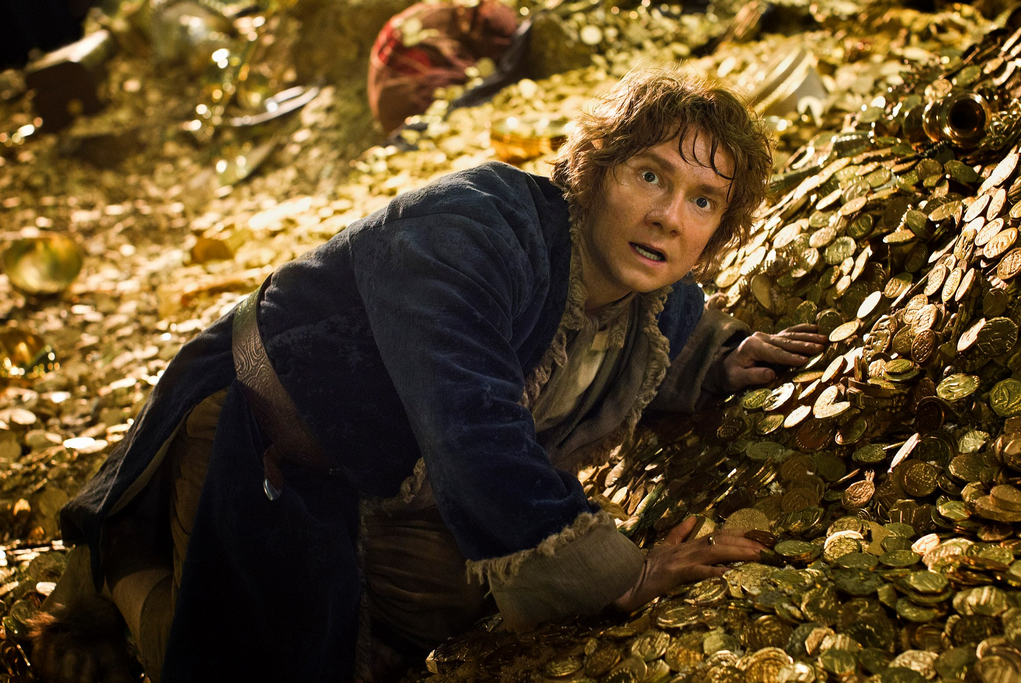
Smaug is the dragon, living in the massive storage caves of the Mountain, and he spends his time, far from desolate, sleeping among the gold and treasures of the dwarves like a big scaled, fire-breathing Scrooge McDuck. When Bilbo's attempts to find the Arkenstone awaken him, there is quite an extensive cat-and-mouse game as the small hobbit scurries around the cumbersome dragon.  Or I should say Cumberbatch, as the ubiquitous actor provides a nicely arch resonant voice to Smaug, which is accompanied by a lip-curling animation to enhance it.  This is where the film shines, as the territory is new, the imagineering of the dragon is fresh, and the surprises are many.  After the previous two hours, that's a bit refreshing.

For if there's a problem with Peter Jackson's version of The Hobbit, it's that, by now, we are so familiar with the way he does things that nothing much really resonates anymore.  The heavily belabored ripostes by the actors seem a bit too predictable—when Bilbo changes his story to gandalf that he found his courage in the goblin caves last movie (rather than The Ring), there's a close-up of Gandalf as he says what half the audience is expecting: "You'll need it." Really, that one and "You should be" are certain candidates for Screenwriting 101 "easy irony" along with "You just don't get it, do you?" and "They're standing behind me, aren't they?"  

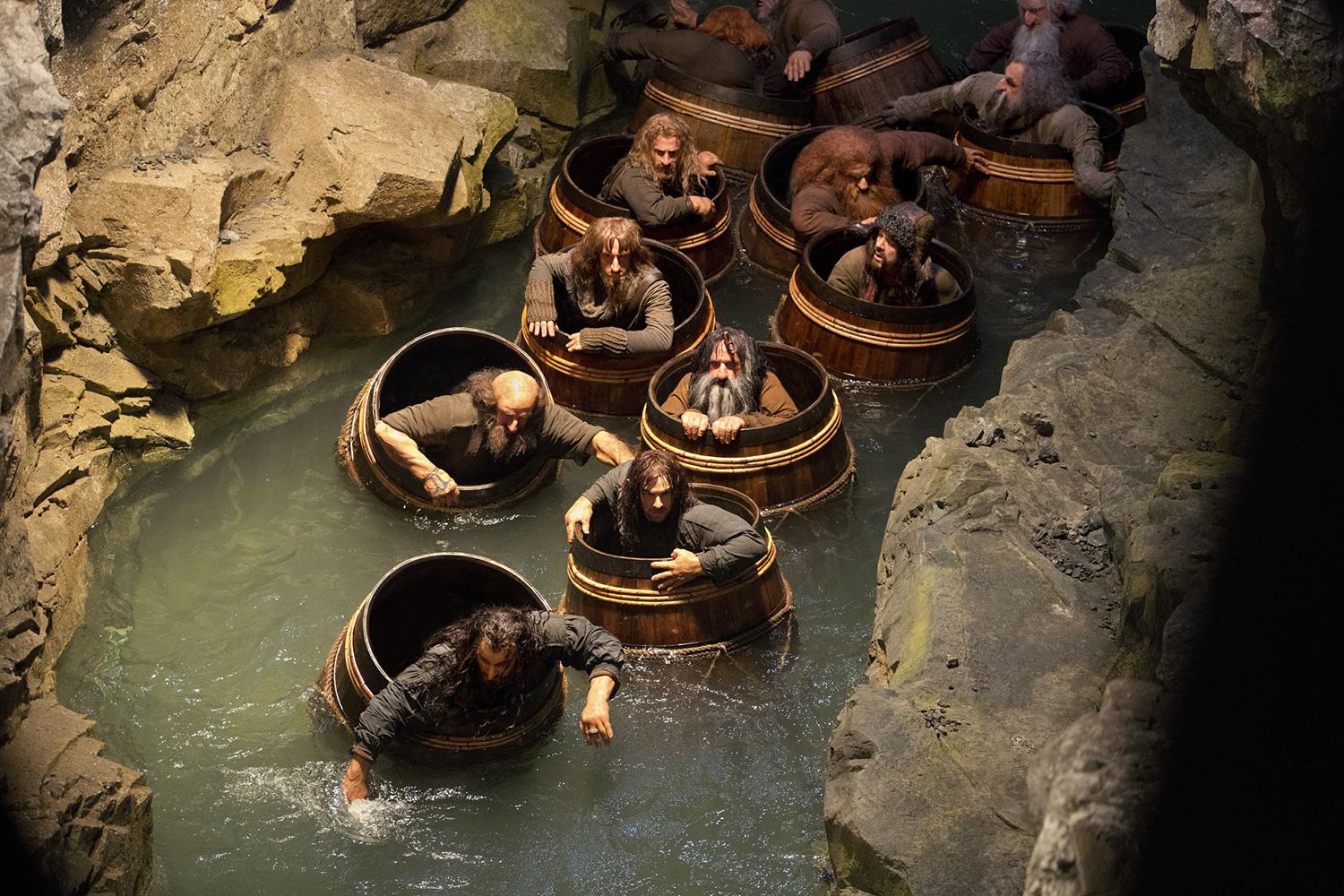
And the action sequences, this time assistant-directed by actor Andy Serkis. go on and on, in ever-increasing silliness.  If last movie set a more rollicking, silly tone than The Lord of the Rings (in part by the influence of Guillermo del Toro), now the joke's wearing a little thin.  Extended fights between orcs and elves are no longer thrilling, they're a demonstration of every possible way you can kill something with an arrow.  An extended rush down a rapids in barrels is accompanied by additional orc-elf fighting, where the barrels are used for any other purpose besides transport, as every tree-limb and branch over-hanging is used as a foot-hold.  Some of this criticism isn't fair, because if this had been the first film in a trilogy of Tolkien adaptations, the marvels of the film would send people off a CGI cliff in amazement.  It might take at least forty-five minutes to tumble down it, though.


One should, however, point out that the "we've been down this glade before" problem didn't occur with Jackson's earlier Tolkien trilogy, where there was enough material to keep things seeming fresh each film, and Jackson and his screenwriters did enough juggling of the narrative to keep things seeming new from film to film.  Their attempts here amount to trying to add a romantic element between the elf warrior Tauriel (Evangeline Lily) and the dwarf Kili (Aidan Turner), much to the consternation of Legolas (Orlando Bloom, back in action).  And while it provides a reprieve from tumbling and shooting and other too-frantic sequences, it does take away from the basic focus on the titular Bilbo Baggins (Martin Freeman) whose story this is.  Freeman's performance is, again, terrific, bringing all sorts of fretting elements to play, and making the transformation of his hobbit into a killer more than a little disturbing.

The vistas are staggeringly rendered, but some short-changing has been done with the characters in action sequences—Orlando Bloom seems to be the chief character robbed of some pixels, here and there, and the attempt to de-age him to a younger self doesn't really work (I've never seen it done convincingly, so far).  the only real surprises come in snatches of casting with Lee Pace, disappearing into the role of the elf Thronduil, Lily's elven warrior, and Stephen Fry's Master of Laketown.   Be on the lookout for some Laketown spies and you might even find Stephen Colbert for a brief second.  Oh, and Jackson gets his own "Hitchcock moment" out of the way very quickly.

Oh.  And SPOILER ALERT there's another movie coming, so this one ends at a rather inopportune time.  You only have to wait another year.

The Hobbit: the Desolation of Smaug is a Matinee.

"Conversations with Smaug" drawn by J.R.R. Tolkien
"Conversations with Smaug" drawn by WETA

Wednesday, December 19, 2012

The Hobbit: An Unexpected Journey

Getting to Be a Hobbit With Me
or
There and Back Again...and Again...And A-GAIN.

Peter Jackson returns to Tolkien's Middle-Earth, the scene of his greatest triumphs as a film-maker.  And it hasn't been easy for him.  "The Lord of the Rings" trilogy took the film industry by storm, changing all sorts of accepted things, like "sittable" film length, production timetables (filming three films simultaneously), elaboration of production design, and whether a "fantasy" film can ever be taken seriously by the Oscar Academy for anything other than technical awards.  In fact, when The Lord of the Rings: The Return of the King won Best Picture a few years back, more than one gossip-monger (or as they're known, "industry press") suggested it was for the entire series of films, rather than for the merits of the final one.  I believe that.  So, pressure immediately started to bring Tolkien's "The Hobbit" to the screen in as much the same way as possible, with Jackson producing and Guillermo del Toro directing, a good choice, actually (and the film benefits from his bizarre creature designs).  

But, "The Hobbit"'s past caught up with it, and the several (animated) versions of it came into play over who owned the film rights, and so The Hobbit: An Unexpected Journey has a complicated production titles sequence with Warner Brothers the (North American) distributor and New Line Cinema and M-G-M as the production facilities.  M-G-M's financial troubles (now long forgotten in the wake of Skyfall's nearly billion dollar take) caused del Toro to drop out, leaving Jackson and his orc-army of New Zealanders to once again handle the short-duties for the assembled hobbitage.


And how is it?  Much as you'd expect.  It's as if they'd never stopped production on the first series, and so sure of the continuity are they, that the moments immediately preceding the start of The Fellowship of the Ring are presented, as if it was the easiest thing in the world to do.  The film's been getting lukewarm reviews, and I can't can't quite fathom why. Nothing's really different.  The supporting cast is uniformly the same (there's no Viggo, but Frodo is briefly there, and Martin Freeman takes over the role of the younger Bilbo Baggins in a way that seems to suggest a more spry Ian Holm with much faster and more comedic reaction-sense), but the main criticism seems to be a more leisurely pace.  This, I don't mind.  Jackson has always regretted not showing more of Hobbiton, which might have given "The Lord of the Rings" more of a sense of "home," and as something worth fighting for—a theme played in spades in TH:AUJ.*

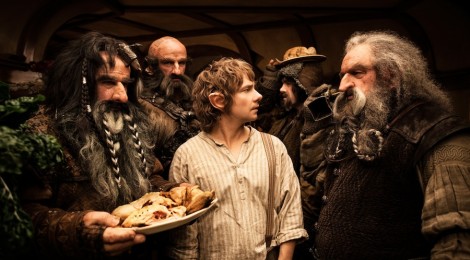
Seeing as so much of it is set in the Hobbit's land, and that the cast is dominated by a baker's dozen of knock-about dwarves (see below for a guide) that have a propensity for one-liners and malapropisms, the tone is considerably lighter and larkier (and dare I say "precious") than the Doom-laden "Rings" trilogy, and it is only once the band of adventurers get going that things change to the previous series' denatured color schemes, brooding skies, ugly thuggery and general bad-assery ensues.**  The pace may be slower, but the film is considerably richer for all of that, and with so many characters in this arc, it's rather a luxury to get to know them before they are threatened in all sorts of ghastly ways.

The other issue with this Tolkien adaptation is technological.  Films, since the frame-rate has been standardized, have traditionally been projected at twenty four frames per second, the estimated time that an image is retained by the eye.  Now that film is mostly passé, the video standard is 30 frames per second, but it's largely an arbitrary rate to match the traditional film experience.  During the late 70's, special effects wizard Douglas Trumbull offered up something he called "Showscan" which was 70mm film projected at 60 frames per second, which produced a larger, sharper image with less "streaking" of movement, due to the higher frame rate.  I saw one of these "Showscans" at the Vancouver World's Fair and the effect was like watching a richer, more beautiful version of videotape.  It was still film, with its photo-chemical reaction to light, but far more relatable to a "life-image" than film.

TH:AUJ is photographed digitally, but at a frame rate of 48 frames per second (what is being called HFR, or "Higher Frame Rate"), twice that of standard film, and in 3-D (to make what Jackson calls a more "immersive" film experience).  The effect, once one has adjusted to it, is quite magical.  Jackson doesn't try to do the 3-D tricks that Ang Lee does in Life of Pi, but the faster frame rate does improve the effect of things moving close by in 3-D; there is no longer the "stutter" effect, if something is moving by in the "near-field" at any rate of speed, which is something of a relief.  And given that Jackson employs even more helicopter shots over New Zealand terrain here than in the "Rings" trilogy (as well as parallel swooping "crane" shots during the many sequences underground), that's a big help.  Where it has its drawbacks are in some scenes that make the CGI characters look like toys figures, some of the impressive building constructs look like play-sets, and a slight mismatch of CGI (particularly during flying scenes) melded with terrain.

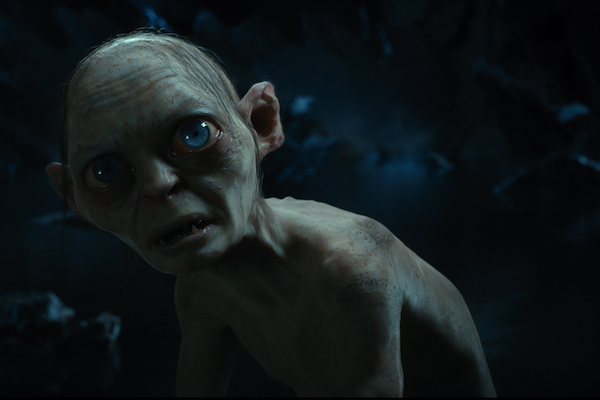
Still, it is hard to quibble when the image is so sharp, Jackson's color sense is eye-popping, and he still manages to keep a shimmering image through murky 3-D glasses.  It doesn't look like videotape (as so many reviewers seem to think), as the lighting is more graded and subtle, but the movement recalls a better videotape image, and even something moving fast still has a better chance of being registered by the naked, or glasses-hampered, eye.  It also allows the telling detail in even the CGI-est of images, like the moistness in Gollum's eyes, or the deep crags under Gandalf's.  It is oddly transporting, and given the care that everyone has put into it, it's a very rewarding experience.


The Hobbit: An Unexpected Journey is a Full-Price Ticket (worth it in 3-D and HFR).


Wilhelm Scream Alert: at 02:05 and 02:35


Ya can't tell a dwarf from a halfling without a program.


* Thauj...sounds like a character name.

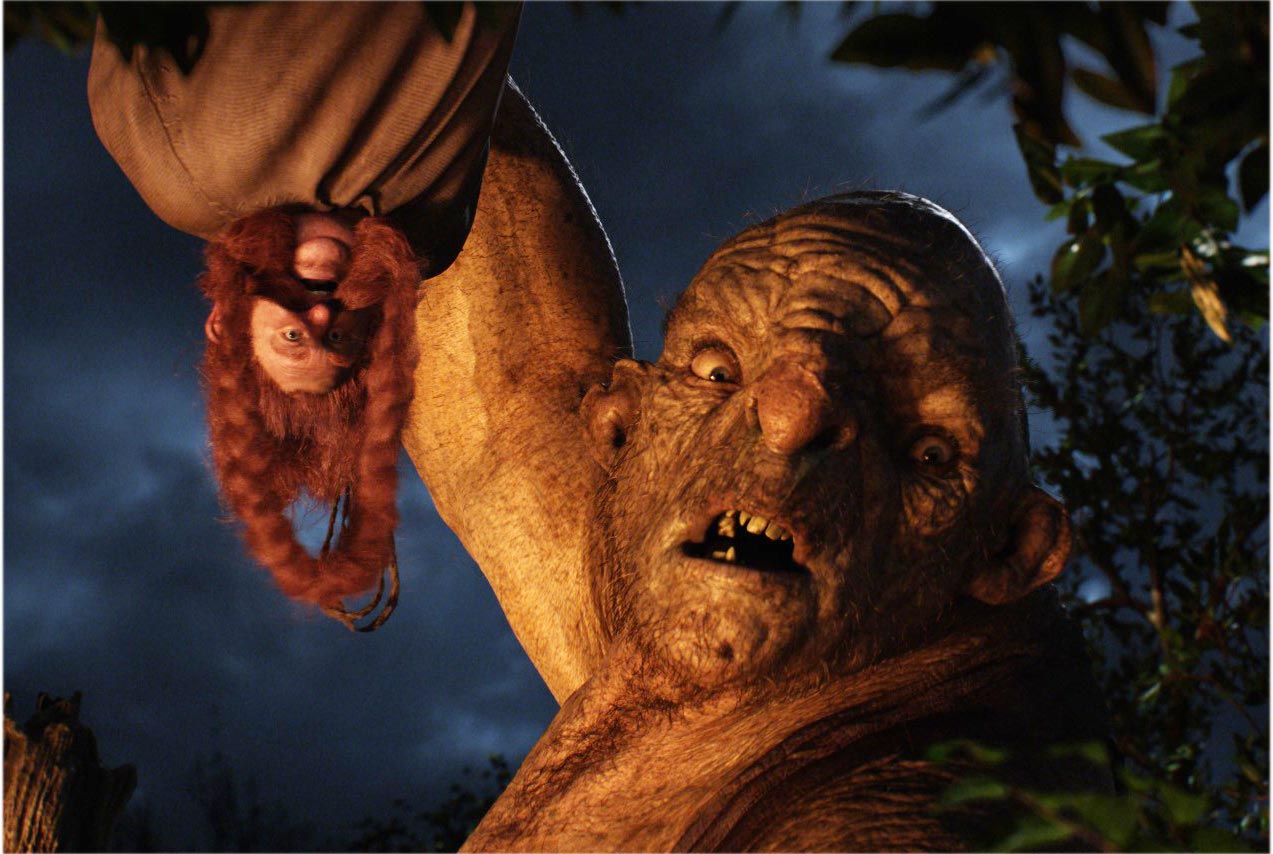
** Speaking of which, things have now approached and gone past the "Indiana Jones" threshold for physical believability here.  There's one particularly Rube Goldbergian sequence fighting trolls in an underground mine that strains credulity—but then, we're talking about a movie with dwarves, trolls, elves, ancient wizards, fire-breathing dragons, giant spiders, animated cliff-sides, and orcs riding big dogs.  That's enough to throw any griping fan-boys off their dyspepsia.  "Dude, this movie troll-kinged the bridge..."

Wednesday, December 28, 2011

The Adventures of Tintin: The Secret of the Unicorn


"Adventures in the Uncanny Valley"
or
"Spielberg Straight Up, No Chaser"

Everyone knows how dynamic and visceral a film-maker Steven Spielberg is.  At times, he can even approach overkill, bouncing along on his little adventures, then, happily, sailing right over a cliff.  Take 1941, for example, or Indiana Jones and the Kingdom of the Crystal Skull, both films of such excess that they immediately inspired ridicule.  That exuberance tries the patience of many film-goers who want the director who features the Moon in his corporate logos to come back down to Earth. The term "nuking the fridge" was derisively created for the fourth Indy film (as if credulity hadn't already been crossed in the  series before...)

But, imagine (if you will...or even can) Spielberg without any constraints.  I'm talking the regular constraints of film-making, the type that keep things down to the possible and even legal.  Things like time, budget, light, focal-lengths, physics, natural laws (like gravity), and even the constraints for safety imposed by studio legalities and The Humane Society.  Take those away—take them all away—and imagine what sort of film Steven Spielberg would make.

Scary thought, isn't it?

Now, with Peter Jackson producing, Spielberg has made his first "Avatar"-style movie, with mostly motion-capture technology, but virtually all CGI—there's no angle he can't shoot from, no perspective he can't take, no transition he can't achieve...whatever Spielberg can think, he can put on the screen, with no compromises and The Adventures of Tintin: The Secret of the Unicorn (based on three of the many Hergé books), shows what an unfettered Spielberg is capable of...and it is amazing.

And a bit headache-inducing, which I imagine would happen even without 3-D (the format I saw it in).  It even approached the stage where my brain started to shut down (a phenomenon I've noticed in myself with very few movies, except for those directed by Terry Gilliam), a kind of movie-narcolepsy where I have to fight sleep, so intense and detail-filled is the movie-going experience.*  Fortunately, Spielberg is so intent on making his 3-D cartoon a movie-movie, that it's quite easy to put oneself in the mode that this is happening through photographic means—only shinier, and with less dust.

So, the story of the Belgy reporter (voiced by Jamie Bellfollowing clues and bad guys to all points of the world, trying to find the answer to the riddles of a model ship he bought at a street vendor's (and why unscrupulous people like chief villain Rackham—voiced interestingly by Daniel Craig**—might want to acquire it, by any means necessary).

And it's all done in a semi-realistic style (although tribute to Hergé's cartoony style is paid early in the film).  Things are made to look real, even if the human forms are semi-cartoony.  That's worked better for Pixar, whose human characters have always looked better the further they diverged from realism.  Here it's a bit of a problem, especially early on in the proceedingsthere's a deadness to the eyes,*** what has been identified as "The Uncanny Valley"—the point at which, when trying to create a human simulation, the human brain (that is, a "real" human brain) rejects it, and even may be horrified by it.  Examples that the film industry have taken notice of have been audiences negative reaction to the CGI baby in Pixar's first full short "Tin Toy," and the reaction of test audiences to a first-draft version of the human-looking Princess Fiona in the first ShrekThe learning curve is high in Tintin, and very quickly the issue is side-stepped with squints and off-camera looks, but it's there, initially (and, to be fair, Hergé never gave Tintin or his other characters eyes, but round pools of india ink. Imagine the horror if they did a motion-capture movie of "L'il Orphan Annie?").  But soon, events overtake our heroes, and we no longer have time to look them in the eye—it's tough enough just trying to follow them.

And that is a case of pure, undistilled Spielbergia.  Enjoy.

The Adventures of Tintin: The Secret of the Unicorn is a Saturday Matinee.


* It's hard for me to explain what is going on (or even admit to it) when this happens. Partially, it might be because I'm not thinking much or analyzing what is happening, but just letting the images wash over me without much interpretation.  When a movie makes me think—for good or ill—I can't fall asleep.  But when there's nothing to really interpret—and there isn't much in Tintin—my mind tends to drift and be lulled.  With Gilliam and Spielberg, it might be because their movies are so full-formed and specific, there's not much for me to do.  It's like TV (which always puts me to sleep), which Marshall McLuhan labeled a "cold" medium, not asking much of its participants (if there's any participation at all), as opposed to a "hot" medium, like radio or books, where the participant's mind is active and fully functioning, filling in gaps, providing pictures and imagineering the story being fed to the brain.

** One of the really keen ideas that Spielberg brings to the table is his independence in creating the characters.  None of the voice-actors resemble their real-life counterparts—stands to reason, animators and Pixar have been doing that for years—but the recent motion-capturers, like Bob Zemeckis and James Cameron have tied their actors' likenesses to their characters, in an attempt to capture the humaness to the pixel-people.  Producer Peter Jackson, though, had no qualms about abandoning any semblance to Andy Serkis when bringing full-life to Gollum in the "Ring" trilogy.

*** One is tempted to recall Quint's soliloquy in Jaws, comparing a shark's eyes to "lifeless eyes, black eyes, like a doll's eyes. When he comes at ya, doesn't seem to be livin'."

Saturday, January 16, 2010

The Lovely Bones

"My Name is Salmon. Like 'Swimming Upstream.'"

I had a heated movie discussion with a friend about "Mystic River" one evening. "Explain to me why you don't like it," I said, genuinely curious.

For those who haven't seen it (and it is a tough slog), it's Clint Eastwood's film of the Dennis Lehane novel about the death of a hoodlum's daughter and his steps to exact revenge. The object of the hood's scrutiny becomes his childhood friend who was kidnapped by pedophiles as a child, a violent act that has colored his adulthood. Tough stuff, but I have high regard for the film, despite the broad (and Oscar-winning) acting by Sean Penn and Tim Robbins.

But the friend couldn't abide it. "Why?" I kept persisting. And finally it boiled down to "there are some subjects—like the victimization of children—that have no place in movies. Now, I could point out all sorts of films, from "
The Wizard of Oz" to "Empire of the Sun," that, unpleasant though they might be at times, convey the theme and are still great films. However, Peter Jackson's film of "The Lovely Bones" had me recalling this conversation, and sympathizing with my friend's attitude.

The award-winning and best-selling novel tells the story of a murder victim—a child of 14—and her experience after death, watching the effects her non-existence has on her family and murderer, as her sense of unfinished business keeps her tied to a "between-place," unwilling to move on, until there is some sense of closure on several fronts, those being her family's efforts to find her killer, her killer's obsession with her and with other family members, the internment of her corpse, and that first kiss with the boy she was falling in love with.

Eh?

Uh...we'll get back to that.

Jackson film differs slightly from the novel (the parents' story is given an upbeat resolution and it's a first kiss, rather than a sexual experience with the boy), but, however much he tries to perfume it, it's still the story of a rotting corpse in a bank-safe. That may sound brutal, but that's what "The Lovely Bones" is, constantly winging back and forth from the girl's conception of heaven (which Jackson conveys as an ever-evolving series of candy-colored landscapes depending on the girl's mood, somewhat reflective of her earthly experiences) and the mordant reality back on terra firma. The lack of satisfying resolutions in some of the cases has a cruel feel to them and, perversely, that may be the only saving grace from the relentlessly oppressive pity-party of "The Lovely Bones"—there is no justice, shit happens and sometimes it happens appropriately in some karmic equation, but it's not the Universe's job to make us feel good by balancing the scales. Jackson provides some lex talionis (at the demand of preview audiences, bless their little Roman hearts), but it's an indifferent cosmos, not a buttoned-up drama, and certainly not a wonderful after-life.

That's the underlying theme of the story, which is creepy and morbid enough, but
you throw in Jackson's interpretation and it turns downright cloying. Jackson and his writing collaborators Fran Walsh and Philippa Boyens make it dreamy and moony in that hormone-addled manner that appeals to young teenage girls (and made the "Twilight" series a phenom') and (lest I be accused of being sexist) not far from the über-romantic manner Francis Ford Coppola filmed his gang story "The Outsiders."* And Jackson is a precise director, one who delves into the details, rather than the over-arching idea. This helps when given a vague impressionistic series of novels like Tolkien's, but it also leads to things like his monstrous 3-hour "King Kong" (Jackson's favorite film is the 1933 version), where the journey to Skull Island is interminable, sequences that flew by in the original drag on and on, and the general deep-love lethargy of the thing drops it like the big ape to the side-walk. "The Lovely Bones" is a series of close-ups, swooping camera moves that graze the edges of things and catch life in clusters and clumps and fussy little details. It has jokey little references to Jackson's other films and a cameo of him that seems indulgent. It's in those little moments that you wonder if the director has forgotten he's making a movie about a girl who's been raped and murdered.

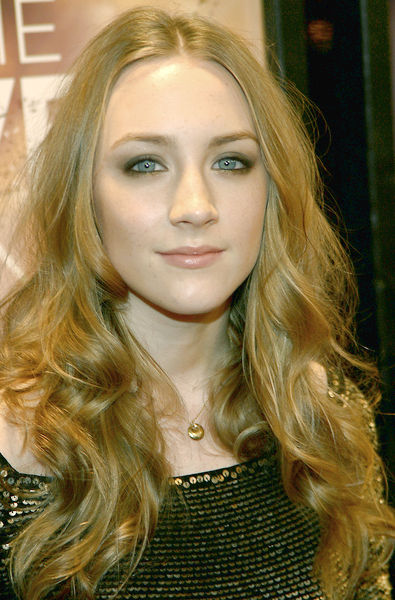
The audience is spared the actual attack (in a spiritual slight-of-hand that sets up the way she can interact with the living that's a wee a bit...convenient), no thanks for small favors. But the creepiest thing about the movie, beyond the trivialization of an After-Life as merely a CGI Disney Channel fantasy (or worse, it reminded me of the land of the Teletubbies), the brutish smugness of its tone, or its moony-goony morbid romanticism is that, of all the characters in the scenario, the one we are given the most information about is the killer. Despite the herculean work of Saoirse Ronan (she was the youngest of the Briony's in "Atonement"**) as Our Girl in Purgatory, Susie Salmon, where the film-maker gets his jollies is showing the planning, the drafting, the intricate handiwork and the general creepiness of the serial killer hiding in plain sight. That he is portrayed by one of the better actors in the cast doesn't help. Mark Wahlberg, who can be quite good, here has the same puppy-earnestness that threatens to turn him into this generation's Steve Guttenberg, Rachel Weisz seems lost and her complicated motivations are lost between edits somewhere. Worst of all is Susan Sarandon as Susie's grandmother, meant to be comic relief, but who is so cluelessly self-centered and destructive, one can't help the stray thought that she had a hand in the killing.

I haven't read the novel, so I can't account for the interest—evidently it is written well, but that doesn't translate to the screen. It shares one unique aspect that Jackson is a bit successful in communicating—the empathetic relationship that victims of the same attacker must feel for each other. It stems from author
Alice Sebold's own violent attack, and her learning subsequently that an earlier victim had been killed. Certainly a novel life-experience, and probably too common in these berserk days. But, whatever empathy in the original is ground up in the film-making machinery. Perhaps it shouldn't have been made at all.

The only reason I can think of for the film to exist (outside of the monetary gain of the makers) is as a cautionary tale of warning to gullible teens...and fulsome directors.

"The Lovely Bones" is a Cable-Watcher.

* Coppola filmed two S.E. Hinton "young adult" stories, "The Outsiders" and "Rumble Fish." "The Outsiders," he said, was filmed in the romantic way teenagers would make it, "Rumble Fish" the way he wanted to make it.

** It is a fine performance, and Roran at the time of filming two years ago, still had the awkward duckling look of a developing teen. At the premiere, she looks like she could be a Redgrave
.